brake Peugeot Bipper 2008 User Guide
[x] Cancel search | Manufacturer: PEUGEOT, Model Year: 2008, Model line: Bipper, Model: Peugeot Bipper 2008Pages: 131, PDF Size: 1.44 MB
Page 85 of 131
79
5
SAFETY
Driving safety
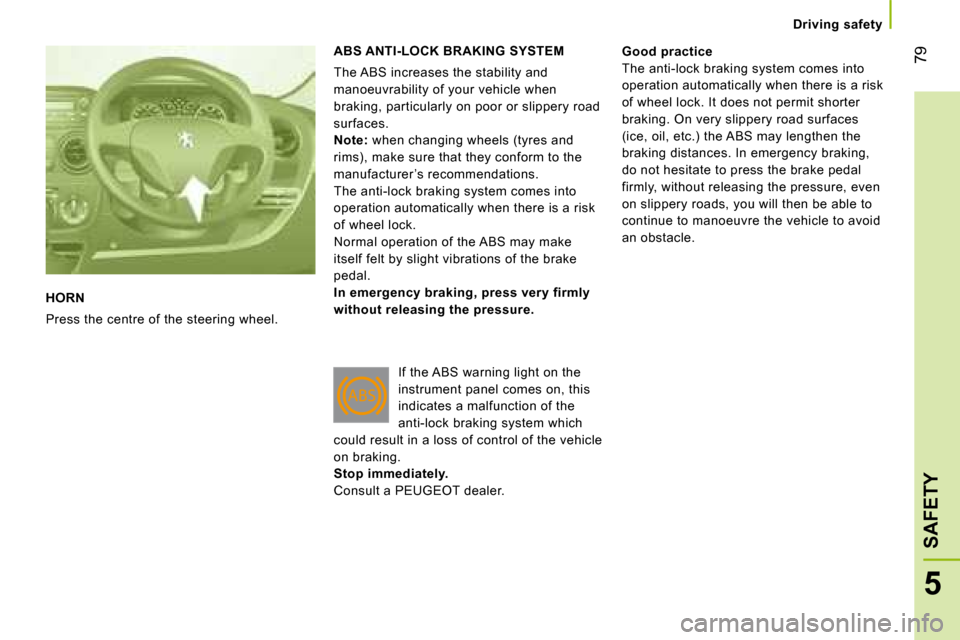
HORN
Press the centre of the steering wheel.
ABS ANTI-LOCK BRAKING SYSTEM
The ABS increases the stability and
manoeuvrability of your vehicle when
braking, particularly on poor or slippery road
surfaces.
Note: when changing wheels (tyres and
rims), make sure that they conform to the
manufacturer ’s recommendations.
The anti-lock braking system comes into
operation automatically when there is a risk
of wheel lock.
Normal operation of the ABS may make
itself felt by slight vibrations of the brake
pedal.
In emergency braking, press very firmly
without releasing the pressure.
If the ABS warning light on the
instrument panel comes on, this
indicates a malfunction of the
anti-lock braking system which
could result in a loss of control of the vehicle
on braking.
Stop immediately.
Consult a PEUGEOT dealer.
Good practice
The anti-lock braking system comes into
operation automatically when there is a risk
of wheel lock. It does not permit shorter
braking. On very slippery road surfaces
(ice, oil, etc.) the ABS may lengthen the
braking distances. In emergency braking,
do not hesitate to press the brake pedal
firmly, without releasing the pressure, even
on slippery roads, you will then be able to
continue to manoeuvre the vehicle to avoid
an obstacle.
Page 103 of 131
94
Towing a trailer
In certain cases of particularly arduous
use (towing the maximum load up a steep
slope in high temperatures), the engine
automatically limits its power. In this
case, the automatic cutting off of the air
conditioning allows the engine power to be
recovered. If the coolant temperature
warning light comes on, stop the
vehicle and switch off the engine
as soon as possible.
See the "Levels" section of chapter 7.
Tyres: check the tyre pressures of the
towing vehicle (see the "Identification
features" section of chapter 7) and of
the trailer, observing the recommended
pressure.
Brakes: towing increases the braking
distance. Drive at a moderate speed,
change down early and brake gradually.
Side wind: sensitivity to side wind is
increased. Drive smoothly and at a
moderate speed.
ABS: the system only controls the vehicle,
not the trailer.
Rear parking assistance: the
assistance will be deactivated
automatically when an original PEUGEOT
towbar is used (see the "Rear parking
assistance" section of chapter 4).
We recommend the use of original
PEUGEOT towbars and their harnesses,
which have been tested and approved from
the design stage of your vehicle, and that
the fitting of this equipment is entrusted to a
PEUGEOT dealer .
If this equipment is not fitted by a PEUGEOT
dealer , it is essential that it is fitted using
the electrical pre-equipment located at the
rear of the vehicle in accordance with the
manufacturer ’s instructions.
The operation of the sensors is deactivated
automatically when the pin of the trailer
cable is inserted in the towbar socket.
When the trailer cable pin is removed, the
sensors are re-activated.
Distribution of loads
Distribute the load in the trailer so that the
heaviest objects are as close as possible
to the axle and the nose weight is close to
the maximum authorised without, however,
exceeding it. The air density decreases with
altitude, so reducing the performance of
the engine. The maximum towed load must
be reduced by 10 % for each 1 000 metres
of altitude. Refer to the "Technical data"
chapter for details of the weights and
towed loads applicable to your vehicle and
also to the administrative documents (V5
registration document, ...).
Page 109 of 131
99
7
TROUBLESHOOTING
Changing a wheel
CHANGING A WHEEL
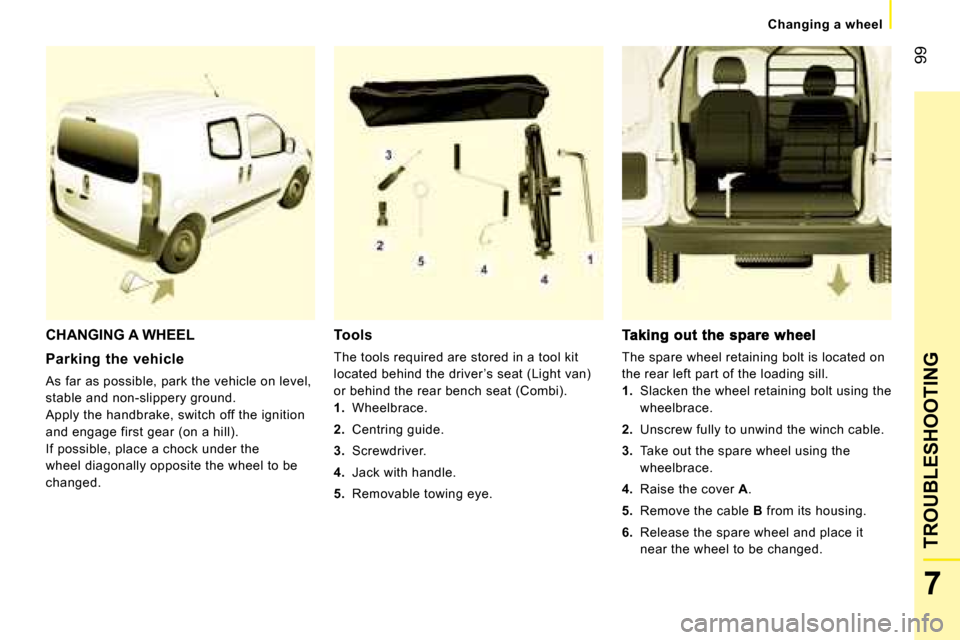
Parking the vehicle
As far as possible, park the vehicle on level,
stable and non-slippery ground.
Apply the handbrake, switch off the ignition
and engage first gear (on a hill).
If possible, place a chock under the
wheel diagonally opposite the wheel to be
changed.
Tools
The tools required are stored in a tool kit
located behind the driver ’s seat (Light van)
or behind the rear bench seat (Combi).
1. Wheelbrace.
2. Centring guide.
3. Screwdriver.
4. Jack with handle.
5. Removable towing eye. The spare wheel retaining bolt is located on
the rear left part of the loading sill.
1. Slacken the wheel retaining bolt using the
wheelbrace.
2. Unscrew fully to unwind the winch cable.
3. Take out the spare wheel using the
wheelbrace.
4. Raise the cover A .
5. Remove the cable B from its housing.
6. Release the spare wheel and place it
near the wheel to be changed.
Page 110 of 131
100
Changing a wheel
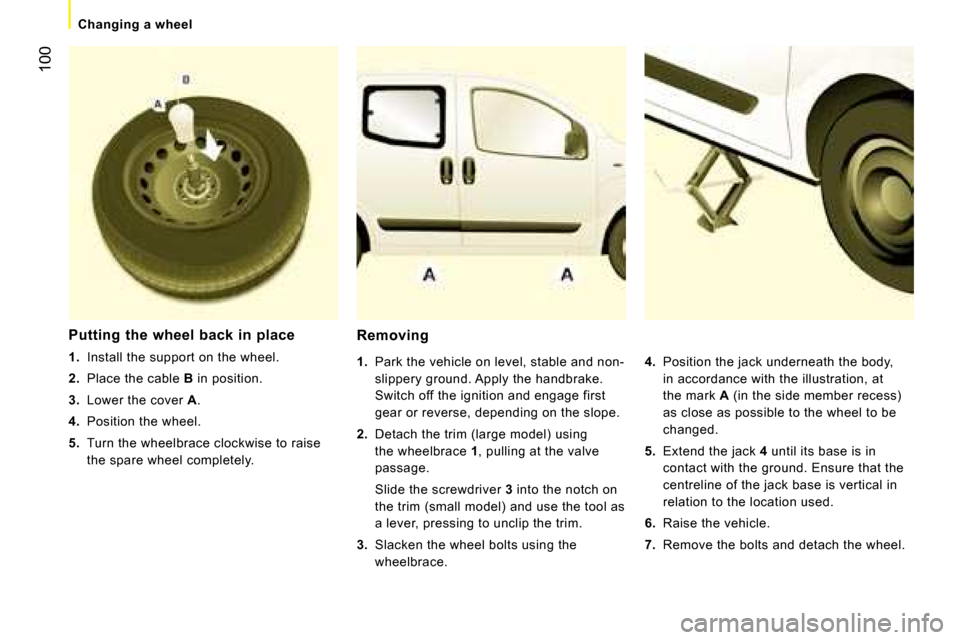
Removing
1. Park the vehicle on level, stable and non-
slippery ground. Apply the handbrake.
Switch off the ignition and engage first
gear or reverse, depending on the slope.
2. Detach the trim (large model) using
the wheelbrace 1 , pulling at the valve
passage.
Slide the screwdriver 3 into the notch on
the trim (small model) and use the tool as
a lever, pressing to unclip the trim.
3. Slacken the wheel bolts using the
wheelbrace.
4. Position the jack underneath the body,
in accordance with the illustration, at
the mark A (in the side member recess)
as close as possible to the wheel to be
changed.
5. Extend the jack 4 until its base is in
contact with the ground. Ensure that the
centreline of the jack base is vertical in
relation to the location used.
6. Raise the vehicle.
7. Remove the bolts and detach the wheel.
Putting the wheel back in place
1. Install the support on the wheel.
2. Place the cable B in position.
3. Lower the cover A .
4. Position the wheel.
5. Turn the wheelbrace clockwise to raise
the spare wheel completely.
Page 118 of 131
107
7
TROUBLESHOOTING
Changing a bulb
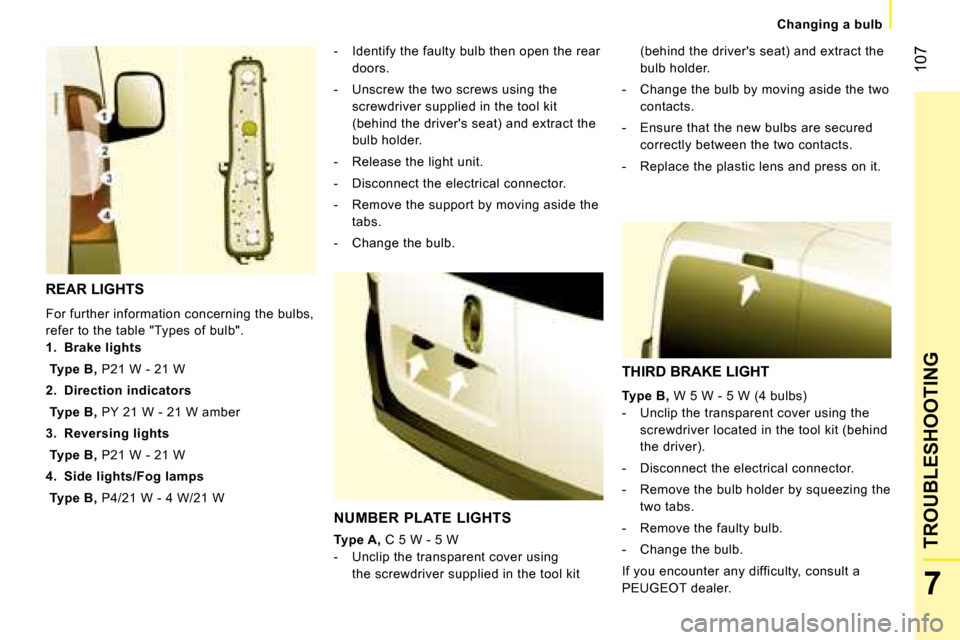
REAR LIGHTS
For further information concerning the bulbs,
refer to the table "Types of bulb".
1. Brake lights
Type B, P21 W - 21 W
2. Direction indicators
Type B, PY 21 W - 21 W amber
3. Reversing lights
Type B, P21 W - 21 W
4. Side lights/Fog lamps
Type B, P4/21 W - 4 W/21 W - Identify the faulty bulb then open the rear
doors.
- Unscrew the two screws using the screwdriver supplied in the tool kit
(behind the driver's seat) and extract the
bulb holder.
- Release the light unit.
- Disconnect the electrical connector.
- Remove the support by moving aside the tabs.
- Change the bulb.
NUMBER PLATE LIGHTS
Type A, C 5 W - 5 W
- Unclip the transparent cover using the screwdriver supplied in the tool kit (behind the driver's seat) and extract the
bulb holder.
- Change the bulb by moving aside the two contacts.
- Ensure that the new bulbs are secured correctly between the two contacts.
- Replace the plastic lens and press on it.
THIRD BRAKE LIGHT
Type B, W 5 W - 5 W (4 bulbs)
- Unclip the transparent cover using the screwdriver located in the tool kit (behind
the driver).
- Disconnect the electrical connector.
- Remove the bulb holder by squeezing the two tabs.
- Remove the faulty bulb.
- Change the bulb.
If you encounter any difficulty, consult a
PEUGEOT dealer.
Page 127 of 131
117
7
TROUBLESHOOTING
Under the bonnet
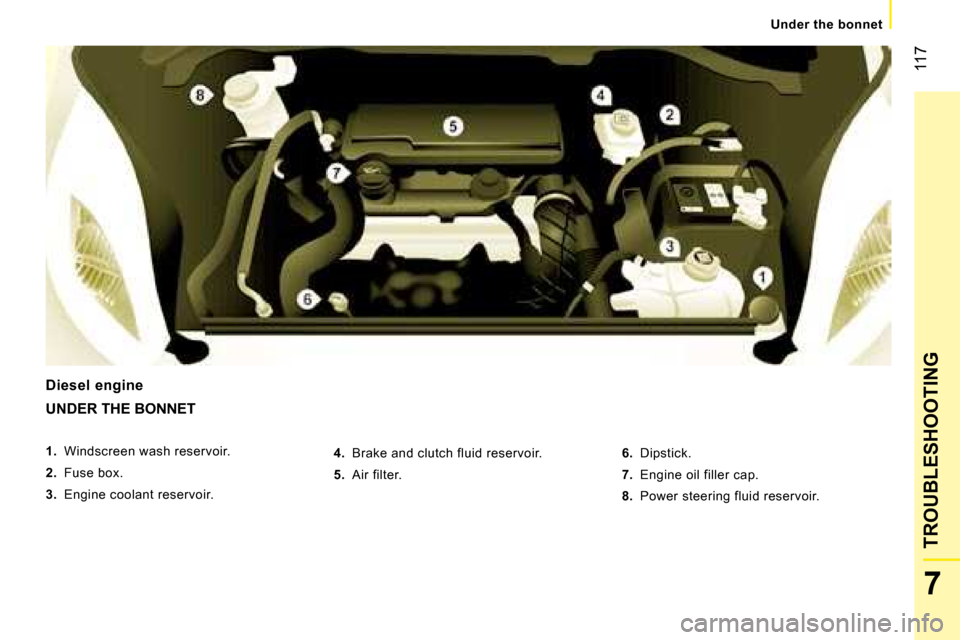
Diesel engine
UNDER THE BONNET
4. Brake and clutch fluid reservoir.
5. Air filter.
6. Dipstick.
7. Engine oil filler cap.
8. Power steering fluid reservoir.
1. Windscreen wash reservoir.
2. Fuse box.
3. Engine coolant reservoir.
Page 128 of 131
118
Under the bonnet
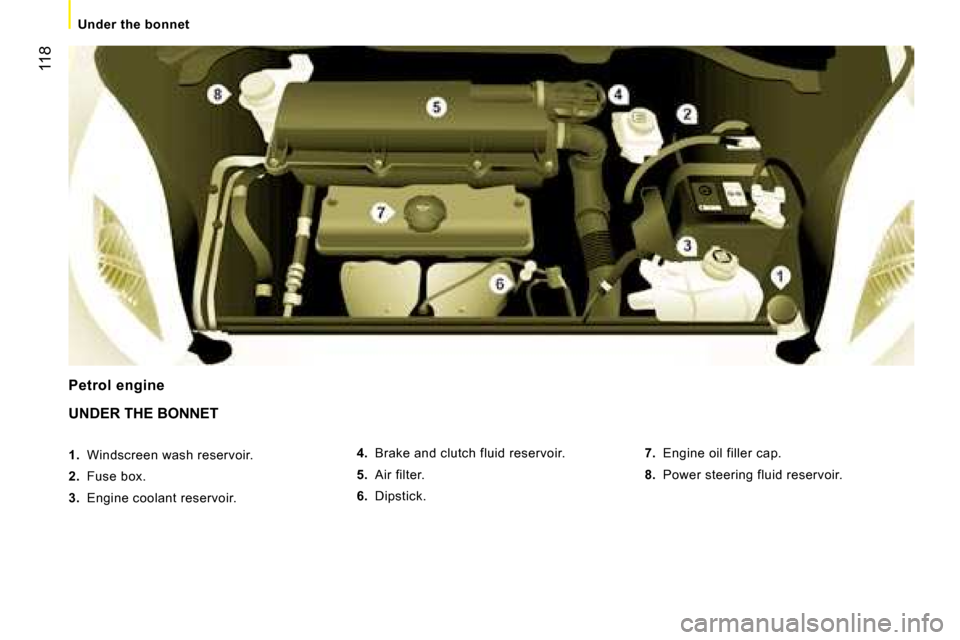
Petrol engine
UNDER THE BONNET
4. Brake and clutch fluid reservoir.
5. Air filter.
6. Dipstick.
7. Engine oil filler cap.
8. Power steering fluid reservoir.
1. Windscreen wash reservoir.
2. Fuse box.
3. Engine coolant reservoir.
Page 129 of 131
119
7
TROUBLESHOOTING
Levels
These regular maintenance operations
will keep your vehicle in good
running order. Consult the instructions at
a PEUGEOT dealership or in the servicing
booklet enclosed in the handbook pack.
LEVELS
Oil level
Check the level regularly and top up
between changes. The maximum
consumption is 0.5 l per 600 miles
(1 000 km). Check the level with the vehicle
level, engine cold, using the dipstick.
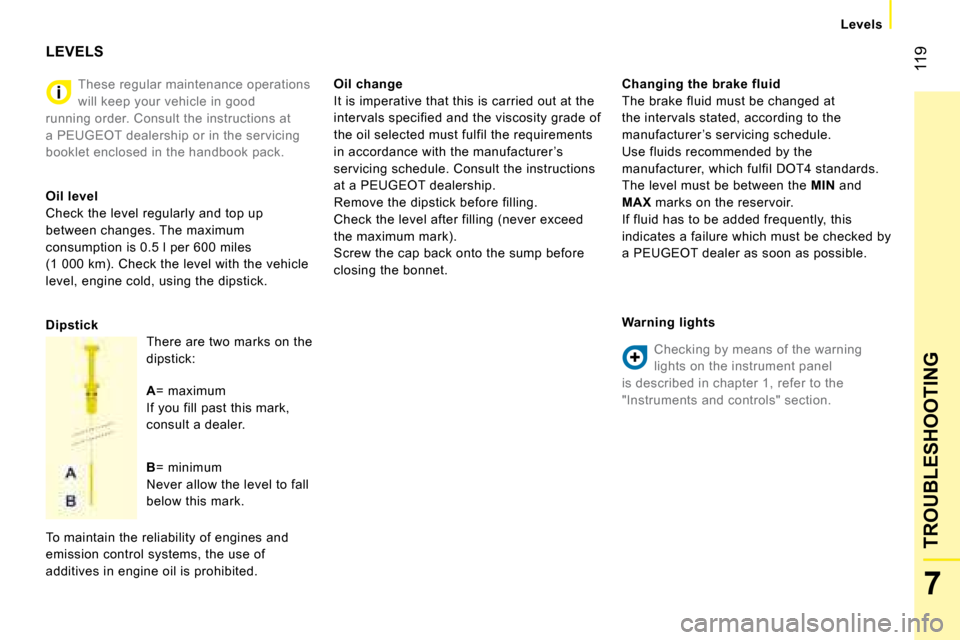
Dipstick
There are two marks on the
dipstick:
A = maximum
If you fill past this mark,
consult a dealer.
B = minimum
Never allow the level to fall
below this mark.
To maintain the reliability of engines and
emission control systems, the use of
additives in engine oil is prohibited.
Oil change
It is imperative that this is carried out at the
intervals specified and the viscosity grade of
the oil selected must fulfil the requirements
in accordance with the manufacturer ’s
servicing schedule. Consult the instructions
at a PEUGEOT dealership.
Remove the dipstick before filling.
Check the level after filling (never exceed
the maximum mark).
Screw the cap back onto the sump before
closing the bonnet.
Changing the brake fluid
The brake fluid must be changed at
the intervals stated, according to the
manufacturer ’s servicing schedule.
Use fluids recommended by the
manufacturer, which fulfil DOT4 standards.
The level must be between the MIN and
MAX marks on the reservoir.
If fluid has to be added frequently, this
indicates a failure which must be checked by
a PEUGEOT dealer as soon as possible.
Warning lights
Checking by means of the warning
lights on the instrument panel
is described in chapter 1, refer to the
"Instruments and controls" section.
Page 130 of 131

120
Levels
Cooling system
Only use the fluid recommended by the
manufacturer. Otherwise, you risk seriously
damaging your engine. When the engine
is warm, the temperature of the coolant is
controlled by the engine fan. As this fan can
operate with the ignition key removed and
because the cooling system is pressurised,
wait for at least one hour after the engine
has stopped before carrying out any work.
Slacken the cap by two turns to release the
pressure to prevent any risk of scalding.
When the pressure has dropped, remove the
cap and top up the level with coolant.
If fluid has to be added frequently, this
indicates a failure which must be checked by
a PEUGEOT dealer as soon as possible.
Topping up
The level must be between the MIN and
MAX marks on the expansion bottle. If
more than 1 litre of fluid is required to top
up the level, have the system checked by a
PEUGEOT dealer.
Power steering fluid level
The vehicle must be parked on level ground
with the engine cold. Unscrew the cap
integrated with the gauge and check the
level which must be between the MIN and
MAX marks.
Windscreen wash level
For best quality cleaning and for your safety,
we would advise that you use products of
the PEUGEOT Universal range.
Capacity of the reservoir: approximately
5.5 litres.
Used oil
Avoid prolonged contact of used oil with the
skin.
Brake fluid is harmful to health and very
corrosive.
Do not dispose of used oil, brake fluid or
coolant into drains or into the ground but
into the containers dedicated to this use at a
PEUGEOT dealership.
Page 131 of 131
121
7
TROUBLESHOOTING
Checks
CHECKS
Bleeding the water contained in the
diesel filter
If this warning light comes on,
bleed the filter, otherwise bleed
regularly each time the engine is
drained.
To evacuate the water, unscrew the bleed
screw or the water in diesel sensor, located
at the base of the filter. Operate until all
of the water has been drained out. Then
tighten the bleed screw or the water sensor.
HDi engines use advanced technology. All
work requires a special qualification which is
guaranteed by a PEUGEOT dealer .
Battery
At the start of winter, have it checked by a
PEUGEOT dealer .
Air filter and passenger compartment
filter
A clogged passenger compartment fi lter may
reduce the performance of the air conditioning
system and generate undesirable odours. The
replacement intervals for these components
are indicated in the servicing booklet.
Depending on the environment (dusty
atmosphere...) and the use of the vehicle
(urban driving...), change them twice as often
if necessary, refer to the "Under the bonnet"
section of chapter 7.
Brake pads
Brake pad wear depends on the style of
driving, in particular for vehicles which are
used in town, over short distances. It may
be necessary to check the thickness of the
pads, even between services.
Unless there is a leak on the circuit, a drop
in the brake fluid level indicates that the
brake pads are worn.
Brake disc/drum wear status
For any information relating to checking
the brake disc/drum wear status, consult a
PEUGEOT dealer .
Handbrake
Where the handbrake travel is too great
or there is a reduction in the performance
of the system, the handbrake should be
adjusted, even between services.
Have it checked by a PEUGEOT dealer .
Oil filter
Change the filter regularly, in accordance
with the servicing schedule.
Manual gearbox
Have the level checked in accordance with
the manufacturer ’s servicing schedule.
To check the main levels and certain
components, in accordance with the
manufacturer ’s servicing schedule, refer
to the pages of the servicing booklet which
correspond to your vehicle’s engine.
Only use products recommended by
PEUGEOT or products of equivalent quality
and characteristics.
In order to optimise the operation of units as
important as the braking circuit, PEUGEOT
selects and offers specific products.
In order to avoid damaging the electrical
units, high pressure washing to clean the
engine compartment is strictly prohibited.