ignition Peugeot Bipper 2008 Owner's Guide
[x] Cancel search | Manufacturer: PEUGEOT, Model Year: 2008, Model line: Bipper, Model: Peugeot Bipper 2008Pages: 131, PDF Size: 1.44 MB
Page 42 of 131
36
Steering wheel controls
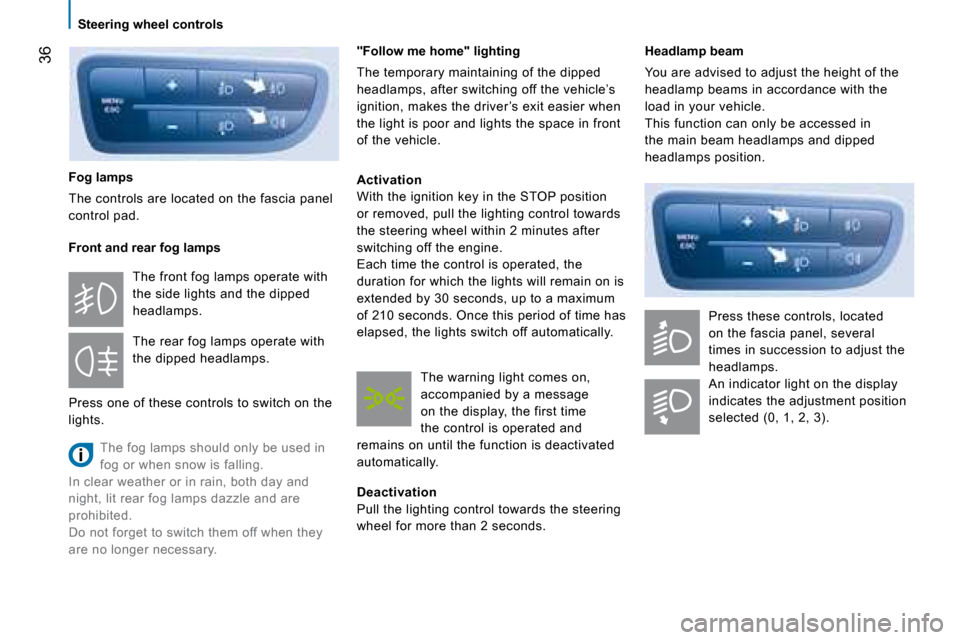
Headlamp beam
You are advised to adjust the height of the
headlamp beams in accordance with the
load in your vehicle.
This function can only be accessed in
the main beam headlamps and dipped
headlamps position. Press these controls, located
on the fascia panel, several
times in succession to adjust the
headlamps.
An indicator light on the display
indicates the adjustment position
selected (0, 1, 2, 3).
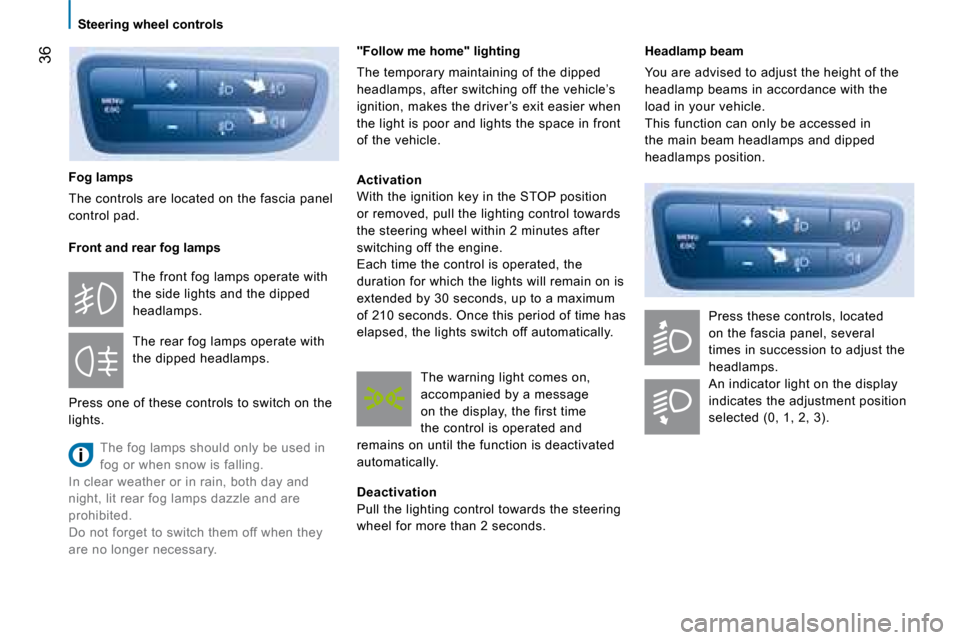
Fog lamps
The controls are located on the fascia panel
control pad.
Front and rear fog lamps
The fog lamps should only be used in
fog or when snow is falling.
In clear weather or in rain, both day and
night, lit rear fog lamps dazzle and are
prohibited.
Do not forget to switch them off when they
are no longer necessary.
"Follow me home" lighting
The temporary maintaining of the dipped
headlamps, after switching off the vehicle’s
ignition, makes the driver ’s exit easier when
the light is poor and lights the space in front
of the vehicle.
Activation
With the ignition key in the STOP position
or removed, pull the lighting control towards
the steering wheel within 2 minutes after
switching off the engine.
Each time the control is operated, the
duration for which the lights will remain on is
extended by 30 seconds, up to a maximum
of 210 seconds. Once this period of time has
elapsed, the lights switch off automatically.
Deactivation
Pull the lighting control towards the steering
wheel for more than 2 seconds.
The front fog lamps operate with
the side lights and the dipped
headlamps.
The rear fog lamps operate with
the dipped headlamps.
Press one of these controls to switch on the
lights. The warning light comes on,
accompanied by a message
on the display, the first time
the control is operated and
remains on until the function is deactivated
automatically.
Page 43 of 131
36
Steering wheel controls
Headlamp beam
You are advised to adjust the height of the
headlamp beams in accordance with the
load in your vehicle.
This function can only be accessed in
the main beam headlamps and dipped
headlamps position. Press these controls, located
on the fascia panel, several
times in succession to adjust the
headlamps.
An indicator light on the display
indicates the adjustment position
selected (0, 1, 2, 3).
Fog lamps
The controls are located on the fascia panel
control pad.
Front and rear fog lamps
The fog lamps should only be used in
fog or when snow is falling.
In clear weather or in rain, both day and
night, lit rear fog lamps dazzle and are
prohibited.
Do not forget to switch them off when they
are no longer necessary.
"Follow me home" lighting
The temporary maintaining of the dipped
headlamps, after switching off the vehicle’s
ignition, makes the driver ’s exit easier when
the light is poor and lights the space in front
of the vehicle.
Activation
With the ignition key in the STOP position
or removed, pull the lighting control towards
the steering wheel within 2 minutes after
switching off the engine.
Each time the control is operated, the
duration for which the lights will remain on is
extended by 30 seconds, up to a maximum
of 210 seconds. Once this period of time has
elapsed, the lights switch off automatically.
Deactivation
Pull the lighting control towards the steering
wheel for more than 2 seconds.
The front fog lamps operate with
the side lights and the dipped
headlamps.
The rear fog lamps operate with
the dipped headlamps.
Press one of these controls to switch on the
lights. The warning light comes on,
accompanied by a message
on the display, the first time
the control is operated and
remains on until the function is deactivated
automatically.
Page 44 of 131
37
1
READY TO SET OFF
Steering wheel controls
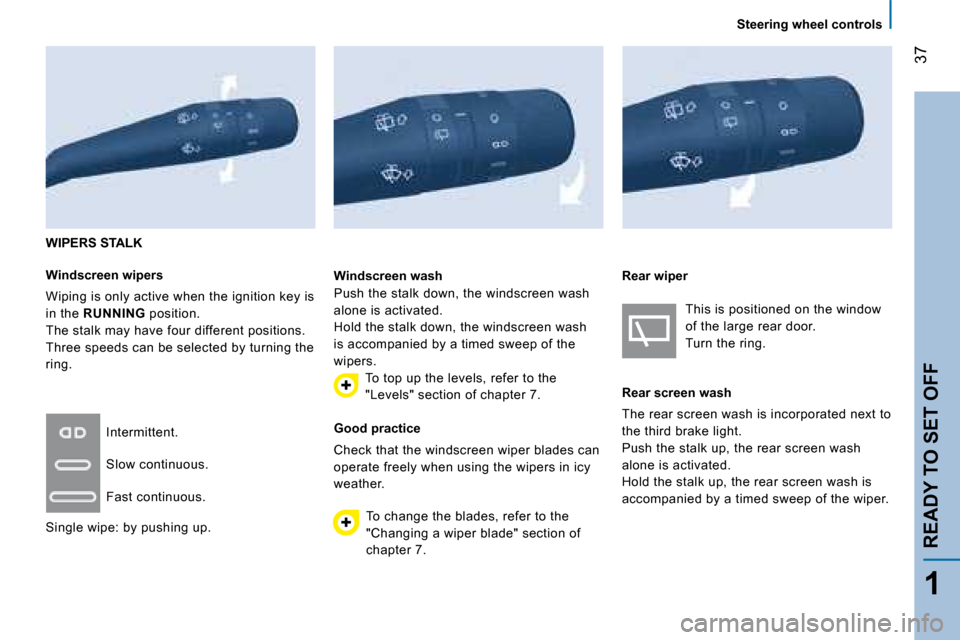
WIPERS STALK
Windscreen wipers
Wiping is only active when the ignition key is
in the RUNNING position.
The stalk may have four different positions.
Three speeds can be selected by turning the
ring.
To change the blades, refer to the
"Changing a wiper blade" section of
chapter 7.
Good practice
Check that the windscreen wiper blades can
operate freely when using the wipers in icy
weather.
Intermittent.
Slow continuous.
Fast continuous.
Single wipe: by pushing up.
Windscreen wash
Push the stalk down, the windscreen wash
alone is activated.
Hold the stalk down, the windscreen wash
is accompanied by a timed sweep of the
wipers. To top up the levels, refer to the
"Levels" section of chapter 7. This is positioned on the window
of the large rear door.
Turn the ring.
Rear screen wash
The rear screen wash is incorporated next to
the third brake light.
Push the stalk up, the rear screen wash
alone is activated.
Hold the stalk up, the rear screen wash is
accompanied by a timed sweep of the wiper.
Rear wiper
Page 46 of 131
39
1
READY TO SET OFF
Mirrors and windows
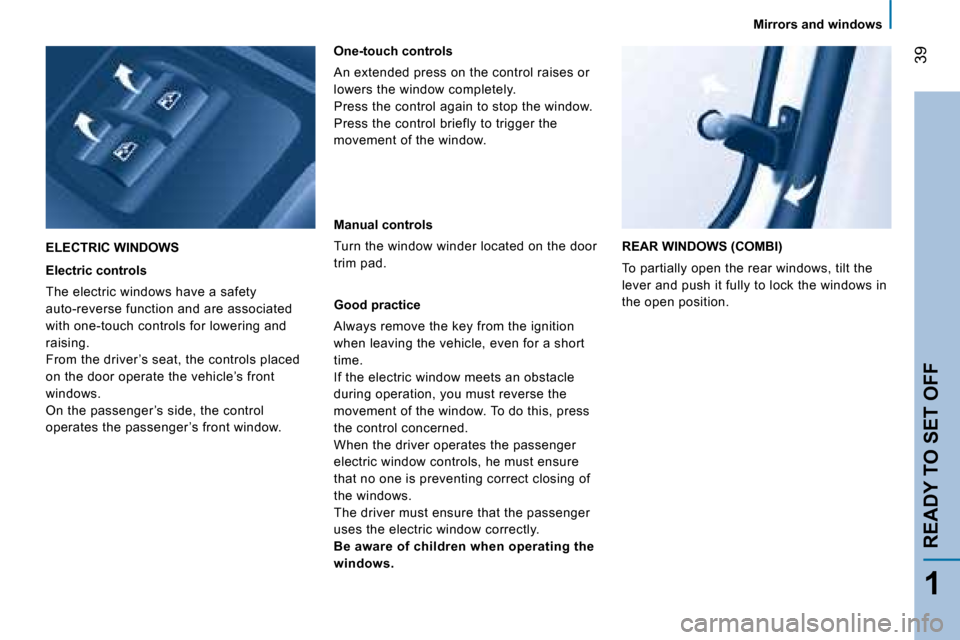
ELECTRIC WINDOWS
Electric controls
The electric windows have a safety
auto-reverse function and are associated
with one-touch controls for lowering and
raising.
From the driver ’s seat, the controls placed
on the door operate the vehicle’s front
windows.
On the passenger ’s side, the control
operates the passenger ’s front window.
One-touch controls
An extended press on the control raises or
lowers the window completely.
Press the control again to stop the window.
Press the control briefly to trigger the
movement of the window.
Manual controls
Turn the window winder located on the door
trim pad.
Good practice
Always remove the key from the ignition
when leaving the vehicle, even for a short
time.
If the electric window meets an obstacle
during operation, you must reverse the
movement of the window. To do this, press
the control concerned.
When the driver operates the passenger
electric window controls, he must ensure
that no one is preventing correct closing of
the windows.
The driver must ensure that the passenger
uses the electric window correctly.
Be aware of children when operating the
windows.
REAR WINDOWS (COMBI)
To partially open the rear windows, tilt the
lever and push it fully to lock the windows in
the open position.
Page 48 of 131
AUTO41
1
READY TO SET OFF
Gearbox and steering wheel
Stopping - Starting on a slope
This gearbox is a piloted manual gearbox
which does not have a clutch pedal.
Do not use the accelerator pedal to
immobilise the vehicle on a slope, apply
the handbrake instead.
When moving off on a slope, accelerate
gradually while releasing the
handbrake.
Switching to sequential mode
Once you have moved off, you can switch to
sequential mode by selecting position M .
"AUTO" disappears and the
gears engaged appear in
succession on the instrument
panel display.
The gear change requests are only carried
out if the engine speed permits it.
Take your foot off the accelerator pedal
gently to engage the gear.
At low speeds, when approaching a stop
or traffic lights for example, the gearbox
changes down to first gear automatically.
Switching to automated mode
After using the sequential mode, you can
return to the automated mode by selecting
position A .
"AUTO" and the gear engaged
appear on the instrument panel
display.
The gearbox then operates in
auto-active mode, without any action on the
part of the driver.
It continuously selects the gear most suited
to the following parameters:
- driving style,
- road characteristics,
- vehicle load.
To optimise driving comfort and obtain the
most suitable gear, avoid sharp variations in
the pressure on the accelerator pedal.
If you press the accelerator pedal beyond
the point of resistance, the gearbox
selects the gear below to permit sharper
acceleration.
Stopping the vehicle
Before switching off the engine, you can:
- move to position N to leave the gearbox
in neutral.
- leave a gear engaged, such as first or reverse.
In both cases, it is imperative that you apply
the handbrake to immobilise the vehicle.
Reinitialisation
Following disconnection of the battery, the
gearbox must be reinitialised:
- switch on the ignition, "AUTO" appears
on the instrument panel display,
- press the brake pedal,
- wait approximately 30 seconds until "N"
or a gear appears on the instrument
panel display,
- release the brake pedal.
The gearbox is operational again.
Operating anomaly
With the ignition on, the flashing
of "AUTO" and lighting of this
warning light, accompanied by
an audible signal and a message
on the instrument panel display, indicate a
gearbox malfunction.
Have it checked by a PEUGEOT dealer. The brake pedal must be pressed while
starting the engine.
Never select neutral N while the vehicle is
moving.
Only engage reverse gear R with the vehicle
immobilised and the brake pedal pressed.
In all cases, it is imperative that you apply
the handbrake in order to immobilise the
vehicle.
On a steep gradient, it is preferable to
switch to sequential mode.
Page 60 of 131
54
Menu
MENU
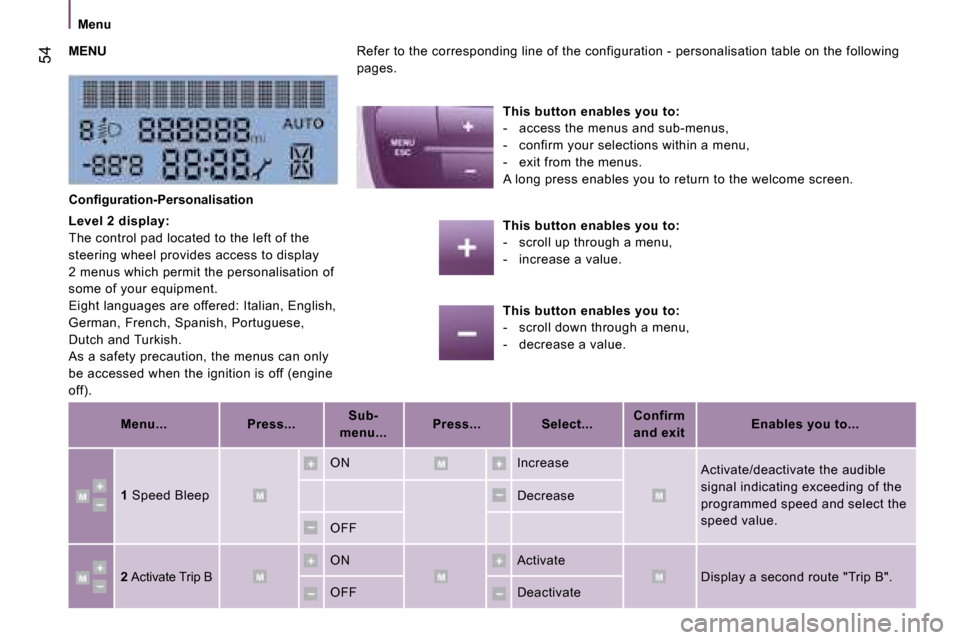
This button enables you to:
- access the menus and sub-menus,
- confirm your selections within a menu,
- exit from the menus.
A long press enables you to return to the welcome screen.
This button enables you to:
- scroll up through a menu,
- increase a value.
This button enables you to:
- scroll down through a menu,
- decrease a value.
Menu... Press...
Sub-
menu...
Press... Select...
Confirm
and exit
Enables you to...
1 Speed Bleep ON Increase
Activate/deactivate the audible
signal indicating exceeding of the
programmed speed and select the
speed value.
Decrease
OFF
2 Activate Trip B ON Activate
Display a second route "Trip B".
OFF Deactivate
Confi guration-Personalisation
Level 2 display:
The control pad located to the left of the
steering wheel provides access to display
2 menus which permit the personalisation of
some of your equipment.
Eight languages are offered: Italian, English,
German, French, Spanish, Portuguese,
Dutch and Turkish.
As a safety precaution, the menus can only
be accessed when the ignition is off (engine
off). Refer to the corresponding line of the configurati
on - personalisation table on the following
pages.
Page 67 of 131
61
3
IN-CAR TECHNOLOGY
Mobile telephone with hands-free function
MOBILE TELEPHONE WITH HANDS-FREE FUNCTION
This new equipment uses wireless
communication technology referred to
as Bluetooth®
which allows you to make
hands-free telephone calls safely from inside
your vehicle via your Bluetooth ®
compatible
mobile telephone.
First connection to the system
Turn the ignition key to the RUNNING
position.
Switch on your mobile telephone.
Activate the Bluetooth ®
function on
your mobile telephone and search for
the Bluetooth ®
accessories around the
telephone.
Follow the instructions on your mobile
telephone during the matching and the search
between the telephone and the system.
Enter the connection code "1234" and confi rm.
Your mobile telephone is now connected in
Bluetooth ®
mode with the vehicle’s hands-
free system (matching).
Activation of the system
Once your mobile telephone has been
matched with the vehicle’s hands-free
system, simply: - turn the ignition key to the RUNNING
position,
- switch on your mobile telephone,
- activate the Bluetooth ®
function on your
mobile telephone.
When the connection is established, an
audible signal is heard and the message
"Phone" appears on the audio equipment
display, if it is switched on.
For further information, consult a PEUGEOT
dealer and your mobile telephone manual.
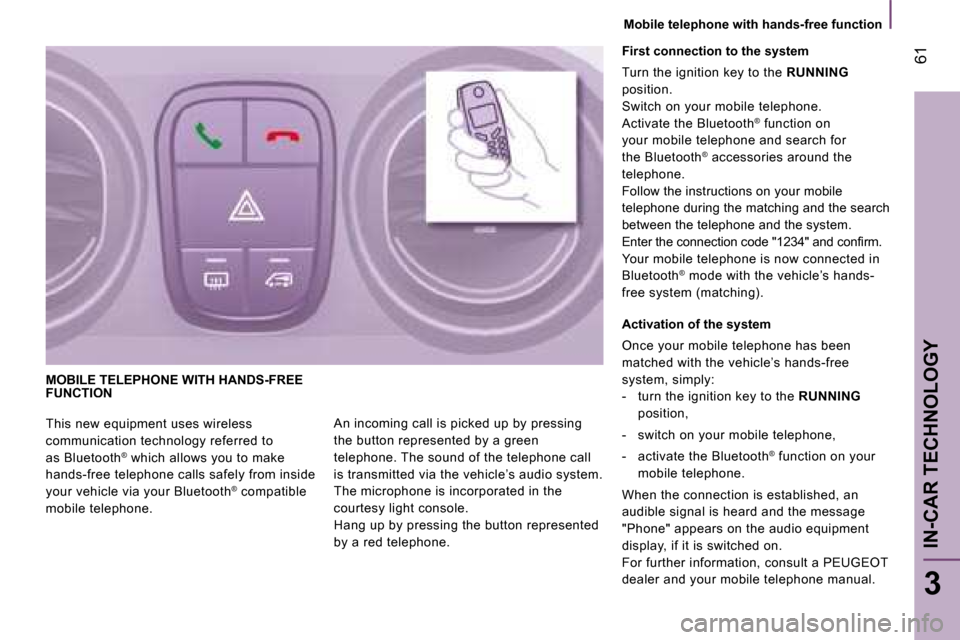
An incoming call is picked up by pressing
the button represented by a green
telephone. The sound of the telephone call
is transmitted via the vehicle’s audio system.
The microphone is incorporated in the
courtesy light console.
Hang up by pressing the button represented
by a red telephone.
Page 68 of 131
62
Mobile telephone with hands-free function
Managing incoming calls
When an incoming call is received, the
message "Phone" appears on the audio
equipment display, if it is switched on.
Single call
To accept a call, press the green
button.
To decline or end a call, press the
red button.
To switch the call between the
system and the mobile telephone
(secret mode) and vice versa, press the
green button.
Call waiting
To accept a second call, press the green
button once.
To switch back to the first call, press the
green button again.
To decline the second call, press the red
button.
To end the call, press the red button again.
It is only possible for the system to manage
the call waiting function if the function is
activated on the mobile telephone.
Managing outgoing calls
Using the keypad
Dial the number of the person to be called
on the mobile telephone keypad.
Press the "Pick up" button on the mobile
telephone.
Depending on the model of mobile
telephone, the call will be transferred to
hands-free mode automatically, if it is not,
press the green button.
To redial the last number dialled, press and
hold the green button until the number has
been redialled.
Using the voice commands
Press the green button.
Wait for the audible signal and/or the
appearance of the message "Phone" on the
audio equipment display.
Say the vocal identity of the person to be
called.
The system repeats the vocal identity
for confirmation and makes the call
automatically.
If the vocal identity repeated by the system
is not correct, press the red button to cancel
and start the procedure again.
In order to use the voice commands,
you must first record a vocal identity
and associate it with the telephone number
to be called; refer to your mobile telephone
manual.
Clearing the system
To clear the contents of the system’s
memory, press the green and red buttons
simultaneously for more than two seconds.
This operation clears all of the matched
mobile telephones and all of the telephone
numbers recorded in the system’s memory.
For the next hands-free call you will have
to repeat the first connection to the system
(matching) procedure.
Good practice
You can match up to three mobile
telephones with the system. For safety reasons and because they
require prolonged attention on the part
of the driver, the operations for matching the
mobile telephone and the Bluetooth ®
hands-
free kit must be carried out with the vehicle
stationary and the ignition on.
Page 83 of 131

77
4
ERGONOMICS and COMFORT
Practical information
INTERIOR LIGHTING
Front courtesy light
This is located in the centre of the roof.
It can be activated by:
- tilting the lens,
- opening or closing a door,
- locking or unlocking the vehicle.
It switches off automatically, after a few
minutes, if the doors remain open, or when
the ignition is switched on.
The courtesy light may be fitted with an
alarm sensor, a microphone for the
hands-free kit and reading lights.
The reading lights have right-hand and
left-hand switches.
Rear lighting
This is located on the upper part of the rear
right side.
Press the courtesy light lens to switch it on
or off.
It comes on automatically when a door is
opened.
Good practice
It switches off automatically:
- if the switch is not pressed down,
- in all cases within approximately15 minutes if the doors remain open,
- when the ignition is switched on.
Page 84 of 131
78
Driving safety
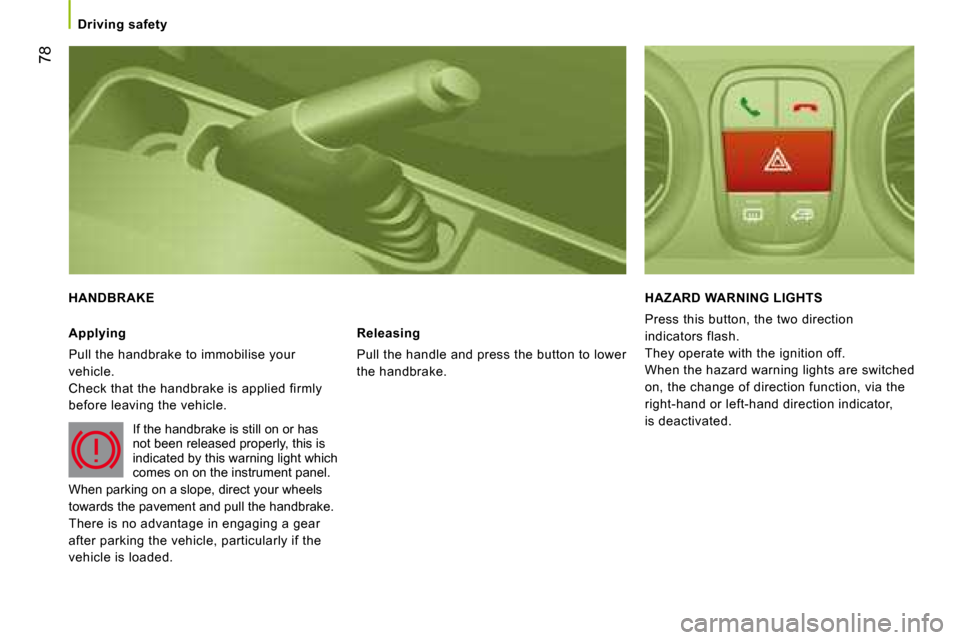
HANDBRAKE
Applying
Pull the handbrake to immobilise your
vehicle.
Check that the handbrake is applied firmly
before leaving the vehicle. If the handbrake is still on or has
not been released properly, this is
indicated by this warning light which
comes on on the instrument panel.
When parking on a slope, direct your wheels
towards the pavement and pull the handbrake.
There is no advantage in engaging a gear
after parking the vehicle, particularly if the
vehicle is loaded.
Releasing
Pull the handle and press the button to lower
the handbrake.
HAZARD WARNING LIGHTS
Press this button, the two direction
indicators flash.
They operate with the ignition off.
When the hazard warning lights are switched
on, the change of direction function, via the
right-hand or left-hand direction indicator,
is deactivated.