stru Peugeot Bipper 2008 Owner's Guide
[x] Cancel search | Manufacturer: PEUGEOT, Model Year: 2008, Model line: Bipper, Model: Peugeot Bipper 2008Pages: 131, PDF Size: 1.44 MB
Page 103 of 131
94
Towing a trailer
In certain cases of particularly arduous
use (towing the maximum load up a steep
slope in high temperatures), the engine
automatically limits its power. In this
case, the automatic cutting off of the air
conditioning allows the engine power to be
recovered. If the coolant temperature
warning light comes on, stop the
vehicle and switch off the engine
as soon as possible.
See the "Levels" section of chapter 7.
Tyres: check the tyre pressures of the
towing vehicle (see the "Identification
features" section of chapter 7) and of
the trailer, observing the recommended
pressure.
Brakes: towing increases the braking
distance. Drive at a moderate speed,
change down early and brake gradually.
Side wind: sensitivity to side wind is
increased. Drive smoothly and at a
moderate speed.
ABS: the system only controls the vehicle,
not the trailer.
Rear parking assistance: the
assistance will be deactivated
automatically when an original PEUGEOT
towbar is used (see the "Rear parking
assistance" section of chapter 4).
We recommend the use of original
PEUGEOT towbars and their harnesses,
which have been tested and approved from
the design stage of your vehicle, and that
the fitting of this equipment is entrusted to a
PEUGEOT dealer .
If this equipment is not fitted by a PEUGEOT
dealer , it is essential that it is fitted using
the electrical pre-equipment located at the
rear of the vehicle in accordance with the
manufacturer ’s instructions.
The operation of the sensors is deactivated
automatically when the pin of the trailer
cable is inserted in the towbar socket.
When the trailer cable pin is removed, the
sensors are re-activated.
Distribution of loads
Distribute the load in the trailer so that the
heaviest objects are as close as possible
to the axle and the nose weight is close to
the maximum authorised without, however,
exceeding it. The air density decreases with
altitude, so reducing the performance of
the engine. The maximum towed load must
be reduced by 10 % for each 1 000 metres
of altitude. Refer to the "Technical data"
chapter for details of the weights and
towed loads applicable to your vehicle and
also to the administrative documents (V5
registration document, ...).
Page 104 of 131
6
ACCESSORIES
Equipment
"Touring": seat covers
compatible with the side air
bags, boot tray, rubber mats,
carpet mats, 3D mats, net on rear
door, set of transverse bars on
longitudinal bars...
To avoid any risk of jamming of the pedals:
- ensure that the mat is positioned correctly,
- never fit one mat on top of another.
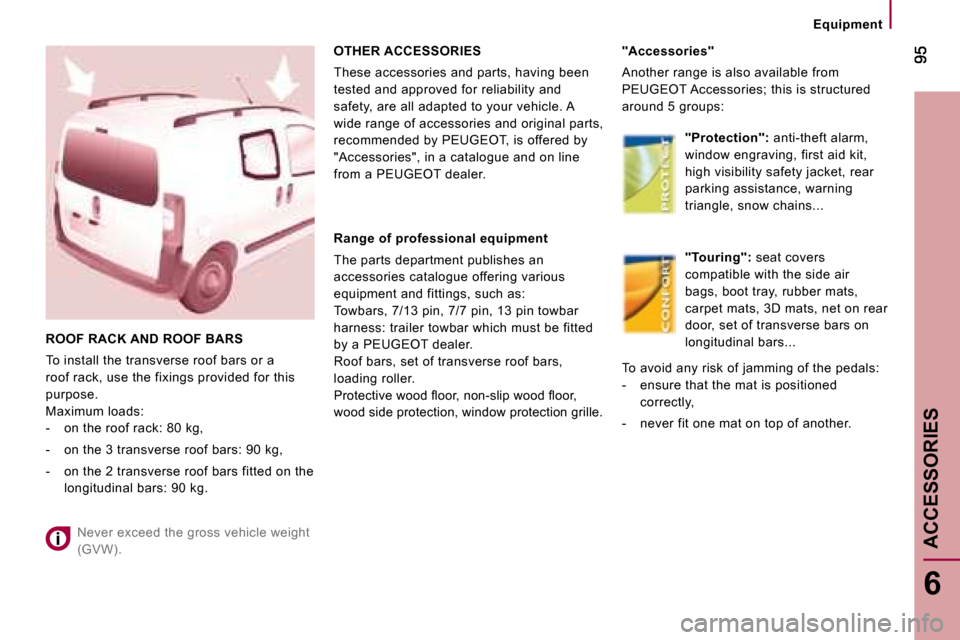
ROOF RACK AND ROOF BARS
To install the transverse roof bars or a
roof rack, use the fixings provided for this
purpose.
Maximum loads:
- on the roof rack: 80 kg,
- on the 3 transverse roof bars: 90 kg,
- on the 2 transverse roof bars fitted on the longitudinal bars: 90 kg.
OTHER ACCESSORIES
These accessories and parts, having been
tested and approved for reliability and
safety, are all adapted to your vehicle. A
wide range of accessories and original parts,
recommended by PEUGEOT , is offered by
"Accessories", in a catalogue and on line
from a PEUGEOT dealer.
Range of professional equipment
The parts department publishes an
accessories catalogue offering various
equipment and fittings, such as:
Towbars, 7/13 pin, 7/7 pin, 13 pin towbar
harness: trailer towbar which must be fitted
by a PEUGEOT dealer.
Roof bars, set of transverse roof bars,
loading roller.
Protective wood fl oor, non-slip wood fl oor,
wood side protection, window protection grille.
"Accessories"
Another range is also available from
PEUGEOT Accessories; this is structured
around 5 groups:
"Protection": anti-theft alarm,
window engraving, first aid kit,
high visibility safety jacket, rear
parking assistance, warning
triangle, snow chains...
Never exceed the gross vehicle weight
(GVW).
Page 105 of 131
6
ACCESSORIES
Equipment
"Touring": seat covers
compatible with the side air
bags, boot tray, rubber mats,
carpet mats, 3D mats, net on rear
door, set of transverse bars on
longitudinal bars...
To avoid any risk of jamming of the pedals:
- ensure that the mat is positioned correctly,
- never fit one mat on top of another.
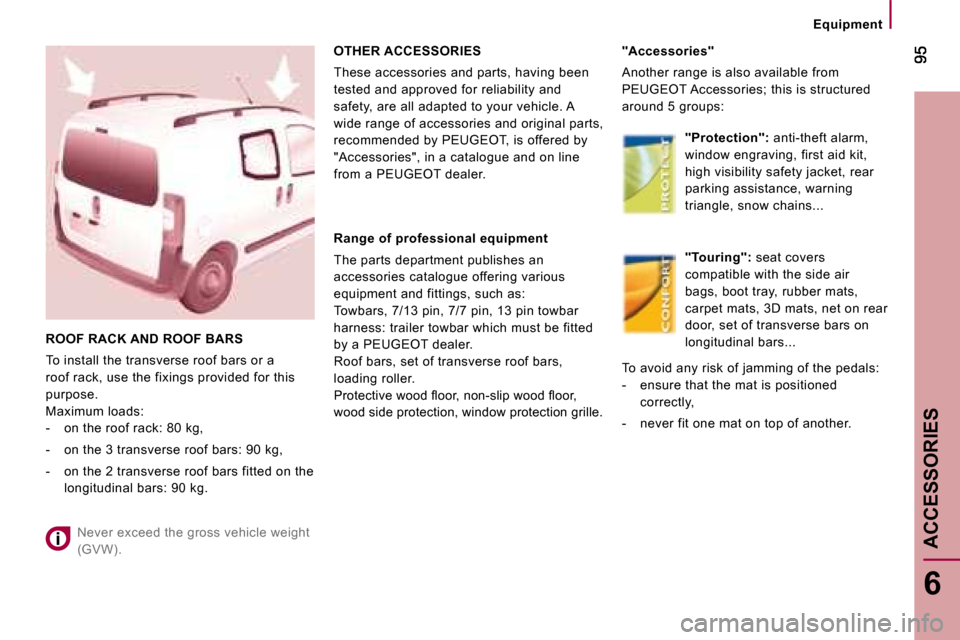
ROOF RACK AND ROOF BARS
To install the transverse roof bars or a
roof rack, use the fixings provided for this
purpose.
Maximum loads:
- on the roof rack: 80 kg,
- on the 3 transverse roof bars: 90 kg,
- on the 2 transverse roof bars fitted on the longitudinal bars: 90 kg.
OTHER ACCESSORIES
These accessories and parts, having been
tested and approved for reliability and
safety, are all adapted to your vehicle. A
wide range of accessories and original parts,
recommended by PEUGEOT , is offered by
"Accessories", in a catalogue and on line
from a PEUGEOT dealer.
Range of professional equipment
The parts department publishes an
accessories catalogue offering various
equipment and fittings, such as:
Towbars, 7/13 pin, 7/7 pin, 13 pin towbar
harness: trailer towbar which must be fitted
by a PEUGEOT dealer.
Roof bars, set of transverse roof bars,
loading roller.
Protective wood fl oor, non-slip wood fl oor,
wood side protection, window protection grille.
"Accessories"
Another range is also available from
PEUGEOT Accessories; this is structured
around 5 groups:
"Protection": anti-theft alarm,
window engraving, first aid kit,
high visibility safety jacket, rear
parking assistance, warning
triangle, snow chains...
Never exceed the gross vehicle weight
(GVW).
Page 107 of 131
97
7
TROUBLESHOOTING
Battery
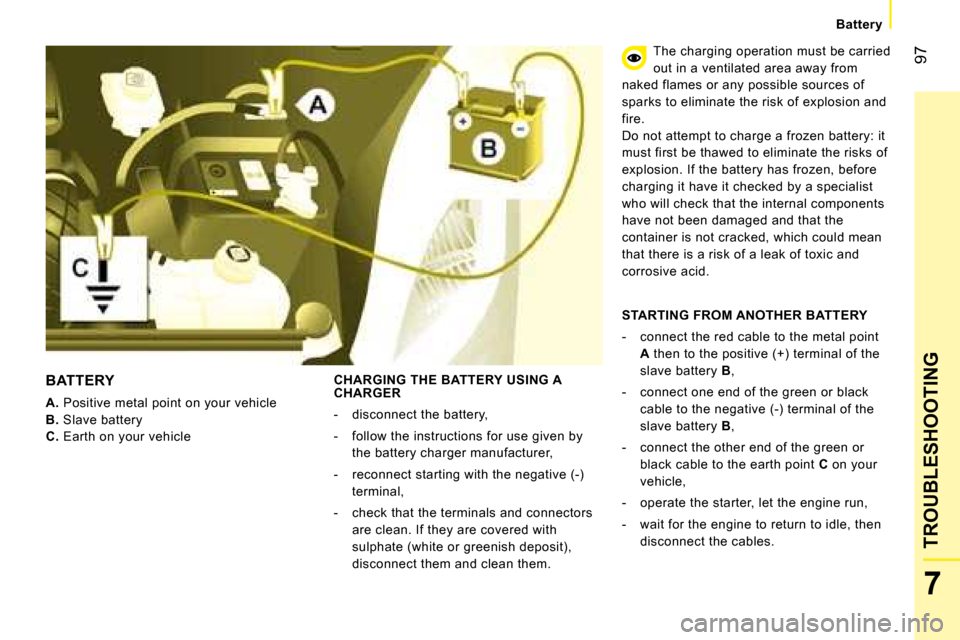
BATTERY
A. Positive metal point on your vehicle
B. Slave battery
C. Earth on your vehicle
CHARGING THE BATTERY USING A CHARGER
- disconnect the battery,
- follow the instructions for use given by
the battery charger manufacturer,
- reconnect starting with the negative (-) terminal,
- check that the terminals and connectors are clean. If they are covered with
sulphate (white or greenish deposit),
disconnect them and clean them. The charging operation must be carried
out in a ventilated area away from
naked flames or any possible sources of
sparks to eliminate the risk of explosion and
fire.
Do not attempt to charge a frozen battery: it
must first be thawed to eliminate the risks of
explosion. If the battery has frozen, before
charging it have it checked by a specialist
who will check that the internal components
have not been damaged and that the
container is not cracked, which could mean
that there is a risk of a leak of toxic and
corrosive acid.
STARTING FROM ANOTHER BATTERY
- connect the red cable to the metal point
A then to the positive (+) terminal of the
slave battery B ,
- connect one end of the green or black cable to the negative (-) terminal of the
slave battery B ,
- connect the other end of the green or black cable to the earth point C on your
vehicle,
- operate the starter, let the engine run,
- wait for the engine to return to idle, then disconnect the cables.
Page 119 of 131
108
Changing a wiper blade
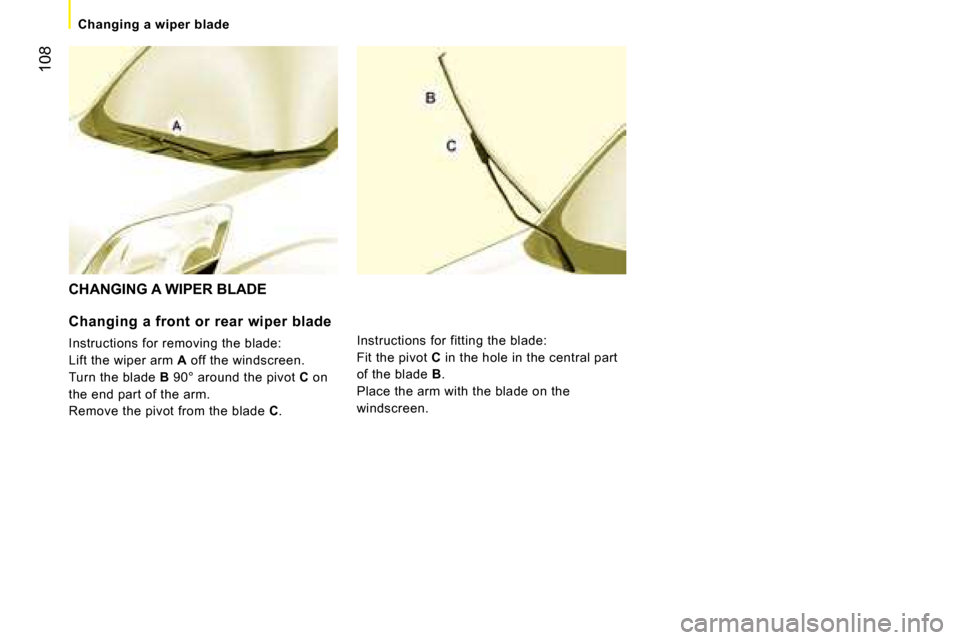
CHANGING A WIPER BLADE
Changing a front or rear wiper blade
Instructions for removing the blade:
Lift the wiper arm A off the windscreen.
Turn the blade B 90° around the pivot C on
the end part of the arm.
Remove the pivot from the blade C . Instructions for fitting the blade:
Fit the pivot
C in the hole in the central part
of the blade B .
Place the arm with the blade on the
windscreen.
Page 120 of 131
109
7
TROUBLESHOOTING
Changing a fuse
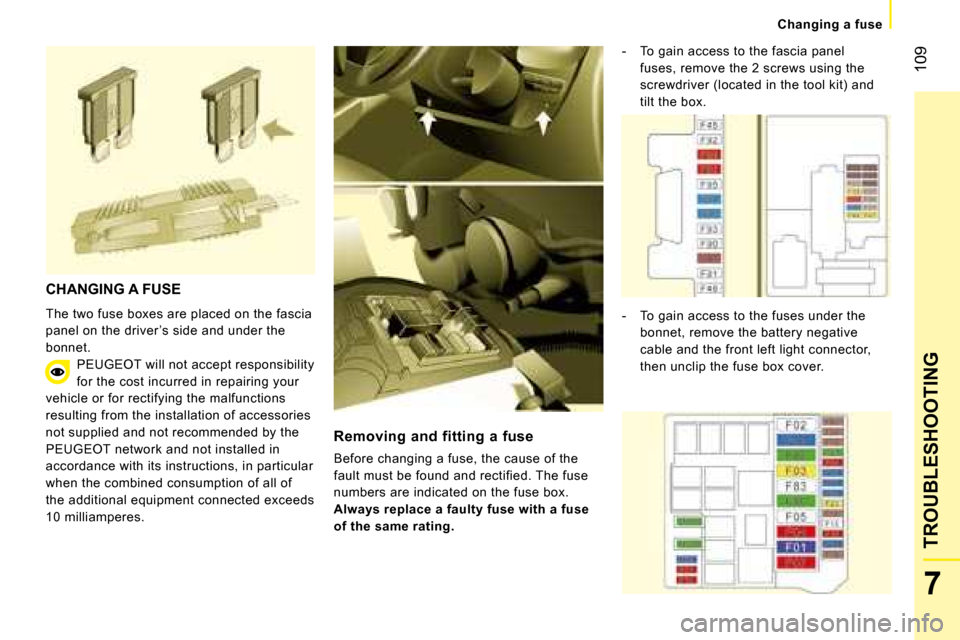
CHANGING A FUSE
The two fuse boxes are placed on the fascia
panel on the driver ’s side and under the
bonnet. PEUGEOT will not accept responsibility
for the cost incurred in repairing your
vehicle or for rectifying the malfunctions
resulting from the installation of accessories
not supplied and not recommended by the
PEUGEOT network and not installed in
accordance with its instructions, in particular
when the combined consumption of all of
the additional equipment connected exceeds
10 milliamperes.
Removing and fitting a fuse
Before changing a fuse, the cause of the
fault must be found and rectified. The fuse
numbers are indicated on the fuse box.
Always replace a faulty fuse with a fuse
of the same rating. - To gain access to the fascia panel
fuses, remove the 2 screws using the
screwdriver (located in the tool kit) and
tilt the box.
- To gain access to the fuses under the bonnet, remove the battery negative
cable and the front left light connector,
then unclip the fuse box cover.
Page 121 of 131
109
7
TROUBLESHOOTING
Changing a fuse
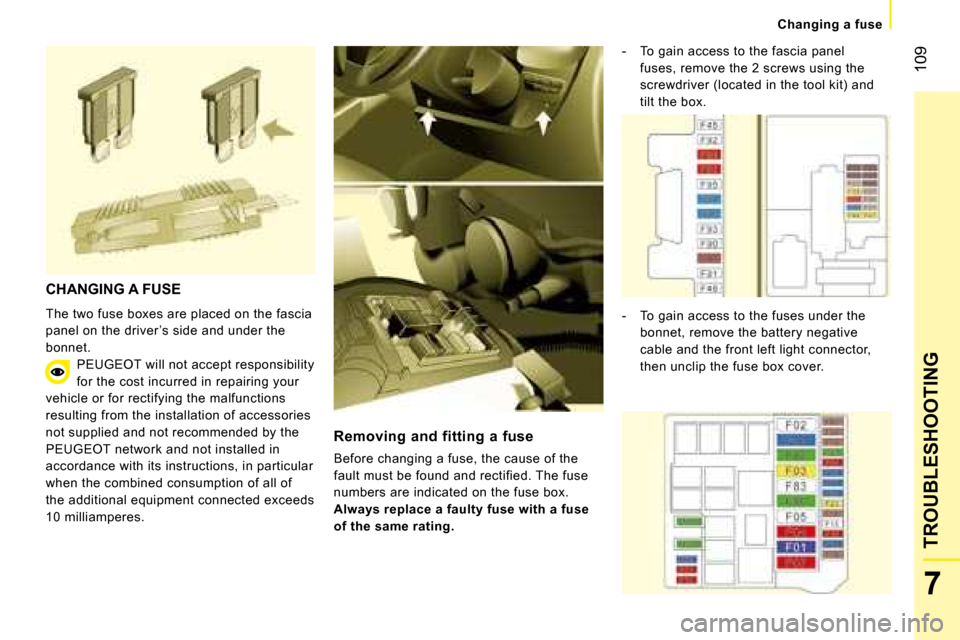
CHANGING A FUSE
The two fuse boxes are placed on the fascia
panel on the driver ’s side and under the
bonnet. PEUGEOT will not accept responsibility
for the cost incurred in repairing your
vehicle or for rectifying the malfunctions
resulting from the installation of accessories
not supplied and not recommended by the
PEUGEOT network and not installed in
accordance with its instructions, in particular
when the combined consumption of all of
the additional equipment connected exceeds
10 milliamperes.
Removing and fitting a fuse
Before changing a fuse, the cause of the
fault must be found and rectified. The fuse
numbers are indicated on the fuse box.
Always replace a faulty fuse with a fuse
of the same rating. - To gain access to the fascia panel
fuses, remove the 2 screws using the
screwdriver (located in the tool kit) and
tilt the box.
- To gain access to the fuses under the bonnet, remove the battery negative
cable and the front left light connector,
then unclip the fuse box cover.
Page 125 of 131
114
Fuel
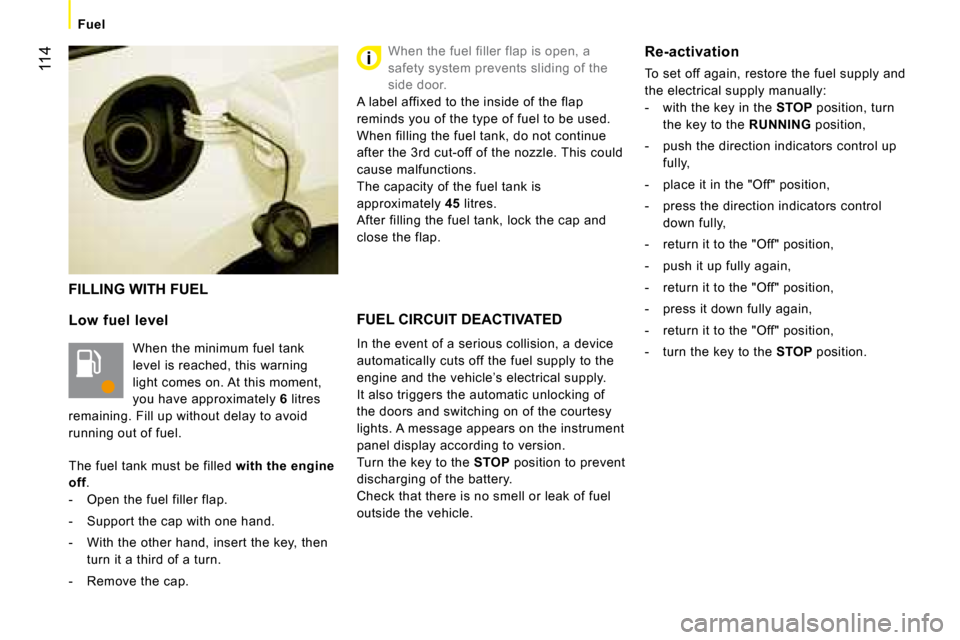
FILLING WITH FUEL
Low fuel level
When the minimum fuel tank
level is reached, this warning
light comes on. At this moment,
you have approximately 6 litres
remaining. Fill up without delay to avoid
running out of fuel.
The fuel tank must be filled with the engine
off .
- Open the fuel filler flap.
- Support the cap with one hand.
- With the other hand, insert the key, then turn it a third of a turn.
- Remove the cap.
FUEL CIRCUIT DEACTIVATED
In the event of a serious collision, a device
automatically cuts off the fuel supply to the
engine and the vehicle’s electrical supply.
It also triggers the automatic unlocking of
the doors and switching on of the courtesy
lights. A message appears on the instrument
panel display according to version.
Turn the key to the STOP position to prevent
discharging of the battery.
Check that there is no smell or leak of fuel
outside the vehicle.
When the fuel filler flap is open, a
safety system prevents sliding of the
side door.
A label affixed to the inside of the flap
reminds you of the type of fuel to be used.
When filling the fuel tank, do not continue
after the 3rd cut-off of the nozzle. This could
cause malfunctions.
The capacity of the fuel tank is
approximately 45 litres.
After filling the fuel tank, lock the cap and
close the flap.
Re-activation
To set off again, restore the fuel supply and
the electrical supply manually:
- with the key in the STOP position, turn
the key to the RUNNING position,
- push the direction indicators control up fully,
- place it in the "Off" position,
- press the direction indicators control down fully,
- return it to the "Off" position,
- push it up fully again,
- return it to the "Off" position,
- press it down fully again,
- return it to the "Off" position,
- turn the key to the STOP position.
Page 129 of 131
119
7
TROUBLESHOOTING
Levels
These regular maintenance operations
will keep your vehicle in good
running order. Consult the instructions at
a PEUGEOT dealership or in the servicing
booklet enclosed in the handbook pack.
LEVELS
Oil level
Check the level regularly and top up
between changes. The maximum
consumption is 0.5 l per 600 miles
(1 000 km). Check the level with the vehicle
level, engine cold, using the dipstick.
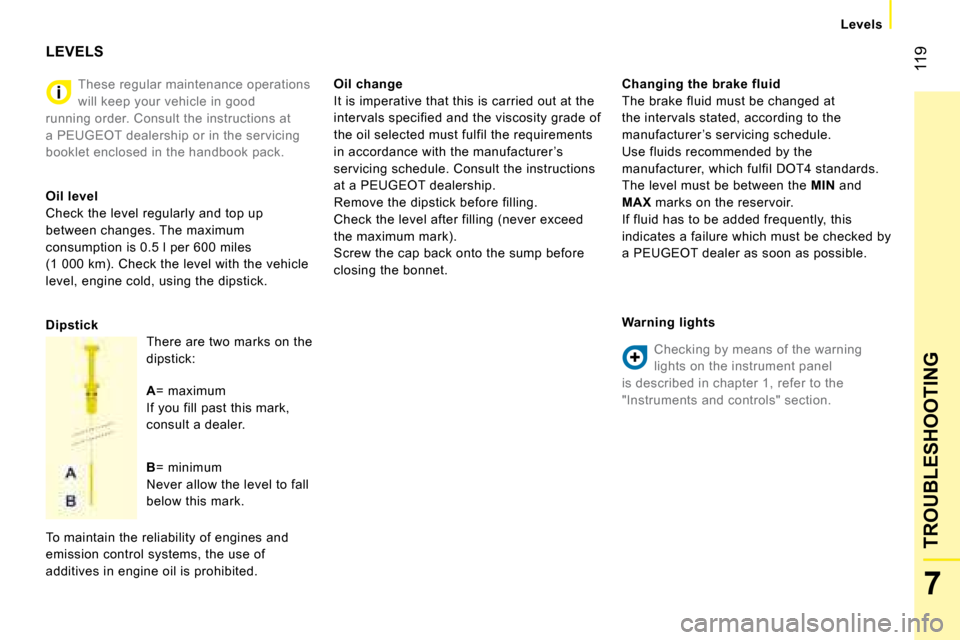
Dipstick
There are two marks on the
dipstick:
A = maximum
If you fill past this mark,
consult a dealer.
B = minimum
Never allow the level to fall
below this mark.
To maintain the reliability of engines and
emission control systems, the use of
additives in engine oil is prohibited.
Oil change
It is imperative that this is carried out at the
intervals specified and the viscosity grade of
the oil selected must fulfil the requirements
in accordance with the manufacturer ’s
servicing schedule. Consult the instructions
at a PEUGEOT dealership.
Remove the dipstick before filling.
Check the level after filling (never exceed
the maximum mark).
Screw the cap back onto the sump before
closing the bonnet.
Changing the brake fluid
The brake fluid must be changed at
the intervals stated, according to the
manufacturer ’s servicing schedule.
Use fluids recommended by the
manufacturer, which fulfil DOT4 standards.
The level must be between the MIN and
MAX marks on the reservoir.
If fluid has to be added frequently, this
indicates a failure which must be checked by
a PEUGEOT dealer as soon as possible.
Warning lights
Checking by means of the warning
lights on the instrument panel
is described in chapter 1, refer to the
"Instruments and controls" section.