wheel PEUGEOT BOXER 2002 User Guide
[x] Cancel search | Manufacturer: PEUGEOT, Model Year: 2002, Model line: BOXER, Model: PEUGEOT BOXER 2002Pages: 182, PDF Size: 1.93 MB
Page 128 of 182
16-09-2002
Operating abnormality Any operating abnormality is indica- ted by flashing of the Snow warninglight on the instrument panel. In this situation the gearbox operates in downgrade mode (locked in 3rd
gear). You may feel a substantialknock when changing from Pto R
and from Nto R(this will not cause
any damage to the gearbox). Do not exceed 100 km/h, keeping within the limit of local speed restric-tions.
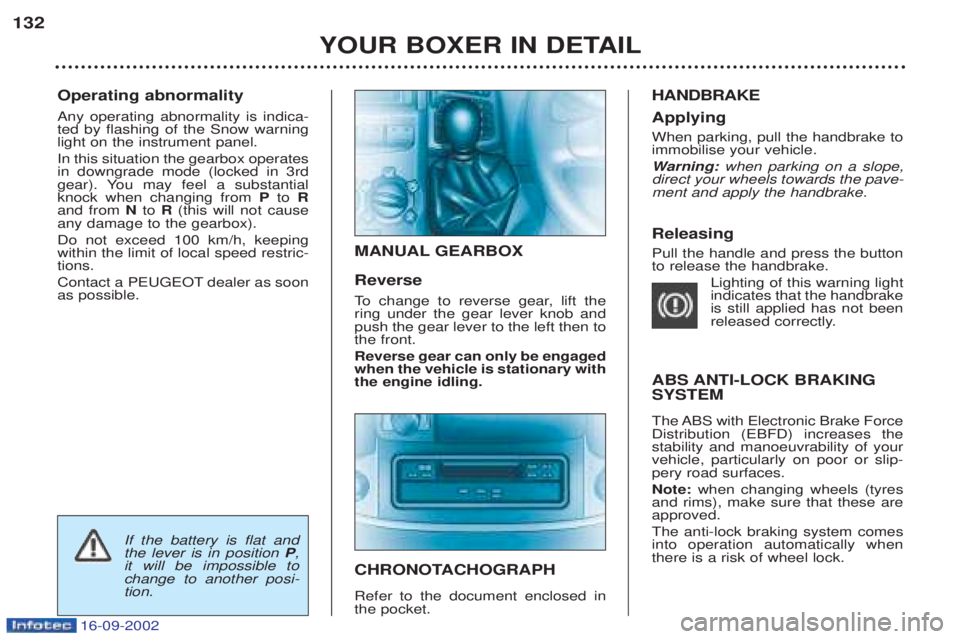
Contact a PEUGEOT dealer as soon as possible. MANUAL GEARBOX Reverse
To
change to reverse gear, lift the
ring under the gear lever knob and push the gear lever to the left then tothe front. Reverse gear can only be engaged when the vehicle is stationary withthe engine idling. HANDBRAKE Applying When parking, pull the handbrake to immobilise your vehicle. W
arning: when parking on a slope,
direct your wheels towards the pave- ment and apply the handbrake.
Releasing Pull the handle and press the button to release the handbrake. Lighting of this warning lightindicates that the handbrakeis still applied has not been
released correctly.
CHRONOTACHOGRAPH Refer to the document enclosed in the pocket.
YOUR BOXER IN DETAIL
132
If the battery is flat and the lever is in position
P,
it will be impossible tochange to another posi-tion.
ABS ANTI-LOCK BRAKING SYSTEM
The ABS with Electronic Brake Force Distribution (EBFD) increases thestability and manoeuvrability of yourvehicle, particularly on poor or slip-pery road surfaces. Note: when changing wheels (tyres
and rims), make sure that these are approved. The anti-lock braking system comes into operation automatically whenthere is a risk of wheel lock.
Page 129 of 182
16-09-2002
Operating abnormality Any operating abnormality is indica- ted by flashing of the Snow warninglight on the instrument panel. In this situation the gearbox operates in downgrade mode (locked in 3rd
gear). You may feel a substantialknock when changing from Pto R
and from Nto R(this will not cause
any damage to the gearbox). Do not exceed 100 km/h, keeping within the limit of local speed restric-tions.
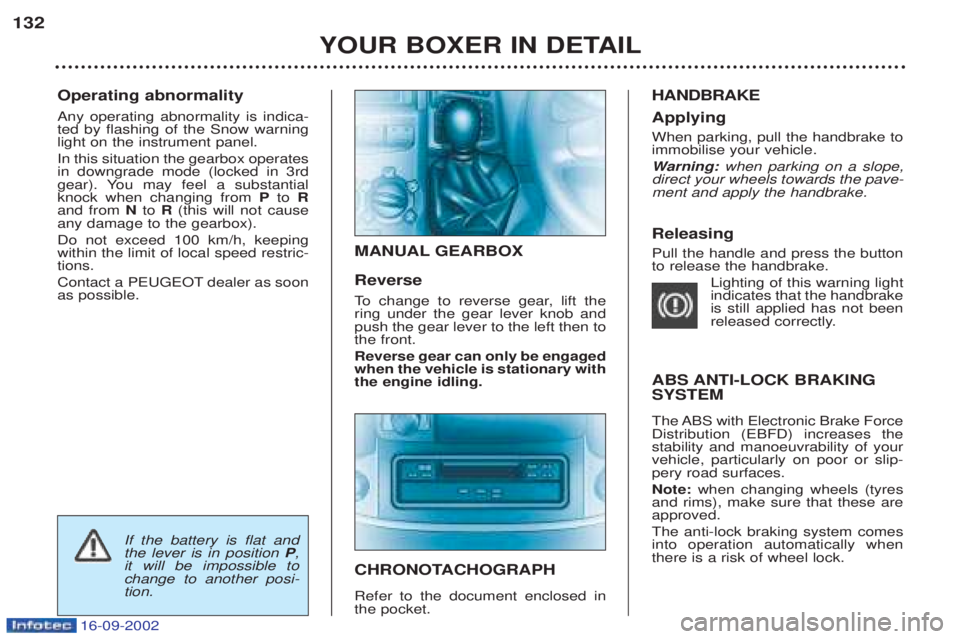
Contact a PEUGEOT dealer as soon as possible. MANUAL GEARBOX Reverse
To
change to reverse gear, lift the
ring under the gear lever knob and push the gear lever to the left then tothe front. Reverse gear can only be engaged when the vehicle is stationary withthe engine idling. HANDBRAKE Applying When parking, pull the handbrake to immobilise your vehicle. W
arning: when parking on a slope,
direct your wheels towards the pave- ment and apply the handbrake.
Releasing Pull the handle and press the button to release the handbrake. Lighting of this warning lightindicates that the handbrakeis still applied has not been
released correctly.
CHRONOTACHOGRAPH Refer to the document enclosed in the pocket.
YOUR BOXER IN DETAIL
132
If the battery is flat and the lever is in position
P,
it will be impossible tochange to another posi-tion.
ABS ANTI-LOCK BRAKING SYSTEM
The ABS with Electronic Brake Force Distribution (EBFD) increases thestability and manoeuvrability of yourvehicle, particularly on poor or slip-pery road surfaces. Note: when changing wheels (tyres
and rims), make sure that these are approved. The anti-lock braking system comes into operation automatically whenthere is a risk of wheel lock.
Page 130 of 182
16-09-2002
Operating abnormality Any operating abnormality is indica- ted by flashing of the Snow warninglight on the instrument panel. In this situation the gearbox operates in downgrade mode (locked in 3rd
gear). You may feel a substantialknock when changing from Pto R
and from Nto R(this will not cause
any damage to the gearbox). Do not exceed 100 km/h, keeping within the limit of local speed restric-tions.
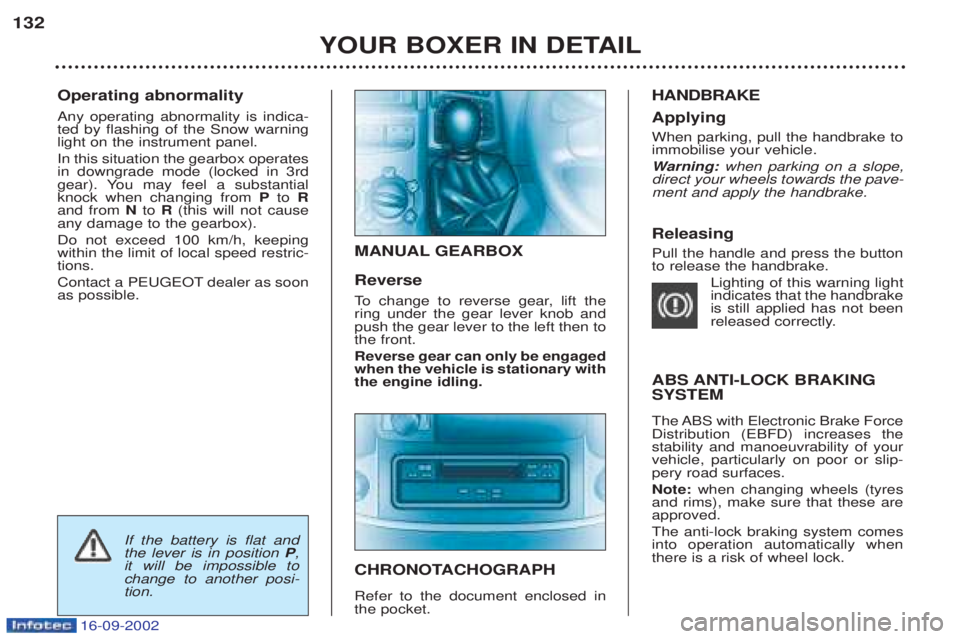
Contact a PEUGEOT dealer as soon as possible. MANUAL GEARBOX Reverse
To
change to reverse gear, lift the
ring under the gear lever knob and push the gear lever to the left then tothe front. Reverse gear can only be engaged when the vehicle is stationary withthe engine idling. HANDBRAKE Applying When parking, pull the handbrake to immobilise your vehicle. W
arning: when parking on a slope,
direct your wheels towards the pave- ment and apply the handbrake.
Releasing Pull the handle and press the button to release the handbrake. Lighting of this warning lightindicates that the handbrakeis still applied has not been
released correctly.
CHRONOTACHOGRAPH Refer to the document enclosed in the pocket.
YOUR BOXER IN DETAIL
132
If the battery is flat and the lever is in position
P,
it will be impossible tochange to another posi-tion.
ABS ANTI-LOCK BRAKING SYSTEM
The ABS with Electronic Brake Force Distribution (EBFD) increases thestability and manoeuvrability of yourvehicle, particularly on poor or slip-pery road surfaces. Note: when changing wheels (tyres
and rims), make sure that these are approved. The anti-lock braking system comes into operation automatically whenthere is a risk of wheel lock.
Page 131 of 182
16-09-2002
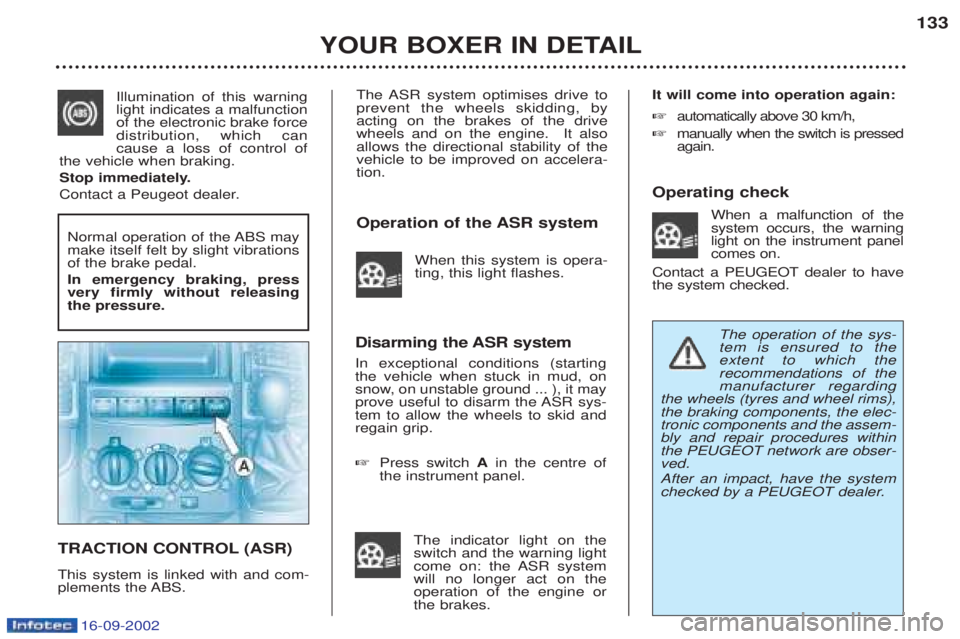
The ASR system optimises drive to prevent the wheels skidding, byacting on the brakes of the drivewheels and on the engine. It alsoallows the directional stability of thevehicle to be improved on accelera-tion.
Operation of the ASR systemWhen this system is opera- ting, this light flashes.
TRACTION CONTROL (ASR) This system is linked with and com-
plements the ABS. Disarming the ASR system In exceptional conditions (starting the vehicle when stuck in mud, on
snow, on unstable ground ... ), it may
prove useful to disarm the ASR sys-tem to allow the wheels to skid andregain grip. ☞
Press switch Ain the centre of
the instrument panel.
The indicator light on the switch and the warning light
come on: the ASR systemwill no longer act on theoperation of the engine orthe brakes. It will come into operation again: ☞
automatically above 30 km/h,
☞ manually when the switch is pressed again.
Operating check When a malfunction of thesystem occurs, the warninglight on the instrument panelcomes on.
Contact a PEUGEOT dealer to havethe system checked.
YOUR BOXER IN DETAIL 133
Normal operation of the ABS may make itself felt by slight vibrationsof the brake pedal. In emergency braking, press very firmly without releasingthe pressure.
The operation of the sys- tem is ensured to theextent to which therecommendations of themanufacturer regarding
the wheels (tyres and wheel rims),the braking components, the elec-tronic components and the assem-bly and repair procedures withinthe PEUGEOT network are obser-ved. After an impact, have the system
checked by a PEUGEOT dealer.
Illumination of this warning light indicates a malfunctionof the electronic brake forcedistribution, which cancause a loss of control of
the vehicle when braking.
Stop immediately.
Contact a Peugeot dealer.
Page 132 of 182
16-09-2002
The ASR system optimises drive to prevent the wheels skidding, byacting on the brakes of the drivewheels and on the engine. It alsoallows the directional stability of thevehicle to be improved on accelera-tion.
Operation of the ASR systemWhen this system is opera- ting, this light flashes.
TRACTION CONTROL (ASR) This system is linked with and com-
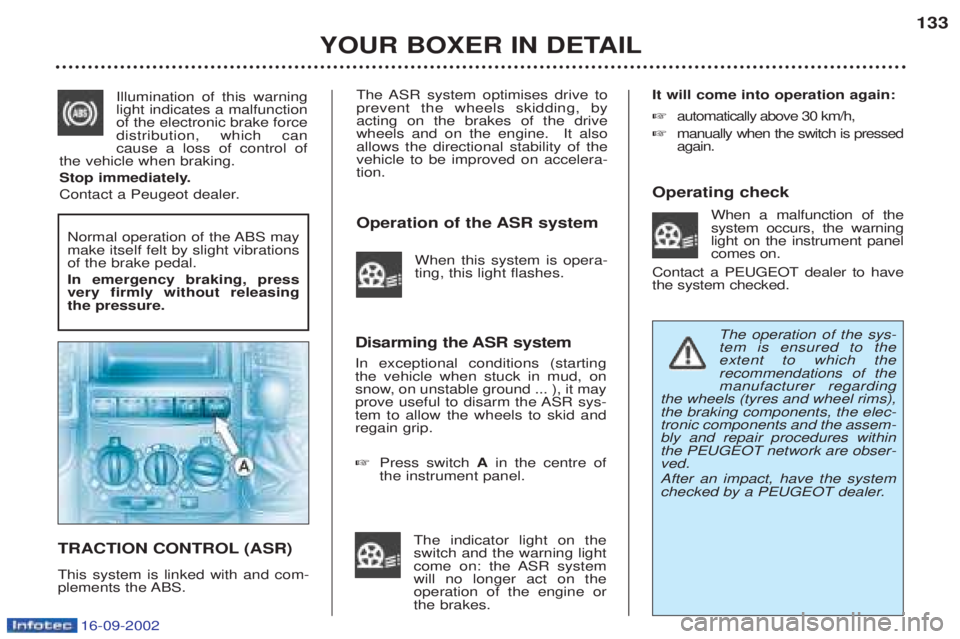
plements the ABS. Disarming the ASR system In exceptional conditions (starting the vehicle when stuck in mud, on
snow, on unstable ground ... ), it may
prove useful to disarm the ASR sys-tem to allow the wheels to skid andregain grip. ☞
Press switch Ain the centre of
the instrument panel.
The indicator light on the switch and the warning light
come on: the ASR systemwill no longer act on theoperation of the engine orthe brakes. It will come into operation again: ☞
automatically above 30 km/h,
☞ manually when the switch is pressed again.
Operating check When a malfunction of thesystem occurs, the warninglight on the instrument panelcomes on.
Contact a PEUGEOT dealer to havethe system checked.
YOUR BOXER IN DETAIL 133
Normal operation of the ABS may make itself felt by slight vibrationsof the brake pedal. In emergency braking, press very firmly without releasingthe pressure.
The operation of the sys- tem is ensured to theextent to which therecommendations of themanufacturer regarding
the wheels (tyres and wheel rims),the braking components, the elec-tronic components and the assem-bly and repair procedures withinthe PEUGEOT network are obser-ved. After an impact, have the system
checked by a PEUGEOT dealer.
Illumination of this warning light indicates a malfunctionof the electronic brake forcedistribution, which cancause a loss of control of
the vehicle when braking.
Stop immediately.
Contact a Peugeot dealer.
Page 133 of 182
16-09-2002
CRUISE CONTROL Cruise control enables the vehicle to maintain a steady speed program-
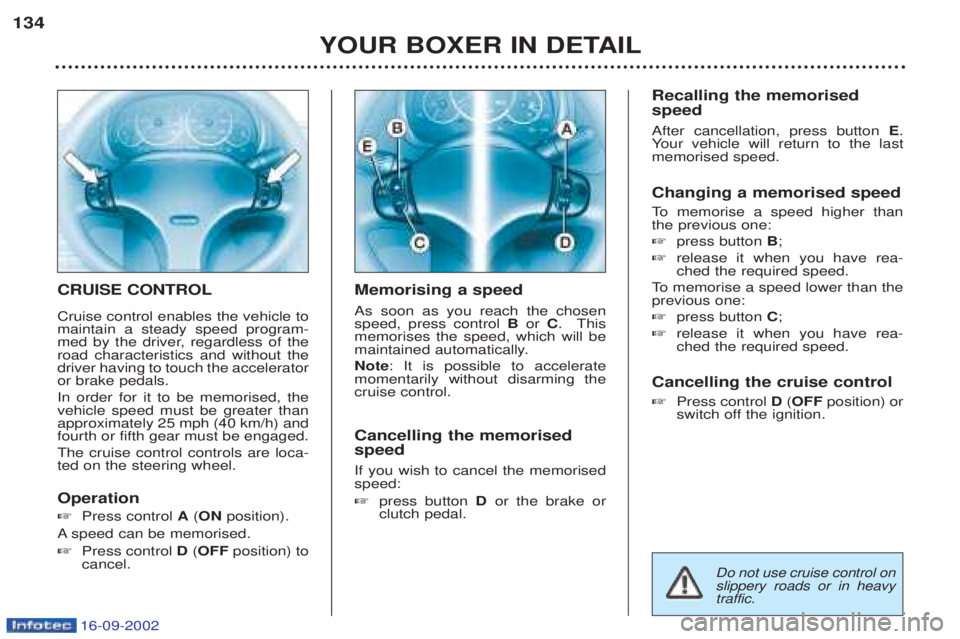
med by the driver, regardless of theroad characteristics and without thedriver having to touch the acceleratoror brake pedals. In order for it to be memorised, the vehicle speed must be greater thanapproximately 25 mph (40 km/h) andfourth or fifth gear must be engaged. The cruise control controls are loca- ted on the steering wheel. Operation ☞Press control A(ON position).
A speed can be memorised.
☞ Press control D(OFF position) to
cancel. Memorising a speed As soon as you reach the chosen speed, press control
Bor C. This
memorises the speed, which will be
maintained automatically. Note : It is possible to accelerate
momentarily without disarming the cruise control. Cancelling the memorised speed If you wish to cancel the memorised speed: ☞ press button Dor the brake or
clutch pedal. Recalling the memorised speed After cancellation, press button
E.
Y our vehicle will return to the last
memorised speed. Changing a memorised speed
To memorise a speed higher than
the previous one: ☞ press button B;
☞ release it when you have rea- ched the required speed.
To memorise a speed lower than the
previous one: ☞ press button C;
☞ release it when you have rea- ched the required speed.
Cancelling the cruise control ☞ Press control D (OFF position) or
switch off the ignition.
YOUR BOXER IN DETAIL
134
Do not use cruise control on slippery roads or in heavytraffic.
Page 136 of 182
16-09-2002
YOUR BOXER IN DETAIL137
AIR BAGS The air bags have been designed to maximise the safety of the occupantsin the event of serious collisions.They work in conjunction with theforce-limiting seat belts. The electronic detectors register and analyse any abrupt deceleration ofthe vehicle: if the triggering thresholdis reached, the air bags inflate ins-tantly and protect the occupants ofthe vehicle. Immediately after the impact, the air bags deflate rapidly so that they donot hinder the visibility of the occu-pants nor their exit if necessary fromthe vehicle. The air bags are not deployed in the case of collisions which are notserious, for which the seat belt is suf-ficient to ensure maximum protec-
tion. The seriousness of a collisiondepends on the nature of the obs-tacle and the speed of the vehicle atthe moment of the collision. Air bags only operate when the ignition is switched on. Note:
the gas escaping from the air
bags can be a minor irritant. FRONT AIR BAGS These are folded in the centre of the steering wheel for the driver and in
the fascia for the front passenger.
They are deployed simultaneously,except in cases where the passen-ger air bag is disarmed. Front air bag fault
If this warning light comes on on the instrument panel,
contact a PEUGEOT dealerto have the system chec-ked. Disarming the passenger air bag*
To
ensure the safety of your child,
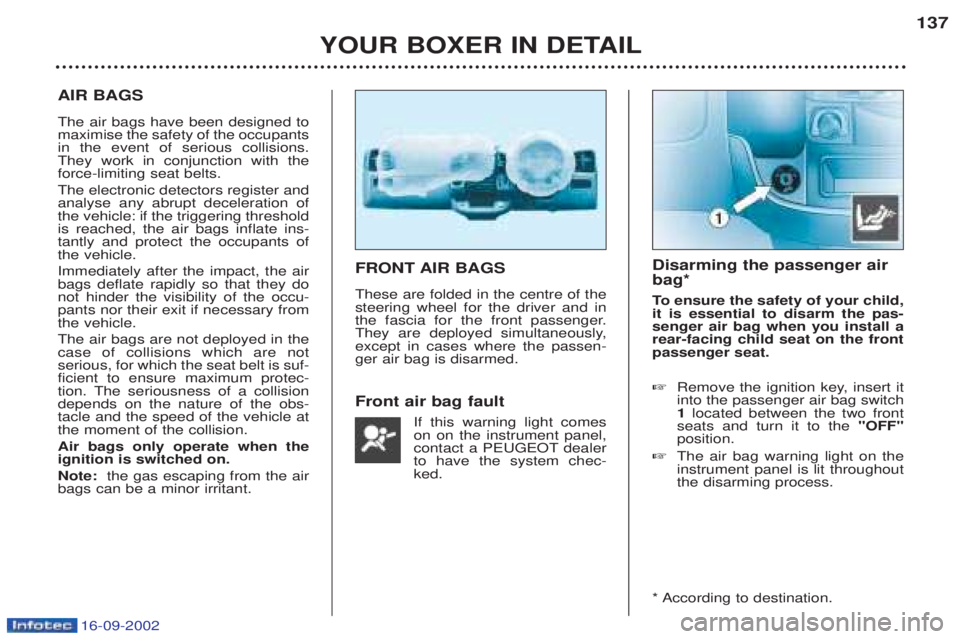
it is essential to disarm the pas- senger air bag when you install arear-facing child seat on the frontpassenger seat. ☞ Remove the ignition key, insert it into the passenger air bag switch1located between the two front
seats and turn it to the "OFF"
position.
☞ The air bag warning light on theinstrument panel is lit throughoutthe disarming process.
* According to destination.
Page 138 of 182
16-09-2002
YOUR BOXER IN DETAIL139
For the front and side* air bags to be fully effective, observe the following safety rules:
¥W
ear a correctly adjusted seat belt.
¥ Sit in a normal upright position.
¥ Do not leave anything between the occupants of the front seats and the air bags (a child, pet, object). This could hamper the operation of the air bags or injure the occupants.
¥ All work on the air bag system is strictly forbidden unless it is carried out by qualified personnel of the PEUGEOT net- work.
¥ After an accident or if the vehicle has been stolen or broken into, have the air bag systems checked.
¥ The air bag systems have been designed to be fully operational for 10 years after the vehicle has been registered.
For greater safety, have them checked by a PEUGEOT dealer within 10 years following the purchase of the vehicle.
Front air bags¥ Do not drive holding the steering wheel by its spokes or resting your hands on the centre part of the wheel.
¥ Passengers must not place their feet on the fascia.
¥ Smoke as little as possible; deployment of the air bags can cause burns or the risk of injury from a cigarette or pipe.
¥ Never remove or pierce the steering wheel or hit it violently.
Side air bags*¥ Only put approved covers on the front seats. Contact your PEUGEOT dealer.
¥ Do not fix or glue anything to the front seat backs. This could cause injury to the chest or arms when the side air bag inflates.
¥ Do not sit with the upper part of the body any nearer to the door than necessary.
* According to destination.
Page 140 of 182
16-09-2002
YOUR BOXER IN DETAIL139
For the front and side* air bags to be fully effective, observe the following safety rules:
¥W
ear a correctly adjusted seat belt.
¥ Sit in a normal upright position.
¥ Do not leave anything between the occupants of the front seats and the air bags (a child, pet, object). This could hamper the operation of the air bags or injure the occupants.
¥ All work on the air bag system is strictly forbidden unless it is carried out by qualified personnel of the PEUGEOT net- work.
¥ After an accident or if the vehicle has been stolen or broken into, have the air bag systems checked.
¥ The air bag systems have been designed to be fully operational for 10 years after the vehicle has been registered.
For greater safety, have them checked by a PEUGEOT dealer within 10 years following the purchase of the vehicle.
Front air bags¥ Do not drive holding the steering wheel by its spokes or resting your hands on the centre part of the wheel.
¥ Passengers must not place their feet on the fascia.
¥ Smoke as little as possible; deployment of the air bags can cause burns or the risk of injury from a cigarette or pipe.
¥ Never remove or pierce the steering wheel or hit it violently.
Side air bags*¥ Only put approved covers on the front seats. Contact your PEUGEOT dealer.
¥ Do not fix or glue anything to the front seat backs. This could cause injury to the chest or arms when the side air bag inflates.
¥ Do not sit with the upper part of the body any nearer to the door than necessary.
* According to destination.
Page 146 of 182
16-09-2002
PRACTICAL INFORMATION145
CHANGING A WHEEL Parking the vehicle ☞
Park the vehicle on level, stable and non-slippery ground.
☞ Apply the handbrake, switch offthe ignition and engage first orreverse gear (position Pfor the
automatic gearbox).
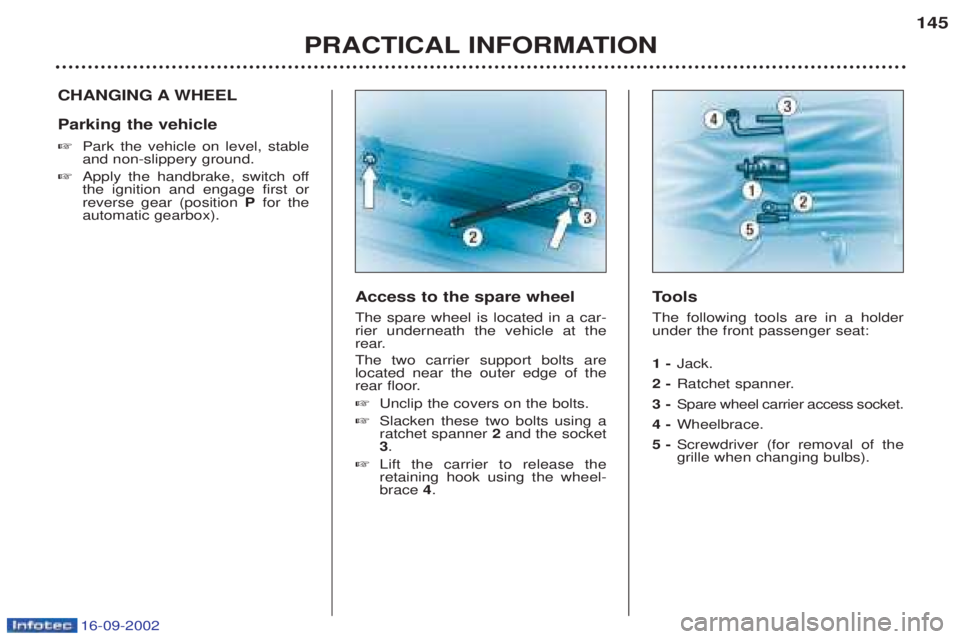
Tools
The following tools are in a holderunder the front passenger seat: 1 - Jack.
2 - Ratchet spanner.
3 - Spare wheel carrier access socket.
4 - Wheelbrace.
5 - Screwdriver (for removal of the grille when changing bulbs).
Access to the spare wheel The spare wheel is located in a car- rier underneath the vehicle at the
rear. The two carrier support bolts are located near the outer edge of the
rear floor. ☞
Unclip the covers on the bolts.
☞ Slacken these two bolts using a ratchet spanner 2and the socket
3 .
☞ Lift the carrier to release theretaining hook using the wheel-brace 4.