steering PEUGEOT BOXER 2003 User Guide
[x] Cancel search | Manufacturer: PEUGEOT, Model Year: 2003, Model line: Boxer, Model: Peugeot Boxer 2003Pages: 180, PDF Size: 1.86 MB
Page 73 of 180
05-05-2003
YOUR BOXER IN DETAIL75
V oice commands
The voice commands enable you to control a certain number of audio/telephone/GPS functions using pre-recorded words or expressions. The voice commands which you can send to the system are divided into two categories: - voice commands without voice identification which permit selection of the system's modes (TEL, RADIO, CD, ...),
- voice commands with voice identification which relate to the entering / recalling of names in the telephone directory
and/or navigation addresses.
Activation / Deactivation of the voice commands Press button Non the audio/telephone/GPS control panel or control 4on the steering wheel to activate or deactivate this
function. Notes: - in the absence of voice commands, this function will be deactivated after approximately ten seconds,
- if a voice command is not understood, a double bleep is emitted.
- the voice command operations are interrupted immediately if an incoming call is received; in this case, when the call ends, the entire operation must be repeated.
Example: to recall the radio station stored on button 3, the key words are: "Radio" "Memory" or"Station" "3" .
To use these key words, you must say the word "Radio", wait for the confirmation bleep, then say the word "Memory"or
"Station" , wait until the system asks "number please?", then end with the word "3", wait for the confirmation bleep which will
carry out the action requested.
List of recognisable commands available The voice commands (key words) which can be recognised by the system are organised into three levels (levels 1, 2 and 3). When a level 1 command is given, the system makes the level 2 commands available; when a level 2 command is given, the system makes the level 3 commands available. - the level 1 commands are the following:
"MEMO" / "RADIO" / "CD PLAYER" / "NAVIGATION" / "CALL" / "DIAL" / "REDIAL" / "PIN" / "DIRECTORY" / "INTERRUPT"
Page 121 of 180
05-05-2003
YOUR BOXER IN DETAIL
118
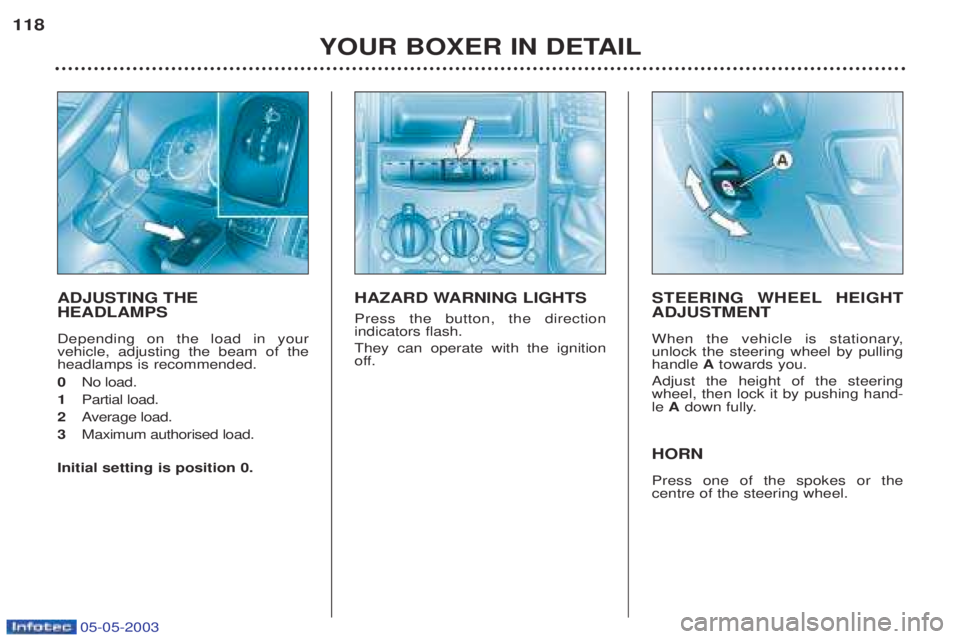
ADJUSTING THE HEADLAMPS Depending on the load in your vehicle, adjusting the beam of theheadlamps is recommended. 0
No load.
1 Partial load.
2 Average load.
3 Maximum authorised load.
Initial setting is position 0. HAZARD WARNING LIGHTS Press the button, the direction indicators flash. They can operate with the ignition
off.
STEERING WHEEL HEIGHT ADJUSTMENT
When the vehicle is stationary, unlock the steering wheel by pullinghandle
Atowards you.
Adjust the height of the steeringwheel, then lock it by pushing hand-le Adown fully.
HORN Press one of the spokes or the centre of the steering wheel.
Page 132 of 180
05-05-2003
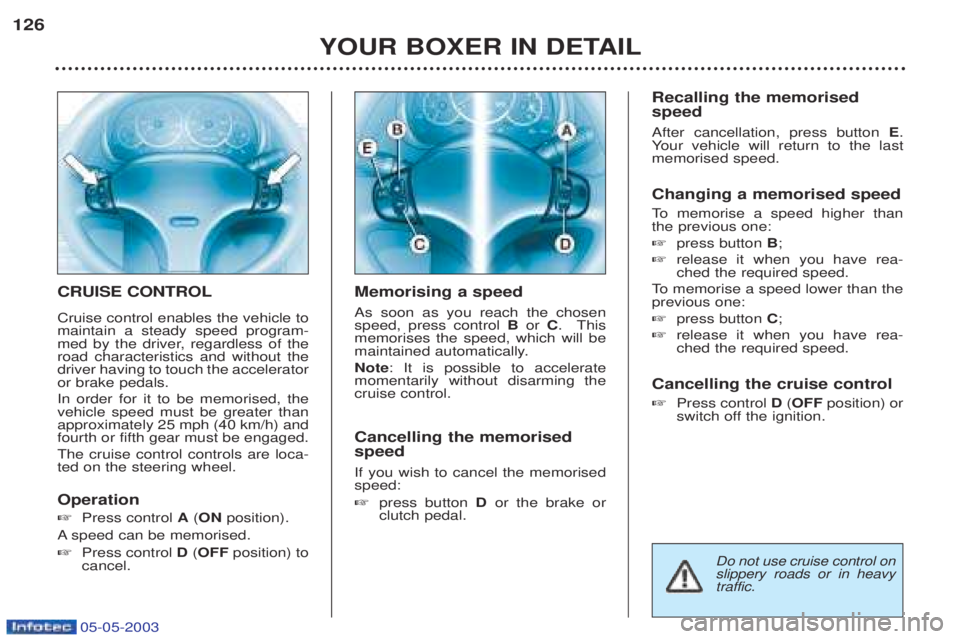
CRUISE CONTROL Cruise control enables the vehicle to maintain a steady speed program-
med by the driver, regardless of theroad characteristics and without thedriver having to touch the acceleratoror brake pedals. In order for it to be memorised, the vehicle speed must be greater thanapproximately 25 mph (40 km/h) andfourth or fifth gear must be engaged. The cruise control controls are loca- ted on the steering wheel. Operation ☞Press control A(ON position).
A speed can be memorised.
☞ Press control D(OFF position) to
cancel. Memorising a speed As soon as you reach the chosen speed, press control
Bor C. This
memorises the speed, which will be
maintained automatically. Note : It is possible to accelerate
momentarily without disarming the cruise control. Cancelling the memorised speed If you wish to cancel the memorised speed: ☞ press button Dor the brake or
clutch pedal. Recalling the memorised speed After cancellation, press button
E.
Y our vehicle will return to the last
memorised speed. Changing a memorised speed
To memorise a speed higher than
the previous one: ☞ press button B;
☞ release it when you have rea- ched the required speed.
To memorise a speed lower than the
previous one: ☞ press button C;
☞ release it when you have rea- ched the required speed.
Cancelling the cruise control ☞ Press control D (OFF position) or
switch off the ignition.
YOUR BOXER IN DETAIL
126
Do not use cruise control on slippery roads or in heavytraffic.
Page 134 of 180
05-05-2003
YOUR BOXER IN DETAIL
128
AIR BAGS The air bags have been designed to maximise the safety of the occupantsin the event of serious collisions.They work in conjunction with theseat belts. The electronic detectors register and analyse any abrupt deceleration ofthe vehicle: if the triggering thresholdis reached, the air bags inflate ins-tantly and protect the occupants ofthe vehicle. Immediately after the impact, the air bags deflate rapidly so that they donot hinder the visibility of the occu-pants nor their exit if necessary fromthe vehicle. The air bags are not deployed in the case of collisions which are notserious, for which the seat belt is suf-ficient to ensure maximum protec-
tion. The seriousness of a collisiondepends on the nature of the obs-tacle and the speed of the vehicle atthe moment of the collision. Air bags only operate when the ignition is switched on. Note:
the gas escaping from the air
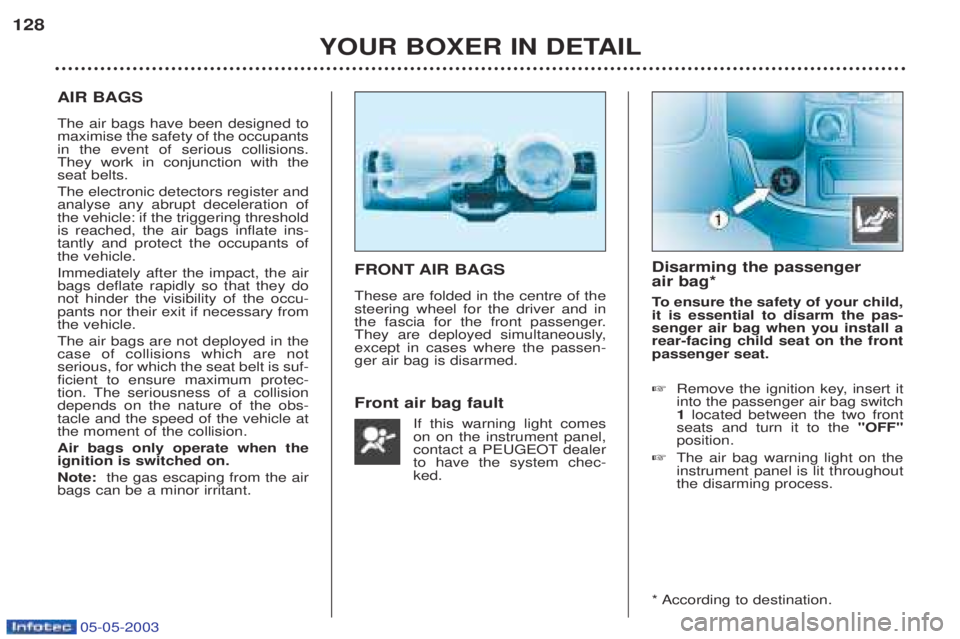
bags can be a minor irritant. FRONT AIR BAGS These are folded in the centre of the steering wheel for the driver and in
the fascia for the front passenger.
They are deployed simultaneously,except in cases where the passen-ger air bag is disarmed. Front air bag fault
If this warning light comes on on the instrument panel,
contact a PEUGEOT dealerto have the system chec-ked. Disarming the passenger air bag*
To
ensure the safety of your child,
it is essential to disarm the pas- senger air bag when you install arear-facing child seat on the frontpassenger seat. ☞ Remove the ignition key, insert it into the passenger air bag switch1located between the two front
seats and turn it to the "OFF"
position.
☞ The air bag warning light on theinstrument panel is lit throughoutthe disarming process.
* According to destination.
Page 136 of 180
05-05-2003
YOUR BOXER IN DETAIL
130
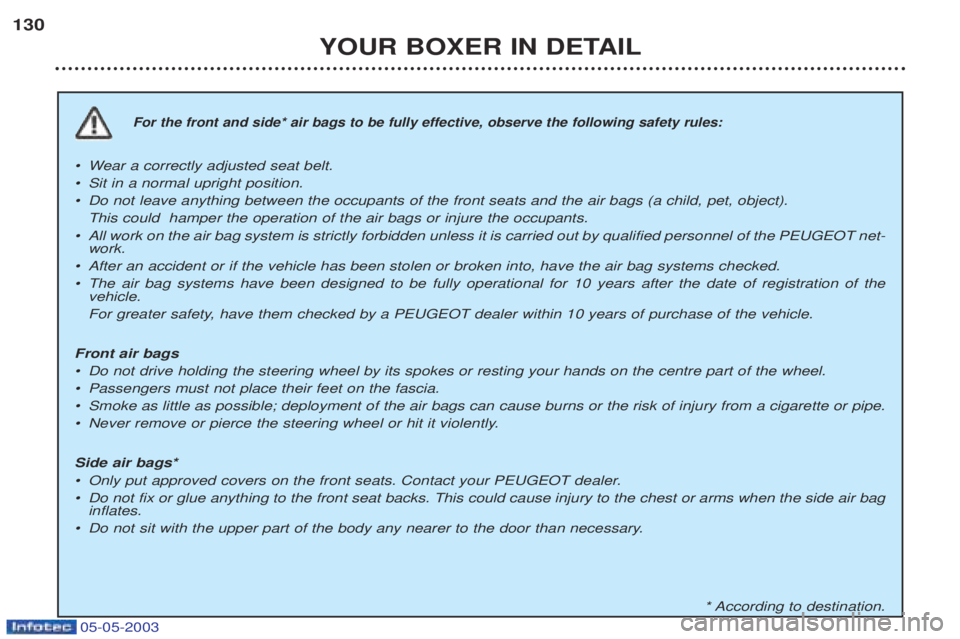
For the front and side* air bags to be fully effective, observe the following safety rules:
¥W
ear a correctly adjusted seat belt.
¥ Sit in a normal upright position.
¥ Do not leave anything between the occupants of the front seats and the air bags (a child, pet, object). This could hamper the operation of the air bags or injure the occupants.
¥ All work on the air bag system is strictly forbidden unless it is carried out by qualified personnel of the PEUGEOT net- work.
¥ After an accident or if the vehicle has been stolen or broken into, have the air bag systems checked.
¥ The air bag systems have been designed to be fully operational for 10 years after the date of registration of thevehicle.
For greater safety, have them checked by a PEUGEOT dealer within 10 years of purchase of the vehicle.
Front air bags¥ Do not drive holding the steering wheel by its spokes or resting your hands on the centre part of the wheel.
¥ Passengers must not place their feet on the fascia.
¥ Smoke as little as possible; deployment of the air bags can cause burns or the risk of injury from a cigarette or pipe.
¥ Never remove or pierce the steering wheel or hit it violently.
Side air bags*¥ Only put approved covers on the front seats. Contact your PEUGEOT dealer.
¥ Do not fix or glue anything to the front seat backs. This could cause injury to the chest or arms when the side air bag inflates.
¥ Do not sit with the upper part of the body any nearer to the door than necessary.
* According to destination.
Page 138 of 180
05-05-2003
YOUR BOXER IN DETAIL
130
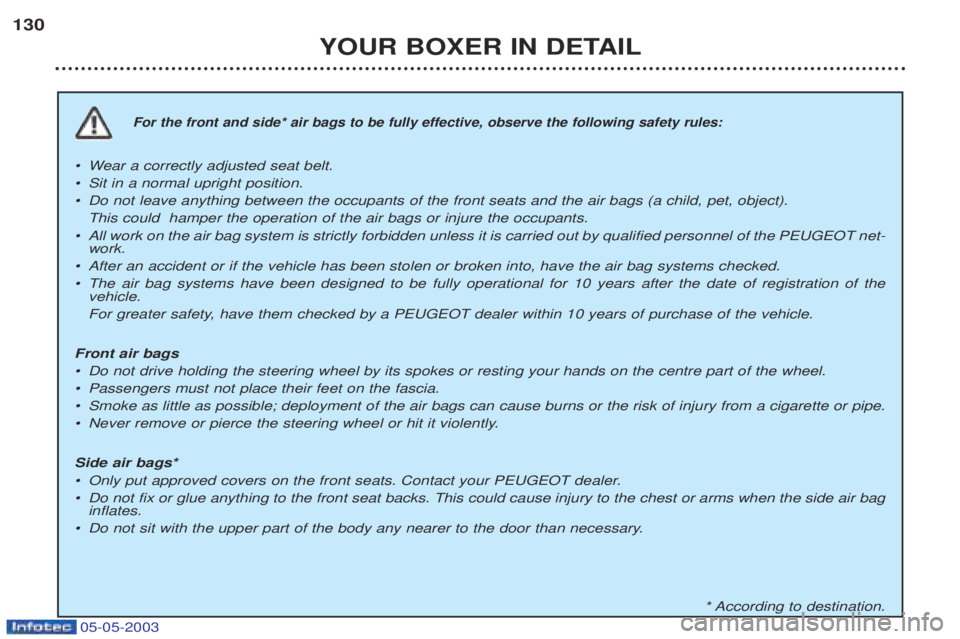
For the front and side* air bags to be fully effective, observe the following safety rules:
¥W
ear a correctly adjusted seat belt.
¥ Sit in a normal upright position.
¥ Do not leave anything between the occupants of the front seats and the air bags (a child, pet, object). This could hamper the operation of the air bags or injure the occupants.
¥ All work on the air bag system is strictly forbidden unless it is carried out by qualified personnel of the PEUGEOT net- work.
¥ After an accident or if the vehicle has been stolen or broken into, have the air bag systems checked.
¥ The air bag systems have been designed to be fully operational for 10 years after the date of registration of thevehicle.
For greater safety, have them checked by a PEUGEOT dealer within 10 years of purchase of the vehicle.
Front air bags¥ Do not drive holding the steering wheel by its spokes or resting your hands on the centre part of the wheel.
¥ Passengers must not place their feet on the fascia.
¥ Smoke as little as possible; deployment of the air bags can cause burns or the risk of injury from a cigarette or pipe.
¥ Never remove or pierce the steering wheel or hit it violently.
Side air bags*¥ Only put approved covers on the front seats. Contact your PEUGEOT dealer.
¥ Do not fix or glue anything to the front seat backs. This could cause injury to the chest or arms when the side air bag inflates.
¥ Do not sit with the upper part of the body any nearer to the door than necessary.
* According to destination.
Page 139 of 180

05-05-2003
PRACTICAL INFORMATION131
1 -
Power steering reservoir.
2 - Battery.
3 - Coolant reservoir. 4 -
Brake fluid reservoir.
5 - Air filter.
6 - Windscreen and headlamp wash
reservoir. 7 -
Fuse box.
8 - Engine oil filler cap.
9 - Dipstick.
2 LITRE PETROL INJECTION ENGINE
Page 140 of 180

05-05-2003
PRACTICAL INFORMATION
132
1 -
Power steering reservoir.
2 - Battery
3 - Coolant reservoir. 4 -
Brake fluid reservoir.
5 - Air filter.
6 - Windscreen and headlamp wash
reservoir. 7 -
Fuse box.
8 - Dipstick.
9 - Engine oil filler cap.
2.0 / 2.2 LITRE TURBO DIESEL HDI ENGINE
Page 141 of 180

05-05-2003
PRACTICAL INFORMATION133
1 -
Power steering reservoir.
2 - Battery.
3 - Coolant reservoir. 4 -
Brake fluid reservoir.
5 - Air filter.
6 - Windscreen and headlamp wash
reservoir. 7 -
Fuse box.
8 - Dipstick.
9 - Engine oil filler cap.
2.8 LITRE TURBO DIESEL HDI/TED ENGINE
Page 142 of 180
05-05-2003
PRACTICAL INFORMATION
134
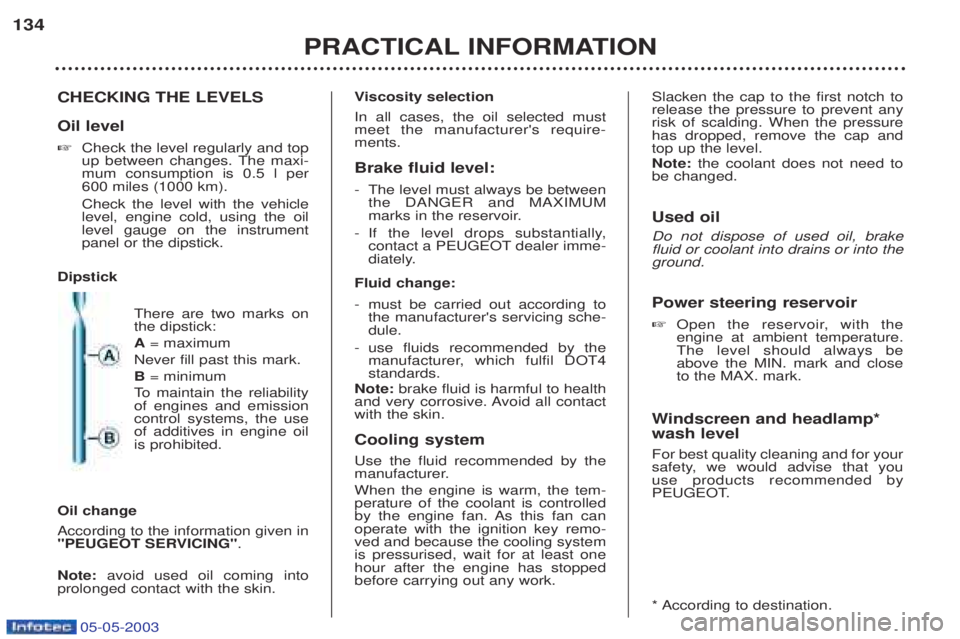
CHECKING THE LEVELS Oil level ☞Check the level regularly and top
up between changes. The maxi-mum consumption is 0.5 l per600 miles (1000 km). Check the level with the vehicle level, engine cold, using the oillevel gauge on the instrumentpanel or the dipstick.
Dipstick
There are two marks onthe dipstick: A= maximum
Never fill past this mark.B = minimum
To maintain the reliability
of engines and emission control systems, the useof additives in engine oilis prohibited.
Oil change According to the information given in
"PEUGEOT SERVICING" .
Note: avoid used oil coming into
prolonged contact with the skin.
V iscosity selection
In all cases, the oil selected must meet the manufacturer's require-ments. Brake fluid level: - The level must always be between the DANGER and MAXIMUM
marks in the reservoir.
- If the level drops substantially,
contact a PEUGEOT dealer imme-
diately.
Fluid change: - must be carried out according to the manufacturer's servicing sche-dule.
- use fluids recommended by the
manufacturer, which fulfil DOT4standards.
Note: brake fluid is harmful to health
and very corrosive. Avoid all contactwith the skin. Cooling system Use the fluid recommended by the
manufacturer. When the engine is warm, the tem- perature of the coolant is controlled
by the engine fan. As this fan canoperate with the ignition key remo-ved and because the cooling systemis pressurised, wait for at least onehour after the engine has stoppedbefore carrying out any work. Slacken the cap to the first notch torelease the pressure to prevent anyrisk of scalding. When the pressurehas dropped, remove the cap andtop up the level. Note:
the coolant does not need to
be changed. Used oil Do not dispose of used oil, brake fluid or coolant into drains or into theground. Power steering reservoir ☞ Open the reservoir, with the engine at ambient temperature.The level should always beabove the MIN. mark and closeto the MAX. mark.
W indscreen and headlamp*
wash level For best quality cleaning and for your
safety, we would advise that you use products recommended by
PEUGEOT.
* According to destination.