ignition Peugeot Boxer 2008.5 User Guide
[x] Cancel search | Manufacturer: PEUGEOT, Model Year: 2008.5, Model line: Boxer, Model: Peugeot Boxer 2008.5Pages: 167, PDF Size: 4.17 MB
Page 27 of 167
Instruments and controls
30
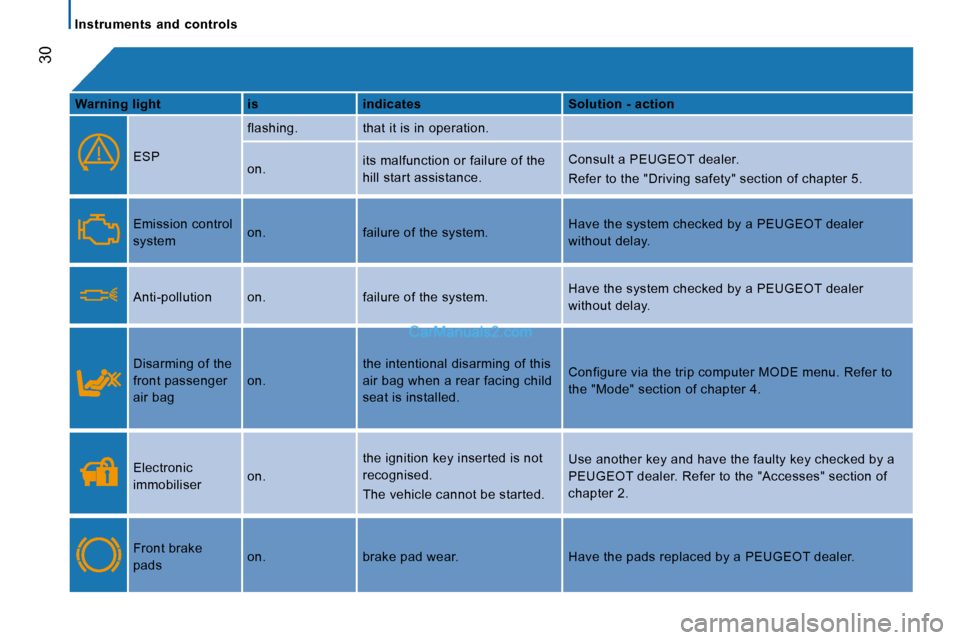
Warning light is indicates Solution - action
ESP flashing. that it is in operation.
on.
its malfunction or failure of the
hill start assistance. Consult a PEUGEOT dealer.
Refer to the "Driving safety" section of chapter 5.
Emission control
system on. failure of the system. Have the system checked by a PEUGEOT dealer
without delay.
Anti-pollution on. failure of the system. Have the system checked by a PEUGEOT dealer
without delay.
Disarming of the
front passenger
air bag on. the intentional disarming of this
air bag when a rear facing child
seat is installed. Configure via the trip computer MODE menu. Refer t
o
the "Mode" section of chapter 4.
Electronic
immobiliser on. the ignition key inserted is not
recognised.
The vehicle cannot be started. Use another key and have the faulty key checked by
a
PEUGEOT dealer. Refer to the "Accesses" section of
chapter 2.
Front brake
pads on. brake pad wear. Have the pads replaced by a
PEUGEOT dealer.
Page 31 of 167
Instruments and controls
34
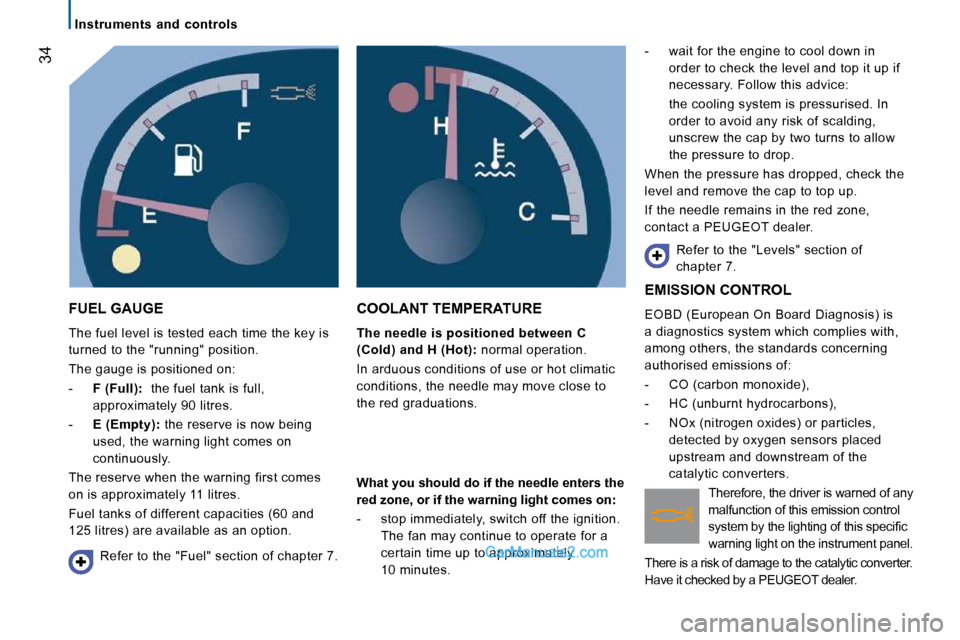
FUEL GAUGE
The fuel level is tested each time the key is
turned to the "running" position.
The gauge is positioned on:
- F (Full): the fuel tank is full,
approximately 90 litres.
- E (Empty): the reserve is now being
used, the warning light comes on
continuously.
The reserve when the warning first comes
on is approximately 11 litres.
Fuel tanks of different capacities (60 and
125 litres) are available as an option.
COOLANT TEMPERATURE
The needle is positioned between C
(Cold) and H (Hot): normal operation.
In arduous conditions of use or hot climatic
conditions, the needle may move close to
the red graduations. - wait for the engine to cool down in
order to check the level and top it up if
necessary. Follow this advice:
the cooling system is pressurised. In order to avoid any risk of scalding,
unscrew the cap by two turns to allow
the pressure to drop.
When the pressure has dropped, check the
level and remove the cap to top up.
If the needle remains in the red zone,
contact a PEUGEOT dealer.
Refer to the "Levels" section of
chapter 7.
Refer to the "Fuel" section of chapter 7.
What you should do if the needle enters the
red zone, or if the warning light comes on:
- stop immediately, switch off the ignition. The fan may continue to operate for a
certain time up to approximately
10 minutes.
EMISSION CONTROL
EOBD (European On Board Diagnosis) is
a diagnostics system which complies with,
among others, the standards concerning
authorised emissions of:
- CO (carbon monoxide),
- HC (unburnt hydrocarbons),
- NOx (nitrogen oxides) or particles, detected by oxygen sensors placed
upstream and downstream of the
catalytic converters.
Therefore, the driver is warned of any
malfunction of this emission control
system by the lighting of this specifi c
warning light on the instrument panel.
There is a risk of damage to the catalytic convert er.
Have it checked by a PEUGEOT dealer.
Page 32 of 167
Instruments and controls
35
2
READY TO SET OFF
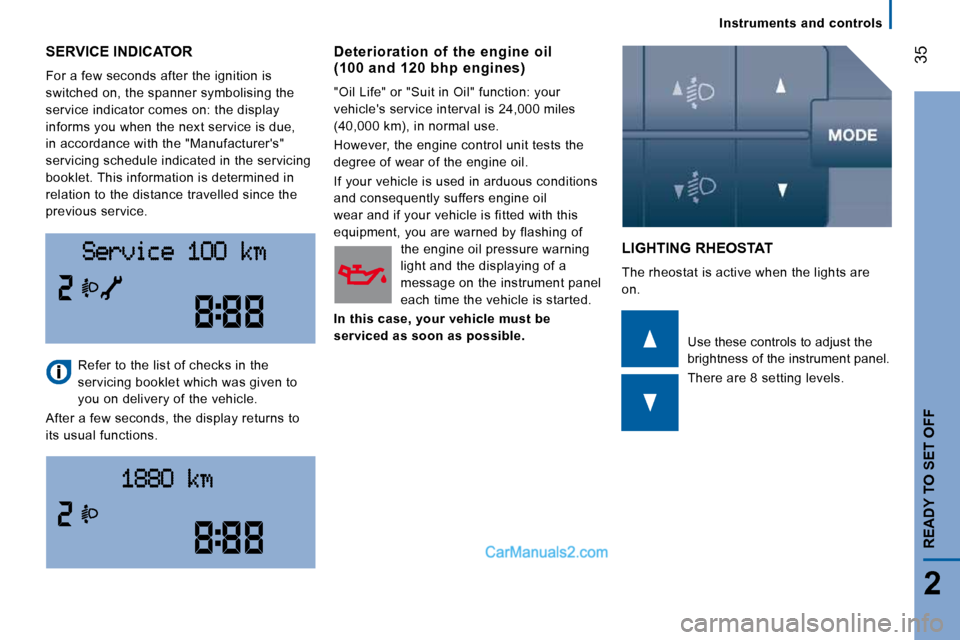
SERVICE INDICATOR
For a few seconds after the ignition is
switched on, the spanner symbolising the
service indicator comes on: the display
informs you when the next service is due,
in accordance with the "Manufacturer's"
servicing schedule indicated in the servicing
booklet. This information is determined in
relation to the distance travelled since the
previous service.
LIGHTING RHEOSTAT
The rheostat is active when the lights are
on.
Refer to the list of checks in the
servicing booklet which was given to
you on delivery of the vehicle.
After a few seconds, the display returns to
its usual functions. Use these controls to adjust the
brightness of the instrument panel.
There are 8 setting levels.
Deterioration of the engine oil (100 and 120 bhp engines)
"Oil Life" or "Suit in Oil" function: your
vehicle's service interval is 24,000 miles
(40,000 km), in normal use.
However, the engine control unit tests the
degree of wear of the engine oil.
If your vehicle is used in arduous conditions
and consequently suffers engine oil
wear and if your vehicle is fitted with this
equipment, you are warned by flashing of
the engine oil pressure warning
light and the displaying of a
message on the instrument panel
each time the vehicle is started.
In this case, your vehicle must be
serviced as soon as possible.
Page 34 of 167
37
2
READY TO SET OFF
Starting and stopping
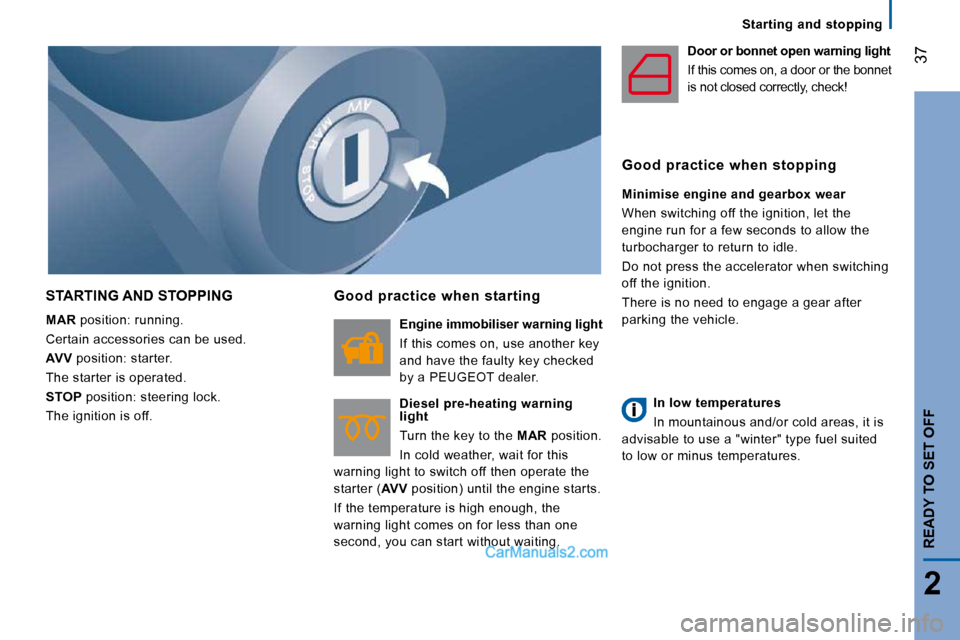
STARTING AND STOPPING
MAR position: running.
Certain accessories can be used.
AVV position: starter.
The starter is operated.
STOP position: steering lock.
The ignition is off.
Good practice when starting
Engine immobiliser warning light
If this comes on, use another key
and have the faulty key checked
by a PEUGEOT dealer.
Diesel pre-heating warning
light
Turn the key to the MAR position.
In cold weather, wait for this
warning light to switch off then operate the
starter ( AVV position) until the engine starts.
If the temperature is high enough, the
warning light comes on for less than one
second, you can start without waiting. Door or bonnet open warning light
If this comes on, a door or the bonnet
is not closed correctly, check!
Good practice when stopping
Minimise engine and gearbox wear
When switching off the ignition, let the
engine run for a few seconds to allow the
turbocharger to return to idle.
Do not press the accelerator when switching
off the ignition.
There is no need to engage a gear after
parking the vehicle.
In low temperatures
In mountainous and/or cold areas, it is
advisable to use a "winter" type fuel suited
to low or minus temperatures.
Page 39 of 167
41
3
ERGONOMICS and COMFORT
Steering wheel controls
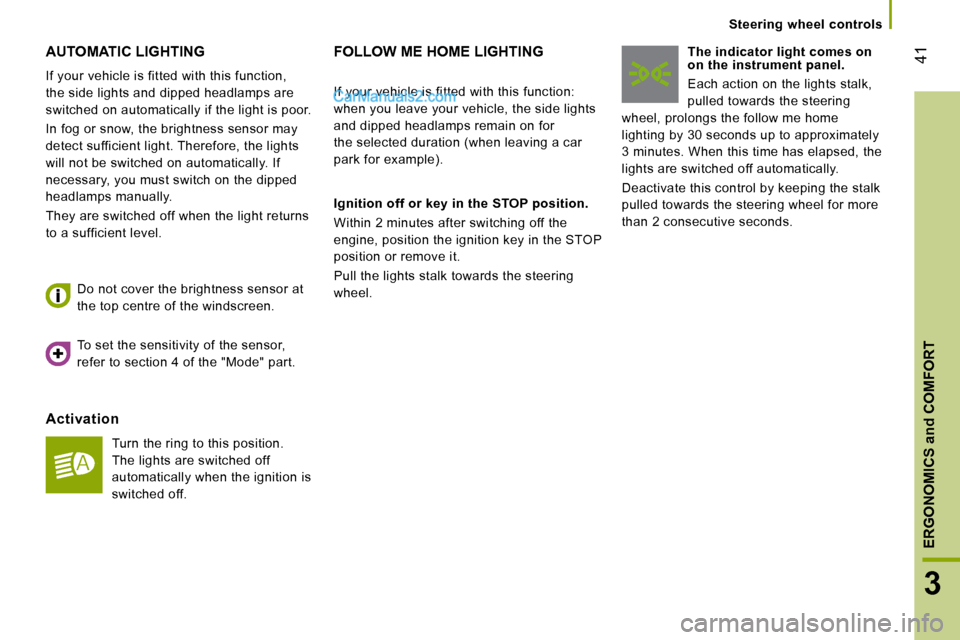
AUTOMATIC LIGHTING
If your vehicle is fitted with this function,
the side lights and dipped headlamps are
switched on automatically if the light is poor.
In fog or snow, the brightness sensor may
detect sufficient light. Therefore, the lights
will not be switched on automatically. If
necessary, you must switch on the dipped
headlamps manually.
They are switched off when the light returns
to a sufficient level.
Activation
Turn the ring to this position.
The lights are switched off
automatically when the ignition is
switched off.
Do not cover the brightness sensor at
the top centre of the windscreen.
FOLLOW ME HOME LIGHTING
Ignition off or key in the STOP position.
Within 2 minutes after switching off the
engine, position the ignition key in the STOP
position or remove it.
Pull the lights stalk towards the steering
wheel. The indicator light comes on
on the instrument panel.
Each action on the lights stalk,
pulled towards the steering
wheel, prolongs the follow me home
lighting by 30 seconds up to approximately
3 minutes. When this time has elapsed, the
lights are switched off automatically.
Deactivate this control by keeping the stalk
pulled towards the steering wheel for more
than 2 consecutive seconds.
If your vehicle is fitted with this function:
when you leave your vehicle, the side lights
and dipped headlamps remain on for
the selected duration (when leaving a car
park for example).
To set the sensitivity of the sensor,
refer to section 4 of the "Mode" part.
Page 40 of 167
42
Steering wheel controls
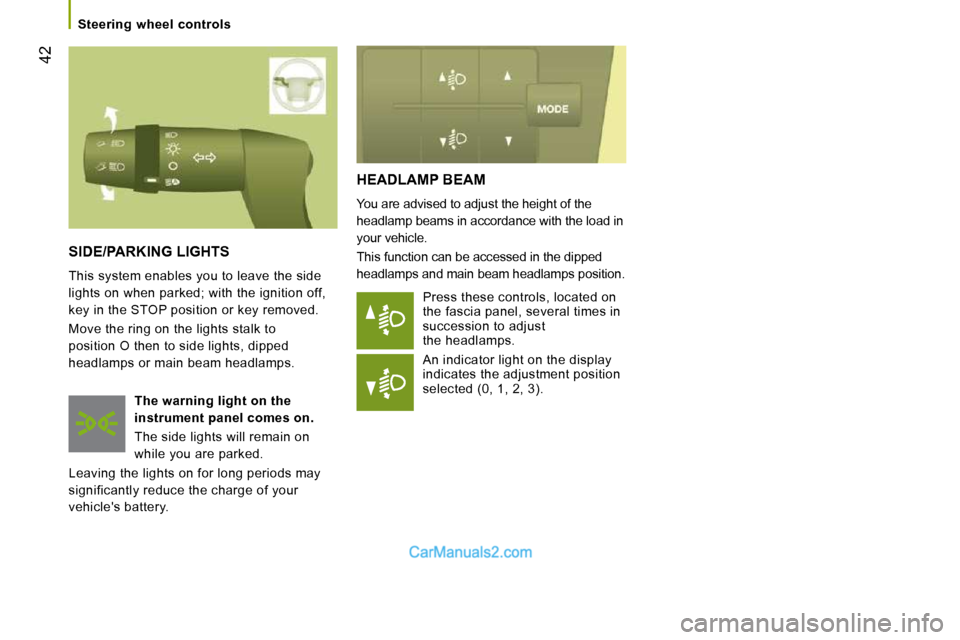
HEADLAMP BEAM
You are advised to adjust the height of the
headlamp beams in accordance with the load in
your vehicle.
This function can be accessed in the dipped
headlamps and main beam headlamps position. Press these controls, located on
the fascia panel, several times in
succession to adjust
the headlamps.
An indicator light on the display
indicates the adjustment position
selected (0, 1, 2, 3).
SIDE/PARKING LIGHTS
This system enables you to leave the side
lights on when parked; with the ignition off,
key in the STOP position or key removed.
Move the ring on the lights stalk to
position O then to side lights, dipped
headlamps or main beam headlamps.
The warning light on the
instrument panel comes on.
The side lights will remain on
while you are parked.
Leaving the lights on for long periods may
significantly reduce the charge of your
vehicle's battery.
Page 41 of 167
43
3
ERGONOMICS and COMFORT
Steering wheel controls
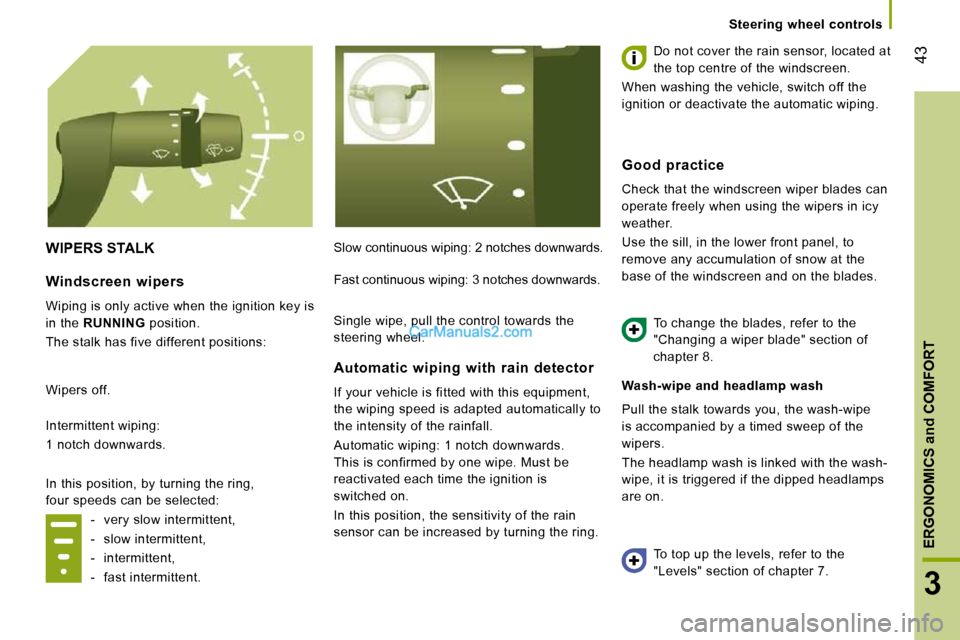
WIPERS STALK Slow continuous wiping: 2 notches downwards. Do not cover the rain sensor, located at
the top centre of the windscreen.
When washing the vehicle, switch off the
ignition or deactivate the automatic wiping.
Wash-wipe and headlamp wash
Pull the stalk towards you, the wash-wipe
is accompanied by a timed sweep of the
wipers.
The headlamp wash is linked with the wash-
wipe, it is triggered if the dipped headlamps
are on.
Windscreen wipers
Wiping is only active when the ignition key is
in the RUNNING position.
The stalk has five different positions:
Wipers off.
Intermittent wiping:
1 notch downwards.
In this position, by turning the ring,
four speeds can be selected: - very slow intermittent,
- slow intermittent,
- intermittent,
- fast intermittent.
Automatic wiping with rain detector
If your vehicle is fitted with this equipment,
the wiping speed is adapted automatically to
the intensity of the rainfall.
Automatic wiping: 1 notch downwards.
This is confirmed by one wipe. Must be
reactivated each time the ignition is
switched on.
In this position, the sensitivity of the rain
sensor can be increased by turning the ring.
Good practice
Check that the windscreen wiper blades can
operate freely when using the wipers in icy
weather.
Use the sill, in the lower front panel, to
remove any accumulation of snow at the
base of the windscreen and on the blades.
To change the blades, refer to the
"Changing a wiper blade" section of
chapter 8.
To top up the levels, refer to the
"Levels" section of chapter 7.
Fast continuous wiping: 3 notches downwards.
Single wipe, pull the control towards the
steering wheel.
Page 44 of 167
46
Steering wheel controls
Good practice
When changing the programmed reference
speed by pressing and holding the control,
take care as the speed may increase or
decrease rapidly.
Do not use the cruise control on slippery
roads or in heavy traffic.
On a steep gradient, the cruise control will
not be able to prevent the vehicle from
exceeding the programmed speed.
The cruise control cannot, in any
circumstances, replace the need to comply
with speed limits nor can it replace the need
for vigilance and responsibility on the part
of driver.
It is advisable to leave your feet near the
pedals.
To prevent the mat from becoming caught
under the pedals:
- ensure that the mat is positioned correctly,
- never fit one mat on top of another.
Cancelling the programmed speed
When the vehicle stops, after the ignition is
switched off, the system no longer stores
any speed.
Operating fault
In the event of a malfunction, the function
is switched off and the indicator light
switches off.
Contact a PEUGEOT dealer to have the
system checked.
Page 65 of 167
67
3
ERGONOMICS and COMFORT
Practical information
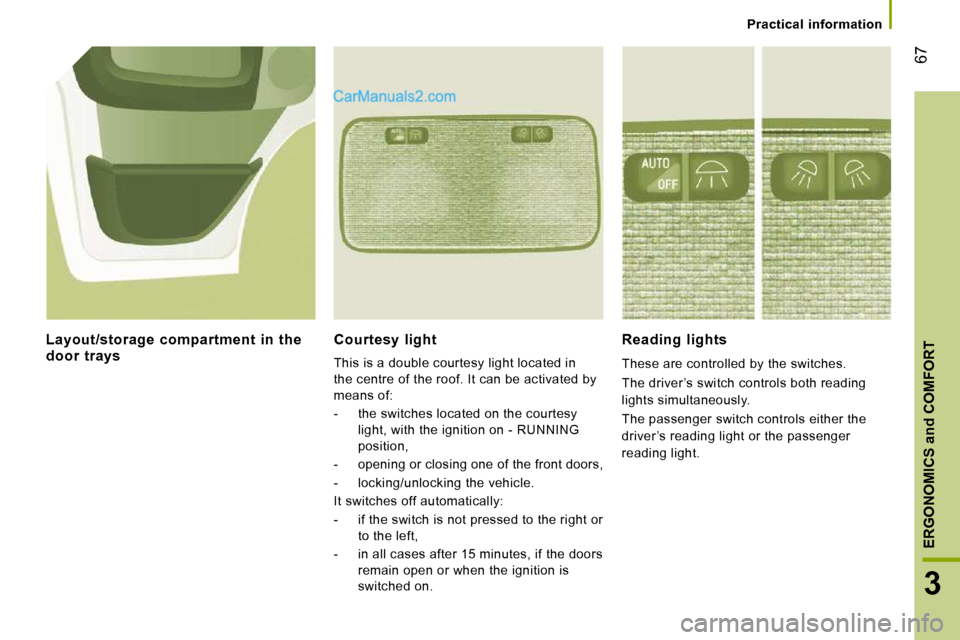
Courtesy light
This is a double courtesy light located in
the centre of the roof. It can be activated by
means of:
- the switches located on the courtesy light, with the ignition on - RUNNING
position,
- opening or closing one of the front doors,
- locking/unlocking the vehicle.
It switches off automatically:
- if the switch is not pressed to the right or to the left,
- in all cases after 15 minutes, if the doors remain open or when the ignition is
switched on.
Reading lights
These are controlled by the switches.
The driver ’s switch controls both reading
lights simultaneously.
The passenger switch controls either the
driver ’s reading light or the passenger
reading light.
Layout/storage compartment in the door trays
Page 69 of 167
71
3
ERGONOMICS and COMFORT
Mirrors and windows
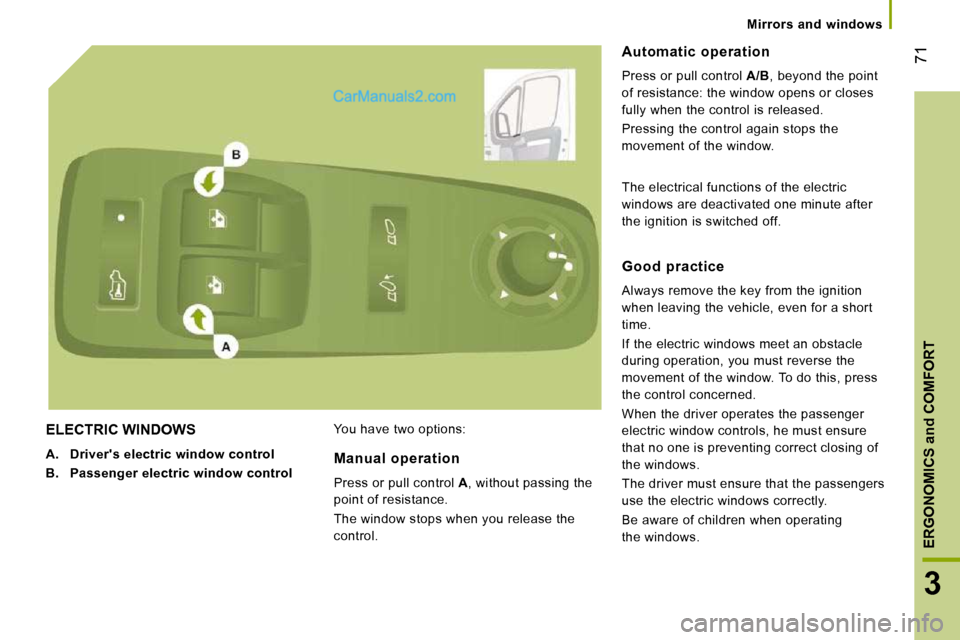
ELECTRIC WINDOWS
A. Driver's electric window control
B. Passenger electric window control You have two options:
Automatic operation
Press or pull control
A/B , beyond the point
of resistance: the window opens or closes
fully when the control is released.
Pressing the control again stops the
movement of the window.
Manual operation
Press or pull control A , without passing the
point of resistance.
The window stops when you release the
control.
Good practice
Always remove the key from the ignition
when leaving the vehicle, even for a short
time.
If the electric windows meet an obstacle
during operation, you must reverse the
movement of the window. To do this, press
the control concerned.
When the driver operates the passenger
electric window controls, he must ensure
that no one is preventing correct closing of
the windows.
The driver must ensure that the passengers
use the electric windows correctly.
Be aware of children when operating
the windows.
The electrical functions of the electric
windows are deactivated one minute after
the ignition is switched off.