steering Peugeot Boxer 2008.5 User Guide
[x] Cancel search | Manufacturer: PEUGEOT, Model Year: 2008.5, Model line: Boxer, Model: Peugeot Boxer 2008.5Pages: 167, PDF Size: 4.17 MB
Page 42 of 167
Steering wheel controls
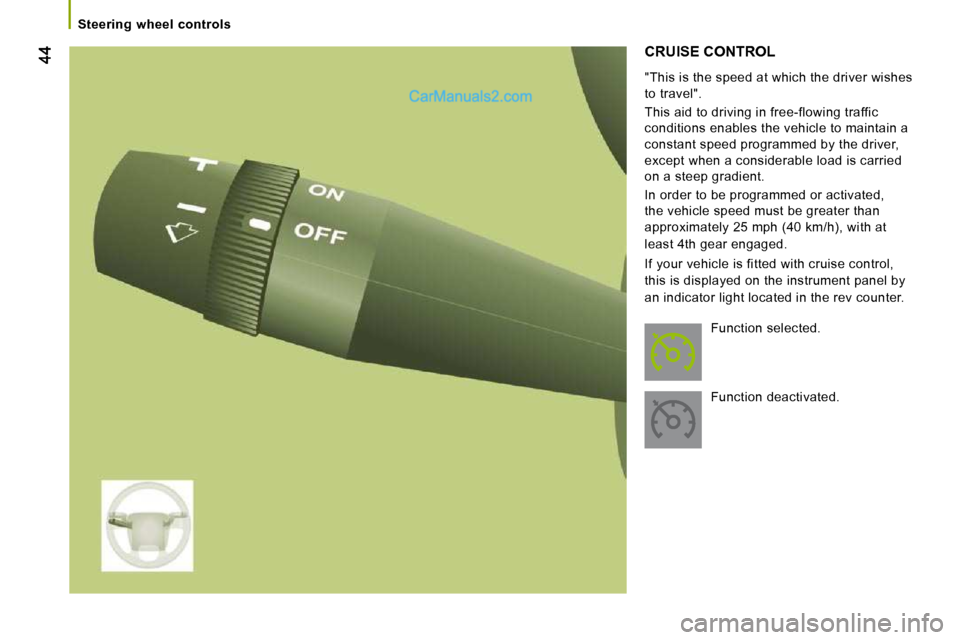
CRUISE CONTROL
"This is the speed at which the driver wishes
to travel".
This aid to driving in free-flowing traffic
conditions enables the vehicle to maintain a
constant speed programmed by the driver,
except when a considerable load is carried
on a steep gradient.
In order to be programmed or activated,
the vehicle speed must be greater than
approximately 25 mph (40 km/h), with at
least 4th gear engaged. Function selected.
Function deactivated.
If your vehicle is fitted with cruise control,
this is displayed on the instrument panel by
an indicator light located in the rev counter.
Page 43 of 167
45
3
ERGONOMICS and COMFORT
Steering wheel controls
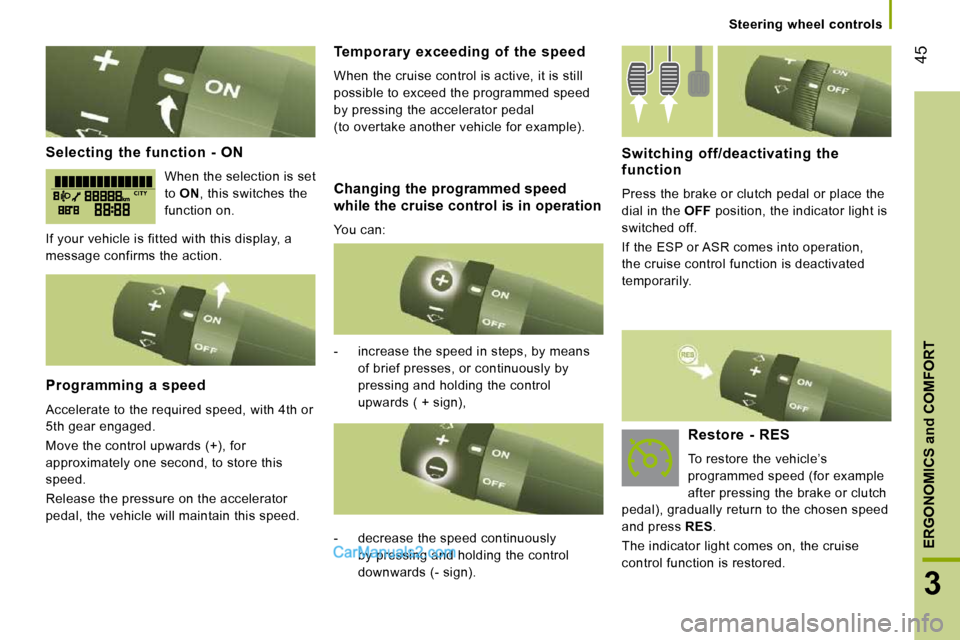
Selecting the function - ON
When the selection is set
to ON , this switches the
function on.
If your vehicle is fitted with this display, a
message confirms the action.
Programming a speed
Accelerate to the required speed, with 4th or
5th gear engaged.
Move the control upwards (+), for
approximately one second, to store this
speed.
Release the pressure on the accelerator
pedal, the vehicle will maintain this speed.
Switching off/deactivating the function
Press the brake or clutch pedal or place the
dial in the OFF position, the indicator light is
switched off.
If the ESP or ASR comes into operation,
the cruise control function is deactivated
temporarily.
- increase the speed in steps, by means of brief presses, or continuously by
pressing and holding the control
upwards ( + sign),
Temporary exceeding of the speed
When the cruise control is active, it is still
possible to exceed the programmed speed
by pressing the accelerator pedal
(to overtake another vehicle for example).
- decrease the speed continuously by pressing and holding the control
downwards (- sign).
Restore - RES
To restore the vehicle’s
programmed speed (for example
after pressing the brake or clutch
pedal), gradually return to the chosen speed
and press RES .
The indicator light comes on, the cruise
control function is restored.
Changing the programmed speed
while the cruise control is in operation
You can:
Page 44 of 167
46
Steering wheel controls
Good practice
When changing the programmed reference
speed by pressing and holding the control,
take care as the speed may increase or
decrease rapidly.
Do not use the cruise control on slippery
roads or in heavy traffic.
On a steep gradient, the cruise control will
not be able to prevent the vehicle from
exceeding the programmed speed.
The cruise control cannot, in any
circumstances, replace the need to comply
with speed limits nor can it replace the need
for vigilance and responsibility on the part
of driver.
It is advisable to leave your feet near the
pedals.
To prevent the mat from becoming caught
under the pedals:
- ensure that the mat is positioned correctly,
- never fit one mat on top of another.
Cancelling the programmed speed
When the vehicle stops, after the ignition is
switched off, the system no longer stores
any speed.
Operating fault
In the event of a malfunction, the function
is switched off and the indicator light
switches off.
Contact a PEUGEOT dealer to have the
system checked.
Page 71 of 167
miles
73
4
IN-CAR TECHNOLOGY
Mode
MODE
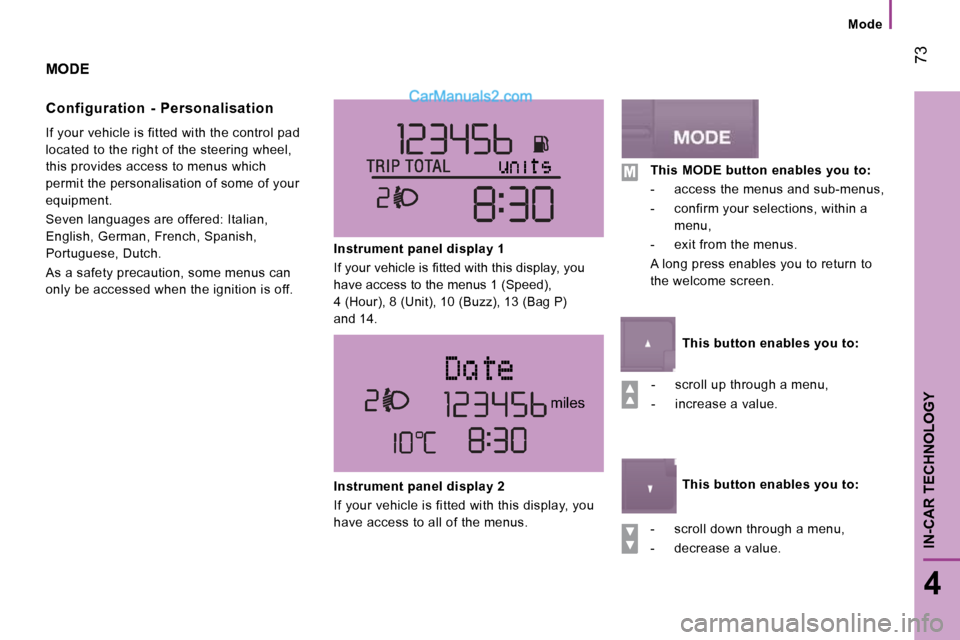
Configuration - Personalisation
If your vehicle is fitted with the control pad
located to the right of the steering wheel,
this provides access to menus which
permit the personalisation of some of your
equipment.
Seven languages are offered: Italian,
English, German, French, Spanish,
Portuguese, Dutch.
As a safety precaution, some menus can
only be accessed when the ignition is off. Instrument panel display 1
If your vehicle is fi tted with this display, you
have access to the menus 1 (Speed),
4 (Hour), 8 (Unit), 10 (Buzz), 13 (Bag P)
and 14.
- scroll up through a menu,
- increase a value.
- scroll down through a menu,
- decrease a value.
Instrument panel display 2
If your vehicle is fitted with this display, you
have access to all of the menus.
This MODE button enables you to:
- access the menus and sub-menus,
- confirm your selections, within a menu,
- exit from the menus.
A long press enables you to return to
the welcome screen.
This button enables you to:
This button enables you to:
Page 101 of 167
103
5
SAFETY
Driving safety
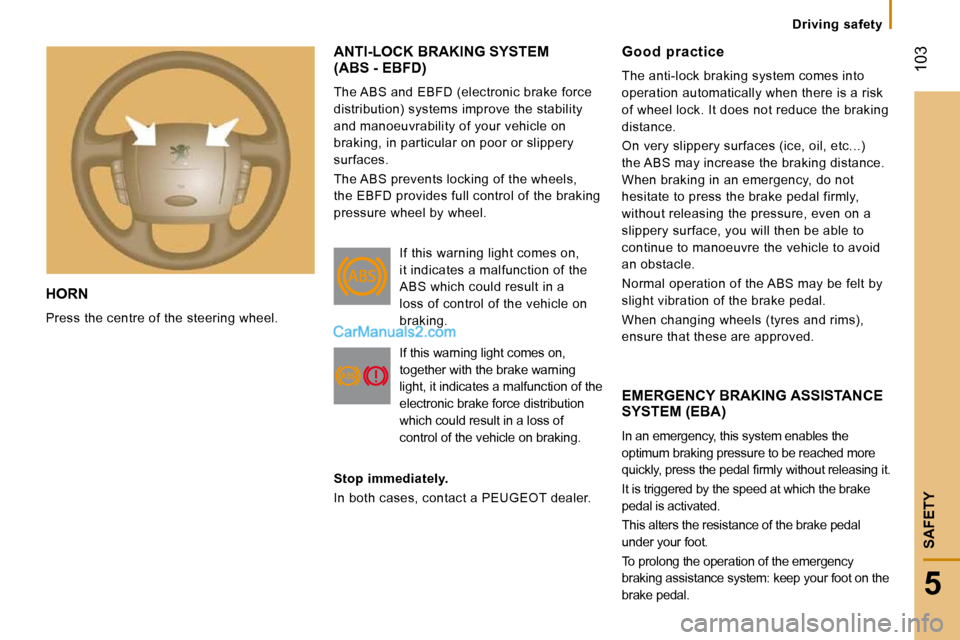
HORN
Press the centre of the steering wheel.
ANTI-LOCK BRAKING SYSTEM(ABS - EBFD)
The ABS and EBFD (electronic brake force
distribution) systems improve the stability
and manoeuvrability of your vehicle on
braking, in particular on poor or slippery
surfaces.
The ABS prevents locking of the wheels,
the EBFD provides full control of the braking
pressure wheel by wheel.
EMERGENCY BRAKING ASSISTANCE SYSTEM (EBA)
In an emergency, this system enables the
optimum braking pressure to be reached more
quickly, press the pedal fi rmly without releasing it.
It is triggered by the speed at which the brake
pedal is activated.
This alters the resistance of the brake pedal
under your foot.
To prolong the operation of the emergency
braking assistance system: keep your foot on the
brake pedal.
Good practice
The anti-lock braking system comes into
operation automatically when there is a risk
of wheel lock. It does not reduce the braking
distance.
On very slippery surfaces (ice, oil, etc...)
the ABS may increase the braking distance.
When braking in an emergency, do not
hesitate to press the brake pedal firmly,
without releasing the pressure, even on a
slippery surface, you will then be able to
continue to manoeuvre the vehicle to avoid
an obstacle.
Normal operation of the ABS may be felt by
slight vibration of the brake pedal.
When changing wheels (tyres and rims),
ensure that these are approved.
If this warning light comes on,
it indicates a malfunction of the
ABS which could result in a
loss of control of the vehicle on
braking.
If this warning light comes on,
together with the brake warning
light, it indicates a malfunction of the
electronic brake force distribution
which could result in a loss of
control of the vehicle on braking.
Stop immediately.
In both cases, contact a PEUGEOT dealer.
Page 108 of 167
Air bags
109
5
SAFETY
AIR BAGS
The air bags have been designed to
maximise the safety of the occupants in the
event of a serious collision; they work in
conjunction with the force limiting seat belts.
In the event of a serious collision, the
electronic detectors record and analyse any
abrupt deceleration of the vehicle:
if the triggering threshold is reached, the
air bags inflate instantly and protect the
occupants of the vehicle.
Immediately after the impact, the air bags
deflate rapidly, so that they do not hinder the
visibility of the occupants nor their possible
exit from the vehicle. The air bags will not be deployed in
collisions which are not serious, for
which the seat belt is sufficient to provide
maximum protection. The seriousness of
the collision depends on the nature of the
obstacle and the speed of the vehicle at the
moment of impact.
Air bags only operate when the ignition is
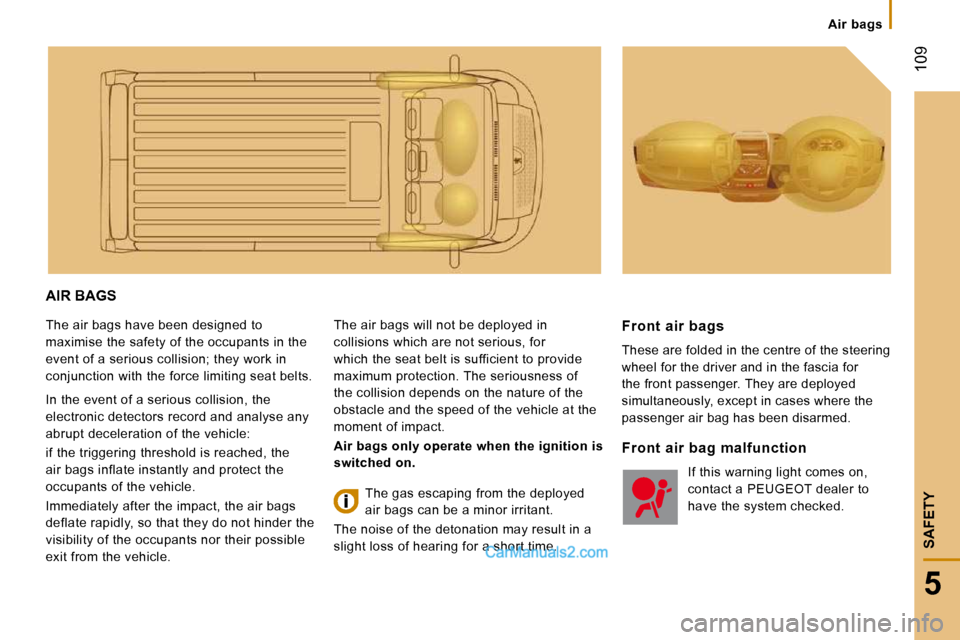
switched on. Front air bags
These are folded in the centre of the steering
wheel for the driver and in the fascia for
the front passenger. They are deployed
simultaneously, except in cases where the
passenger air bag has been disarmed.
The gas escaping from the deployed
air bags can be a minor irritant.
The noise of the detonation may result in a
slight loss of hearing for a short time.
Front air bag malfunction
If this warning light comes on,
contact a PEUGEOT dealer to
have the system checked.
Page 110 of 167
Air bags
111
5
SAFETY
Good practice
If your vehicle is fitted with front, side
and curtain air bags, in order for these to
be fully effective, observe the following
safety rules:
Wear a correctly adjusted seat belt.
Sit in a normal upright position.
Do not leave anything between the
occupants and the air bags (child, animal,
object...).
This could hamper the operation of the air
bags or injure the occupants.
All work on the air bag systems is strictly
prohibited unless it is carried out by qualified
personnel of the PEUGEOT network.
After an accident or if the vehicle has been
stolen or broken into, have the air bag
systems checked. Do not drive holding the steering wheel
by its spokes or resting your hands on the
centre part of the wheel.
Passengers must not place their feet on the
fascia.
Smoke as little as possible; deployment of
the air bags can cause burns or the risk of
injury from a cigarette or pipe.
Never remove or pierce the steering wheel
or hit it violently.
Side air bags
Only put approved covers on the front seats.
Consult a PEUGEOT dealer.
Do not fix or glue anything to the front seat
backs. This could cause injury to the chest
or arms when the side air bag is deployed.
Do not sit with the upper part of the body
any nearer to the door than necessary.
Curtain air bags
Do not fix or glue anything to the pillars or
the roof. This could cause injury to the head
when the curtain air bag is deployed.
Do not remove the bolts from the grab
handles installed on the roof, they play a
part in securing the curtain air bags.
Page 112 of 167
Air bags
111
5
SAFETY
Good practice
If your vehicle is fitted with front, side
and curtain air bags, in order for these to
be fully effective, observe the following
safety rules:
Wear a correctly adjusted seat belt.
Sit in a normal upright position.
Do not leave anything between the
occupants and the air bags (child, animal,
object...).
This could hamper the operation of the air
bags or injure the occupants.
All work on the air bag systems is strictly
prohibited unless it is carried out by qualified
personnel of the PEUGEOT network.
After an accident or if the vehicle has been
stolen or broken into, have the air bag
systems checked. Do not drive holding the steering wheel
by its spokes or resting your hands on the
centre part of the wheel.
Passengers must not place their feet on the
fascia.
Smoke as little as possible; deployment of
the air bags can cause burns or the risk of
injury from a cigarette or pipe.
Never remove or pierce the steering wheel
or hit it violently.
Side air bags
Only put approved covers on the front seats.
Consult a PEUGEOT dealer.
Do not fix or glue anything to the front seat
backs. This could cause injury to the chest
or arms when the side air bag is deployed.
Do not sit with the upper part of the body
any nearer to the door than necessary.
Curtain air bags
Do not fix or glue anything to the pillars or
the roof. This could cause injury to the head
when the curtain air bag is deployed.
Do not remove the bolts from the grab
handles installed on the roof, they play a
part in securing the curtain air bags.
Page 127 of 167
Under the bonnet
125
7
CHECKS
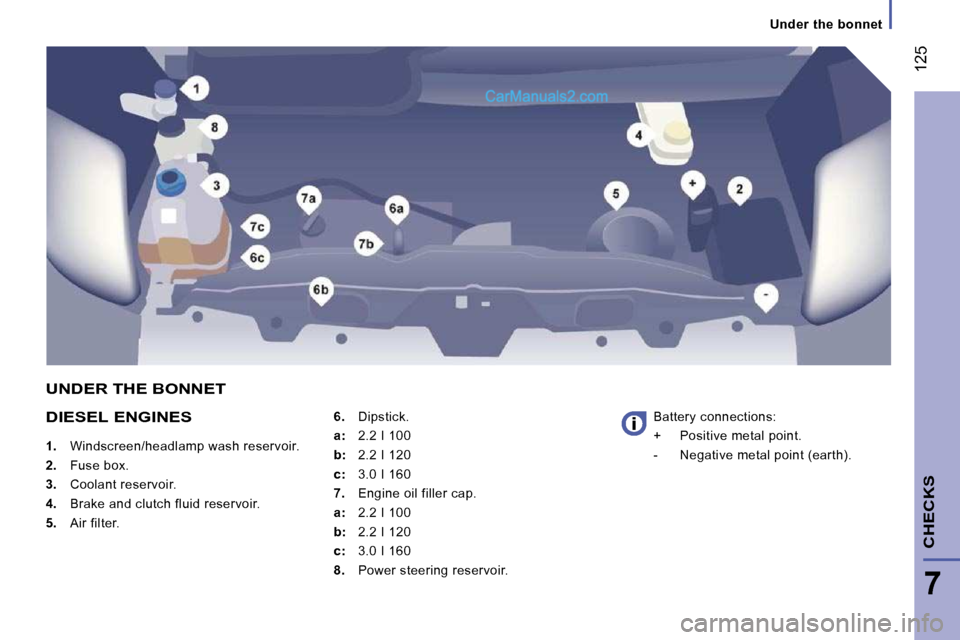
DIESEL ENGINES
1. Windscreen/headlamp wash reservoir.
2. Fuse box.
3. Coolant reservoir.
4. Brake and clutch fluid reservoir.
5. Air filter.
6. Dipstick.
a: 2.2 I 100
b
: 2.2 I 120
c
: 3.0 I 160
7. Engine oil filler cap.
a
: 2.2 I 100
b
: 2.2 I 120
c
: 3.0 I 160
8. Power steering reservoir. Battery connections:
+ Positive metal point.
- Negative metal point (earth).
UNDER THE BONNET
Page 129 of 167
Levels
127
7
CHECKS
Cooling system
Only use the fluid recommended by the
manufacturer. Otherwise, you risk seriously
damaging your engine. When the engine
is warm, the temperature of the coolant is
controlled by the engine fan. As this fan can
operate with the ignition key removed and
because the cooling system is pressurised,
wait for at least one hour after the engine
has stopped before carrying out any work.
Slacken the cap by 1/4 of a turn to release
the pressure to prevent any risk of scalding.
When the pressure has dropped, remove the
cap and top up the level with coolant.
If fluid has to be added frequently, this
indicates a failure which must be checked by
a PEUGEOT dealer as soon as possible.
Power steering fluid level
The vehicle must be parked on level ground
with the engine cold. Unscrew the cap
integrated with the gauge and check the
level which must be between the MIN and
MAX marks.
Used oil
Avoid prolonged contact of used oil with the
skin.
Brake fluid is harmful to health and very
corrosive.
Do not dispose of used oil, brake fluid or
coolant into drains or into the ground but
into the containers dedicated to this use at
PEUGEOT dealerships.
Topping up
The level must be between the MIN and
MAX marks on the expansion bottle. If
more than 1 litre of fluid is required to top
up the level, have the system checked by a
PEUGEOT dealer.
Windscreen wash and headlamp wash level
For best quality cleaning and to prevent
freezing, this fluid must not be topped up or
replaced with water.
Capacity of the reservoir: approximately
5.5 litres.