warning light Peugeot Boxer 2008.5 User Guide
[x] Cancel search | Manufacturer: PEUGEOT, Model Year: 2008.5, Model line: Boxer, Model: Peugeot Boxer 2008.5Pages: 167, PDF Size: 4.17 MB
Page 28 of 167
Instruments and controls
31
2
READY TO SET OFF
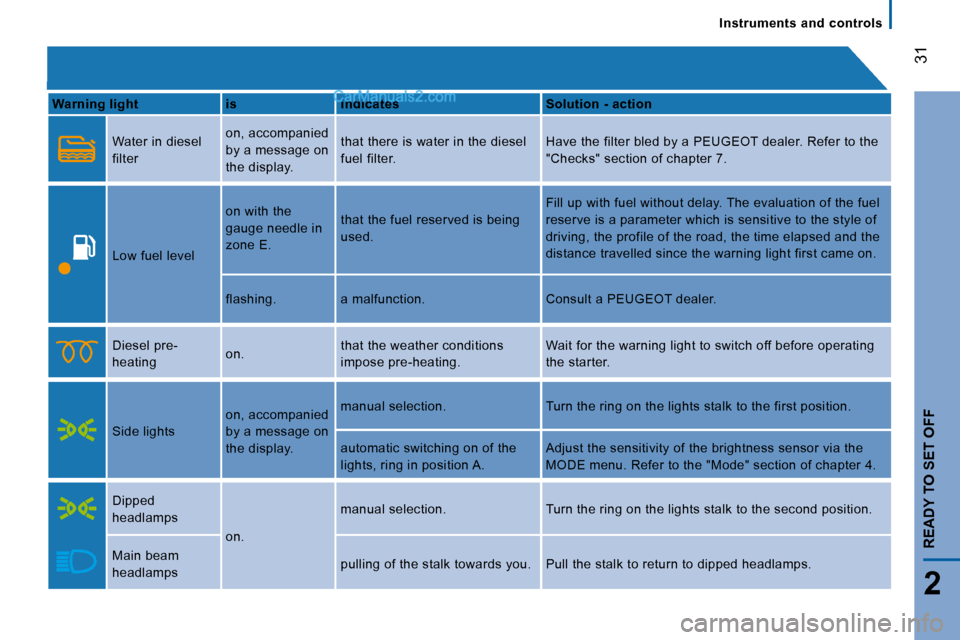
Warning light is indicates Solution - action
Water in diesel
filter on, accompanied
by a message on
the display. that there is water in the diesel
fuel filter.
Have the filter bled by a PEUGEOT dealer. Refer to
the
"Checks" section of chapter 7.
Low fuel level on with the
gauge needle in
zone E.
that the fuel reserved is being
used. Fill up with fuel without delay. The evaluation of
the fuel
reserve is a parameter which is sensitive to the st yle of
driving, the profile of the road, the time elapsed and the
distance travelled since the warning light first ca me on.
flashing. a malfunction. Consult a PEUGEOT deale r.
Diesel pre-
heating on. that the weather conditions
impose pre-heating. Wait for the warning light to switch off before op
erating
the starter.
Side lights on, accompanied
by a message on
the display. manual selection. Turn the ring on the lights sta
lk to the first position.
automatic switching on of the
lights, ring in position A. Adjust the sensitivity of the brightness sensor vi
a the
MODE menu. Refer to the "Mode" section of chapter 4 .
Dipped
headlamps on. manual selection. Turn the ring on the lights sta
lk to the second position.
Main beam
headlamps pulling of the stalk towards you. Pull the stalk
to return to dipped headlamps.
Page 29 of 167
32
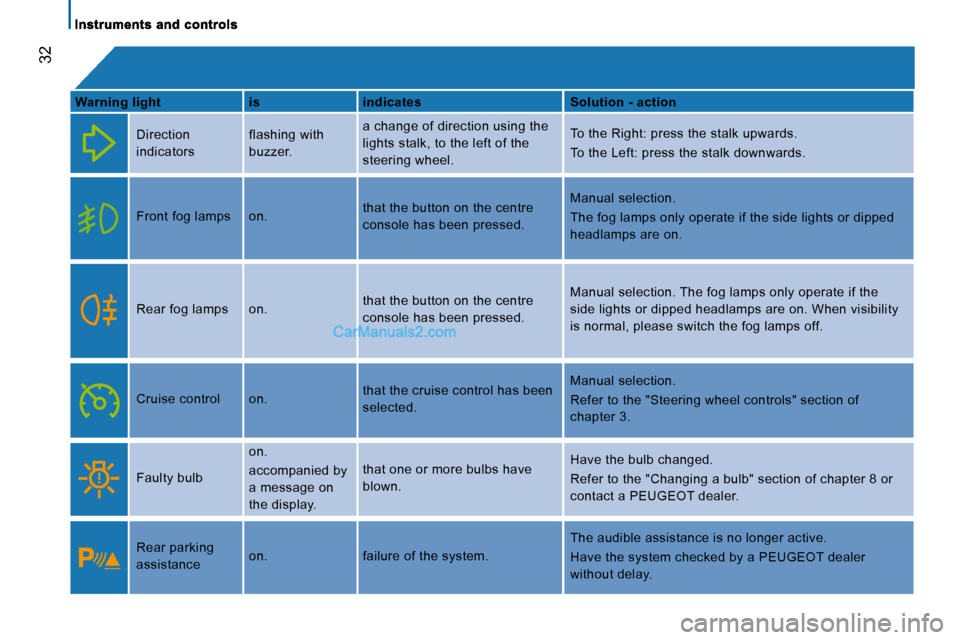
Warning light is indicates Solution - action
Direction
indicators flashing with
buzzer. a change of direction using the
lights stalk, to the left of the
steering wheel. To the Right: press the stalk upwards.
To the Left: press the stalk downwards.
Front fog lamps on. that the button on the centre
console has been pressed. Manual selection.
The fog lamps only operate if the side lights or di
pped
headlamps are on.
Rear fog lamps on. that the button on the centre
console has been pressed. Manual selection. The fog lamps only operate if th
e
side lights or dipped headlamps are on. When visibi lity
is normal, please switch the fog lamps off.
Cruise control on. that the cruise control has been
selected. Manual selection.
Refer to the "Steering wheel controls" section of
chapter 3.
Faulty bulb on.
accompanied by
a message on
the display. that one or more bulbs have
blown.
Have the bulb changed.
Refer to the "Changing a bulb" section of chapter 8
or
contact a PEUGEOT dealer.
Rear parking
assistance on. failure of the system. The audible assistance is no longer active.
Have the system checked by a PEUGEOT dealer
without delay.
Page 31 of 167
Instruments and controls
34
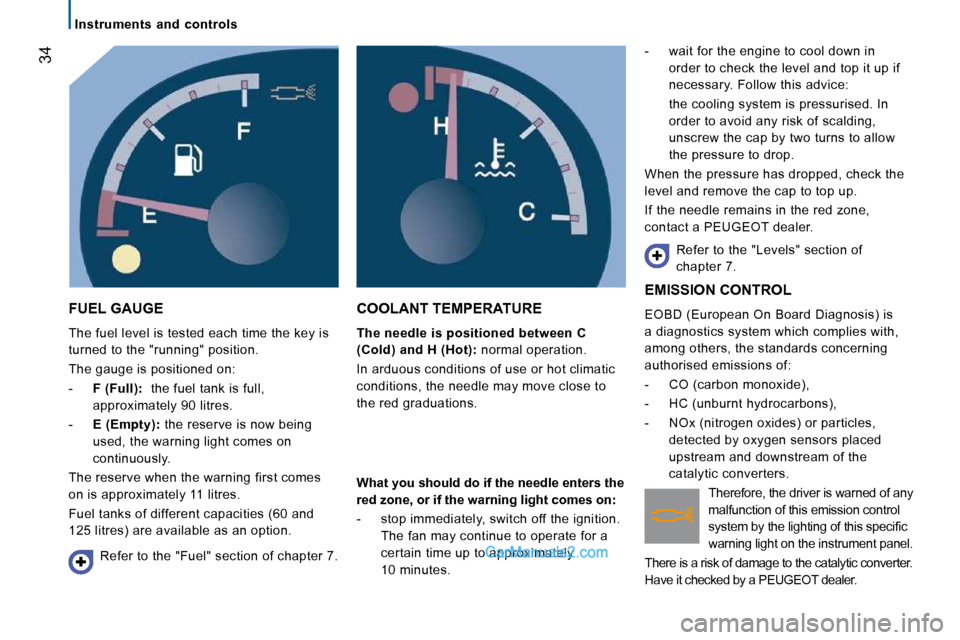
FUEL GAUGE
The fuel level is tested each time the key is
turned to the "running" position.
The gauge is positioned on:
- F (Full): the fuel tank is full,
approximately 90 litres.
- E (Empty): the reserve is now being
used, the warning light comes on
continuously.
The reserve when the warning first comes
on is approximately 11 litres.
Fuel tanks of different capacities (60 and
125 litres) are available as an option.
COOLANT TEMPERATURE
The needle is positioned between C
(Cold) and H (Hot): normal operation.
In arduous conditions of use or hot climatic
conditions, the needle may move close to
the red graduations. - wait for the engine to cool down in
order to check the level and top it up if
necessary. Follow this advice:
the cooling system is pressurised. In order to avoid any risk of scalding,
unscrew the cap by two turns to allow
the pressure to drop.
When the pressure has dropped, check the
level and remove the cap to top up.
If the needle remains in the red zone,
contact a PEUGEOT dealer.
Refer to the "Levels" section of
chapter 7.
Refer to the "Fuel" section of chapter 7.
What you should do if the needle enters the
red zone, or if the warning light comes on:
- stop immediately, switch off the ignition. The fan may continue to operate for a
certain time up to approximately
10 minutes.
EMISSION CONTROL
EOBD (European On Board Diagnosis) is
a diagnostics system which complies with,
among others, the standards concerning
authorised emissions of:
- CO (carbon monoxide),
- HC (unburnt hydrocarbons),
- NOx (nitrogen oxides) or particles, detected by oxygen sensors placed
upstream and downstream of the
catalytic converters.
Therefore, the driver is warned of any
malfunction of this emission control
system by the lighting of this specifi c
warning light on the instrument panel.
There is a risk of damage to the catalytic convert er.
Have it checked by a PEUGEOT dealer.
Page 32 of 167
Instruments and controls
35
2
READY TO SET OFF
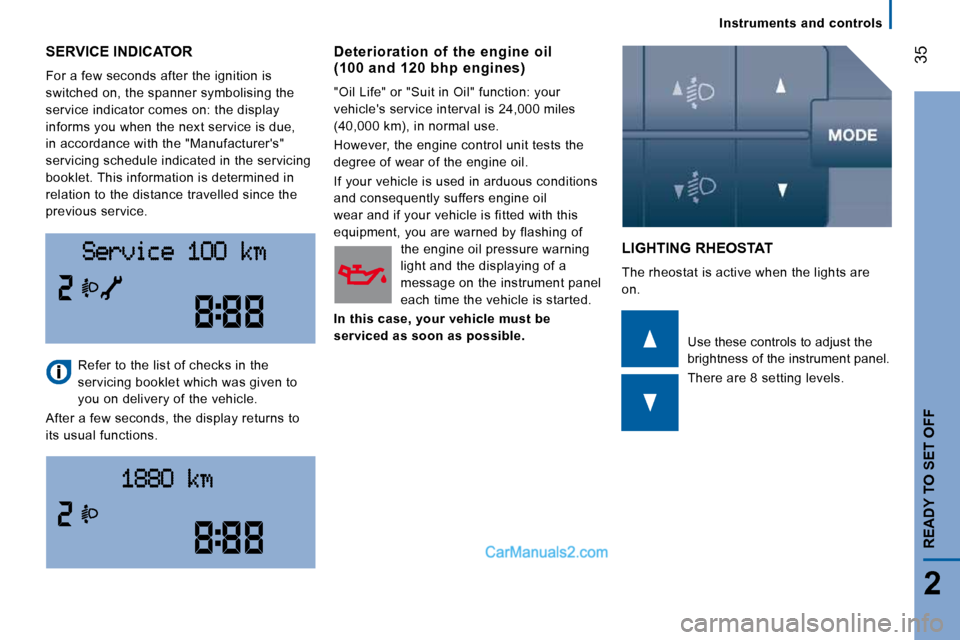
SERVICE INDICATOR
For a few seconds after the ignition is
switched on, the spanner symbolising the
service indicator comes on: the display
informs you when the next service is due,
in accordance with the "Manufacturer's"
servicing schedule indicated in the servicing
booklet. This information is determined in
relation to the distance travelled since the
previous service.
LIGHTING RHEOSTAT
The rheostat is active when the lights are
on.
Refer to the list of checks in the
servicing booklet which was given to
you on delivery of the vehicle.
After a few seconds, the display returns to
its usual functions. Use these controls to adjust the
brightness of the instrument panel.
There are 8 setting levels.
Deterioration of the engine oil (100 and 120 bhp engines)
"Oil Life" or "Suit in Oil" function: your
vehicle's service interval is 24,000 miles
(40,000 km), in normal use.
However, the engine control unit tests the
degree of wear of the engine oil.
If your vehicle is used in arduous conditions
and consequently suffers engine oil
wear and if your vehicle is fitted with this
equipment, you are warned by flashing of
the engine oil pressure warning
light and the displaying of a
message on the instrument panel
each time the vehicle is started.
In this case, your vehicle must be
serviced as soon as possible.
Page 34 of 167
37
2
READY TO SET OFF
Starting and stopping
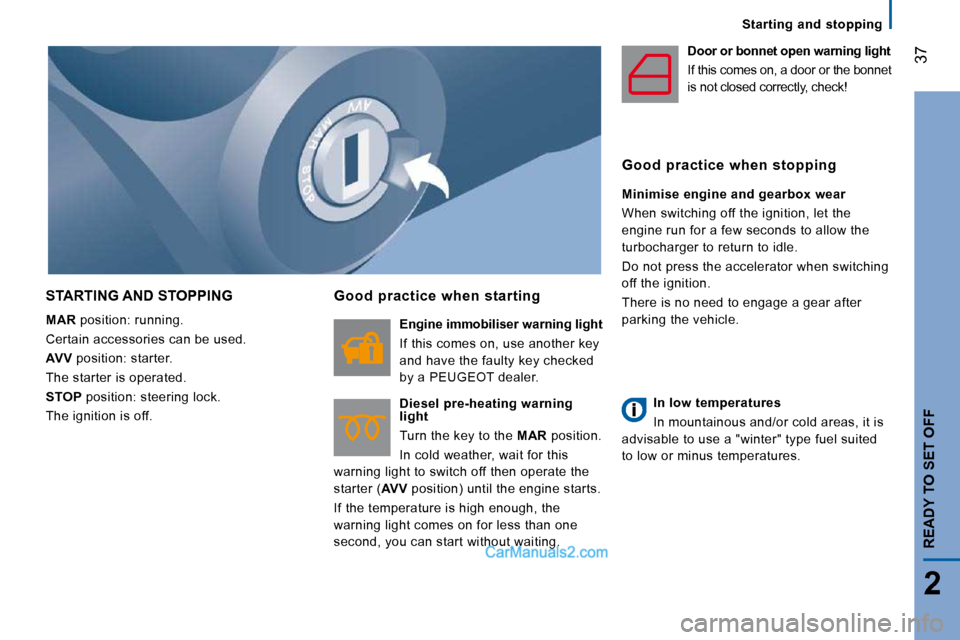
STARTING AND STOPPING
MAR position: running.
Certain accessories can be used.
AVV position: starter.
The starter is operated.
STOP position: steering lock.
The ignition is off.
Good practice when starting
Engine immobiliser warning light
If this comes on, use another key
and have the faulty key checked
by a PEUGEOT dealer.
Diesel pre-heating warning
light
Turn the key to the MAR position.
In cold weather, wait for this
warning light to switch off then operate the
starter ( AVV position) until the engine starts.
If the temperature is high enough, the
warning light comes on for less than one
second, you can start without waiting. Door or bonnet open warning light
If this comes on, a door or the bonnet
is not closed correctly, check!
Good practice when stopping
Minimise engine and gearbox wear
When switching off the ignition, let the
engine run for a few seconds to allow the
turbocharger to return to idle.
Do not press the accelerator when switching
off the ignition.
There is no need to engage a gear after
parking the vehicle.
In low temperatures
In mountainous and/or cold areas, it is
advisable to use a "winter" type fuel suited
to low or minus temperatures.
Page 35 of 167
Starting and stopping
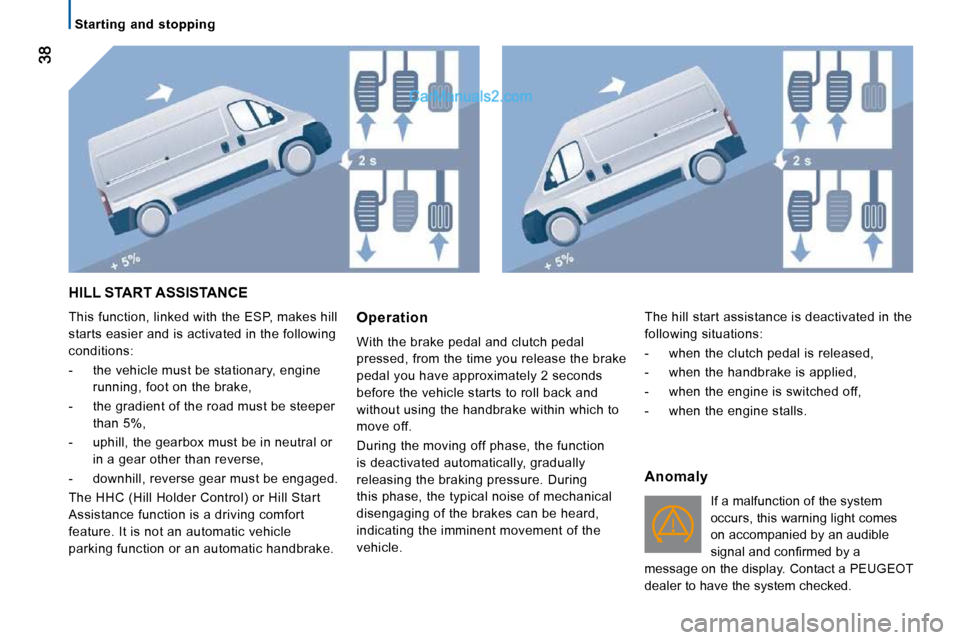
HILL START ASSISTANCE
This function, linked with the ESP, makes hill
starts easier and is activated in the following
conditions:
- the vehicle must be stationary, engine running, foot on the brake,
- the gradient of the road must be steeper than 5%,
- uphill, the gearbox must be in neutral or in a gear other than reverse,
- downhill, reverse gear must be engaged.
The HHC (Hill Holder Control) or Hill Start
Assistance function is a driving comfort
feature. It is not an automatic vehicle
parking function or an automatic handbrake. Operation
With the brake pedal and clutch pedal
pressed, from the time you release the brake
pedal you have approximately 2 seconds
before the vehicle starts to roll back and
without using the handbrake within which to
move off.
During the moving off phase, the function
is deactivated automatically, gradually
releasing the braking pressure. During
this phase, the typical noise of mechanical
disengaging of the brakes can be heard,
indicating the imminent movement of the
vehicle.
Anomaly
If a malfunction of the system
occurs, this warning light comes
on accompanied by an audible
signal and confi rmed by a
message on the display. Contact a PEUGEOT
dealer to have the system checked.
The hill start assistance is deactivated in the
following situations:
- when the clutch pedal is released,
- when the handbrake is applied,
- when the engine is switched off,
- when the engine stalls.
Page 36 of 167
Starting and stopping
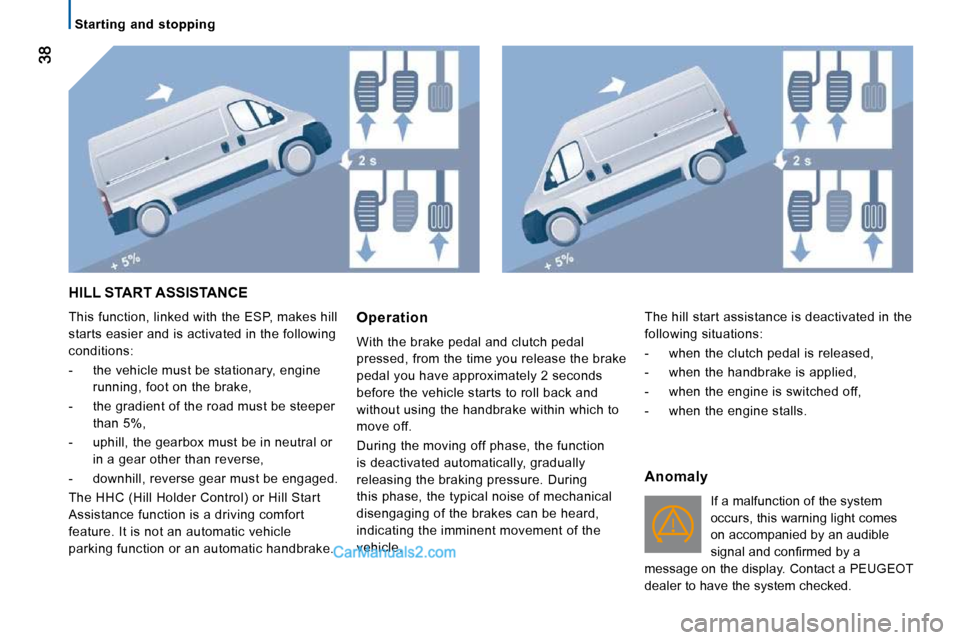
HILL START ASSISTANCE
This function, linked with the ESP, makes hill
starts easier and is activated in the following
conditions:
- the vehicle must be stationary, engine running, foot on the brake,
- the gradient of the road must be steeper than 5%,
- uphill, the gearbox must be in neutral or in a gear other than reverse,
- downhill, reverse gear must be engaged.
The HHC (Hill Holder Control) or Hill Start
Assistance function is a driving comfort
feature. It is not an automatic vehicle
parking function or an automatic handbrake. Operation
With the brake pedal and clutch pedal
pressed, from the time you release the brake
pedal you have approximately 2 seconds
before the vehicle starts to roll back and
without using the handbrake within which to
move off.
During the moving off phase, the function
is deactivated automatically, gradually
releasing the braking pressure. During
this phase, the typical noise of mechanical
disengaging of the brakes can be heard,
indicating the imminent movement of the
vehicle.
Anomaly
If a malfunction of the system
occurs, this warning light comes
on accompanied by an audible
signal and confi rmed by a
message on the display. Contact a PEUGEOT
dealer to have the system checked.
The hill start assistance is deactivated in the
following situations:
- when the clutch pedal is released,
- when the handbrake is applied,
- when the engine is switched off,
- when the engine stalls.
Page 40 of 167
42
Steering wheel controls
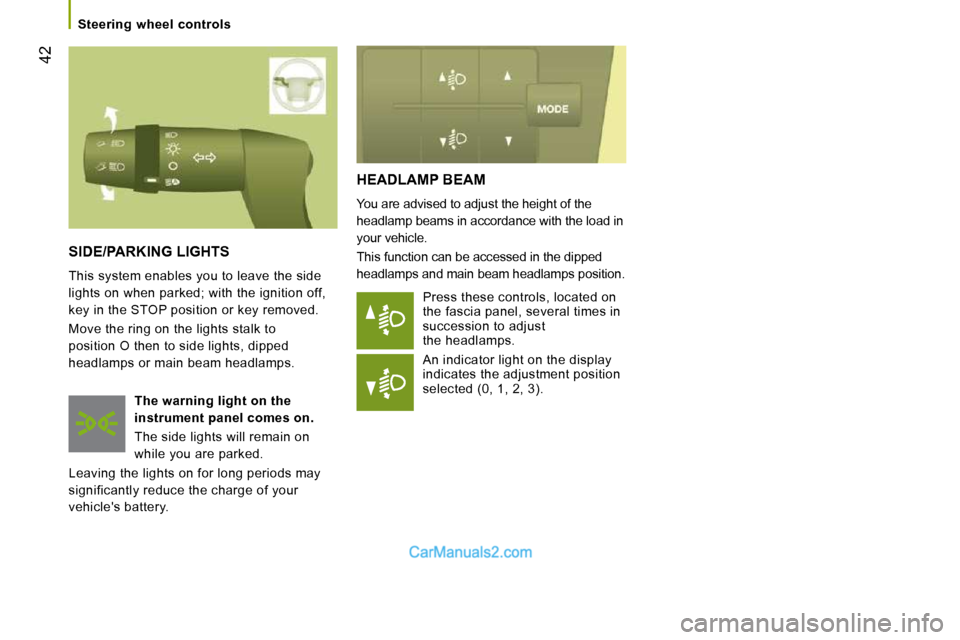
HEADLAMP BEAM
You are advised to adjust the height of the
headlamp beams in accordance with the load in
your vehicle.
This function can be accessed in the dipped
headlamps and main beam headlamps position. Press these controls, located on
the fascia panel, several times in
succession to adjust
the headlamps.
An indicator light on the display
indicates the adjustment position
selected (0, 1, 2, 3).
SIDE/PARKING LIGHTS
This system enables you to leave the side
lights on when parked; with the ignition off,
key in the STOP position or key removed.
Move the ring on the lights stalk to
position O then to side lights, dipped
headlamps or main beam headlamps.
The warning light on the
instrument panel comes on.
The side lights will remain on
while you are parked.
Leaving the lights on for long periods may
significantly reduce the charge of your
vehicle's battery.
Page 74 of 167
kmC I T Y
76
Parking assistance
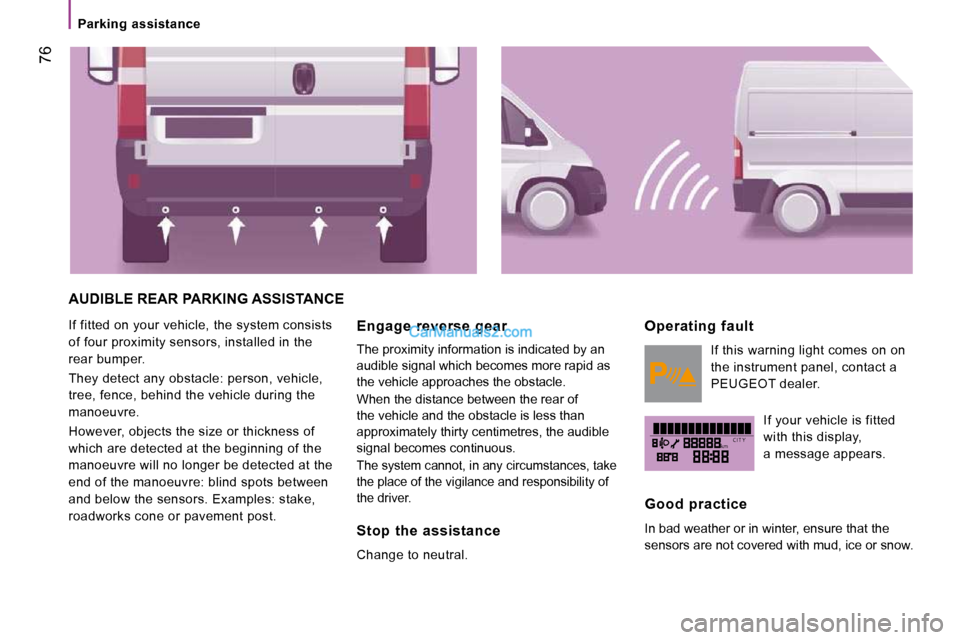
AUDIBLE REAR PARKING ASSISTANCE
If fitted on your vehicle, the system consists
of four proximity sensors, installed in the
rear bumper.
They detect any obstacle: person, vehicle,
tree, fence, behind the vehicle during the
manoeuvre.
However, objects the size or thickness of
which are detected at the beginning of the
manoeuvre will no longer be detected at the
end of the manoeuvre: blind spots between
and below the sensors. Examples: stake,
roadworks cone or pavement post. Engage reverse gear
The proximity information is indicated by an
audible signal which becomes more rapid as
the vehicle approaches the obstacle.
When the distance between the rear of
the vehicle and the obstacle is less than
approximately thirty centimetres, the audible
signal becomes continuous.
The system cannot, in any circumstances, take
the place of the vigilance and responsibility of
the driver.
Stop the assistance
Change to neutral.
Operating fault
If this warning light comes on on
the instrument panel, contact a
PEUGEOT dealer. If your vehicle is fitted
with this display,
a message appears.
Good practice
In bad weather or in winter, ensure that the
sensors are not covered with mud, ice or snow.
Page 77 of 167
79
4
IN-CAR TECHNOLOGY
Pneumatic suspension
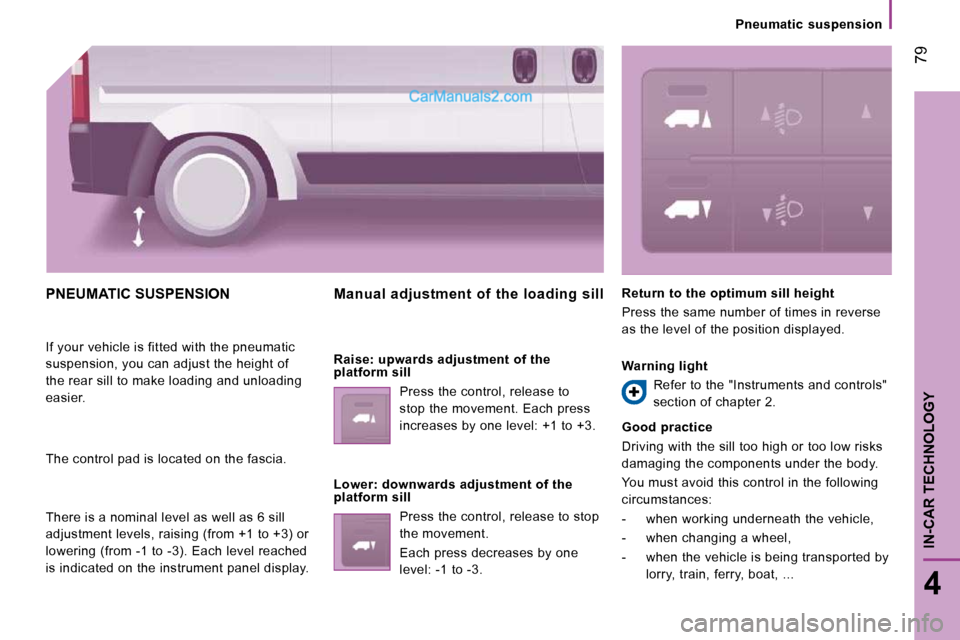
PNEUMATIC SUSPENSION
If your vehicle is fitted with the pneumatic
suspension, you can adjust the height of
the rear sill to make loading and unloading
easier.
The control pad is located on the fascia.
There is a nominal level as well as 6 sill
adjustment levels, raising (from +1 to +3) or
lowering (from -1 to -3). Each level reached
is indicated on the instrument panel display.
Manual adjustment of the loading sill
Raise: upwards adjustment of the
platform sill Press the control, release to
stop the movement. Each press
increases by one level: +1 to +3.
Lower: downwards adjustment of the
platform sill Press the control, release to stop
the movement.
Each press decreases by one
level: -1 to -3. Return to the optimum sill height
Press the same number of times in reverse
as the level of the position displayed.
Warning light
Refer to the "Instruments and controls"
section of chapter 2.
Good practice
Driving with the sill too high or too low risks
damaging the components under the body.
You must avoid this control in the following
circumstances:
- when working underneath the vehicle,
- when changing a wheel,
- when the vehicle is being transported by lorry, train, ferry, boat, ...