light Peugeot Boxer 2008 Owner's Guide
[x] Cancel search | Manufacturer: PEUGEOT, Model Year: 2008, Model line: Boxer, Model: Peugeot Boxer 2008Pages: 154, PDF Size: 3.27 MB
Page 35 of 154
51
3
ERGONOMICS AND COMFORT
Ventilation
Comfort value adjustment ring
The graduation ranges between:
- increasing of the interior ambient air
temperature HI (High) which heats to a
maximum graduation of 32,
- cooling of the interior ambient air temperature LO (Low) which cools to a
graduation of 16. increase (+) or reduce (-) the force of the
interior air flow.
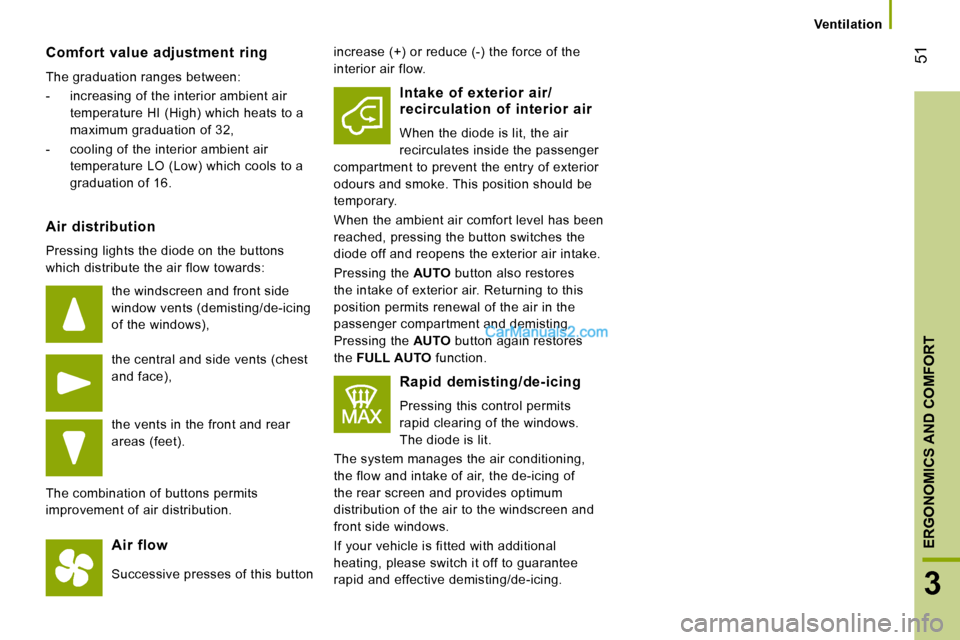
Air distribution
Pressing lights the diode on the buttons
which distribute the air flow towards: the windscreen and front side
window vents (demisting/de-icing
of the windows),
the central and side vents (chest
and face),
the vents in the front and rear
areas (feet).
The combination of buttons permits
improvement of air distribution. Air flow
Successive presses of this button Intake of exterior air/
recirculation of interior air
When the diode is lit, the air
recirculates inside the passenger
compartment to prevent the entry of exterior
odours and smoke. This position should be
temporary.
When the ambient air comfort level has been
reached, pressing the button switches the
diode off and reopens the exterior air intake.
Pressing the AUTO button also restores
the intake of exterior air. Returning to this
position permits renewal of the air in the
passenger compartment and demisting.
Pressing the AUTO button again restores
the FULL AUTO function.
Rapid demisting/de-icing
Pressing this control permits
rapid clearing of the windows.
The diode is lit.
The system manages the air conditioning,
the flow and intake of air, the de-icing of
the rear screen and provides optimum
distribution of the air to the windscreen and
front side windows.
If your vehicle is fitted with additional
heating, please switch it off to guarantee
rapid and effective demisting/de-icing.
Page 38 of 154
54
Ventilation
PROGRAMMABLE ADDITIONAL
HEATING
If your vehicle is fitted with autonomous
programmable heating: it gradually brings
the engine up to a good temperature to
facilitate starting. An integrated clock permits programming of
its start time. The passenger compartment
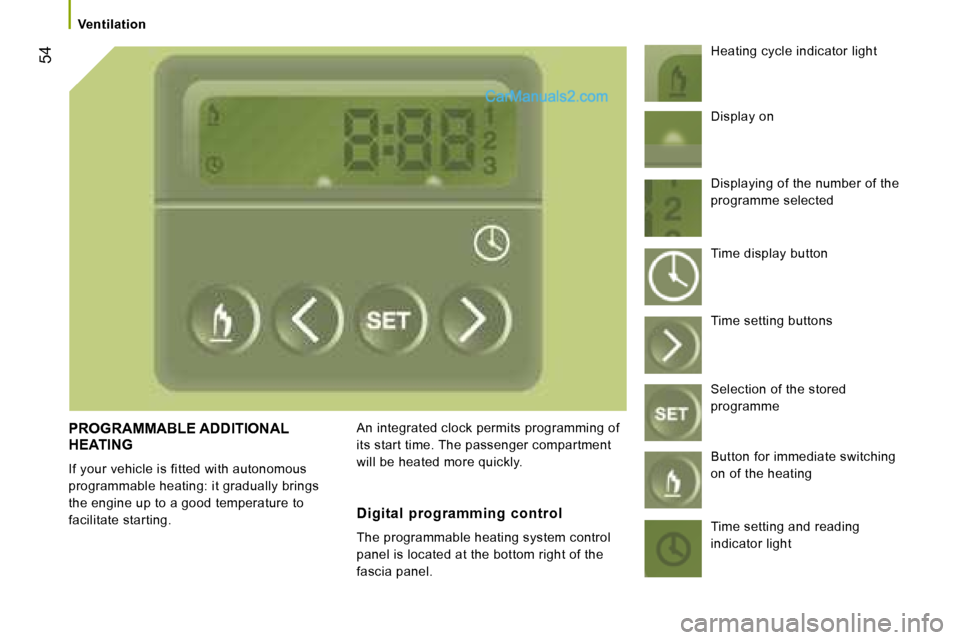
will be heated more quickly. Heating cycle indicator light
Digital programming control
The programmable heating system control
panel is located at the bottom right of the
fascia panel. Display on
Displaying of the number of the
programme selected
Time display button
Time setting buttons
Selection of the stored
programme
Button for immediate switching
on of the heating
Time setting and reading
indicator light
Page 39 of 154
55
3
ERGONOMICS AND COMFORT
Ventilation
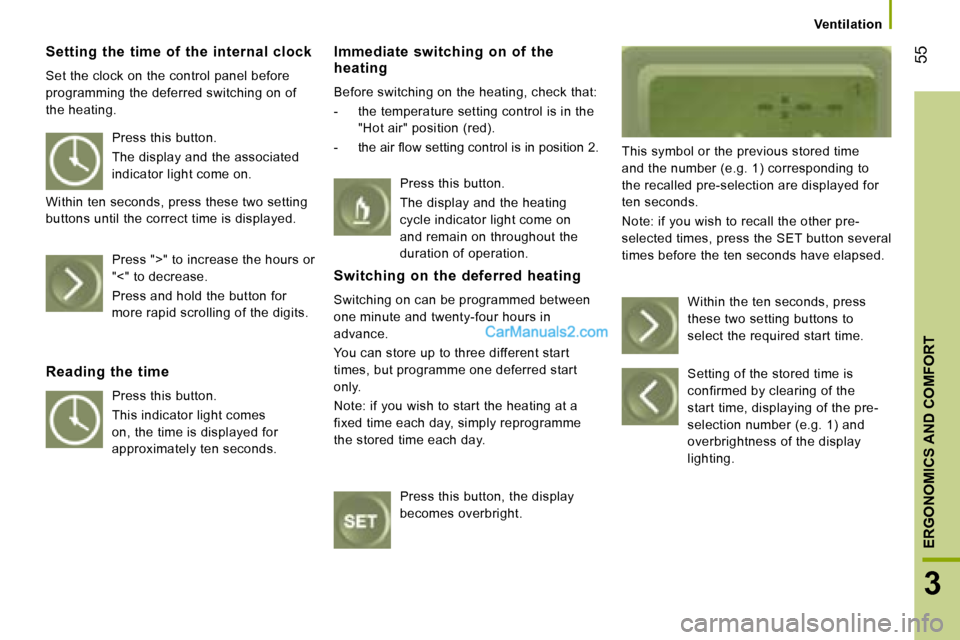
Setting the time of the internal clock
Set the clock on the control panel before
programming the deferred switching on of
the heating. Immediate switching on of the
heating
Before switching on the heating, check that:
- the temperature setting control is in the
"Hot air" position (red).
- the air low setting control is in position 2. This symbol or the previous stored time
and the number (e.g. 1) corresponding to
the recalled pre-selection are displayed for
ten seconds.
Note: if you wish to recall the other pre-
selected times, press the SET button several
times before the ten seconds have elapsed.
Press this button.
The display and the associated
indicator light come on.
Within ten seconds, press these two setting
buttons until the correct time is displayed.
Press ">" to increase the hours or
"<" to decrease.
Press and hold the button for
more rapid scrolling of the digits.
Reading the time Press this button.
This indicator light comes
on, the time is displayed for
approximately ten seconds. Press this button.
The display and the heating
cycle indicator light come on
and remain on throughout the
duration of operation.
Switching on the deferred heating
Switching on can be programmed between
one minute and twenty-four hours in
advance.
You can store up to three different start
times, but programme one deferred start
only.
Note: if you wish to start the heating at a
fixed time each day, simply reprogramme
the stored time each day.
Press this button, the display
becomes overbright. Within the ten seconds, press
these two setting buttons to
select the required start time.
Setting of the stored time is
confirmed by clearing of the
start time, displaying of the pre-
selection number (e.g. 1) and
overbrightness of the display
lighting.
Page 40 of 154
56
Ventilation
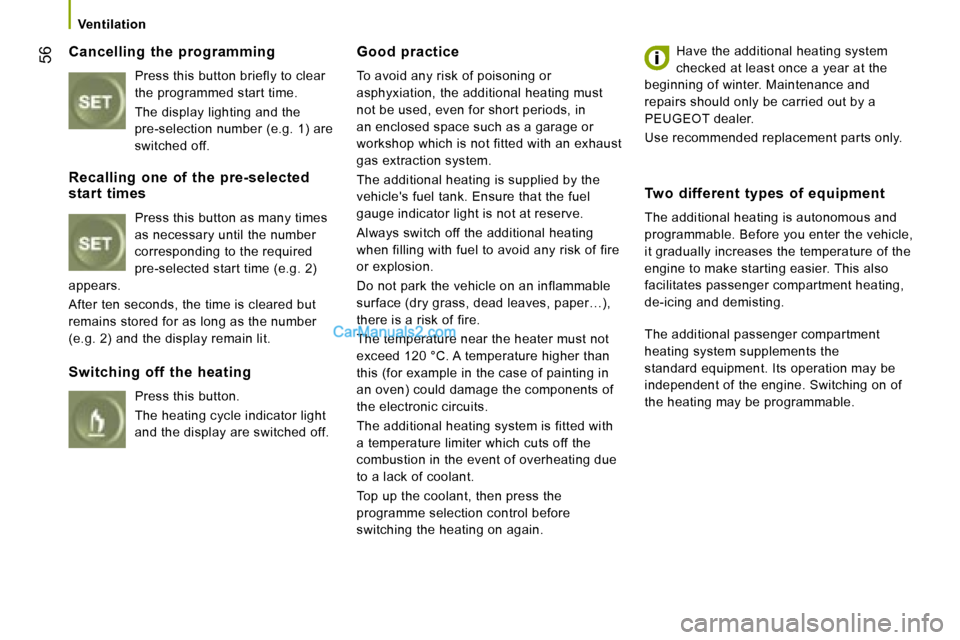
Cancelling the programming Press this button briefly to clear
the programmed start time.
The display lighting and the
pre-selection number (e.g. 1) are
switched off. Good practice
To avoid any risk of poisoning or
asphyxiation, the additional heating must
not be used, even for short periods, in
an enclosed space such as a garage or
workshop which is not fitted with an exhaust
gas extraction system.
The additional heating is supplied by the
vehicle's fuel tank. Ensure that the fuel
gauge indicator light is not at reserve.
Always switch off the additional heating
when filling with fuel to avoid any risk of fire
or explosion.
Do not park the vehicle on an inflammable
surface (dry grass, dead leaves, paper…),
there is a risk of fire.
The temperature near the heater must not
exceed 120 °C. A temperature higher than
this (for example in the case of painting in
an oven) could damage the components of
the electronic circuits.
The additional heating system is fitted with
a temperature limiter which cuts off the
combustion in the event of overheating due
to a lack of coolant.
Top up the coolant, then press the
programme selection control before
switching the heating on again. Have the additional heating system
checked at least once a year at the
beginning of winter. Maintenance and
repairs should only be carried out by a
PEUGEOT dealer.
Use recommended replacement parts only.
Recalling one of the pre-selected
start times Press this button as many times
as necessary until the number
corresponding to the required
pre-selected start time (e.g. 2)
appears.
After ten seconds, the time is cleared but
remains stored for as long as the number
(e.g. 2) and the display remain lit.
Switching off the heating
Press this button.
The heating cycle indicator light
and the display are switched off. Two different types of equipment
The additional heating is autonomous and
programmable. Before you enter the vehicle,
it gradually increases the temperature of the
engine to make starting easier. This also
facilitates passenger compartment heating,
de-icing and demisting.
The additional passenger compartment
heating system supplements the
standard equipment. Its operation may be
independent of the engine. Switching on of
the heating may be programmable.
Page 49 of 154
65
3
ERGONOMICS AND COMFORT
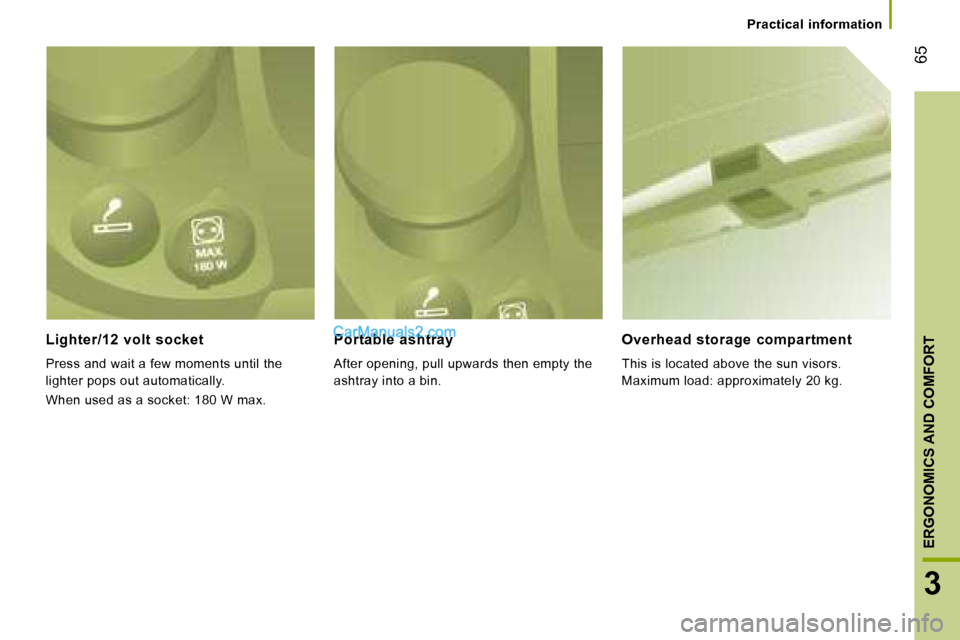
Lighter/12 volt socket
Press and wait a few moments until the
lighter pops out automatically.
When used as a socket: 180 W max. Portable ashtray
After opening, pull upwards then empty the
ashtray into a bin.
Overhead storage compartment
This is located above the sun visors.
Maximum load: approximately 20 kg.Practical information
Page 50 of 154
66
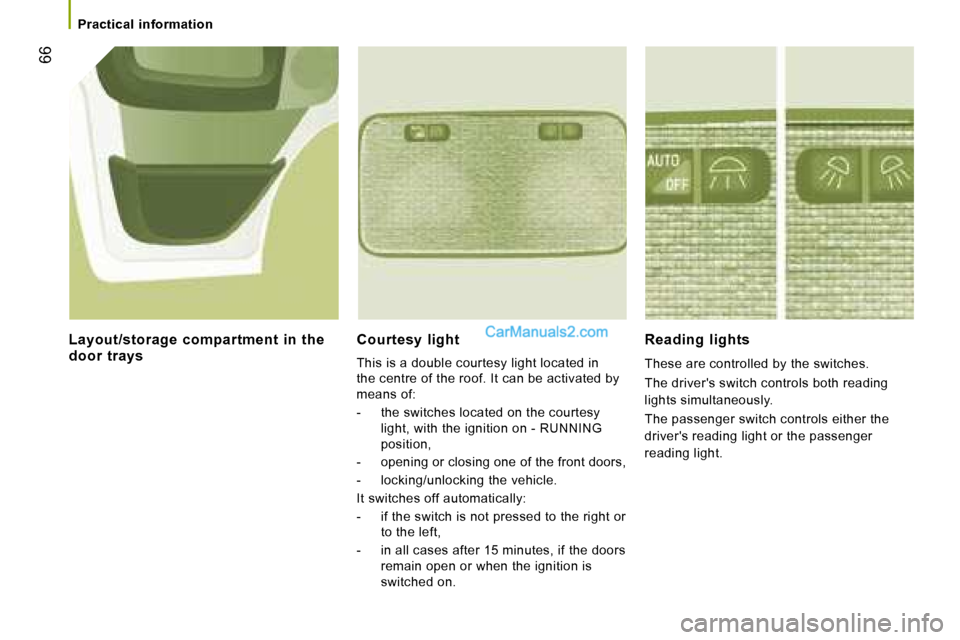
Courtesy light
This is a double courtesy light located in
the centre of the roof. It can be activated by
means of:
- the switches located on the courtesy
light, with the ignition on - RUNNING
position,
- opening or closing one of the front doors,
- locking/unlocking the vehicle.
It switches off automatically:
- if the switch is not pressed to the right or to the left,
- in all cases after 15 minutes, if the doors remain open or when the ignition is
switched on. Reading lights
These are controlled by the switches.
The driver's switch controls both reading
lights simultaneously.
The passenger switch controls either the
driver's reading light or the passenger
reading light.
Layout/storage compartment in the
door trays Practical information
Page 52 of 154
68
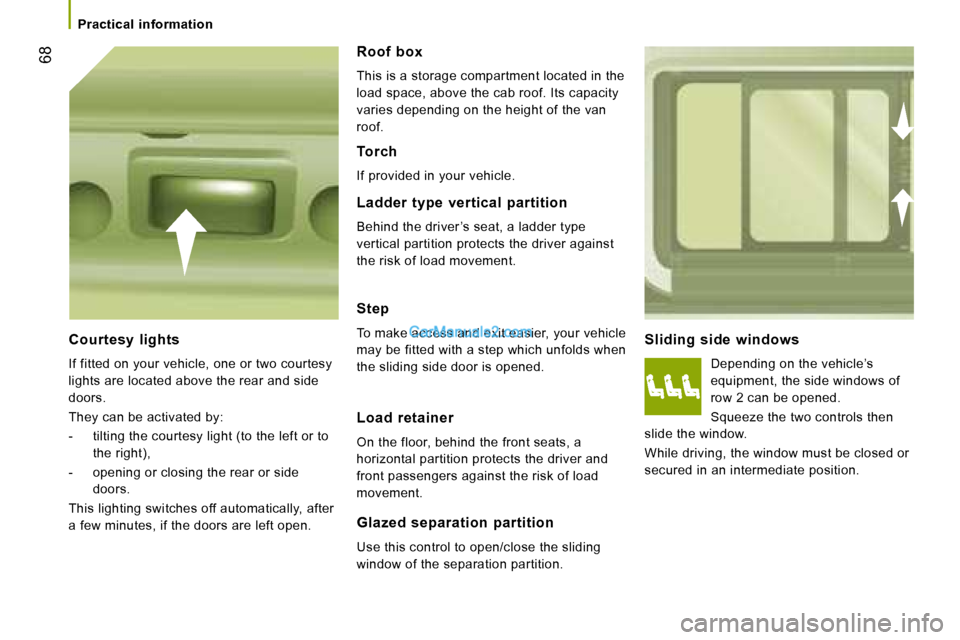
Sliding side windows
Depending on the vehicle’s
equipment, the side windows of
row 2 can be opened.
Squeeze the two controls then
slide the window.
While driving, the window must be closed or
secured in an intermediate position.
Step
To make access and exit easier, your vehicle
may be fitted with a step which unfolds when
the sliding side door is opened.
Courtesy lights
If fitted on your vehicle, one or two courtesy
lights are located above the rear and side
doors.
They can be activated by:
- tilting the courtesy light (to the left or to
the right),
- opening or closing the rear or side doors.
This lighting switches off automatically, after
a few minutes, if the doors are left open. Roof box
This is a storage compartment located in the
load space, above the cab roof. Its capacity
varies depending on the height of the van
roof.
Torch
If provided in your vehicle.
Ladder type vertical partition
Behind the driver ’s seat, a ladder type
vertical partition protects the driver against
the risk of load movement.
Load retainer
On the floor, behind the front seats, a
horizontal partition protects the driver and
front passengers against the risk of load
movement.
Glazed separation partition
Use this control to open/close the sliding
window of the separation partition.
Practical information
Page 59 of 154
kmC I T Y
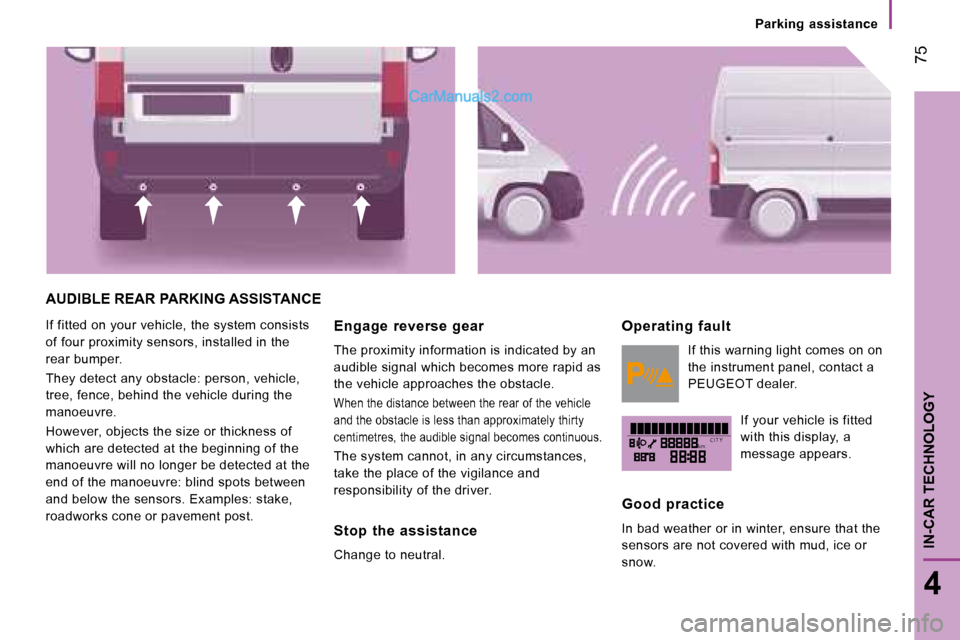
AUDIBLE REAR PARKING ASSISTANCE
If fitted on your vehicle, the system consists
of four proximity sensors, installed in the
rear bumper.
They detect any obstacle: person, vehicle,
tree, fence, behind the vehicle during the
manoeuvre.
However, objects the size or thickness of
which are detected at the beginning of the
manoeuvre will no longer be detected at the
end of the manoeuvre: blind spots between
and below the sensors. Examples: stake,
roadworks cone or pavement post.Engage reverse gear
The proximity information is indicated by an
audible signal which becomes more rapid as
the vehicle approaches the obstacle.
When the distance between the rear of the vehicle
and the obstacle is less than approximately thirty
centimetres, the audible signal becomes continuous.
The system cannot, in any circumstances,
take the place of the vigilance and
responsibility of the driver.
Stop the assistance
Change to neutral.Operating fault
If this warning light comes on on
the instrument panel, contact a
PEUGEOT dealer.
If your vehicle is fitted
with this display, a
message appears.
Good practice
In bad weather or in winter, ensure that the
sensors are not covered with mud, ice or
snow.
75
4
IN-CAR TECHNOLOGY
Parking assistance
Page 60 of 154
76
Reversing camera
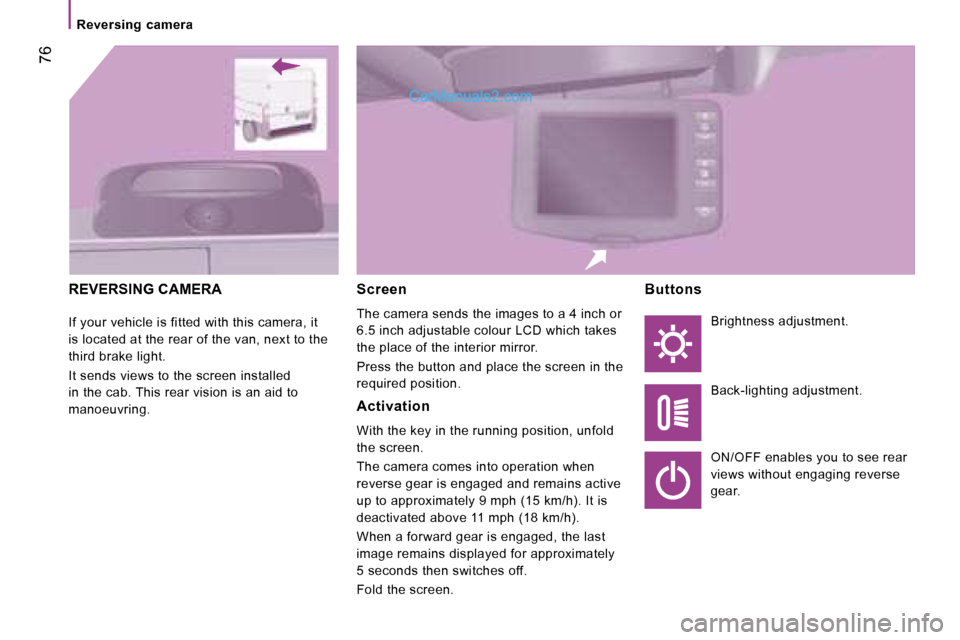
REVERSING CAMERA
If your vehicle is fitted with this camera, it
is located at the rear of the van, next to the
third brake light.
It sends views to the screen installed
in the cab. This rear vision is an aid to
manoeuvring. Screen
The camera sends the images to a 4 inch or
6.5 inch adjustable colour LCD which takes
the place of the interior mirror.
Press the button and place the screen in the
required position.
Activation
With the key in the running position, unfold
the screen.
The camera comes into operation when
reverse gear is engaged and remains active
up to approximately 9 mph (15 km/h). It is
deactivated above 11 mph (18 km/h).
When a forward gear is engaged, the last
image remains displayed for approximately
5 seconds then switches off.
Fold the screen.Buttons
Brightness adjustment.
Back-lighting adjustment.
ON/OFF enables you to see rear
views without engaging reverse
gear.
Page 62 of 154
78
Pneumatic suspension
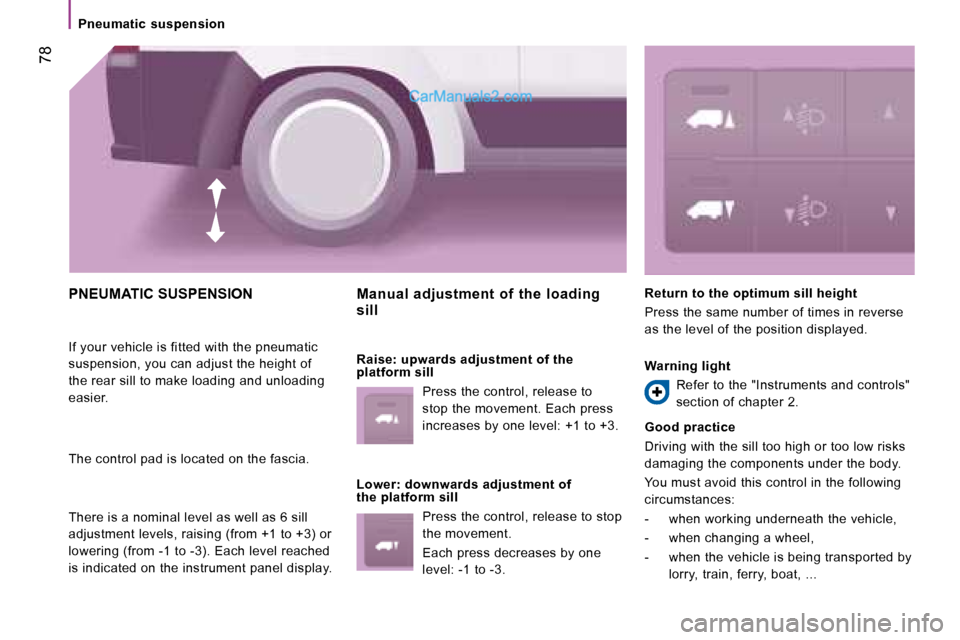
PNEUMATIC SUSPENSION
If your vehicle is fitted with the pneumatic
suspension, you can adjust the height of
the rear sill to make loading and unloading
easier.
The control pad is located on the fascia.
There is a nominal level as well as 6 sill
adjustment levels, raising (from +1 to +3) or
lowering (from -1 to -3). Each level reached
is indicated on the instrument panel display.Manual adjustment of the loading
sill
Raise: upwards adjustment of the
platform sill
Press the control, release to
stop the movement. Each press
increases by one level: +1 to +3.
Lower: downwards adjustment of
the platform sill Press the control, release to stop
the movement.
Each press decreases by one
level: -1 to -3. Return to the optimum sill height
Press the same number of times in reverse
as the level of the position displayed.
Warning light
Refer to the "Instruments and controls"
section of chapter 2.
Good practice
Driving with the sill too high or too low risks
damaging the components under the body.
You must avoid this control in the following
circumstances:
- when working underneath the vehicle,
- when changing a wheel,
- when the vehicle is being transported by lorry, train, ferry, boat, ...