light Peugeot Boxer 2008 Service Manual
[x] Cancel search | Manufacturer: PEUGEOT, Model Year: 2008, Model line: Boxer, Model: Peugeot Boxer 2008Pages: 154, PDF Size: 3.27 MB
Page 96 of 154
kmC I T Y
108
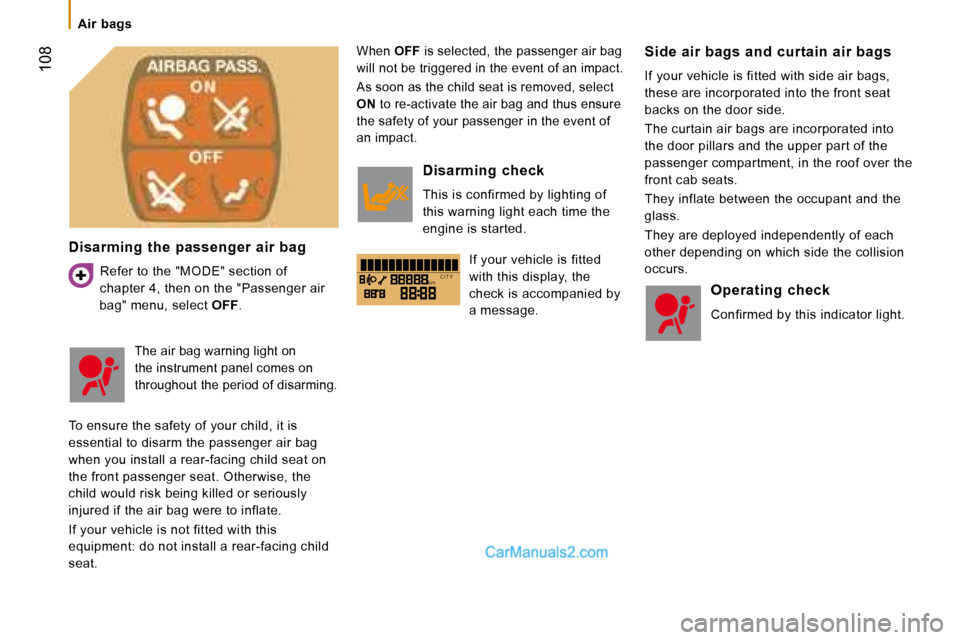
Disarming the passenger air bagRefer to the "MODE" section of
chapter 4, then on the "Passenger air
bag" menu, select OFF.
When OFF is selected, the passenger air bag
will not be triggered in the event of an impact.
As soon as the child seat is removed, select
ON to re-activate the air bag and thus ensure
the safety of your passenger in the event of
an impact.Side air bags and curtain air bags
If your vehicle is fitted with side air bags,
these are incorporated into the front seat
backs on the door side.
The curtain air bags are incorporated into
the door pillars and the upper part of the
passenger compartment, in the roof over the
front cab seats.
They inflate between the occupant and the
glass.
They are deployed independently of each
other depending on which side the collision
occurs.
The air bag warning light on
the instrument panel comes on
throughout the period of disarming.
To ensure the safety of your child, it is
essential to disarm the passenger air bag
when you install a rear-facing child seat on
the front passenger seat. Otherwise, the
child would risk being killed or seriously
injured if the air bag were to inflate.
If your vehicle is not fitted with this
equipment: do not install a rear-facing child
seat. Disarming check
This is confirmed by lighting of
this warning light each time the
engine is started.
If your vehicle is fitted
with this display, the
check is accompanied by
a message. Operating check
Confirmed by this indicator light.
Air bags
Page 106 of 154
117
6
ACCESSORIES
Towing a trailer
Cooling: towing a trailer on a slope
increases the coolant temperature.
As the fan is electrically controlled, its
cooling capacity is not dependent on the
engine speed.
On the contrary, use a high gear to lower the
engine speed and reduce your speed.
In all cases, pay attention to the coolant
temperature. Tyres:
check the tyre pressures of the
towing vehicle (see the "Identification
features" section of chapter 9) and of
the trailer, observing the recommended
pressure.Towbar
We recommend the use of original
PEUGEOT towbars and their harnesses,
which have been tested and approved from
the design stage of your vehicle and that
the fitting of this equipment is entrusted to a
PEUGEOT dealer.
If this equipment is not fitted by a
PEUGEOT dealer, it is imperative that it
is fitted using the electrical pre-equipment
installed at the rear of the vehicle and
in accordance with the manufacturer ’s
instructions.
Good practice
In certain cases of particularly arduous
use (towing the maximum load up a steep
slope in high temperatures), the engine
automatically limits its power. In this
case, the automatic cutting off of the air
conditioning allows the engine power to be
recovered.
If the coolant temperature
warning light comes on, stop the
vehicle and switch off the engine
as soon as possible.
See the "Levels" section of chapter 7. Brakes:
towing increases the braking
distance. Drive at a moderate speed,
change down early and brake gradually.
Side wind: sensitivity to side wind is
increased. Drive smoothly and at a
moderate speed.
ABS: the system only controls the vehicle,
not the trailer.
Rear parking assistance: the assistance
does not function while the vehicle is towing.
Page 110 of 154
120
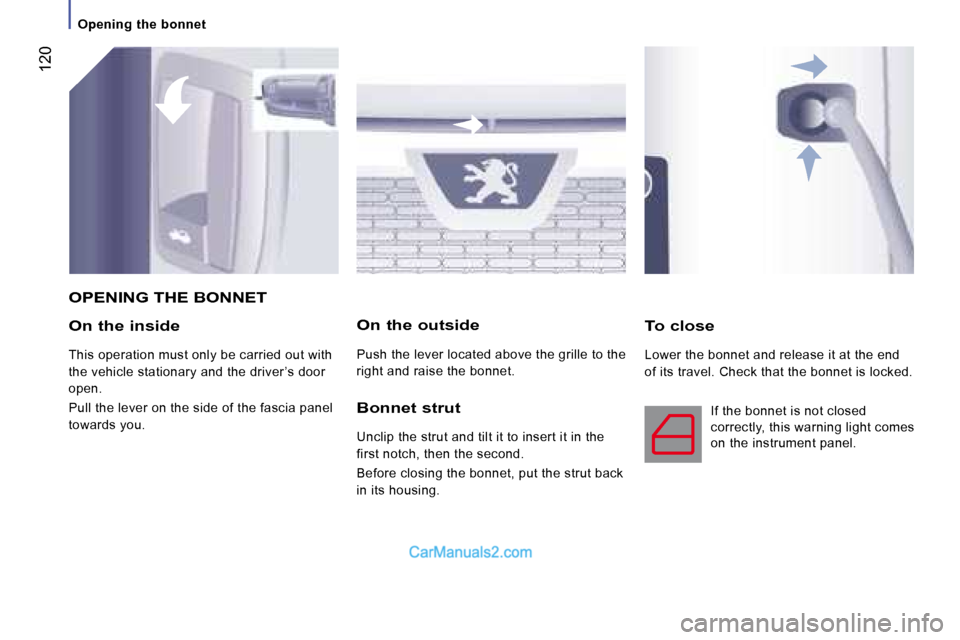
On the inside
This operation must only be carried out with
the vehicle stationary and the driver ’s door
open.
Pull the lever on the side of the fascia panel
towards you.
On the outside
Push the lever located above the grille to the
right and raise the bonnet.
To close
Lower the bonnet and release it at the end
of its travel. Check that the bonnet is locked.
OPENING THE BONNET
Bonnet strut
Unclip the strut and tilt it to insert it in the
first notch, then the second.
Before closing the bonnet, put the strut back
in its housing.If the bonnet is not closed
correctly, this warning light comes
on the instrument panel.
Opening the bonnet
Page 112 of 154
BA
122
LEVELS
These regular maintenance operations
will keep your vehicle in good running
order. Consult the instructions at PEUGEOT
dealerships or in the servicing booklet
enclosed in the handbook pack. To maintain the reliability of engines and
emission control systems, the use of
additives in engine oil is prohibited.
Changing the brake fluid
The brake fluid must be changed at
the intervals stated, according to the
manufacturer's servicing schedule.
Use fluids recommended by the
manufacturer, which fulfil DOT4 standards.
The level must be between the
MIN and
MAX marks on the reservoir.
If fluid has to be added frequently, this
indicates a failure which must be checked by
a PEUGEOT dealer as soon as possible.
If you have to remove/refit the engine
style cover, handle it with care to avoid
damaging the fixing clips.
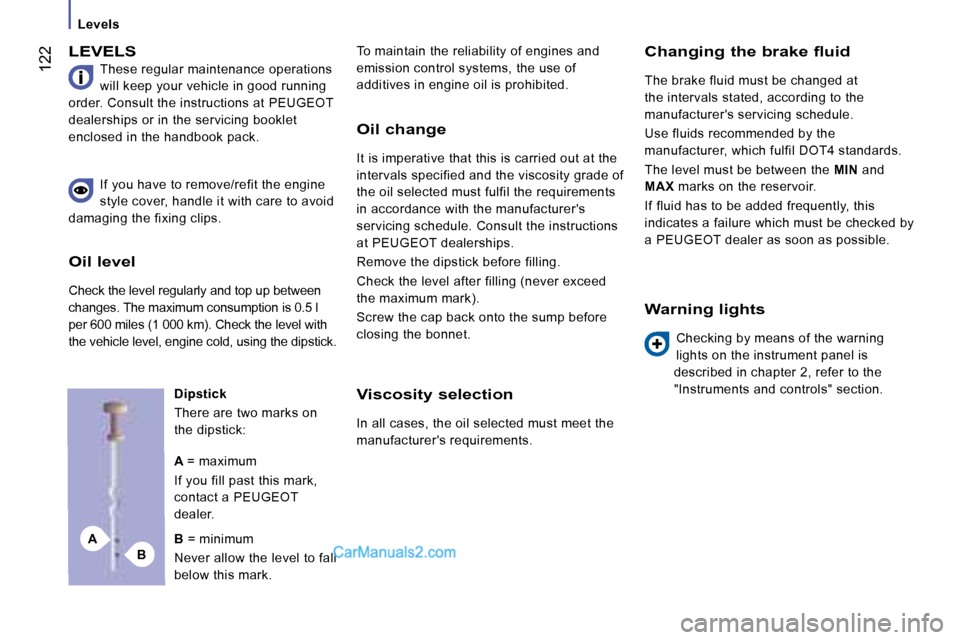
Dipstick
There are two marks on
the dipstick:
Oil change
It is imperative that this is carried out at the
intervals specified and the viscosity grade of
the oil selected must fulfil the requirements
in accordance with the manufacturer's
servicing schedule. Consult the instructions
at PEUGEOT dealerships.
Remove the dipstick before filling.
Check the level after filling (never exceed
the maximum mark).
Screw the cap back onto the sump before
closing the bonnet.
Viscosity selection
In all cases, the oil selected must meet the
manufacturer's requirements.
Warning lights
Checking by means of the warning
lights on the instrument panel is
described in chapter 2, refer to the
"Instruments and controls" section.
A = maximum
If you fill past this mark,
contact a PEUGEOT
dealer.
B = minimum
Never allow the level to fall
below this mark.
Oil level
Check the level regularly and top up between
changes. The maximum consumption is 0.5 l
per 600 miles (1 000 km). Check the level with
the vehicle level, engine cold, using the dipstick.
Levels
Page 114 of 154
124
CHECKS
Air filter and passenger
compartment filter
A clogged passenger compartment filter
may reduce the performance of the
air conditioning system and generate
undesirable odours. The replacement
intervals for these components are indicated
in the servicing booklet.
Depending on the environment (dusty
atmosphere...) and the use of the vehicle
(urban driving...), change them twice as
often if necessary, refer to the "Under the
bonnet" section of chapter 7.
Manual gearbox
Have the level checked in accordance with
the manufacturer ’s servicing schedule.To check the main levels and certain
components, in accordance with the
manufacturer ’s servicing schedule, refer
to the pages of the servicing booklet which
correspond to your vehicle’s engine.
Only use products recommended by
PEUGEOT or products of equivalent quality
and characteristics.
In order to optimise the operation of units as
important as the braking circuit, PEUGEOT
selects and offers specific products.
In order to avoid damaging the electrical
units, high pressure washing to clean the
engine compartment is strictly prohibited.
Handbrake
Where the handbrake travel is too great
or there is a reduction in the performance
of the system, the handbrake should be
adjusted, even between services.
Have the system checked by a PEUGEOT
dealer.
Bleeding the water contained in
the diesel filter
If this warning light comes on,
bleed the filter, otherwise bleed
regularly each time the engine is
drained.
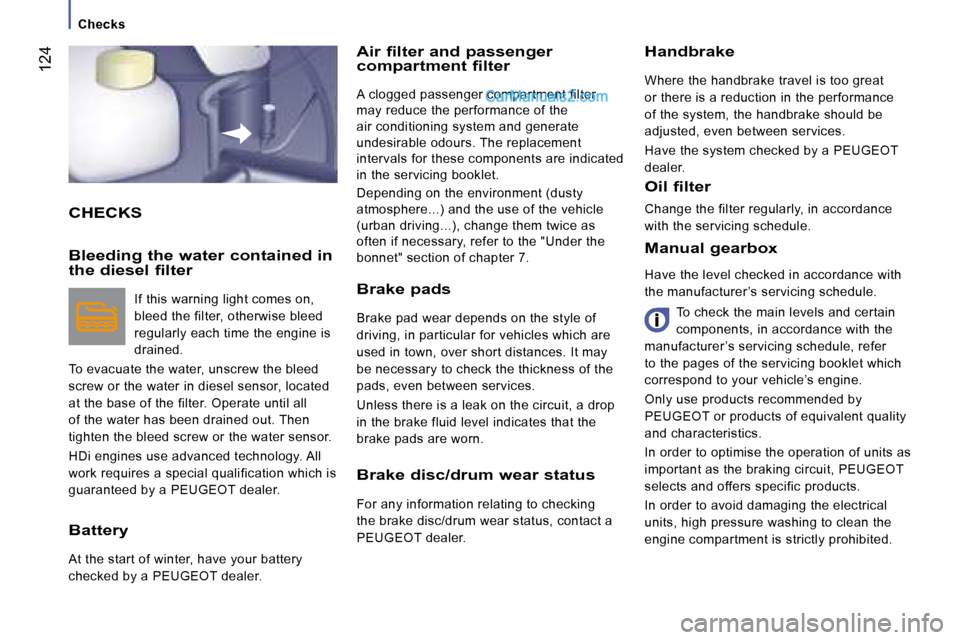
To evacuate the water, unscrew the bleed
screw or the water in diesel sensor, located
at the base of the filter. Operate until all
of the water has been drained out. Then
tighten the bleed screw or the water sensor.
HDi engines use advanced technology. All
work requires a special qualification which is
guaranteed by a PEUGEOT dealer.
Battery
At the start of winter, have your battery
checked by a PEUGEOT dealer.
Brake pads
Brake pad wear depends on the style of
driving, in particular for vehicles which are
used in town, over short distances. It may
be necessary to check the thickness of the
pads, even between services.
Unless there is a leak on the circuit, a drop
in the brake fluid level indicates that the
brake pads are worn.
Brake disc/drum wear status
For any information relating to checking
the brake disc/drum wear status, contact a
PEUGEOT dealer.
Oil filter
Change the filter regularly, in accordance
with the servicing schedule.
Checks
Page 115 of 154
126
Low fuel level
When the fuel tank level E
(Empty) is reached, this warning
light comes on. At this moment,
you have enough fuel left to
drive approximately 30 miles (50 km) ,
depending on the driving conditions, the
engine and the profile of the road. Fill up
without delay to avoid running out of fuel. The fuel tank must be illed
with the engine off.
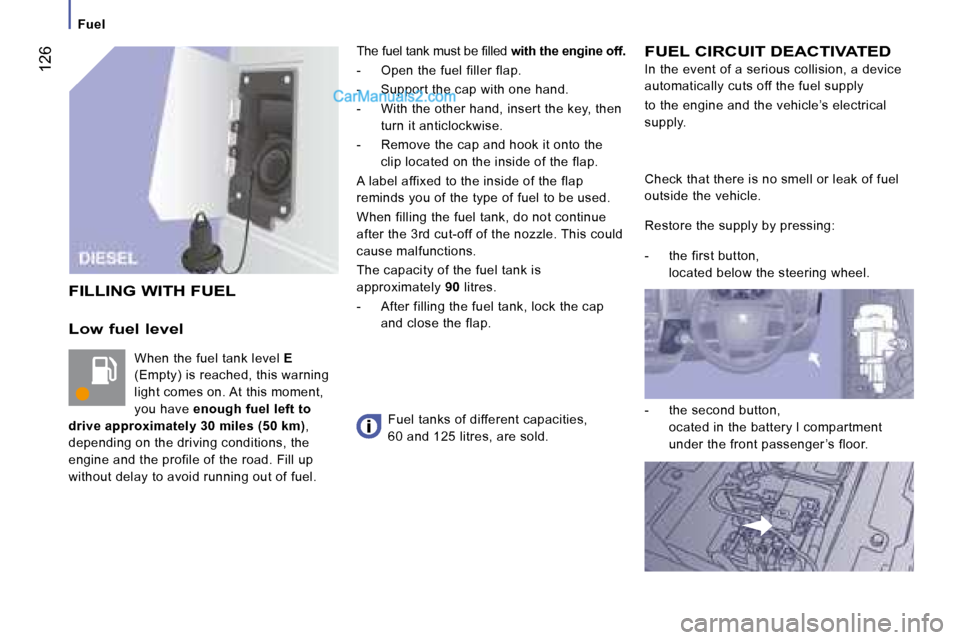
- Open the fuel filler flap.
- Support the cap with one hand.
- With the other hand, insert the key, then turn it anticlockwise.
- Remove the cap and hook it onto the clip located on the inside of the flap.
A label affixed to the inside of the flap
reminds you of the type of fuel to be used.
When filling the fuel tank, do not continue
after the 3rd cut-off of the nozzle. This could
cause malfunctions.
The capacity of the fuel tank is
approximately 90 litres.
- After filling the fuel tank, lock the cap and close the flap.
FUEL CIRCUIT DEACTIVATED
In the event of a serious collision, a device
automatically cuts off the fuel supply
to the engine and the vehicle’s electrical
supply.
FILLING WITH FUEL
Fuel tanks of different capacities,
60 and 125 litres, are sold. Check that there is no smell or leak of fuel
outside the vehicle.
Restore the supply by pressing:
- the first button,
located below the steering wheel.
- the second button, ocated in the battery l compartment
under the front passenger ’s floor.
Fuel
Page 117 of 154
128
The batteries contain harmful
substances such as sulphuric acid and
lead. They must be discarded in accordance
with the provisions of the law and must not,
in any circumstances, be discarded with
household waste.
Take used batteries to a special collection
point. It is advisable to disconnect the
negative (-) terminal of the battery if
the vehicle is not to be used for a period of
more than one month.
Before disconnecting the battery, you must
wait for 2 minutes after switching off the
ignition.
Never disconnect a terminal when the
engine is running.
Never charge a battery without first
disconnecting the terminals.
Close the windows and doors before
disconnecting the battery.
After every reconnection of the battery,
switch on the ignition and wait 1 minute
before starting to allow the electronic
systems to be initialised. If slight difficulties
are experienced after this, please contact a
PEUGEOT dealer. If the battery has been disconnected
for some time, it may be necessary to
reinitialise the following functions:
- the display parameters (date, time,
language, distance unit and temperature
unit),
- the radio stations,
- the central locking.
Some settings are cleared and must be
reprogrammed, consult a PEUGEOT.
If your vehicle is fitted with a
chronotachograph or an alarm,
disconnection of the negative (-) terminal of
the battery (located under the floor on the
left-hand side, in the cab) is recommended if
the vehicle is not to be used for a period of
more than 5 days.
Battery
Page 124 of 154
4
2
1
3
135
TROUBLESHOOTING
8
FRONT LIGHTS
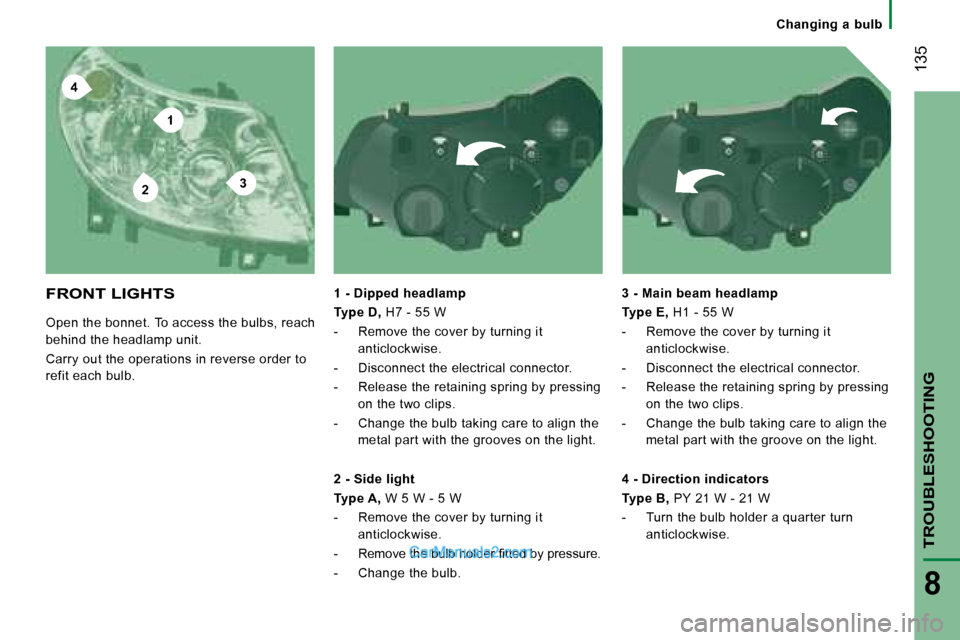
Open the bonnet. To access the bulbs, reach
behind the headlamp unit.
Carry out the operations in reverse order to
refit each bulb.1 - Dipped headlamp
Type D,
H7 - 55 W
- Remove the cover by turning it anticlockwise.
- Disconnect the electrical connector.
- Release the retaining spring by pressing on the two clips.
- Change the bulb taking care to align the metal part with the grooves on the light. 3 - Main beam headlamp
Type E,
H1 - 55 W
- Remove the cover by turning it anticlockwise.
- Disconnect the electrical connector.
- Release the retaining spring by pressing on the two clips.
- Change the bulb taking care to align the metal part with the groove on the light.
2 - Side light
Type A, W 5 W - 5 W
- Remove the cover by turning it anticlockwise.
- Remove the bulb holder itted by pressure.
- Change the bulb. 4 - Direction indicators
Type B,
PY 21 W - 21 W
- Turn the bulb holder a quarter turn anticlockwise. Changing a bulb
Page 125 of 154
136
- Remove the bulb by pressing it lightly while turning it anticlockwise.
- Change the bulb.
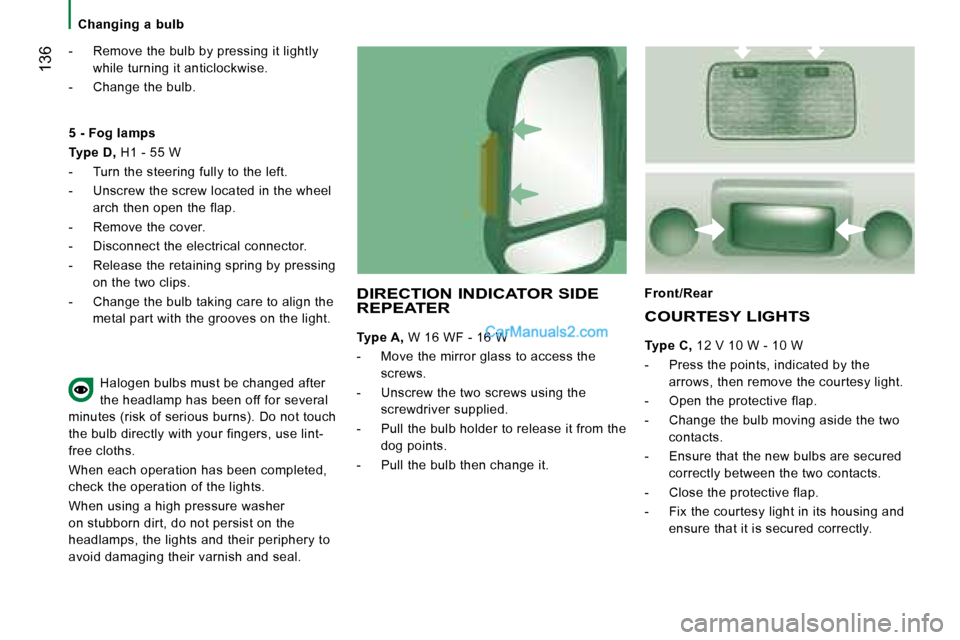
DIRECTION INDICATOR SIDE
REPEATER
Type A, W 16 WF - 16 W
- Move the mirror glass to access the screws.
- Unscrew the two screws using the screwdriver supplied.
- Pull the bulb holder to release it from the dog points.
- Pull the bulb then change it. Front/Rear
5 - Fog lamps
Type D,
H1 - 55 W
- Turn the steering fully to the left.
- Unscrew the screw located in the wheel arch then open the flap.
- Remove the cover.
- Disconnect the electrical connector.
- Release the retaining spring by pressing on the two clips.
- Change the bulb taking care to align the metal part with the grooves on the light.
Halogen bulbs must be changed after
the headlamp has been off for several
minutes (risk of serious burns). Do not touch
the bulb directly with your fingers, use lint-
free cloths.
When each operation has been completed,
check the operation of the lights.
When using a high pressure washer
on stubborn dirt, do not persist on the
headlamps, the lights and their periphery to
avoid damaging their varnish and seal.
COURTESY LIGHTS
Type C, 12 V 10 W - 10 W
- Press the points, indicated by the arrows, then remove the courtesy light.
- Open the protective flap.
- Change the bulb moving aside the two contacts.
- Ensure that the new bulbs are secured correctly between the two contacts.
- Close the protective flap.
- Fix the courtesy light in its housing and ensure that it is secured correctly.
Changing a bulb
Page 126 of 154
1
2
3
4
137
TROUBLESHOOTING
8
Changing a bulb
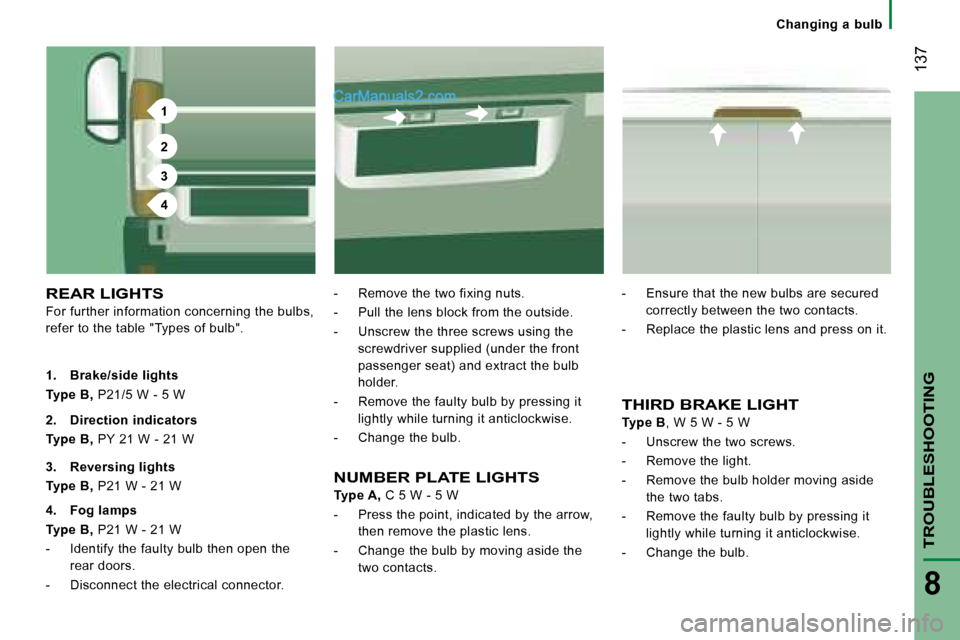
REAR LIGHTS
For further information concerning the bulbs,
refer to the table "Types of bulb".- Remove the two fixing nuts.
- Pull the lens block from the outside.
- Unscrew the three screws using the
screwdriver supplied (under the front
passenger seat) and extract the bulb
holder.
- Remove the faulty bulb by pressing it lightly while turning it anticlockwise.
- Change the bulb.
1.
Brake/side lights
Type B, P21/5 W - 5 W
THIRD BRAKE LIGHT
Type B, W 5 W - 5 W
- Unscrew the two screws.
- Remove the light.
- Remove the bulb holder moving aside the two tabs.
- Remove the faulty bulb by pressing it lightly while turning it anticlockwise.
- Change the bulb.
2.
Direction indicators
Type B, PY 21 W - 21 W
3. Reversing lights
Type B, P21 W - 21 W
4. Fog lamps
Type B, P21 W - 21 W
- Identify the faulty bulb then open the rear doors.
- Disconnect the electrical connector.
NUMBER PLATE LIGHTS
Type A, C 5 W - 5 W
- Press the point, indicated by the arrow, then remove the plastic lens.
- Change the bulb by moving aside the two contacts. - Ensure that the new bulbs are secured
correctly between the two contacts.
- Replace the plastic lens and press on it.