wheel Peugeot Boxer 2008 Owner's Guide
[x] Cancel search | Manufacturer: PEUGEOT, Model Year: 2008, Model line: Boxer, Model: Peugeot Boxer 2008Pages: 154, PDF Size: 3.27 MB
Page 89 of 154
103
5
SAFETY
Driving safety
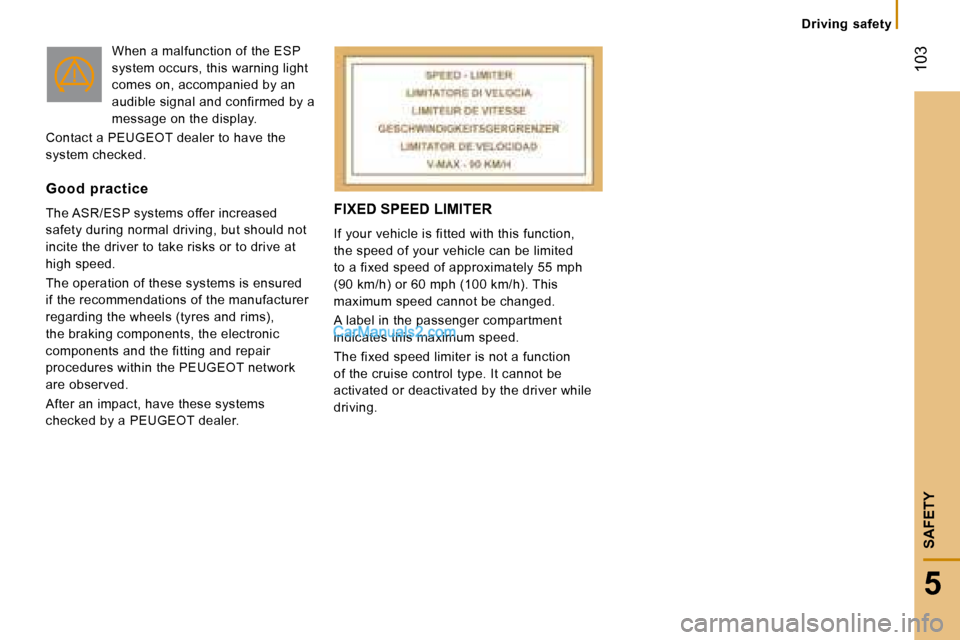
FIXED SPEED LIMITER
If your vehicle is fitted with this function,
the speed of your vehicle can be limited
to a fixed speed of approximately 55 mph
(90 km/h) or 60 mph (100 km/h). This
maximum speed cannot be changed.
A label in the passenger compartment
indicates this maximum speed.
The fixed speed limiter is not a function
of the cruise control type. It cannot be
activated or deactivated by the driver while
driving.
When a malfunction of the ESP
system occurs, this warning light
comes on, accompanied by an
audible signal and confirmed by a
message on the display.
Contact a PEUGEOT dealer to have the
system checked.
Good practice
The ASR/ESP systems offer increased
safety during normal driving, but should not
incite the driver to take risks or to drive at
high speed.
The operation of these systems is ensured
if the recommendations of the manufacturer
regarding the wheels (tyres and rims),
the braking components, the electronic
components and the fitting and repair
procedures within the PEUGEOT network
are observed.
After an impact, have these systems
checked by a PEUGEOT dealer.
Page 93 of 154
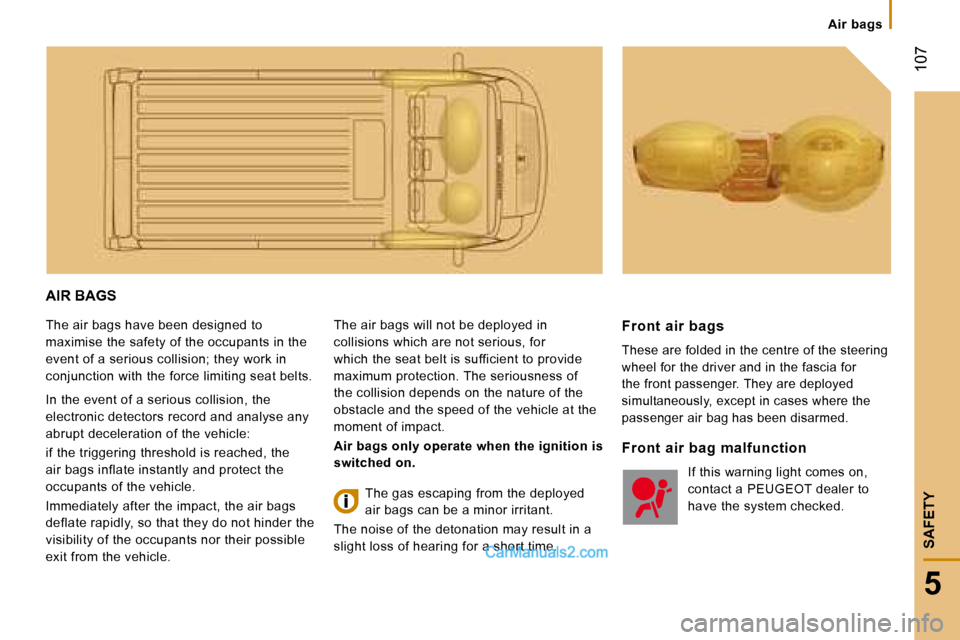
AIR BAGS
The air bags have been designed to
maximise the safety of the occupants in the
event of a serious collision; they work in
conjunction with the force limiting seat belts.
In the event of a serious collision, the
electronic detectors record and analyse any
abrupt deceleration of the vehicle:
if the triggering threshold is reached, the
air bags inflate instantly and protect the
occupants of the vehicle.
Immediately after the impact, the air bags
deflate rapidly, so that they do not hinder the
visibility of the occupants nor their possible
exit from the vehicle.The air bags will not be deployed in
collisions which are not serious, for
which the seat belt is sufficient to provide
maximum protection. The seriousness of
the collision depends on the nature of the
obstacle and the speed of the vehicle at the
moment of impact.
Air bags only operate when the ignition is
switched on.
Front air bags
These are folded in the centre of the steering
wheel for the driver and in the fascia for
the front passenger. They are deployed
simultaneously, except in cases where the
passenger air bag has been disarmed.
The gas escaping from the deployed
air bags can be a minor irritant.
The noise of the detonation may result in a
slight loss of hearing for a short time. Front air bag malfunction
If this warning light comes on,
contact a PEUGEOT dealer to
have the system checked.
107
5
SAFETY
Air bags
Page 95 of 154
Good practice
If your vehicle is fitted with front, side
and curtain air bags, in order for these to
be fully effective, observe the following
safety rules:
Wear a correctly adjusted seat belt.
Sit in a normal upright position.
Do not leave anything between the
occupants and the air bags (child, animal,
object...).
This could hamper the operation of the air
bags or injure the occupants.
All work on the air bag systems is strictly
prohibited unless it is carried out by qualified
personnel of the PEUGEOT network.
After an accident or if the vehicle has been
stolen or broken into, have the air bag
systems checked.Front air bags
Do not drive holding the steering wheel
by its spokes or resting your hands on the
centre part of the wheel.
Passengers must not place their feet on the
fascia.
Smoke as little as possible; deployment of
the air bags can cause burns or the risk of
injury from a cigarette or pipe.
Never remove or pierce the steering wheel
or hit it violently.
Side air bags
Only put approved covers on the front seats.
Consult a PEUGEOT dealer.
Do not fix or glue anything to the front seat
backs. This could cause injury to the chest
or arms when the side air bag is deployed.
Do not sit with the upper part of the body
any nearer to the door than necessary.Curtain air bags
Do not fix or glue anything to the pillars or
the roof. This could cause injury to the head
when the curtain air bag is deployed.
Do not remove the bolts from the grab
handles installed on the roof, they play a
part in securing the curtain air bags.
109
5
SAFETY
Air bags
Page 97 of 154
Good practice
If your vehicle is fitted with front, side
and curtain air bags, in order for these to
be fully effective, observe the following
safety rules:
Wear a correctly adjusted seat belt.
Sit in a normal upright position.
Do not leave anything between the
occupants and the air bags (child, animal,
object...).
This could hamper the operation of the air
bags or injure the occupants.
All work on the air bag systems is strictly
prohibited unless it is carried out by qualified
personnel of the PEUGEOT network.
After an accident or if the vehicle has been
stolen or broken into, have the air bag
systems checked.Front air bags
Do not drive holding the steering wheel
by its spokes or resting your hands on the
centre part of the wheel.
Passengers must not place their feet on the
fascia.
Smoke as little as possible; deployment of
the air bags can cause burns or the risk of
injury from a cigarette or pipe.
Never remove or pierce the steering wheel
or hit it violently.
Side air bags
Only put approved covers on the front seats.
Consult a PEUGEOT dealer.
Do not fix or glue anything to the front seat
backs. This could cause injury to the chest
or arms when the side air bag is deployed.
Do not sit with the upper part of the body
any nearer to the door than necessary.Curtain air bags
Do not fix or glue anything to the pillars or
the roof. This could cause injury to the head
when the curtain air bag is deployed.
Do not remove the bolts from the grab
handles installed on the roof, they play a
part in securing the curtain air bags.
109
5
SAFETY
Air bags
Page 105 of 154
116
Towing a trailer
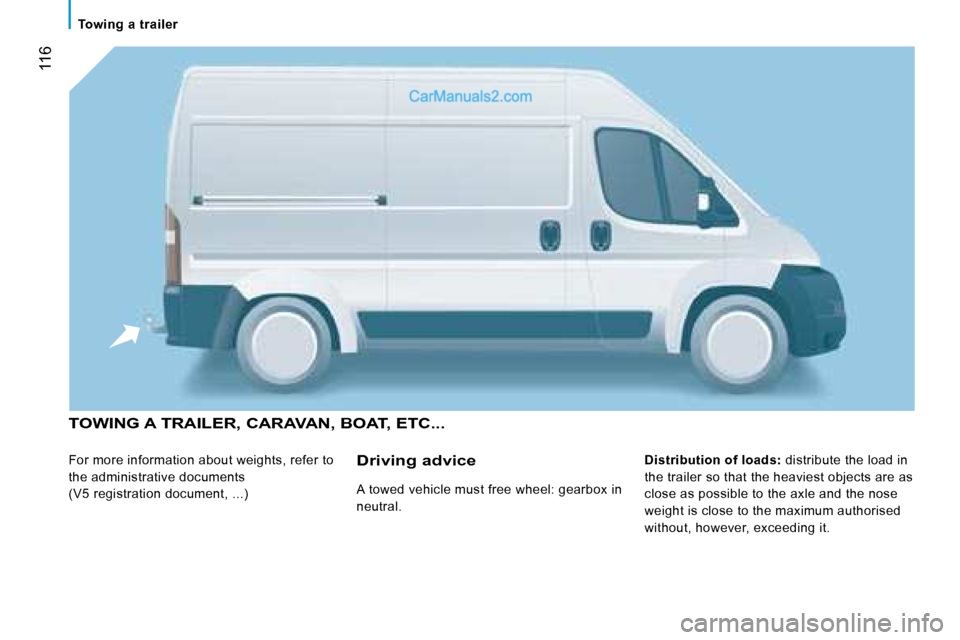
TOWING A TRAILER, CARAVAN, BOAT, ETC...
For more information about weights, refer to
the administrative documents
(V5 registration document, ...)Distribution of loads:
distribute the load in
the trailer so that the heaviest objects are as
close as possible to the axle and the nose
weight is close to the maximum authorised
without, however, exceeding it.Driving advice
A towed vehicle must free wheel: gearbox in
neutral.
Page 107 of 154
Equipment
118
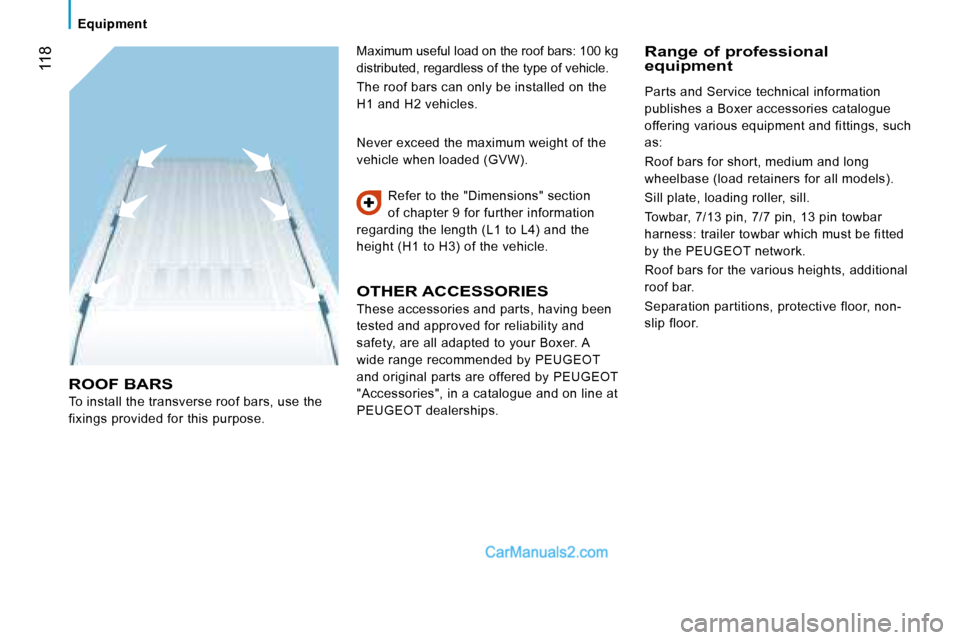
ROOF BARS
To install the transverse roof bars, use the
fixings provided for this purpose.Refer to the "Dimensions" section
of chapter 9 for further information
regarding the length (L1 to L4) and the
height (H1 to H3) of the vehicle.
Never exceed the maximum weight of the
vehicle when loaded (GVW).
OTHER ACCESSORIES
These accessories and parts, having been
tested and approved for reliability and
safety, are all adapted to your Boxer. A
wide range recommended by PEUGEOT
and original parts are offered by PEUGEOT
"Accessories", in a catalogue and on line at
PEUGEOT dealerships.
Range of professional
equipmentMaximum useful load on the roof bars: 100 kg
distributed, regardless of the type of vehicle.
The roof bars can only be installed on the
H1 and H2 vehicles.
Parts and Service technical information
publishes a Boxer accessories catalogue
offering various equipment and fittings, such
as:
Roof bars for short, medium and long
wheelbase (load retainers for all models).
Sill plate, loading roller, sill.
Towbar, 7/13 pin, 7/7 pin, 13 pin towbar
harness: trailer towbar which must be fitted
by the PEUGEOT network.
Roof bars for the various heights, additional
roof bar.
Separation partitions, protective floor, non-
slip floor.
Page 108 of 154
Equipment
118
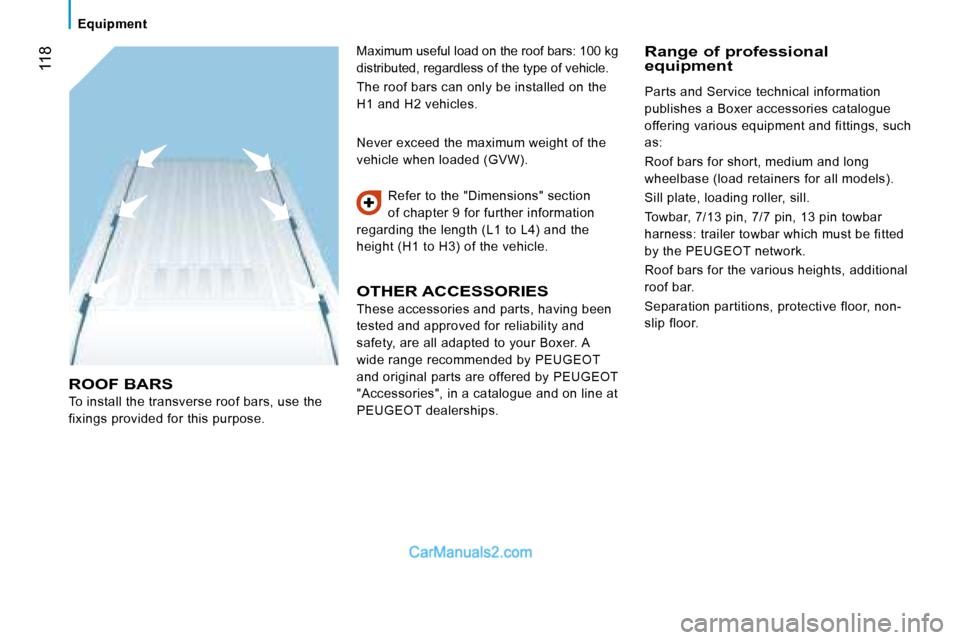
ROOF BARS
To install the transverse roof bars, use the
fixings provided for this purpose.Refer to the "Dimensions" section
of chapter 9 for further information
regarding the length (L1 to L4) and the
height (H1 to H3) of the vehicle.
Never exceed the maximum weight of the
vehicle when loaded (GVW).
OTHER ACCESSORIES
These accessories and parts, having been
tested and approved for reliability and
safety, are all adapted to your Boxer. A
wide range recommended by PEUGEOT
and original parts are offered by PEUGEOT
"Accessories", in a catalogue and on line at
PEUGEOT dealerships.
Range of professional
equipmentMaximum useful load on the roof bars: 100 kg
distributed, regardless of the type of vehicle.
The roof bars can only be installed on the
H1 and H2 vehicles.
Parts and Service technical information
publishes a Boxer accessories catalogue
offering various equipment and fittings, such
as:
Roof bars for short, medium and long
wheelbase (load retainers for all models).
Sill plate, loading roller, sill.
Towbar, 7/13 pin, 7/7 pin, 13 pin towbar
harness: trailer towbar which must be fitted
by the PEUGEOT network.
Roof bars for the various heights, additional
roof bar.
Separation partitions, protective floor, non-
slip floor.
Page 115 of 154
126
Low fuel level
When the fuel tank level E
(Empty) is reached, this warning
light comes on. At this moment,
you have enough fuel left to
drive approximately 30 miles (50 km) ,
depending on the driving conditions, the
engine and the profile of the road. Fill up
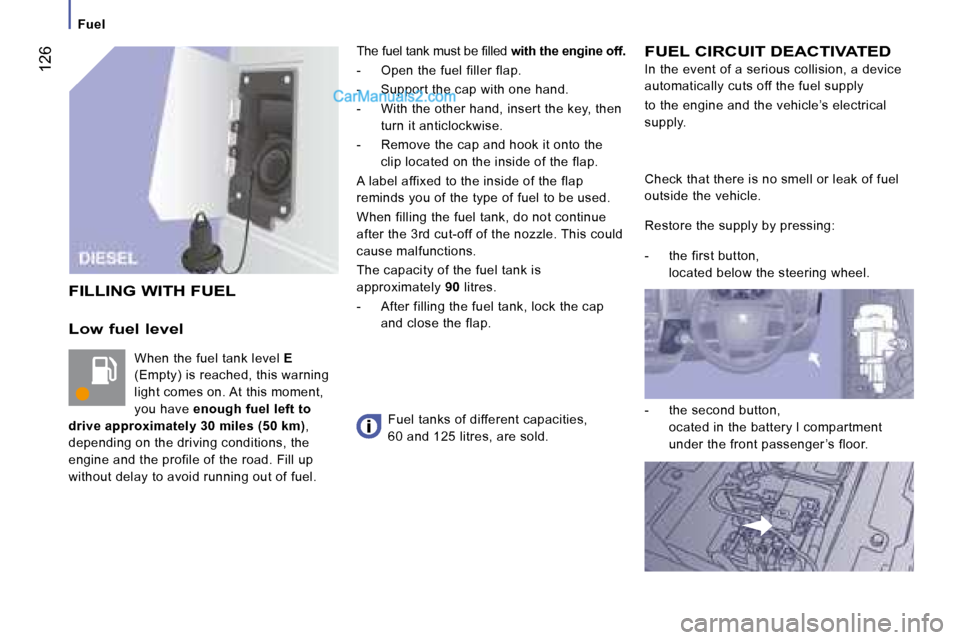
without delay to avoid running out of fuel. The fuel tank must be illed
with the engine off.
- Open the fuel filler flap.
- Support the cap with one hand.
- With the other hand, insert the key, then turn it anticlockwise.
- Remove the cap and hook it onto the clip located on the inside of the flap.
A label affixed to the inside of the flap
reminds you of the type of fuel to be used.
When filling the fuel tank, do not continue
after the 3rd cut-off of the nozzle. This could
cause malfunctions.
The capacity of the fuel tank is
approximately 90 litres.
- After filling the fuel tank, lock the cap and close the flap.
FUEL CIRCUIT DEACTIVATED
In the event of a serious collision, a device
automatically cuts off the fuel supply
to the engine and the vehicle’s electrical
supply.
FILLING WITH FUEL
Fuel tanks of different capacities,
60 and 125 litres, are sold. Check that there is no smell or leak of fuel
outside the vehicle.
Restore the supply by pressing:
- the first button,
located below the steering wheel.
- the second button, ocated in the battery l compartment
under the front passenger ’s floor.
Fuel
Page 118 of 154
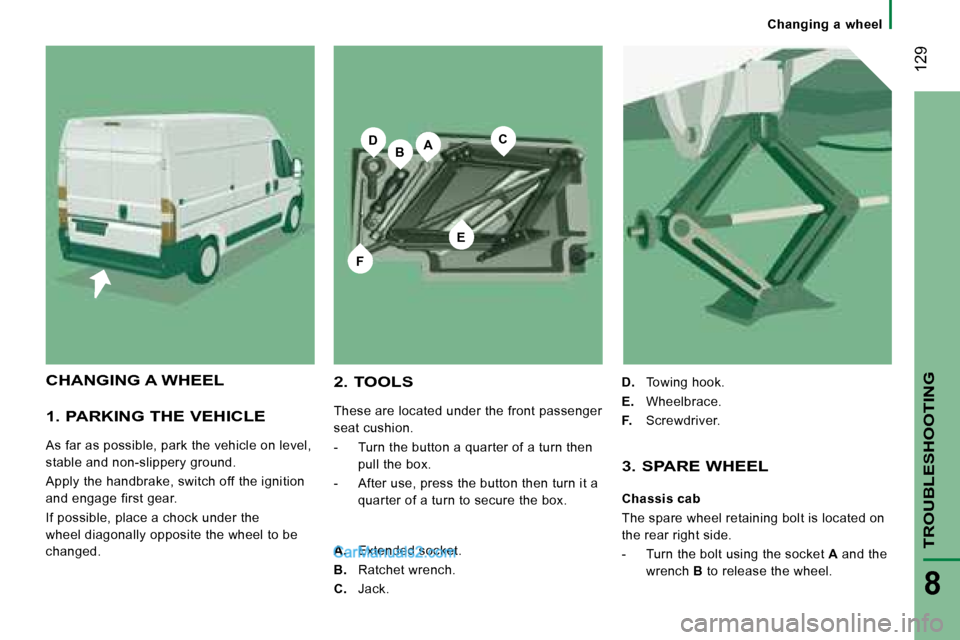
BA
E
CD
F
129
TROUBLESHOOTING
8
1. PARKING THE VEHICLE
As far as possible, park the vehicle on level,
stable and non-slippery ground.
Apply the handbrake, switch off the ignition
and engage first gear.
If possible, place a chock under the
wheel diagonally opposite the wheel to be
changed.
2. TOOLS
These are located under the front passenger
seat cushion.
- Turn the button a quarter of a turn then pull the box.
- After use, press the button then turn it a quarter of a turn to secure the box. D.
Towing hook.
E. Wheelbrace.
F. Screwdriver.
CHANGING A WHEEL
3. SPARE WHEEL
Chassis cab
The spare wheel retaining bolt is located on
the rear right side.
- Turn the bolt using the socket A
and the
wrench B to release the wheel.
A.
Extended socket.
B. Ratchet wrench.
C. Jack. Changing a wheel
Page 119 of 154
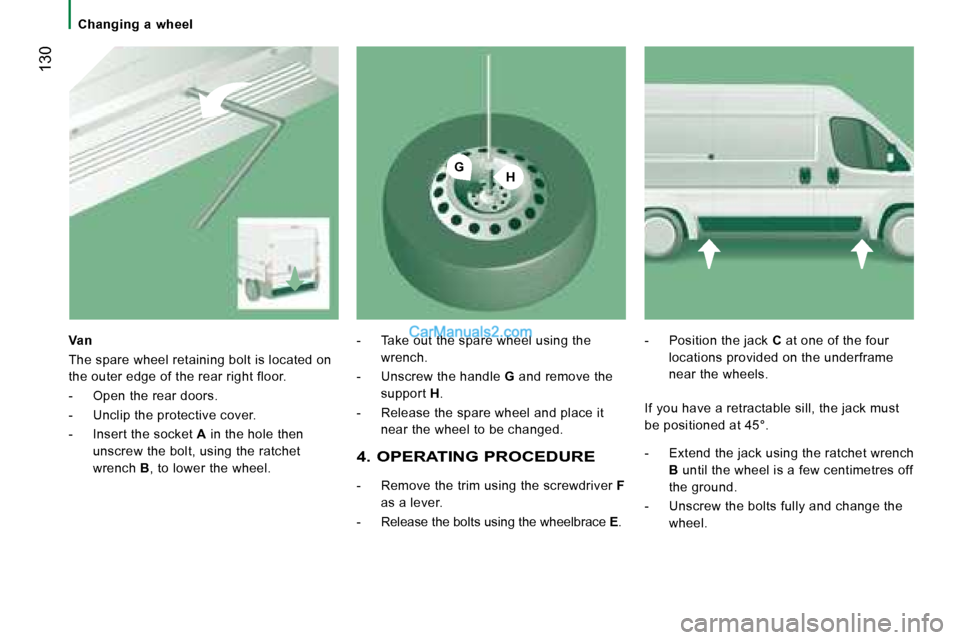
GH
130
Van
The spare wheel retaining bolt is located on
the outer edge of the rear right floor.
- Open the rear doors.
- Unclip the protective cover.
- Insert the socket A
in the hole then
unscrew the bolt, using the ratchet
wrench B, to lower the wheel. - Take out the spare wheel using the
wrench.
- Unscrew the handle G
and remove the
support H.
- Release the spare wheel and place it near the wheel to be changed. - Position the jack
C at one of the four
locations provided on the underframe
near the wheels.
4. OPERATING PROCEDURE
- Remove the trim using the screwdriver F
as a lever.
- Release the bolts using the wheelbrace E
. If you have a retractable sill, the jack must
be positioned at 45°.
- Extend the jack using the ratchet wrench
B until the wheel is a few centimetres off
the ground.
- Unscrew the bolts fully and change the wheel.
Changing a wheel