battery Peugeot Boxer 2008 Owner's Manual
[x] Cancel search | Manufacturer: PEUGEOT, Model Year: 2008, Model line: Boxer, Model: Peugeot Boxer 2008Pages: 154, PDF Size: 3.27 MB
Page 3 of 154
3
2
1
20
Accesses
KEY
This locks and unlocks the locks on the
vehicle and starts the engine.
REMOTE CONTROL BATTERY
If the diode flashes when one of the remote
control buttons is pressed, the battery must
be changed.
Reference: CR 2032/3 volts.
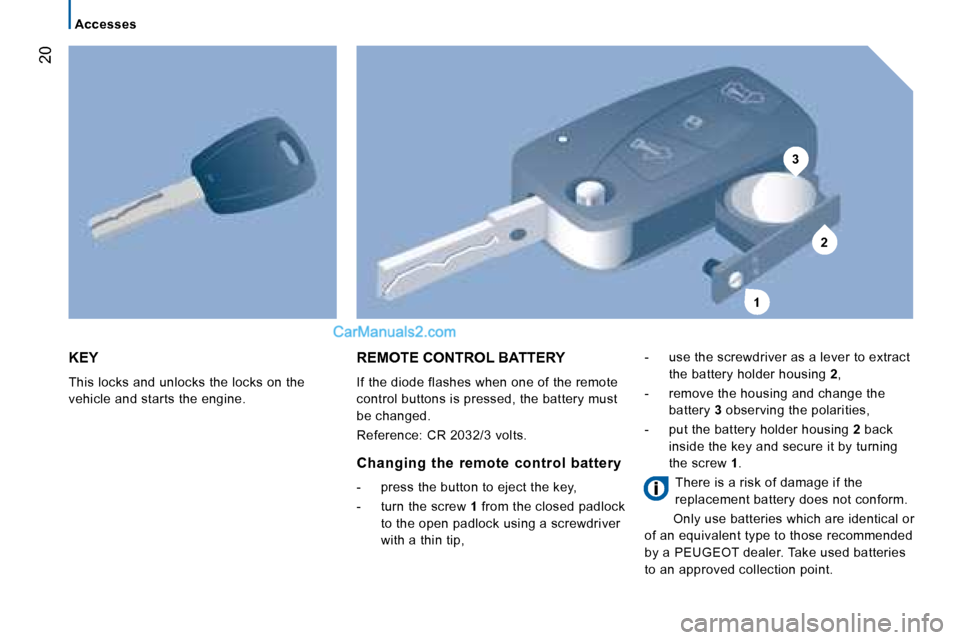
Changing the remote control battery
- press the button to eject the key,
- turn the screw 1
from the closed padlock
to the open padlock using a screwdriver
with a thin tip, - use the screwdriver as a lever to extract
the battery holder housing 2,
- remove the housing and change the battery 3 observing the polarities,
- put the battery holder housing 2
back
inside the key and secure it by turning
the screw 1.
There is a risk of damage if the
replacement battery does not conform.
Only use batteries which are identical or
of an equivalent type to those recommended
by a PEUGEOT dealer. Take used batteries
to an approved collection point.
Page 11 of 154
28
Instruments and controls
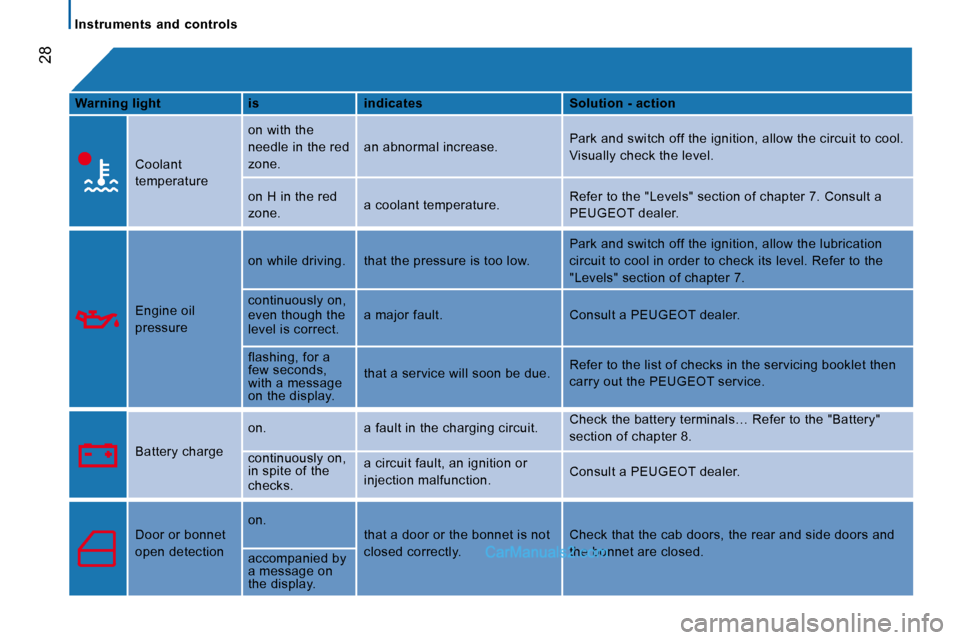
Warning light is indicates Solution - action
Coolant
temperature on with the
needle in the red
zone.
an abnormal increase.
Park and switch off the ignition, allow the circuit
to cool.
Visually check the level.
on H in the red
zone. a coolant temperature. Refer to the "Levels" section of chapter 7. Consult
a
PEUGEOT dealer.
Engine oil
pressure on while driving. that the pressure is too low.
Park and switch off the ignition, allow the lubrica
tion
circuit to cool in order to check its level. Refer to the
"Levels" section of chapter 7.
continuously on,
even though the
level is correct. a major fault. Consult a PEUGEOT dealer.
flashing, for a
few seconds,
with a message
on the display. that a service will soon be due.
Refer to the list of checks in the servicing bookle
t then
carry out the PEUGEOT service.
Battery charge on. a fault in the charging circuit.
Check the battery terminals… Refer to the "Battery"
section of chapter 8.
continuously on,
in spite of the
checks. a circuit fault, an ignition or
injection malfunction.
Consult a PEUGEOT dealer.
Door or bonnet
open detection on.
that a door or the bonnet is not
closed correctly. Check that the cab doors, the rear and side doors a
nd
the bonnet are closed.
accompanied by
a message on
the display.
Page 63 of 154
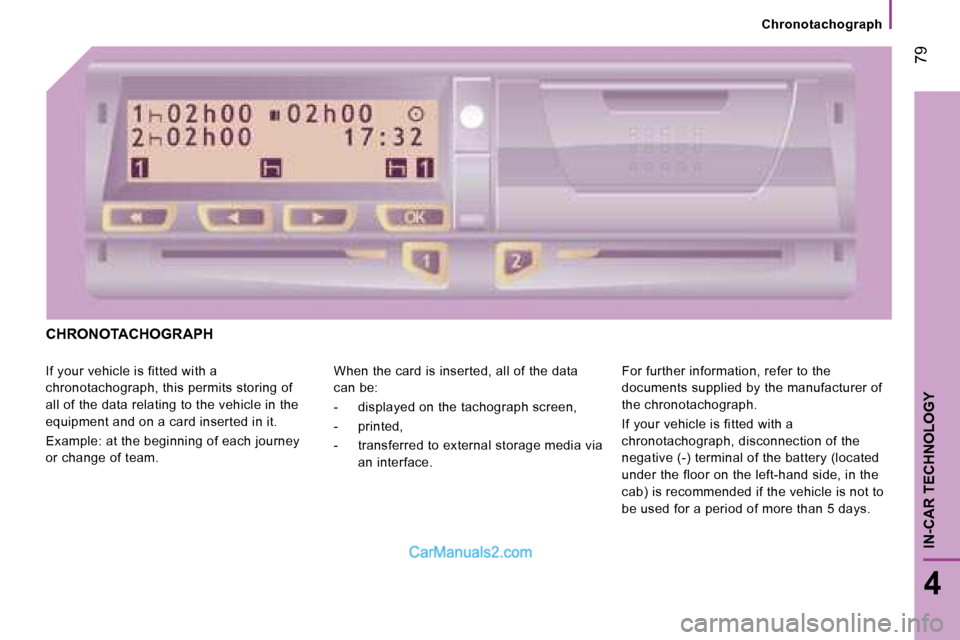
CHRONOTACHOGRAPH
If your vehicle is fitted with a
chronotachograph, this permits storing of
all of the data relating to the vehicle in the
equipment and on a card inserted in it.
Example: at the beginning of each journey
or change of team.When the card is inserted, all of the data
can be:
- displayed on the tachograph screen,
- printed,
- transferred to external storage media via
an interface. For further information, refer to the
documents supplied by the manufacturer of
the chronotachograph.
If your vehicle is fitted with a
chronotachograph, disconnection of the
negative (-) terminal of the battery (located
under the floor on the left-hand side, in the
cab) is recommended if the vehicle is not to
be used for a period of more than 5 days.
79
4
IN-CAR TECHNOLOGY
Chronotachograph
Page 72 of 154
KEY
Indicates that a maintained press is required to start the action described.
Voice mode Press the control to start the voice recognition, a n audible signal confirms that the function has bee n activated, do not speak until
you hear this signal.
For further information regarding the voice command s, say "Help" or refer to the tables at the end of this document.
INTRODUCTION
This equipment chiefly enables you to:
- connect your Bluetooth® mobile telephone to your vehicle leaving your hands free,
- play audio sources (mp3, wma, wav) from a portabl e player,
- use the voice commands.
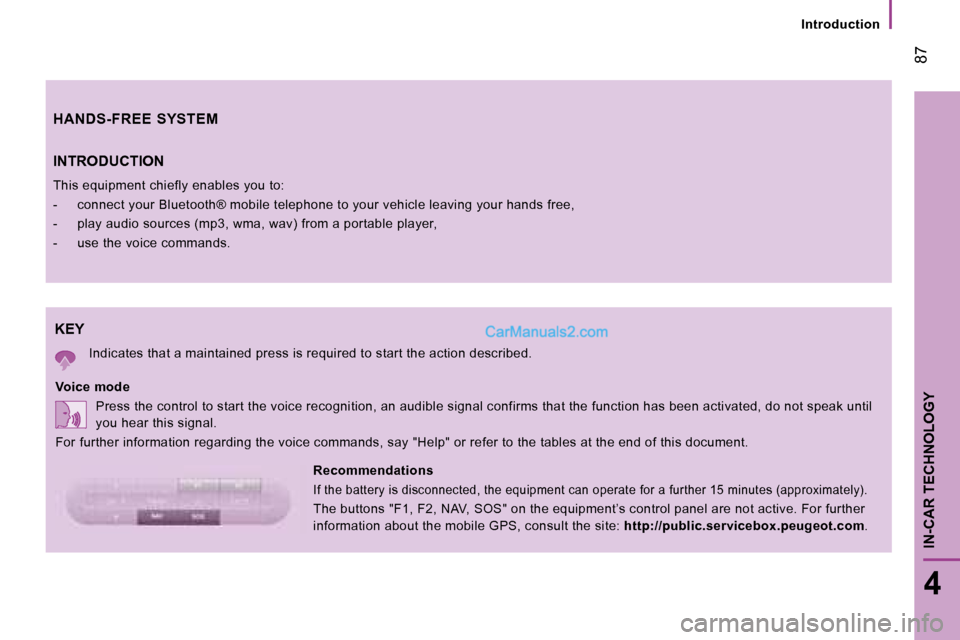
Recommendations
If the battery is disconnected, the equipment can o perate for a further 15 minutes (approximately).
The buttons "F1, F2, NAV, SOS" on the equipment’s c ontrol panel are not active. For further
information about the mobile GPS, consult the site: http://public.servicebox.peugeot.com .
HANDS-FREE SYSTEM
87
4
IN-CAR TECHNOLOGY
Introduction
Page 111 of 154
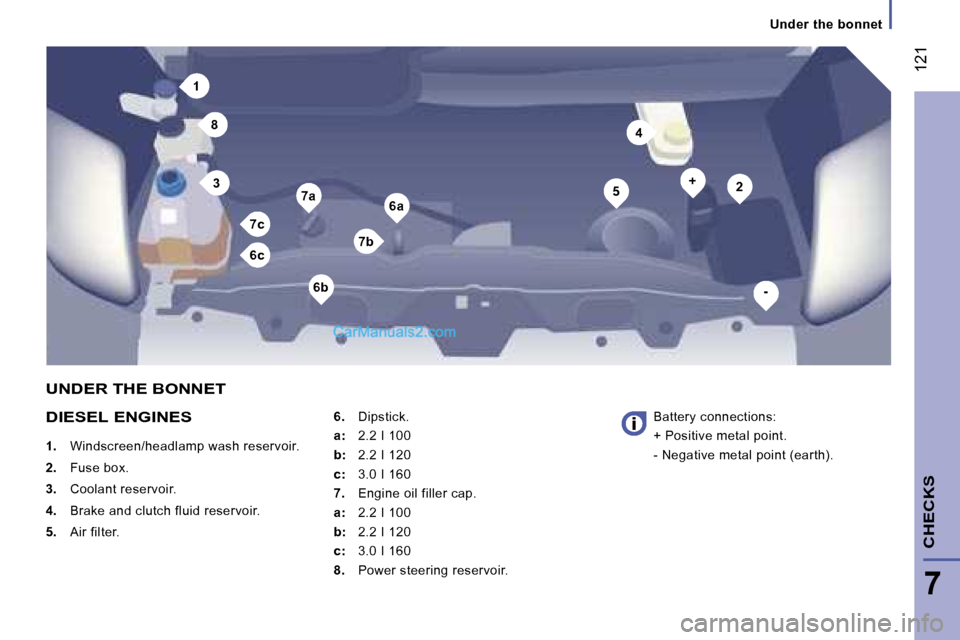
1
23
4
56a7a
8
6c7b
7c
6b
+
-
121
7
CHECKS
DIESEL ENGINES
1. Windscreen/headlamp wash reservoir.
2. Fuse box.
3. Coolant reservoir.
4. Brake and clutch fluid reservoir.
5. Air filter. 6.
Dipstick.
a: 2.2 I 100
b: 2.2 I 120
c: 3.0 I 160
7. Engine oil filler cap.
a: 2.2 I 100
b: 2.2 I 120
c: 3.0 I 160
8. Power steering reservoir. Battery connections:
+ Positive metal point.
- Negative metal point (earth).
UNDER THE BONNET
Under the bonnet
Page 114 of 154
124
CHECKS
Air filter and passenger
compartment filter
A clogged passenger compartment filter
may reduce the performance of the
air conditioning system and generate
undesirable odours. The replacement
intervals for these components are indicated
in the servicing booklet.
Depending on the environment (dusty
atmosphere...) and the use of the vehicle
(urban driving...), change them twice as
often if necessary, refer to the "Under the
bonnet" section of chapter 7.
Manual gearbox
Have the level checked in accordance with
the manufacturer ’s servicing schedule.To check the main levels and certain
components, in accordance with the
manufacturer ’s servicing schedule, refer
to the pages of the servicing booklet which
correspond to your vehicle’s engine.
Only use products recommended by
PEUGEOT or products of equivalent quality
and characteristics.
In order to optimise the operation of units as
important as the braking circuit, PEUGEOT
selects and offers specific products.
In order to avoid damaging the electrical
units, high pressure washing to clean the
engine compartment is strictly prohibited.
Handbrake
Where the handbrake travel is too great
or there is a reduction in the performance
of the system, the handbrake should be
adjusted, even between services.
Have the system checked by a PEUGEOT
dealer.
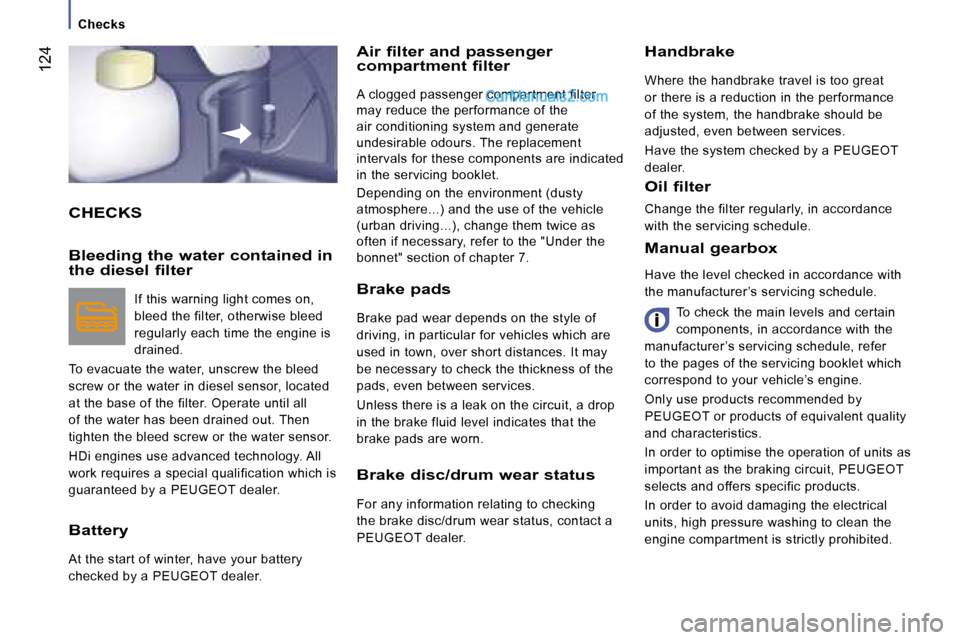
Bleeding the water contained in
the diesel filter
If this warning light comes on,
bleed the filter, otherwise bleed
regularly each time the engine is
drained.
To evacuate the water, unscrew the bleed
screw or the water in diesel sensor, located
at the base of the filter. Operate until all
of the water has been drained out. Then
tighten the bleed screw or the water sensor.
HDi engines use advanced technology. All
work requires a special qualification which is
guaranteed by a PEUGEOT dealer.
Battery
At the start of winter, have your battery
checked by a PEUGEOT dealer.
Brake pads
Brake pad wear depends on the style of
driving, in particular for vehicles which are
used in town, over short distances. It may
be necessary to check the thickness of the
pads, even between services.
Unless there is a leak on the circuit, a drop
in the brake fluid level indicates that the
brake pads are worn.
Brake disc/drum wear status
For any information relating to checking
the brake disc/drum wear status, contact a
PEUGEOT dealer.
Oil filter
Change the filter regularly, in accordance
with the servicing schedule.
Checks
Page 115 of 154
126
Low fuel level
When the fuel tank level E
(Empty) is reached, this warning
light comes on. At this moment,
you have enough fuel left to
drive approximately 30 miles (50 km) ,
depending on the driving conditions, the
engine and the profile of the road. Fill up
without delay to avoid running out of fuel. The fuel tank must be illed
with the engine off.
- Open the fuel filler flap.
- Support the cap with one hand.
- With the other hand, insert the key, then turn it anticlockwise.
- Remove the cap and hook it onto the clip located on the inside of the flap.
A label affixed to the inside of the flap
reminds you of the type of fuel to be used.
When filling the fuel tank, do not continue
after the 3rd cut-off of the nozzle. This could
cause malfunctions.
The capacity of the fuel tank is
approximately 90 litres.
- After filling the fuel tank, lock the cap and close the flap.
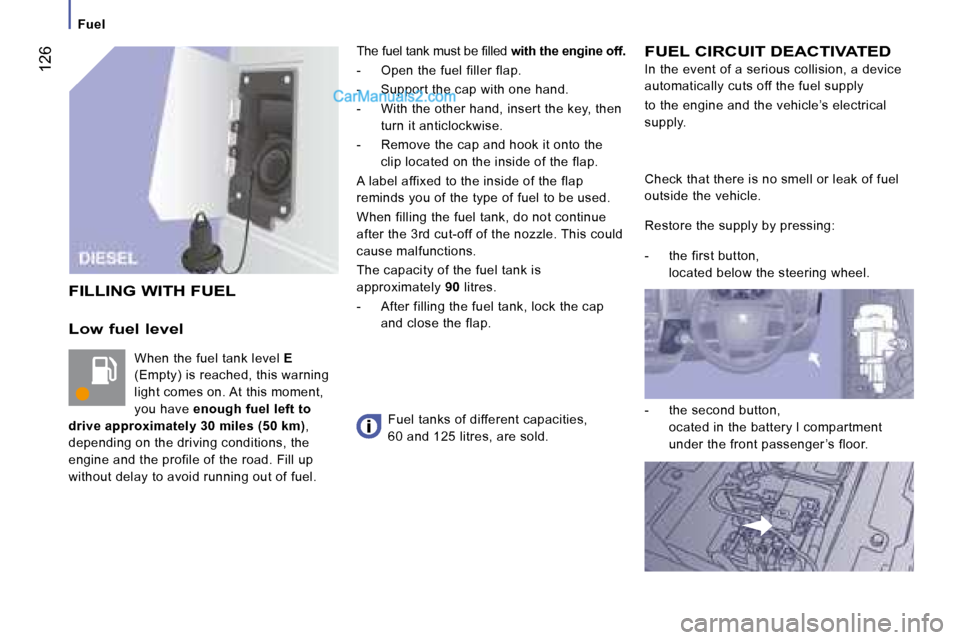
FUEL CIRCUIT DEACTIVATED
In the event of a serious collision, a device
automatically cuts off the fuel supply
to the engine and the vehicle’s electrical
supply.
FILLING WITH FUEL
Fuel tanks of different capacities,
60 and 125 litres, are sold. Check that there is no smell or leak of fuel
outside the vehicle.
Restore the supply by pressing:
- the first button,
located below the steering wheel.
- the second button, ocated in the battery l compartment
under the front passenger ’s floor.
Fuel
Page 116 of 154
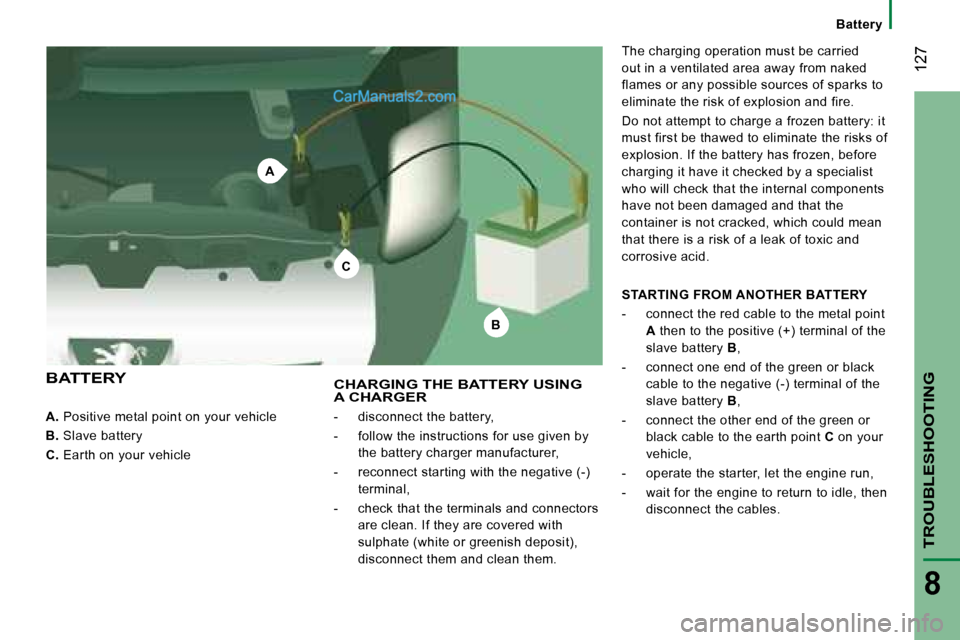
C
B
A
127
TROUBLESHOOTING
8
A. Positive metal point on your vehicle
B. Slave battery
C. Earth on your vehicle
CHARGING THE BATTERY USING
A CHARGER
- disconnect the battery,
- follow the instructions for use given by
the battery charger manufacturer,
- reconnect starting with the negative (-) terminal,
- check that the terminals and connectors are clean. If they are covered with
sulphate (white or greenish deposit),
disconnect them and clean them. The charging operation must be carried
out in a ventilated area away from naked
flames or any possible sources of sparks to
eliminate the risk of explosion and fire.
Do not attempt to charge a frozen battery: it
must first be thawed to eliminate the risks of
explosion. If the battery has frozen, before
charging it have it checked by a specialist
who will check that the internal components
have not been damaged and that the
container is not cracked, which could mean
that there is a risk of a leak of toxic and
corrosive acid.
BATTERY
STARTING FROM ANOTHER BATTERY
- connect the red cable to the metal point
A then to the positive (+) terminal of the
slave battery B,
- connect one end of the green or black cable to the negative (-) terminal of the
slave battery B,
- connect the other end of the green or black cable to the earth point C on your
vehicle,
- operate the starter, let the engine run,
- wait for the engine to return to idle, then disconnect the cables. Battery
Page 117 of 154
128
The batteries contain harmful
substances such as sulphuric acid and
lead. They must be discarded in accordance
with the provisions of the law and must not,
in any circumstances, be discarded with
household waste.
Take used batteries to a special collection
point. It is advisable to disconnect the
negative (-) terminal of the battery if
the vehicle is not to be used for a period of
more than one month.
Before disconnecting the battery, you must
wait for 2 minutes after switching off the
ignition.
Never disconnect a terminal when the
engine is running.
Never charge a battery without first
disconnecting the terminals.
Close the windows and doors before
disconnecting the battery.
After every reconnection of the battery,
switch on the ignition and wait 1 minute
before starting to allow the electronic
systems to be initialised. If slight difficulties
are experienced after this, please contact a
PEUGEOT dealer. If the battery has been disconnected
for some time, it may be necessary to
reinitialise the following functions:
- the display parameters (date, time,
language, distance unit and temperature
unit),
- the radio stations,
- the central locking.
Some settings are cleared and must be
reprogrammed, consult a PEUGEOT.
If your vehicle is fitted with a
chronotachograph or an alarm,
disconnection of the negative (-) terminal of
the battery (located under the floor on the
left-hand side, in the cab) is recommended if
the vehicle is not to be used for a period of
more than 5 days.
Battery