key Peugeot Boxer 2010 User Guide
[x] Cancel search | Manufacturer: PEUGEOT, Model Year: 2010, Model line: Boxer, Model: Peugeot Boxer 2010Pages: 167, PDF Size: 4.33 MB
Page 41 of 167
43
3
EASE OF USE AND COMFORT
Steering mounted controls
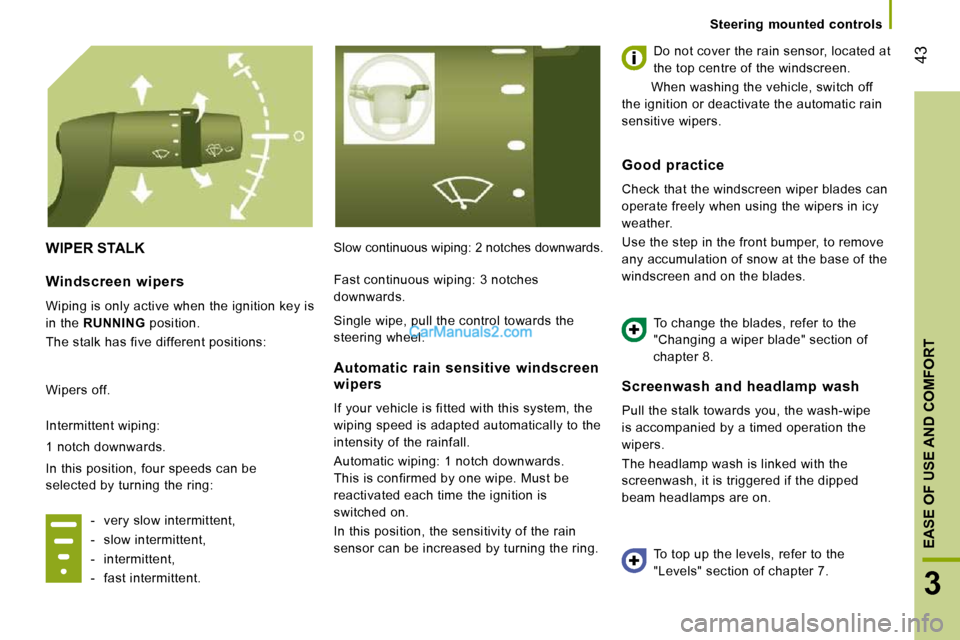
WIPER STALK Slow continuous wiping: 2 notches downwards.
Do not cover the rain sensor, located at
the top centre of the windscreen.
When washing the vehicle, switch off
the ignition or deactivate the automatic rain
sensitive wipers.
Screenwash and headlamp wash
Pull the stalk towards you, the wash-wipe
is accompanied by a timed operation the
wipers.
The headlamp wash is linked with the
screenwash, it is triggered if the dipped
beam headlamps are on.
Windscreen wipers
Wiping is only active when the ignition key is
in the RUNNING position.
The stalk has five different positions:
Wipers off.
Intermittent wiping:
1 notch downwards.
In this position, four speeds can be
selected by turning the ring:
- very slow intermittent,
- slow intermittent,
- intermittent,
- fast intermittent.
Automatic rain sensitive windscreen wipers
If your vehicle is fitted with this system, the
wiping speed is adapted automatically to the
intensity of the rainfall.
Automatic wiping: 1 notch downwards.
This is confirmed by one wipe. Must be
reactivated each time the ignition is
switched on.
In this position, the sensitivity of the rain
sensor can be increased by turning the ring.
Good practice
Check that the windscreen wiper blades can
operate freely when using the wipers in icy
weather.
Use the step in the front bumper, to remove
any accumulation of snow at the base of the
windscreen and on the blades.
To change the blades, refer to the
"Changing a wiper blade" section of
chapter 8.
To top up the levels, refer to the
"Levels" section of chapter 7.
Fast continuous wiping: 3 notches
downwards.
Single wipe, pull the control towards the
steering wheel.
Page 69 of 167

71
3
EASE OF USE AND COMFORT
Mirrors and windows
ELECTRIC WINDOWS
A. Driver's electric window control
B. Passenger
's
electric window control You have two options:
Automatic operation
Press or pull control A/B , beyond the point of
resistance: the window opens or closes fully
when the control is released.
Pressing the control again stops the
movement of the window.
Manual operation
Press or pull control A , without passing the
point of resistance.
The window stops when you release the
control.
Good practice
Always remove the key from the ignition
when leaving the vehicle, even for a short
time.
If the electric windows meet an obstacle
during operation, you must reverse the
movement of the window. To do this, press
the control concerned.
When the driver operates the passenger
electric window controls, they must ensure
that no one is preventing correct closing of
the windows.
The driver must ensure that the passengers
use the electric windows correctly.
Be aware of children when operating
the windows.
The electrical functions of the electric
windows are deactivated one minute after
the ignition is switched off.
Page 75 of 167
77
4
TECHNOLOGY ON BOARD
Reversing camera
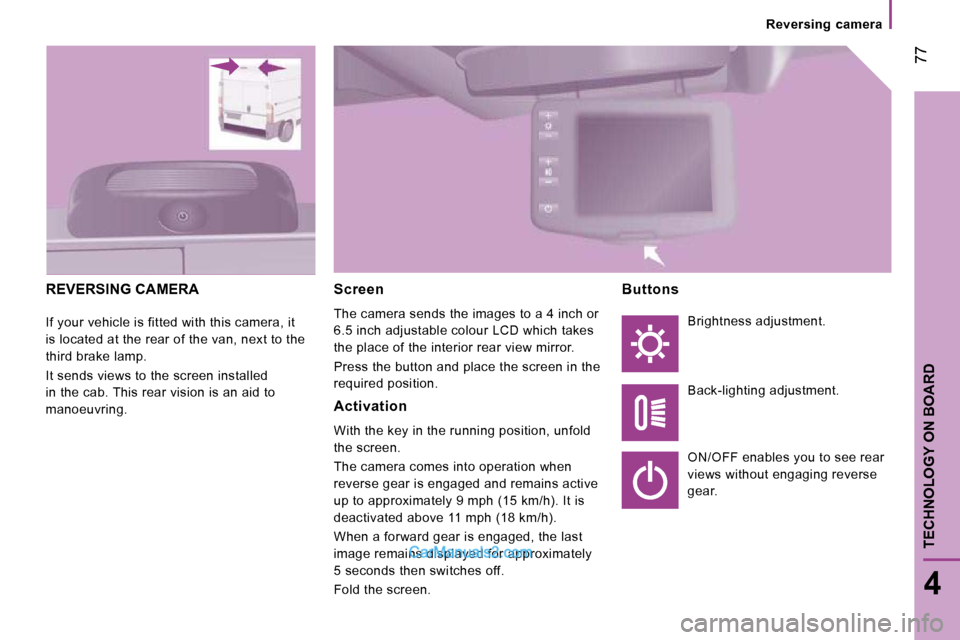
REVERSING CAMERA
If your vehicle is fitted with this camera, it
is located at the rear of the van, next to the
third brake lamp.
It sends views to the screen installed
in the cab. This rear vision is an aid to
manoeuvring.
Screen
The camera sends the images to a 4 inch or
6.5 inch adjustable colour LCD which takes
the place of the interior rear view mirror.
Press the button and place the screen in the
required position.
Activation
With the key in the running position, unfold
the screen.
The camera comes into operation when
reverse gear is engaged and remains active
up to approximately 9 mph (15 km/h). It is
deactivated above 11 mph (18 km/h).
When a forward gear is engaged, the last
image remains displayed for approximately
5 seconds then switches off.
Fold the screen.
Buttons
Brightness adjustment.
Back-lighting adjustment.
ON/OFF enables you to see rear
views without engaging reverse
gear.
Page 83 of 167
4
TECHNOLOGY ON BOARD
Audio equipment
Scroll the
display
Select
Display
Select
Display
Select
Display
Select
Display
Enables you
to…
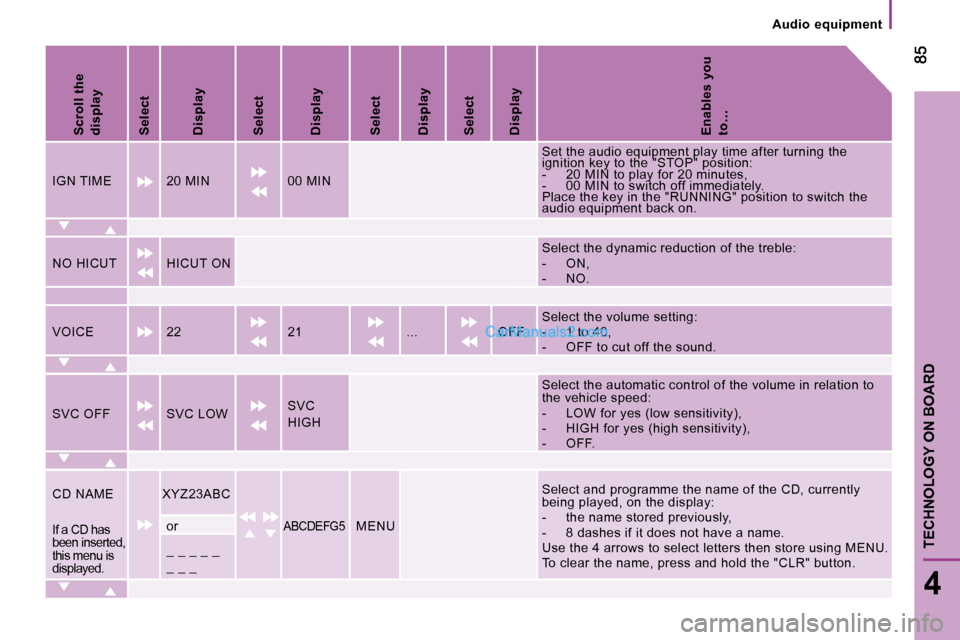
IGN TIME 20 MIN 00 MIN
Set the audio equipment play time after turning th e
ignition key to the "STOP" position:
- 20 MIN to play for 20 minutes,
- 00 MIN to switch off immediately.
Place the key in the "RUNNING" position to switch the
audio equipment back on.
NO HICUT HICUT ON Select the dynamic reduction of the treble:
- ON,
- NO.
VOICE 22 21 ... OFF Select the volume setting:
- 1 to 40,
- OFF to cut off the sound.
SVC OFF SVC LOW
SVC
HIGH
Select the automatic control of the volume in rela
tion to
the vehicle speed:
- LOW for yes (low sensitivity),
- HIGH for yes (high sensitivity),
- OFF.
CD NAME
XYZ23ABC
ABCDEFG5 MENU
Select and programme the name of the CD, currently
being played, on the display:
- the name stored previously,
- 8 dashes if it does not have a name.
Use the 4 arrows to select letters then store usin g MENU.
To clear the name, press and hold the "CLR" button .
If a CD has
been inserted,
this menu is
displayed. or
_ _ _ _ _
_ _ _
Page 87 of 167
89
4
TECHNOLOGY ON BOARD
Introduction
KEY
Indicates that a maintained press is required to start the action described.
Voice mode Press the control to start the voice recognition, an audible signal confirms that the function has be en activated, do not speak until
you hear this signal.
For further information regarding the voice comman ds, say "Help" or refer to the tables at the end of this document.
INTRODUCTION
This equipment chiefly enables you to:
- connect your Bluetooth®
mobile telephone to your vehicle leaving your hand s free,
- play audio sources (mp3, wma, wav) from a port able player,
- use the voice commands.
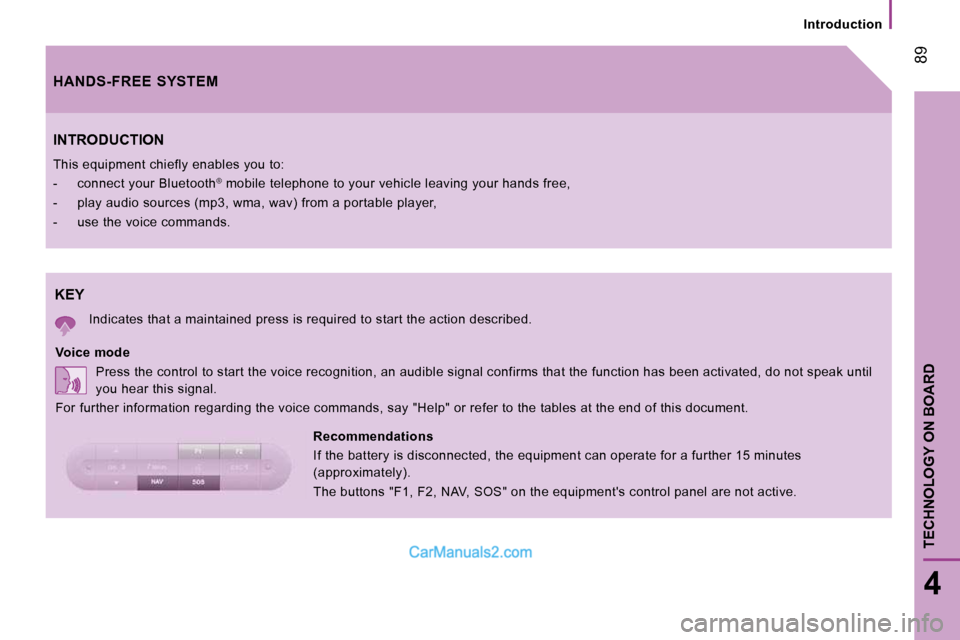
Recommendations
If the battery is disconnected, the equipment can operate for a further 15 minutes
(approximately).
The buttons "F1, F2, NAV, SOS" on the equipment's control panel are not active.
HANDS-FREE SYSTEM
Page 90 of 167
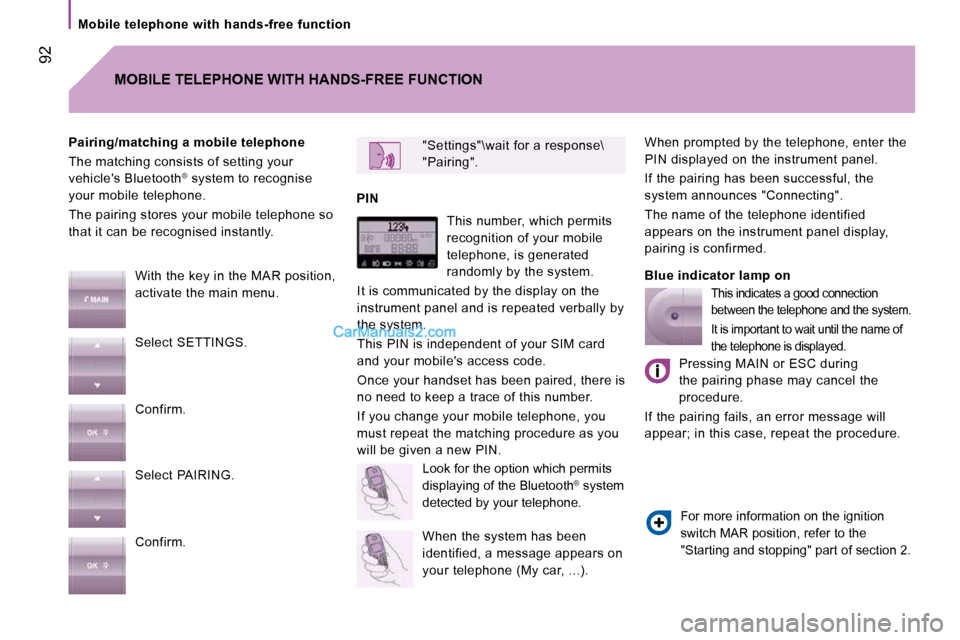
Mobile telephone with hands-free function
92
When prompted by the telephone, enter the
PIN displayed on the instrument panel.
If the pairing has been successful, the
system announces "Connecting".
The name of the telephone identified
appears on the instrument panel display,
pairing is confirmed.
Blue indicator lamp on
"Settings"\wait for a response\
"Pairing".
PIN
Pairing/matching a mobile telephone
The matching consists of setting your
vehicle's Bluetooth
®
system to recognise
your mobile telephone.
The pairing stores your mobile telephone so
that it can be recognised instantly.
MOBILE TELEPHONE WITH HANDS-FREE FUNCTION
With the key in the MAR position,
activate the main menu.
Select SETTINGS.
Confirm.
Select PAIRING.
Confirm. This number, which permits
recognition of your mobile
telephone, is generated
randomly by the system.
It is communicated by the display on the
instrument panel and is repeated verbally by
the system.
This PIN is independent of your SIM card
and your mobile's access code.
Once your handset has been paired, there is
no need to keep a trace of this number.
If you change your mobile telephone, you
must repeat the matching procedure as you
will be given a new PIN. Look for the option which permits
displaying of the Bluetooth ®
system
detected by your telephone.
When the system has been
identified, a message appears on
your telephone (My car, ...).
This indicates a good connection
between the telephone and the system.
It is important to wait until the name of
the telephone is displayed.
Pressing MAIN or ESC during
the pairing phase may cancel the
procedure.
If the pairing fails, an error message will
appear; in this case, repeat the procedure.
For more information on the ignition
switch MAR position, refer to the
"Starting and stopping" part of section 2.
Page 93 of 167
95
4
TECHNOLOGY ON BOARD
Mobile telephone with hands-free function
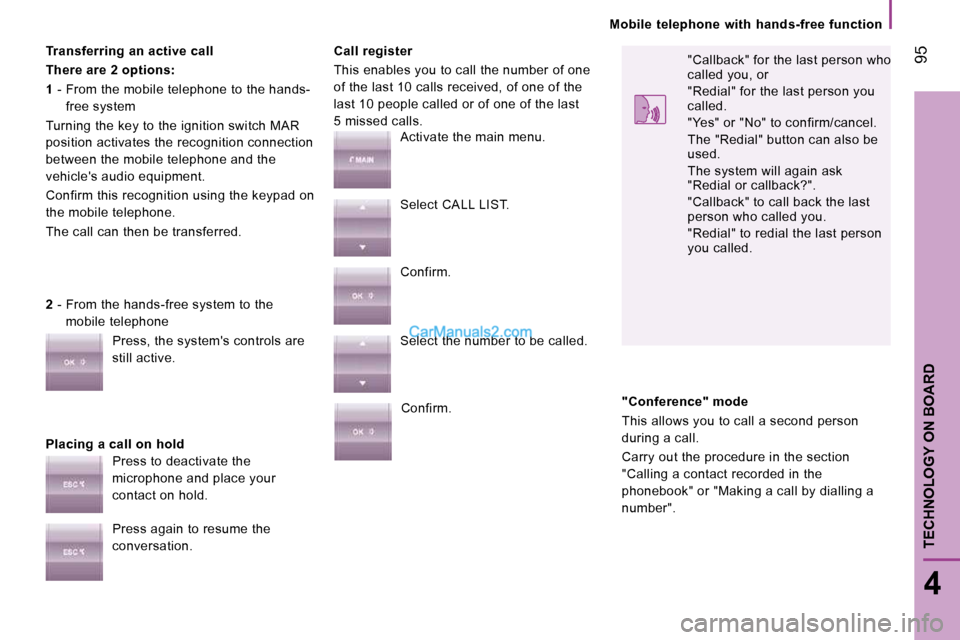
Transferring an active call
There are 2 options:
1 - From the mobile telephone to the hands-
free system
Turning the key to the ignition switch MAR
position activates the recognition connection
between the mobile telephone and the
vehicle's audio equipment.
Confirm this recognition using the keypad on
the mobile telephone.
The call can then be transferred.
Placing a call on hold Call register
This enables you to call the number of one
of the last 10 calls received, of one of the
last 10 people called or of one of the last
5 missed calls.
2 - From the hands-free system to the
mobile telephone
Press, the system's controls are
still active.
Press to deactivate the
microphone and place your
contact on hold.
Press again to resume the
conversation. Activate the main menu.
Select CALL LIST.
Confirm.
Select the number to be called.
Confirm. "Callback" for the last person who
called you, or
"Redial" for the last person you
called.
"Yes" or "No" to confirm/cancel.
The "Redial" button can also be
used.
The system will again ask
"Redial or callback?".
"Callback" to call back the last
person who called you.
"Redial" to redial the last person
you called.
"Conference" mode
This allows you to call a second person
during a call.
Carry out the procedure in the section
"Calling a contact recorded in the
phonebook" or "Making a call by dialling a
number".
Page 94 of 167
Portable equipment audio player
96
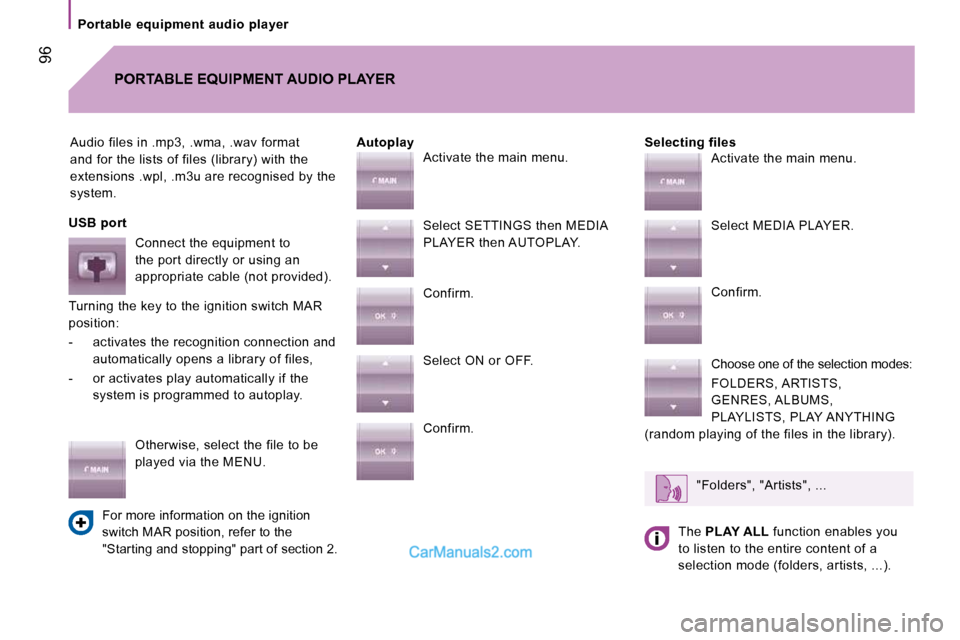
Audio files in .mp3, .wma, .wav format
and for the lists of files (library) with the
extensions .wpl, .m3u are recognised by the
system. Selecting files
PORTABLE EQUIPMENT AUDIO PLAYER
Autoplay
USB port Connect the equipment to
the port directly or using an
appropriate cable (not provided).
Turning the key to the ignition switch MAR
position:
- activates the recognition connection and automatically opens a library of files,
- or activates play automatically if the system is programmed to autoplay.
Otherwise, select the file to be
played via the MENU.
For more information on the ignition
switch MAR position, refer to the
"Starting and stopping" part of section 2. Activate the main menu.
Select SETTINGS then MEDIA
PLAYER then AUTOPLAY.
Confirm.
Select ON or OFF.
Confirm.
Activate the main menu.
Select MEDIA PLAYER.
Confirm.
Choose one of the selection modes:
FOLDERS, ARTISTS,
GENRES, ALBUMS,
PLAYLISTS, PLAY ANYTHING
(random playing of the files in the library).
"Folders", "Artists", ...
The PLAY ALL function enables you
to listen to the entire content of a
selection mode (folders, artists, ...).
Page 96 of 167
Voice commands
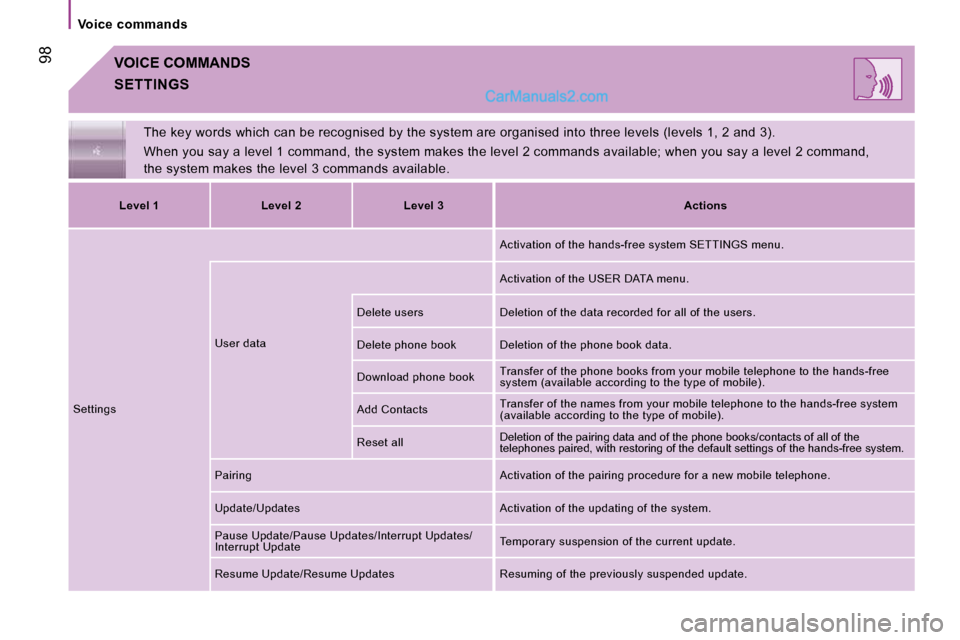
98 VOICE COMMANDS
The key words which can be recognised by the system are organised into three levels (levels 1, 2 and 3).
When you say a level 1 command, the system makes t he level 2 commands available; when you say a level 2 command,
the system makes the level 3 commands available.
SETTINGS
Level 1 Level 2 Level 3
Actions
Settings User data Activation of the hands-free system SETTINGS menu.
Activation of the USER DATA menu.
Delete users Deletion of the data recorded for all of the users.
Delete phone book Deletion of the phone book data.
Download phone book Transfer of the phone books from your mobile telep
hone to the hands-free
system (available according to the type of mobile).
Add Contacts Transfer of the names from your mobile telephone t
o the hands-free system
(available according to the type of mobile).
Reset all Deletion of the pairing data and of the phone books/co
ntacts of all of the
telephones paired, with restoring of the default settings of the hands-free system.
Pairing Activation of the pairing procedure for a new mobile telephone.
Update/Updates Activation of the updating of the system.
Pause Update/Pause Updates/Interrupt Updates/
Interrupt Update Temporary suspension of the current update.
Resume Update/Resume Updates Resuming of the previ ously suspended update.
Page 98 of 167
Voice commands
100
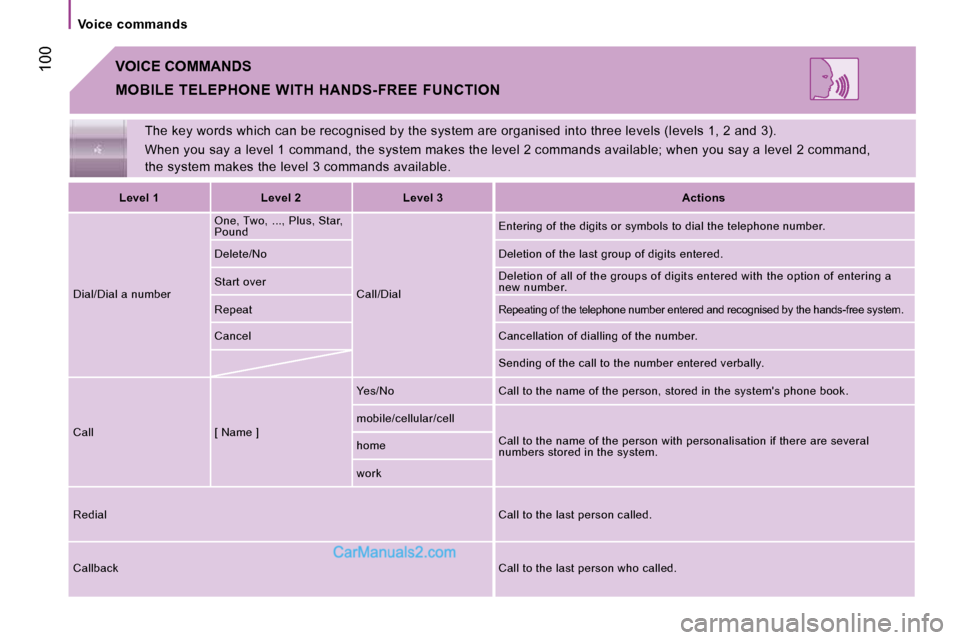
The key words which can be recognised by the system are organised into three levels (levels 1, 2 and 3).
When you say a level 1 command, the system makes t he level 2 commands available; when you say a level 2 command,
the system makes the level 3 commands available.
VOICE COMMANDS
MOBILE TELEPHONE WITH HANDS-FREE FUNCTION
Level 1 Level 2 Level 3
Actions
Dial/Dial a number One, Two, ..., Plus, Star,
Pound
Call/Dial Entering of the digits or symbols to dial the tele
phone number.
Delete/No Deletion of the last group of digits entered.
Start over Deletion of all of the groups of digits entered wi
th the option of entering a
new number.
Repeat
Repeating of the telephone number entered and reco gnised by the hands-free system.
Cancel Cancellation of dialling of the number.
Sending of the call to the number entered verbally.
Call [ Name ] Yes/No Call to the name of the person, stored in
the system's phone book.
mobile/cellular/cell Call to the name of the person with personalisatio n if there are several
numbers stored in the system.
home
work
Redial Call to the last person called.
Callback Call to the last person who called.