steering Peugeot Boxer 2010 User Guide
[x] Cancel search | Manufacturer: PEUGEOT, Model Year: 2010, Model line: Boxer, Model: Peugeot Boxer 2010Pages: 167, PDF Size: 4.33 MB
Page 101 of 167
103
5
Driving safely
SAFETY
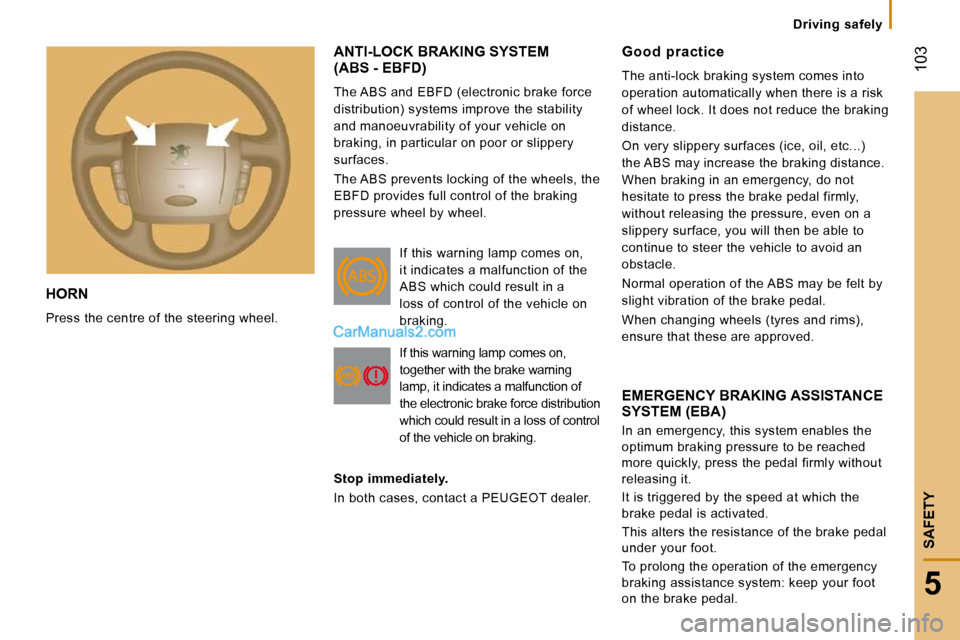
HORN
Press the centre of the steering wheel.
ANTI-LOCK BRAKING SYSTEM(ABS - EBFD)
The ABS and EBFD (electronic brake force
distribution) systems improve the stability
and manoeuvrability of your vehicle on
braking, in particular on poor or slippery
surfaces.
The ABS prevents locking of the wheels, the
EBFD provides full control of the braking
pressure wheel by wheel.
EMERGENCY BRAKING ASSISTANCE SYSTEM (EBA)
In an emergency, this system enables the
optimum braking pressure to be reached
more quickly, press the pedal firmly without
releasing it.
It is triggered by the speed at which the
brake pedal is activated.
This alters the resistance of the brake pedal
under your foot.
To prolong the operation of the emergency
braking assistance system: keep your foot
on the brake pedal.
Good practice
The anti-lock braking system comes into
operation automatically when there is a risk
of wheel lock. It does not reduce the braking
distance.
On very slippery surfaces (ice, oil, etc...)
the ABS may increase the braking distance.
When braking in an emergency, do not
hesitate to press the brake pedal firmly,
without releasing the pressure, even on a
slippery surface, you will then be able to
continue to steer the vehicle to avoid an
obstacle.
Normal operation of the ABS may be felt by
slight vibration of the brake pedal.
When changing wheels (tyres and rims),
ensure that these are approved.
If this warning lamp comes on,
it indicates a malfunction of the
ABS which could result in a
loss of control of the vehicle on
braking.
If this warning lamp comes on,
together with the brake warning
lamp, it indicates a malfunction of
the electronic brake force distribution
which could result in a loss of control
of the vehicle on braking.
Stop immediately.
In both cases, contact a PEUGEOT dealer.
Page 108 of 167
109
5
SAFETY
Airbags
AIRBAGS
The airbags have been designed to
maximise the safety of the occupants in the
event of a serious collision; they work in
conjunction with the force limiting seat belts.
In the event of a serious collision, the
electronic detectors record and analyse any
abrupt deceleration of the vehicle:
if the triggering threshold is reached, the
airbags inflate instantly and protect the
occupants of the vehicle.
Immediately after the impact, the airbags
deflate rapidly, so that they do not hinder the
visibility of the occupants nor their possible
exit from the vehicle. The airbags will not be deployed in collisions
which are not serious, for which the seat belt
is sufficient to provide maximum protection.
The seriousness of the collision depends on
the nature of the obstacle and the speed of
the vehicle at the moment of impact.
Airbags
only operate when the ignition is
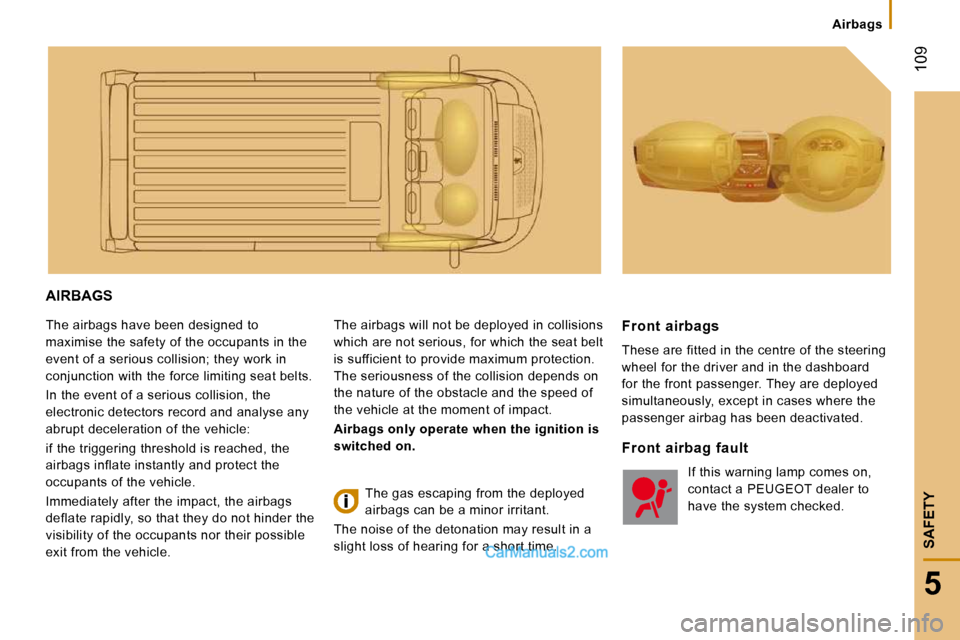
switched on. Front airbags
These are fitted in the centre of the steering
wheel for the driver and in the dashboard
for the front passenger. They are deployed
simultaneously, except in cases where the
passenger airbag has been deactivated.
The gas escaping from the deployed
airbags can be a minor irritant.
The noise of the detonation may result in a
slight loss of hearing for a short time.
Front airbag fault
If this warning lamp comes on,
contact a PEUGEOT dealer to
have the system checked.
Page 110 of 167
111
5
SAFETY
Airbags
Good practice
If your vehicle is fitted with front,
lateral
and curtain
airbags
, in order for these to
be fully effective, observe the following
safety rules:
Wear a correctly adjusted seat belt.
Sit in a normal upright position.
Do not leave anything between the
occupants and the airbags (child, animal,
object...).
This could hamper the operation of the
airbags or injure the occupants.
All work on the airbag systems is strictly
prohibited unless it is carried out by qualified
personnel of the PEUGEOT network.
After an accident or if the vehicle has been
stolen or broken into, have the airbag
systems checked.
Front airbags
Do not drive holding the steering wheel
by its spokes or resting your hands on the
centre part of the wheel.
Passengers must not place their feet on the
dashboard.
Smoke as little as possible; deployment of
the airbags can cause burns or the risk of
injury from a cigarette or pipe.
Never remove or pierce the steering wheel
or hit it violently.
Lateral airbags
Only put approved covers on the front seats.
Consult a PEUGEOT dealer.
Do not fix or attach anything to the front seat
backs. This could cause injury to the chest
or arms when the lateral airbag is deployed.
Do not sit with the upper part of the body
any nearer to the door than necessary.
Curtain airbags
Do not fix or attach anything to the pillars or
the roof. This could cause injury to the head
when the curtain airbag is deployed.
Do not remove the bolts from the grab
handles installed on the roof, they play a
part in securing the curtain airbags.
Page 112 of 167
111
5
SAFETY
Airbags
Good practice
If your vehicle is fitted with front,
lateral
and curtain
airbags
, in order for these to
be fully effective, observe the following
safety rules:
Wear a correctly adjusted seat belt.
Sit in a normal upright position.
Do not leave anything between the
occupants and the airbags (child, animal,
object...).
This could hamper the operation of the
airbags or injure the occupants.
All work on the airbag systems is strictly
prohibited unless it is carried out by qualified
personnel of the PEUGEOT network.
After an accident or if the vehicle has been
stolen or broken into, have the airbag
systems checked.
Front airbags
Do not drive holding the steering wheel
by its spokes or resting your hands on the
centre part of the wheel.
Passengers must not place their feet on the
dashboard.
Smoke as little as possible; deployment of
the airbags can cause burns or the risk of
injury from a cigarette or pipe.
Never remove or pierce the steering wheel
or hit it violently.
Lateral airbags
Only put approved covers on the front seats.
Consult a PEUGEOT dealer.
Do not fix or attach anything to the front seat
backs. This could cause injury to the chest
or arms when the lateral airbag is deployed.
Do not sit with the upper part of the body
any nearer to the door than necessary.
Curtain airbags
Do not fix or attach anything to the pillars or
the roof. This could cause injury to the head
when the curtain airbag is deployed.
Do not remove the bolts from the grab
handles installed on the roof, they play a
part in securing the curtain airbags.
Page 127 of 167
125
7
CHECKS
Under the bonnet
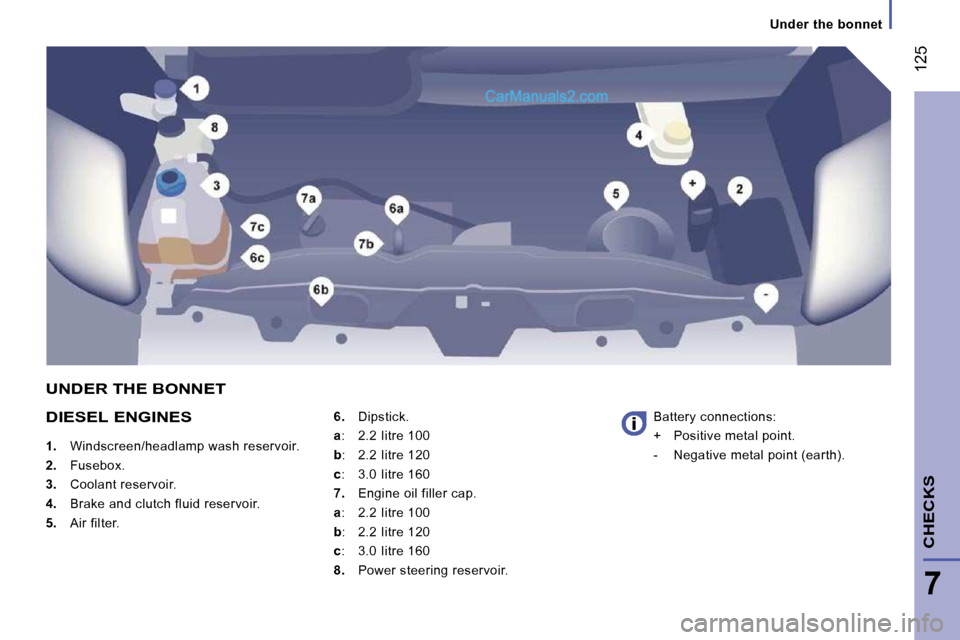
DIESEL ENGINES
1. Windscreen/headlamp wash reservoir.
2. Fusebox.
3. Coolant reservoir.
4. Brake and clutch fluid reservoir.
5. Air filter.
6. Dipstick.
a : 2.2 Iitre 100
b : 2.2 Iitre 120
c : 3.0 Iitre 160
7. Engine oil filler cap.
a : 2.2 Iitre 100
b : 2.2 Iitre 120
c : 3.0 Iitre 160
8. Power steering reservoir. Battery connections:
+ Positive metal point.
- Negative metal point (earth).
UNDER THE BONNET
Page 129 of 167
127
7
CHECKS
Levels
Cooling system
Only use the fluid recommended by the
manufacturer. Otherwise, you risk seriously
damaging your engine. When the engine
is warm, the temperature of the coolant is
controlled by the engine fan. As this fan can
operate with the ignition key removed and
because the cooling system is pressurised,
wait for at least one hour after the engine
has stopped before carrying out any work.
Slacken the cap by 1/4 of a turn to release
the pressure to prevent any risk of scalding.
When the pressure has dropped, remove the
cap and top up the level with coolant.
If fluid has to be added frequently, this
indicates a failure which must be checked by
a PEUGEOT dealer as soon as possible.
Power steering fluid level
The vehicle must be parked on level ground
with the engine cold. Unscrew the cap
integrated with the gauge and check the
level which must be between the MIN and
MAX marks.
Used oil
Avoid prolonged contact of used oil with the
skin.
Brake fluid is harmful to health and very
corrosive.
Do not dispose of used oil, brake fluid or
coolant into drains or into the ground but
into the containers dedicated to this use at
PEUGEOT dealerships (France) or to an
authorised waste disposal site.
Topping up
The level must be between the MIN and
MAX marks on the expansion bottle. If
more than 1 litre of fluid is required to top
up the level, have the system checked by a
PEUGEOT dealer.
Windscreen wash and headlamp wash level
For best quality cleaning and to prevent
freezing, this fluid must not be topped up or
replaced with plain water.
Capacity of the reservoir: approximately
5.5 litres.
Page 131 of 167
130
Fuel
Low fuel level
When the fuel tank level E
(Empty) is reached, this warning
lamp comes on. At this moment,
you have enough fuel left to
drive approximately 30 miles (50 km) ,
depending on the driving conditions, the
engine and the profile of the road. Fill up
without delay to avoid running out of fuel. The fuel tank must be filled
with the engine
off.
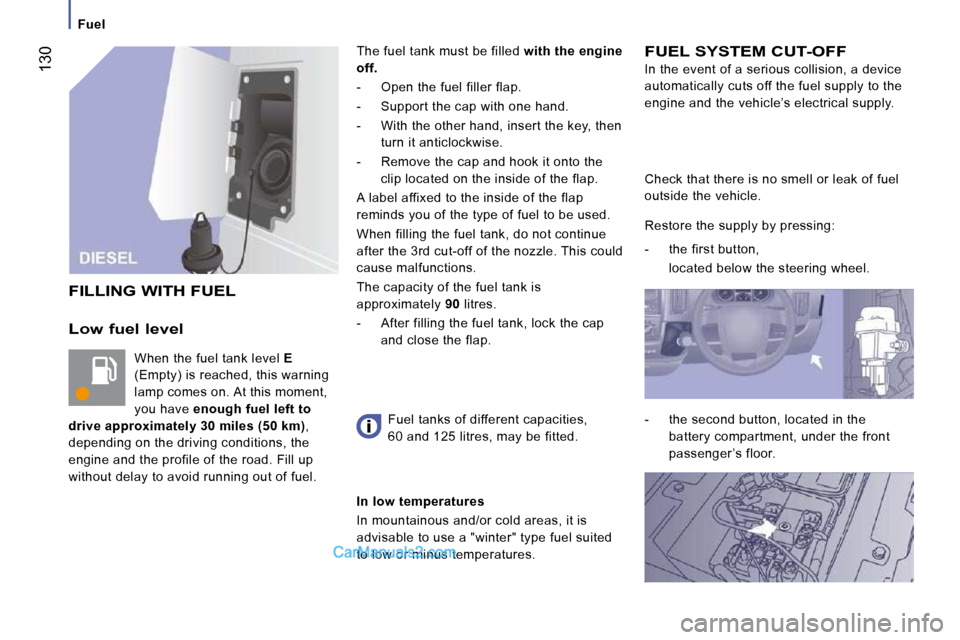
- Open the fuel filler flap.
- Support the cap with one hand.
- With the other hand, insert the key, then turn it anticlockwise.
- Remove the cap and hook it onto the clip located on the inside of the flap.
A label affixed to the inside of the flap
reminds you of the type of fuel to be used.
When filling the fuel tank, do not continue
after the 3rd cut-off of the nozzle. This could
cause malfunctions.
The capacity of the fuel tank is
approximately 90 litres.
- After filling the fuel tank, lock the cap and close the flap.
FUEL SYSTEM CUT-OFF
In the event of a serious collision, a device
automatically cuts off the fuel supply to the
engine and the vehicle’s electrical supply.
FILLING WITH FUEL
Fuel tanks of different capacities,
60 and 125 litres, may be fitted. Check that there is no smell or leak of fuel
outside the vehicle.
Restore the supply by pressing:
- the first button,
located below the steering wheel.
- the second button, located in the
battery compartment, under the front
passenger ’s floor.
In low temperatures
In mountainous and/or cold areas, it is
advisable to use a "winter" type fuel suited
to low or minus temperatures.
Page 140 of 167
139
QUICK HELP
8
Changing a bulb
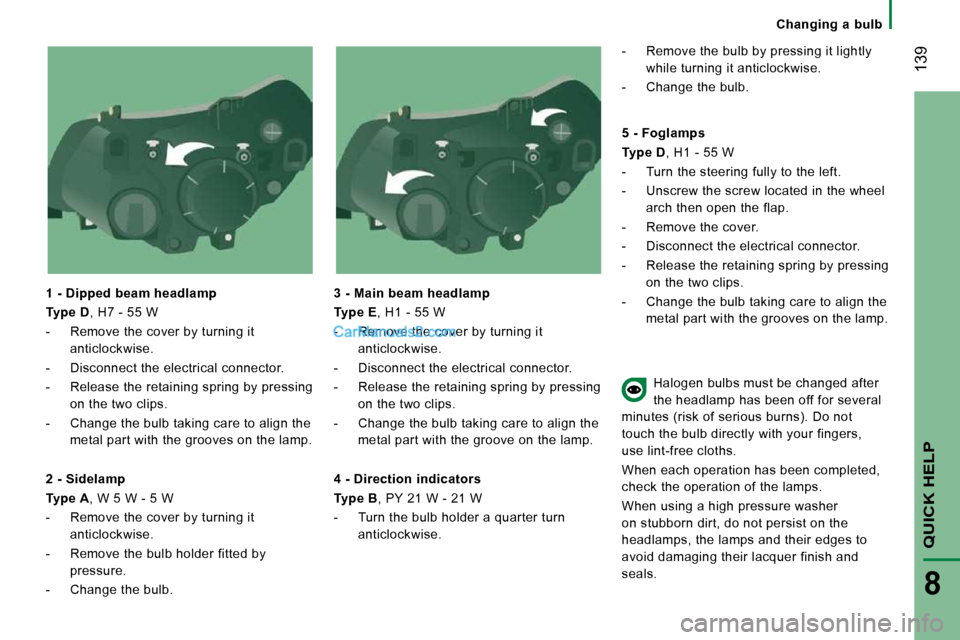
1 - Dipped beam headlamp
Type D , H7 - 55 W
- Remove the cover by turning it anticlockwise.
- Disconnect the electrical connector.
- Release the retaining spring by pressing on the two clips.
- Change the bulb taking care to align the metal part with the grooves on the lamp. 3 - Main beam headlamp
Type E , H1 - 55 W
- Remove the cover by turning it anticlockwise.
- Disconnect the electrical connector.
- Release the retaining spring by pressing on the two clips.
- Change the bulb taking care to align the metal part with the groove on the lamp.
2 - Sidelamp
Type A , W 5 W - 5 W
- Remove the cover by turning it anticlockwise.
- Remove the bulb holder fitted by pressure.
- Change the bulb. 4 - Direction indicators
Type B , PY 21 W - 21 W
- Turn the bulb holder a quarter turn anticlockwise. - Remove the bulb by pressing it lightly
while turning it anticlockwise.
- Change the bulb.
5 - Foglamps
Type D , H1 - 55 W
- Turn the steering fully to the left.
- Unscrew the screw located in the wheel arch then open the flap.
- Remove the cover.
- Disconnect the electrical connector.
- Release the retaining spring by pressing on the two clips.
- Change the bulb taking care to align the metal part with the grooves on the lamp.
Halogen bulbs must be changed after
the headlamp has been off for several
minutes (risk of serious burns). Do not
touch the bulb directly with your fingers,
use lint-free cloths.
When each operation has been completed,
check the operation of the lamps.
When using a high pressure washer
on stubborn dirt, do not persist on the
headlamps, the lamps and their edges to
avoid damaging their lacquer finish and
seals.
Page 148 of 167

QUICK HELP
8
Having your vehicle towed
BEING TOWED
Without lifting (four wheels on the ground)
You must always use a towing bar.
From the rear
Hook the bar onto the rigid eye located
under the bumper.
From the front
The removable towing eye is located in the
box under the front passenger seat.
Unclip the cover using a flat tool.
Screw the removable towing eye in fully.
Place the gear lever in neutral. Failure to
observe this special condition may result in
damage to certain braking components and
the absence of braking assistance when the
engine is re-started.
With lifting (2 wheels only on the ground)
It is preferable to lift the vehicle using
professional lifting equipment. When being towed with the engine
off, there is no braking or steering
assistance.