seats Peugeot Boxer 2010 Owner's Manual
[x] Cancel search | Manufacturer: PEUGEOT, Model Year: 2010, Model line: Boxer, Model: Peugeot Boxer 2010Pages: 167, PDF Size: 4.33 MB
Page 51 of 167
53
3
EASE OF USE AND COMFORT
Ventilation
ADDITIONAL HEATING SYSTEMS
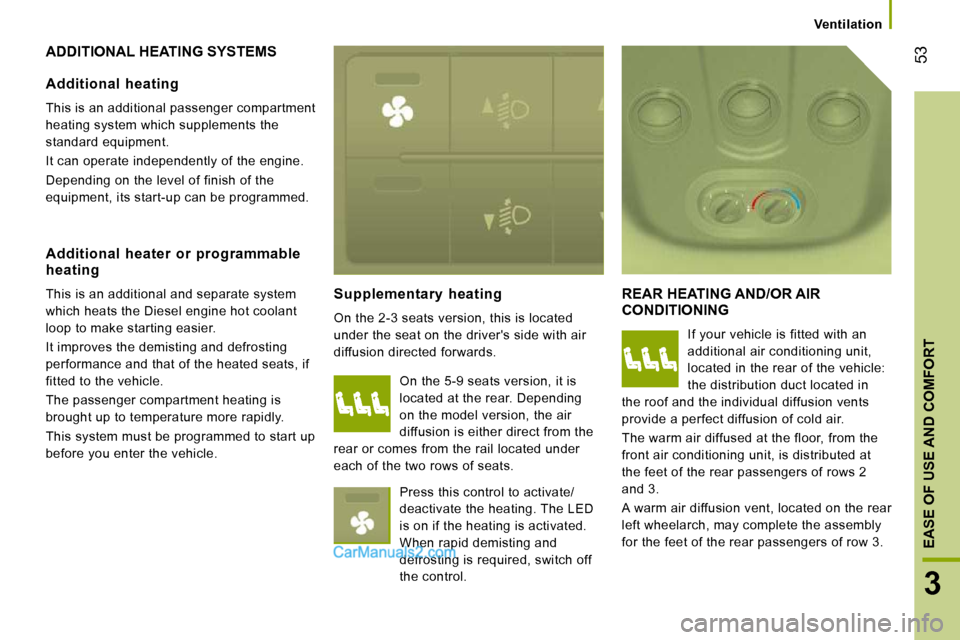
Supplementary heating
On the 2-3 seats version, this is located
under the seat on the driver's side with air
diffusion directed forwards.
REAR HEATING AND/OR AIR CONDITIONING
If your vehicle is fitted with an
additional air conditioning unit,
located in the rear of the vehicle:
the distribution duct located in
the roof and the individual diffusion vents
provide a perfect diffusion of cold air.
The warm air diffused at the floor, from the
front air conditioning unit, is distributed at
the feet of the rear passengers of rows 2
and 3.
A warm air diffusion vent, located on the rear
left wheelarch, may complete the assembly
for the feet of the rear passengers of row 3.
Additional heating
This is an additional passenger compartment
heating system which supplements the
standard equipment.
It can operate independently of the engine.
Depending on the level of finish of the
equipment, its start-up can be programmed.
Additional heater or programmable heating
This is an additional and separate system
which heats the Diesel engine hot coolant
loop to make starting easier.
It improves the demisting and defrosting
performance and that of the heated seats, if
fitted to the vehicle.
The passenger compartment heating is
brought up to temperature more rapidly.
This system must be programmed to start up
before you enter the vehicle. On the 5-9 seats version, it is
located at the rear. Depending
on the model version, the air
diffusion is either direct from the
rear or comes from the rail located under
each of the two rows of seats.
Press this control to activate/
deactivate the heating. The LED
is on if the heating is activated.
When rapid demisting and
defrosting is required, switch off
the control.
Page 56 of 167

58
Seats
DRIVER'S SEAT
SEATS
Head restraint
Press the tab to adjust the height of the
head restraint.
To remove the head restraint, press the tabs
and raise the head restraint.
Adjustable armrest
Turn the control located under the end of
the armrest.
Page 57 of 167
59
3
EASE OF USE AND COMFORT
Seats
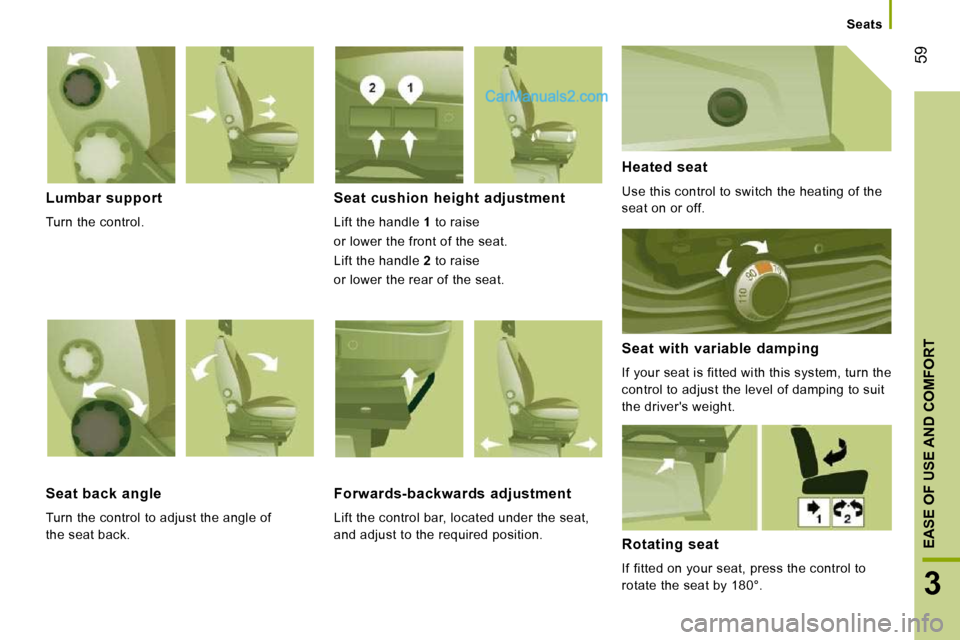
Lumbar support
Turn the control.
Seat cushion height adjustment
Lift the handle 1 to raise
or lower the front of the seat.
Lift the handle 2 to raise
or lower the rear of the seat.
Heated seat
Use this control to switch the heating of the
seat on or off.
Seat with variable damping
If your seat is fitted with this system, turn the
control to adjust the level of damping to suit
the driver's weight.
Seat back angle
Turn the control to adjust the angle of
the seat back.
Forwards-backwards adjustment
Lift the control bar, located under the seat,
and adjust to the required position.
Rotating seat
If fitted on your seat, press the control to
rotate the seat by 180°.
Page 58 of 167

60
Seats
2-SEAT FRONT BENCH
This is fitted with two seat belts.
Grab handle
This is located above the centre passenger.
Writing table
The back of the centre seat folds to form a
writing table.
Pull the handle located at the top of the seat
back cushion.
Page 59 of 167

61
3
EASE OF USE AND COMFORT
Seats
REAR SEATS
Seat back angle
Turn the control to adjust the
angle of the seat back.
Access to the rear seats
To gain access to row 3, manoeuvre the
control on the outer seat of row 2 and tilt the
seat back forwards.
To return the seat back to its initial position,
bring it to the vertical position without
touching the control.
Seat back folded position of the central seat (rows 2 and 3)
The back of the central seat can be folded
fully onto the cushion and used as a cup
holder table.
Lower the head restraint then raise the
control and fold the seat back forwards.
To return the seat back to its initial position,
raise the control again.
Page 60 of 167

62
Seats
REAR BENCH SEATS
Removing the bench seat
At least two people are required to
remove the bench seat.
Fold the seat back onto the cushion as
described above.
Turn the two levers forwards.
Tilt the base of the bench seat forwards to
place the assembly in the vertical position.
Good practice
Following the various operations:
- do not remove a head restraint without storing it securely,
- do not travel in row 3 with the row 2 bench seat in the vertical position,
- do not store any kind of object on the folded seat back of row 2,
- check that the seat belts are always accessible and easy for the passenger
to use,
- a passenger must not take their seat without correctly adjusting their seat's
head restraint and adjusting and
fastening their seat belt. Access to the rear seats
Lower the head restraints then raise the
control and tilt the seat back forwards.
Seat back folded position
Remove the head restraints then tilt the seat
back as described above.
With your right hand, raise the lever then tilt
the seat back 5° towards the rear.
With your left hand, tilt the seat back
forwards onto the cushion. Turn the two levers upwards.
Raise the bench seat and remove it.
Page 61 of 167

63
3
EASE OF USE AND COMFORT
Seats
CREW CAB
Consisting of an ergonomic 4-seat bench
and a high-strength partition, it offers
comfort and safety.
Each seat of the bench is fitted with an
inertia reel seat belt.
Refer to section 5 to read the "Good
practice" recommendations.
Access to the box under the bench seat
From the cab
Tilt the seat cushion forwards to gain access
to the large box.
From the load space
Raise the two flaps which make the full
length at the floor available. The flaps are
retained in the raised position by magnets
on the back of the partition.
Good pratice
Do not tilt the bench seat cushion during
transportation.
No not attach anything to the cab fixing
structure.
Do not exceed the number of passengers
indicated on the registration certificate.
Do not install child seats, booster cushions or
carrycots on the rear seats of the crew cab.
In the rear, the load space is intended for
the transportation of goods only.
You are advised to place the goods or heavy
objects as far forwards as possible in the
load space (towards the cab) and secure
them by means of straps using the stowing
rings on the floor.
Page 67 of 167

3
EASE OF USE AND COMFORT
Practical information
Sliding side windows
Depending on the vehicle's
equipment, the side windows of
row 2 can be opened.
Squeeze the two controls then
slide the window.
While driving, the window must be closed or
secured in an intermediate position.
Step
To make access and exit easier, your vehicle
may be fitted with a step which unfolds when
the sliding side door is opened. Courtesy lamps
If fitted on your vehicle, one or two courtesy
lamps are located above the rear and side
doors.
They can be activated by:
- tilting the courtesy lamp (to the left or to the right),
- opening or closing the rear or side doors.
This lighting switches off automatically, after
a few minutes, if the doors are left open.
Roof box
This is a storage compartment located in
the load space, above the cab roof. Its
capacity varies depending on the height of
the van roof.
Torch
If provided in your vehicle.
Ladder type vertical partition
Behind the driver's seat, a ladder type
vertical partition protects the driver against
the risk of load movement.
Load retainer
On the floor, behind the front seats,
a horizontal partition protects the driver
and front passengers against the risk of
load movement.
Glazed separation partition
Use the control to open/close the sliding
window of the separation partition.
Page 105 of 167
106
Seat belts
SEAT BELTS
CAB SEAT BELTS
The front seats are fitted with pre-tensioners
and force limiters. REAR SEAT BELTS
The seats/bench seats are fitted with
three-point seat belts and inertia reels.
The centre seat has a seat belt guide and
inertia reel, solid with the seat back.
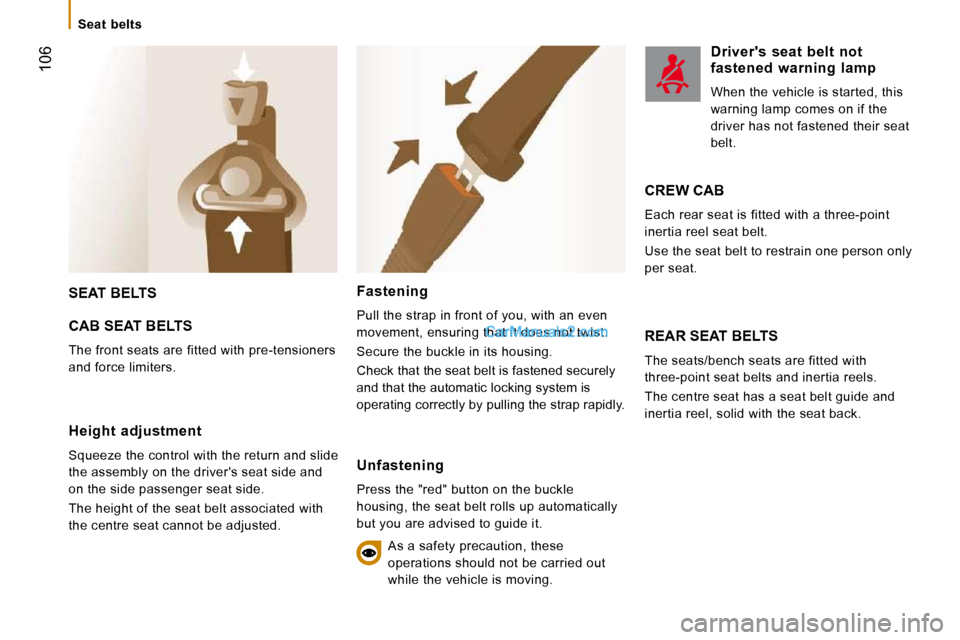
Height adjustment
Squeeze the control with the return and slide
the assembly on the driver's seat side and
on the side passenger seat side.
The height of the seat belt associated with
the centre seat cannot be adjusted.
Fastening
Pull the strap in front of you, with an even
movement, ensuring that it does not twist.
Secure the buckle in its housing.
Check that the seat belt is fastened securely
and that the automatic locking system is
operating correctly by pulling the strap rapidly.
Unfastening
Press the "red" button on the buckle
housing, the seat belt rolls up automatically
but you are advised to guide it. As a safety precaution, these
operations should not be carried out
while the vehicle is moving.
Driver's seat belt not fastened warning lamp
When the vehicle is started, this
warning lamp comes on if the
driver has not fastened their seat
belt.
CREW CAB
Each rear seat is fitted with a three-point
inertia reel seat belt.
Use the seat belt to restrain one person only
per seat.
Page 106 of 167
107
5
SAFETY
Seat belts
The force limiter reduces the pressure of the
seat belt against the body of the occupants.
The pretensioning seat belts are active when
the ignition is switched on.
The inertia reels are fitted with a device
which automatically locks the strap in the
event of a collision or emergency braking or
if the vehicle rolls over.
You can unfasten the seat belt by pressing
the red button on the buckle. Guide the seat
belt after unfastening. Good practice
The driver must ensure that passengers use
the seat belts correctly and that they are all
strapped in securely before moving off.
Wherever you are seated in the vehicle, always
fasten your seat belt, even for short journeys.
The seat belts are fitted with an inertia reel
which automatically adjusts the length of
the strap to your size.
Do not use accessories (clothes pegs, clips,
safety pins, etc.) which permit a clearance
with the seat belt straps.
Ensure that the seat belt has reeled in
correctly after use.
After folding or moving a seat or a rear
bench seat, ensure that the seat belt has
reeled in correctly and that the buckle is
ready to accommodate the tongue.
Depending on the nature and seriousness
of any impact, the pretensioning device may
be triggered before and independently of
inflation of the airbags. It instantly tightens
the seat belts against the body of the
occupants.
Triggering of the pretensioners is
accompanied by a slight discharge of
harmless smoke and a noise, due to the
activation of the pyrotechnic cartridge
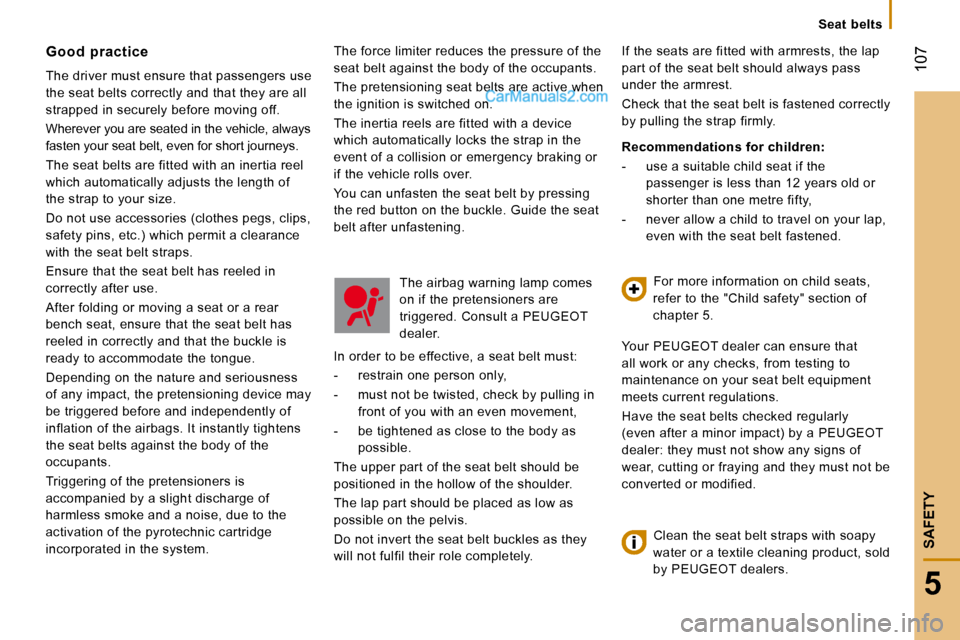
incorporated in the system. The airbag warning lamp comes
on if the pretensioners are
triggered. Consult a PEUGEOT
dealer.
In order to be effective, a seat belt must:
- restrain one person only,
- must not be twisted, check by pulling in front of you with an even movement,
- be tightened as close to the body as possible.
The upper part of the seat belt should be
positioned in the hollow of the shoulder.
The lap part should be placed as low as
possible on the pelvis.
Do not invert the seat belt buckles as they
will not fulfil their role completely. If the seats are fitted with armrests, the lap
part of the seat belt should always pass
under the armrest.
Check that the seat belt is fastened correctly
by pulling the strap firmly.
Recommendations for children:
- use a suitable child seat if the
passenger is less than 12 years old or
shorter than one metre fifty,
- never allow a child to travel on your lap, even with the seat belt fastened.
For more information on child seats,
refer to the "Child safety" section of
chapter 5.
Your PEUGEOT dealer can ensure that
all work or any checks, from testing to
maintenance on your seat belt equipment
meets current regulations.
Have the seat belts checked regularly
(even after a minor impact) by a PEUGEOT
dealer: they must not show any signs of
wear, cutting or fraying and they must not be
converted or modified.
Clean the seat belt straps with soapy
water or a textile cleaning product, sold
by PEUGEOT dealers.