ESP Peugeot Boxer 2013 User Guide
[x] Cancel search | Manufacturer: PEUGEOT, Model Year: 2013, Model line: Boxer, Model: Peugeot Boxer 2013Pages: 184, PDF Size: 4.53 MB
Page 85 of 184
Parking sensors
83
4
TECHNOLOGY ON BOAR
D
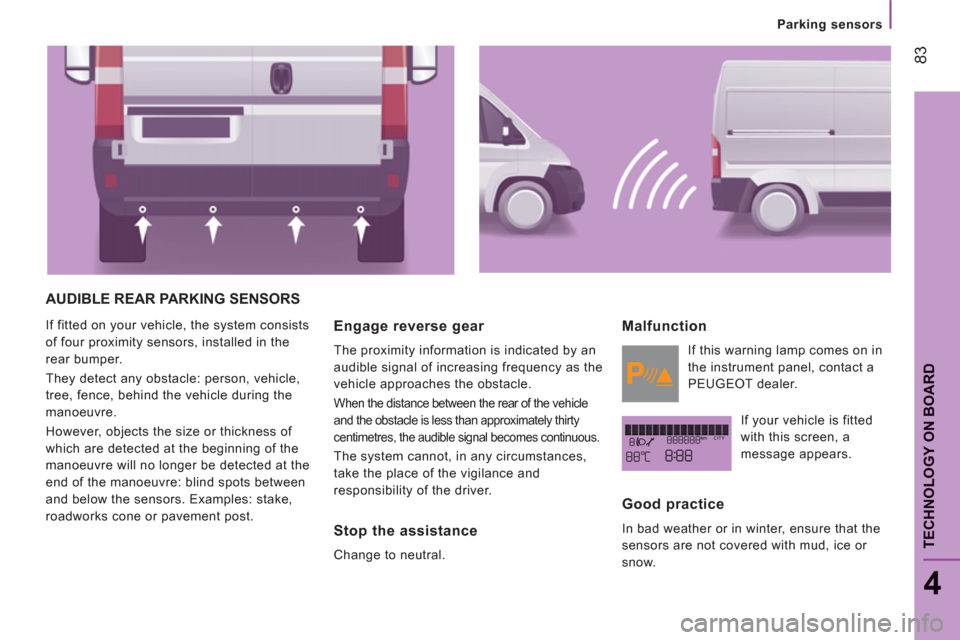
AUDIBLE REAR PARKING SENSORS
If fitted on your vehicle, the system consists
of four proximity sensors, installed in the
rear bumper.
They detect any obstacle: person, vehicle,
tree, fence, behind the vehicle during the
manoeuvre.
However, objects the size or thickness of
which are detected at the beginning of the
manoeuvre will no longer be detected at the
end of the manoeuvre: blind spots between
and below the sensors. Examples: stake,
roadworks cone or pavement post.
Engage reverse gear
The proximity information is indicated by an
audible signal of increasing frequency as the
vehicle approaches the obstacle.
When the distance between the rear of the vehicle
and the obstacle is less than approximately thirty
centimetres, the audible signal becomes continuous.
The system cannot, in any circumstances,
take the place of the vigilance and
responsibility of the driver.
Stop the assistance
Change to neutral.
Malfunction
If this warning lamp comes on in
the instrument panel, contact a
PEUGEOT dealer.
If your vehicle is fitted
with this screen, a
message appears.
Good practice
In bad weather or in winter, ensure that the
sensors are not covered with mud, ice or
snow.
Page 102 of 184
100
Bluetooth hands-free system
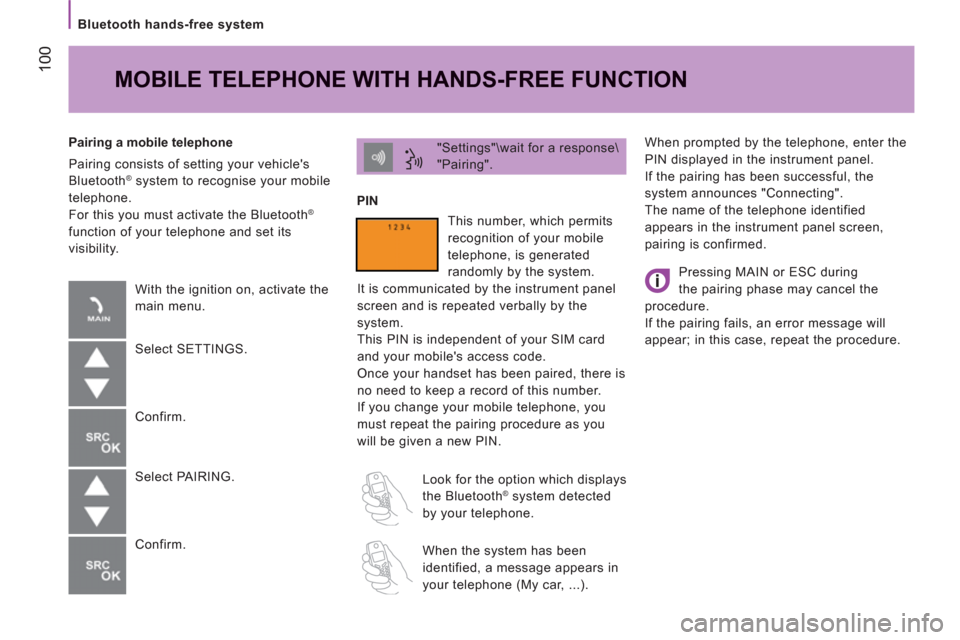
When prompted by the telephone, enter the
PIN displayed in the instrument panel.
If the pairing has been successful, the
system announces "Connecting".
The name of the telephone identified
appears in the instrument panel screen,
pairing is confirmed. "Settings"\wait for a response\
"Pairing".
PIN
Pairing a mobile telephone
Pairing consists of setting your vehicle's
Bluetooth
® system to recognise your mobile
telephone.
For this you must activate the Bluetooth
®
function of your telephone and set its
visibility.
MOBILE TELEPHONE WITH HANDS-FREE FUNCTION
With the ignition on, activate the
main menu.
Select SETTINGS.
Confirm.
Select PAIRING.
Confirm. This number, which permits
recognition of your mobile
telephone, is generated
randomly by the system.
It is communicated by the instrument panel
screen and is repeated verbally by the
system.
This PIN is independent of your SIM card
and your mobile's access code.
Once your handset has been paired, there is
no need to keep a record of this number.
If you change your mobile telephone, you
must repeat the pairing procedure as you
will be given a new PIN.
Look for the option which displays
the Bluetooth
® system detected
by your telephone.
When the system has been
identified, a message appears in
your telephone (My car, ...).
Pressing MAIN or ESC during
the pairing phase may cancel the
procedure.
If the pairing fails, an error message will
appear; in this case, repeat the procedure.
Page 118 of 184
11
6
Driving safely
ANTI-SLIP REGULATION (ASR)
AND ELECTRONIC STABILITY
PROGRAMME
(ESP)
These systems are linked and complement
the ABS.
The ASR system is very useful for
maintaining optimum drive and avoiding
losses of control of the vehicle on
acceleration.
The system optimises drive to prevent the
wheels skidding, by acting on the brakes of
the drive wheels and on the engine. It also
allows the directional stability of the vehicle
to be improved on acceleration.
Use the ESP to hold your course without
attempting to countersteer. If there is a variation between the trajectory
followed by the vehicle and that required
by the driver, the ESP system automatically
acts on the engine and the brake of one
or more wheels, in order to put the vehicle
back on course.
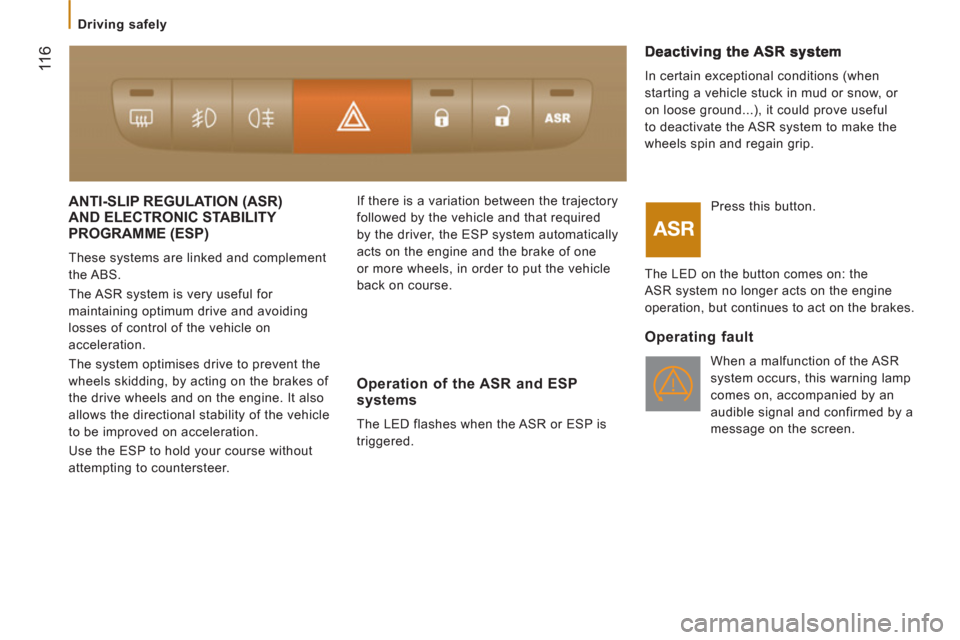
In certain exceptional conditions (when
starting a vehicle stuck in mud or snow, or
on loose ground...), it could prove useful
to deactivate the ASR system to make the
wheels spin and regain grip.
Operation of the ASR and ESP
systems
The LED flashes when the ASR or ESP is
triggered. Press this button.
The LED on the button comes on: the
ASR system no longer acts on the engine
operation, but continues to act on the brakes.
Operating fault
When a malfunction of the ASR
system occurs, this warning lamp
comes on, accompanied by an
audible signal and confirmed by a
message on the screen.
Page 119 of 184
11
7
5
Driving safely
SAFETY
When a malfunction of the ESP
system occurs, this warning lamp
comes on, accompanied by an
audible signal and confirmed by a
message on the screen.
Contact a PEUGEOT dealer to have the
system checked.
Good practice
The ASR/ESP systems offer increased
safety during normal driving, but should not
incite the driver to take risks or to drive at
high speed.
The operation of these systems is ensured
if the recommendations of the manufacturer
regarding the wheels (tyres and rims),
the braking components, the electronic
components and the fitting and repair
procedures within the PEUGEOT network
are observed.
After an impact, have these systems
checked by a PEUGEOT dealer. Intelligent Traction Control
System to improve traction on slippery
surfaces (snow, black ice, mud...)
This system checks for situations of difficult
surface adhesion that could make it difficult
to move off or make progress.
In these situations, Intelligent Traction
Control
takes over from the ASR
system,
by transferring drive to the wheel with the
best grip on the ground to provide the best
traction and trajectory control.
Activation
On starting the vehicle, the system is
deactivated.
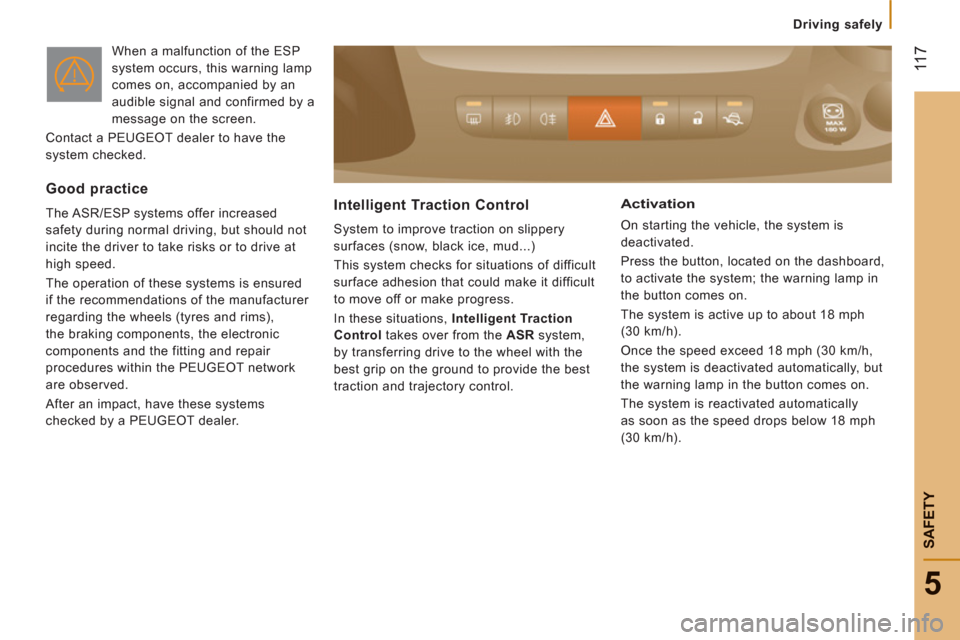
Press the button, located on the dashboard,
to activate the system; the warning lamp in
the button comes on.
The system is active up to about 18 mph
(30 km/h).
Once the speed exceed 18 mph (30 km/h,
the system is deactivated automatically, but
the warning lamp in the button comes on.
The system is reactivated automatically
as soon as the speed drops below 18 mph
(30 km/h).
Page 129 of 184
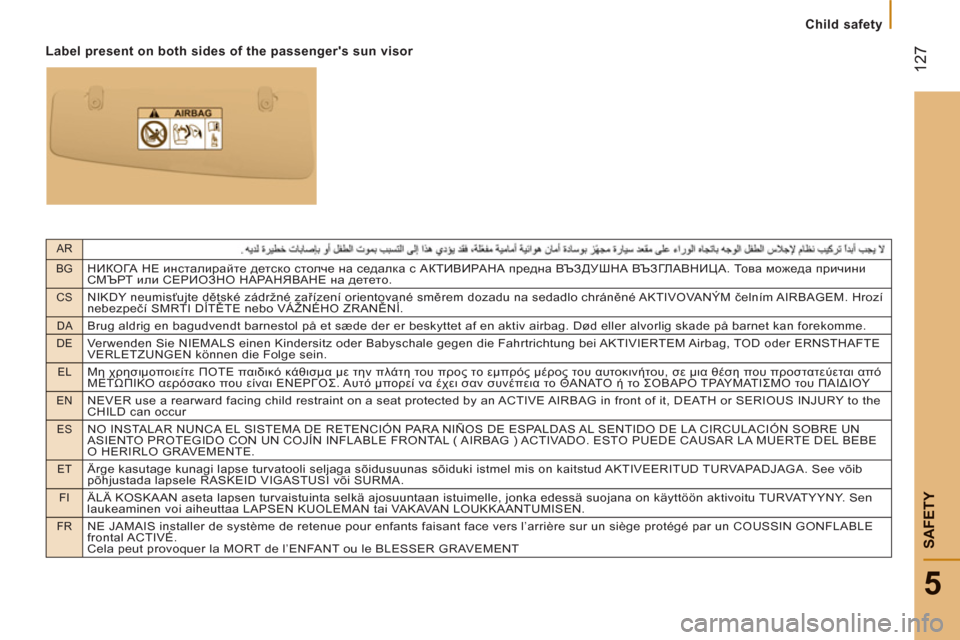
AR
BG
НИКОГА НЕ инсталирайте детско столче на седалка с АКТИВИРАНА предна ВЪЗДУШНА ВЪЗГЛАВНИЦА. То в а можеда причини
СМЪРТ или СЕРИОЗНО НАРАНЯВАНЕ на детето.
CSNIKDY neumisťujte dětské zádržné zařízení orientované směrem dozadu na sedadlo chráněné AKTIVOVANÝM čelním AIRBAGEM. Hrozí
nebezpečí SMRTI DÍTĚTE nebo VÁŽNÉHO ZRANĚNÍ.
DABrug aldrig en bagudvendt barnestol på et sæde der er beskyttet af en aktiv airbag. Død eller alvorlig skade på barnet kan forekomme.
DEVerwenden Sie NIEMALS einen Kindersitz oder Babyschale gegen die Fahrtrichtung bei AKTIVIERTEM Airbag, TOD oder ERNSTHAFTE
VERLETZUNGEN können die Folge sein.
ELΜη χρησιμοποιείτε ΠΟΤΕ παιδικό κάθισμα με την πλάτη του προς το εμπρός μέρος του αυτοκινήτου, σε μια θέση που προστατεύεται από
ΜΕΤΩΠΙΚΟ αερόσακο που είναι ΕΝΕΡΓΟΣ. Αυτό μπορεί να έχει σαν συνέπεια το ΘΑΝΑΤΟ ή το ΣΟΒΑΡΟ ΤΡΑΥΜΑΤΙΣΜΟ του ΠΑΙΔΙΟΥ
ENNEVER use a rearward facing child restraint on a seat protected by an ACTIVE AIRBAG in front of it, DEATH or SERIOUS INJURY to the
CHILD can occur
ESNO INSTALAR NUNCA EL SISTEMA DE RETENCIÓN PARA NIÑOS DE ESPALDAS AL SENTIDO DE LA CIRCULACIÓN SOBRE UN
ASIENTO PROTEGIDO CON UN COJÍN INFLABLE FRONTAL ( AIRBAG ) ACTIVADO. ESTO PUEDE CAUSAR LA MUERTE DEL BEBE
O HERIRLO GRAVEMENTE.
ETÄrge kasutage kunagi lapse turvatooli seljaga sõidusuunas sõiduki istmel mis on kaitstud AKTIVEERITUD TURVAPADJAGA. See võib
põhjustada lapsele RASKEID VIGASTUSI või SURMA.
FIÄLÄ KOSKAAN aseta lapsen turvaistuinta selkä ajosuuntaan istuimelle, jonka edessä suojana on käyttöön aktivoitu TURVATYYNY. Sen
laukeaminen voi aiheuttaa LAPSEN KUOLEMAN tai VAKAVAN LOUKKAANTUMISEN.
FRNE JAMAIS installer de système de retenue pour enfants faisant face vers l’arrière sur un siège protégé par un COUSSIN GONFLABLE
frontal ACTIVÉ.
Cela peut provoquer la MORT de l’ENFANT ou le BLESSER GRAVEMENT
Child safety
12
7
SAFETY
5
Label present on both sides of the passenger's sun visor
Page 143 of 184
Checks
14
1
CHECK
S
7
CHECKS
Air filter and passenger compartment filter
A clogged passenger compartment filter
may reduce the performance of the
air conditioning system and generate
undesirable odours. The replacement
intervals for these components are indicated
in the servicing booklet.
Depending on the environment (dusty
atmosphere...) and the use of the vehicle
(urban driving...), change them twice as
often if necessary, refer to the "Under the
bonnet" section of chapter 7.
Manual gearbox
Have the level checked in accordance with
the manufacturer's servicing schedule.
To check the main levels and certain
components, in accordance with the
manufacturer's servicing schedule, refer to
the pages of the servicing booklet which
correspond to your vehicle's engine.
Only use products recommended by
PEUGEOT or products of equivalent quality
and specification.
In order to optimise the operation of units as
important as the braking system, PEUGEOT
selects and offers specific products.
In order to avoid damaging the electrical
units, high pressure washing to clean the
engine compartment is strictly prohibited.
Parking brake
Where the parking brake travel is too great
or there is a reduction in the performance
of the system, the parking brake should be
adjusted, even between services.
Have the system checked by a PEUGEOT
dealer. Bleeding the water contained inthe Diesel filter
If this warning lamp comes on,
bleed the filter, otherwise bleed
regularly each time the engine oil
is changed.
To drain the water out, unscrew the bleed
screw or the water in Diesel sensor, located
at the base of the filter. Leave open until
all of the water has been drained out. Then
tighten the bleed screw or the water sensor.
HDi engines use advanced technology. All
work requires a special qualification which is
guaranteed by a PEUGEOT dealer.
Battery
At the start of winter, have your battery
checked by a PEUGEOT dealer.
Brake pads
Brake pad wear depends on the style of
driving, in particular for vehicles which are
used in town, over short distances. It may
be necessary to check the thickness of the
pads, even between services.
Unless there is a leak on the system, a drop
in the brake fluid level indicates that the
brake pads are worn.
Brake disc/drum wear status
For any information relating to checking
the brake disc/drum wear status, contact a
PEUGEOT dealer.
Oil filter
Change the filter regularly, in accordance
with the servicing schedule.
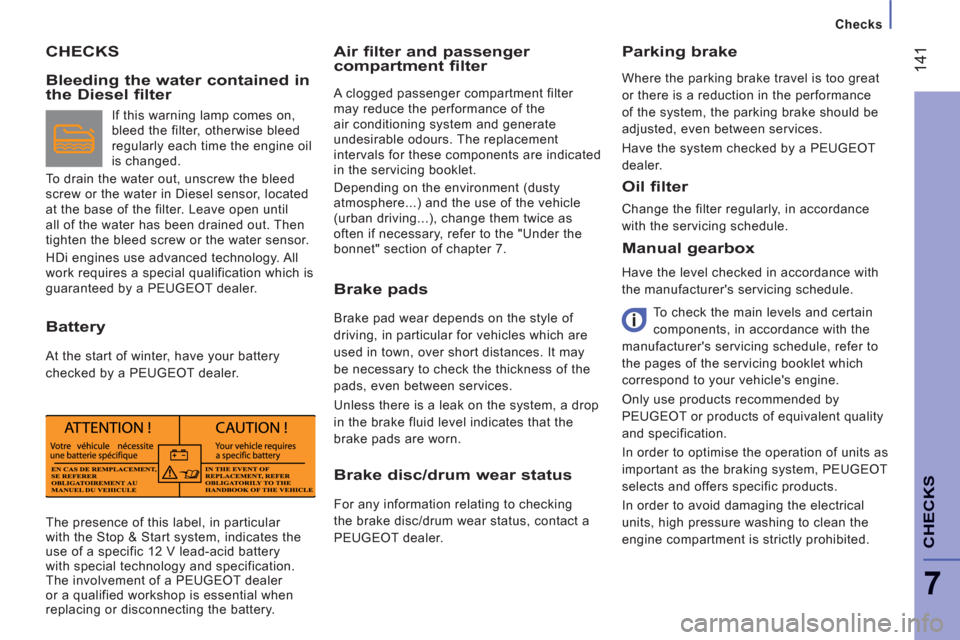
The presence of this label, in particular
with the Stop & Start system, indicates the
use of a specific 12 V lead-acid battery
with special technology and specification.
The involvement of a PEUGEOT dealer
or a qualified workshop is essential when
replacing or disconnecting the battery.
Page 154 of 184
Changing a wheel
152
- If a pressure of at least 3 bars
is not
reached within 5 minutes, disconnect
the compressor from the valve and the
power socket, then move the vehicle
forward by approximately 10 metres to
distribute the sealant fluid inside the
tyre.
- Then repeat the inflating operation:
●
if a pressure of at least 3 bars
is not
reached within 10 minutes, switch off
your vehicle: the tyre has suffered too
much damage and repair has not been
possible. Consult a PEUGEOT dealer.
●
if the tyre has been inflated to a
pressure of 4 bars
, set off again
immediately.
After driving for approximately 10 minutes,
stop and check the pressure of the tyre
again.
Adjust the pressure if necessary and contact
a PEUGEOT dealer as soon as possible.
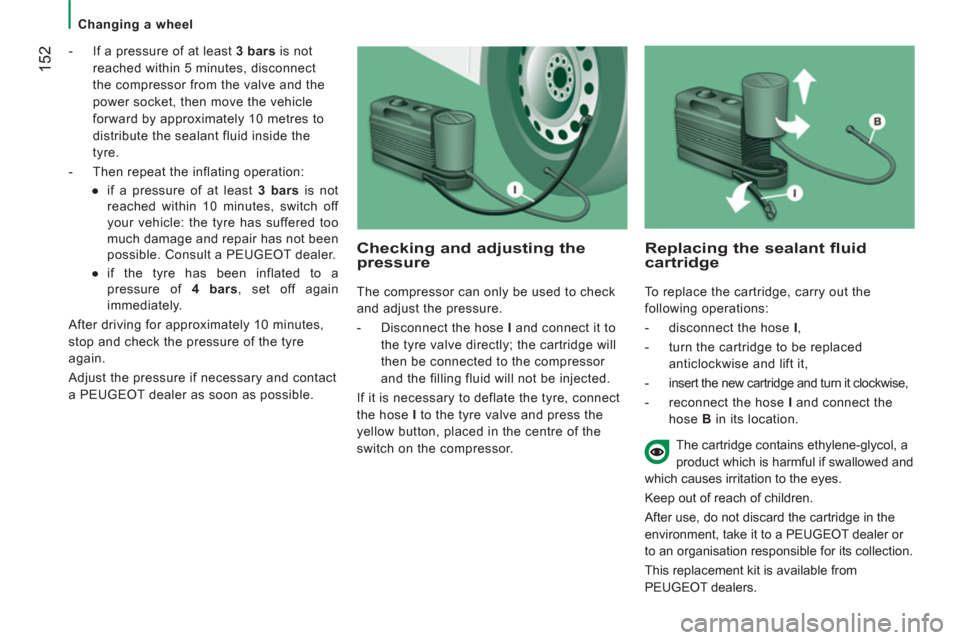
Checking and adjusting the pressure
The compressor can only be used to check
and adjust the pressure.
- Disconnect the hose I
and connect it to
the tyre valve directly; the cartridge will
then be connected to the compressor
and the filling fluid will not be injected.
If it is necessary to deflate the tyre, connect
the hose I
to the tyre valve and press the
yellow button, placed in the centre of the
switch on the compressor.
Replacing the sealant fluidcartridge
To replace the cartridge, carry out the
following operations:
- disconnect the hose I
,
- turn the cartridge to be replaced
anticlockwise and lift it,
- insert the new cartridge and turn it clockwise,
- reconnect the hose I
and connect the
hose B
in its location.
The cartridge contains ethylene-glycol, a
product which is harmful if swallowed and
which causes irritation to the eyes.
Keep out of reach of children.
After use, do not discard the cartridge in the
environment, take it to a PEUGEOT dealer or
to an organisation responsible for its collection.
This replacement kit is available from
PEUGEOT dealers.
Page 159 of 184
Changing a fuse
157
QUICK HELP
8
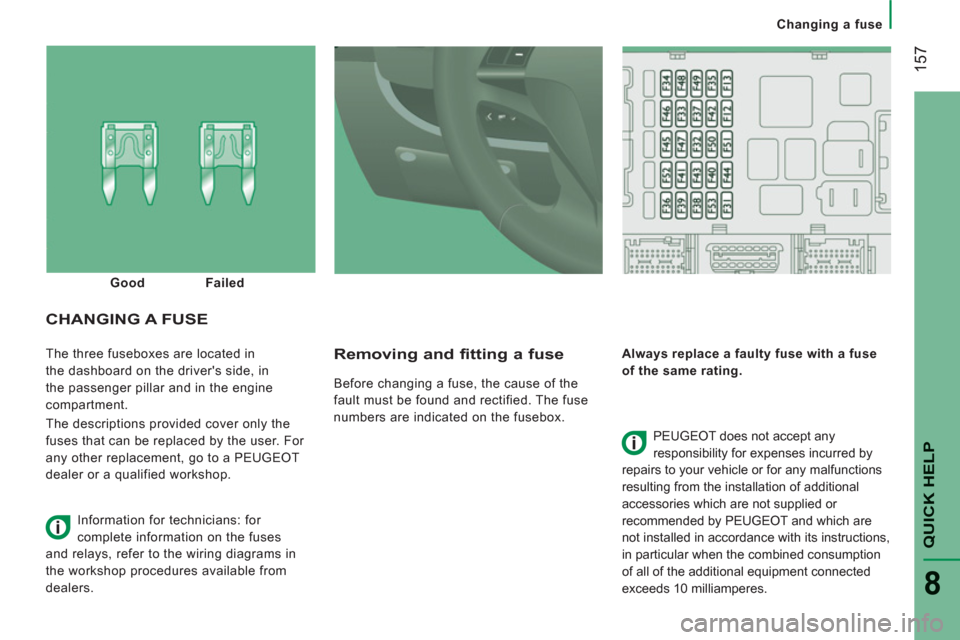
The three fuseboxes are located in
the dashboard on the driver's side, in
the passenger pillar and in the engine
compartment.
The descriptions provided cover only the
fuses that can be replaced by the user. For
any other replacement, go to a PEUGEOT
dealer or a qualified workshop.
Removing and fitting a fuse
Before changing a fuse, the cause of the
fault must be found and rectified. The fuse
numbers are indicated on the fusebox.
Always replace a faulty fuse with a fuse
of the same rating.
CHANGING A FUSE
PEUGEOT does not accept any
responsibility for expenses incurred by
repairs to your vehicle or for any malfunctions
resulting from the installation of additional
accessories which are not supplied or
recommended by PEUGEOT and which are
not installed in accordance with its instructions,
in particular when the combined consumption
of all of the additional equipment connected
exceeds 10 milliamperes.
Good
Failed
Information for technicians: for
complete information on the fuses
and relays, refer to the wiring diagrams in
the workshop procedures available from
dealers.
Page 160 of 184
Changing a fuse
158
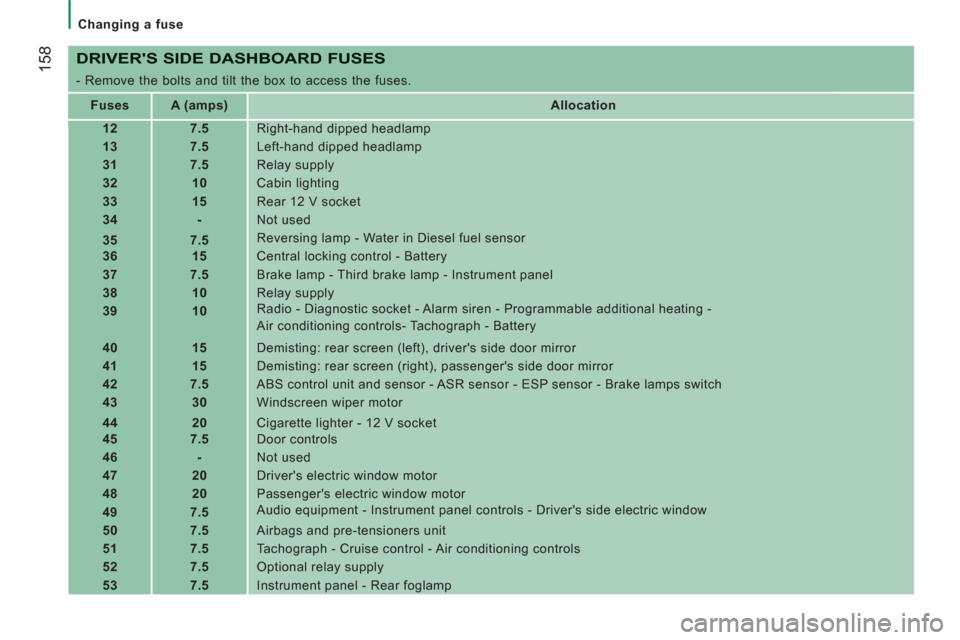
DRIVER'S SIDE DASHBOARD FUSES
- Remove the bolts and tilt the box to access the fuses.
Fuses
A (amps)
Allocation
12
7.5
Right-hand dipped headlamp
13
7.5
Left-hand dipped headlamp
31
7.5
Relay supply
32
10
Cabin lighting
33
15
Rear 12 V socket
34
-
Not used
35
7.5
Reversing lamp - Water in Diesel fuel sensor
36
15
Central locking control - Battery
37
7.5
Brake lamp - Third brake lamp - Instrument panel
38
10
Relay supply
39
10
Radio - Diagnostic socket - Alarm siren - Programmable additional heating -
Air conditioning controls- Tachograph - Battery
40
15
Demisting: rear screen (left), driver's side door mirror
41
15
Demisting: rear screen (right), passenger's side door mirror
42
7.5
ABS control unit and sensor - ASR sensor - ESP sensor - Brake lamps switch
43
30
Windscreen wiper motor
44
20
Cigarette lighter - 12 V socket
45
7.5
Door controls
46
-
Not used
47
20
Driver's electric window motor
48
20
Passenger's electric window motor
49
7.5
Audio equipment - Instrument panel controls - Driver's side electric window
50
7.5
Airbags and pre-tensioners unit
51
7.5
Tachograph - Cruise control - Air conditioning controls
52
7.5
Optional relay supply
53
7.5
Instrument panel - Rear foglamp
Page 176 of 184
174
Exterior
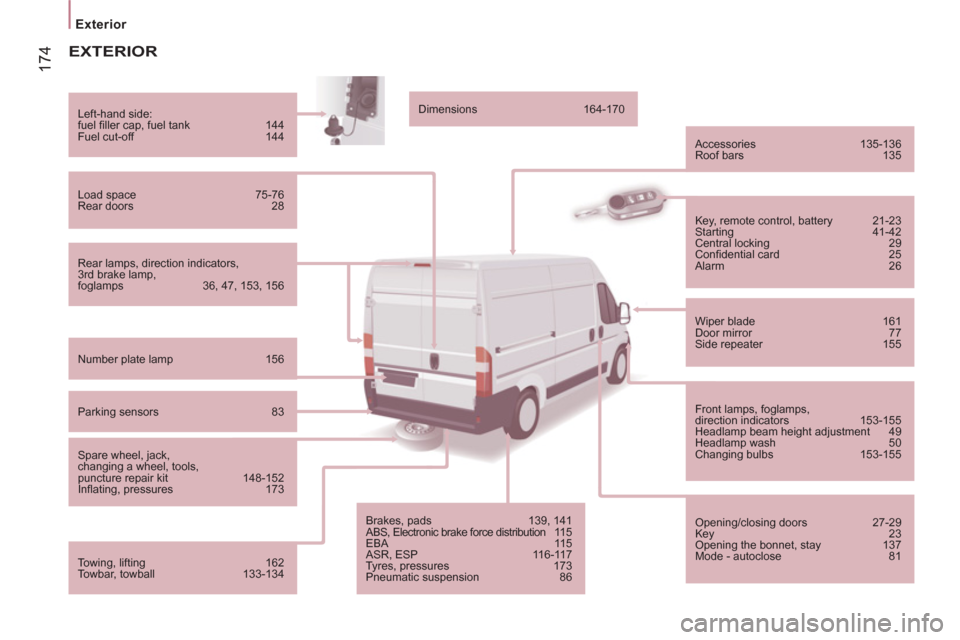
EXTERIOR
Rear lamps, direction indicators,
3 rd brake lamp,
foglamps 36, 47, 153, 156
Left-hand side:
fuel fi ller cap, fuel tank 144
Fuel cut-off 144
Load space 75-76
Rear doors 28
Number plate lamp 156
Parking sensors 83
Spare wheel, jack,
changing a wheel, tools,
puncture repair kit 148-152
Infl ating, pressures 173
Towing, lifting 162
Towbar, towball 133-134
Dimensions 164-170
Accessories 135-136
Roof bars 135
Brakes, pads 139, 141
ABS, Electronic brake force distribution 115
EBA 115
ASR, ESP 116-117
Tyres, pressures 173
Pneumatic suspension 86
Key, remote control, battery 21-23
Starting 41-42
Central locking 29
Confi dential card 25
Alarm 26
Wiper blade 161
Door mirror 77
Side repeater 155
Front lamps, foglamps,
direction indicators 153-155
Headlamp beam height adjustment 49
Headlamp wash 50
Changing bulbs 153-155
Opening/closing doors 27-29
Key 23
Opening the bonnet, stay 137
Mode - autoclose 81