warning Peugeot Boxer 2014 Service Manual
[x] Cancel search | Manufacturer: PEUGEOT, Model Year: 2014, Model line: Boxer, Model: Peugeot Boxer 2014Pages: 240, PDF Size: 8.98 MB
Page 107 of 240
105
5
SAFETY
Airbags
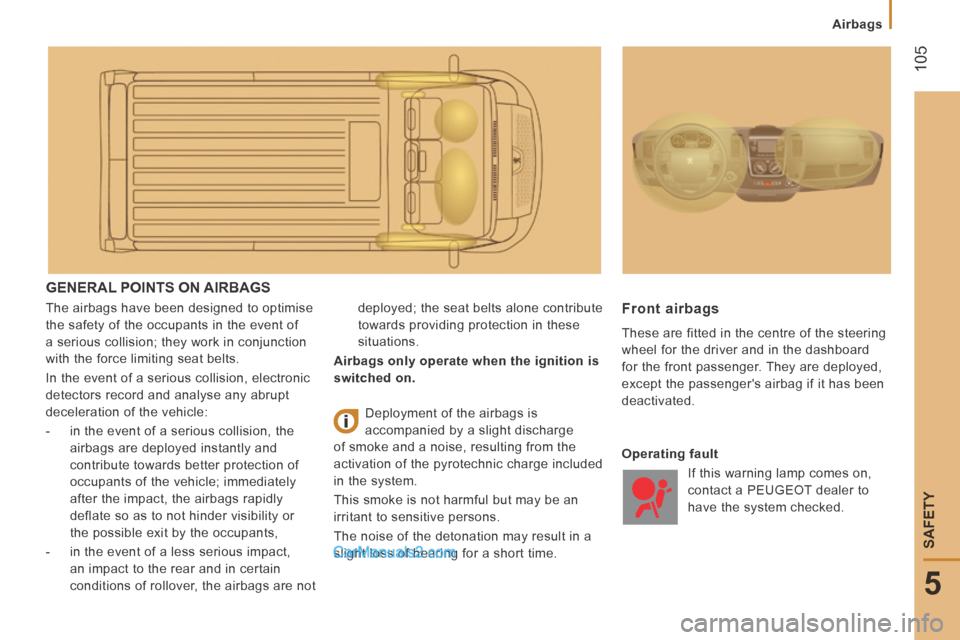
GENERAL POINTS ON AIRBAGS
The airbags have been designed to optimise
the safety of the occupants in the event of
a serious collision; they work in conjunction
with the force limiting seat belts.
In the event of a serious collision, electronic
detectors record and analyse any abrupt
deceleration of the vehicle:
- in the event of a serious collision, the airbags are deployed instantly and
contribute towards better protection of
occupants of the vehicle; immediately
after the impact, the airbags rapidly
deflate so as to not hinder visibility or
the possible exit by the occupants,
- in the event of a less serious impact, an impact to the rear and in certain
conditions of rollover, the airbags are not deployed; the seat belts alone contribute
towards providing protection in these
situations.
Airbags only operate when the ignition is
switched on. Front airbags
These are fitted in the centre of the steering
wheel for the driver and in the dashboard
for the front passenger. They are deployed,
except the passenger's airbag if it has been
deactivated.
Deployment of the airbags is
accompanied by a slight discharge
of smoke and a noise, resulting from the
activation of the pyrotechnic charge included
in the system.
This smoke is not harmful but may be an
irritant to sensitive persons.
The noise of the detonation may result in a
slight loss of hearing for a short time. Operating fault
If this warning lamp comes on,
contact a PEUGEOT dealer to
have the system checked.
Page 108 of 240
106
Airbags
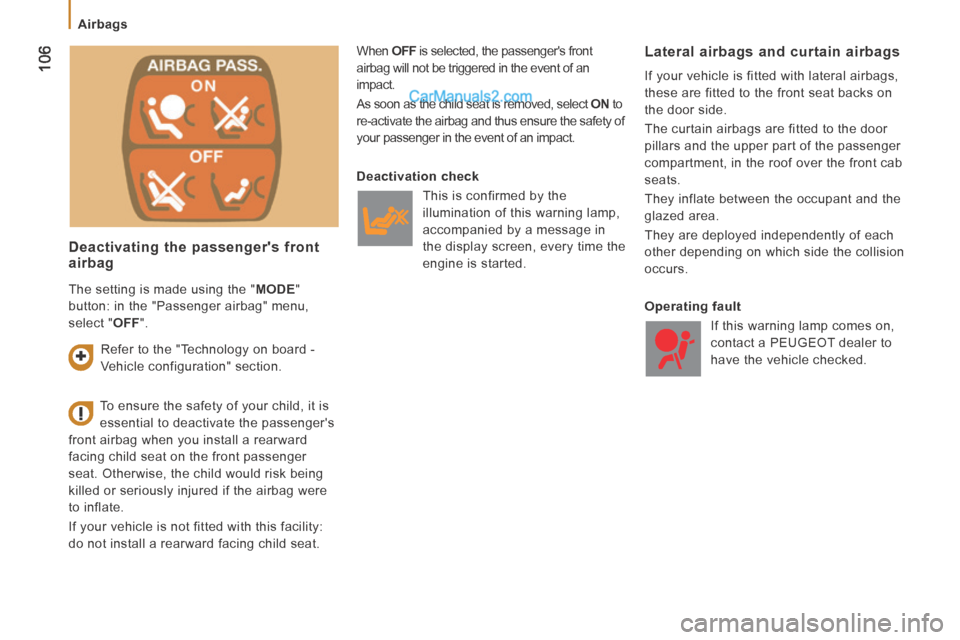
Deactivating the passenger's front airbag
When OFF is selected, the passenger's front
airbag will not be triggered in the event of an
impact.
As soon as the child seat is removed, select ON to
re-activate the airbag and thus ensure the safety of
your passenger in the event of an impact. Lateral airbags and curtain airbags
If your vehicle is fitted with lateral airbags,
these are fitted to the front seat backs on
the door side.
The curtain airbags are fitted to the door
pillars and the upper part of the passenger
compartment, in the roof over the front cab
seats.
They inflate between the occupant and the
glazed area.
They are deployed independently of each
other depending on which side the collision
occurs.
To ensure the safety of your child, it is
essential to deactivate the passenger's
front airbag when you install a rearward
facing child seat on the front passenger
seat. Otherwise, the child would risk being
killed or seriously injured if the airbag were
to inflate.
If your vehicle is not fitted with this facility:
do not install a rearward facing child seat. Deactivation check
T his is confirmed by the
illumination of this warning lamp,
accompanied by a message in
the display screen, every time the
engine is started.
Operating fault If this warning lamp comes on,
contact a PEUGEOT dealer to
have the vehicle checked.
Refer to the "Technology on board -
Vehicle configuration" section.
The setting is made using the "
MODE "
button: in the "Passenger airbag" menu,
select " OFF ".
Page 111 of 240
109
5
SAFETY
Child safety
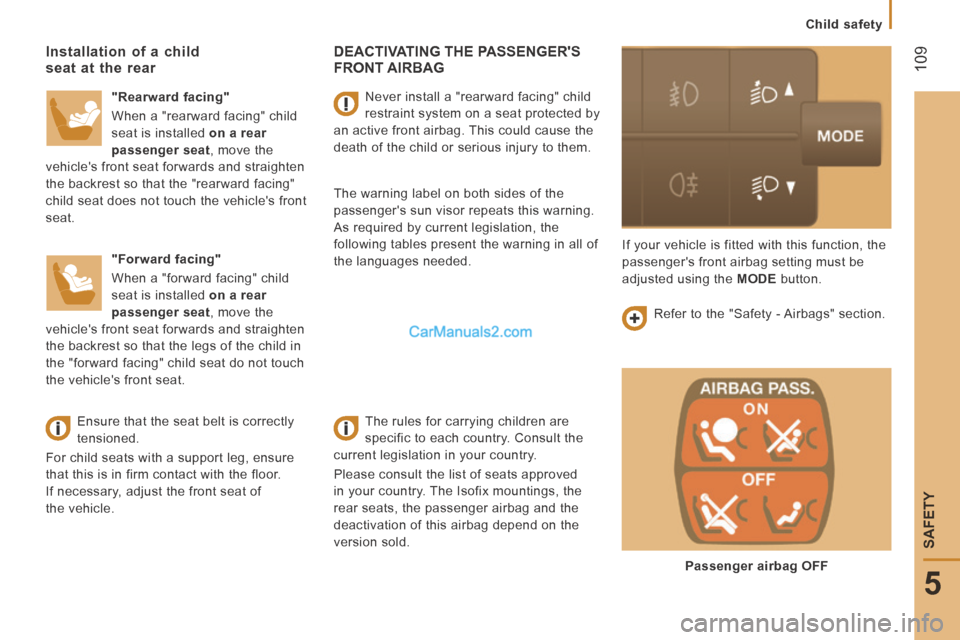
DEACTIVATING THE PASSENGER'S FRONT AIRBAG
The rules for carrying children are
specific to each country. Consult the
current legislation in your country.
Please consult the list of seats approved
in your country. The Isofix mountings, the
rear seats, the passenger airbag and the
deactivation of this airbag depend on the
version sold.
Installation of a child seat at the rear
"Rearward facing"
When a "rearward facing" child
seat is installed on a rear
passenger seat , move the
vehicle's front seat forwards and straighten
the backrest so that the "rearward facing"
child seat does not touch the vehicle's front
seat.
"Forward facing"
When a "forward facing" child
seat is installed on a rear
passenger seat , move the
vehicle's front seat forwards and straighten
the backrest so that the legs of the child in
the "forward facing" child seat do not touch
the vehicle's front seat.
Ensure that the seat belt is correctly
tensioned.
For child seats with a support leg, ensure
that this is in firm contact with the floor.
If necessary, adjust the front seat of
the vehicle. Refer to the "Safety - Airbags" section.
Never install a "rearward facing" child
restraint system on a seat protected by
an active front airbag. This could cause the
death of the child or serious injury to them.
The warning label on both sides of the
passenger's sun visor repeats this warning.
As required by current legislation, the
following tables present the warning in all of
the languages needed. If your vehicle is fitted with this function, the
passenger's front airbag setting must be
adjusted using the
MODE button.
Passenger airbag OFF
Page 119 of 240
11 7
6
ACCESSORIES
Transport solutions
Distribution of loads: distribute the load in
the trailer so that the heaviest objects are as
close as possible to the axle and the nose
weight is close to the maximum authorised
without, however, exceeding it.
Driving advice
A towed vehicle must free wheel: gearbox in
neutral.
Cooling: towing a trailer on a slope
increases the coolant temperature.
As the fan is electrically controlled, its
cooling capacity is not dependent on the
engine speed.
On the contrary, use a high gear to lower the
engine speed and reduce your speed.
In all cases, pay attention to the coolant
temperature. Tyres: check the tyre pressures of the
towing vehicle and of the trailer, observing
the recommended pressures.
Fitting a towbar
We recommend the use of genuine
PEUGEOT towbars and their harnesses,
which have been tested and approved from
the design stage of your vehicle and that
the fitting of this equipment is entrusted to a
PEUGEOT dealer.
These genuine towbars are compatible with
the operation of the rear parking sensors
and the reversing camera, if fitted to your
vehicle.
If this equipment is not fitted by a PEUGEOT
dealer, it must be fitted in line with the
manufacturer's instructions.
Good practice
In certain cases of particularly arduous
use (towing the maximum load up a steep
slope in high temperatures), the engine
automatically limits its power. In this
case, the automatic cutting off of the air
conditioning allows the engine power to be
recovered.
If the coolant temperature
warning lamp comes on, stop the
vehicle and switch off the engine
as soon as possible.
Refer to the "Checks - Levels and
checks" section.
Brakes: towing increases the braking
distance. Drive at a moderate speed,
change down early and brake gradually. Side wind: sensitivity to side wind is
increased. Drive smoothly and at a
moderate speed.
ABS: the system only controls the vehicle,
not the trailer.
Rear parking sensors: the system does not
operate while the vehicle is towing.
Refer to the "Technical data -
Identification markings" section.
Page 121 of 240
Equipment
11 9
6
ACCESSORIES
OTHER ACCESSORIES
These accessories and parts, having been
tested and approved for reliability and
safety, are all adapted to your vehicle.
A wide range of recommended and genuine
parts is available.
"Comfort":
Air deflectors, insulated module, scented air
fresheners, reading lamp, cigarette lighter,
portable ashtray, non-slip seat cushions,
rear parking sensors...
"Protection":
Mats, mudflaps, vehicle protective cover,
seat covers, security grills for rear door
windows, twin rear security doors with
security locks, paint touch-up... "Security":
Anti-intrusion alarm, vehicle tracking system,
snow chains, non-slip covers, child seats,
first aid kit, warning triangle, high visibility
vest, fire extinguisher, pet safety belt, seat
belt cutter / glass hammer...
"Style":
Alloy wheels...
"Multimedia":
CD player, Wi-Fi on Board, semi-integral
satellite navigation system, hands-free kits,
driving aids, rear multimedia support, DVD
player, navigation mapping update, portable
satellite navigation systems, telephone
carrier, aftermarket digital radio, audio
systems, 230V socket...
"Transport solutions":
Towbars, towbar wiring harness with 7/13
connector, 7/7 connector, 13 connector,
interior protection kits, non-slip floor, wheel
arch protector, cab dividers, transverse roof
bars, roof racks, ladder for roof rack, roof
loading runners, loading plate for roof rack...
Installation of radiocommunication
transmitters
You are advised to contact a PEUGEOT
dealer before installing accessory
radiocommunication transmitters with
external aerial on your vehicle.
PEUGEOT dealers can advise you on
the specifications (frequency waveband,
maximum output power, aerial position,
specific installation conditions) of the
transmitters which can be fitted, in
accordance with the Vehicle Electromagnetic
Compatibility Directive (2004/104/EC).
The fitting of electrical equipment or
accessories which are not listed by
PEUGEOT may result in the failure of your
vehicle's electronic system.
We request that you take note of this point
and recommend that you contact a dealer
to be shown the range of recommended
equipment and accessories.
Depending on the country in which the
vehicle is sold or operated, it may be
compulsory to have a high visibility vest,
warning triangle, replacement bulbs and
breathalyzer in the vehicle.
To prevent the mat from becoming caught
under the pedals:
- ensure that the mat and its fixings are
positioned correctly,
- never fit one mat on top of another.
Page 124 of 240
122
Under the bonnet
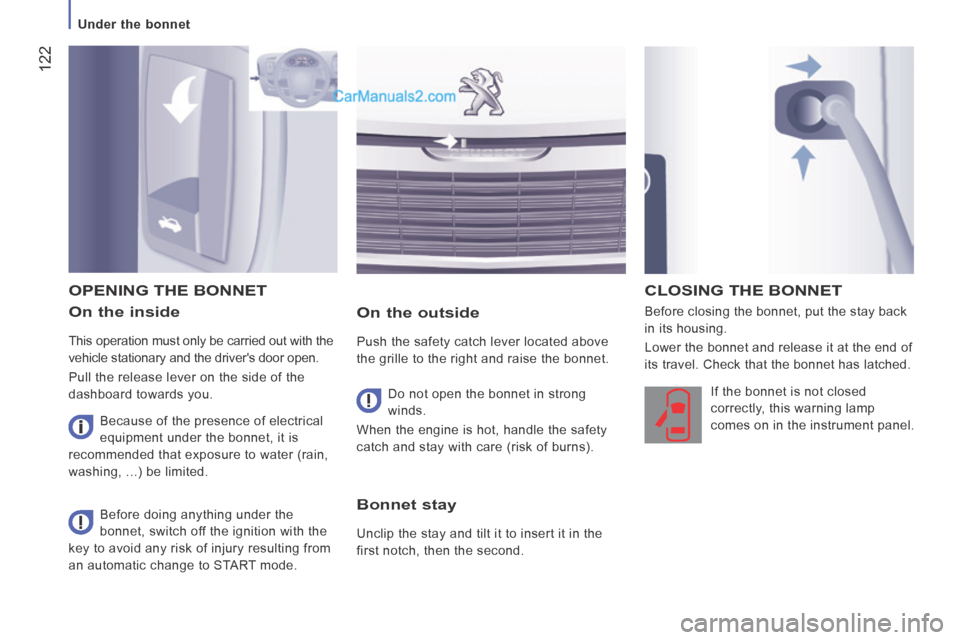
On the inside
This operation must only be carried out with the
vehicle stationary and the driver's door open.
Pull the release lever on the side of the
dashboard towards you.
On the outside
Push the safety catch lever located above
the grille to the right and raise the bonnet. Before closing the bonnet, put the stay back
in its housing.
Lower the bonnet and release it at the end of
its travel. Check that the bonnet has latched.
OPENING THE BONNET
Do not open the bonnet in strong
winds.
When the engine is hot, handle the safety
catch and stay with care (risk of burns). If the bonnet is not closed
correctly, this warning lamp
comes on in the instrument panel.
Before doing anything under the
bonnet, switch off the ignition with the
key to avoid any risk of injury resulting from
an automatic change to START mode.
CLOSING THE BONNET
Bonnet stay
Unclip the stay and tilt it to insert it in the
first notch, then the second.
Because of the presence of electrical
equipment under the bonnet, it is
recommended that exposure to water (rain,
washing, ...) be limited.
Page 126 of 240
Levels and checks
124
Used products
Avoid prolonged contact of used oil or fluids
with the skin.
Most of these fluids are harmful to health or
indeed very corrosive.
Do not discard used oil or fluids into sewers
or onto the ground.
Take used oil to a PEUGEOT dealer or
a qualified workshop (France) or to an
authorised waste disposal site.
LEVELS
These regular maintenance operations
will keep your vehicle in good running
order. Ask for advice at a PEUGEOT dealer
or consult the warranty and maintenance
record contained in the handbook pack.
To maintain the reliability of engines and
emission control systems, the use of
additives in engine oil is prohibited.
Changing the brake fluid
The brake fluid must be changed at
the intervals stated, according to the
manufacturer's servicing schedule.
Use fluids recommended by the
manufacturer, which fulfil DOT4 standards.
The level must be between the MIN and
MAX marks on the reservoir.
If fluid has to be added frequently, this
indicates a failure which must be checked by
a PEUGEOT dealer or a qualified workshop
as soon as possible.
If you have to remove/refit the engine
styling cover, handle it with care to
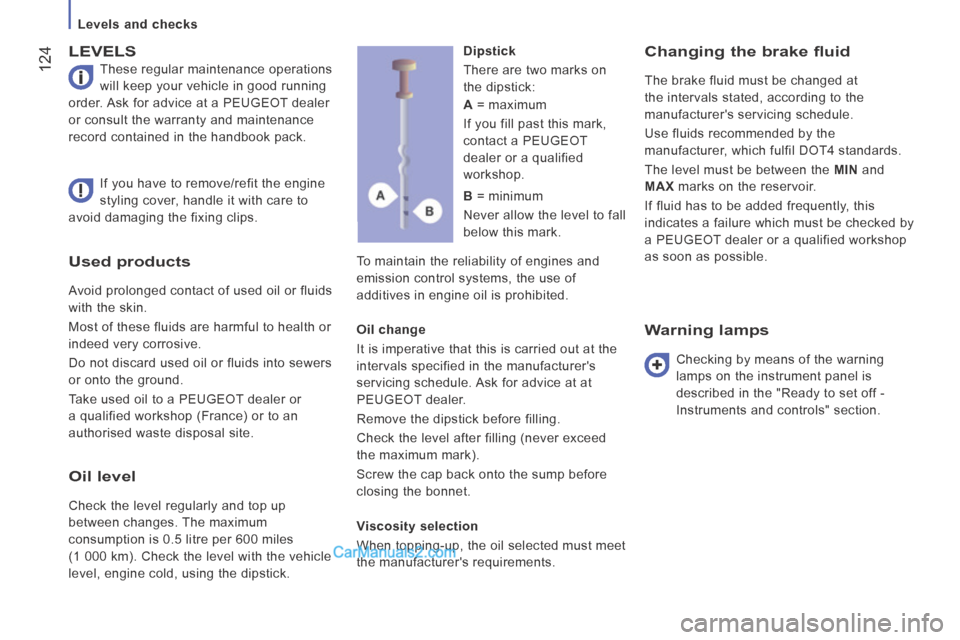
avoid damaging the fixing clips. Dipstick
There are two marks on
the dipstick:
Oil change
It is imperative that this is carried out at the
intervals specified in the manufacturer's
servicing schedule. Ask for advice at at
PEUGEOT dealer.
Remove the dipstick before filling.
Check the level after filling (never exceed
the maximum mark).
Screw the cap back onto the sump before
closing the bonnet.
Viscosity selection
When topping-up, the oil selected must meet
the manufacturer's requirements.
Warning lamps
Checking by means of the warning
lamps on the instrument panel is
described in the "Ready to set off -
Instruments and controls" section.
A
= maximum
If you fill past this mark,
contact a PEUGEOT
dealer or a qualified
workshop.
B = minimum
Never allow the level to fall
below this mark.
Oil level
Check the level regularly and top up
between changes. The maximum
consumption is 0.5 litre per 600 miles
(1 000 km). Check the level with the vehicle
level, engine cold, using the dipstick.
Page 128 of 240
Levels and checks
126
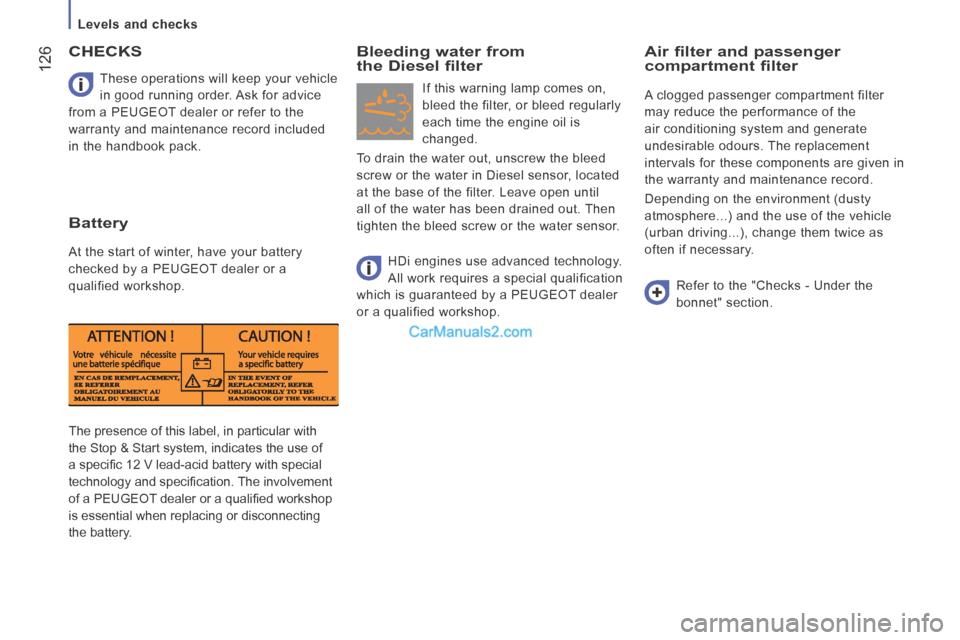
The presence of this label, in particular with
the Stop & Start system, indicates the use of
a specifi c 12 V lead-acid battery with special
technology and specifi cation. The involvement
of a PEUGEOT dealer or a qualifi ed workshop
is essential when replacing or disconnecting
the battery. These operations will keep your vehicle
in good running order. Ask for advice
from a PEUGEOT dealer or refer to the
warranty and maintenance record included
in the handbook pack.
CHECKS
Battery
At the start of winter, have your battery
checked by a PEUGEOT dealer or a
qualified workshop.
Bleeding water from the Diesel filter
If this warning lamp comes on,
bleed the filter, or bleed regularly
each time the engine oil is
changed.
To drain the water out, unscrew the bleed
screw or the water in Diesel sensor, located
at the base of the filter. Leave open until
all of the water has been drained out. Then
tighten the bleed screw or the water sensor.
Air filter and passenger compartment filter
A clogged passenger compartment filter
may reduce the performance of the
air conditioning system and generate
undesirable odours. The replacement
intervals for these components are given in
the warranty and maintenance record.
Depending on the environment (dusty
atmosphere...) and the use of the vehicle
(urban driving...), change them twice as
often if necessary.
Refer to the "Checks - Under the
bonnet" section.
HDi engines use advanced technology.
All work requires a special qualification
which is guaranteed by a PEUGEOT dealer
or a qualified workshop.
Page 129 of 240
Levels and checks
127
7
CHECKS
Manual gearbox
Have the level checked in accordance with
the manufacturer's servicing schedule.
Good practice
To check the main levels and certain
components, in accordance with the
manufacturer's servicing schedule, refer to
the pages of the warranty and maintenance
record which correspond to your vehicle's
engine.
Only use products recommended by
PEUGEOT or products of equivalent quality
and specification.
In order to optimise the operation of units as
important as the braking system, PEUGEOT
selects and offers specific products.
Oil filter
Change the filter regularly, in accordance
with the manufacturer's servicing schedule.
Brake pads
Brake pad wear depends on the style of
driving, in particular for vehicles which are
used in town, over short distances. It may
be necessary to check the thickness of the
pads, even between services.
Brake disc/drum wear status
For any information relating to checking
the brake disc/drum wear status, contact a
PEUGEOT dealer or a qualified workshop.
Parking brake
Where the parking brake travel is too great
or there is a reduction in the performance
of the system, the parking brake should be
adjusted, even between services.
Have the system checked by a PEUGEOT
dealer or a qualified workshop.
If this warning lamp comes on,
have the brake pad wear checked
by a PEUGEOT dealer or a
qualified workshop. In order to avoid damaging the
electrical units, high pressure washing
to clean the engine compartment is strictly
prohibited.
After washing the vehicle dampness, or in
winter, ice may form on the brake discs and
pads: braking efficiency may be reduced.
Make some light brake applications to dry
and de-ice the brakes.
Page 130 of 240
Levels and checks
128
Operating fault
If this alert persists, do not ignore the
warning; it indicates that a fault has occurred
in the exhaust / particle filter system.
Have the whole system checked by a
PEUGEOT dealer or a qualified workshop.
If there is risk of blockage of the
filter, this warning lamp comes on
in the instrument panel.
Saturation / Regeneration Because of the higher exhaust
gas temperature resulting from the
normal operation of the particle filter, it is
recommended that you do not park the
vehicle over inflammable materials (grass,
dry leaves, pine needles, ...) so as to avoid
any risk of fire.
Particle filter system (Diesel)
An addition to the catalytic converter, this
filter makes an active contribution to the
preservation of air quality by the retaining
of the unburnt pollutant particles. Black
exhaust fumes are thus no longer emitted.
Operation
This filter, fitted to the exhaust system,
accumulates particles of soot. The engine
management unit controls the automatic
periodic elimination of the soot particles
(regeneration).
The regeneration procedure is invoked
according to the quantity of particles
accumulated and the driving conditions
of the vehicle. During this phase, you
may notice some unusual phenomena -
increased idling speed, cooling fan running,
increase in smoke and higher exhaust gas
temperature - which does not affect the
operation of the vehicle or the environment. After prolonged idling or driving at very
low speeds, you may occasionally
notice water vapour being emitted from the
exhaust when accelerating. This is of no
consequence to the running of the vehicle or
to the environment. To regenerate the filter, it is advised to
drive as soon as possible, when traffic
conditions and the law permit, at a speed
of at least 40 mph (around 60 km/h), with
an engine speed above 2 000 rpm for about
fifteen minutes (until the warning lamp and/
or the message disappears).
If possible, avoid switching off the engine
before the end of regeneration of the
filter; repeated interruptions could cause
premature deterioration of the engine oil. It
is not recommended to end regeneration of
the filter with the vehicle stationary.
This alert tells you that the particle filter
is starting to fill up (in conditions of urban
driving of exceptionally long duration: low
speeds, traffic jams etc.)