tyre Peugeot Boxer 2016 User Guide
[x] Cancel search | Manufacturer: PEUGEOT, Model Year: 2016, Model line: Boxer, Model: Peugeot Boxer 2016Pages: 292, PDF Size: 10.07 MB
Page 127 of 292
125
boxer_en_Chap06_Accessoires_ed01-2015
SnoW cHAInS
In wintry conditions, snow chains improve
traction as well as the behaviour of the
vehicle when braking.
t
he snow chains must be fitted only to
the driving wheels.
t
hey must never be
fitted to "space-saver" type spare wheels.
take account of the legislation in force
in your country on the use of snow
chains and the maximum running speed
authorised . Advice on installation
F
If you have to fit the chains during
a journey, stop the vehicle on a flat
surface on the side of the road.
F
Apply the parking brake and position any
wheel chocks to prevent movement of
your vehicle.
F
Fit the chains following the instructions
provided by the manufacturer.
F
Move of
f gently and drive for a few
moments, without exceeding 30 mph
(50
km/h).
F
Stop your vehicle and check that the
snow chains are correctly tightened.
It is recommended that before you
leave, you practise fitting the snow
chains on a level and dry surface. Avoid driving with chains on roads that
have been cleared of snow, to avoid
damaging your vehicle's tyres and the road
surface. If your vehicle is fitted with alloy
wheels, check that no part of the chain or its
fixings is in contact with the wheel rim.u se only the chains designed to be fitted to
the type of wheel fitted to your vehicle:
Original
tyre size Maximum link
size.
215/70 R15 12 mm
225/75 R15 16 mm
215/75 R16 16 mm
225/75 R16 16 mm
For more information on snow chains,
contact a P
euge O t
dealer or a qualified
workshop.
equipment
6
ACCeSSORIeS
Page 162 of 292
160
boxer_en_Chap08_Aide-Rapide_ed01-2015
Refer to the "technical data -
Identification markings" section for the
location of the tyre pressure label.
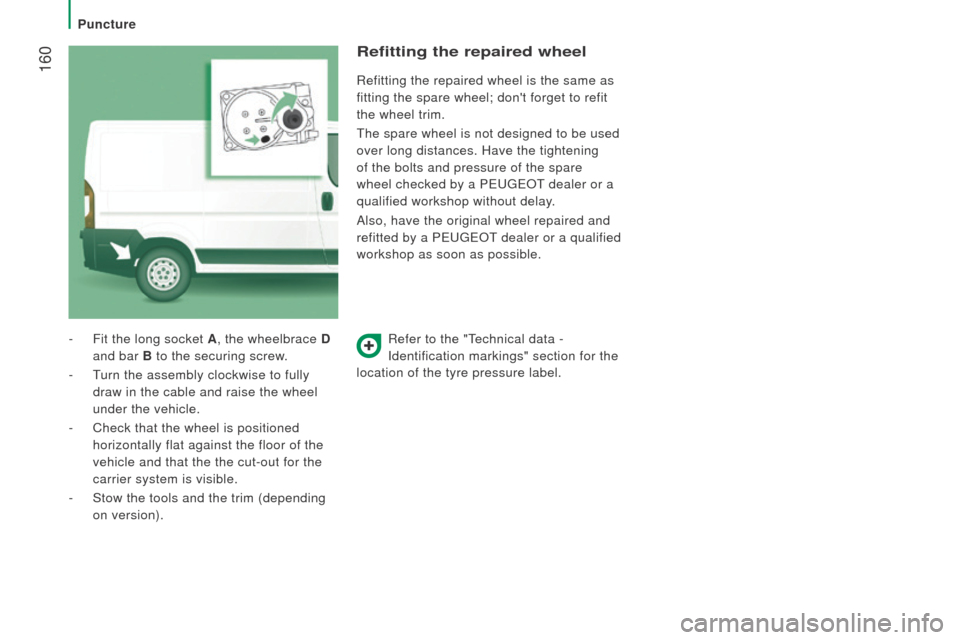
-
Fit the long socket
A
, the wheelbrace
d
and bar B to the securing screw.
-
t
urn the assembly clockwise to fully
draw in the cable and raise the wheel
under the vehicle.
-
Check that the wheel is positioned
horizontally flat against the floor of the
vehicle and that the the cut-out for the
carrier system is visible.
-
Stow the tools and the trim (depending
on version).
refitting the repaired wheel
Refitting the repaired wheel is the same as
fitting the spare wheel; don't forget to refit
the wheel trim.
t
he spare wheel is not designed to be used
over long distances. Have the tightening
of the bolts and pressure of the spare
wheel checked by a P
euge O t
dealer or a
qualified workshop without delay.
Also, have the original wheel repaired and
refitted by a P
euge O t
dealer or a qualified
workshop as soon as possible.
Puncture
Page 163 of 292
161
boxer_en_Chap08_Aide-Rapide_ed01-2015
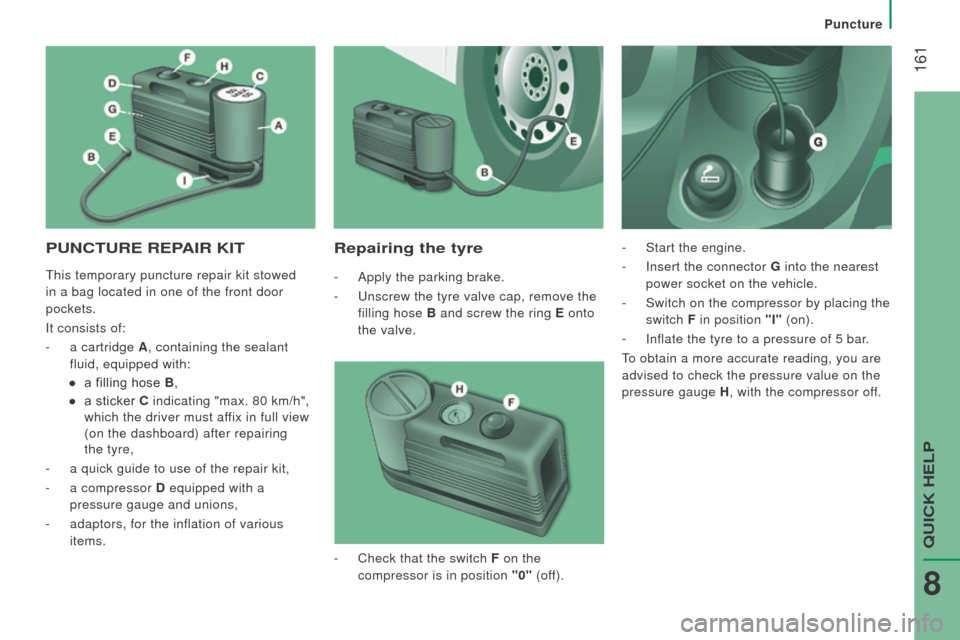
PuncturE rEPAIr KItrepairing the tyre
- Apply the parking brake.
- u nscrew the tyre valve cap, remove the
filling hose B and screw the ring E onto
the valve. -
Start the engine.
-
Insert the connector G
into the nearest
power socket on the vehicle.
-
Switch on the compressor by placing the
switch F in position "I" (on).
-
Inflate the tyre to a pressure of 5 bar
.
to obtain a more accurate reading, you are
advised to check the pressure value on the
pressure gauge H , with the compressor off.
-
Check that the switch
F on the
compressor is in position "0" (off).t
his temporary puncture repair kit stowed
in a bag located in one of the front door
pockets.
It consists of:
-
a cartridge
A , containing the sealant
fluid, equipped with:
●
a filling hose
B ,
●
a sticker
c
indicating "max. 80 km/h",
which the driver must affix in full view
(on the dashboard) after repairing
the
tyre,
-
a quick guide to use of the repair kit,
-
a compressor
d
equipped with a
pressure gauge and unions,
-
adaptors, for the inflation of various
items.
Puncture
QuICK HeLP
8
Page 164 of 292
162
boxer_en_Chap08_Aide-Rapide_ed01-2015
- If a pressure of at least 3 bar is not
reached within 5 minutes, disconnect
the compressor from the valve and the
power socket, then move the vehicle
forward by approximately 10 metres to
distribute the sealant fluid inside the
tyre.
-
t hen repeat the inflation operation:
●
if a pressure of at least
3 bar is not
reached within 10 minutes, switch off
your vehicle: the tyre has suffered
too much damage and repair has not
been possible. Contact a P
euge O t
dealer or a qualified workshop.
●
if the tyre has been inflated to a
pressure of 5 bar, set off again
immediately.
After driving for approximately 10 minutes,
stop and check the pressure of the tyre
again.
Adjust the pressure to the value given on the
label on the driver's door pillar, and contact
a P
euge O t
dealer or a qualified workshop
as soon as possible.
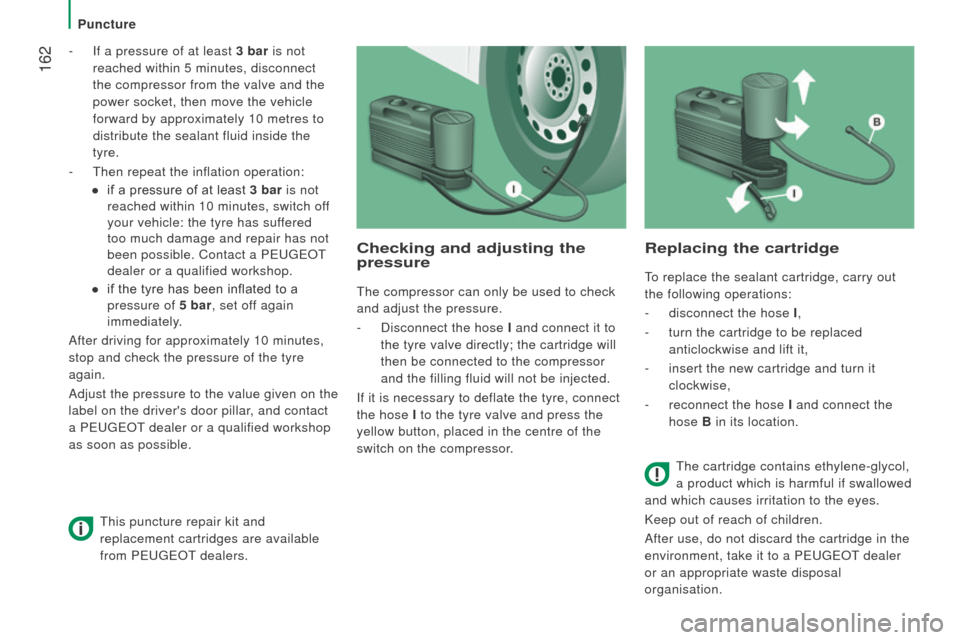
checking and adjusting the
pressure
the compressor can only be used to check
and adjust the pressure.
-
Disconnect the hose
I and connect it to
the tyre valve directly; the cartridge will
then be connected to the compressor
and the filling fluid will not be injected.
If it is necessary to deflate the tyre, connect
the hose I to the tyre valve and press the
yellow button, placed in the centre of the
switch on the compressor.
replacing the cartridge
to replace the sealant cartridge, carry out
the following operations:
-
disconnect the hose
I,
-
turn the cartridge to be replaced
anticlockwise and lift it,
-
insert the new cartridge and turn it
clockwise,
-
reconnect the hose
I and connect the
hose B in its location.
t
he cartridge contains ethylene-glycol,
a product which is harmful if swallowed
and which causes irritation to the eyes.
Keep out of reach of children.
After use, do not discard the cartridge in the
environment, take it to a P
euge O t dealer
or an appropriate waste disposal
organisation.
t
his puncture repair kit and
replacement cartridges are available
from P
euge
O
t
dealers.
Puncture
Page 184 of 292
182
boxer_en_Chap09_Caracteristiques-techniques_ed01-2015
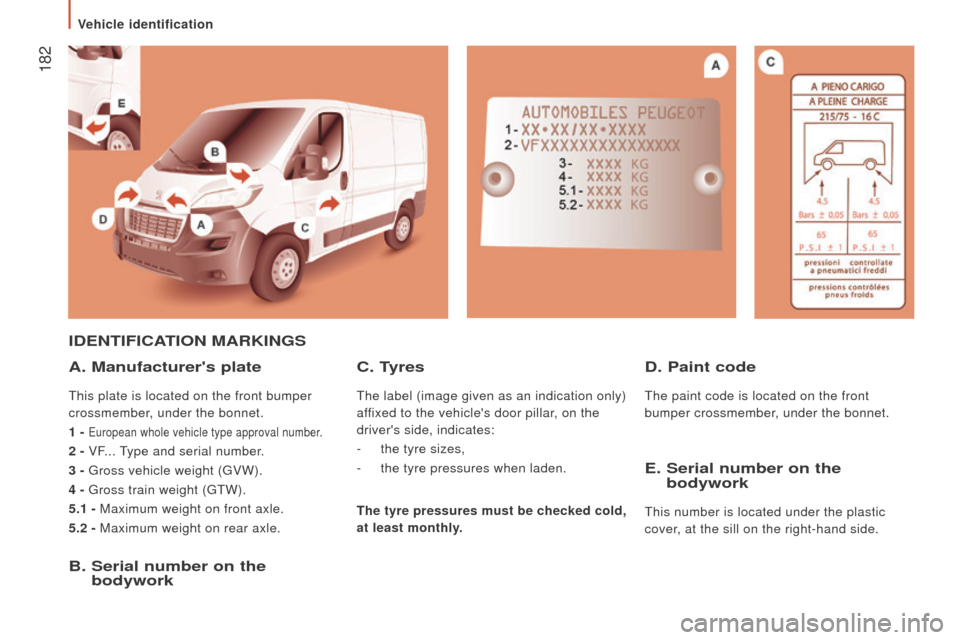
IdEntIFIcAtI on MA r KI n GS
A. Manufacturer's plate
this plate is located on the front bumper
crossmember , under the bonnet.
1 -
european whole vehicle type approval number.
2 - VF... type and serial number .
3 - g ross vehicle weight ( g VW).
4 -
g ross train weight ( gt W).
5.1 - Maximum weight on front axle.
5.2 - Maximum weight on rear axle.
B. Serial number on the
bodywork
d
. Paint code
the paint code is located on the front
bumper crossmember , under the bonnet.
c. tyres
the label (image given as an indication only)
af fixed to the vehicle's door pillar, on the
driver's side, indicates:
-
the tyre sizes,
-
the tyre pressures when laden.E. Serial number on the
bodywork
this number is located under the plastic
cover , at the sill on the right-hand side.t
he tyre pressures must be checked cold,
at least monthly.
Vehicle identification
Page 261 of 292
259
boxer_en_Chap11_Particularites_ed01-2015
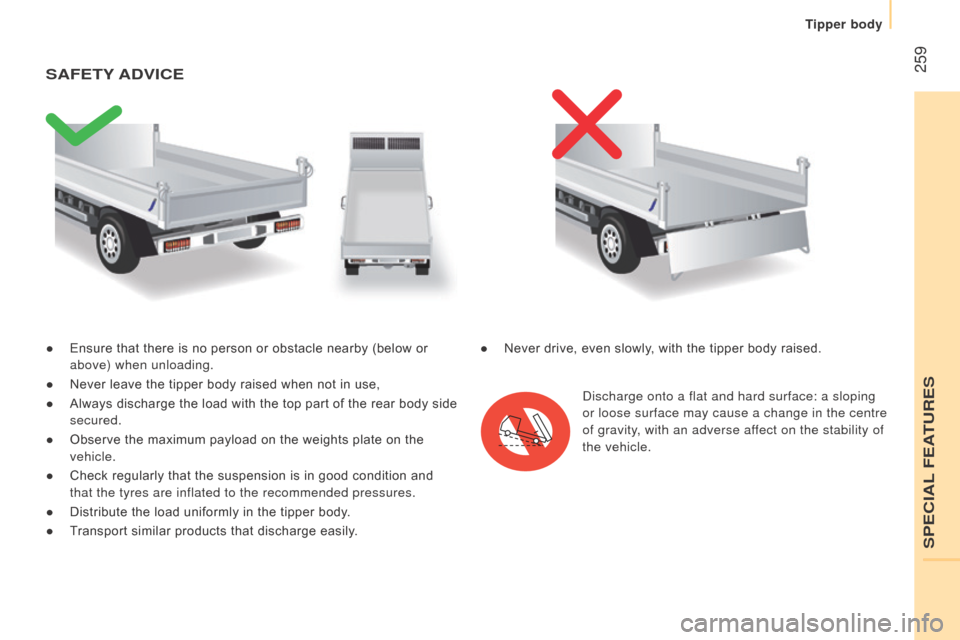
● Ensure that there is no person or obstacle nearby (below or
above) when unloading.
●
Never leave the tipper body raised when not in use,
●
Always discharge the load with the top part of the rear body si
de
secured.
●
Observe the maximum payload on the weights plate on the
vehicle.
●
Check regularly that the suspension is in good condition and
that the tyres are inflated to the recommended pressures.
●
Distribute the load uniformly in the tipper body
.
●
T
ransport similar products that discharge easily.
SAFEtY A d VI c E
Discharge onto a flat and hard surface: a sloping
or loose surface may cause a change in the centre
of gravity, with an adverse affect on the stability of
the vehicle.
●
Never drive, even slowly
, with the tipper body raised.
SPeCIAL FeAtuReS
tipper body