tyre Peugeot Boxer 2016 Owner's Manual
[x] Cancel search | Manufacturer: PEUGEOT, Model Year: 2016, Model line: Boxer, Model: Peugeot Boxer 2016Pages: 292, PDF Size: 10.07 MB
Page 4 of 292
2
boxer_en_Chap00a_Sommaire_ed01-2015
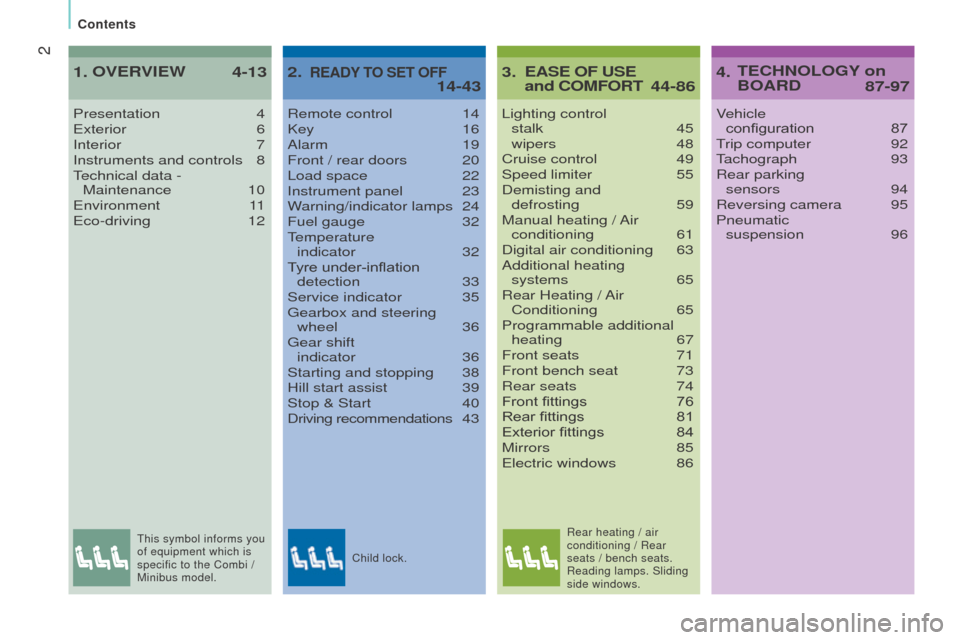
3. 44-86
EASE
o F u SE
and co MF ort
Lighting control
stalk 45
wipers
48
Cruise control
49
Speed limiter
55
Demisting and
defrosting
59
Manual heating / Air conditioning
61
Digital air conditioning
63
Additional heating
systems
65
Rear Heating /
Air
Conditioning
65
Programmable additional heating
67
Front seats
71
Front bench seat
73
Rear seats
74
Front fittings
76
Rear fittings
81
Exterior fittings
84
Mirrors
85
e
lectric windows
86
Presentation
4e
xterior
6
Interior
7
Instruments and controls
8technical data - Maintenance
10e
nvironment
11
e
co-driving
12
1. 4-13 oVE rVIEW
4.
87-97tE c H no L o GY on
B o A rd
Vehicle
configuration 87trip computer
92tachograph
93
Rear parking
sensors
94
Reversing camera
95
Pneumatic
suspension
96
2.
14-43rEAdY to SEt oFF
Remote control 14
Key 16
Alarm
19
Front / rear doors
20
Load space
22
Instrument panel
23
W
arning/indicator lamps
24
Fuel gauge
32temperature
indicator
32
Tyre under-inflation detection
33
Service indicator
35g
earbox and steering
wheel
36
g
ear shift
indicator
36
Starting and stopping
38
Hill start assist
39
Stop & Start
40
Driving recommendations
4
3
this symbol informs you
of equipment which is
specific to the Combi
/
Minibus model. Child lock.Rear heating / air
conditioning / Rear
seats / bench seats.
Reading lamps. Sliding
side windows.
Contents
Page 8 of 292
6
boxer_en_Chap01_Vue-ensemble_ed01-2015
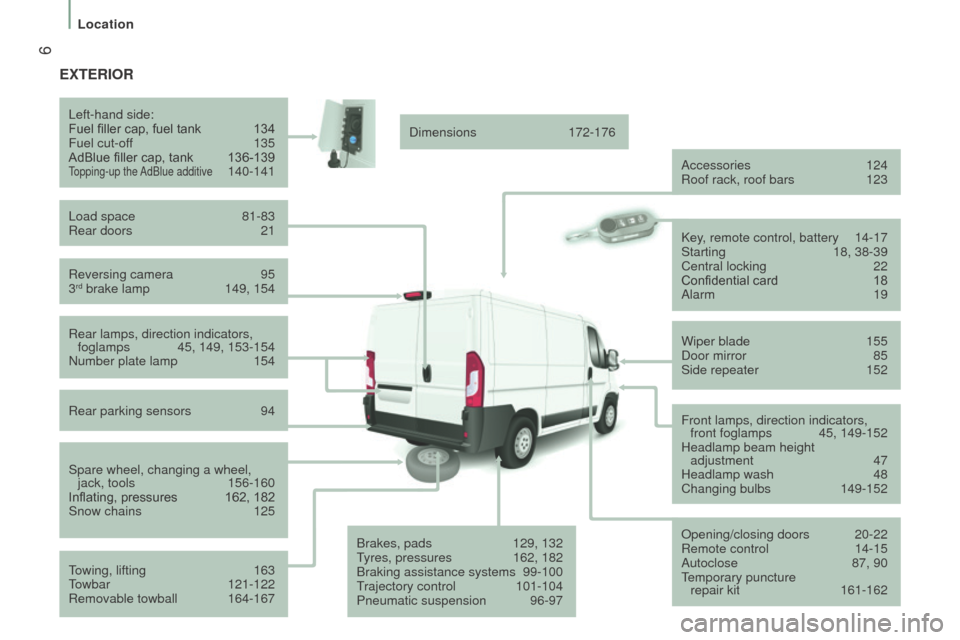
ExtErIor
Reversing camera 95
3rd brake lamp 149, 154
Left-hand side:
Fuel filler cap, fuel tank
134
Fuel cut-of
f
135
AdBlue filler cap, tank
136-139topping-up the
AdBlue additive 140-141
Load space
81-83
Rear doors
21
Rear lamps, direction indicators, foglamps
45, 149, 153-154
Number plate lamp
154
Rear parking sensors
94
Spare wheel, changing a wheel, jack, tools
156-160
Inflating, pressures
162, 182
Snow chains
125
towing, lifting
163towbar
121-122
Removable towball
164-167 Dimensions
172-176
Accessories
124
Roof rack, roof bars 123
Brakes, pads
129, 132tyres, pressures
162, 182
Braking assistance systems
99-100trajectory control
101-104
Pneumatic suspension
96-97Key
, remote control, battery
14-17
Starting
18, 38-39
Central locking
22
Confidential card
18
Alarm
19
Wiper blade
155
Door mirror
85
Side repeater
152
Opening/closing doors
20-22
Remote control
14-15
Autoclose
87, 90temporary puncture repair kit
161-162
Front lamps, direction indicators,
front foglamps
45, 149-152
Headlamp beam height adjustment
47
Headlamp wash
48
Changing bulbs
149-152
Location
Page 12 of 292
10
boxer_en_Chap01_Vue-ensemble_ed01-2015
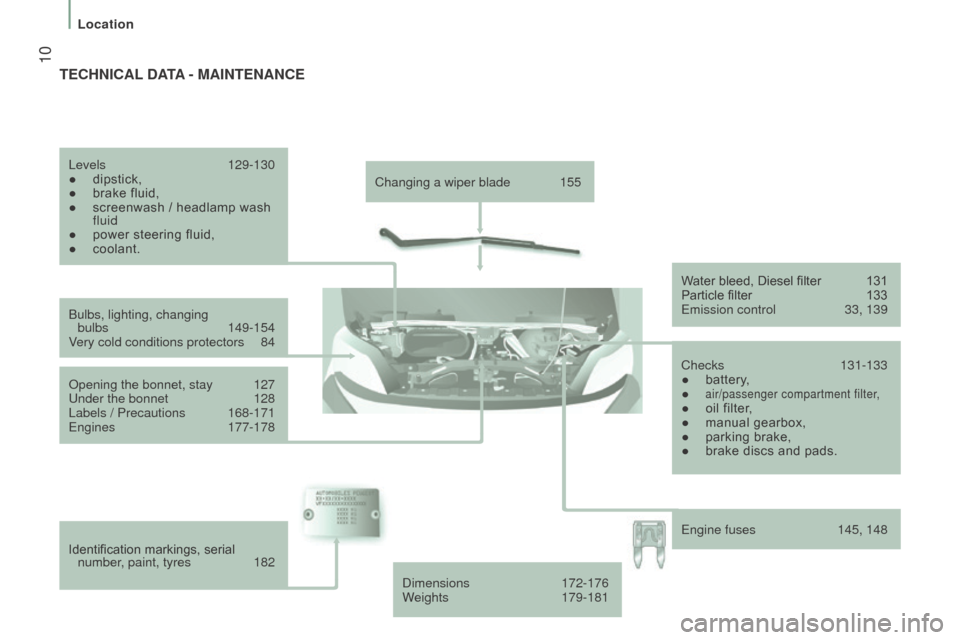
Changing a wiper blade 155
Bulbs, lighting, changing bulbs
149-154
Very cold conditions protectors
84
Opening the bonnet, stay
127u
nder the bonnet
128
Labels / Precautions
168-171e
ngines
177-178
Identification markings, serial number, paint, tyres
182
Levels
129-130
●
dipstick,
●
brake fluid,
●
screenwash / headlamp wash
fluid
●
power steering fluid,
●
coolant. W
ater bleed, Diesel filter
131
Particle filter
133e
mission control
33, 139
Checks
131-133
●
battery
,
●
air/passenger compartment filter,● oil filter,
● manual gearbox,
●
parking brake,
●
brake discs and pads.
tEcHnIcAL d AtA - M AI nt E n A nc E
Dimensions 172-176
W eights 179-181
e
ngine fuses
145, 148
Location
Page 15 of 292
13
boxer_en_Chap01_Vue-ensemble_ed01-2015
Limit the causes of excess consumption
Spread loads throughout the vehicle; place the heaviest items in
the bottom of the boot, as close as possible to the rear seats.
Limit the loads carried in the vehicle and reduce wind resistance
(roof bars, roof rack, trailer...).
At the end of winter, remove snow tyres and refit your summer
tyres.
observe the recommendations on maintenance
Check the tyre pressures regularly, when cold, referring to the
label in the door aperture, driver's side.
Carry out this check in particular:
-
before a long journey
,
-
at each change of season,
-
after a long period out of use.
Don't forget the spare wheel and the tyres on any trailer or
caravan.
Have your vehicle serviced regularly (engine oil, oil filter, air
filter, cabin filter...) and observe the schedule of operations in the
manufacturer's service schedule.
With a BlueHDi Diesel engine, if the SCR has a fault your vehicle
becomes polluting; go to a P
euge O t
dealer or a qualified
workshop as soon as possible to bring the levels of nitrous oxide
emissions back into line with the regulations.
When refuelling, do not continue after the 3
rd cut-off of the nozzle
to avoid any overflow.
At the wheel of your new vehicle, it is only after the first
1
800
miles (3 000 kilometres) that you will see the fuel
consumption settle down to a consistent average.
1
OVeRVIeW
Motoring & the environment
Page 29 of 292
27
boxer_en_Chap02_Pret-a-Partir_ed01-2015
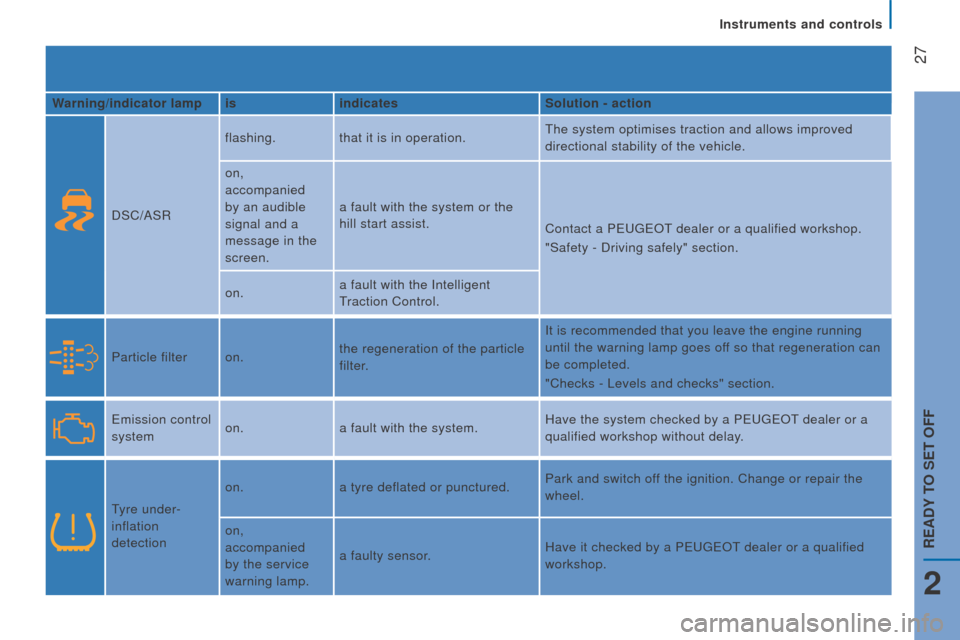
Warning/indicator lampisindicates Solution - action
DSC/ASR flashing.
that it is in operation.
t
he system optimises traction and allows improved
directional stability of the vehicle.
on,
accompanied
by an audible
signal and a
message in the
screen. a fault with the system or the
hill start assist.
Contact a P
euge O t
dealer or a qualified workshop.
"Safety - Driving safely" section.
on. a fault with the Intelligent
traction Control.
Particle filter on. the regeneration of the particle
filter. It is recommended that you leave the engine running
until the warning lamp goes off so that regeneration can
be completed.
"Checks - Levels and checks" section.
e
mission control
system on.
a fault with the system. Have the system checked by a P
euge O t
dealer or a
qualified workshop without delay.
tyre under-
inflation
detection on.
a tyre deflated or punctured. Park and switch off the ignition. Change or repair the
wheel.
on,
accompanied
by the service
warning lamp. a faulty sensor.
Have it checked by a P
euge O t
dealer or a qualified
workshop.
Instruments and controls
2
rEAdY to SEt oFF
Page 35 of 292
33
boxer_en_Chap02_Pret-a-Partir_ed01-2015
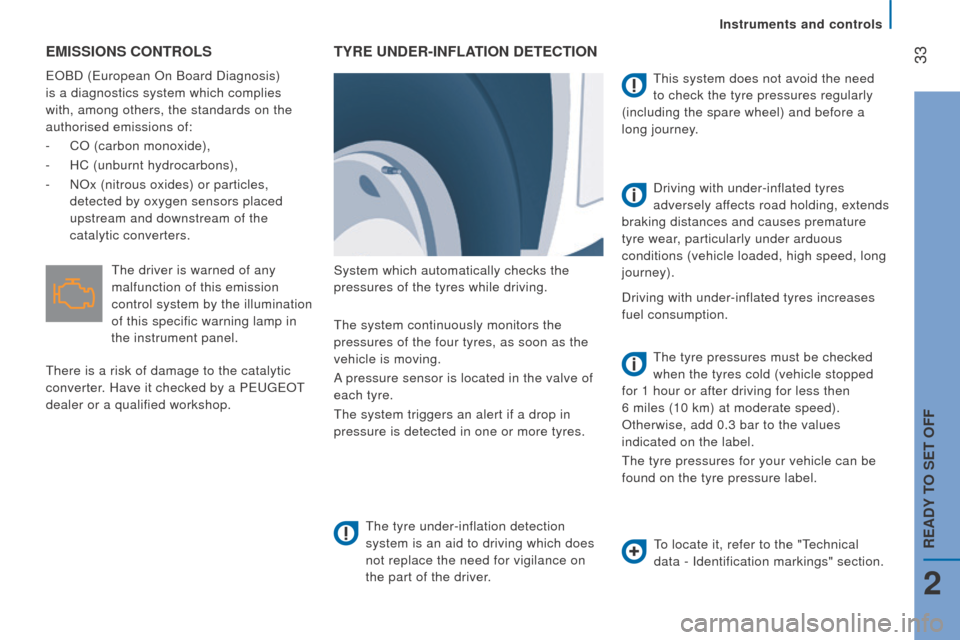
EMISSIonS controLS
eOBD (european On Board Diagnosis)
is a diagnostics system which complies
with, among others, the standards on the
authorised emissions of:
-
CO (carbon monoxide),
-
HC (unburnt hydrocarbons),
-
NOx (nitrous oxides) or particles,
detected by oxygen sensors placed
upstream and downstream of the
catalytic converters.
tYrE undEr-InFLAt I on d E t E ct I on
System which automatically checks the
pressures of the tyres while driving.
t
he tyre under-inflation detection
system is an aid to driving which does
not replace the need for vigilance on
the part of the driver.
t
his system does not avoid the need
to check the tyre pressures regularly
(including the spare wheel) and before a
long journey.
Driving with under-inflated tyres increases
fuel consumption.
t
he system continuously monitors the
pressures of the four tyres, as soon as the
vehicle is moving.
A pressure sensor is located in the valve of
each tyre.
t
he system triggers an alert if a drop in
pressure is detected in one or more tyres.
t
he tyre pressures must be checked
when the tyres cold (vehicle stopped
for 1 hour or after driving for less then
6 miles (10 km) at moderate speed).
Otherwise, add 0.3 bar to the values
indicated on the label.
t
he tyre pressures for your vehicle can be
found on the tyre pressure label.t
he driver is warned of any
malfunction of this emission
control system by the illumination
of this specific warning lamp in
the instrument panel.
t
here is a risk of damage to the catalytic
converter. Have it checked by a P
euge
O
t
dealer or a qualified workshop.
to locate it, refer to the "
t
echnical
data
- Identification markings" section.
Driving with under-inflated tyres
adversely affects road holding, extends
braking distances and causes premature
tyre wear, particularly under arduous
conditions (vehicle loaded, high speed, long
journey).
Instruments and controls
2
rEAdY to SEt oFF
Page 36 of 292
34
boxer_en_Chap02_Pret-a-Partir_ed01-2015
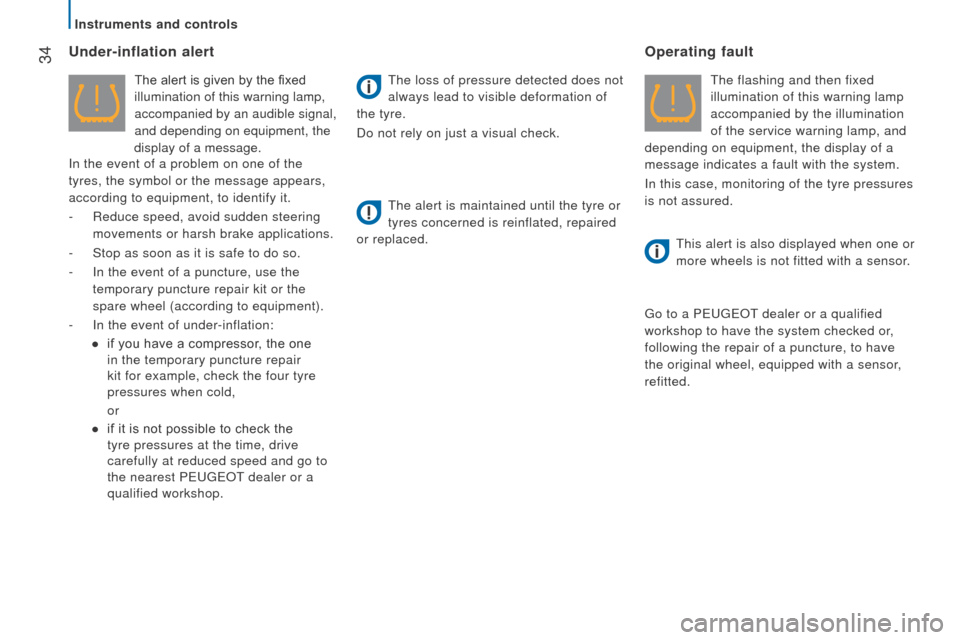
under-inflation alert
The alert is given by the fixed
illumination of this warning lamp,
accompanied by an audible signal,
and depending on equipment, the
display of a message.
In the event of a problem on one of the
tyres, the symbol or the message appears,
according to equipment, to identify it.
-
Reduce speed, avoid sudden steering
movements or harsh brake applications.
-
Stop as soon as it is safe to do so.
-
In the event of a puncture, use the
temporary puncture repair kit or the
spare wheel (according to equipment).
-
In the event of under-inflation:
●
if you have a compressor
, the one
in the temporary puncture repair
kit for example, check the four tyre
pressures when cold,
or
●
if it is not possible to check the
tyre pressures at the time, drive
carefully at reduced speed and go to
the nearest P
euge O t
dealer or a
qualified workshop.t he loss of pressure detected does not
always lead to visible deformation of
the tyre.
Do not rely on just a visual check.
t
he alert is maintained until the tyre or
tyres concerned is reinflated, repaired
or replaced.
operating fault
the flashing and then fixed
illumination of this warning lamp
accompanied by the illumination
of the service warning lamp, and
depending on equipment, the display of a
message indicates a fault with the system.
In this case, monitoring of the tyre pressures
is not assured.
t
his alert is also displayed when one or
more wheels is not fitted with a sensor.
g
o to a P
euge O t
dealer or a qualified
workshop
to have the system checked or,
following the repair of a puncture, to have
the original wheel, equipped with a sensor,
refitted.
Instruments and controls
Page 102 of 292
100
boxer_en_Chap05_Securite_ed01-2015
Good practice
t
he ABS system does not provide shorter
braking distances. On very slippery surfaces
(black ice, oil...) the ABS can extend braking
distances. For emergency braking, press the
brake pedal hard and do not release it, even
on a slipper surface; you will then be able to
steer the vehicle and avoid an obstacle.
When replacing wheels (tyres and
rims), ensure that they conform to the
manufacturer's recommendations.Emergency braking assistance
System which, in an emergency, enables
you to obtain the optimum braking pressure
more quickly, thus reducing the stopping
distance.
o
peration
It is triggered by the speed at which the
brake pedal is pressed.
t
he effect of this is a reduction in the
resistance of the pedal and an increase in
braking efficiency.
Switching off
t
his system cannot be deactivated by the
driver.
o
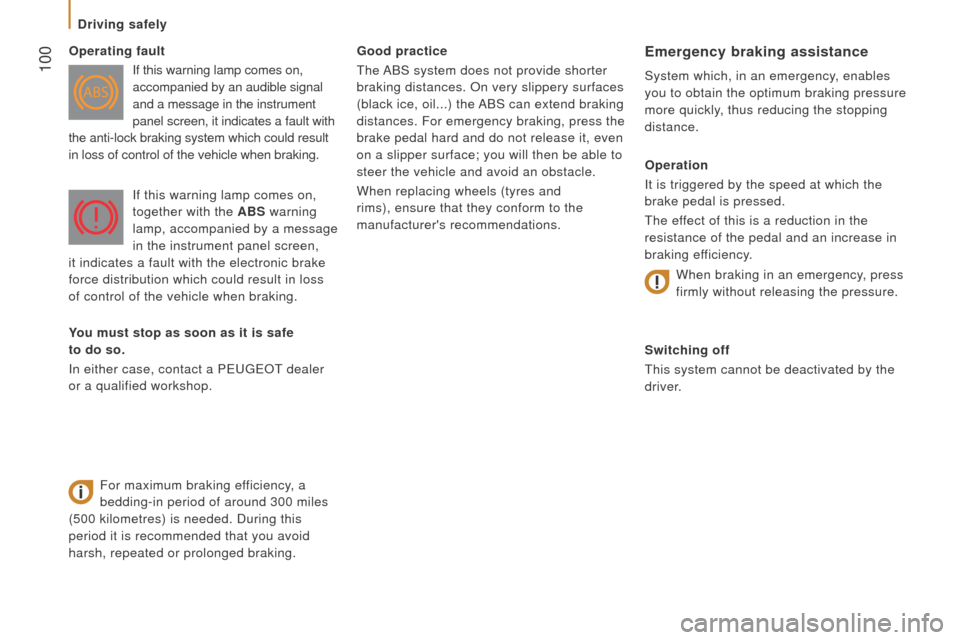
perating fault
If this warning lamp comes on,
accompanied by an audible signal
and a message in the instrument
panel screen, it indicates a fault with
the anti-lock braking system which could result
in loss of control of the vehicle when braking.
For maximum braking efficiency, a
bedding-in period of around 300 miles
(500 kilometres) is needed. During this
period it is recommended that you avoid
harsh, repeated or prolonged braking. If this warning lamp comes on,
together with the ABS warning
lamp, accompanied by a message
in the instrument panel screen,
it indicates a fault with the electronic brake
force distribution which could result in loss
of control of the vehicle when braking. When braking in an emergency, press
firmly without releasing the pressure.
You must stop as soon as it is safe
to
do
so.
In either case, contact a P
euge
O
t
dealer
or a qualified workshop.
Driving safely
Page 104 of 292
102
boxer_en_Chap05_Securite_ed01-2015
reactivation
t
he ASR system is reactivated automatically
every time the ignition is switched back on.
-
Press this button again to reactivate it
manually.
o
perating fault
If this warning lamp comes on,
accompanied by an audible signal
and a message in the instrument
panel screen, this indicates a fault
with the ASR system.
Have it checked by a P
euge O t
dealer or a
qualified workshop. Good practice
t
he DSC and ASR systems offer exceptional
safety in normal driving, but this should not
encourage the driver to take extra risks or
drive at high speed.
t
he correct operation of these systems
depend on observation of the manufacturer's
recommendations regarding the wheels
(tyres and rims), the braking components,
the electronic components and assembly
and repair procedures.
After an impact, have these systems
checked by a P
euge O t
dealer or a
qualified workshop.
Load inertia control
the true total weight of a commercial vehicle
can vary considerably depending on the load
carried. As a result, the centre of gravity of
the vehicle can move, both longitudinally
and in height.
All such variations have an effect on braking,
traction, the behaviour of the vehicle when
cornering and the tendency to overturn.
Load inertia control estimates the true
total weight of the vehicle by analysing its
behaviour under acceleration and braking.
t
his system then adapts the operation of
the DSC and ASR systems according to the
weight distribution in the vehicle. In critical
situations, your vehicle than remains more
securely on its intended trajectory.
Driving safely
Page 124 of 292
122
boxer_en_Chap06_Accessoires_ed01-2015
driving advice
distribution of loads: distribute the load in
the trailer so that the heaviest objects are as
close as possible to the axle and the nose
weight is close to the maximum authorised
without, however, exceeding it.
c
ooling: towing a trailer on a slope
increases the coolant temperature.
As the fan is electrically controlled, its
cooling capacity is not dependent on the
engine speed.
On the contrary, use a high gear to lower the
engine speed and reduce your speed.
In all cases, pay attention to the coolant
temperature.
tyres:
check the tyre pressures of the
towing vehicle and of the trailer, observing
the recommended pressures.
Fitting a towbar
We recommend the use of genuine
P euge O t
towbars and their harnesses,
which have been tested and approved from
the design stage of your vehicle and that
the fitting of this equipment is entrusted to a
P
euge O t
dealer
.
t
hese genuine towbars are compatible with
the operation of the rear parking sensors
and the reversing camera, if fitted to your
vehicle.
If this equipment is not fitted by a P
euge O t
dealer
, it must be fitted in line with the
manufacturer's instructions.
Good practice
If the coolant temperature
warning lamp comes on, stop the
vehicle and switch off the engine
as soon as possible.
Refer to the "Checks - Levels and
checks" section.
Brakes: towing increases the braking
distance. Drive at a moderate speed,
change down early and brake gradually. Side wind: sensitivity to side wind is
increased. Drive smoothly and at a
moderate speed. ABS: the system only controls the vehicle,
not the trailer.
r
ear parking sensors: the system is
deactivated while the vehicle is towing with a
genuine P
euge O t
towbar fitted.
Refer to the "
t
echnical data -
Identification markings" section.
transport solutions