wheel Peugeot Boxer 2018 User Guide
[x] Cancel search | Manufacturer: PEUGEOT, Model Year: 2018, Model line: Boxer, Model: Peugeot Boxer 2018Pages: 232, PDF Size: 9.09 MB
Page 64 of 232
62
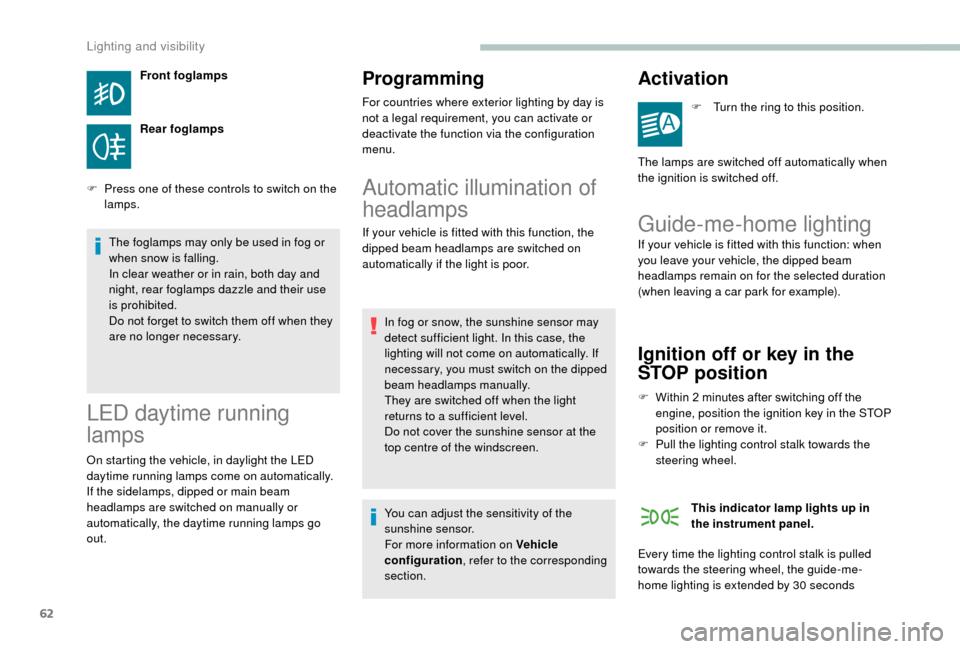
Front foglamps
Rear foglamps
F
P
ress one of these controls to switch on the
lamps.
The foglamps may only be used in fog or
when snow is falling.
In clear weather or in rain, both day and
night, rear foglamps dazzle and their use
is prohibited.
Do not forget to switch them off when they
are no longer necessary.
LED daytime running
lamps
On starting the vehicle, in daylight the LED
daytime running lamps come on automatically.
If the sidelamps, dipped or main beam
headlamps are switched on manually or
automatically, the daytime running lamps go
out.
Programming
For countries where exterior lighting by day is
not a legal requirement, you can activate or
deactivate the function via the configuration
menu.
Automatic illumination of
headlamps
If your vehicle is fitted with this function, the
dipped beam headlamps are switched on
automatically if the light is poor.
In fog or snow, the sunshine sensor may
detect sufficient light. In this case, the
lighting will not come on automatically. If
necessary, you must switch on the dipped
beam headlamps manually.
They are switched off when the light
returns to a
sufficient level.
Do not cover the sunshine sensor at the
top centre of the windscreen.
Activation
F Turn the ring to this position.
The lamps are switched off automatically when
the ignition is switched off.
Guide-me-home lighting
If your vehicle is fitted with this function: when
you leave your vehicle, the dipped beam
headlamps remain on for the selected duration
(when leaving a car park for example).
Ignition off or key in the
STOP position
F Within 2 minutes after switching off the
engine, position the ignition key in the STOP
position or remove it.
F
P
ull the lighting control stalk towards the
steering wheel.
This indicator lamp lights up in
the instrument panel.
Every time the lighting control stalk is pulled
towards the steering wheel, the guide-me-
home lighting is extended by 30
seconds
You can adjust the sensitivity of the
sunshine sensor.
For more information on
Vehicle
configuration , refer to the corresponding
section.
Lighting and visibility
Page 65 of 232
63
up to approximately 3 minutes. When this
t ime has elapsed, the lamps are switched off
automatically.
Deactivate this control by keeping the stalk
pulled towards the steering wheel for more than
2
seconds.
Adaptive lighting
System which automatically changes to main
beam according to the ambient light level and
the driving conditions, using a camera located
at the top of the windscreen.
This system is a
driving aid.
The driver remains responsible for the
vehicle's lighting, its correct use for the
prevailing conditions of light, visibility
and traffic, and obser vation of driving
regulations.
Activation
F Turn the lighting control stalk ring to this position.
F
A
ctivate the function with the MODE button;
in the "Automatic headlamp dipping" menu,
select "ON". For more information on Vehicle
configuration
, refer to the corresponding
section.
F
F
lash the headlamps (going beyond the
point of resistance) to activate the function.
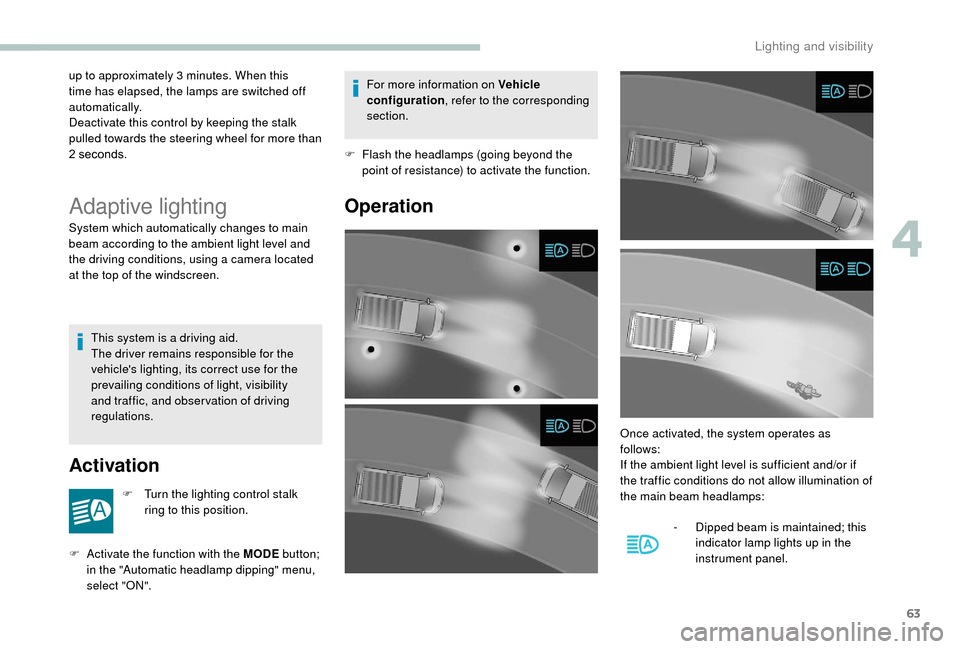
Operation
Once activated, the system operates as
follows:
If the ambient light level is sufficient and/or if
the traffic conditions do not allow illumination of
the main beam headlamps:
-
D
ipped beam is maintained; this
indicator lamp lights up in the
instrument panel.
4
Lighting and visibility
Page 67 of 232
65
Headlamp beam height
adjustment
To avoid causing a nuisance to other road
u sers, the height of the halogen headlamp
beams must be adjusted according to the load
in the vehicle.
This function works in the dipped and main
beam headlamps position.
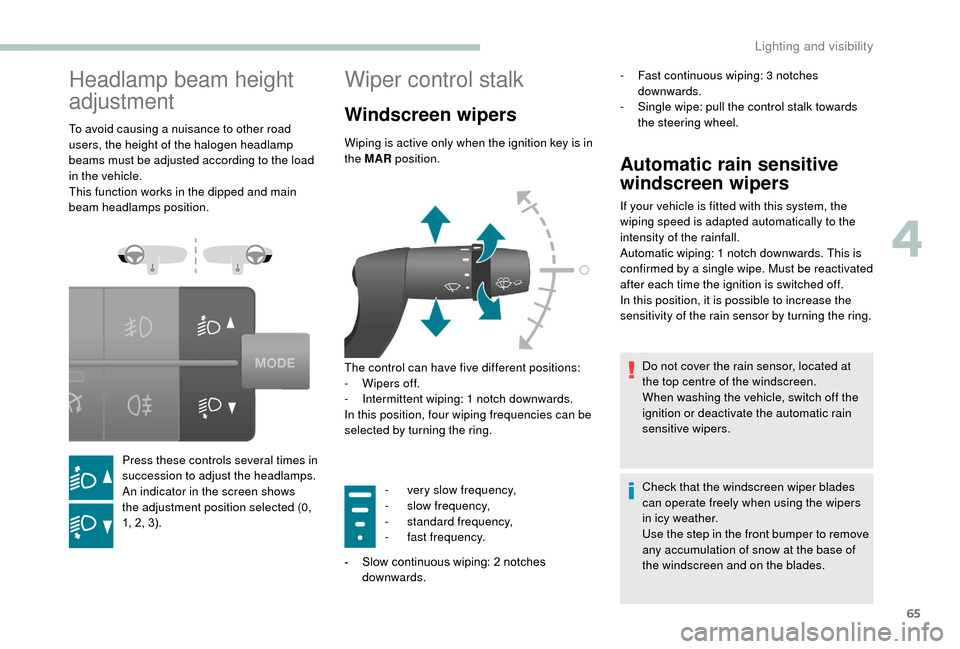
Press these controls several times in
succession to adjust the headlamps.
An indicator in the screen shows
the adjustment position selected (0,
1, 2, 3).
Wiper control stalk
Windscreen wipers
Wiping is active only when the ignition key is in
the MAR position.
The control can have five different positions:
-
W
ipers off.
-
I
ntermittent wiping: 1 notch downwards.
In this position, four wiping frequencies can be
selected by turning the ring.
Automatic rain sensitive
windscreen wipers
If your vehicle is fitted with this system, the
wiping speed is adapted automatically to the
intensity of the rainfall.
Automatic wiping: 1
notch downwards. This is
confirmed by a
single wipe. Must be reactivated
after each time the ignition is switched off.
In this position, it is possible to increase the
sensitivity of the rain sensor by turning the ring.
Do not cover the rain sensor, located at
the top centre of the windscreen.
When washing the vehicle, switch off the
ignition or deactivate the automatic rain
sensitive wipers.
Check that the windscreen wiper blades
can operate freely when using the wipers
in icy weather.
Use the step in the front bumper to remove
any accumulation of snow at the base of
the windscreen and on the blades.
-
v
ery slow frequency,
-
sl
ow frequency,
-
s
tandard frequency,
-
f
ast frequency.
-
S
low continuous wiping: 2
notches
downwards. -
F
ast continuous wiping: 3 notches
downwards.
-
S
ingle wipe: pull the control stalk towards
the steering wheel.
4
Lighting and visibility
Page 70 of 232
68
Hazard warning lamps
Visual warning by means of the direction
indicators to alert other road users to a vehicle
breakdown, towing or accident.
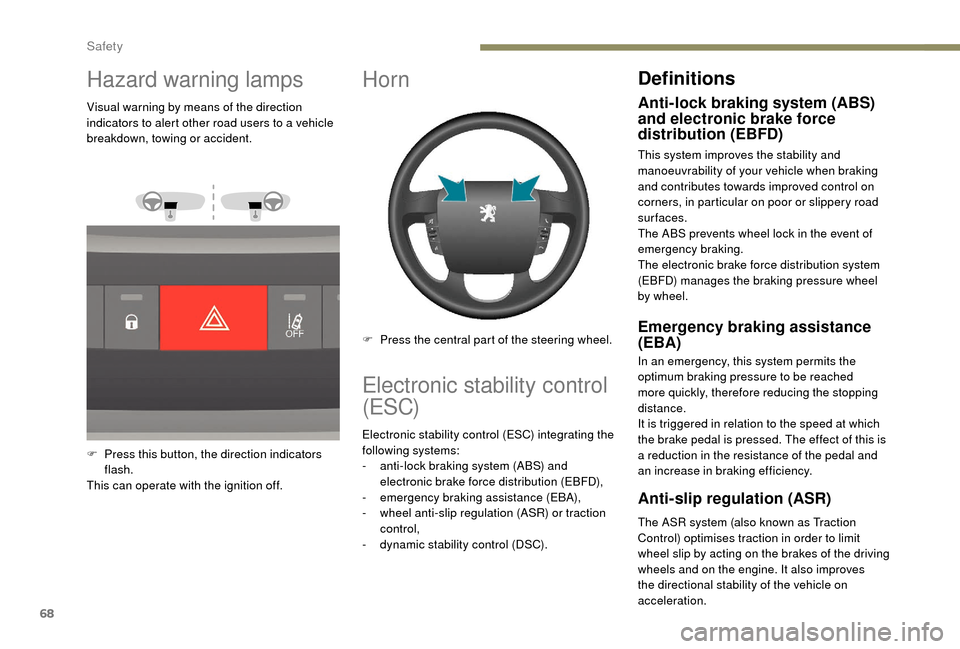
F
P
ress this button, the direction indicators
flash.
This can operate with the ignition off.
Electronic stability control
(ESC)
Electronic stability control (ESC) integrating the
following systems:
-
a
nti-lock braking system (ABS) and
electronic brake force distribution (EBFD),
-
em
ergency braking assistance (EBA),
-
w
heel anti-slip regulation (ASR) or traction
control,
-
d
ynamic stability control (DSC).
Horn
F Press the central part of the steering wheel.
Definitions
Anti-lock braking system (ABS)
and electronic brake force
distribution (EBFD)
This system improves the stability and
manoeuvrability of your vehicle when braking
and contributes towards improved control on
corners, in particular on poor or slippery road
surfaces.
The ABS prevents wheel lock in the event of
emergency braking.
The electronic brake force distribution system
(EBFD) manages the braking pressure wheel
by wheel.
Emergency braking assistance
(EBA)
In an emergency, this system permits the
optimum braking pressure to be reached
more quickly, therefore reducing the stopping
distance.
It is triggered in relation to the speed at which
the brake pedal is pressed. The effect of this is
a reduction in the resistance of the pedal and
an increase in braking efficiency.
Anti-slip regulation (ASR)
The ASR system (also known as Traction
Control) optimises traction in order to limit
wheel slip by acting on the brakes of the driving
wheels and on the engine. It also improves
the directional stability of the vehicle on
acceleration.
Safety
Page 71 of 232
69
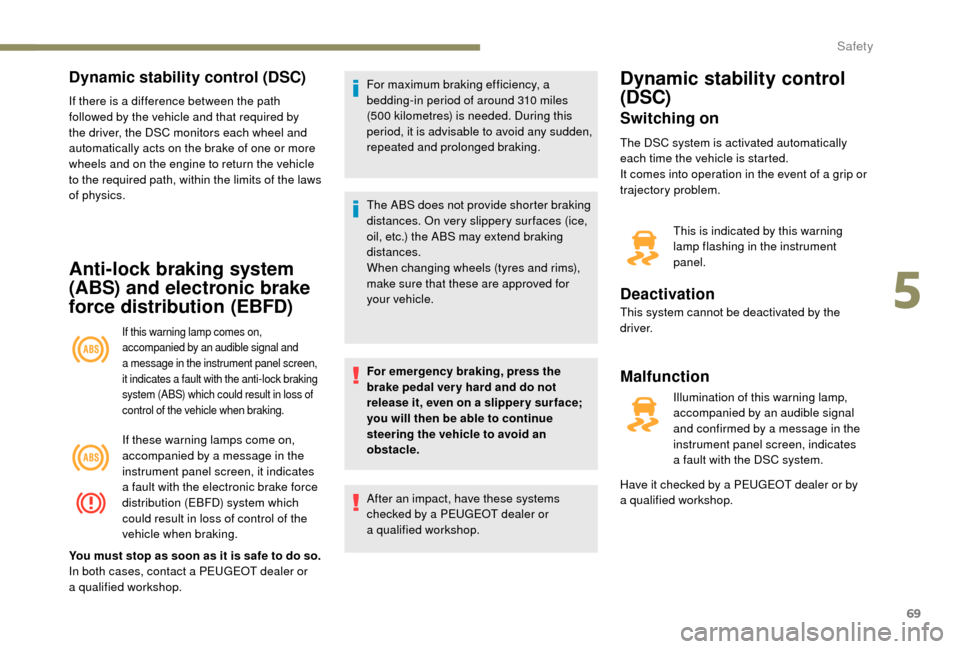
Dynamic stability control (DSC)
If there is a difference between the path
f ollowed by the vehicle and that required by
the driver, the DSC monitors each wheel and
automatically acts on the brake of one or more
wheels and on the engine to return the vehicle
to the required path, within the limits of the laws
of physics.
Anti-lock braking system
(ABS) and electronic brake
force distribution (EBFD)
If this warning lamp comes on,
accompanied by an audible signal and
a
message in the instrument panel screen,
it indicates a
f
ault with the anti-lock braking
system (ABS) which could result in loss of
control of the vehicle when braking.
If these warning lamps come on,
accompanied by a message in the
instrument panel screen, it indicates
a
fault with the electronic brake force
distribution (EBFD) system which
could result in loss of control of the
vehicle when braking.
You must stop as soon as it is safe to do so.
In both cases, contact a
PEUGEOT dealer or
a
qualified workshop. For maximum braking efficiency, a
bedding-in period of around 310
miles
(500 kilometres) is needed. During this
period, it is advisable to avoid any sudden,
repeated and prolonged braking.
The ABS does not provide shorter braking
distances. On very slippery sur faces (ice,
oil, etc.) the ABS may extend braking
distances.
When changing wheels (tyres and rims),
make sure that these are approved for
your vehicle.
For emergency braking, press the
brake pedal ver y hard and do not
release it, even on a slipper y sur face;
you will then be able to continue
steering the vehicle to avoid an
obstacle.
After an impact, have these systems
checked by a
PEUGEOT dealer or
a
qualified workshop.
Dynamic stability control
(DSC)
Switching on
The DSC system is activated automatically
each time the vehicle is started.
It comes into operation in the event of a grip or
trajectory problem.
This is indicated by this warning
lamp flashing in the instrument
panel.
Deactivation
This system cannot be deactivated by the
driver.
Malfunction
Illumination of this warning lamp,
accompanied by an audible signal
and confirmed by a message in the
instrument panel screen, indicates
a
fault with the DSC system.
Have it checked by a
PEUGEOT dealer or by
a
qualified workshop.
5
5
Safety
Page 72 of 232
70
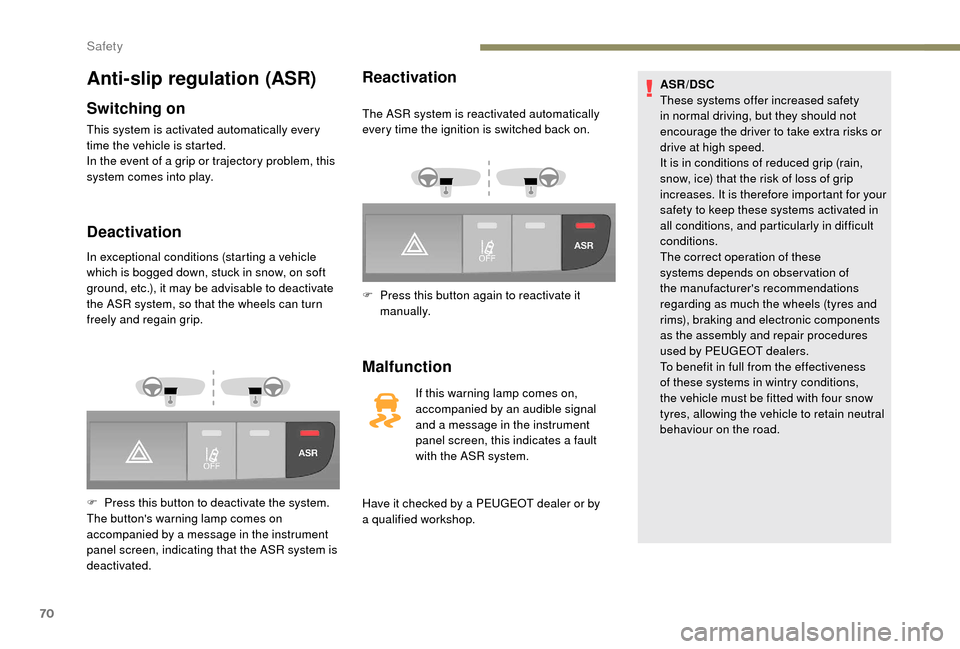
Anti-slip regulation (ASR)
Switching on
This system is activated automatically every
time the vehicle is started.
In the event of a grip or trajectory problem, this
system comes into play.
Deactivation
In exceptional conditions (starting a vehicle
w hich is bogged down, stuck in snow, on soft
ground, etc.), it may be advisable to deactivate
the ASR system, so that the wheels can turn
freely and regain grip.
F
P
ress this button to deactivate the system.
The button's warning lamp comes on
accompanied by a
message in the instrument
panel screen, indicating that the ASR system is
deactivated.
Reactivation
The ASR system is reactivated automatically
every time the ignition is switched back on.
F
P
ress this button again to reactivate it
manually.
Malfunction
If this warning lamp comes on,
accompanied by an audible signal
and a
message in the instrument
panel screen, this indicates a
fault
with the ASR system.
Have it checked by a
PEUGEOT dealer or by
a
qualified workshop. ASR/DSC
These systems offer increased safety
in normal driving, but they should not
encourage the driver to take extra risks or
drive at high speed.
It is in conditions of reduced grip (rain,
snow, ice) that the risk of loss of grip
increases. It is therefore important for your
safety to keep these systems activated in
all conditions, and particularly in difficult
conditions.
The correct operation of these
systems depends on obser vation of
the manufacturer's recommendations
regarding as much the wheels (tyres and
rims), braking and electronic components
as the assembly and repair procedures
used by PEUGEOT dealers.
To benefit in full from the effectiveness
of these systems in wintry conditions,
the vehicle must be fitted with four snow
tyres, allowing the vehicle to retain neutral
behaviour on the road.
Safety
Page 73 of 232
71
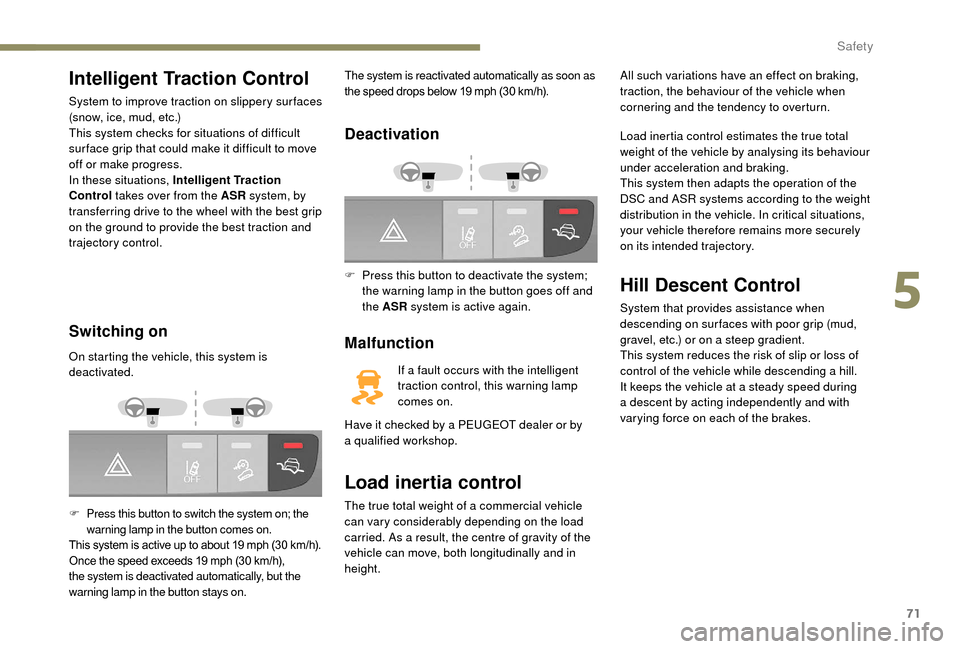
Intelligent Traction Control
System to improve traction on slippery sur faces
(snow, ice, mud, etc.)
This system checks for situations of difficult
sur face grip that could make it difficult to move
off or make progress.
In these situations, Intelligent Traction
Control takes over from the ASR system, by
transferring drive to the wheel with the best grip
on the ground to provide the best traction and
trajectory control.
Switching on
On starting the vehicle, this system is
deactivated.
F
Press this button to switch the system on; the warning lamp in the button comes on.
This system is active up to about 19
mph (30 km/h).
Once the speed exceeds 19
mph (30 km/h),
the system is deactivated automatically, but the
warning lamp in the button stays on. The system is reactivated automatically as soon as
the speed drops below 19
mph (30 km/h).
Deactivation
F Press this button to deactivate the system;
the warning lamp in the button goes off and
the ASR system is active again.
Malfunction
If a fault occurs with the intelligent
t raction control, this warning lamp
comes on.
Have it checked by a
PEUGEOT dealer or by
a
qualified workshop.
Load inertia control
All such variations have an effect on braking,
traction, the behaviour of the vehicle when
cornering and the tendency to overturn.
The true total weight of a
commercial vehicle
can vary considerably depending on the load
carried. As a
result, the centre of gravity of the
vehicle can move, both longitudinally and in
height. Load inertia control estimates the true total
weight of the vehicle by analysing its behaviour
under acceleration and braking.
This system then adapts the operation of the
DSC and ASR systems according to the weight
distribution in the vehicle. In critical situations,
your vehicle therefore remains more securely
on its intended trajectory.
Hill Descent Control
System that provides assistance when
descending on sur faces with poor grip (mud,
gravel, etc.) or on a
steep gradient.
This system reduces the risk of slip or loss of
control of the vehicle while descending a
hill.
It keeps the vehicle at a
steady speed during
a
descent by acting independently and with
varying force on each of the brakes.
5
5
Safety
Page 77 of 232
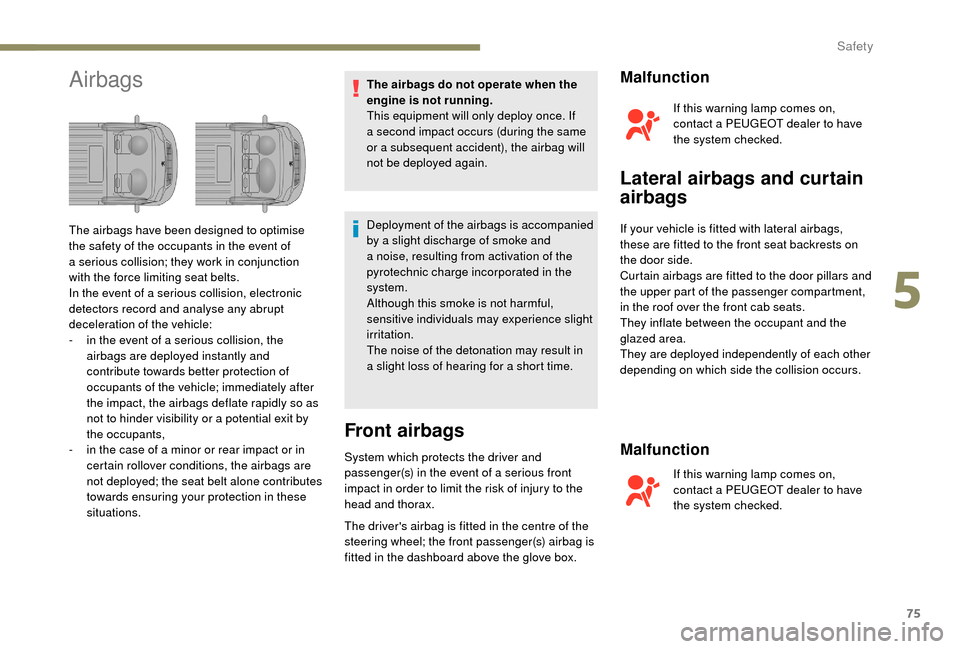
75
AirbagsThe airbags do not operate when the
engine is not running.
This equipment will only deploy once. If
a second impact occurs (during the same
or a
subsequent accident), the airbag will
not be deployed again.
The airbags have been designed to optimise
the safety of the occupants in the event of
a
serious collision; they work in conjunction
with the force limiting seat belts.
In the event of a
serious collision, electronic
detectors record and analyse any abrupt
deceleration of the vehicle:
-
i
n the event of a
serious collision, the
airbags are deployed instantly and
contribute towards better protection of
occupants of the vehicle; immediately after
the impact, the airbags deflate rapidly so as
not to hinder visibility or a
potential exit by
the occupants,
-
i
n the case of a
minor or rear impact or in
certain rollover conditions, the airbags are
not deployed; the seat belt alone contributes
towards ensuring your protection in these
situations. Deployment of the airbags is accompanied
by a
slight discharge of smoke and
a
noise, resulting from activation of the
pyrotechnic charge incorporated in the
system.
Although this smoke is not harmful,
sensitive individuals may experience slight
irritation.
The noise of the detonation may result in
a
slight loss of hearing for a short time.
Front airbags
System which protects the driver and
passenger(s) in the event of a serious front
impact in order to limit the risk of injury to the
head and thorax.
The driver's airbag is fitted in the centre of the
steering wheel; the front passenger(s) airbag is
fitted in the dashboard above the glove box.
Malfunction
If this warning lamp comes on,
contact a PEUGEOT dealer to have
the system checked.
Lateral airbags and curtain
airbags
If your vehicle is fitted with lateral airbags,
these are fitted to the front seat backrests on
the door side.
Curtain airbags are fitted to the door pillars and
the upper part of the passenger compartment,
in the roof over the front cab seats.
They inflate between the occupant and the
glazed area.
They are deployed independently of each other
depending on which side the collision occurs.
Malfunction
If this warning lamp comes on,
contact a PEUGEOT dealer to have
the system checked.
5
5
Safety
Page 78 of 232
76
Advice
For the airbags to be fully effective,
observe the safety recommendations
below.
Adopt a normal and upright sitting position.
Fasten your seat belt, ensuring it is positioned
c o r r e c t l y.
Do not leave anything between the occupants
and the airbags (a child, pet, object, etc.), nor
fix or attach anything close to the inflation
trajectory of the airbags; this could cause
injuries during their deployment.
Never modify the original definition of your
vehicle, particularly in the area directly
around the airbags.
After an accident or if the vehicle has been
stolen or broken into, have the airbag systems
checked.
All work on the airbag system must be carried
out by a
PEUGEOT dealer or a qualified
workshop.
Even if all of the precautions mentioned
are obser ved, a risk of injury or of minor
burns to the head, chest or arms when an
airbag is deployed cannot be ruled out. The
bag inflates almost instantly (within a
few
milliseconds) then deflates within the same
time discharging the hot gas via openings
provided for this purpose. Front airbags
Do not drive holding the steering wheel by its
spokes or resting your hands on the centre
part of the wheel.
Passengers must not place their feet on the
dashboard.
Do not smoke as deployment of the airbags
can cause burns or the risk of injury from
a
cigarette or pipe.
Never remove or pierce the steering wheel or
hit it violently.
Do not fit or attach anything to the steering
wheel or dashboard, this could cause injuries
with deployment of the airbags.
Lateral airbags
Use only approved covers on the seats,
compatible with the deployment the lateral
airbags. For information on the range of seat
covers suitable for your vehicle, you can
contact a
PEUGEOT dealer.
Do not attach anything to or hang anything
from the seat backrests (clothes, etc.) as
this could cause injuries to the thorax or arm
when the lateral airbag is deployed.
Do not sit with the upper part of the body any
nearer to the door than necessary. Curtain airbags
Do not attach anything to or hang anything
from the roof, as this could cause head
injuries when the curtain airbag is deployed.
If fitted on your vehicle, do not remove the
grab handles installed on the roof, they play
a
part in securing the curtain airbags.
Safety
Page 89 of 232
87
Driving recommendations
Observe the driving regulations and remain
vigilant whatever the traffic conditions.
Pay close attention to the traffic and keep your
hands on the wheel so that you are ready to
react at any time to any eventuality.
As a safety measure, the driver should only
carry out any operations that require close
attention when the vehicle is stationary.
On a
long journey, a break every two hours is
strongly recommended.
In difficult weather, drive smoothly, anticipate
the need to brake and increase the distance
from other vehicles.
Never leave the engine running in
an enclosed area without adequate
ventilation: internal combustion engines
emit toxic exhaust gases, such as carbon
monoxide. There is a
risk of poisoning and
death!
In very severe wintry conditions
(temperatures below -23°C), to guarantee
correct operation and the longevity of
the mechanical elements of your vehicle,
engine and gearbox, the engine must be
left running for 4
minutes before driving.
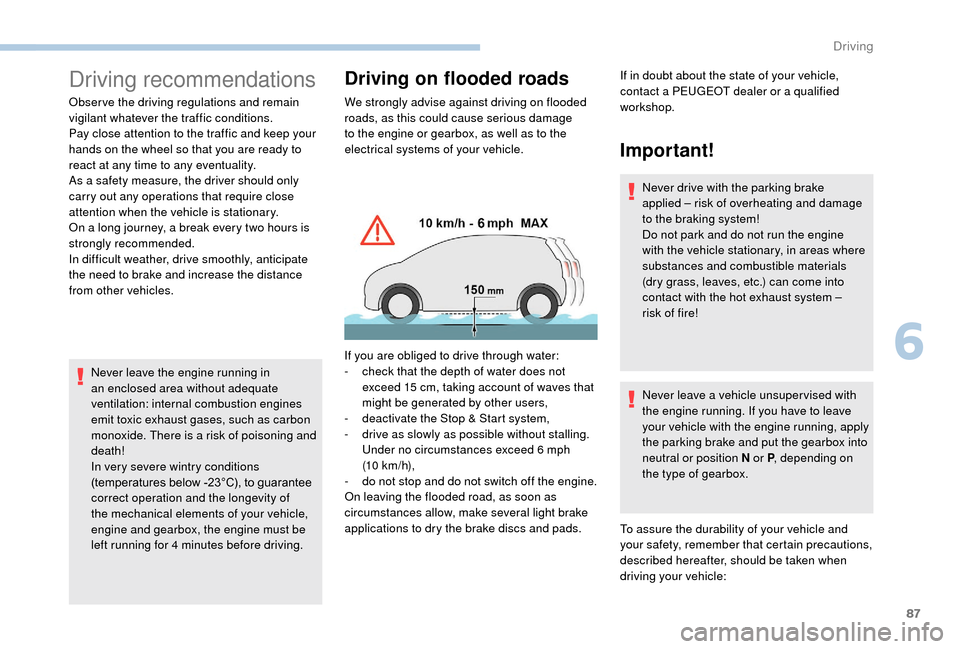
Driving on flooded roads
We strongly advise against driving on flooded
roads, as this could cause serious damage
to the engine or gearbox, as well as to the
electrical systems of your vehicle.
Important!
If you are obliged to drive through water:
- c heck that the depth of water does not
exceed 15
cm, taking account of waves that
might be generated by other users,
-
d
eactivate the Stop & Start system,
-
d
rive as slowly as possible without stalling.
Under no circumstances exceed 6
mph
(10
km/h),
-
d
o not stop and do not switch off the engine.
On leaving the flooded road, as soon as
circumstances allow, make several light brake
applications to dry the brake discs and pads. If in doubt about the state of your vehicle,
contact a
PEUGEOT dealer or a qualified
workshop.
Never drive with the parking brake
applied – risk of overheating and damage
to the braking system!
Do not park and do not run the engine
with the vehicle stationary, in areas where
substances and combustible materials
(dry grass, leaves, etc.) can come into
contact with the hot exhaust system –
risk of fire!
Never leave a vehicle unsuper vised with
the engine running. If you have to leave
your vehicle with the engine running, apply
the parking brake and put the gearbox into
neutral or position N or P , depending on
the type of gearbox.
To assure the durability of your vehicle and
your safety, remember that certain precautions,
described hereafter, should be taken when
driving your vehicle:
6
Driving