light Peugeot Boxer Dag 2010 User Guide
[x] Cancel search | Manufacturer: PEUGEOT, Model Year: 2010, Model line: Boxer Dag, Model: Peugeot Boxer Dag 2010Pages: 167, PDF Size: 4.33 MB
Page 67 of 167
3
EASE OF USE AND COMFORT
Practical information
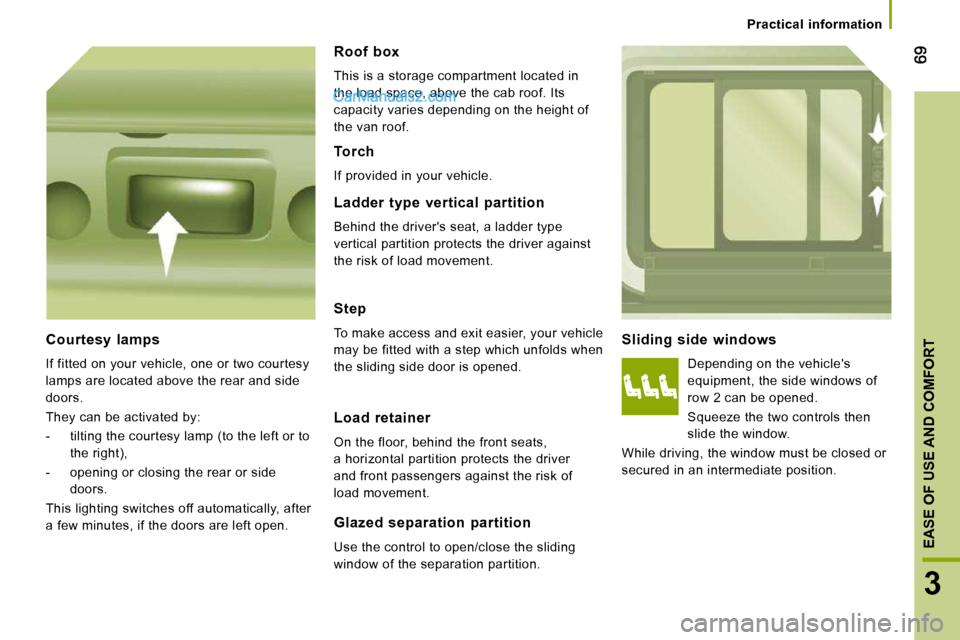
Sliding side windows
Depending on the vehicle's
equipment, the side windows of
row 2 can be opened.
Squeeze the two controls then
slide the window.
While driving, the window must be closed or
secured in an intermediate position.
Step
To make access and exit easier, your vehicle
may be fitted with a step which unfolds when
the sliding side door is opened. Courtesy lamps
If fitted on your vehicle, one or two courtesy
lamps are located above the rear and side
doors.
They can be activated by:
- tilting the courtesy lamp (to the left or to the right),
- opening or closing the rear or side doors.
This lighting switches off automatically, after
a few minutes, if the doors are left open.
Roof box
This is a storage compartment located in
the load space, above the cab roof. Its
capacity varies depending on the height of
the van roof.
Torch
If provided in your vehicle.
Ladder type vertical partition
Behind the driver's seat, a ladder type
vertical partition protects the driver against
the risk of load movement.
Load retainer
On the floor, behind the front seats,
a horizontal partition protects the driver
and front passengers against the risk of
load movement.
Glazed separation partition
Use the control to open/close the sliding
window of the separation partition.
Page 75 of 167
77
4
TECHNOLOGY ON BOARD
Reversing camera
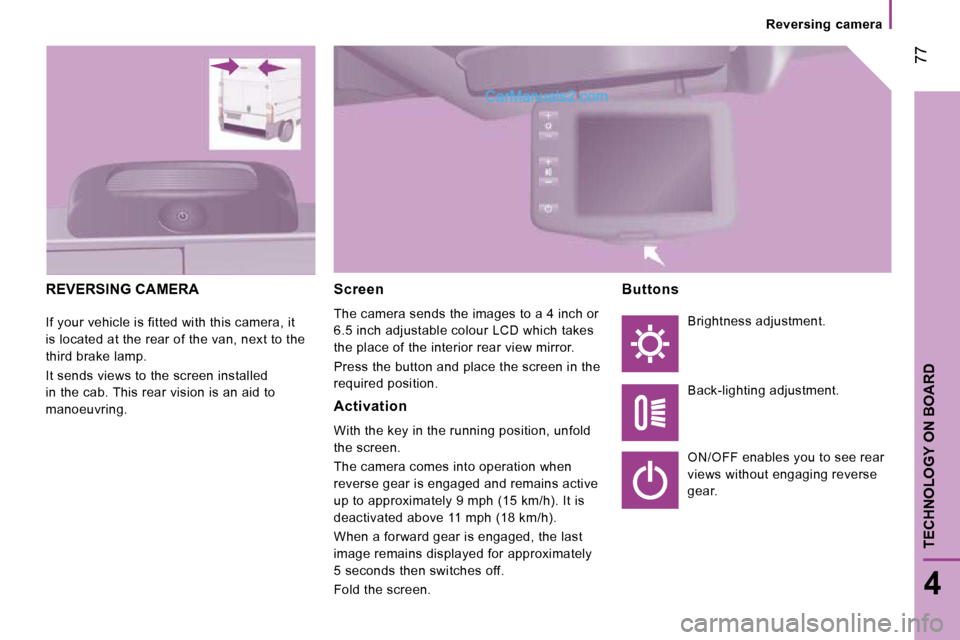
REVERSING CAMERA
If your vehicle is fitted with this camera, it
is located at the rear of the van, next to the
third brake lamp.
It sends views to the screen installed
in the cab. This rear vision is an aid to
manoeuvring.
Screen
The camera sends the images to a 4 inch or
6.5 inch adjustable colour LCD which takes
the place of the interior rear view mirror.
Press the button and place the screen in the
required position.
Activation
With the key in the running position, unfold
the screen.
The camera comes into operation when
reverse gear is engaged and remains active
up to approximately 9 mph (15 km/h). It is
deactivated above 11 mph (18 km/h).
When a forward gear is engaged, the last
image remains displayed for approximately
5 seconds then switches off.
Fold the screen.
Buttons
Brightness adjustment.
Back-lighting adjustment.
ON/OFF enables you to see rear
views without engaging reverse
gear.
Page 101 of 167
103
5
SAFETY
Driving safety
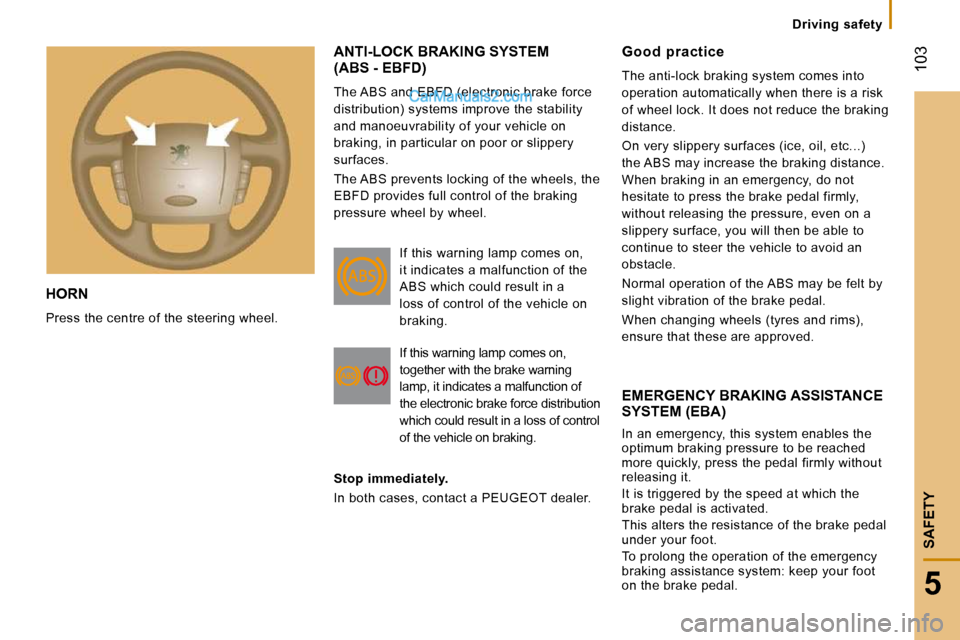
HORN
Press the centre of the steering wheel.
ANTI-LOCK BRAKING SYSTEM(ABS - EBFD)
The ABS and EBFD (electronic brake force
distribution) systems improve the stability
and manoeuvrability of your vehicle on
braking, in particular on poor or slippery
surfaces.
The ABS prevents locking of the wheels, the
EBFD provides full control of the braking
pressure wheel by wheel.
EMERGENCY BRAKING ASSISTANCE SYSTEM (EBA)
In an emergency, this system enables the
optimum braking pressure to be reached
more quickly, press the pedal firmly without
releasing it.
It is triggered by the speed at which the
brake pedal is activated.
This alters the resistance of the brake pedal
under your foot.
To prolong the operation of the emergency
braking assistance system: keep your foot
on the brake pedal.
Good practice
The anti-lock braking system comes into
operation automatically when there is a risk
of wheel lock. It does not reduce the braking
distance.
On very slippery surfaces (ice, oil, etc...)
the ABS may increase the braking distance.
When braking in an emergency, do not
hesitate to press the brake pedal firmly,
without releasing the pressure, even on a
slippery surface, you will then be able to
continue to steer the vehicle to avoid an
obstacle.
Normal operation of the ABS may be felt by
slight vibration of the brake pedal.
When changing wheels (tyres and rims),
ensure that these are approved.
If this warning lamp comes on,
it indicates a malfunction of the
ABS which could result in a
loss of control of the vehicle on
braking.
If this warning lamp comes on,
together with the brake warning
lamp, it indicates a malfunction of
the electronic brake force distribution
which could result in a loss of control
of the vehicle on braking.
Stop immediately.
In both cases, contact a PEUGEOT dealer.
Page 106 of 167
Seat belts
107
5
SAFETY
The force limiter reduces the pressure of the
seat belt against the body of the occupants.
The pretensioning seat belts are active when
the ignition is switched on.
The inertia reels are fitted with a device
which automatically locks the strap in the
event of a collision or emergency braking or
if the vehicle rolls over.
You can unfasten the seat belt by pressing
the red button on the buckle. Guide the seat
belt after unfastening. Good practice
The driver must ensure that passengers use
the seat belts correctly and that they are all
strapped in securely before moving off.
Wherever you are seated in the vehicle, always
fasten your seat belt, even for short journeys.
The seat belts are fitted with an inertia reel
which automatically adjusts the length of
the strap to your size.
Do not use accessories (clothes pegs, clips,
safety pins, etc.) which permit a clearance
with the seat belt straps.
Ensure that the seat belt has reeled in
correctly after use.
After folding or moving a seat or a rear
bench seat, ensure that the seat belt has
reeled in correctly and that the buckle is
ready to accommodate the tongue.
Depending on the nature and seriousness
of any impact, the pretensioning device may
be triggered before and independently of
inflation of the airbags. It instantly tightens
the seat belts against the body of the
occupants.
Triggering of the pretensioners is
accompanied by a slight discharge of
harmless smoke and a noise, due to the
activation of the pyrotechnic cartridge
incorporated in the system. The airbag warning lamp comes
on if the pretensioners are
triggered. Consult a PEUGEOT
dealer.
In order to be effective, a seat belt must:
- restrain one person only,
- must not be twisted, check by pulling in front of you with an even movement,
- be tightened as close to the body as possible.
The upper part of the seat belt should be
positioned in the hollow of the shoulder.
The lap part should be placed as low as
possible on the pelvis.
Do not invert the seat belt buckles as they
will not fulfil their role completely. If the seats are fitted with armrests, the lap
part of the seat belt should always pass
under the armrest.
Check that the seat belt is fastened correctly
by pulling the strap firmly.
Recommendations for children:
- use a suitable child seat if the
passenger is less than 12 years old or
shorter than one metre fifty,
- never allow a child to travel on your lap, even with the seat belt fastened.
For more information on child seats,
refer to the "Child safety" section of
chapter 5.
Your PEUGEOT dealer can ensure that
all work or any checks, from testing to
maintenance on your seat belt equipment
meets current regulations.
Have the seat belts checked regularly
(even after a minor impact) by a PEUGEOT
dealer: they must not show any signs of
wear, cutting or fraying and they must not be
converted or modified.
Clean the seat belt straps with soapy
water or a textile cleaning product, sold
by PEUGEOT dealers.
Page 108 of 167
Airbags
109
5
SAFETY
AIRBAGS
The airbags have been designed to
maximise the safety of the occupants in the
event of a serious collision; they work in
conjunction with the force limiting seat belts.
In the event of a serious collision, the
electronic detectors record and analyse any
abrupt deceleration of the vehicle:
if the triggering threshold is reached, the
airbags inflate instantly and protect the
occupants of the vehicle.
Immediately after the impact, the airbags
deflate rapidly, so that they do not hinder the
visibility of the occupants nor their possible
exit from the vehicle. The airbags will not be deployed in collisions
which are not serious, for which the seat belt
is sufficient to provide maximum protection.
The seriousness of the collision depends on
the nature of the obstacle and the speed of
the vehicle at the moment of impact.
Airbags
only operate when the ignition is
switched on. Front airbags
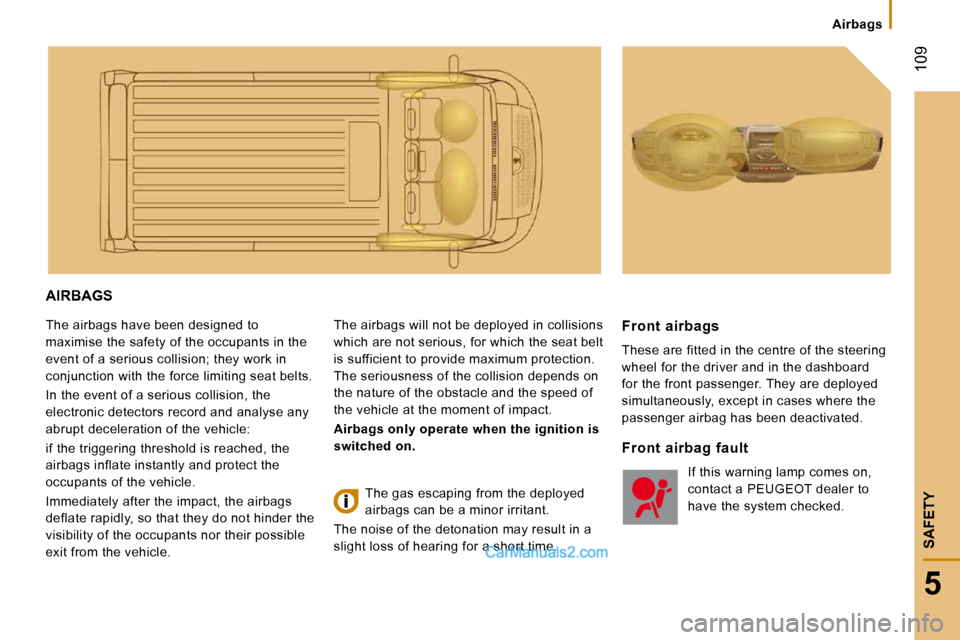
These are fitted in the centre of the steering
wheel for the driver and in the dashboard
for the front passenger. They are deployed
simultaneously, except in cases where the
passenger airbag has been deactivated.
The gas escaping from the deployed
airbags can be a minor irritant.
The noise of the detonation may result in a
slight loss of hearing for a short time.
Front airbag fault
If this warning lamp comes on,
contact a PEUGEOT dealer to
have the system checked.
Page 109 of 167
kmC I T Y
Airbags
110
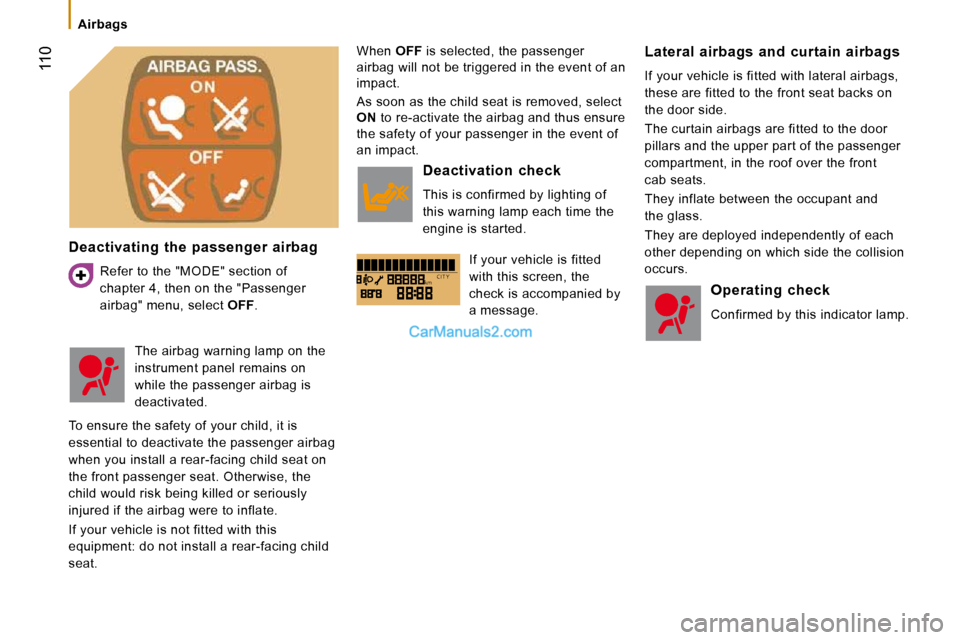
Deactivating the passenger airbag
Refer to the "MODE" section of
chapter 4, then on the "Passenger
airbag" menu, select OFF . When
OFF is selected, the passenger
airbag will not be triggered in the event of an
impact.
As soon as the child seat is removed, select
ON to re-activate the airbag and thus ensure
the safety of your passenger in the event of
an impact.
Lateral airbags and curtain airbags
If your vehicle is fitted with lateral airbags,
these are fitted to the front seat backs on
the door side.
The curtain airbags are fitted to the door
pillars and the upper part of the passenger
compartment, in the roof over the front
cab seats.
They inflate between the occupant and
the glass.
They are deployed independently of each
other depending on which side the collision
occurs.
The airbag warning lamp on the
instrument panel remains on
while the passenger airbag is
deactivated.
To ensure the safety of your child, it is
essential to deactivate the passenger airbag
when you install a rear-facing child seat on
the front passenger seat. Otherwise, the
child would risk being killed or seriously
injured if the airbag were to inflate.
If your vehicle is not fitted with this
equipment: do not install a rear-facing child
seat.
Deactivation check
This is confirmed by lighting of
this warning lamp each time the
engine is started.
If your vehicle is fitted
with this screen, the
check is accompanied by
a message.
Operating check
Confirmed by this indicator lamp.
Page 111 of 167

kmC I T Y
Airbags
110
Deactivating the passenger airbag
Refer to the "MODE" section of
chapter 4, then on the "Passenger
airbag" menu, select OFF . When
OFF is selected, the passenger
airbag will not be triggered in the event of an
impact.
As soon as the child seat is removed, select
ON to re-activate the airbag and thus ensure
the safety of your passenger in the event of
an impact.
Lateral airbags and curtain airbags
If your vehicle is fitted with lateral airbags,
these are fitted to the front seat backs on
the door side.
The curtain airbags are fitted to the door
pillars and the upper part of the passenger
compartment, in the roof over the front
cab seats.
They inflate between the occupant and
the glass.
They are deployed independently of each
other depending on which side the collision
occurs.
The airbag warning lamp on the
instrument panel remains on
while the passenger airbag is
deactivated.
To ensure the safety of your child, it is
essential to deactivate the passenger airbag
when you install a rear-facing child seat on
the front passenger seat. Otherwise, the
child would risk being killed or seriously
injured if the airbag were to inflate.
If your vehicle is not fitted with this
equipment: do not install a rear-facing child
seat.
Deactivation check
This is confirmed by lighting of
this warning lamp each time the
engine is started.
If your vehicle is fitted
with this screen, the
check is accompanied by
a message.
Operating check
Confirmed by this indicator lamp.
Page 133 of 167
132
The batteries contain harmful
substances such as sulphuric acid and
lead. They must be discarded in accordance
with the provisions of the law and must not,
in any circumstances, be discarded with
household waste.
Take used batteries to a special collection
point. It is advisable to disconnect the negative
(-) terminal of the battery if the vehicle is
not to be used for a period of more than
one month.
Before disconnecting the battery, you must
wait for 2 minutes after switching off the
ignition.
Never disconnect a terminal when the
engine is running.
Never charge a battery without first
disconnecting the terminals.
Close the windows and doors before
disconnecting the battery.
After every reconnection of the battery,
switch on the ignition and wait 1 minute
before starting to allow the electronic
systems to be initialised. If slight difficulties
are experienced after this, please contact a
PEUGEOT dealer. If the battery has been disconnected
for some time, it may be necessary to
reinitialise the following functions:
- the display parameters (date, time,
language, distance unit and
temperature unit),
- the radio stations,
- the central locking.
Some settings are cleared and must be
reprogrammed, consult a PEUGEOT.
If your vehicle is fitted with a tachograph or
an alarm, disconnection of the negative (-)
terminal of the battery (located under the
floor on the left-hand side, in the cab) is
recommended if the vehicle is not to be used
for a period of more than 5 days.
Battery
Page 140 of 167
139
QUICK HELP
8
Changing a bulb
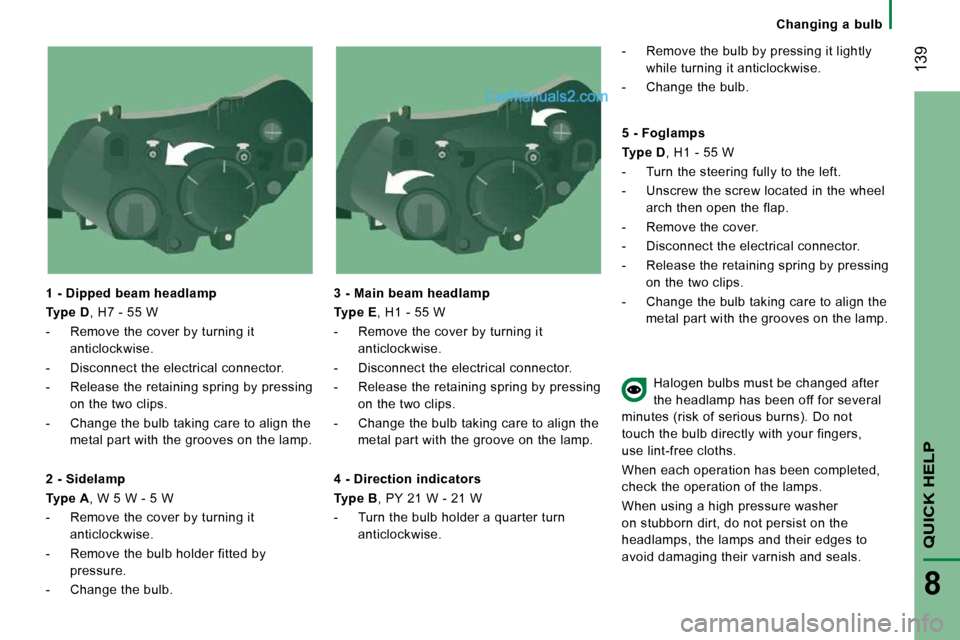
1 - Dipped beam headlamp
Type D , H7 - 55 W
- Remove the cover by turning it anticlockwise.
- Disconnect the electrical connector.
- Release the retaining spring by pressing on the two clips.
- Change the bulb taking care to align the metal part with the grooves on the lamp. 3 - Main beam headlamp
Type E , H1 - 55 W
- Remove the cover by turning it anticlockwise.
- Disconnect the electrical connector.
- Release the retaining spring by pressing on the two clips.
- Change the bulb taking care to align the metal part with the groove on the lamp.
2 - Sidelamp
Type A , W 5 W - 5 W
- Remove the cover by turning it anticlockwise.
- Remove the bulb holder fitted by pressure.
- Change the bulb. 4 - Direction indicators
Type B , PY 21 W - 21 W
- Turn the bulb holder a quarter turn anticlockwise. - Remove the bulb by pressing it lightly
while turning it anticlockwise.
- Change the bulb.
5 - Foglamps
Type D , H1 - 55 W
- Turn the steering fully to the left.
- Unscrew the screw located in the wheel arch then open the flap.
- Remove the cover.
- Disconnect the electrical connector.
- Release the retaining spring by pressing on the two clips.
- Change the bulb taking care to align the metal part with the grooves on the lamp.
Halogen bulbs must be changed after
the headlamp has been off for several
minutes (risk of serious burns). Do not
touch the bulb directly with your fingers,
use lint-free cloths.
When each operation has been completed,
check the operation of the lamps.
When using a high pressure washer
on stubborn dirt, do not persist on the
headlamps, the lamps and their edges to
avoid damaging their varnish and seals.
Page 142 of 167
QUICK HELP
8
Changing a bulb
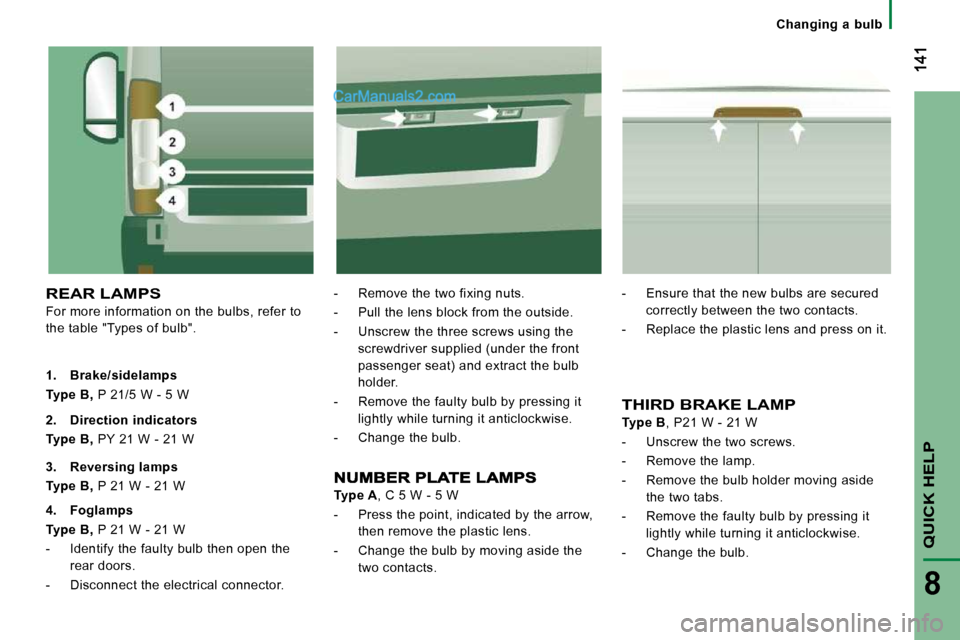
REAR LAMPS
For more information on the bulbs, refer to
the table "Types of bulb". - Remove the two fixing nuts.
- Pull the lens block from the outside.
- Unscrew the three screws using the
screwdriver supplied (under the front
passenger seat) and extract the bulb
holder.
- Remove the faulty bulb by pressing it lightly while turning it anticlockwise.
- Change the bulb.
1. Brake/
sidelamps
Type B, P 21/5 W - 5 W
THIRD BRAKE LAMP
Type B , P21 W - 21 W
- Unscrew the two screws.
- Remove the lamp.
- Remove the bulb holder moving aside the two tabs.
- Remove the faulty bulb by pressing it lightly while turning it anticlockwise.
- Change the bulb.
2. Direction indicators
Type B, PY 21 W - 21 W
3. Reversing
lamps
Type B, P 21 W - 21 W
4. Foglamps
Type B, P 21 W - 21 W
- Identify the faulty bulb then open the rear doors.
- Disconnect the electrical connector.
Type A , C 5 W - 5 W
- Press the point, indicated by the arrow, then remove the plastic lens.
- Change the bulb by moving aside the two contacts. - Ensure that the new bulbs are secured
correctly between the two contacts.
- Replace the plastic lens and press on it.