lock Peugeot Boxer Dag 2010 Owner's Guide
[x] Cancel search | Manufacturer: PEUGEOT, Model Year: 2010, Model line: Boxer Dag, Model: Peugeot Boxer Dag 2010Pages: 167, PDF Size: 4.33 MB
Page 120 of 167
Child safety
119
5
SAFETY
ADVICE ON CHILD SEATS
The incorrect installation of a child seat in a
vehicle compromises the child's protection in
the event of an accident.
Remember to fasten the seat belts or the
child seat harnesses keeping the slack in
relation to the child's body to a minimum ,
even for short journeys.
For optimum installation of the "forward
facing" child seat, ensure that the back of
the child seat is in contact with the back of
the vehicle's seat and that the head restraint
does not cause any discomfort.
If the head restraint has to be removed,
ensure that it is stored or attached securely
to prevent it from being thrown around the
vehicle in the event of sharp braking.
Children under the age of 10 must not travel
in the "forward facing" position on the front
passenger seat, unless the rear seats are
already occupied by other children, cannot
be used or are absent. Deactivate the passenger airbag when a
"rear facing" child seat is installed on the
front seat.
Otherwise, the child would risk being
seriously injured or killed if the airbag were
to inflate.
As a safety precaution, do not leave:
- one or more children alone and
unsupervised in a vehicle,
- a child or an animal in a vehicle which is exposed to the sun, with the windows
closed,
- the keys within reach of children inside the vehicle.
To prevent accidental opening of the doors,
use the "Child Lock".
Take care not to open the rear windows by
more than one third.
To protect young children from the rays of
the sun, fit side blinds to the rear windows.
Installing a booster seat
The chest part of the seat belt must be
positioned on the child's shoulder without
touching the neck.
Ensure that the lap part of the seat belt
passes correctly over the child's thighs.
PEUGEOT recommends the use of a
booster seat which has a back, fitted with a
seat belt guide at shoulder level.
Crew cab
Do not install child seats, booster cushions
or carrycots on the rear seats of the cab.
Page 131 of 167
130
Fuel
Low fuel level
When the fuel tank level E
(Empty) is reached, this warning
lamp comes on. At this moment,
you have enough fuel left to
drive approximately 30 miles (50 km) ,
depending on the driving conditions, the
engine and the profile of the road. Fill up
without delay to avoid running out of fuel. The fuel tank must be filled
with the engine
off.
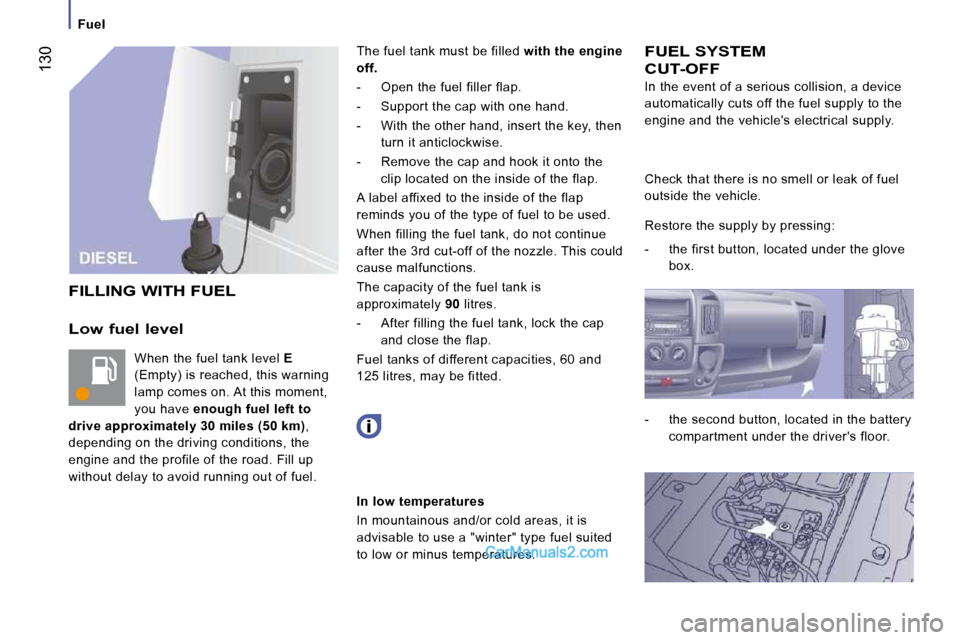
- Open the fuel filler flap.
- Support the cap with one hand.
- With the other hand, insert the key, then turn it anticlockwise.
- Remove the cap and hook it onto the clip located on the inside of the flap.
A label affixed to the inside of the flap
reminds you of the type of fuel to be used.
When filling the fuel tank, do not continue
after the 3rd cut-off of the nozzle. This could
cause malfunctions.
The capacity of the fuel tank is
approximately 90 litres.
- After filling the fuel tank, lock the cap and close the flap.
Fuel tanks of different capacities, 60 and
125 litres, may be fitted.
FUEL SYSTEM
CUT-OFF
In the event of a serious collision, a device
automatically cuts off the fuel supply to the
engine and the vehicle's electrical supply.
FILLING WITH FUEL
Check that there is no smell or leak of fuel
outside the vehicle.
Restore the supply by pressing:
- the first button, located under the glove box.
- the second button, located in the battery compartment under the driver's floor.
In low temperatures
In mountainous and/or cold areas, it is
advisable to use a "winter" type fuel suited
to low or minus temperatures.
Page 133 of 167
132
The batteries contain harmful
substances such as sulphuric acid and
lead. They must be discarded in accordance
with the provisions of the law and must not,
in any circumstances, be discarded with
household waste.
Take used batteries to a special collection
point. It is advisable to disconnect the negative
(-) terminal of the battery if the vehicle is
not to be used for a period of more than
one month.
Before disconnecting the battery, you must
wait for 2 minutes after switching off the
ignition.
Never disconnect a terminal when the
engine is running.
Never charge a battery without first
disconnecting the terminals.
Close the windows and doors before
disconnecting the battery.
After every reconnection of the battery,
switch on the ignition and wait 1 minute
before starting to allow the electronic
systems to be initialised. If slight difficulties
are experienced after this, please contact a
PEUGEOT dealer. If the battery has been disconnected
for some time, it may be necessary to
reinitialise the following functions:
- the display parameters (date, time,
language, distance unit and
temperature unit),
- the radio stations,
- the central locking.
Some settings are cleared and must be
reprogrammed, consult a PEUGEOT.
If your vehicle is fitted with a tachograph or
an alarm, disconnection of the negative (-)
terminal of the battery (located under the
floor on the left-hand side, in the cab) is
recommended if the vehicle is not to be used
for a period of more than 5 days.
Battery
Page 135 of 167
Changing a wheel
4. OPERATING PROCEDURE
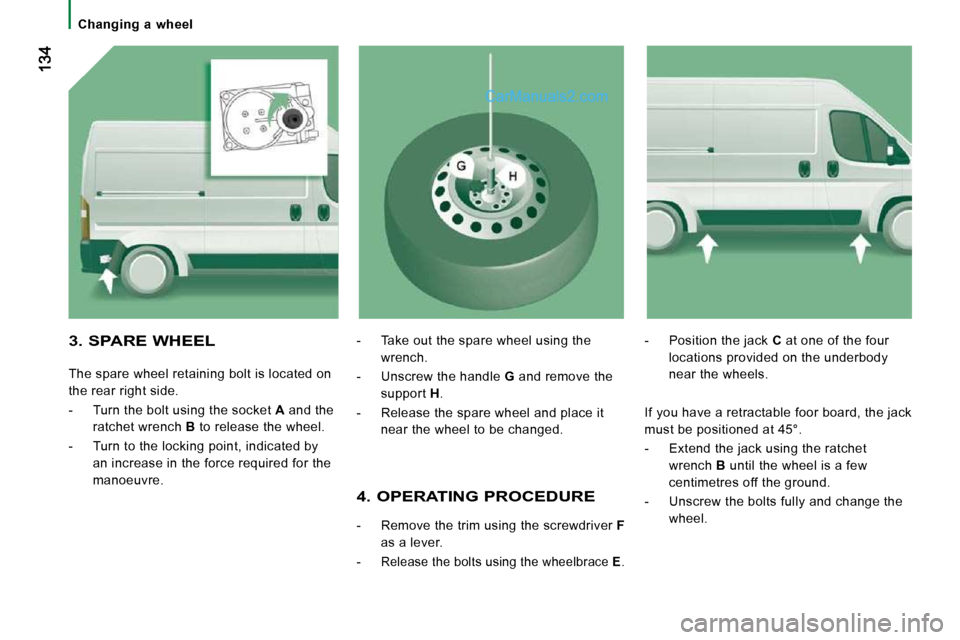
- Remove the trim using the screwdriver F
as a lever.
-
Release the bolts using the wheelbrace E .
- Position the jack C at one of the four
locations provided on the underbody
near the wheels. 3. SPARE WHEEL
The spare wheel retaining bolt is located on
the rear right side.
- Turn the bolt using the socket A and the
ratchet wrench B to release the wheel.
- Turn to the locking point, indicated by an increase in the force required for the
manoeuvre. - Take out the spare wheel using the
wrench.
- Unscrew the handle G and remove the
support H .
- Release the spare wheel and place it near the wheel to be changed. If you have a retractable foor board, the jack
must be positioned at 45°.
- Extend the jack using the ratchet
wrench B until the wheel is a few
centimetres off the ground.
- Unscrew the bolts fully and change the wheel.
Page 139 of 167
138
Changing a bulb
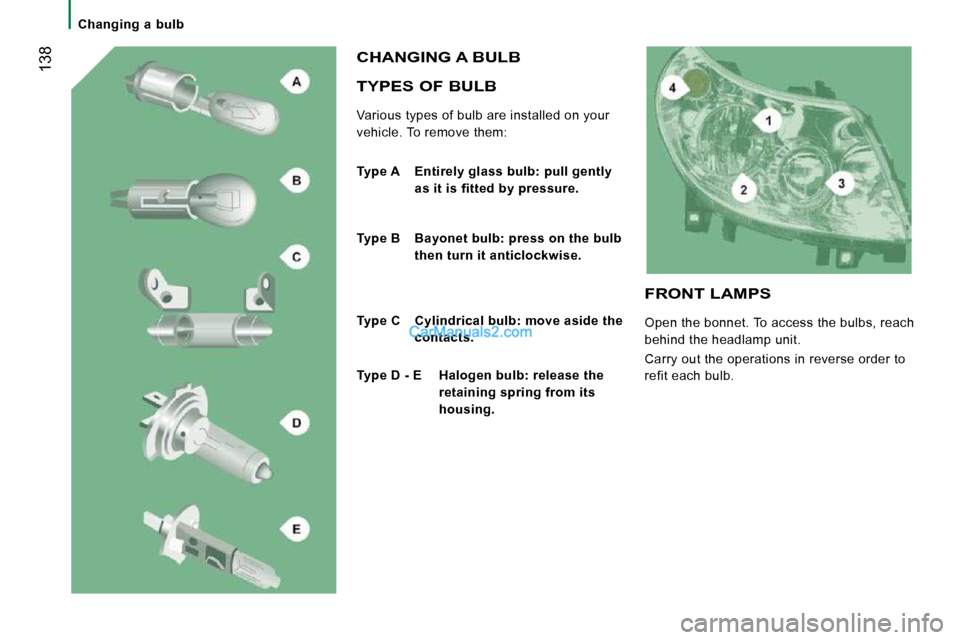
TYPES OF BULB
Various types of bulb are installed on your
vehicle. To remove them:
CHANGING A BULB
Type A Entirely glass bulb: pull gently
as it is fitted by pressure.
Type B Bayonet bulb: press on the bulb
then turn it anticlockwise.
Type C Cylindrical bulb: move aside the
contacts.
Type D - E Halogen bulb: release the
retaining spring from its
housing.
FRONT LAMPS
Open the bonnet. To access the bulbs, reach
behind the headlamp unit.
Carry out the operations in reverse order to
refit each bulb.
Page 140 of 167
139
QUICK HELP
8
Changing a bulb
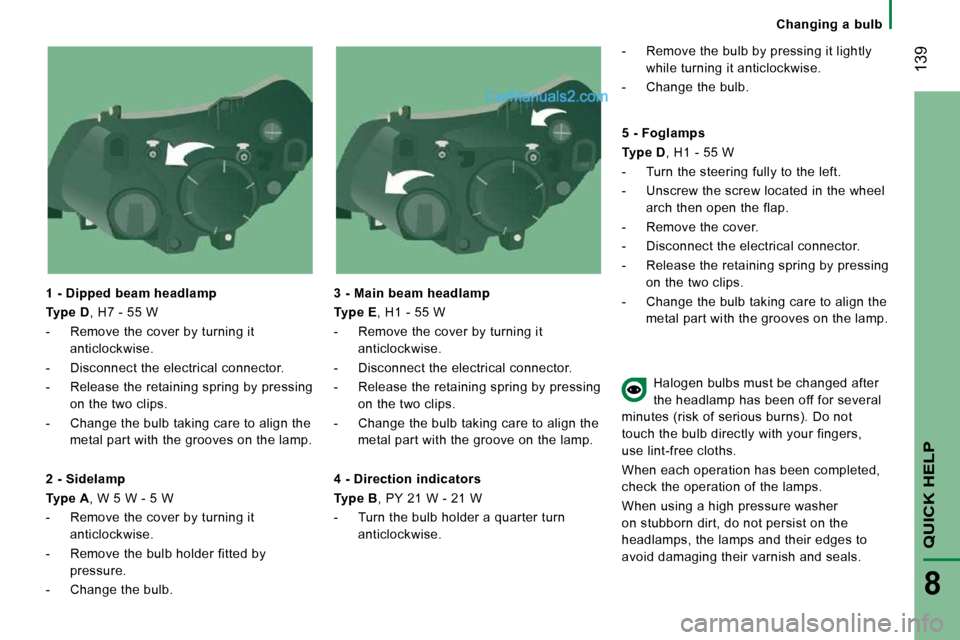
1 - Dipped beam headlamp
Type D , H7 - 55 W
- Remove the cover by turning it anticlockwise.
- Disconnect the electrical connector.
- Release the retaining spring by pressing on the two clips.
- Change the bulb taking care to align the metal part with the grooves on the lamp. 3 - Main beam headlamp
Type E , H1 - 55 W
- Remove the cover by turning it anticlockwise.
- Disconnect the electrical connector.
- Release the retaining spring by pressing on the two clips.
- Change the bulb taking care to align the metal part with the groove on the lamp.
2 - Sidelamp
Type A , W 5 W - 5 W
- Remove the cover by turning it anticlockwise.
- Remove the bulb holder fitted by pressure.
- Change the bulb. 4 - Direction indicators
Type B , PY 21 W - 21 W
- Turn the bulb holder a quarter turn anticlockwise. - Remove the bulb by pressing it lightly
while turning it anticlockwise.
- Change the bulb.
5 - Foglamps
Type D , H1 - 55 W
- Turn the steering fully to the left.
- Unscrew the screw located in the wheel arch then open the flap.
- Remove the cover.
- Disconnect the electrical connector.
- Release the retaining spring by pressing on the two clips.
- Change the bulb taking care to align the metal part with the grooves on the lamp.
Halogen bulbs must be changed after
the headlamp has been off for several
minutes (risk of serious burns). Do not
touch the bulb directly with your fingers,
use lint-free cloths.
When each operation has been completed,
check the operation of the lamps.
When using a high pressure washer
on stubborn dirt, do not persist on the
headlamps, the lamps and their edges to
avoid damaging their varnish and seals.
Page 142 of 167
QUICK HELP
8
Changing a bulb
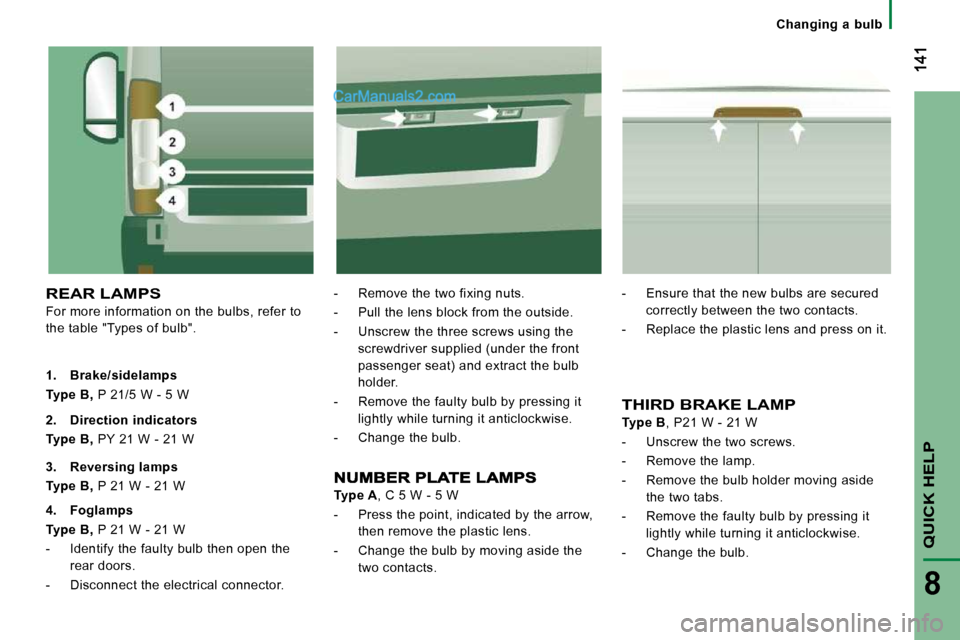
REAR LAMPS
For more information on the bulbs, refer to
the table "Types of bulb". - Remove the two fixing nuts.
- Pull the lens block from the outside.
- Unscrew the three screws using the
screwdriver supplied (under the front
passenger seat) and extract the bulb
holder.
- Remove the faulty bulb by pressing it lightly while turning it anticlockwise.
- Change the bulb.
1. Brake/
sidelamps
Type B, P 21/5 W - 5 W
THIRD BRAKE LAMP
Type B , P21 W - 21 W
- Unscrew the two screws.
- Remove the lamp.
- Remove the bulb holder moving aside the two tabs.
- Remove the faulty bulb by pressing it lightly while turning it anticlockwise.
- Change the bulb.
2. Direction indicators
Type B, PY 21 W - 21 W
3. Reversing
lamps
Type B, P 21 W - 21 W
4. Foglamps
Type B, P 21 W - 21 W
- Identify the faulty bulb then open the rear doors.
- Disconnect the electrical connector.
Type A , C 5 W - 5 W
- Press the point, indicated by the arrow, then remove the plastic lens.
- Change the bulb by moving aside the two contacts. - Ensure that the new bulbs are secured
correctly between the two contacts.
- Replace the plastic lens and press on it.
Page 144 of 167
143
QUICK HELP
8
Changing a fuse
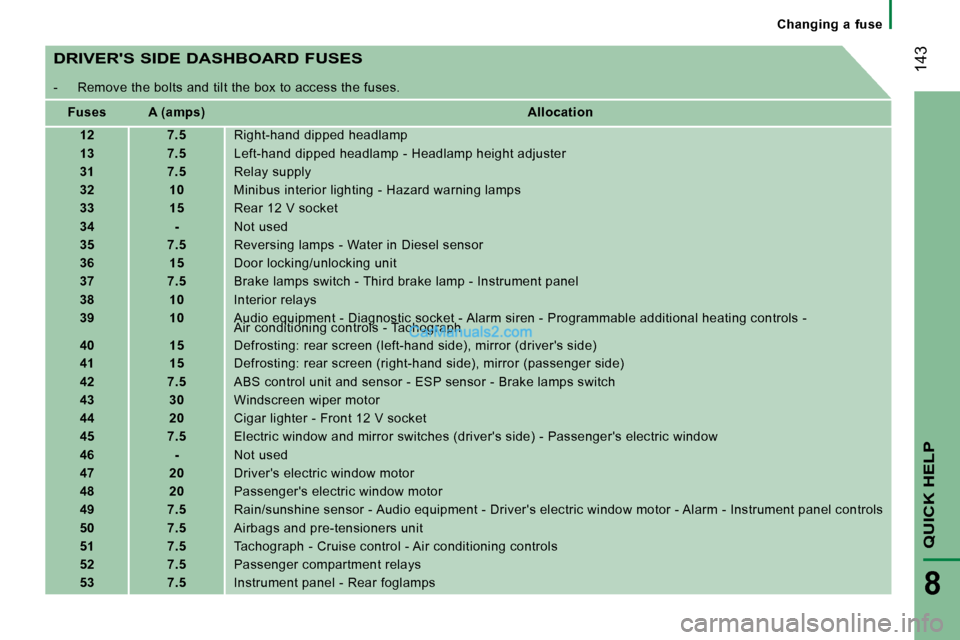
DRIVER'S SIDE DASHBOARD FUSES
- Remove the bolts and tilt the box to access the fuses.
Fuses A (amps)
Allocation
12 7.5 Right-hand dipped headlamp
13 7.5 Left-hand dipped headlamp - Headlamp height adj uster
31 7.5 Relay supply
32 10 Minibus interior lighting - Hazard warning lamp s
33 15 Rear 12 V socket
34 - Not used
35 7.5 Reversing lamps - Water in Diesel sensor
36 15 Door locking/unlocking unit
37 7.5 Brake lamps switch - Third brake lamp - Instrum ent panel
38 10 Interior relays
39 10 Audio equipment - Diagnostic socket - Alarm sir en - Programmable additional heating controls -
Air conditioning controls - Tachograph
40 15 Defrosting: rear screen (left-hand side), mirro r (driver's side)
41 15 Defrosting: rear screen (right-hand side), mirr or (passenger side)
42 7.5 ABS control unit and sensor - ESP sensor - Brak e lamps switch
43 30 Windscreen wiper motor
44 20 Cigar lighter - Front 12 V socket
45 7.5 Electric window and mirror switches (driver's s ide) - Passenger's electric window
46 - Not used
47 20 Driver's electric window motor
48 20 Passenger's electric window motor
49 7.5 Rain/sunshine sensor - Audio equipment - Driver 's electric window motor - Alarm - Instrument panel controls
50 7.5 Airbags and pre-tensioners unit
51 7.5 Tachograph - Cruise control - Air conditioning controls
52 7.5 Passenger compartment relays
53 7.5 Instrument panel - Rear foglamps
Page 147 of 167
146
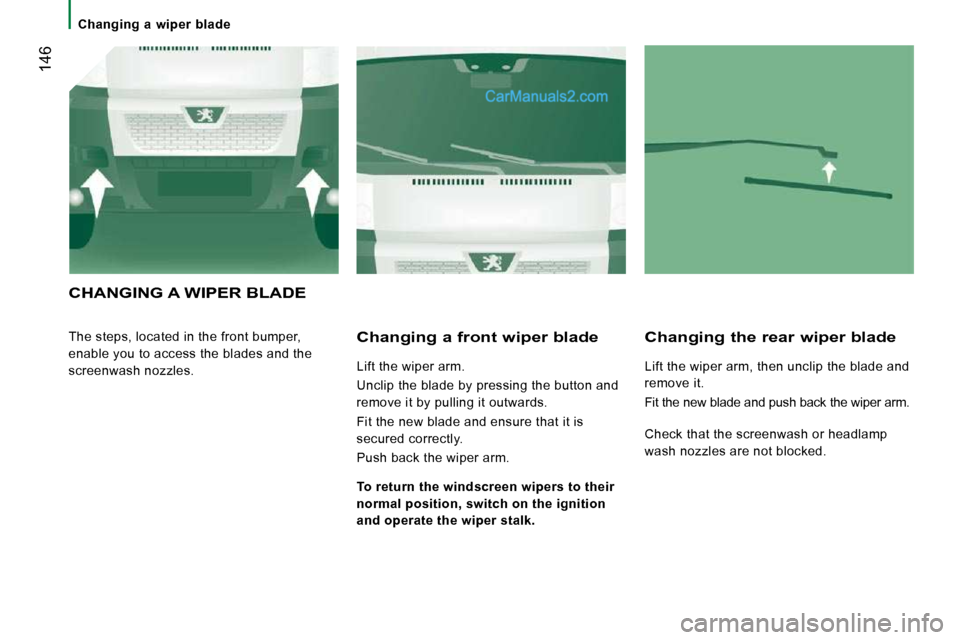
Changing a wiper blade
CHANGING A WIPER BLADE
The steps, located in the front bumper,
enable you to access the blades and the
screenwash nozzles. Changing a front wiper blade
Lift the wiper arm.
Unclip the blade by pressing the button and
remove it by pulling it outwards.
Fit the new blade and ensure that it is
secured correctly.
Push back the wiper arm.
Changing the rear wiper blade
Lift the wiper arm, then unclip the blade and
remove it.
Fit the new blade and push back the wiper arm.
To return the windscreen wipers to their
normal position, switch on the ignition
and operate the
wiper
stalk. Check that the screenwash or headlamp
wash nozzles are not blocked.