engine PEUGEOT EXPERT 2018 Owners Manual
[x] Cancel search | Manufacturer: PEUGEOT, Model Year: 2018, Model line: EXPERT, Model: PEUGEOT EXPERT 2018Pages: 416, PDF Size: 14.12 MB
Page 256 of 416
254
Use only AdBlue® fluid that meets the
ISO
22241
standard.
Never dilute AdBlue
® with water.
Never pour AdBlue® into the Diesel fuel
tank.
Never top up from an AdBlue
® dispenser
reserved for heavy goods vehicles.
Recommendations on storage
AdBlue® freezes below around -11°C and
deteriorates above 25°C. It is recommended
that bottles or containers be stored in a cool
place and protected from direct sunlight.
Under these conditions, the fluid can be kept
for at least a year.
If the additive has frozen, it can be used once it
has completely thawed out.
Never store bottles or containers of
AdBlue
® in your vehicle.
In winter, check that the temperature
of the vehicle is above -11°C. If not, in
freezing weather, the AdBlue
® cannot be
poured into the tank. Park your vehicle
somewhere warmer for a few hours before
topping up.
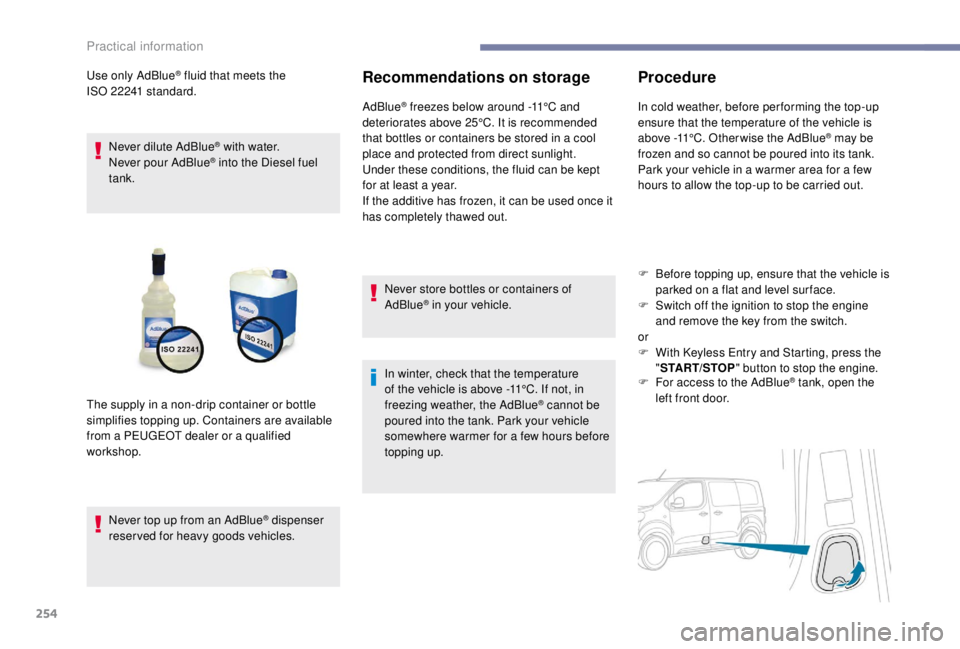
The supply in a non-drip container or bottle
simplifies topping up. Containers are available
from a PEUGEOT dealer or a qualified
workshop.
Procedure
In cold weather, before per forming the top-up
ensure that the temperature of the vehicle is
above -11°C. Other wise the AdBlue
® may be
frozen and so cannot be poured into its tank.
Park your vehicle in a warmer area for a few
hours to allow the top-up to be carried out.
F
B
efore topping up, ensure that the vehicle is
parked on a flat and level sur face.
F
S
witch off the ignition to stop the engine
and remove the key from the switch.
or
F
W
ith
K
eyless Entry and Starting, press the
" START/STOP " button to stop the engine.
F
F
or access to the AdBlue
® tank, open the
left front door.
Practical information
Page 257 of 416
255
Important: if your vehicle's AdBlue®
tank is completely empty – which is
confirmed by the alert messages and the
impossibility of starting the engine – you
must add at least 4
litres and no more than
10
litres.
F
A
fter emptying the container or bottle, wipe
away any spillage around the tank filler
using a damp cloth.
If any fluid is spilt or splashed, wash
immediately with cold water or wipe with a
damp cloth.
If the fluid has crystallised, clean it off
using a sponge and hot water.
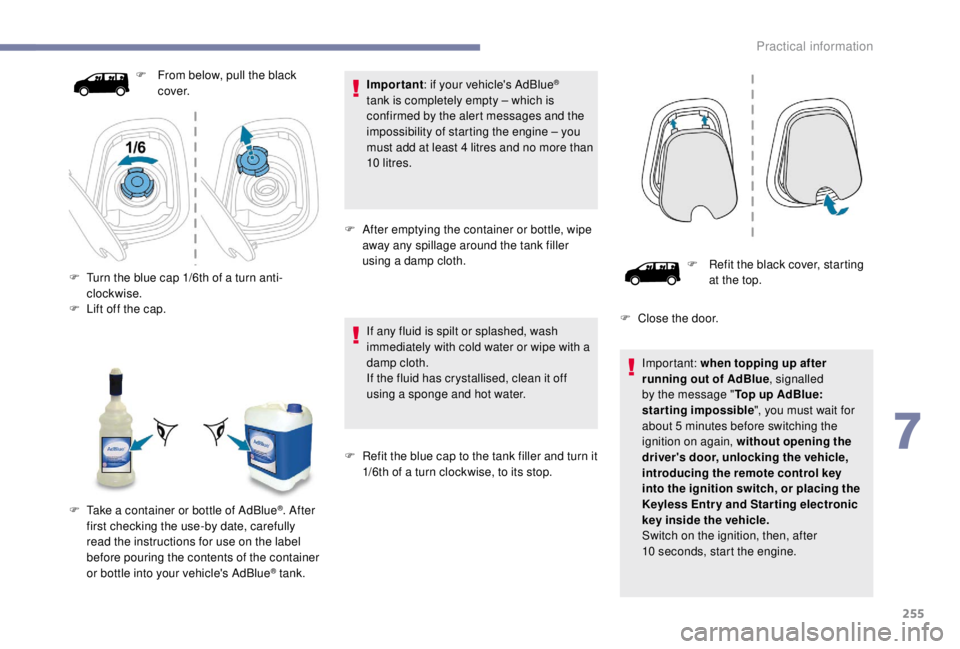
F
R
efit the blue cap to the tank filler and turn it
1/6th of a turn clockwise, to its stop.
F
F
rom below, pull the black
c ove r.
F
T
urn the blue cap 1/6th of a turn anti-
clockwise.
F
L
ift off the cap.
F
T
ake a container or bottle of AdBlue
®. After
first checking the use-by date, carefully
read the instructions for use on the label
before pouring the contents of the container
or bottle into your vehicle's AdBlue
® tank. F
R
efit the black cover, starting
at the top.
F
C
lose the door.
Important: when topping up after
running out of AdBlue , signalled
by the message " Top up AdBlue:
starting impossible ", you must wait for
about 5 minutes before switching the
ignition on again, without opening the
driver's door, unlocking the vehicle,
introducing the remote control key
into the ignition switch, or placing the
K
eyless Entr y and Star ting electronic
key inside the vehicle.
Switch on the ignition, then, after
10
seconds, start the engine.
7
Practical information
Page 258 of 416
256
Advice on care
General recommendations on the care and maintenance of your vehicle are given in the Warranty
and Maintenance Record.Observe the following recommendations to
avoid damaging your vehicle:
-
D
o not clean your headlamps with a dry
or abrasive cloth, nor with detergent or
solvent products. Use a sponge and
soapy water or a pH neutral product.
-
W
hen using a high pressure washer on
stubborn dirt, avoid prolonged use on the
headlamps, the lamps and their edges to
avoid damaging their lacquer finish and
seals.
-
N
ever use an abrasive sponge to clean
persistent dirt, as this may scratch the
paint sur face. Use a soft cloth with soapy
water instead.
-
W
hen washing your vehicle, never clean
the interior with a water jet.
-
W
hen washing your vehicle in an
automatic roller-brush car wash, be sure
to lock your doors and, depending on the
version you have, remove the key and
deactivate the " Hands-Free Tailgate
Access " system. It is always preferable to have paint
repairs carried out by a PEUGEOT dealer
or a qualified workshop.
-
N
ever use high pressure washing to
clean the engine compartment, in order
to avoid damaging the electrical units.
-
L
iquids carried in an open vessel (a cup
or mug) could be spilt, presenting a risk
of damage on contact with the controls
in the dashboard and centre console. Be
careful.
Depending on the version you have, in order
to avoid damaging or unpeeling the stickers
on the bodywork, you are strongly advised
against using high-pressure cleaners to
wash your vehicle. It is recommended that
you wash it using a high-flow water jet and
rinse the vehicle down using demineralised
water.
Only a microfibre cloth is recommended for
wiping your vehicle, it must be clean and
used gently.
Practical information
Page 259 of 416
257
Warning triangle
This safety equipment should be used in
addition to the hazard warning lamps.
Its presence in the vehicle may be mandatory.
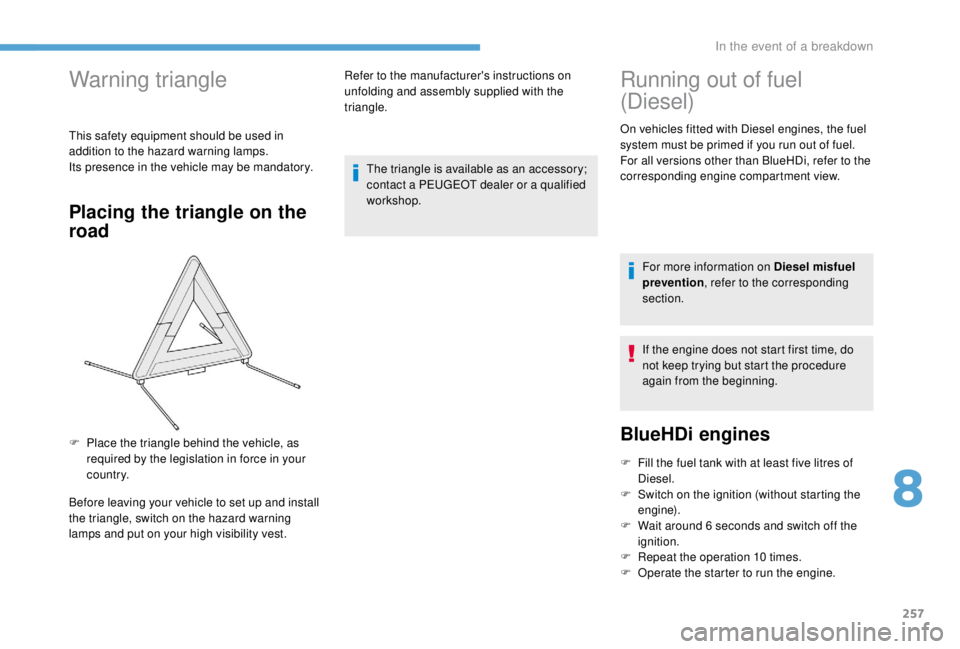
Placing the triangle on the
road
Before leaving your vehicle to set up and install
the triangle, switch on the hazard warning
lamps and put on your high visibility vest.Refer to the manufacturer's instructions on
unfolding and assembly supplied with the
triangle.
The triangle is available as an accessory;
contact a PEUGEOT dealer or a qualified
workshop.
F
P
lace the triangle behind the vehicle, as
required by the legislation in force in your
c o u nt r y.
Running out of fuel
(Diesel)
On vehicles fitted with Diesel engines, the fuel
system must be primed if you run out of fuel.
For all versions other than BlueHDi, refer to the
corresponding engine compartment view.
For more information on Diesel misfuel
prevention , refer to the corresponding
section.
If the engine does not start first time, do
not keep trying but start the procedure
again from the beginning.
BlueHDi engines
F Fill the fuel tank with at least five litres of Diesel.
F
S
witch on the ignition (without starting the
engine).
F
W
ait around 6 seconds and switch off the
ignition.
F
R
epeat the operation 10
times.
F
O
perate the starter to run the engine.
8
In the event of a breakdown
Page 260 of 416
258
F Operate the priming pump repeatedly until resistance is felt (there may be resistance at
the first press).
F
O
perate the starter to start the engine (if the
engine does not start at the first attempt,
wait around 15
seconds before trying
again).
F
I
f the engine does not start after a few
attempts, operate the priming pump again
then start the engine.
F
P
ut the cover in place and clip it in.
F
C
lose the bonnet.
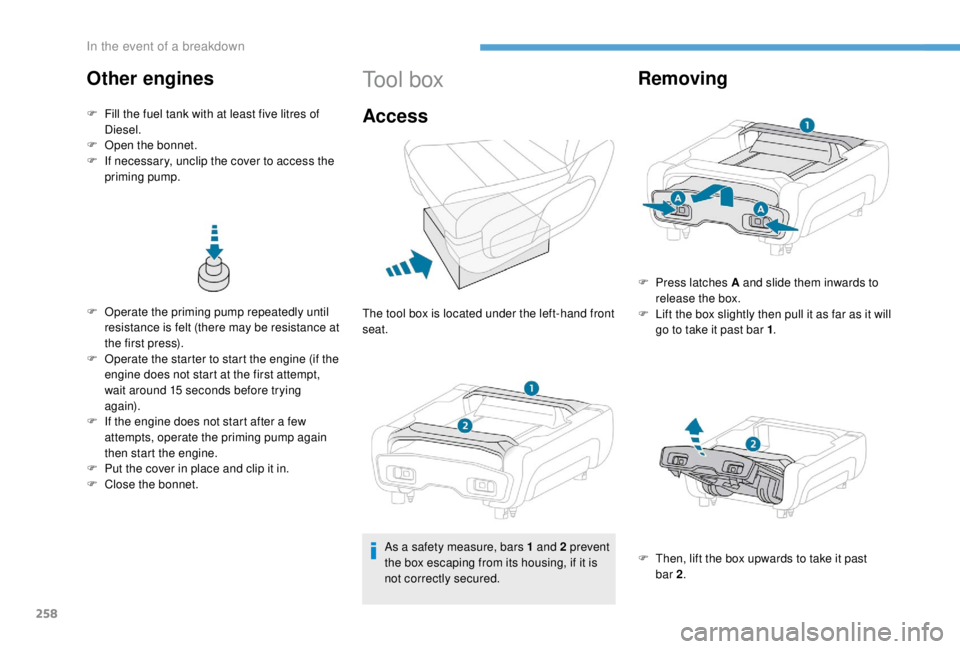
Tool box
Access
The tool box is located under the left-hand front
seat.
As a safety measure, bars 1
and 2 prevent
the box escaping from its housing, if it is
not correctly secured.
Removing
Other engines
F Fill the fuel tank with at least five litres of
Diesel.
F
O
pen the bonnet.
F
I
f necessary, unclip the cover to access the
priming pump.
F
P
ress latches A and slide them inwards to
release the box.
F
L
ift the box slightly then pull it as far as it will
go to take it past bar 1 .
F
T
hen, lift the box upwards to take it past
bar 2 .
In the event of a breakdown
Page 264 of 416
262
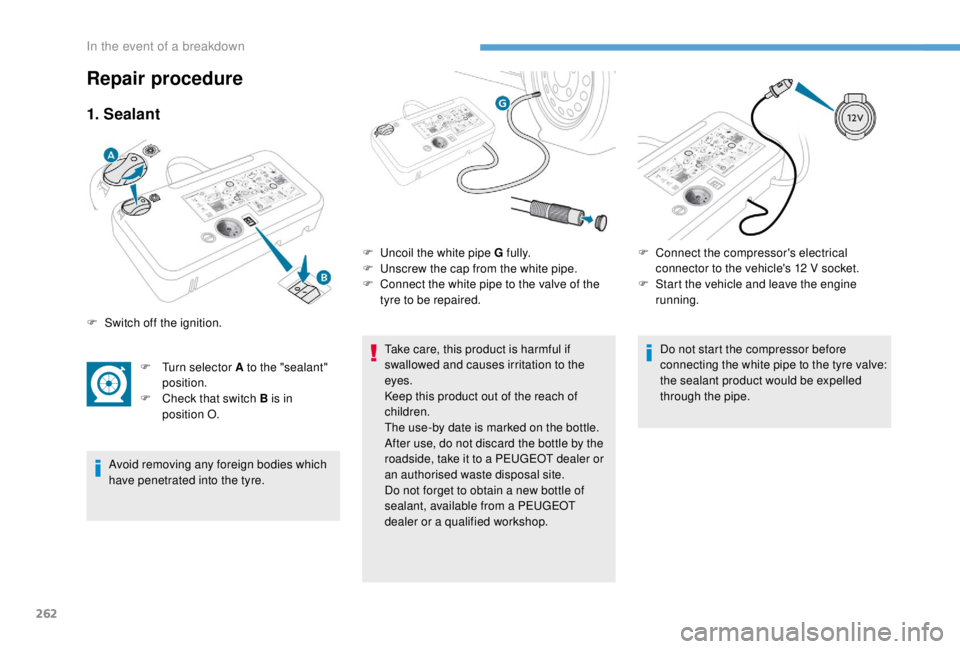
1. Sealant
F Turn selector A to the "sealant" position.
F
C
heck that switch B is in
position O.
Avoid removing any foreign bodies which
have penetrated into the tyre. Take care, this product is harmful if
swallowed and causes irritation to the
eyes.
Keep this product out of the reach of
children.
The use-by date is marked on the bottle.
After use, do not discard the bottle by the
roadside, take it to a PEUGEOT dealer or
an authorised waste disposal site.
Do not forget to obtain a new bottle of
sealant, available from a PEUGEOT
dealer or a qualified workshop.Do not start the compressor before
connecting the white pipe to the tyre valve:
the sealant product would be expelled
through the pipe.
Repair procedure
F Switch off the ignition.
F
U
ncoil the white pipe G fully.
F
U
nscrew the cap from the white pipe.
F
C
onnect the white pipe to the valve of the
tyre to be repaired. F
C
onnect the compressor's electrical
connector to the vehicle's 12 V socket.
F
S
tart the vehicle and leave the engine
running.
In the event of a breakdown
Page 265 of 416
263
If after around five to seven minutes this
pressure is not reached, this indicates
that the tyre is not repairable; contact a
PEUGEOT dealer or a qualified workshop
for assistance.
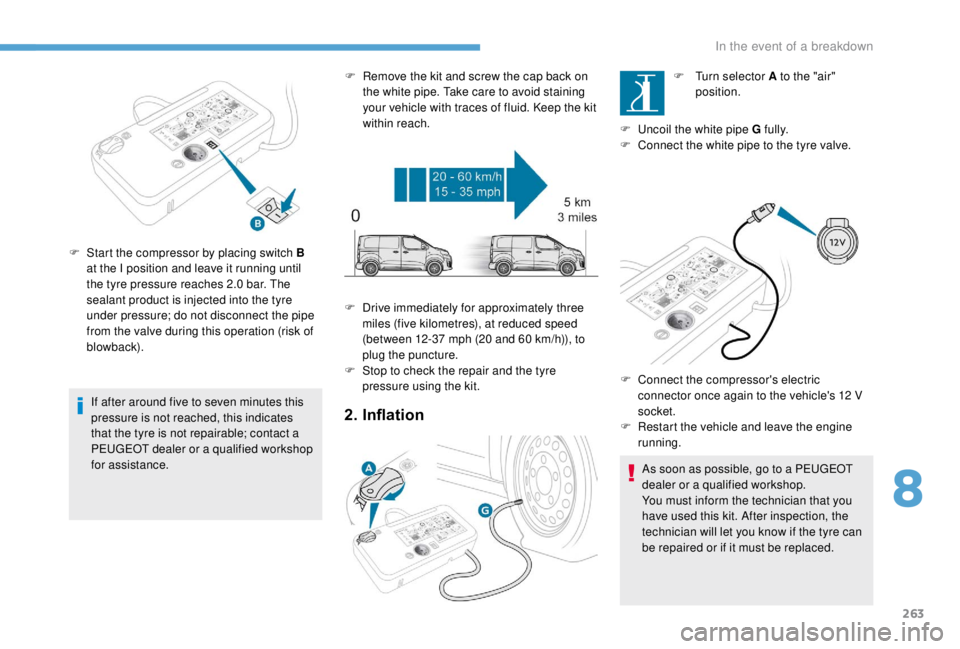
F
S
tart the compressor by placing switch B
at the I position and leave it running until
the tyre pressure reaches 2.0 bar. The
sealant product is injected into the tyre
under pressure; do not disconnect the pipe
from the valve during this operation (risk of
blowback). F
R
emove the kit and screw the cap back on
the white pipe. Take care to avoid staining
your vehicle with traces of fluid. Keep the kit
within reach.2. Inflation
F Turn selector A to the "air" position.
F
U
ncoil the white pipe G fully.
F
C
onnect the white pipe to the tyre valve.
As soon as possible, go to a PEUGEOT
dealer or a qualified workshop.
You must inform the technician that you
have used this kit. After inspection, the
technician will let you know if the tyre can
be repaired or if it must be replaced.
F
C
onnect the compressor's electric
connector once again to the vehicle's 12
V
socket.
F
R
estart the vehicle and leave the engine
running.
F
D
rive immediately for approximately three
miles (five kilometres), at reduced speed
(between 12-37 mph (20
and 60
km/h)), to
plug the puncture.
F
S
top to check the repair and the tyre
pressure using the kit.
8
In the event of a breakdown
Page 267 of 416
265
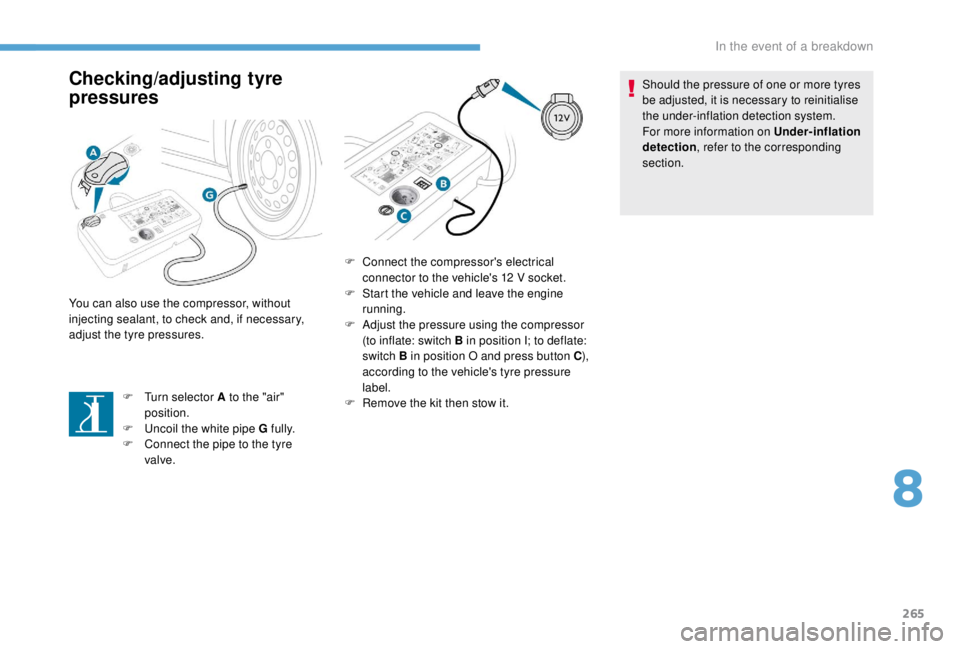
Checking/adjusting tyre
pressures
F Turn selector A to the "air" position.
F
U
ncoil the white pipe G fully.
F
C
onnect the pipe to the tyre
valve.
You can also use the compressor, without
injecting sealant, to check and, if necessary,
adjust the tyre pressures.
F
C
onnect the compressor's electrical
connector to the vehicle's 12 V socket.
F
S
tart the vehicle and leave the engine
running.
F
A
djust the pressure using the compressor
(to inflate: switch B in position I; to deflate:
switch B in position O and press button C ),
according to the vehicle's tyre pressure
label.
F R emove the kit then stow it. Should the pressure of one or more tyres
be adjusted, it is necessary to reinitialise
the under-inflation detection system.
For more information on Under-inflation
detection
, refer to the corresponding
section.
8
In the event of a breakdown
Page 289 of 416
287
Engine compartment fuses
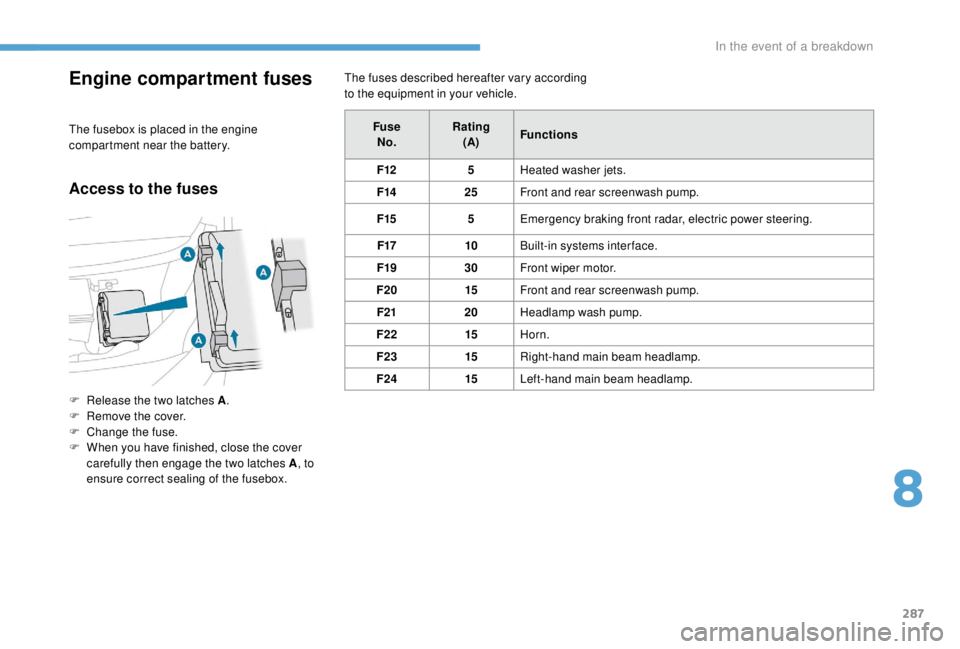
The fusebox is placed in the engine
compartment near the battery.
Access to the fuses
The fuses described hereafter vary according
to the equipment in your vehicle.
F
R
elease the two latches A .
F
R
emove the cover.
F
C
hange the fuse.
F
W
hen you have finished, close the cover
carefully then engage the two latches A , to
ensure correct sealing of the fusebox. Fuse
No. Rating
(A) Functions
F12 5Heated washer jets.
F14 25Front and rear screenwash pump.
F15 5Emergency braking front radar, electric power steering.
F17 10Built-in systems inter face.
F19 30Front wiper motor.
F20 15Front and rear screenwash pump.
F21 20Headlamp wash pump.
F22 15Horn.
F23 15Right-hand main beam headlamp.
F24 15Left-hand main beam headlamp.
8
In the event of a breakdown
Page 290 of 416
288
12 V battery
Procedure for starting the engine using another
battery or charging a discharged battery.
Lead-acid starter batteries Access to the battery
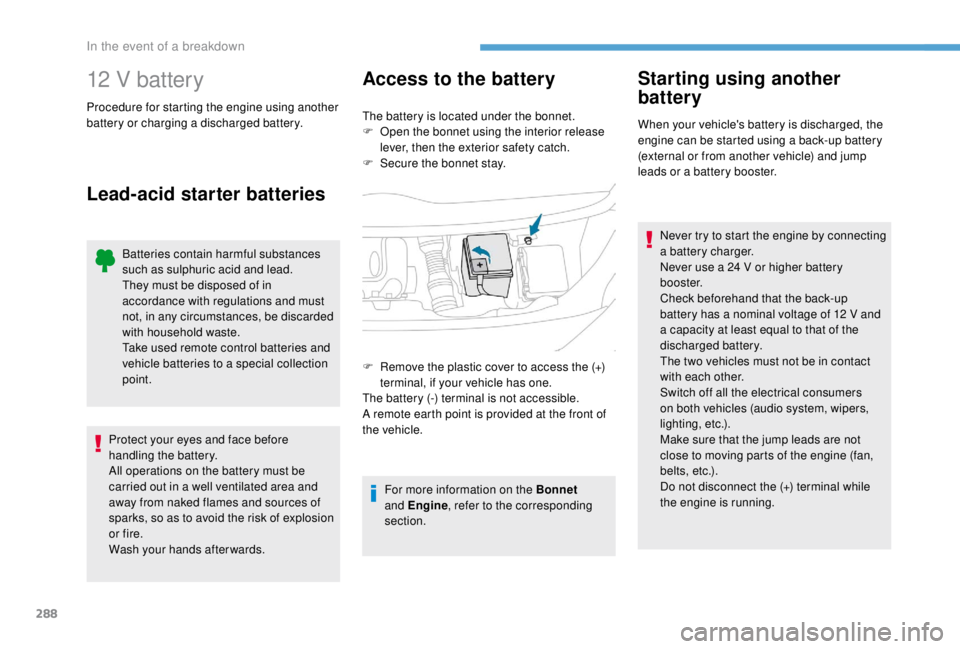
The battery is located under the bonnet.
F
O pen the bonnet using the interior release
lever, then the exterior safety catch.
F
S
ecure the bonnet stay.
For more information on the Bonnet
and Engine , refer to the corresponding
section.
Starting using another
battery
When your vehicle's battery is discharged, the
engine can be started using a back-up battery
(external or from another vehicle) and jump
leads or a battery booster.
Never try to start the engine by connecting
a battery charger.
Never use a 24
V or higher battery
b o o s t e r.
Check beforehand that the back-up
battery has a nominal voltage of 12 V and
a capacity at least equal to that of the
discharged battery.
The two vehicles must not be in contact
with each other.
Switch off all the electrical consumers
on both vehicles (audio system, wipers,
lighting, etc.).
Make sure that the jump leads are not
close to moving parts of the engine (fan,
belts, etc.).
Do not disconnect the (+) terminal while
the engine is running.
F
R
emove the plastic cover to access the (+)
terminal, if your vehicle has one.
The battery (-) terminal is not accessible.
A remote earth point is provided at the front of
the vehicle.
Batteries contain harmful substances
such as sulphuric acid and lead.
They must be disposed of in
accordance with regulations and must
not, in any circumstances, be discarded
with household waste.
Take used remote control batteries and
vehicle batteries to a special collection
point.
Protect your eyes and face before
handling the battery.
All operations on the battery must be
carried out in a well ventilated area and
away from naked flames and sources of
sparks, so as to avoid the risk of explosion
or fire.
Wash your hands afterwards.
In the event of a breakdown