seats PEUGEOT EXPERT 2018 User Guide
[x] Cancel search | Manufacturer: PEUGEOT, Model Year: 2018, Model line: EXPERT, Model: PEUGEOT EXPERT 2018Pages: 416, PDF Size: 14.12 MB
Page 108 of 416
106
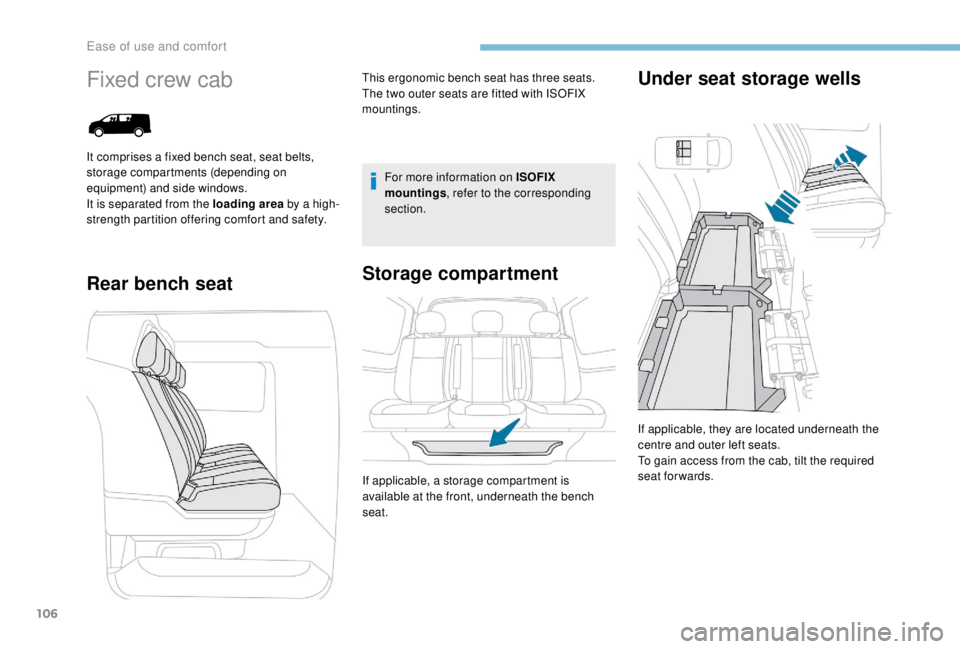
Fixed crew cab
Rear bench seatStorage compartment Under seat storage wells
For more information on ISOFIX
mountings
, refer to the corresponding
section.
If applicable, they are located underneath the
centre and outer left seats.
To gain access from the cab, tilt the required
seat forwards.
This ergonomic bench seat has three seats.
The two outer seats are fitted with ISOFIX
mountings.
If applicable, a storage compartment is
available at the front, underneath the bench
seat.
It comprises a fixed bench seat, seat belts,
storage compartments (depending on
equipment) and side windows.
It is separated from the loading area
by a high-
strength partition offering comfort and safety.
Ease of use and comfort
Page 114 of 416
112
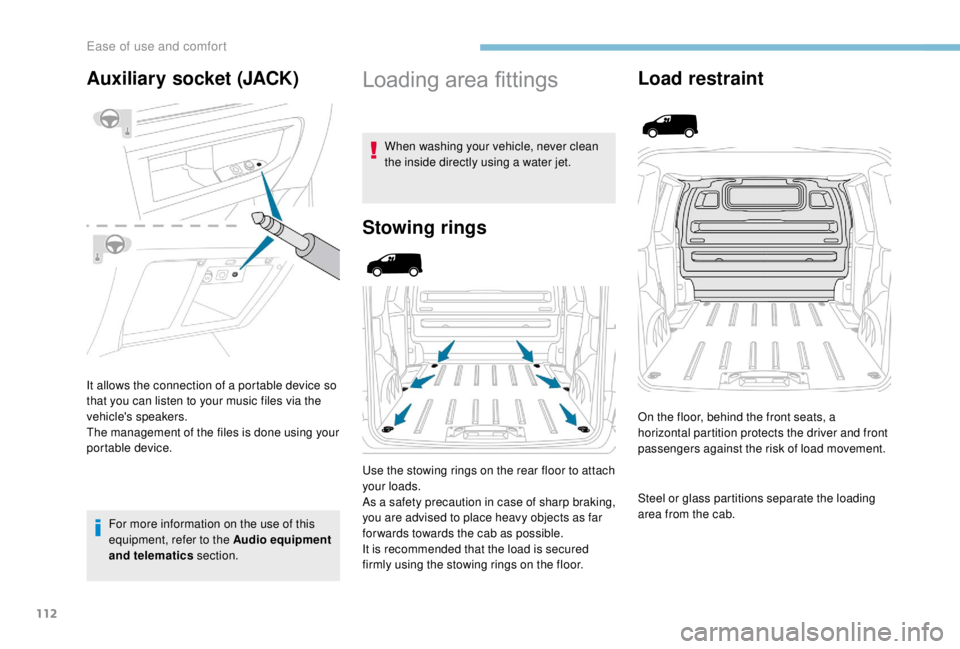
Auxiliary socket (JACK)
It allows the connection of a portable device so
that you can listen to your music files via the
vehicle's speakers.
The management of the files is done using your
portable device.For more information on the use of this
equipment, refer to the Audio equipment
and telematics section.
Loading area fittings
When washing your vehicle, never clean
the inside directly using a water jet.
Stowing rings
Use the stowing rings on the rear floor to attach
your loads.
As a safety precaution in case of sharp braking,
you are advised to place heavy objects as far
for wards towards the cab as possible.
It is recommended that the load is secured
firmly using the stowing rings on the floor.
Load restraint
On the floor, behind the front seats, a
horizontal partition protects the driver and front
passengers against the risk of load movement.
Steel or glass partitions separate the loading
area from the cab.
Ease of use and comfort
Page 115 of 416
113
Seating area fittings
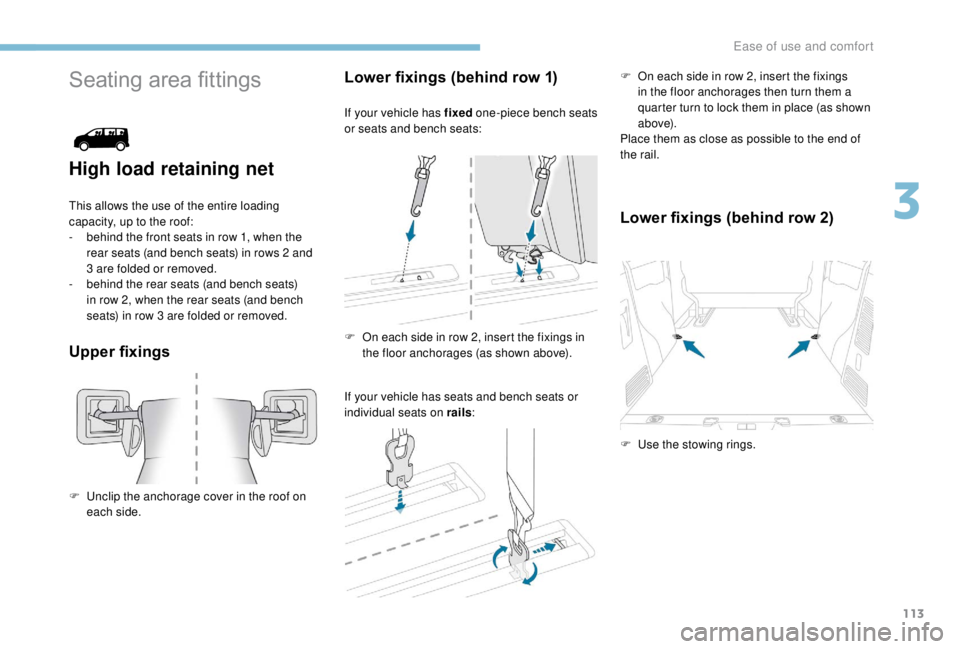
High load retaining net
This allows the use of the entire loading
capacity, up to the roof:
-
b
ehind the front seats in row 1, when the
rear seats (and bench seats) in rows 2
and
3
are folded or removed.
-
b
ehind the rear seats (and bench seats)
in row 2, when the rear seats (and bench
seats) in row 3
are folded or removed.
Upper fixings Lower fixings (behind row 1)
If your vehicle has fixed
one-piece bench seats
or seats and bench seats:
If your vehicle has seats and bench seats or
individual seats on rails : F
O
n each side in row 2, insert the fixings
in the floor anchorages then turn them a
quarter turn to lock them in place (as shown
a b ove).
Place them as close as possible to the end of
the rail.
Lower fixings (behind row 2)
F Unclip the anchorage cover in the roof on each side. F
O
n each side in row 2, insert the fixings in
the floor anchorages (as shown above).
F
U
se the stowing rings.
3
Ease of use and comfort
Page 116 of 416
114
Fitting the net
Unclip the upper fixing covers and secure the
lower fixings (as previously described).
F
F
old (table position) or remove the seats
and bench seats in rows 2
and 3 (depending
on equipment).
F
C
lose the rear heating and air conditioning
vents (depending on equipment).
F
U
nroll the high load retaining net.
F
P
osition the upper net fixings in the
corresponding anchorages in the roof (first
one side, then the other).
F
F
ully extend the straps.
F
O
n each side, attach the bottom fixings of
the net to the lower anchorages (behind
row 1) or in the stowing rings (behind row 2).
F
T
ension the straps to extend the net.
F
C
heck that the net is attached securely and
properly extended.
Never use the ISOFIX ring for the strap
fixing point of a child seat with Top Tether.
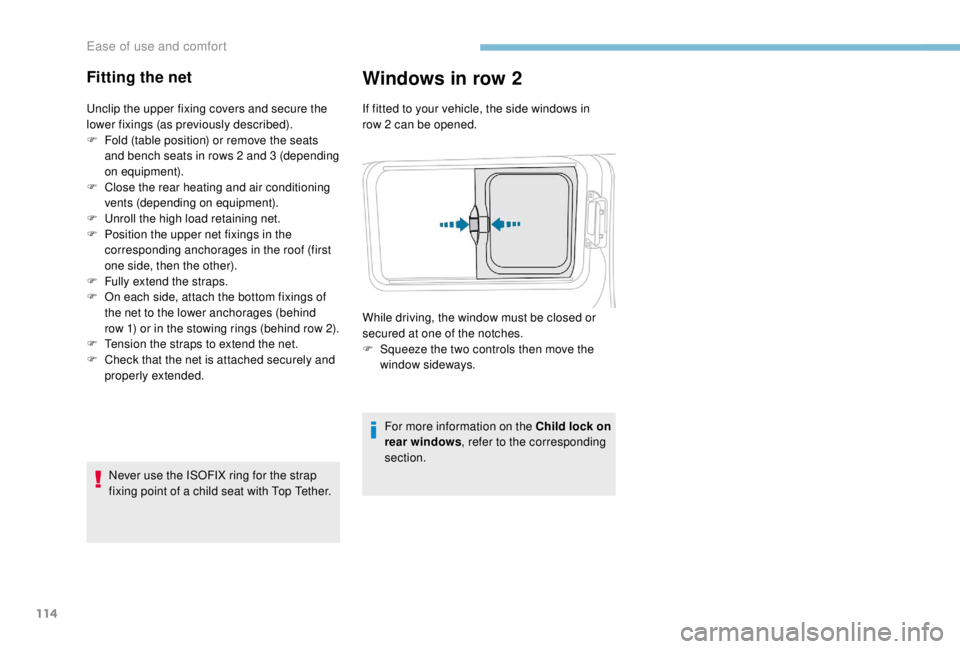
Windows in row 2
If fitted to your vehicle, the side windows in
row 2 can be opened.
For more information on the Child lock on
rear windows , refer to the corresponding
section.
While driving, the window must be closed or
secured at one of the notches.
F
S
queeze the two controls then move the
window sideways.
Ease of use and comfort
Page 139 of 416
137
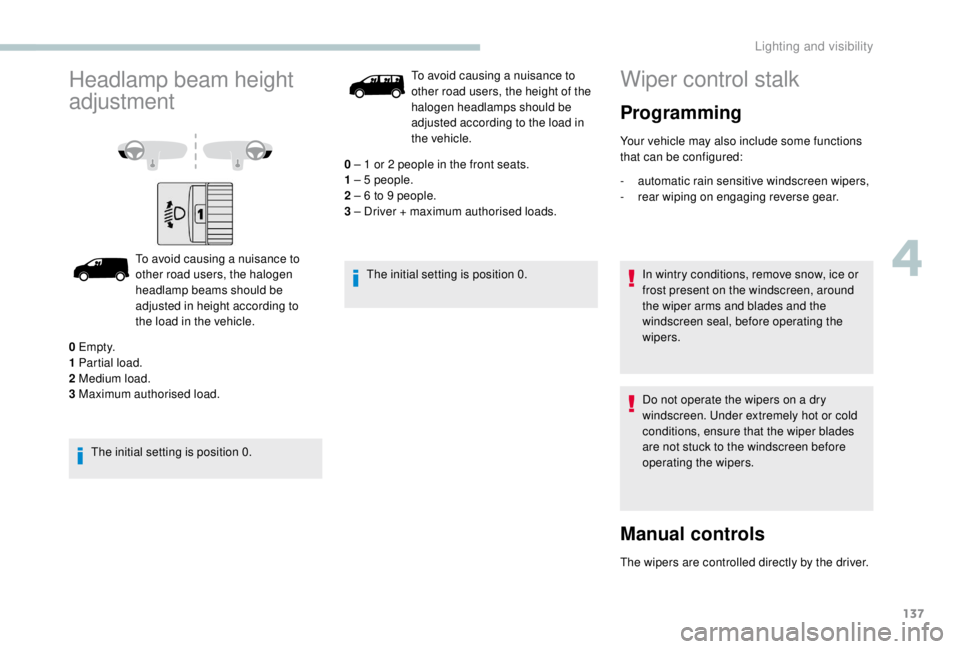
Headlamp beam height
adjustment
To avoid causing a nuisance to
other road users, the halogen
headlamp beams should be
adjusted in height according to
the load in the vehicle.
The initial setting is position 0. To avoid causing a nuisance to
other road users, the height of the
halogen headlamps should be
adjusted according to the load in
the vehicle.
0 – 1 or 2 people in the front seats.
1 – 5
people.
2 – 6 to 9 people.
3 – Driver + maximum authorised loads.
The initial setting is position 0.
0
Em pt y.
1
Partial load.
2
Medium load.
3
Maximum authorised load.
Wiper control stalk
Programming
Your vehicle may also include some functions
that can be configured:
-
a
utomatic rain sensitive windscreen wipers,
-
r
ear wiping on engaging reverse gear.
In wintry conditions, remove snow, ice or
frost present on the windscreen, around
the wiper arms and blades and the
windscreen seal, before operating the
wipers.
Do not operate the wipers on a dry
windscreen. Under extremely hot or cold
conditions, ensure that the wiper blades
are not stuck to the windscreen before
operating the wipers.
Manual controls
The wipers are controlled directly by the driver.
4
Lighting and visibility
Page 152 of 416
150
Seat belts
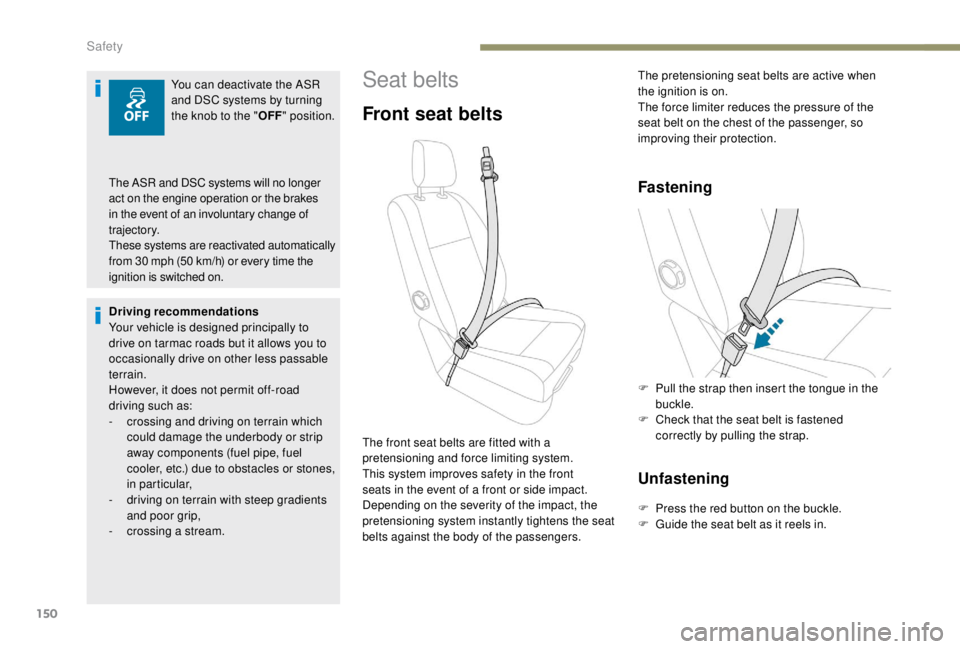
Front seat belts
Fastening
Unfastening
F Press the red button on the buckle.
F G uide the seat belt as it reels in.
The front seat belts are fitted with a
pretensioning and force limiting system.
This system improves safety in the front
seats in the event of a front or side impact.
Depending on the severity of the impact, the
pretensioning system instantly tightens the seat
belts against the body of the passengers. The pretensioning seat belts are active when
the ignition is on.
The force limiter reduces the pressure of the
seat belt on the chest of the passenger, so
improving their protection.
F
P
ull the strap then insert the tongue in the
buckle.
F
C
heck that the seat belt is fastened
correctly by pulling the strap.
You can deactivate the ASR
and DSC systems by turning
the knob to the "
OFF" position.
The ASR and DSC systems will no longer
act on the engine operation or the brakes
in the event of an involuntary change of
trajectory.
These systems are reactivated automatically
from 30
mph (50
km/h) or every time the
ignition is switched on.
Driving recommendations
Your vehicle is designed principally to
drive on tarmac roads but it allows you to
occasionally drive on other less passable
terrain.
However, it does not permit off-road
driving such as:
-
c
rossing and driving on terrain which
could damage the underbody or strip
away components (fuel pipe, fuel
cooler, etc.) due to obstacles or stones,
in particular,
-
d
riving on terrain with steep gradients
and poor grip,
-
c
rossing a stream.
Safety
Page 153 of 416
151
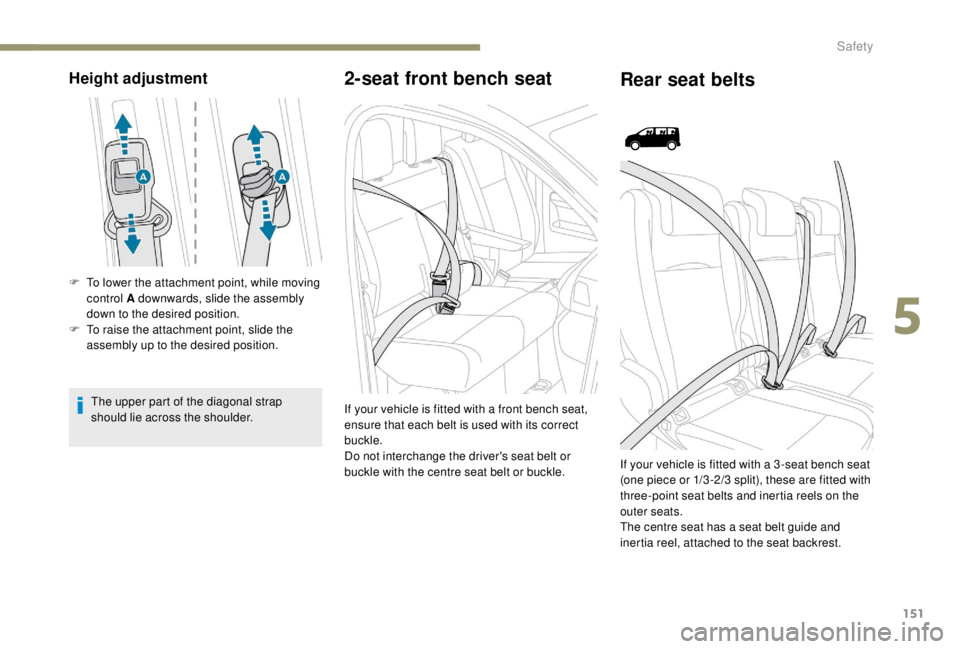
Height adjustment
F To lower the attachment point, while moving control A downwards, slide the assembly
down to the desired position.
F
T
o raise the attachment point, slide the
assembly up to the desired position.
The upper part of the diagonal strap
should lie across the shoulder.
2-seat front bench seat
If your vehicle is fitted with a front bench seat,
ensure that each belt is used with its correct
buckle.
Do not interchange the driver's seat belt or
buckle with the centre seat belt or buckle.
Rear seat belts
If your vehicle is fitted with a 3 -seat bench seat
(one piece or 1/3 -2/3 split), these are fitted with
three-point seat belts and inertia reels on the
outer seats.
The centre seat has a seat belt guide and
inertia reel, attached to the seat backrest.
5
Safety
Page 154 of 416
152
For rows 2 and 3, fit each seat belt to its
c orrect buckle.
Do not interchange the belts or buckles for
the outer seats with the belt or buckle for
the centre seat.
When folding the outer seats or placing
a backrest in the table position, avoid
trapping the belt for the centre seat.
After folding a rear seat or bench seat,
ensure that the seat belt has reeled
in correctly and the buckle is ready to
receive the belt tongue.
When handling the outer seats (removing
or refitting) or for access to row 3, avoid
trapping the centre belt.
The seat belt reels for the outer seats in row
2
have force limiters.
The seats in row 3 have three-point seat belts
with inertia reels.
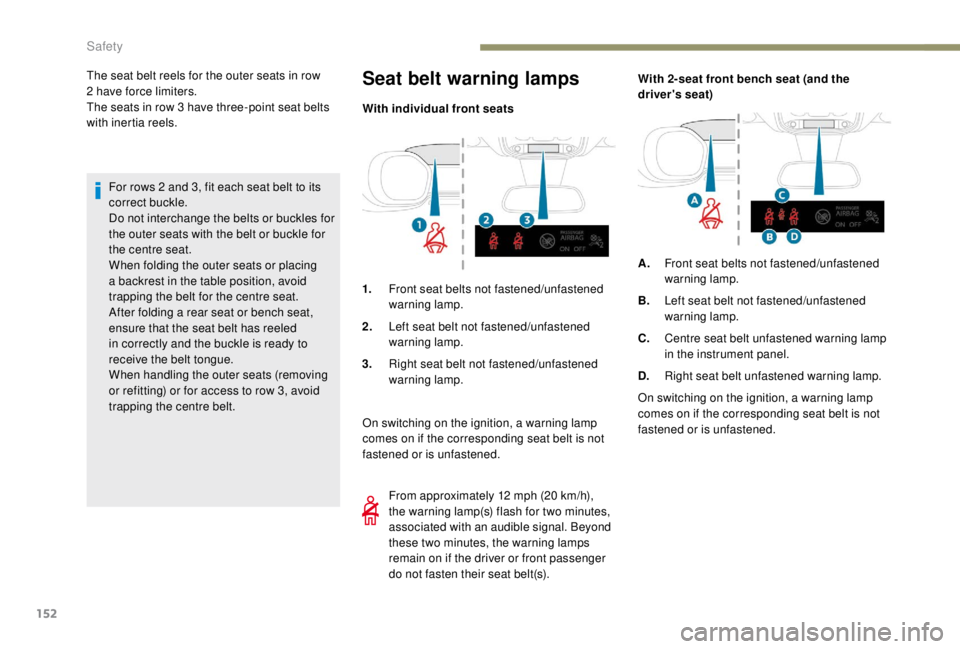
Seat belt warning lamps
With individual front seats
1. Front seat belts not fastened/unfastened
warning lamp.
2. Left seat belt not fastened/unfastened
warning lamp.
3. Right seat belt not fastened/unfastened
warning lamp.
On switching on the ignition, a warning lamp
comes on if the corresponding seat belt is not
fastened or is unfastened. From approximately 12
mph (20 km/h),
the warning lamp(s) flash for two minutes,
associated with an audible signal. Beyond
these two minutes, the warning lamps
remain on if the driver or front passenger
do not fasten their seat belt(s). With 2-seat front bench seat (and the
driver's seat)
On switching on the ignition, a warning lamp
comes on if the corresponding seat belt is not
fastened or is unfastened. A.
Front seat belts not fastened/unfastened
warning lamp.
B. Left seat belt not fastened/unfastened
warning lamp.
C. Centre seat belt unfastened warning lamp
in the instrument panel.
D. Right seat belt unfastened warning lamp.
Safety
Page 155 of 416
153
Advice
The driver must ensure that passengers use
the seat belts correctly and that they are all
restrained securely before setting off.
Wherever you are seated in the vehicle,
always fasten your seat belt, even for short
journeys.
Do not interchange the seat belt buckles as
they will not completely fulfil their role.
The seat belts are equipped with an inertia
reel which allows the strap length to adjust
automatically to your shape. The seat belt is
stowed automatically when not in use.
Before and after use, ensure that the seat belt
is reeled in correctly.
The lower part of the strap must be positioned
as low as possible on the pelvis.
The upper part must be positioned in the
hollow of the shoulder.
The inertia reels have an automatic blocking
device at the time of a collision, during
sudden braking or if the vehicle turns over.
You can release the device by pulling the
strap firmly and then releasing it so that it
reels in slightly.Instructions for children
Use a suitable child seat, if the passenger
is less than 12
years old or shorter than
one and a half metres.
Never use the same seat belt to secure
more than one person.
Never allow a child to travel on your lap.
For more information on Child seats , refer
to the corresponding section.
In case of impact
Depending on the nature and seriousness
of the impact, the pyrotechnic may be
deployed before and independent of the
airbags. Deployment of the pyrotechnics
is accompanied by a slight discharge of
harmless smoke and a noise, due to the
activation of the pyrotechnic cartridge
incorporated in the system.
In all cases, the airbag warning lamp is lit.
After an impact, get the seat belt system
checked and, if necessary, have it
replaced by a PEUGEOT dealer or a
qualified workshop.
In order to be effective, a seat belt must:
-
b e tightened as close to the body as
possible,
-
b
e pulled in front of you with a smooth
movement, checking that it does not twist,
-
b
e used to restrain only one person,
-
n
ot show any signs of cuts or fraying,
-
n
ot be converted or modified to avoid
affecting its performance.
In accordance with current safety regulations,
for all repairs on your vehicle's seat belts, go
to a qualified workshop with the skills and
equipment needed, which a PEUGEOT dealer
is able to provide.
Have your seat belts checked regularly by a
PEUGEOT dealer or a qualified workshop,
particularly if the straps show signs of
damage.
Clean the seat belt straps with soapy water or
a textile cleaning product, sold by PEUGEOT
dealers.
After folding or moving a seat or a rear bench
seat, ensure that the seat belt is positioned
and reeled in correctly.
5
Safety
Page 157 of 416
155
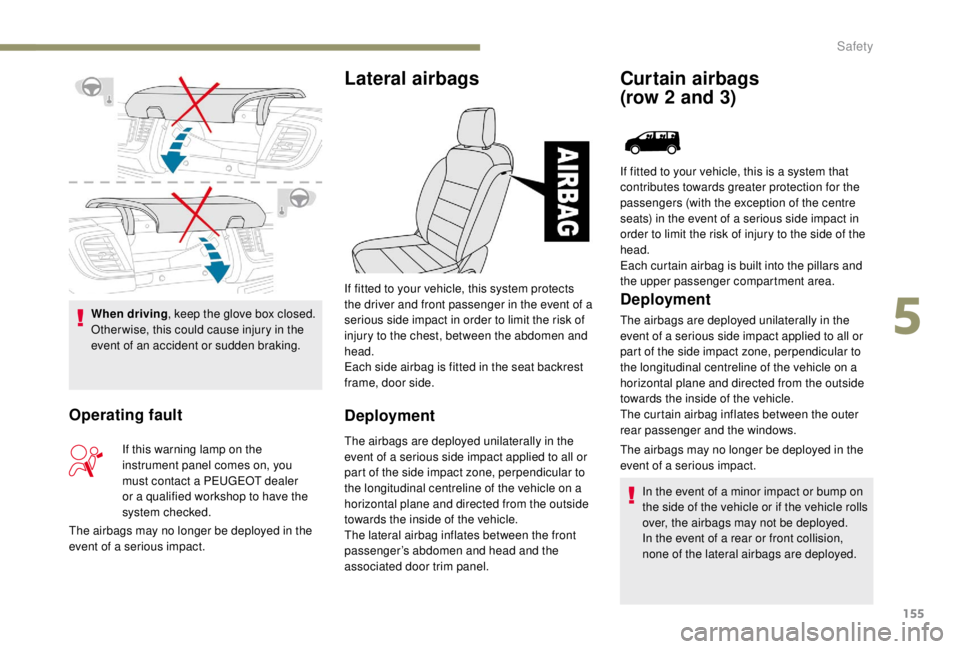
When driving, keep the glove box closed.
Other wise, this could cause injury in the
event of an accident or sudden braking.
Lateral airbags
Deployment
The airbags are deployed unilaterally in the
event of a serious side impact applied to all or
part of the side impact zone, perpendicular to
the longitudinal centreline of the vehicle on a
horizontal plane and directed from the outside
towards the inside of the vehicle.
The lateral airbag inflates between the front
passenger’s abdomen and head and the
associated door trim panel.
Curtain airbags
(row 2 and 3)
If fitted to your vehicle, this is a system that
contributes towards greater protection for the
passengers (with the exception of the centre
seats) in the event of a serious side impact in
order to limit the risk of injury to the side of the
head.
Each curtain airbag is built into the pillars and
the upper passenger compartment area.
If fitted to your vehicle, this system protects
the driver and front passenger in the event of a
serious side impact in order to limit the risk of
injury to the chest, between the abdomen and
head.
Each side airbag is fitted in the seat backrest
frame, door side.
Deployment
The airbags are deployed unilaterally in the
event of a serious side impact applied to all or
part of the side impact zone, perpendicular to
the longitudinal centreline of the vehicle on a
horizontal plane and directed from the outside
towards the inside of the vehicle.
The curtain airbag inflates between the outer
rear passenger and the windows.
The airbags may no longer be deployed in the
event of a serious impact.
Operating fault
If this warning lamp on the
instrument panel comes on, you
must contact a PEUGEOT dealer
or a qualified workshop to have the
system checked.
The airbags may no longer be deployed in the
event of a serious impact. In the event of a minor impact or bump on
the side of the vehicle or if the vehicle rolls
over, the airbags may not be deployed.
In the event of a rear or front collision,
none of the lateral airbags are deployed.
5
Safety