weight PEUGEOT EXPERT 2018 User Guide
[x] Cancel search | Manufacturer: PEUGEOT, Model Year: 2018, Model line: EXPERT, Model: PEUGEOT EXPERT 2018Pages: 416, PDF Size: 14.12 MB
Page 244 of 416
242
Towing a trailer
We recommend the use of genuine
PEUGEOT towbars and their harnesses
that have been tested and approved from
the design stage of your vehicle, and that
the fitting of the towbar is entrusted to a
PEUGEOT dealer or a qualified workshop.
If the towbar is not fitted by a PEUGEOT
dealer, it must still be fitted in accordance
with the vehicle manufacturer's
instructions.
Driving with a trailer places greater
demands on the towing vehicle and the
driver must take particular care.Please respect the maximum authorised
towable weights, indicated on the
registration certificate or in your vehicle’s
technical data.
For more information on Driving advice
,
particularly when towing, refer to the
corresponding section.
Energy economy mode
System which manages the duration of use of
certain functions to conser ve a sufficient level
of charge in the battery.
After the engine has stopped, you can still use
functions such as the audio and telematics
system, windscreen wipers, dipped beam
headlamps, courtesy lamps, etc. for a
maximum combined duration of about forty
minutes.
Switching to this mode
A message appears in the instrument panel
screen indicating that the vehicle has switched
to economy mode and the active functions are
put on standby.
If a telephone call is being made at this
time, it will be maintained for around
10
minutes with the hands-free kit of your
audio system.
Your vehicle is primarily designed for
transporting people and luggage, but it may
also be used for towing a trailer.
Practical information
Page 246 of 416
244
As a safety measure and to avoid
damaging the roof, it is essential to use
the transverse bars approved for your
vehicle.
Obser ve the instructions on fitting and use
contained in the guide supplied with the
roof bars.
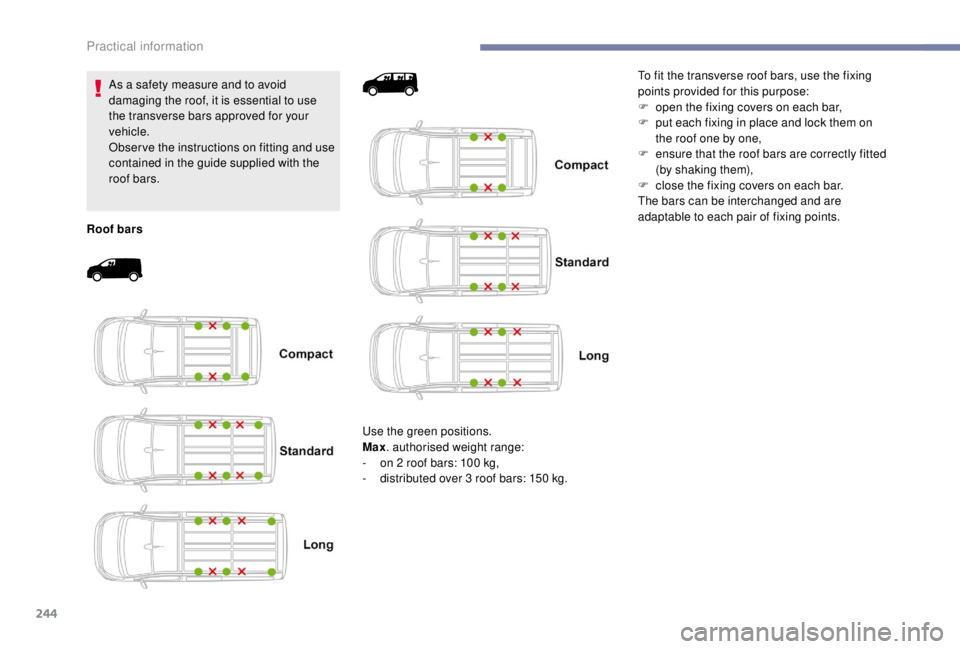
Roof bars
Use the green positions.
Max. authorised weight range:
-
o
n 2 roof bars: 100 kg,
-
d
istributed over 3 roof bars: 150 kg.To fit the transverse roof bars, use the fixing
points provided for this purpose:
F
o
pen the fixing covers on each bar,
F
p
ut each fixing in place and lock them on
the roof one by one,
F
e
nsure that the roof bars are correctly fitted
(by shaking them),
F
c
lose the fixing covers on each bar.
The bars can be interchanged and are
adaptable to each pair of fixing points.
Practical information
Page 247 of 416
245
Changing a wiper blade
Before removing a front
wiper
F Within one minute after switching off the ignition, operate the wiper stalk to position
the wiper blades in the middle of the
windscreen (maintenance position).
Removing
F Lift the corresponding wiper arm away from the windscreen.
F
U
nclip and remove the wiper blade.
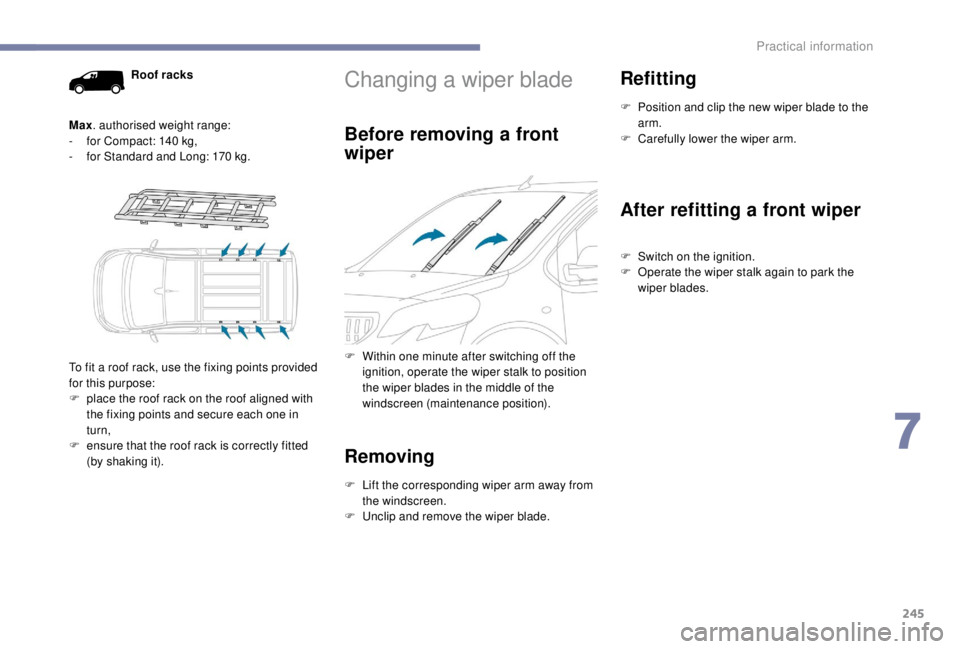
Roof racks
Max . authorised weight range:
-
f
or Compact: 140
kg,
-
f
or Standard and Long: 170
kg.
To fit a roof rack, use the fixing points provided
for this purpose:
F
p
lace the roof rack on the roof aligned with
the fixing points and secure each one in
turn,
F
e
nsure that the roof rack is correctly fitted
(by shaking it).
Refitting
F Position and clip the new wiper blade to the arm.
F
C
arefully lower the wiper arm.
After refitting a front wiper
F Switch on the ignition.
F O perate the wiper stalk again to park the
wiper blades.
7
Practical information
Page 295 of 416
293
Towing your vehicleTowing another vehicle
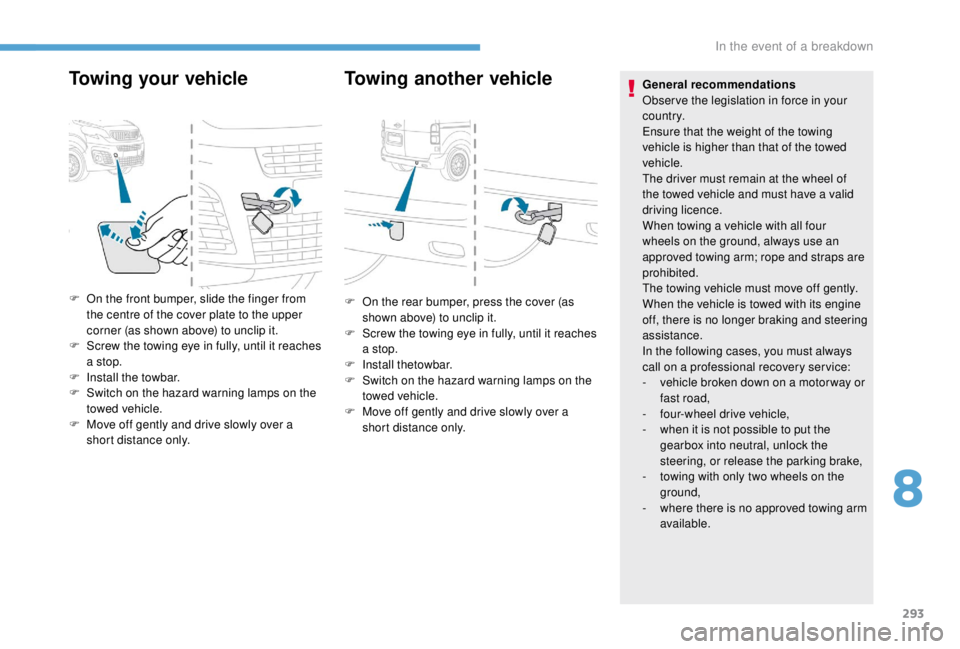
F On the front bumper, slide the finger from
the centre of the cover plate to the upper
corner (as shown above) to unclip it.
F
S
crew the towing eye in fully, until it reaches
a stop.
F
I
nstall the towbar.
F
S
witch on the hazard warning lamps on the
towed vehicle.
F
M
ove off gently and drive slowly over a
short distance only. General recommendations
Obser ve the legislation in force in your
c o u nt r y.
Ensure that the weight of the towing
vehicle is higher than that of the towed
vehicle.
The driver must remain at the wheel of
the towed vehicle and must have a valid
driving licence.
When towing a vehicle with all four
wheels on the ground, always use an
approved towing arm; rope and straps are
prohibited.
The towing vehicle must move off gently.
When the vehicle is towed with its engine
off, there is no longer braking and steering
assistance.
In the following cases, you must always
call on a professional recovery ser vice:
-
v
ehicle broken down on a motor way or
fast road,
-
f
our-wheel drive vehicle,
-
w
hen it is not possible to put the
gearbox into neutral, unlock the
steering, or release the parking brake,
-
t
owing with only two wheels on the
ground,
-
w
here there is no approved towing arm
available.
F
O n the rear bumper, press the cover (as
shown above) to unclip it.
F
S
crew the towing eye in fully, until it reaches
a stop.
F
I
nstall thetowbar.
F
S
witch on the hazard warning lamps on the
towed vehicle.
F
M
ove off gently and drive slowly over a
short distance only.
8
In the event of a breakdown
Page 296 of 416
294
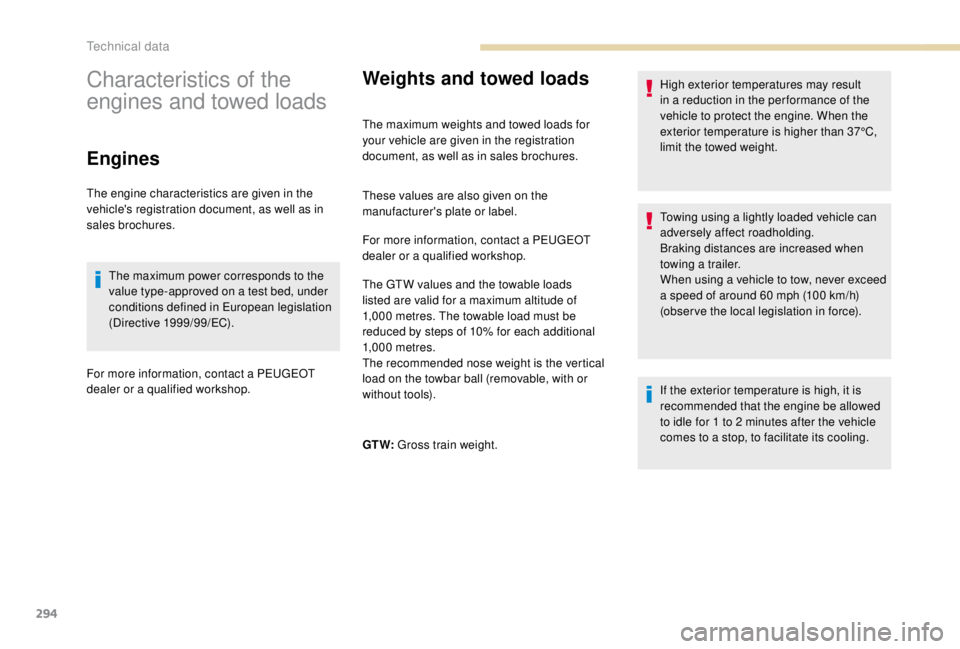
Characteristics of the
engines and towed loads
Engines
The engine characteristics are given in the
vehicle's registration document, as well as in
sales brochures.The maximum power corresponds to the
value type-approved on a test bed, under
conditions defined in European legislation
(Directive 1999/99/EC).
For more information, contact a PEUGEOT
dealer or a qualified workshop.
Weights and towed loads
The maximum weights and towed loads for
your vehicle are given in the registration
document, as well as in sales brochures.
These values are also given on the
manufacturer's plate or label.
For more information, contact a PEUGEOT
dealer or a qualified workshop.
The GTW values and the towable loads
listed are valid for a maximum altitude of
1,000
metres. The towable load must be
reduced by steps of 10% for each additional
1,000
metres.
The recommended nose weight is the vertical
load on the towbar ball (removable, with or
without tools).
GT W: Gross train weight. High exterior temperatures may result
in a reduction in the per formance of the
vehicle to protect the engine. When the
exterior temperature is higher than 37°C,
limit the towed weight.
Towing using a lightly loaded vehicle can
adversely affect roadholding.
Braking distances are increased when
towing a trailer.
When using a vehicle to tow, never exceed
a speed of around 60
mph (100 km/h)
(obser ve the local legislation in force).
If the exterior temperature is high, it is
recommended that the engine be allowed
to idle for 1
to 2 minutes after the vehicle
comes to a stop, to facilitate its cooling.
Technical data
Page 297 of 416
295
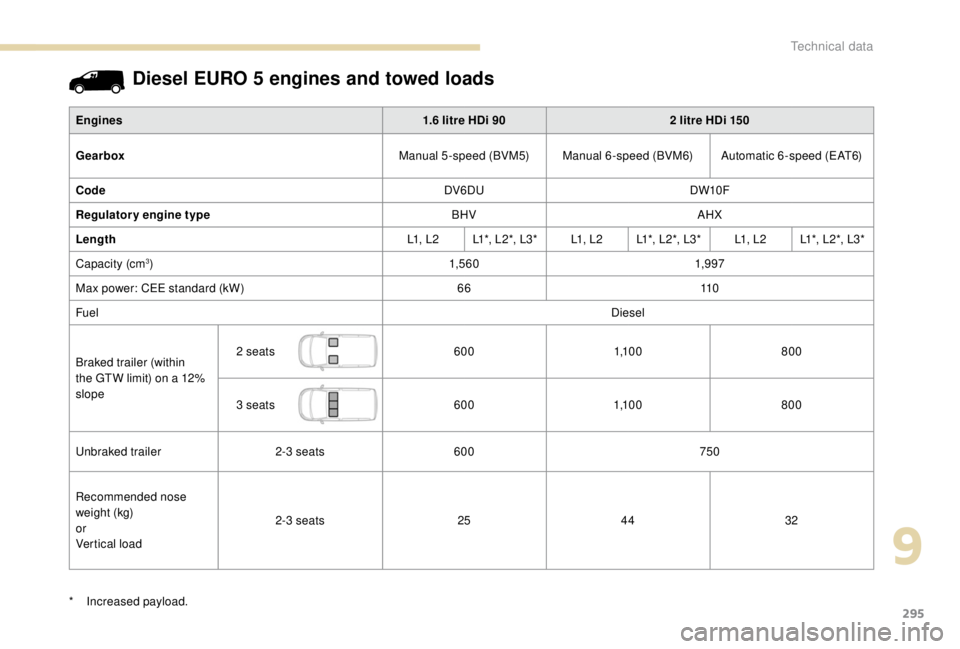
Diesel EURO 5 engines and towed loads
Engines1.6 litre HDi 902 litre HDi 150
Gearbox Manual 5-speed (BVM5) Manual 6-speed (BVM6)Automatic 6-speed (EAT6)
Code DV6DUDW10F
Regulatory engine type BHVAHX
Length L1 , L 2L1*, L 2 *, L 3 * L1 , L 2L1*, L 2 *, L 3 * L1 , L 2L1*, L 2 *, L 3 *
Capacity (cm
3) 1,5 6 01,9 97
Max power: CEE standard (kW) 6611 0
Fuel Diesel
Braked trailer (within
the GTW limit) on a 12%
slope 2
seats 6001,1 0 0 800
3
seats 6001,1 0 0 800
Unbraked trailer 2-3
seats 600 750
Recommended nose
weight (kg)
or
Vertical load 2-3
seats 25 44 32
*
I
ncreased payload.
9
Technical data
Page 298 of 416
296
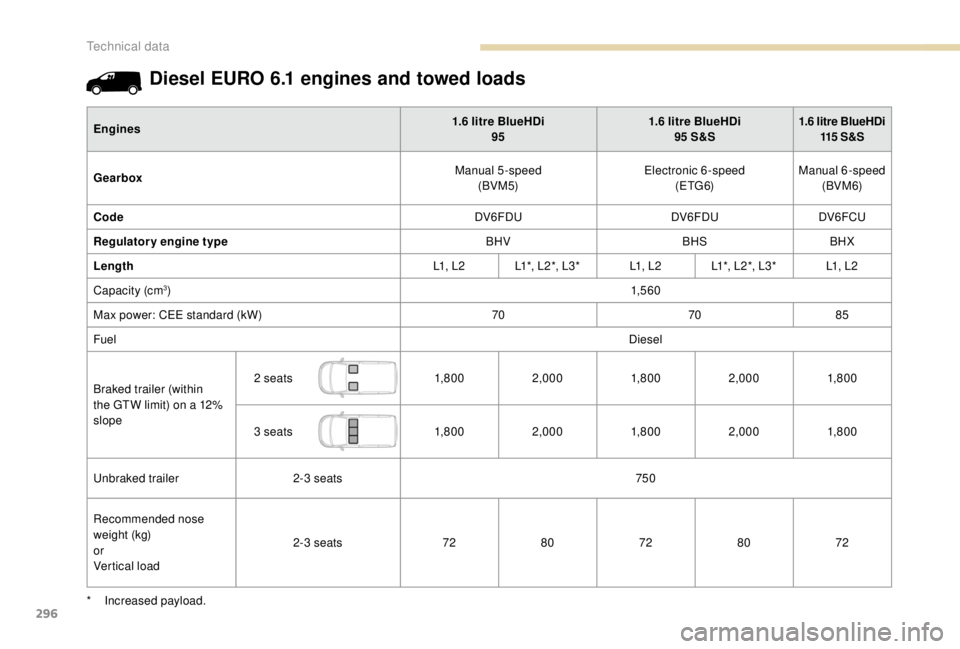
Diesel EURO 6.1 engines and towed loads
Engines1.6 litre BlueHDi
95 1.6
litre BlueHDi
95 S&S1.6
litre BlueHDi
115 S & S
Gearbox Manual 5-speed
(BVM5) Electronic 6-speed
(ETG6) Manual 6-speed
(BVM 6)
Code DV6FDUDV6FDUDV6FCU
Regulatory engine type BHVBHSBHX
Length L1 , L 2L1*, L 2 *, L 3 * L1 , L 2L1*, L 2 *, L 3 * L1 , L 2
Capacity (cm
3) 1,5 6 0
Max power: CEE standard (kW) 707085
Fuel Diesel
Braked trailer (within
the GTW limit) on a 12%
slope 2
seats 1,8 0 02,000 1,8 0 02,000 1,8 0 0
3
seats 1,8 0 02,000 1,8 0 02,000 1,8 0 0
Unbraked trailer 2-3
seats 750
Recommended nose
weight (kg)
or
Vertical load 2-3
seats7280 7280 72
*
I
ncreased payload.
Technical data
Page 299 of 416
297
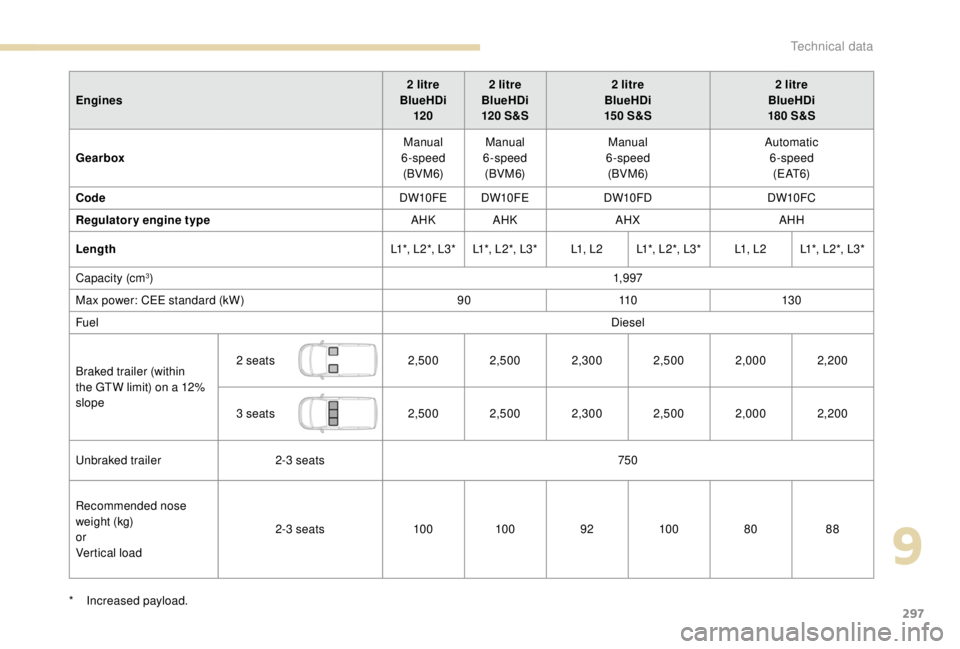
Engines2 litre
BlueHDi 120 2
litre
BlueHDi
120 S&S2
litre
BlueHDi
15 0 S&S2
litre
BlueHDi
180 S&S
Gearbox Manual
6-speed (BVM 6) Manual
6-speed (BVM 6) Manual
6-speed (BVM 6) Automatic
6-speed ( E AT 6)
Code DW10FE DW10FEDW10FDDW10FC
Regulatory engine type AHK AHKAHXAHH
Length L1*, L 2 *, L 3 * L1*, L 2 *, L 3 *L1 , L 2L1*, L 2 *, L 3 * L1 , L 2L1*, L 2 *, L 3 *
Capacity (cm
3) 1,9 97
Max power: CEE standard (kW) 9011 0 13 0
Fuel Diesel
Braked trailer (within
the GTW limit) on a 12%
slope 2
seats 2,500 2,500 2,300 2,500 2,0002,200
3
seats 2,500 2,500 2,300 2,500 2,0002,200
Unbraked trailer 2-3
seats 750
Recommended nose
weight (kg)
or
Vertical load 2-3
seats10 010 0 9210 0 8088
*
I
ncreased payload.
9
Technical data
Page 300 of 416
298
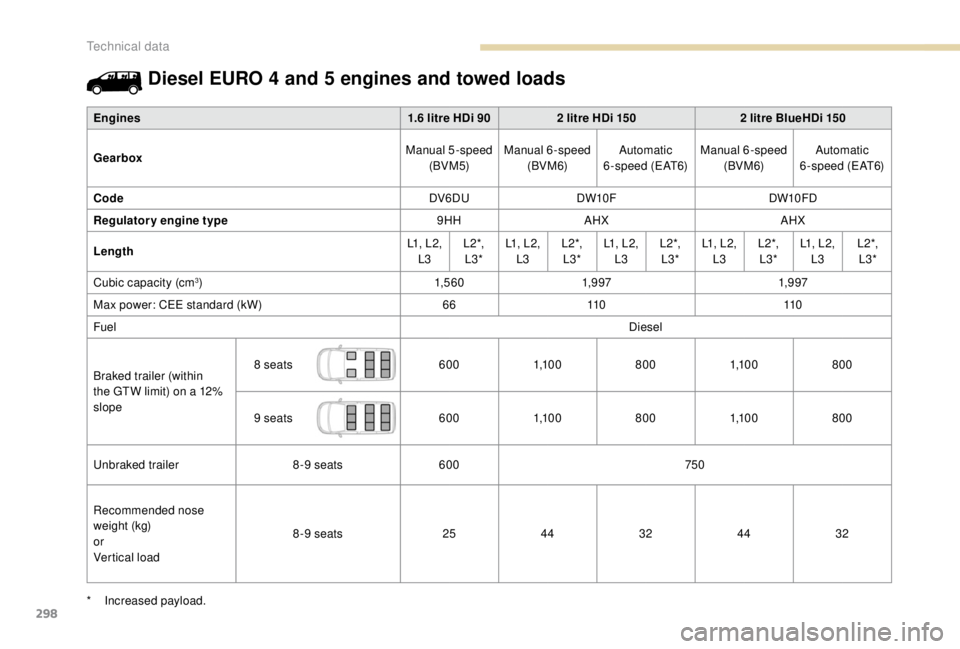
Diesel EURO 4 and 5 engines and towed loads
Engines1.6 litre HDi 902 litre HDi 1502 litre BlueHDi 150
Gearbox Manual 5-speed
(BVM5) Manual 6-speed
(BVM 6) Automatic
6-speed (EAT6) Manual 6-speed
(BVM 6) Automatic
6-speed (EAT6)
Code DV6DUDW10F DW10FD
Regulatory engine type 9HHAHX AHX
Length L1, L2,
L3 L 2 *,
L3* L1, L2,
L3 L 2 *,
L3* L1, L2,
L3 L 2 *,
L3* L1, L2,
L3 L 2 *,
L3* L1, L2,
L3 L 2 *,
L3*
Cubic capacity (cm
3) 1,5 6 01,9 97 1,9 97
Max power: CEE standard (kW) 6611 0 11 0
Fuel Diesel
Braked trailer (within
the GTW limit) on a 12%
slope 8
seats 6001,1 0 0 8001,1 0 0 800
9
seats 6001,1 0 0 8001,1 0 0 800
Unbraked trailer 8-9
seats 600 750
Recommended nose
weight (kg)
or
Vertical load 8-9
seats 2544 3244 32
*
I
ncreased payload.
Technical data
Page 301 of 416
299
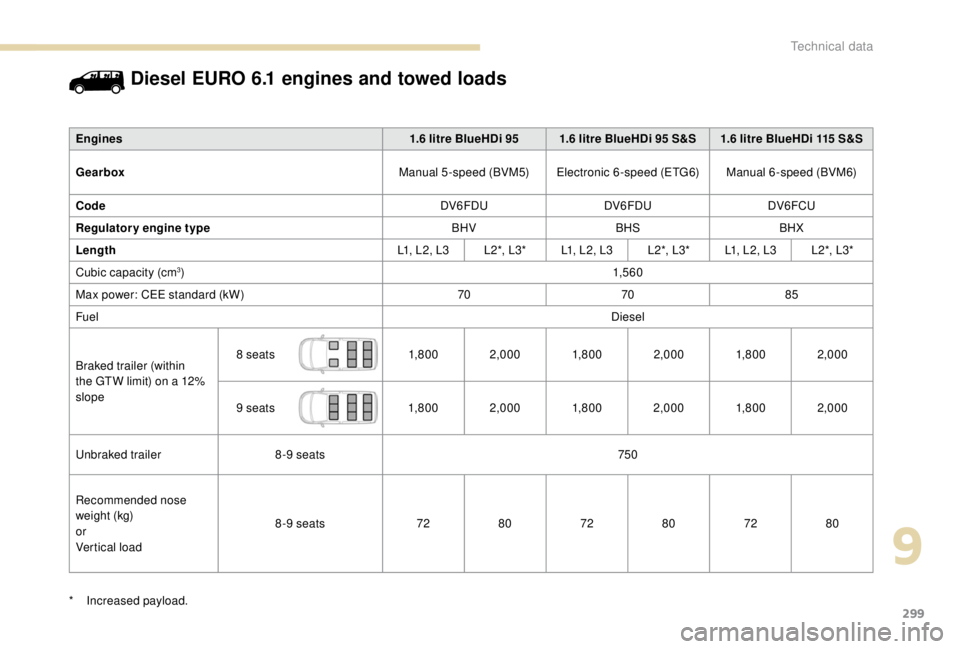
Diesel EURO 6.1 engines and towed loads
Engines1.6 litre BlueHDi 95 1.6 litre BlueHDi 95 S&S 1.6 litre BlueHDi 115 S&S
Gearbox Manual 5-speed (BVM5)Electronic 6-speed (ETG6) Manual 6-speed (BVM6)
Code DV6FDUDV6FDU DV6FCU
Regulatory engine type BHVBHSBHX
Length L1, L2, L3L 2 *, L 3 *L1, L2, L3 L 2 *, L 3 *L1, L2, L3 L 2 *, L 3 *
Cubic capacity (cm
3) 1,5 6 0
Max power: CEE standard (kW) 707085
Fuel Diesel
Braked trailer (within
the GTW limit) on a 12%
slope 8
seats 1,8 0 02,000 1,8 0 02,000 1,8 0 02,000
9
seats 1,8 0 02,000 1,8 0 02,000 1,8 0 02,000
Unbraked trailer 8-9
seats 750
Recommended nose
weight (kg)
or
Vertical load 8-9
seats 7280 7280 7280
*
I
ncreased payload.
9
Technical data