ignition PEUGEOT EXPERT 2018 Workshop Manual
[x] Cancel search | Manufacturer: PEUGEOT, Model Year: 2018, Model line: EXPERT, Model: PEUGEOT EXPERT 2018Pages: 416, PDF Size: 14.12 MB
Page 143 of 416
141
Special position of the
windscreen wipers
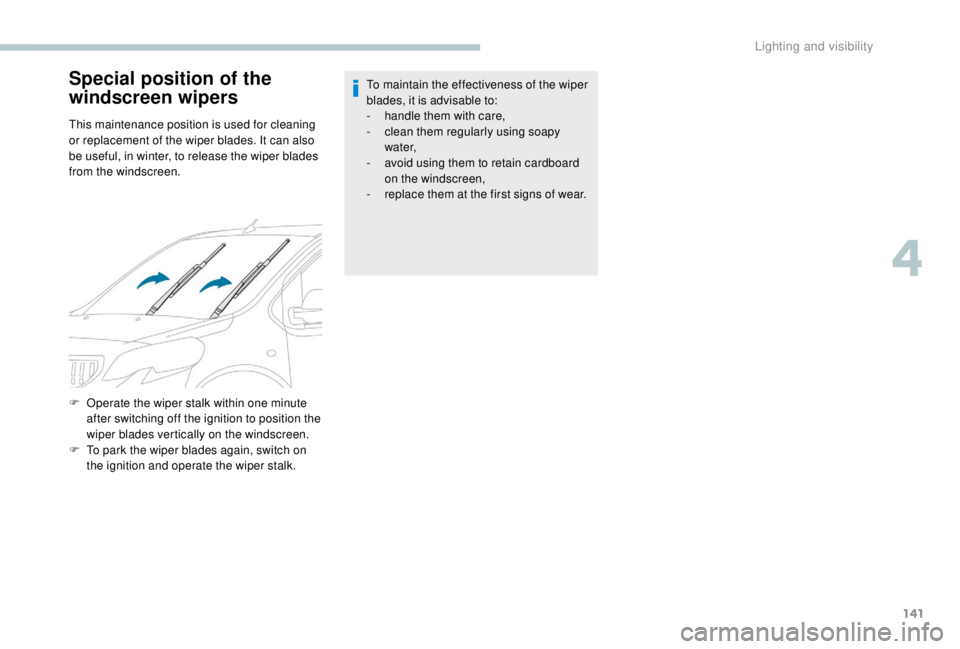
This maintenance position is used for cleaning
or replacement of the wiper blades. It can also
be useful, in winter, to release the wiper blades
from the windscreen.
F
O
perate the wiper stalk within one minute
after switching off the ignition to position the
wiper blades vertically on the windscreen.
F
T
o park the wiper blades again, switch on
the ignition and operate the wiper stalk. To maintain the effectiveness of the wiper
blades, it is advisable to:
-
h andle them with care,
- c lean them regularly using soapy
water,
-
a
void using them to retain cardboard
on the windscreen,
-
r
eplace them at the first signs of wear.
4
Lighting and visibility
Page 145 of 416
143
Hazard warning lamps
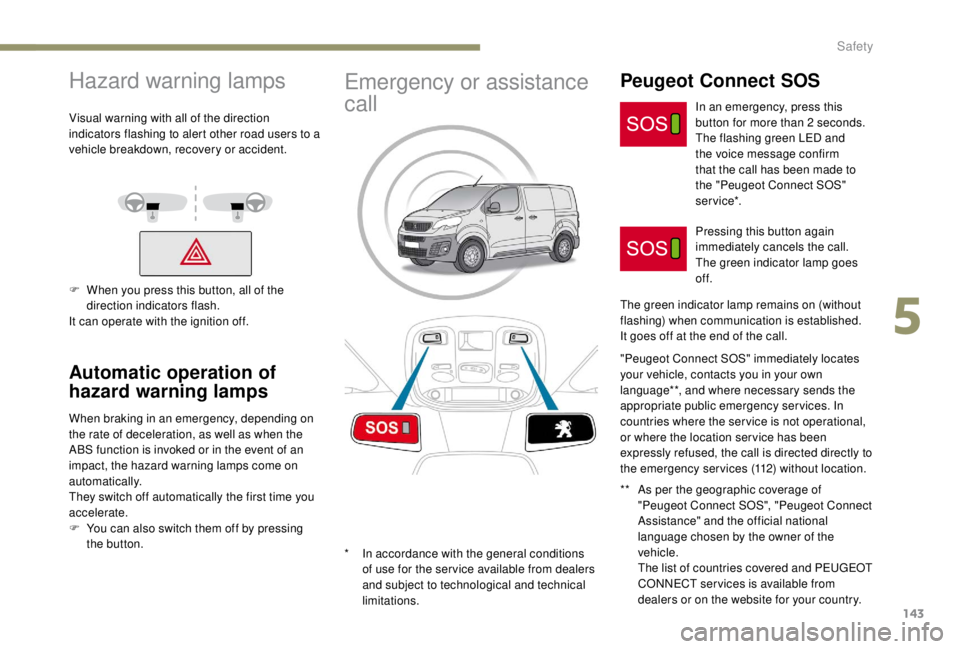
Visual warning with all of the direction
indicators flashing to alert other road users to a
vehicle breakdown, recovery or accident.
F
W
hen you press this button, all of the
direction indicators flash.
It can operate with the ignition off.
Automatic operation of
hazard warning lamps
When braking in an emergency, depending on
the rate of deceleration, as well as when the
ABS function is invoked or in the event of an
impact, the hazard warning lamps come on
automatically.
They switch off automatically the first time you
accelerate.
F
Y
ou can also switch them off by pressing
the button.
Emergency or assistance
callPeugeot Connect SOS
In an emergency, press this
button for more than 2 seconds.
The flashing green LED and
the voice message confirm
that the call has been made to
the "Peugeot Connect SOS"
service*.
Pressing this button again
immediately cancels the call.
The green indicator lamp goes
of f.
The green indicator lamp remains on (without
flashing) when communication is established.
It goes off at the end of the call.
"Peugeot Connect SOS" immediately locates
your vehicle, contacts you in your own
language**, and where necessary sends the
appropriate public emergency services. In
countries where the ser vice is not operational,
or where the location ser vice has been
expressly refused, the call is directed directly to
the emergency services (112) without location.
**
A
s per the geographic coverage of
"Peugeot Connect SOS", "Peugeot Connect
Assistance" and the official national
language chosen by the owner of the
vehicle.
T
he list of countries covered and PEUGEOT
CONNECT services is available from
dealers or on the website for your country.
*
I
n accordance with the general conditions
of use for the ser vice available from dealers
and subject to technological and technical
limitations.
5
Safety
Page 146 of 416
144
Geolocation
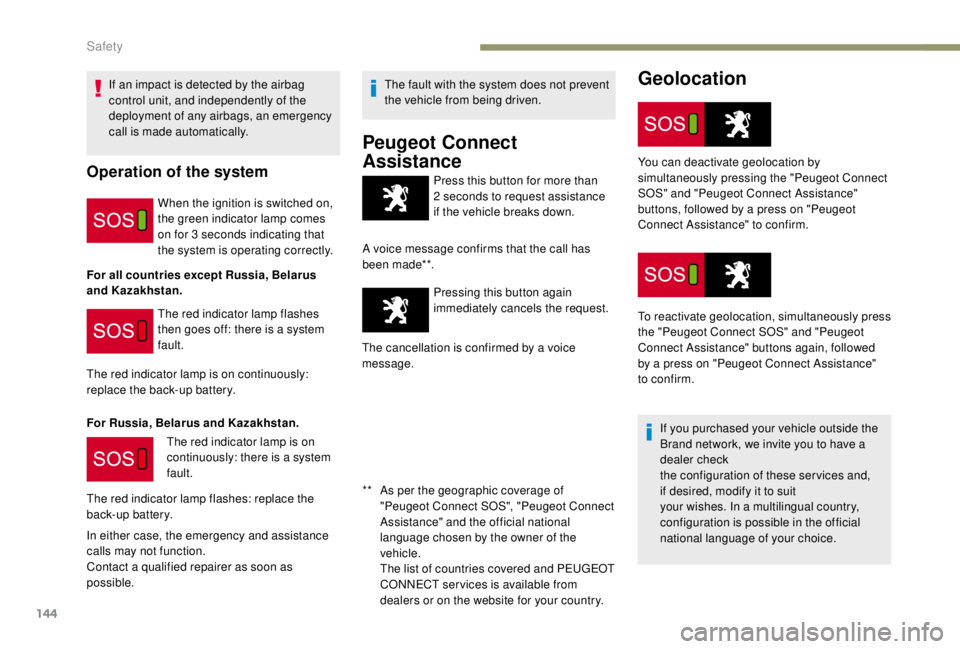
Press this button for more than
2 seconds to request assistance
if the vehicle breaks down.
A voice message confirms that the call has
been made**. Pressing this button again
immediately cancels the request.
The cancellation is confirmed by a voice
message.
If an impact is detected by the airbag
control unit, and independently of the
deployment of any airbags, an emergency
call is made automatically.Operation of the system
When the ignition is switched on,
the green indicator lamp comes
on for 3
seconds indicating that
the system is operating correctly.
For all countries except Russia, Belarus
and Kazakhstan. The red indicator lamp flashes
then goes off: there is a system
fault.
The red indicator lamp is on continuously:
replace the back-up battery.
For Russia, Belarus and Kazakhstan. The red indicator lamp is on
continuously: there is a system
fault.
The red indicator lamp flashes: replace the
back-up battery.
In either case, the emergency and assistance
calls may not function.
Contact a qualified repairer as soon as
possible. The fault with the system does not prevent
the vehicle from being driven.
Peugeot Connect
Assistance
** As per the geographic coverage of
"Peugeot Connect SOS", "Peugeot Connect
Assistance" and the official national
language chosen by the owner of the
vehicle.
T
he list of countries covered and PEUGEOT
CONNECT services is available from
dealers or on the website for your country. You can deactivate geolocation by
simultaneously pressing the "Peugeot Connect
SOS" and "Peugeot Connect Assistance"
buttons, followed by a press on "Peugeot
Connect Assistance" to confirm.
To reactivate geolocation, simultaneously press
the "Peugeot Connect SOS" and "Peugeot
Connect Assistance" buttons again, followed
by a press on "Peugeot Connect Assistance"
to confirm.
If you purchased your vehicle outside the
Brand network, we invite you to have a
dealer check
the configuration of these services and,
if desired, modify it to suit
your wishes. In a multilingual country,
configuration is possible in the official
national language of your choice.
Safety
Page 149 of 416
147
If you need to brake in an emergency,
press the brake pedal ver y firmly and
keep the pressure applied.
After an impact, have the system checked
by a PEUGEOT dealer or a qualified
workshop.
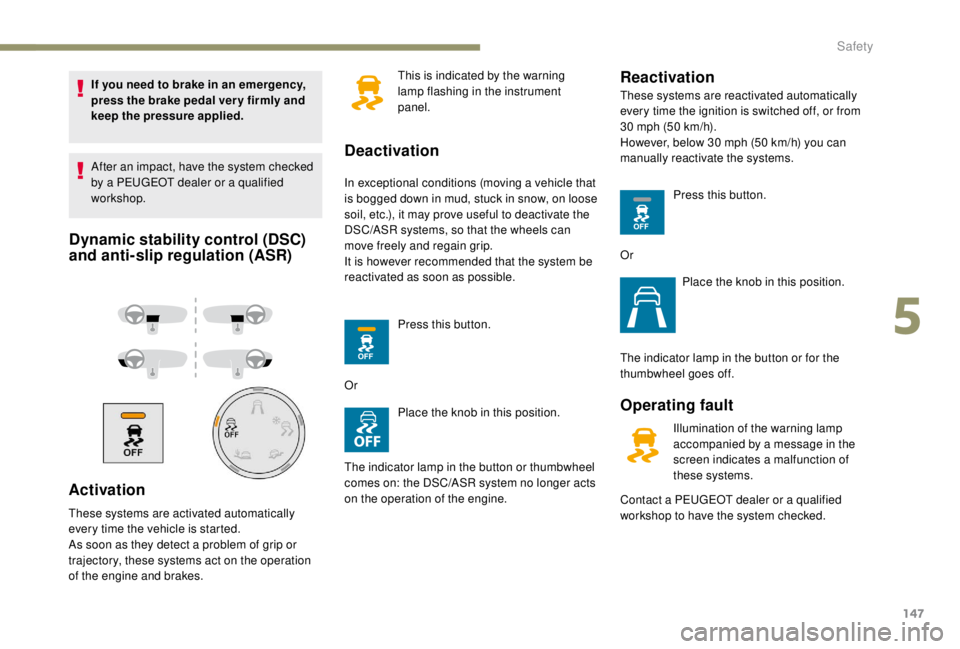
Dynamic stability control (DSC)
and anti-slip regulation (ASR)
Activation
These systems are activated automatically
every time the vehicle is started.
As soon as they detect a problem of grip or
trajectory, these systems act on the operation
of the engine and brakes. This is indicated by the warning
lamp flashing in the instrument
panel.
Deactivation
In exceptional conditions (moving a vehicle that
is bogged down in mud, stuck in snow, on loose
soil, etc.), it may prove useful to deactivate the
DSC/ASR systems, so that the wheels can
move freely and regain grip.
It is however recommended that the system be
reactivated as soon as possible.
Press this button.
Or Place the knob in this position.
The indicator lamp in the button or thumbwheel
comes on: the DSC/ASR system no longer acts
on the operation of the engine.
Reactivation
These systems are reactivated automatically
every time the ignition is switched off, or from
30 mph (50 km/h).
However, below 30
mph (50 km/h) you can
manually reactivate the systems.
Press this button.
Or Place the knob in this position.
The indicator lamp in the button or for the
thumbwheel goes off.
Operating fault
Illumination of the warning lamp
accompanied by a message in the
screen indicates a malfunction of
these systems.
Contact a PEUGEOT dealer or a qualified
workshop to have the system checked.
5
Safety
Page 150 of 416
148
Grip control
Special patented traction control system which
improves traction on snow, mud and sand.
This system, the operation of which has been
optimised for each situation, allows you to
manoeuvre in most conditions of poor grip
(encountered during touring use).
The accelerator pedal should be pressed
sufficiently to allow the system to use the power
of the engine. Operation at high engine speeds
is completely normal.
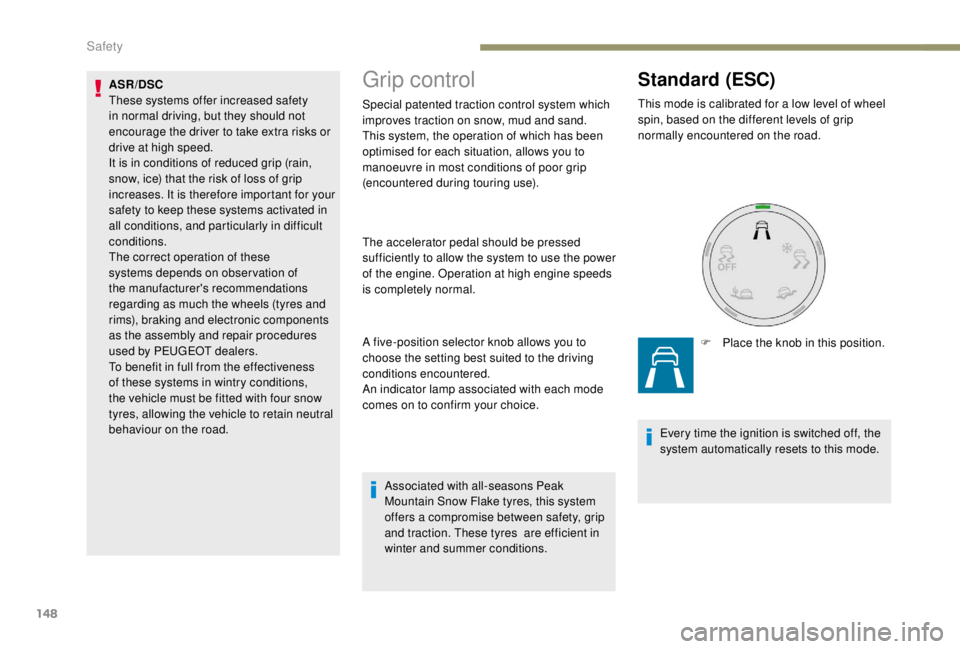
Standard (ESC)
F Place the knob in this position.
ASR/DSC
These systems offer increased safety
in normal driving, but they should not
encourage the driver to take extra risks or
drive at high speed.
It is in conditions of reduced grip (rain,
snow, ice) that the risk of loss of grip
increases. It is therefore important for your
safety to keep these systems activated in
all conditions, and particularly in difficult
conditions.
The correct operation of these
systems depends on obser vation of
the manufacturer's recommendations
regarding as much the wheels (tyres and
rims), braking and electronic components
as the assembly and repair procedures
used by PEUGEOT dealers.
To benefit in full from the effectiveness
of these systems in wintry conditions,
the vehicle must be fitted with four snow
tyres, allowing the vehicle to retain neutral
behaviour on the road.
A five-position selector knob allows you to
choose the setting best suited to the driving
conditions encountered.
An indicator lamp associated with each mode
comes on to confirm your choice.
Associated with all-seasons Peak
Mountain Snow Flake tyres, this system
offers a compromise between safety, grip
and traction. These tyres are efficient in
winter and summer conditions. This mode is calibrated for a low level of wheel
spin, based on the different levels of grip
normally encountered on the road.
Every time the ignition is switched off, the
system automatically resets to this mode.
Safety
Page 152 of 416
150
Seat belts
Front seat belts
Fastening
Unfastening
F Press the red button on the buckle.
F G uide the seat belt as it reels in.
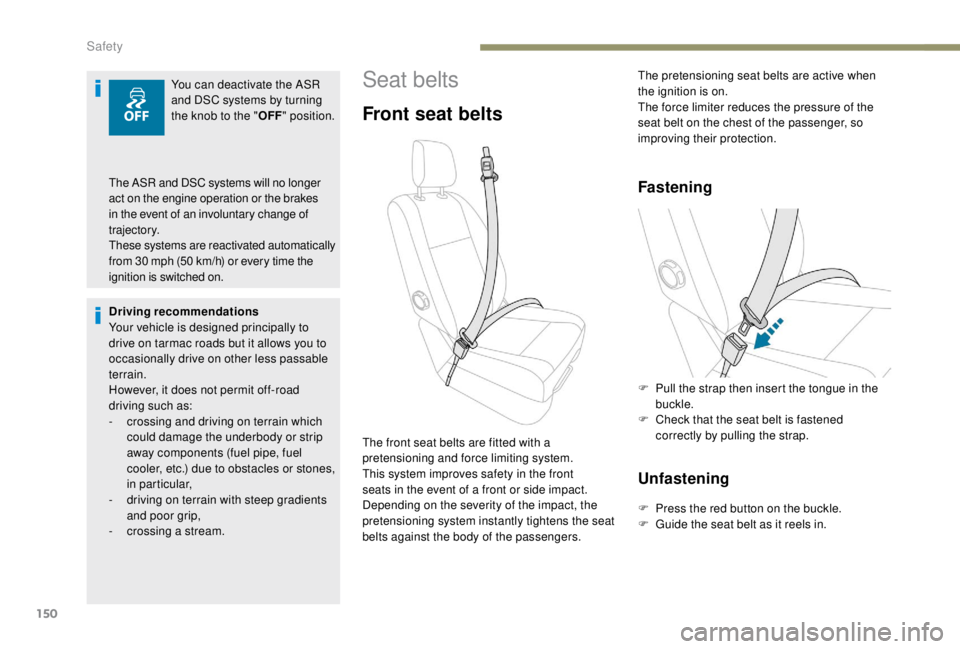
The front seat belts are fitted with a
pretensioning and force limiting system.
This system improves safety in the front
seats in the event of a front or side impact.
Depending on the severity of the impact, the
pretensioning system instantly tightens the seat
belts against the body of the passengers. The pretensioning seat belts are active when
the ignition is on.
The force limiter reduces the pressure of the
seat belt on the chest of the passenger, so
improving their protection.
F
P
ull the strap then insert the tongue in the
buckle.
F
C
heck that the seat belt is fastened
correctly by pulling the strap.
You can deactivate the ASR
and DSC systems by turning
the knob to the "
OFF" position.
The ASR and DSC systems will no longer
act on the engine operation or the brakes
in the event of an involuntary change of
trajectory.
These systems are reactivated automatically
from 30
mph (50
km/h) or every time the
ignition is switched on.
Driving recommendations
Your vehicle is designed principally to
drive on tarmac roads but it allows you to
occasionally drive on other less passable
terrain.
However, it does not permit off-road
driving such as:
-
c
rossing and driving on terrain which
could damage the underbody or strip
away components (fuel pipe, fuel
cooler, etc.) due to obstacles or stones,
in particular,
-
d
riving on terrain with steep gradients
and poor grip,
-
c
rossing a stream.
Safety
Page 154 of 416
152
For rows 2 and 3, fit each seat belt to its
c orrect buckle.
Do not interchange the belts or buckles for
the outer seats with the belt or buckle for
the centre seat.
When folding the outer seats or placing
a backrest in the table position, avoid
trapping the belt for the centre seat.
After folding a rear seat or bench seat,
ensure that the seat belt has reeled
in correctly and the buckle is ready to
receive the belt tongue.
When handling the outer seats (removing
or refitting) or for access to row 3, avoid
trapping the centre belt.
The seat belt reels for the outer seats in row
2
have force limiters.
The seats in row 3 have three-point seat belts
with inertia reels.
Seat belt warning lamps
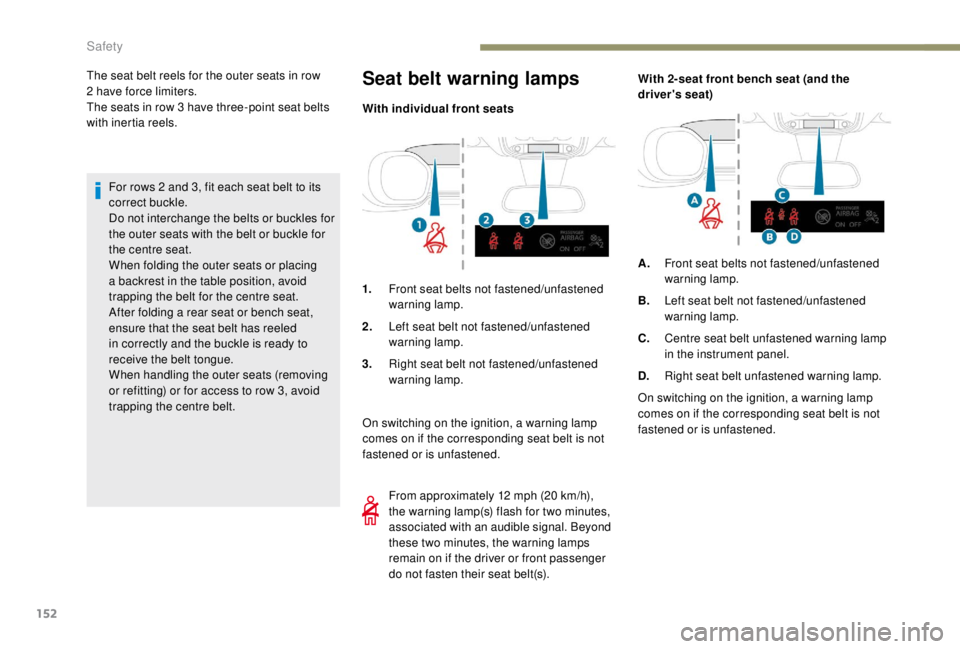
With individual front seats
1. Front seat belts not fastened/unfastened
warning lamp.
2. Left seat belt not fastened/unfastened
warning lamp.
3. Right seat belt not fastened/unfastened
warning lamp.
On switching on the ignition, a warning lamp
comes on if the corresponding seat belt is not
fastened or is unfastened. From approximately 12
mph (20 km/h),
the warning lamp(s) flash for two minutes,
associated with an audible signal. Beyond
these two minutes, the warning lamps
remain on if the driver or front passenger
do not fasten their seat belt(s). With 2-seat front bench seat (and the
driver's seat)
On switching on the ignition, a warning lamp
comes on if the corresponding seat belt is not
fastened or is unfastened. A.
Front seat belts not fastened/unfastened
warning lamp.
B. Left seat belt not fastened/unfastened
warning lamp.
C. Centre seat belt unfastened warning lamp
in the instrument panel.
D. Right seat belt unfastened warning lamp.
Safety
Page 156 of 416
154
Airbags
The airbags do not operate when the
ignition is switched off.
This equipment will only deploy once. If a
second impact occurs (during the same or
a subsequent accident), the airbag will not
be deployed again.
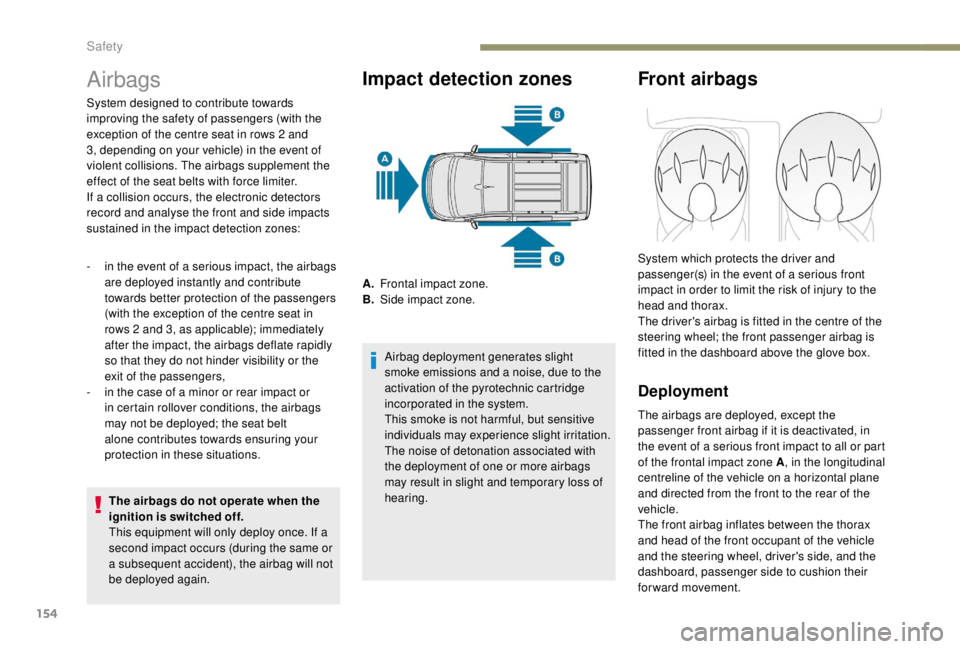
Impact detection zones
Airbag deployment generates slight
smoke emissions and a noise, due to the
activation of the pyrotechnic cartridge
incorporated in the system.
This smoke is not harmful, but sensitive
individuals may experience slight irritation.
The noise of detonation associated with
the deployment of one or more airbags
may result in slight and temporary loss of
hearing.
A.
F
rontal impact zone.
B.
S
ide impact zone.
Front airbags
System which protects the driver and
passenger(s) in the event of a serious front
impact in order to limit the risk of injury to the
head and thorax.
The driver's airbag is fitted in the centre of the
steering wheel; the front passenger airbag is
fitted in the dashboard above the glove box.
Deployment
The airbags are deployed, except the
passenger front airbag if it is deactivated, in
the event of a serious front impact to all or part
of the frontal impact zone A
, in the longitudinal
centreline of the vehicle on a horizontal plane
and directed from the front to the rear of the
vehicle.
The front airbag inflates between the thorax
and head of the front occupant of the vehicle
and the steering wheel, driver's side, and the
dashboard, passenger side to cushion their
for ward movement.
System designed to contribute towards
improving the safety of passengers (with the
exception of the centre seat in rows 2
and
3, depending on your vehicle) in the event of
violent collisions. The airbags supplement the
effect of the seat belts with force limiter.
If a collision occurs, the electronic detectors
record and analyse the front and side impacts
sustained in the impact detection zones:
-
i
n the event of a serious impact, the airbags
are deployed instantly and contribute
towards better protection of the passengers
(with the exception of the centre seat in
rows 2
and 3, as applicable); immediately
after the impact, the airbags deflate rapidly
so that they do not hinder visibility or the
exit of the passengers,
-
i
n the case of a minor or rear impact or
in certain rollover conditions, the airbags
may not be deployed; the seat belt
alone contributes towards ensuring your
protection in these situations.
Safety
Page 162 of 416
160
Deactivation
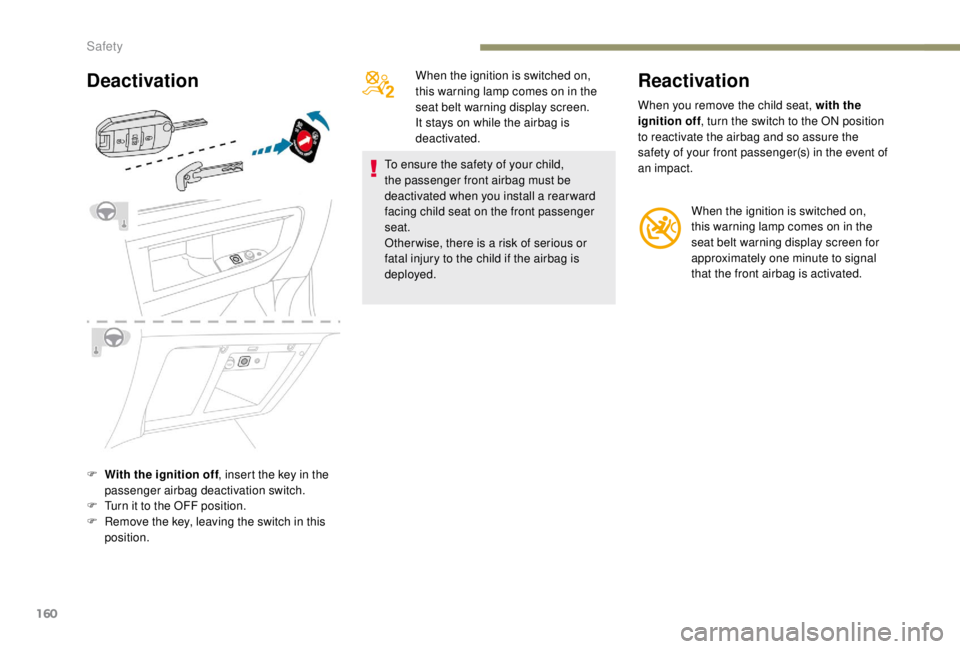
F With the ignition off, insert the key in the
passenger airbag deactivation switch.
F
T
urn it to the OFF position.
F
R
emove the key, leaving the switch in this
position. When the ignition is switched on,
this warning lamp comes on in the
seat belt warning display screen.
It stays on while the airbag is
deactivated.
To ensure the safety of your child,
the passenger front airbag must be
deactivated when you install a rear ward
facing child seat on the front passenger
seat.
Other wise, there is a risk of serious or
fatal injury to the child if the airbag is
deployed.
Reactivation
When you remove the child seat, with the
ignition off , turn the switch to the ON position
to reactivate the airbag and so assure the
safety of your front passenger(s) in the event of
an impact.
When the ignition is switched on,
this warning lamp comes on in the
seat belt warning display screen for
approximately one minute to signal
that the front airbag is activated.
Safety
Page 176 of 416
174
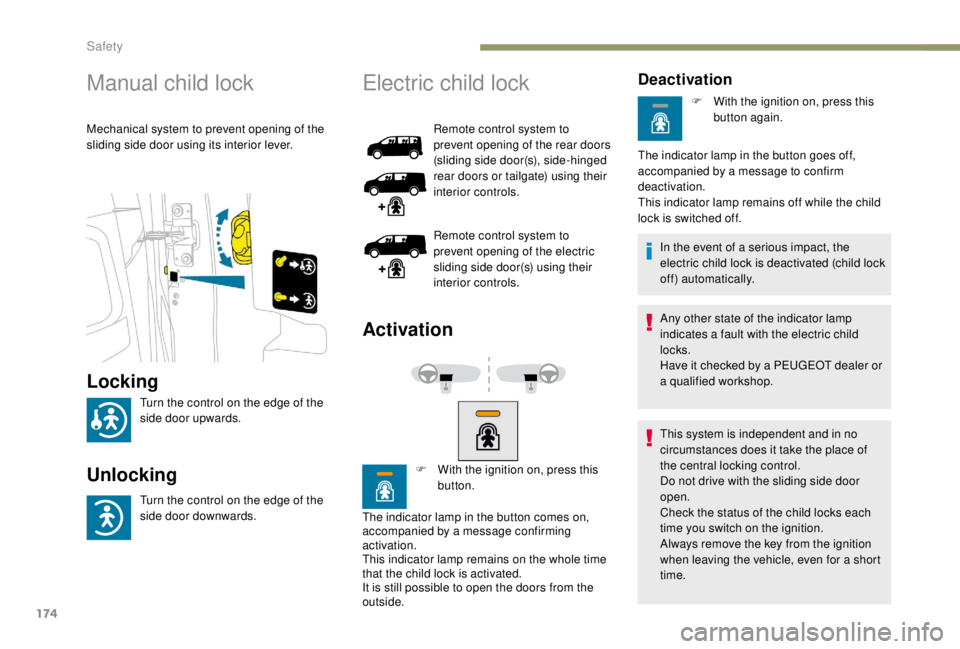
Manual child lock
Mechanical system to prevent opening of the
sliding side door using its interior lever.
Electric child lock
Remote control system to
prevent opening of the rear doors
(sliding side door(s), side-hinged
rear doors or tailgate) using their
interior controls.
Remote control system to
prevent opening of the electric
sliding side door(s) using their
interior controls.
Activation
F With the ignition on, press this button.
Deactivation
F With the ignition on, press this button again.
The indicator lamp in the button comes on,
accompanied by a message confirming
activation.
This indicator lamp remains on the whole time
that the child lock is activated.
It is still possible to open the doors from the
outside. The indicator lamp in the button goes off,
accompanied by a message to confirm
deactivation.
This indicator lamp remains off while the child
lock is switched off.
In the event of a serious impact, the
electric child lock is deactivated (child lock
off) automatically.
Any other state of the indicator lamp
indicates a fault with the electric child
locks.
Have it checked by a PEUGEOT dealer or
a qualified workshop.
This system is independent and in no
circumstances does it take the place of
the central locking control.
Do not drive with the sliding side door
open.
Check the status of the child locks each
time you switch on the ignition.
Always remove the key from the ignition
when leaving the vehicle, even for a short
time.
Locking
Turn the control on the edge of the
side door upwards.
Unlocking
Turn the control on the edge of the
side door downwards.
Safety