lock PEUGEOT EXPERT 2018 Repair Manual
[x] Cancel search | Manufacturer: PEUGEOT, Model Year: 2018, Model line: EXPERT, Model: PEUGEOT EXPERT 2018Pages: 416, PDF Size: 14.12 MB
Page 128 of 416
126
Using these two clocks and according to
season you can, for example, select one
or the other start time.
A message in the screen confirms your
choice.
Long range remote control
The range of the remote control is about
0.6 miles (1 km) in open country.
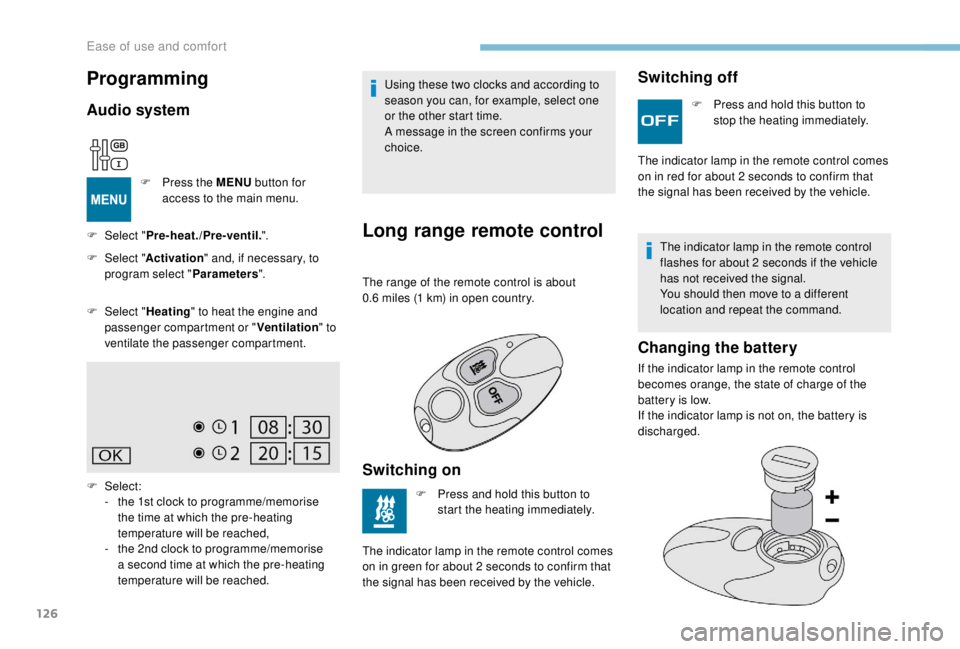
Switching on
F Press and hold this button to start the heating immediately.
The indicator lamp in the remote control comes
on in green for about 2
seconds to confirm that
the signal has been received by the vehicle.
Switching off
F Press and hold this button to stop the heating immediately.
The indicator lamp in the remote control comes
on in red for about 2
seconds to confirm that
the signal has been received by the vehicle.
The indicator lamp in the remote control
flashes for about 2
seconds if the vehicle
has not received the signal.
You should then move to a different
location and repeat the command.
Changing the battery
If the indicator lamp in the remote control
becomes orange, the state of charge of the
battery is low.
If the indicator lamp is not on, the battery is
discharged.
Programming
Audio system
F Press the MENU button for
access to the main menu.
F
Sel
ect " Pre-heat./Pre-ventil. ".
F
Sel
ect " Activation " and, if necessary, to
program select " Parameters".
F
Sel
ect " Heating " to heat the engine and
passenger compartment or " Ventilation" to
ventilate the passenger compartment.
F
Select:
-
t
he 1st clock to programme/memorise
the time at which the pre-heating
temperature will be reached,
-
t
he 2nd clock to programme/memorise
a second time at which the pre-heating
temperature will be reached.
Ease of use and comfort
Page 130 of 416
128
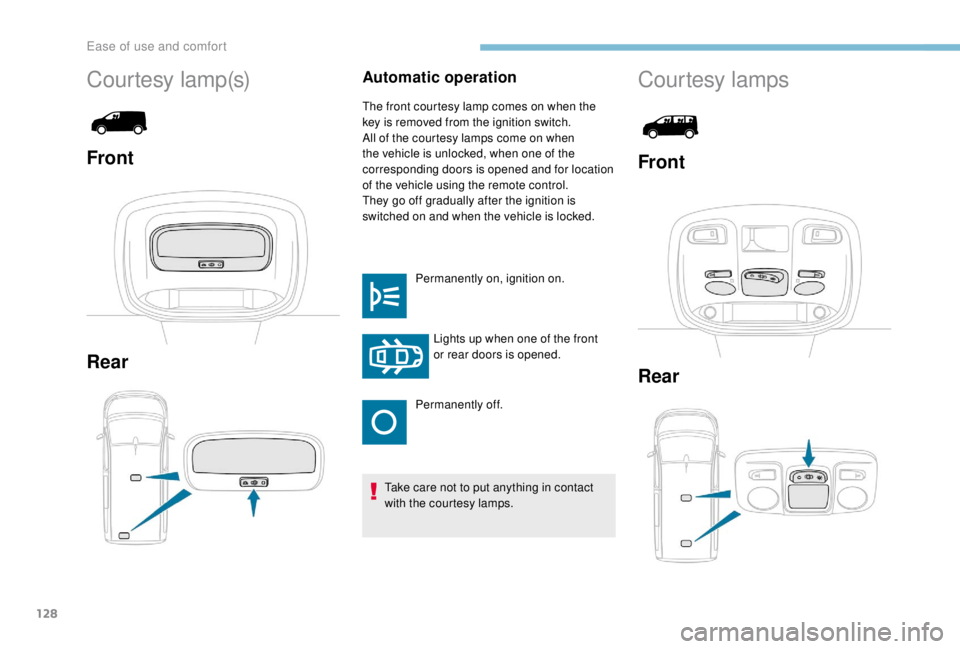
Automatic operation
The front courtesy lamp comes on when the
key is removed from the ignition switch.
All of the courtesy lamps come on when
the vehicle is unlocked, when one of the
corresponding doors is opened and for location
of the vehicle using the remote control.
They go off gradually after the ignition is
switched on and when the vehicle is locked.Permanently on, ignition on.Lights up when one of the front
or rear doors is opened.
Permanently off.
Take care not to put anything in contact
with the courtesy lamps.
Courtesy lamps
Front
Rear
Courtesy lamp(s)
Front
Rear
Ease of use and comfort
Page 131 of 416
129
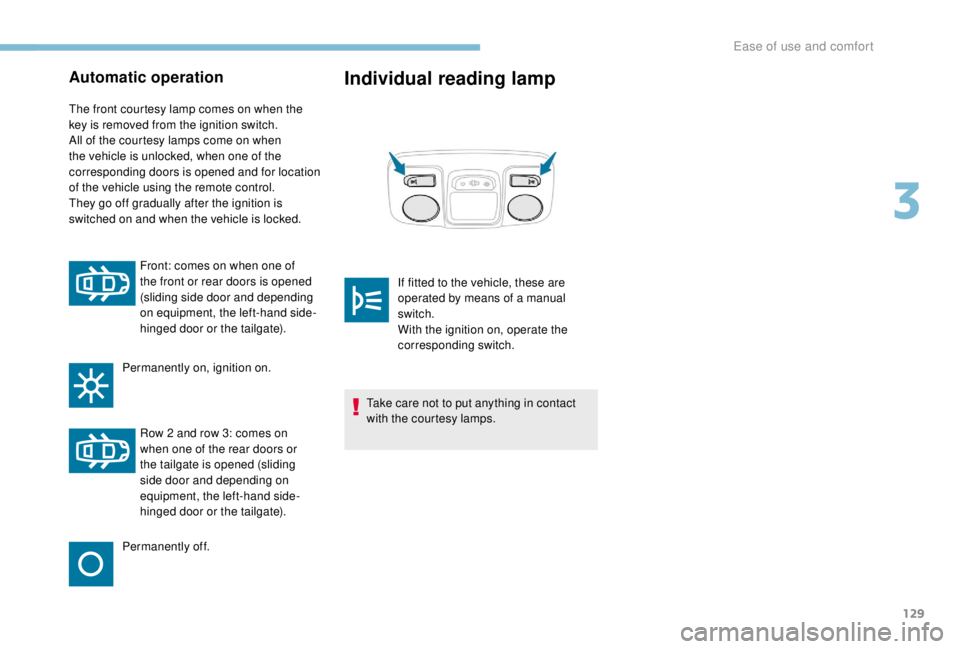
Automatic operation
The front courtesy lamp comes on when the
key is removed from the ignition switch.
All of the courtesy lamps come on when
the vehicle is unlocked, when one of the
corresponding doors is opened and for location
of the vehicle using the remote control.
They go off gradually after the ignition is
switched on and when the vehicle is locked.Front: comes on when one of
the front or rear doors is opened
(sliding side door and depending
on equipment, the left-hand side-
hinged door or the tailgate).
Permanently on, ignition on.
Row 2
and row 3: comes on
when one of the rear doors or
the tailgate is opened (sliding
side door and depending on
equipment, the left-hand side-
hinged door or the tailgate).
Permanently off.
Individual reading lamp
Take care not to put anything in contact
with the courtesy lamps. If fitted to the vehicle, these are
operated by means of a manual
switch.
With the ignition on, operate the
corresponding switch.
3
Ease of use and comfort
Page 136 of 416

134
Programming
The activation, deactivation and selection of
the duration of the guide-me-home lighting can
be configured.
With audio system
In the "Personalisation-
configuration " menu, activate/
deactivate " Guide-me-home
lighting ".
With touch screen
In the "Driving/Vehicle " menu,
activate/deactivate " Guide-me-
home lighting ".
Exterior welcome lighting
The remote control operation of the lighting
makes your approach to the vehicle easier
in poor light. It is activated when the lighting
control is in the " AUTO" position and the level
of light detected by the sunshine sensor is low.
Switching on
Press the open padlock on the
remote control or one of the front
door handles with the Keyless Entry
and Starting system.
The dipped beam headlamps and the
sidelamps come on; your vehicle is also
unlocked.
Switching off
The exterior welcome lighting switches off
automatically after a set time, when the ignition
is switched on or on locking the vehicle.
Programming
The activation, deactivation and selection of
the of the welcome lighting duration can be
configured.
With audio system
In the " Personalisation-
configuration " menu, activate/
deactivate " Welcome lighting ".
With touch screen
In the "Driving/Vehicle " menu,
activate/deactivate " Welcome
lighting ".
Cornering lighting
With dipped or main beams, this system
makes use of the beam from a front foglamp
to illuminate the inside of a bend, when the
vehicle speed is below 25
mph (approximately
40
km/h) (urban driving, winding road,
intersections, parking manoeuvres, etc.).
Lighting and visibility
Page 147 of 416
145
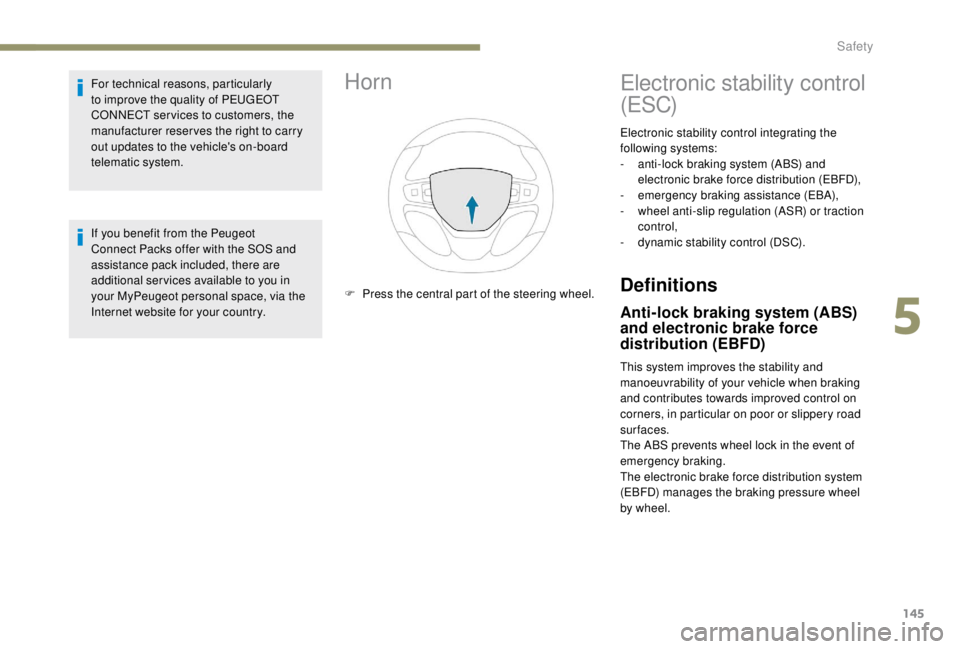
Horn
F Press the central part of the steering wheel.
Electronic stability control
(ESC)
Electronic stability control integrating the
following systems:
-
a
nti-lock braking system (ABS) and
electronic brake force distribution (EBFD),
-
em
ergency braking assistance (EBA),
-
w
heel anti-slip regulation (ASR) or traction
control,
-
d
ynamic stability control (DSC).
For technical reasons, particularly
to improve the quality of PEUGEOT
CONNECT ser vices to customers, the
manufacturer reser ves the right to carry
out updates to the vehicle's on-board
telematic system.
If you benefit from the Peugeot
Connect Packs offer with the SOS and
assistance pack included, there are
additional ser vices available to you in
your MyPeugeot personal space, via the
Internet website for your country.
Definitions
Anti-lock braking system (ABS)
and electronic brake force
distribution (EBFD)
This system improves the stability and
manoeuvrability of your vehicle when braking
and contributes towards improved control on
corners, in particular on poor or slippery road
surfaces.
The ABS prevents wheel lock in the event of
emergency braking.
The electronic brake force distribution system
(EBFD) manages the braking pressure wheel
by wheel.
5
Safety
Page 148 of 416
146
Emergency braking assistance
(EBA)
In an emergency, this system permits the
optimum braking pressure to be reached
more quickly, therefore reducing the stopping
distance.
It is triggered in relation to the speed at which
the brake pedal is pressed. The effect of this is
a reduction in the resistance of the pedal and
an increase in braking efficiency.
Anti-slip regulation (ASR)
The ASR system (also known as Traction
Control) optimises traction in order to limit
wheel slip by acting on the brakes of the driving
wheels and on the engine. It also improves
the directional stability of the vehicle on
acceleration.
Dynamic stability control (DSC)
If there is a difference between the path
followed by the vehicle and that required by
the driver, the DSC monitors each wheel and
automatically acts on the brake of one or more
wheels and on the engine to return the vehicle
to the required path, within the limits of the laws
of physics.
Intelligent traction control
If your vehicle has this system, it features a
system to help driving on snow: intelligent
traction control.
This system detects situations of difficult
sur face grip that could make it difficult to move
off or make progress on deep fresh snow or
compacted snow.
In these situations, the intelligent traction
control limits the amount of wheel spin to
provide the best traction and trajectory control
for your vehicle.
The use of snow tyres is strongly
recommended on sur faces offering low
levels of grip.
Anti-lock braking system
(ABS) and electronic brake
force distribution (EBFD)
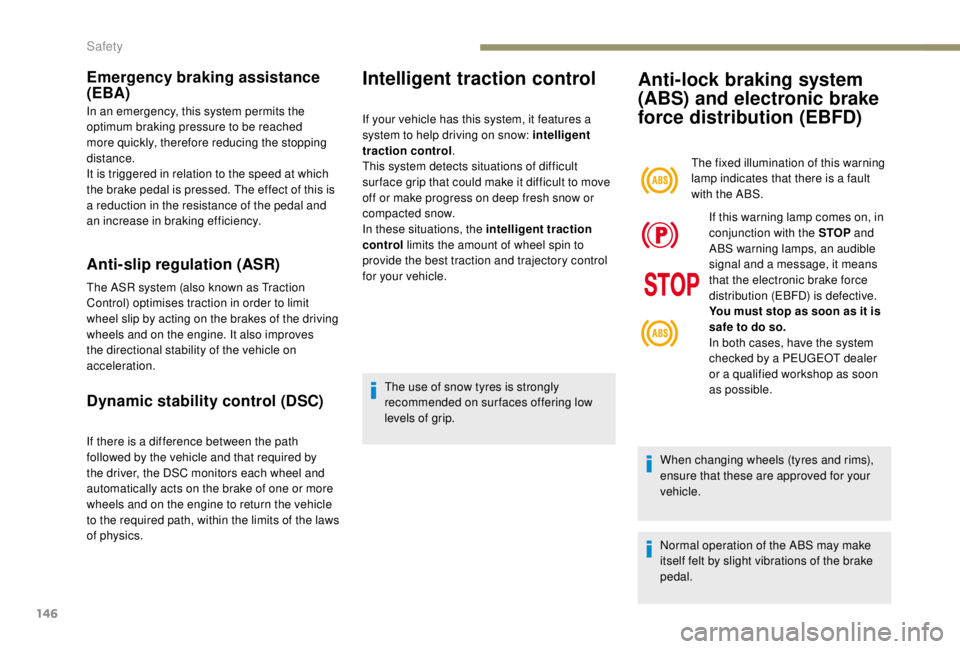
The fixed illumination of this warning
lamp indicates that there is a fault
with the ABS.If this warning lamp comes on, in
conjunction with the STOP and
ABS warning lamps, an audible
signal and a message, it means
that the electronic brake force
distribution (EBFD) is defective.
You must stop as soon as it is
safe to do so.
In both cases, have the system
checked by a PEUGEOT dealer
or a qualified workshop as soon
as possible.
When changing wheels (tyres and rims),
ensure that these are approved for your
vehicle.
Normal operation of the ABS may make
itself felt by slight vibrations of the brake
pedal.
Safety
Page 155 of 416
153
Advice
The driver must ensure that passengers use
the seat belts correctly and that they are all
restrained securely before setting off.
Wherever you are seated in the vehicle,
always fasten your seat belt, even for short
journeys.
Do not interchange the seat belt buckles as
they will not completely fulfil their role.
The seat belts are equipped with an inertia
reel which allows the strap length to adjust
automatically to your shape. The seat belt is
stowed automatically when not in use.
Before and after use, ensure that the seat belt
is reeled in correctly.
The lower part of the strap must be positioned
as low as possible on the pelvis.
The upper part must be positioned in the
hollow of the shoulder.
The inertia reels have an automatic blocking
device at the time of a collision, during
sudden braking or if the vehicle turns over.
You can release the device by pulling the
strap firmly and then releasing it so that it
reels in slightly.Instructions for children
Use a suitable child seat, if the passenger
is less than 12
years old or shorter than
one and a half metres.
Never use the same seat belt to secure
more than one person.
Never allow a child to travel on your lap.
For more information on Child seats , refer
to the corresponding section.
In case of impact
Depending on the nature and seriousness
of the impact, the pyrotechnic may be
deployed before and independent of the
airbags. Deployment of the pyrotechnics
is accompanied by a slight discharge of
harmless smoke and a noise, due to the
activation of the pyrotechnic cartridge
incorporated in the system.
In all cases, the airbag warning lamp is lit.
After an impact, get the seat belt system
checked and, if necessary, have it
replaced by a PEUGEOT dealer or a
qualified workshop.
In order to be effective, a seat belt must:
-
b e tightened as close to the body as
possible,
-
b
e pulled in front of you with a smooth
movement, checking that it does not twist,
-
b
e used to restrain only one person,
-
n
ot show any signs of cuts or fraying,
-
n
ot be converted or modified to avoid
affecting its performance.
In accordance with current safety regulations,
for all repairs on your vehicle's seat belts, go
to a qualified workshop with the skills and
equipment needed, which a PEUGEOT dealer
is able to provide.
Have your seat belts checked regularly by a
PEUGEOT dealer or a qualified workshop,
particularly if the straps show signs of
damage.
Clean the seat belt straps with soapy water or
a textile cleaning product, sold by PEUGEOT
dealers.
After folding or moving a seat or a rear bench
seat, ensure that the seat belt is positioned
and reeled in correctly.
5
Safety
Page 175 of 416
173
Advice
Child seats
The incorrect installation of a child seat in a
vehicle compromises the child's protection in
the event of an accident.
Ensure that there is no seat belt or seat belt
buckle under the child seat, as this could
destabilise it.
Remember to fasten the seat belts or the
child seat harnesses keeping the slack
relative to the child's body to a minimum,
even for short journeys.
When installing a child seat using the seat
belt, ensure that the seat belt is tightened
correctly on the child seat and that it secures
the child seat firmly on the seat of your
vehicle. If your passenger seat is adjustable,
move it for wards if necessary.
At rear seating positions, always leave
sufficient space between the front seat and:
-
a r
ear ward facing child seat,
-
t
he child's feet for a child seat fitted
forward facing.
To do this, move the front seat for wards
and, if necessary, move its backrest into the
upright position. For optimal installation of the forward-facing
child seat, verify that its backrest is as close
as possible to the backrest of the vehicle
seat, or if possible in contact with it.
You must remove the head restraint before
installing a child seat with backrest to a
passenger seat.
Ensure that the head restraint is stored or
attached securely to prevent it from being
thrown around the vehicle in the event of
sharp braking.
Refit the head restraint once the child seat
has been removed.
Children in front
The legislation on carrying children on the
front passenger seat is specific to each
country. Refer to the legislation in force in the
country in which you are driving.
Deactivate the passenger's front airbag when
a rear ward facing child seat is installed on
the front passenger seat. Otherwise, the child
risks being seriously injured or killed if the
airbag were deployed.
Installing a booster seat
The chest part of the seat belt must be
positioned on the child's shoulder without
touching the neck.
Ensure that the lap part of the seat belt
passes correctly over the child's thighs.
PEUGEOT recommends using a booster seat
with a backrest equipped with a belt guide at
shoulder level.
As a safety precaution, do not leave:
-
a c
hild or children alone and unattended in
a vehicle,
-
a c
hild or an animal in a vehicle under the
sun, with the windows closed,
-
t
he keys within the reach of children inside
the vehicle.
To prevent accidental opening of the doors,
use the child lock.
Take care not to open the rear windows by
more than one third.
To protect young children from the rays of the
sun, fit side blinds on the rear windows.
5
Safety
Page 176 of 416
174
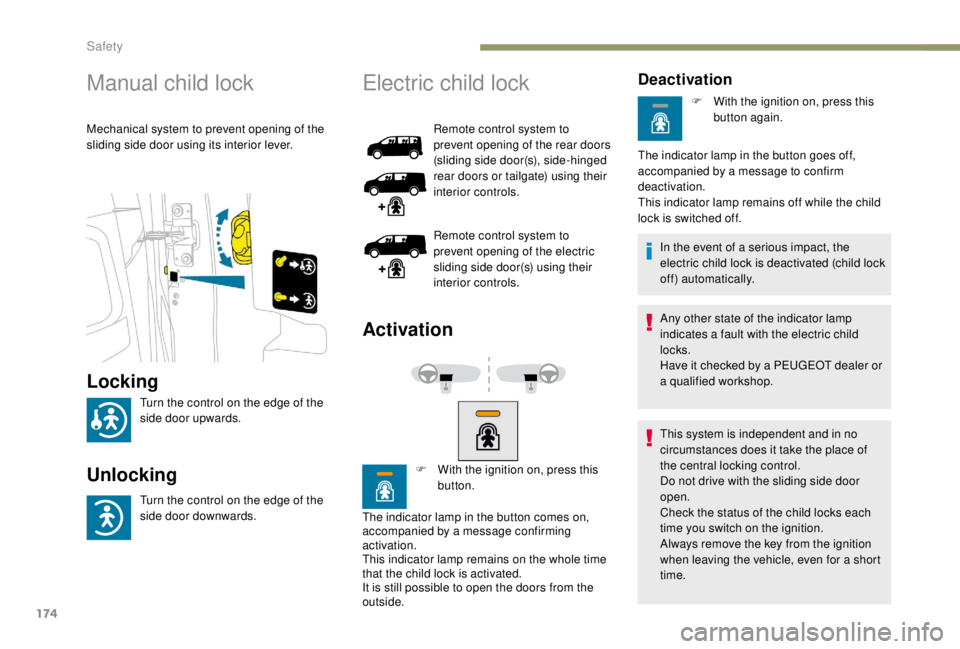
Manual child lock
Mechanical system to prevent opening of the
sliding side door using its interior lever.
Electric child lock
Remote control system to
prevent opening of the rear doors
(sliding side door(s), side-hinged
rear doors or tailgate) using their
interior controls.
Remote control system to
prevent opening of the electric
sliding side door(s) using their
interior controls.
Activation
F With the ignition on, press this button.
Deactivation
F With the ignition on, press this button again.
The indicator lamp in the button comes on,
accompanied by a message confirming
activation.
This indicator lamp remains on the whole time
that the child lock is activated.
It is still possible to open the doors from the
outside. The indicator lamp in the button goes off,
accompanied by a message to confirm
deactivation.
This indicator lamp remains off while the child
lock is switched off.
In the event of a serious impact, the
electric child lock is deactivated (child lock
off) automatically.
Any other state of the indicator lamp
indicates a fault with the electric child
locks.
Have it checked by a PEUGEOT dealer or
a qualified workshop.
This system is independent and in no
circumstances does it take the place of
the central locking control.
Do not drive with the sliding side door
open.
Check the status of the child locks each
time you switch on the ignition.
Always remove the key from the ignition
when leaving the vehicle, even for a short
time.
Locking
Turn the control on the edge of the
side door upwards.
Unlocking
Turn the control on the edge of the
side door downwards.
Safety
Page 177 of 416
175
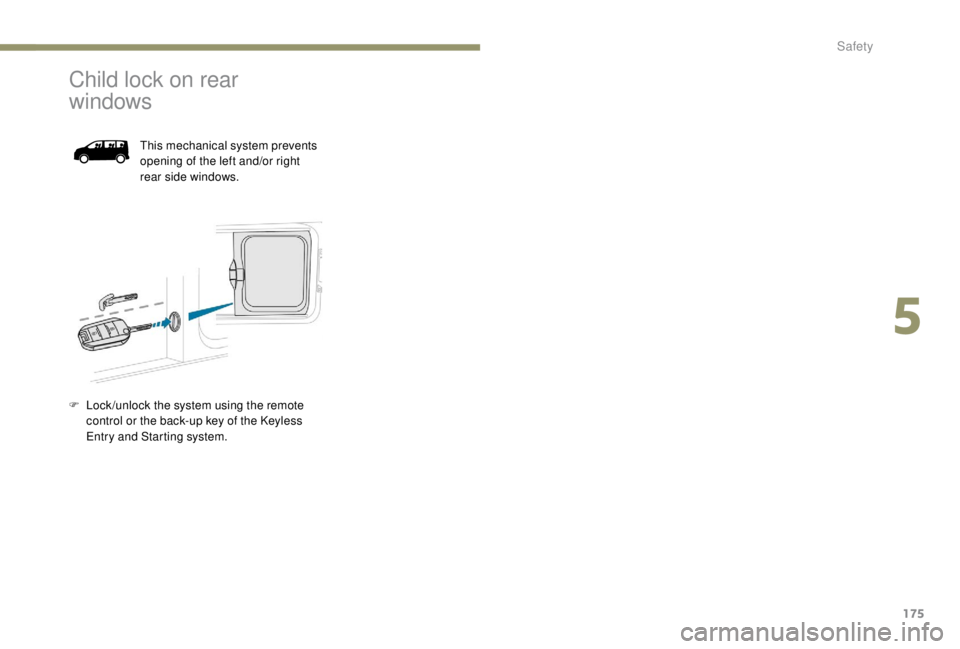
Child lock on rear
windows
This mechanical system prevents
opening of the left and/or right
rear side windows.
F
L
ock /unlock the system using the remote
control or the back-up key of the
K
eyless
Entry and Starting system.
5
Safety