brake PEUGEOT EXPERT 2018 Owners Manual
[x] Cancel search | Manufacturer: PEUGEOT, Model Year: 2018, Model line: EXPERT, Model: PEUGEOT EXPERT 2018Pages: 416, PDF Size: 14.12 MB
Page 5 of 416
3
.
.
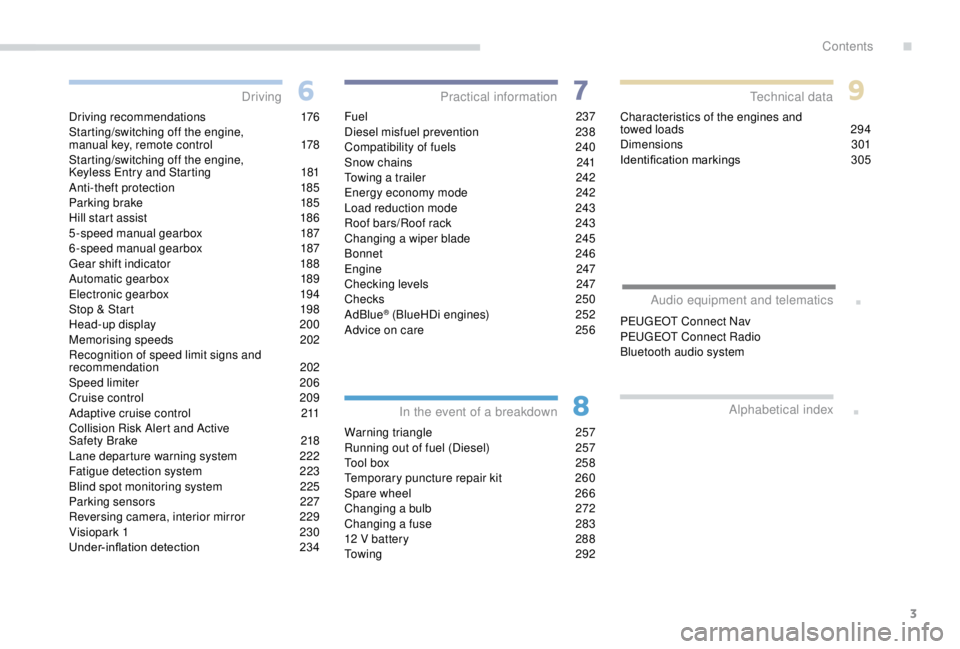
Driving recommendations 176
Starting/switching off the engine,
manual key, remote control
1
78
Starting/switching off the engine,
Keyless Entry and Starting
1
81
Anti-theft protection
1
85
Parking brake
1
85
Hill start assist
1
86
5-speed manual gearbox
1
87
6-speed manual gearbox
1
87
Gear shift indicator
1
88
Automatic gearbox
1
89
Electronic gearbox
1
94
Stop & Start
1
98
Head-up display
2
00
Memorising speeds
2
02
Recognition of speed limit signs and
recommendation
202
Spe
ed limiter
20
6
Cruise control
2
09
Adaptive cruise control
2
11
Collision Risk Alert and Active
Safety Brake
2
18
Lane departure warning system
2
22
Fatigue detection system
2
23
Blind spot monitoring system
2
25
Parking sensors
2
27
Reversing camera, interior mirror
2
29
Visiopark 1
2
30
Under-inflation detection
23
4Fuel
237
Diesel misfuel prevention 23 8
Compatibility of fuels
2
40
Snow chains
2
41
Towing a trailer
2
42
Energy economy mode
2
42
Load reduction mode
2
43
Roof bars/Roof rack
2
43
Changing a wiper blade
2
45
Bonnet
246
Engine
247
Checking levels
2
47
Checks
2
50
AdBlue
® (BlueHDi engines) 2 52
Advice on care 2 56
Warning triangle
2
57
Running out of fuel (Diesel)
2
57
Tool box
2
58
Temporary puncture repair kit
2
60
Spare wheel
26
6
Changing a bulb
2
72
Changing a fuse
2
83
12
V battery
2
88
To w i n g
2
9 2Characteristics of the engines and
towed loads
2
94
Dimensions
301
Identification markings
3
05
PEUGEOT Connect Nav
PEUGEOT Connect Radio
Bluetooth audio system
Driving Practical information
In the event of a breakdown Technical data
Alphabetical index
Audio equipment and telematics
.
Contents
Page 10 of 416
8
As a passenger, if you avoid connecting your
multimedia devices (film, music, video game
etc.), you will contribute towards limiting the
consumption of electrical energy, and so of
fuel.
Disconnect your portable devices before
leaving the vehicle.
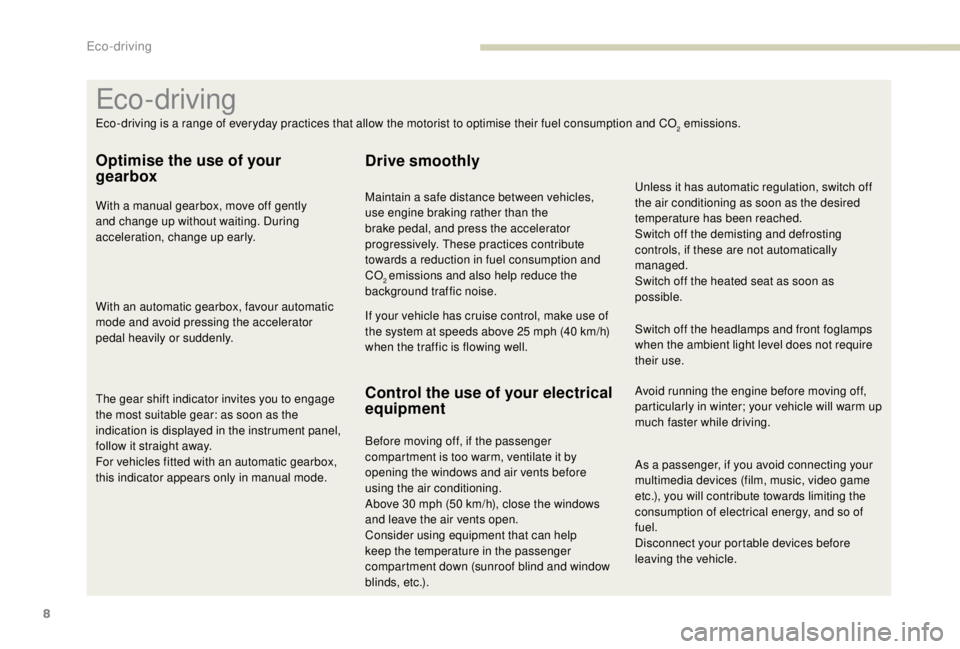
Eco- driving
Eco-driving is a range of everyday practices that allow the motorist to optimise their fuel consumption and CO2 emissions.
Optimise the use of your
gearbox
With a manual gearbox, move off gently
and change up without waiting. During
acceleration, change up early.
With an automatic gearbox, favour automatic
mode and avoid pressing the accelerator
pedal heavily or suddenly.
The gear shift indicator invites you to engage
the most suitable gear: as soon as the
indication is displayed in the instrument panel,
follow it straight away.
For vehicles fitted with an automatic gearbox,
this indicator appears only in manual mode.
Drive smoothly
Maintain a safe distance between vehicles,
use engine braking rather than the
brake pedal, and press the accelerator
progressively. These practices contribute
towards a reduction in fuel consumption and
CO
2 emissions and also help reduce the
background traffic noise.
If your vehicle has cruise control, make use of
the system at speeds above 25
mph (40 km/h)
when the traffic is flowing well.
Control the use of your electrical
equipment
Before moving off, if the passenger
compartment is too warm, ventilate it by
opening the windows and air vents before
using the air conditioning.
Above 30
mph (50 km/h), close the windows
and leave the air vents open.
Consider using equipment that can help
keep the temperature in the passenger
compartment down (sunroof blind and window
blinds, etc.). Switch off the headlamps and front foglamps
when the ambient light level does not require
their use.
Avoid running the engine before moving off,
particularly in winter; your vehicle will warm up
much faster while driving. Unless it has automatic regulation, switch off
the air conditioning as soon as the desired
temperature has been reached.
Switch off the demisting and defrosting
controls, if these are not automatically
managed.
Switch off the heated seat as soon as
possible.
Eco-driving
Page 16 of 416
14
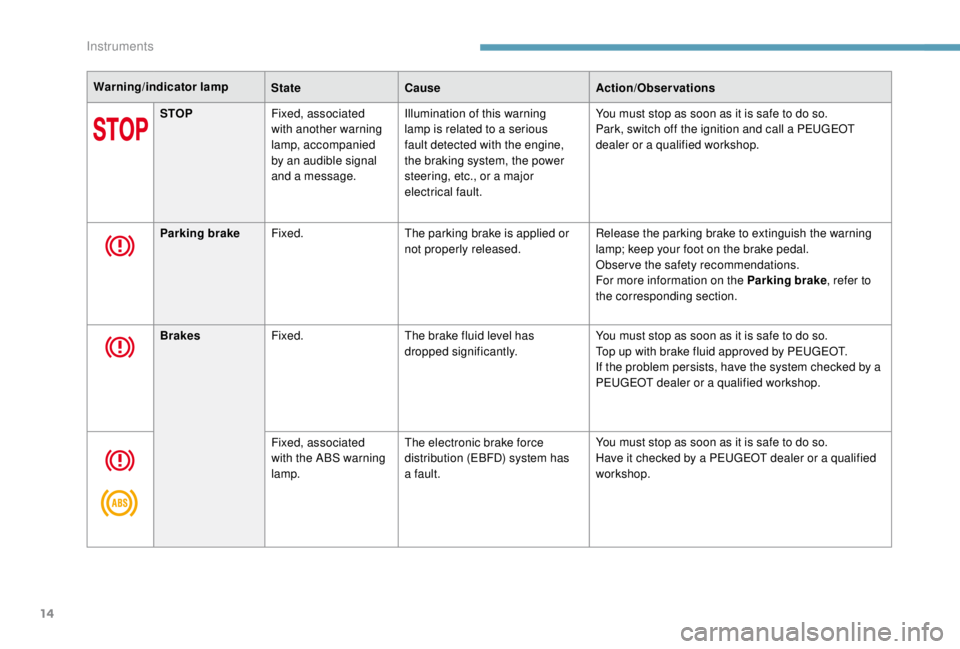
Warning/indicator lampStateCause Action/Observations
STOP Fixed, associated
with another warning
lamp, accompanied
by an audible signal
and a message. Illumination of this warning
lamp is related to a serious
fault detected with the engine,
the braking system, the power
steering, etc., or a major
electrical fault. You must stop as soon as it is safe to do so.
Park, switch off the ignition and call a PEUGEOT
dealer or a qualified workshop.
Parking brake Fixed. The parking brake is applied or
not properly released. Release the parking brake to extinguish the warning
lamp; keep your foot on the brake pedal.
Observe the safety recommendations.
For more information on the Parking brake
, refer to
the corresponding section.
Brakes Fixed. The brake fluid level has
dropped significantly. You must stop as soon as it is safe to do so.
Top up with brake fluid approved by PEUGEOT.
If the problem persists, have the system checked by a
PEUGEOT dealer or a qualified workshop.
Fixed, associated
with the ABS warning
lamp. The electronic brake force
distribution (EBFD) system has
a fault. You must stop as soon as it is safe to do so.
Have it checked by a PEUGEOT dealer or a qualified
workshop.
Instruments
Page 20 of 416
18
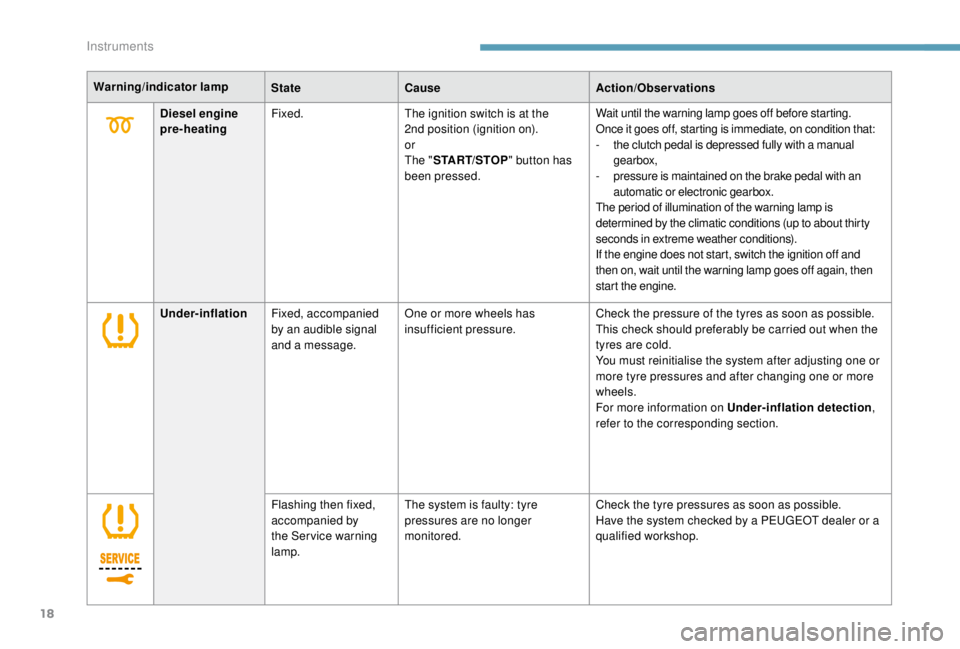
Warning/indicator lampStateCause Action/Observations
Under-inflation Fixed, accompanied
by an audible signal
and a message. One or more wheels has
insufficient pressure.
Check the pressure of the tyres as soon as possible.
This check should preferably be carried out when the
tyres are cold.
You must reinitialise the system after adjusting one or
more tyre pressures and after changing one or more
wheels.
For more information on Under-inflation detection
,
refer to the corresponding section.
Flashing then fixed,
accompanied by
the Ser vice warning
lamp. The system is faulty: tyre
pressures are no longer
monitored.
Check the tyre pressures as soon as possible.
Have the system checked by a PEUGEOT dealer or a
qualified workshop.
Diesel engine
pre-heating
Fixed.
The ignition switch is at the
2nd position (ignition on).
or
The "START/STOP " button has
been pressed. Wait until the warning lamp goes off before starting.
Once it goes off, starting is immediate, on condition that:
-
t
he clutch pedal is depressed fully with a manual
gearbox,
-
p
ressure is maintained on the brake pedal with an
automatic or electronic gearbox.
The period of illumination of the warning lamp is
determined by the climatic conditions (up to about thirty
seconds in extreme weather conditions).
If the engine does not start, switch the ignition off and
then on, wait until the warning lamp goes off again, then
start the engine.
Instruments
Page 21 of 416
19
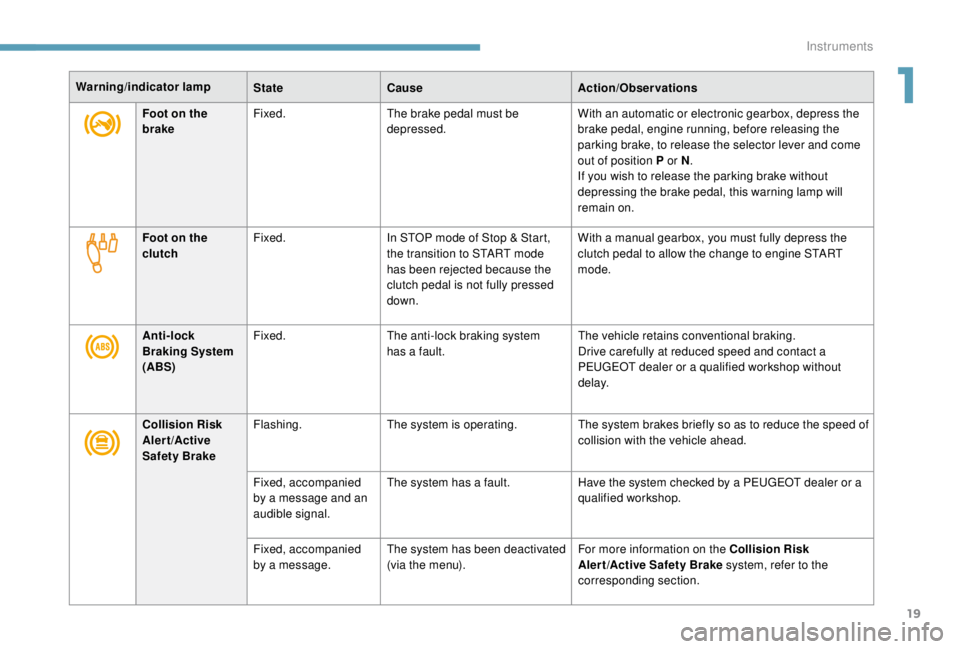
Foot on the
brakeFixed.
The brake pedal must be
depressed. With an automatic or electronic gearbox, depress the
brake pedal, engine running, before releasing the
parking brake, to release the selector lever and come
out of position P or N
.
If you wish to release the parking brake without
depressing the brake pedal, this warning lamp will
remain on.
Foot on the
clutch Fixed.
In STOP mode of Stop & Start,
the transition to START mode
has been rejected because the
clutch pedal is not fully pressed
down. With a manual gearbox, you must fully depress the
clutch pedal to allow the change to engine START
mode.
Warning/indicator lamp
StateCause Action/Observations
Anti-lock
Braking System
(ABS) Fixed.
The anti-lock braking system
has a fault. The vehicle retains conventional braking.
Drive carefully at reduced speed and contact a
PEUGEOT dealer or a qualified workshop without
d e l ay.
Collision Risk
Alert/Active
Safety Brake Flashing.
The system is operating. The system brakes briefly so as to reduce the speed of
collision with the vehicle ahead.
Fixed, accompanied
by a message and an
audible signal. The system has a fault.
Have the system checked by a PEUGEOT dealer or a
qualified workshop.
Fixed, accompanied
by a message. The system has been deactivated
(via the menu). For more information on the Collision Risk
Aler t /Active Safety Brake system, refer to the
corresponding section.
1
Instruments
Page 147 of 416
145
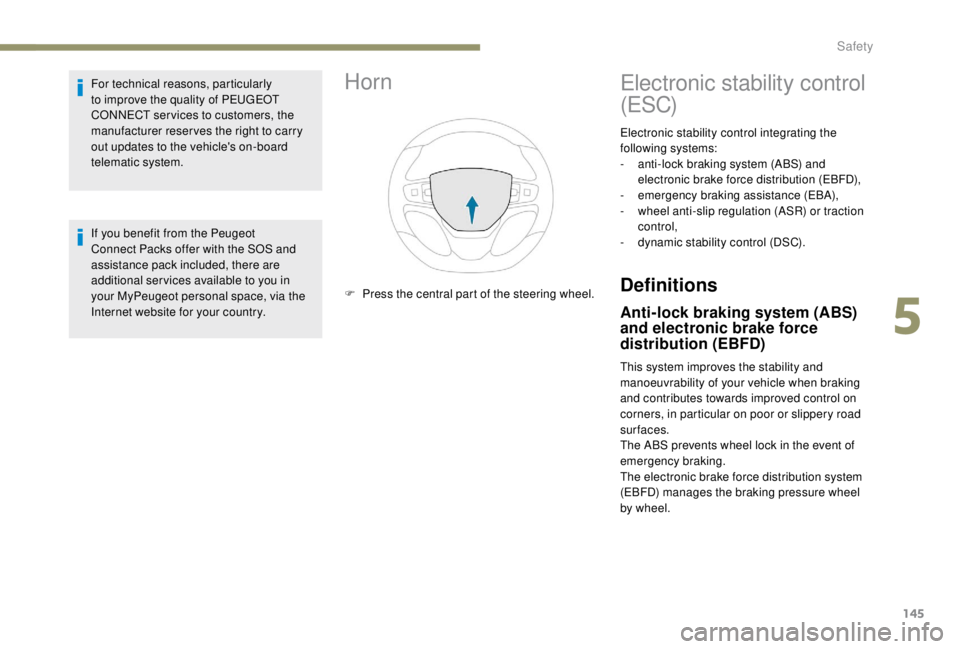
Horn
F Press the central part of the steering wheel.
Electronic stability control
(ESC)
Electronic stability control integrating the
following systems:
-
a
nti-lock braking system (ABS) and
electronic brake force distribution (EBFD),
-
em
ergency braking assistance (EBA),
-
w
heel anti-slip regulation (ASR) or traction
control,
-
d
ynamic stability control (DSC).
For technical reasons, particularly
to improve the quality of PEUGEOT
CONNECT ser vices to customers, the
manufacturer reser ves the right to carry
out updates to the vehicle's on-board
telematic system.
If you benefit from the Peugeot
Connect Packs offer with the SOS and
assistance pack included, there are
additional ser vices available to you in
your MyPeugeot personal space, via the
Internet website for your country.
Definitions
Anti-lock braking system (ABS)
and electronic brake force
distribution (EBFD)
This system improves the stability and
manoeuvrability of your vehicle when braking
and contributes towards improved control on
corners, in particular on poor or slippery road
surfaces.
The ABS prevents wheel lock in the event of
emergency braking.
The electronic brake force distribution system
(EBFD) manages the braking pressure wheel
by wheel.
5
Safety
Page 148 of 416
146
Emergency braking assistance
(EBA)
In an emergency, this system permits the
optimum braking pressure to be reached
more quickly, therefore reducing the stopping
distance.
It is triggered in relation to the speed at which
the brake pedal is pressed. The effect of this is
a reduction in the resistance of the pedal and
an increase in braking efficiency.
Anti-slip regulation (ASR)
The ASR system (also known as Traction
Control) optimises traction in order to limit
wheel slip by acting on the brakes of the driving
wheels and on the engine. It also improves
the directional stability of the vehicle on
acceleration.
Dynamic stability control (DSC)
If there is a difference between the path
followed by the vehicle and that required by
the driver, the DSC monitors each wheel and
automatically acts on the brake of one or more
wheels and on the engine to return the vehicle
to the required path, within the limits of the laws
of physics.
Intelligent traction control
If your vehicle has this system, it features a
system to help driving on snow: intelligent
traction control.
This system detects situations of difficult
sur face grip that could make it difficult to move
off or make progress on deep fresh snow or
compacted snow.
In these situations, the intelligent traction
control limits the amount of wheel spin to
provide the best traction and trajectory control
for your vehicle.
The use of snow tyres is strongly
recommended on sur faces offering low
levels of grip.
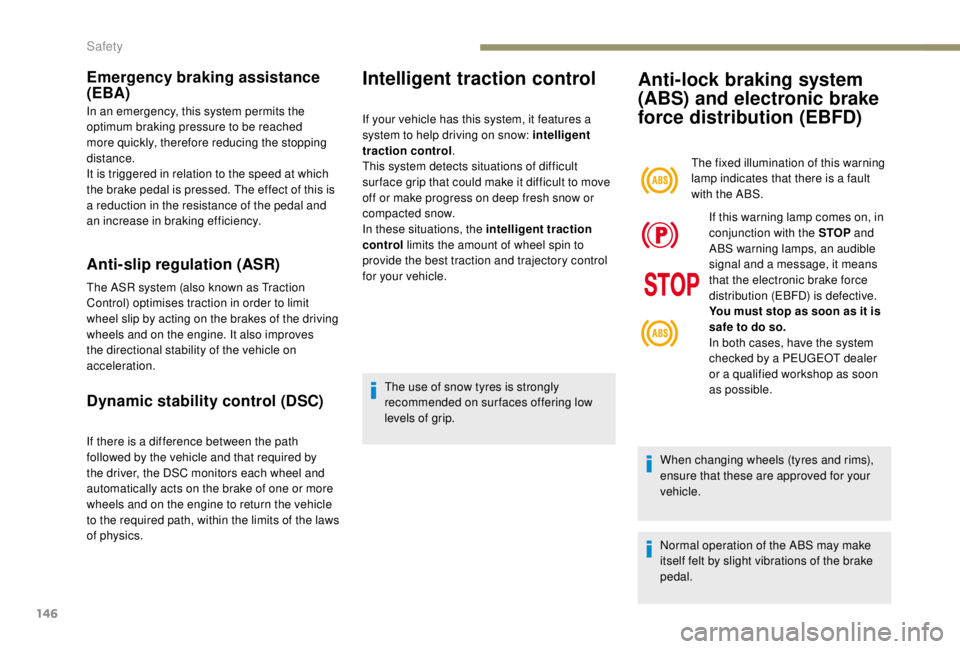
Anti-lock braking system
(ABS) and electronic brake
force distribution (EBFD)
The fixed illumination of this warning
lamp indicates that there is a fault
with the ABS.If this warning lamp comes on, in
conjunction with the STOP and
ABS warning lamps, an audible
signal and a message, it means
that the electronic brake force
distribution (EBFD) is defective.
You must stop as soon as it is
safe to do so.
In both cases, have the system
checked by a PEUGEOT dealer
or a qualified workshop as soon
as possible.
When changing wheels (tyres and rims),
ensure that these are approved for your
vehicle.
Normal operation of the ABS may make
itself felt by slight vibrations of the brake
pedal.
Safety
Page 149 of 416
147
If you need to brake in an emergency,
press the brake pedal ver y firmly and
keep the pressure applied.
After an impact, have the system checked
by a PEUGEOT dealer or a qualified
workshop.
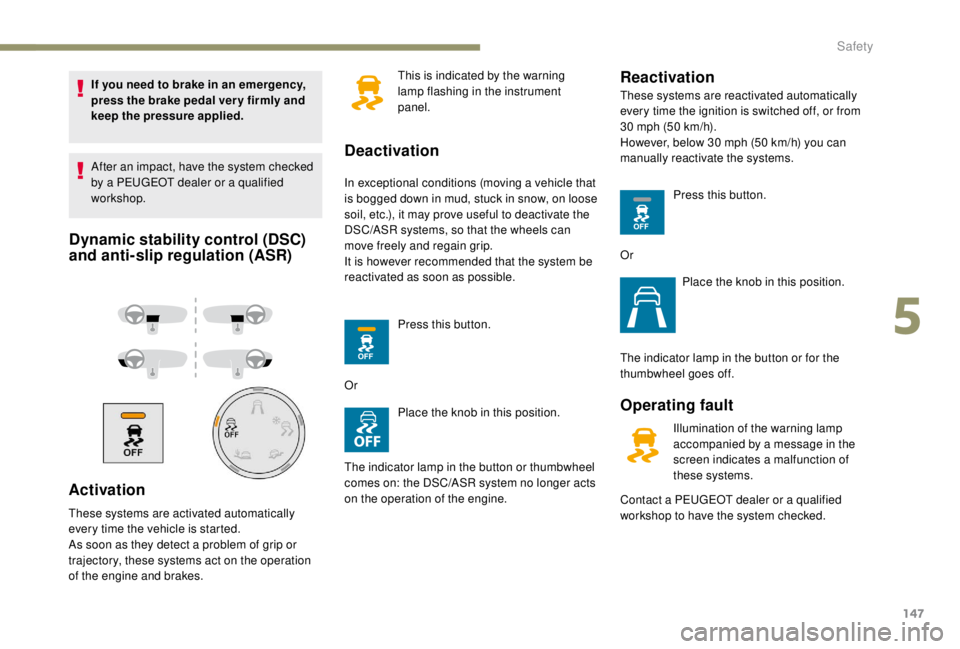
Dynamic stability control (DSC)
and anti-slip regulation (ASR)
Activation
These systems are activated automatically
every time the vehicle is started.
As soon as they detect a problem of grip or
trajectory, these systems act on the operation
of the engine and brakes. This is indicated by the warning
lamp flashing in the instrument
panel.
Deactivation
In exceptional conditions (moving a vehicle that
is bogged down in mud, stuck in snow, on loose
soil, etc.), it may prove useful to deactivate the
DSC/ASR systems, so that the wheels can
move freely and regain grip.
It is however recommended that the system be
reactivated as soon as possible.
Press this button.
Or Place the knob in this position.
The indicator lamp in the button or thumbwheel
comes on: the DSC/ASR system no longer acts
on the operation of the engine.
Reactivation
These systems are reactivated automatically
every time the ignition is switched off, or from
30 mph (50 km/h).
However, below 30
mph (50 km/h) you can
manually reactivate the systems.
Press this button.
Or Place the knob in this position.
The indicator lamp in the button or for the
thumbwheel goes off.
Operating fault
Illumination of the warning lamp
accompanied by a message in the
screen indicates a malfunction of
these systems.
Contact a PEUGEOT dealer or a qualified
workshop to have the system checked.
5
Safety
Page 152 of 416
150
Seat belts
Front seat belts
Fastening
Unfastening
F Press the red button on the buckle.
F G uide the seat belt as it reels in.
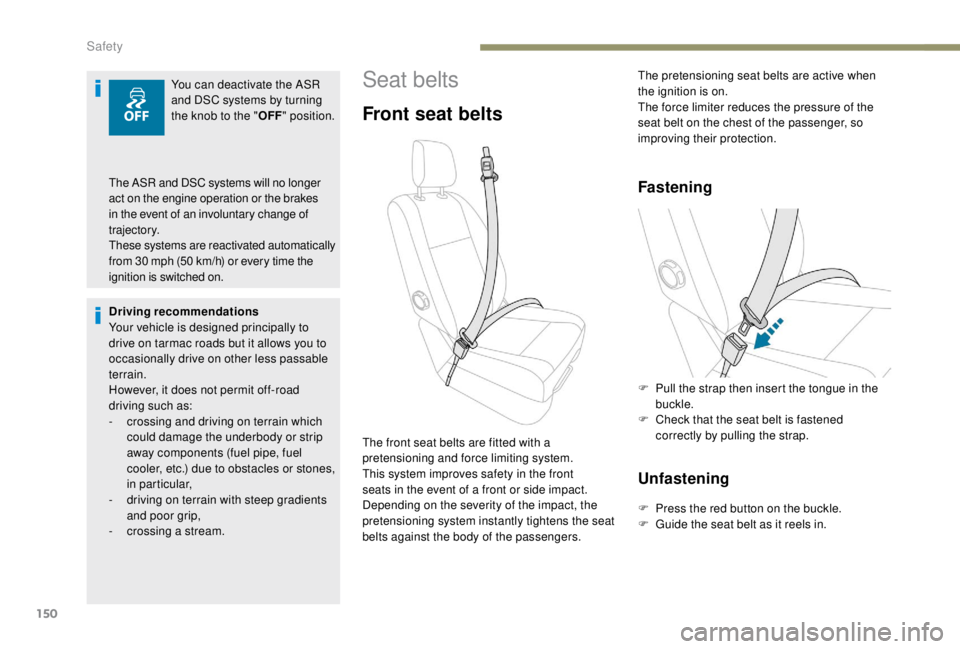
The front seat belts are fitted with a
pretensioning and force limiting system.
This system improves safety in the front
seats in the event of a front or side impact.
Depending on the severity of the impact, the
pretensioning system instantly tightens the seat
belts against the body of the passengers. The pretensioning seat belts are active when
the ignition is on.
The force limiter reduces the pressure of the
seat belt on the chest of the passenger, so
improving their protection.
F
P
ull the strap then insert the tongue in the
buckle.
F
C
heck that the seat belt is fastened
correctly by pulling the strap.
You can deactivate the ASR
and DSC systems by turning
the knob to the "
OFF" position.
The ASR and DSC systems will no longer
act on the engine operation or the brakes
in the event of an involuntary change of
trajectory.
These systems are reactivated automatically
from 30
mph (50
km/h) or every time the
ignition is switched on.
Driving recommendations
Your vehicle is designed principally to
drive on tarmac roads but it allows you to
occasionally drive on other less passable
terrain.
However, it does not permit off-road
driving such as:
-
c
rossing and driving on terrain which
could damage the underbody or strip
away components (fuel pipe, fuel
cooler, etc.) due to obstacles or stones,
in particular,
-
d
riving on terrain with steep gradients
and poor grip,
-
c
rossing a stream.
Safety
Page 178 of 416
176
Driving recommendations
Observe the driving regulations and remain
vigilant whatever the traffic conditions.
Pay close attention to the traffic and keep your
hands on the wheel so that you are ready to
react at any time to any eventuality.
As a safety measure, the driver should only
carry out any operations that require close
attention when the vehicle is stationary.
On a long journey, a break every two hours is
strongly recommended.
In difficult weather, drive smoothly, anticipate
the need to brake and increase the distance
from other vehicles.
Driving on flooded roads
We strongly advise against driving on flooded
roads, as this could cause serious damage
to the engine or gearbox, as well as to the
electrical systems of your vehicle.
Important!
Never drive with the parking brake
applied – Risk of overheating and damage
to the braking system!
As the exhaust system of your vehicle
is very hot, even several minutes after
switching off the engine, never park or run
the engine on inflammable sur faces (dry
grass, fallen leaves, etc.): Risk of fire!
Never leave a vehicle unsuper vised with
the engine running. If you have to leave
your vehicle with the engine running, apply
the parking brake and put the gearbox into
neutral or position N or P, depending on
the type of gearbox.
To assure the durability of your vehicle and
your safety, remember that certain precautions,
described hereafter, should be taken when
driving your vehicle:
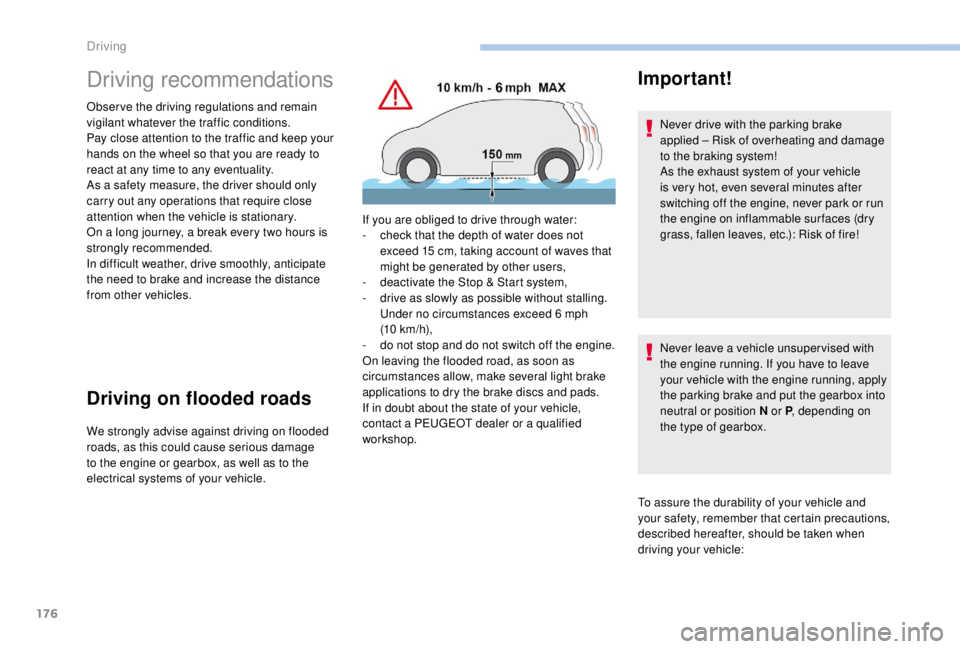
If you are obliged to drive through water:
-
c
heck that the depth of water does not
exceed 15
cm, taking account of waves that
might be generated by other users,
-
d
eactivate the Stop & Start system,
-
d
rive as slowly as possible without stalling.
Under no circumstances exceed 6
mph
(10
km/h),
-
d
o not stop and do not switch off the engine.
On leaving the flooded road, as soon as
circumstances allow, make several light brake
applications to dry the brake discs and pads.
If in doubt about the state of your vehicle,
contact a PEUGEOT dealer or a qualified
workshop.
Driving