break Peugeot Expert 2019 User Guide
[x] Cancel search | Manufacturer: PEUGEOT, Model Year: 2019, Model line: Expert, Model: Peugeot Expert 2019Pages: 324, PDF Size: 13.07 MB
Page 172 of 324
170
For more information on the Head-up
display, refer to the corresponding
section.
Messages and alerts
The display of these messages or alerts is
not sequential.
Operating limits
“Cruise control paused” or “Cruise
control suspended” following a brief
acceleration by the driver.
“Cruise control active”, no vehicle
detected.
“Cruise control active”, vehicle
detected.
“Cruise control active and speed
adjusted”, vehicle detected too close
or at a slower speed.
“Cruise control active and speed
adjusted”, automatic deactivation
imminent following a cruise control
limit being reached.
“Cruise control paused”, automatic
deactivation following speed limit
adjustment being exceeded and no
reaction from the driver. The regulation range is limited to a
maximum difference of 19 mph (30
km/h)
between the cruise speed setting and the
speed of the vehicle in front.
Above this, the system pauses itself if the
safety distance becomes too short.
The adaptive cruise control uses only engine
braking to slow the vehicle. Consequently the
vehicle loses speed slowly, as when releasing
the accelerator pedal.
The system is paused automatically:
-
i
f the vehicle in front slows down too much
or too suddenly, and the driver does not
brake,
-
i
f a vehicle comes between your vehicle and
the vehicle in front,
-
i
f the system does not slow the vehicle
enough to continue to maintain a safe
distance, for example when descending a
steep hill.
Cases of non- detection by the radar:
-
S
tationary vehicles (traffic jam, breakdown,
e t c .) .
-
V
ehicles driving in the opposite direction.
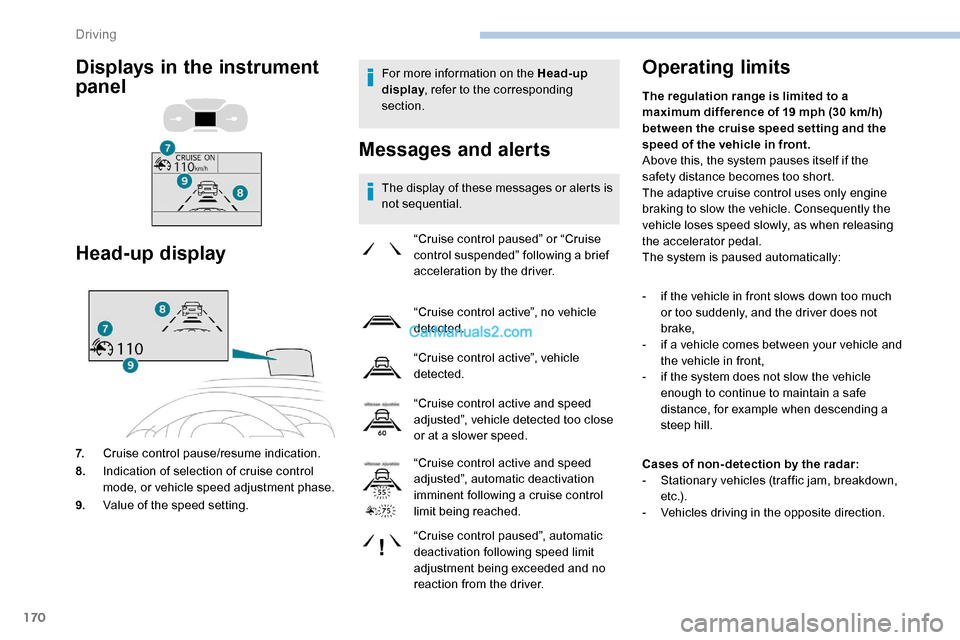
Head-up display
7.Cruise control pause/resume indication.
8. Indication of selection of cruise control
mode, or vehicle speed adjustment phase.
9. Value of the speed setting.
Displays in the instrument
panel
Driving
Page 177 of 324
175
Malfunction
Depending on the vehicle’s equipment:The indicator lamp in this button
flashes.
The button flashes and a fault appears.
Contact a PEUGEOT dealer or a qualified
workshop. Detection may be disrupted:
-
i
f the markings on the ground are worn
and do not contrast well with the road
sur face,
-
i
f the windscreen is dirty,
-
i
n certain extreme weather conditions:
fog, heavy rain, snow, shade, bright
sunlight or direct exposure to the sun
(low sun, leaving a tunnel, etc.).
or
Fatigue detection system
Refer to the General recommendations on
the use of driving and manoeuvring aids
.
Take a break as soon as you feel tired or at
least every two hours.
Depending on version, the function comprises
either the "Driver Attention Warning" system
alone or combined with the "Driver Attention
Alert" system.
Activation/Deactivation
Activation or deactivation is done in
the vehicle configuration menu.
Driver Attention Warning
The system triggers an alert as soon
as it detects that the driver has not
taken a break after two hours of
driving at a speed above 40 mph
(65
km/h).
This alert is issued via the display of a
message encouraging you to take a break,
accompanied by an audible signal.
If the driver does not follow this advice, the
alert is repeated hourly until the vehicle is
stopped. The system resets itself if one of the following
conditions is met:
-
e
ngine running, the vehicle has been
stationary for more than 15 minutes,
-
t
he ignition has been switched off for a few
minutes,
-
t
he driver's seat belt is unfastened and their
door is opened.
As soon as the speed of the vehicle drops
below 40 mph (65 km/h), the system goes
into standby.
The driving time is counted again once the
speed is above 40 mph (65 km/h).
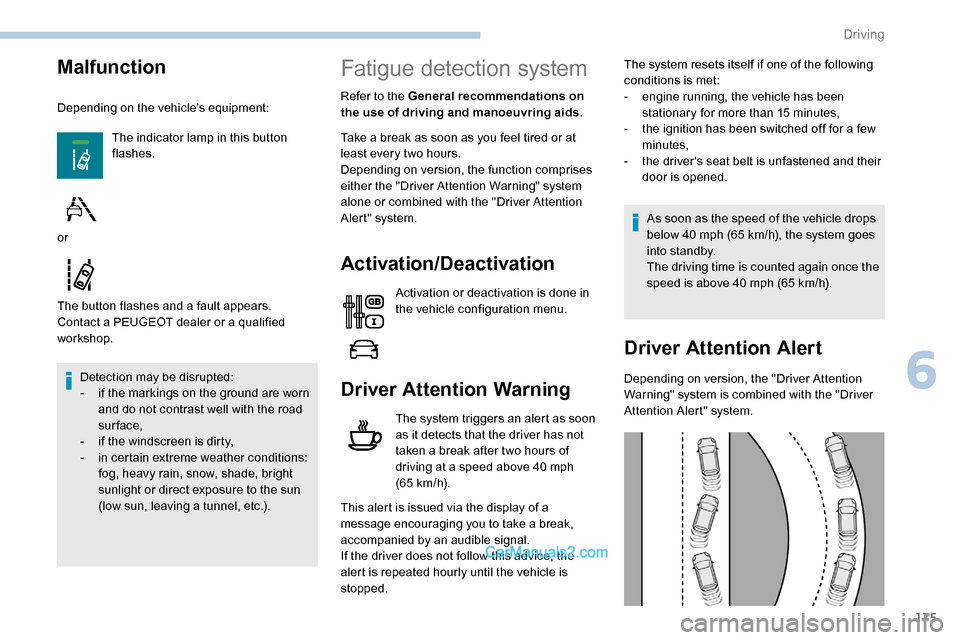
Driver Attention Alert
Depending on version, the "Driver Attention
Warning" system is combined with the "Driver
Attention Alert" system.
6
Driving
Page 178 of 324
176
Using a camera placed at the top
of the windscreen, the system
assesses the driver's level of
vigilance by identifying variations
in trajectory compared to the lane
markings.
This system is particularly suited to fast roads
(speed higher than 40 mph (65
km/h)).
When the system interprets the behaviour of
the vehicle as indicating a certain threshold of
driver fatigue or inattention, it triggers the first
level of alert.
The driver is then alerted by the message
" Ta k e c a r e ! ", accompanied by an audible
signal.
After three first level alerts, the system triggers
a further alert with the message " Dangerous
driving: take a break ", accompanied by a
more pronounced audible signal.
In certain driving conditions (poor road
sur face or strong winds), the system may
give alerts independent of the driver's
level of vigilance. The following situations may interfere with
the operation of the system or prevent it
from working:
-
l
ane markings absent, worn, hidden
(snow, mud) or multiple (roadworks),
-
c
lose to the vehicle ahead (lane
markings not detected),
-
r
oads that are narrow, winding, etc.
Blind Spot Detection
Refer to the General recommendations on
the use of driving and manoeuvring aids.
This system warns the driver of the presence of
another vehicle (car, lorry, bicycle) in the blind
spots of their vehicle (areas hidden from the
driver's field of vision), as soon as this presents
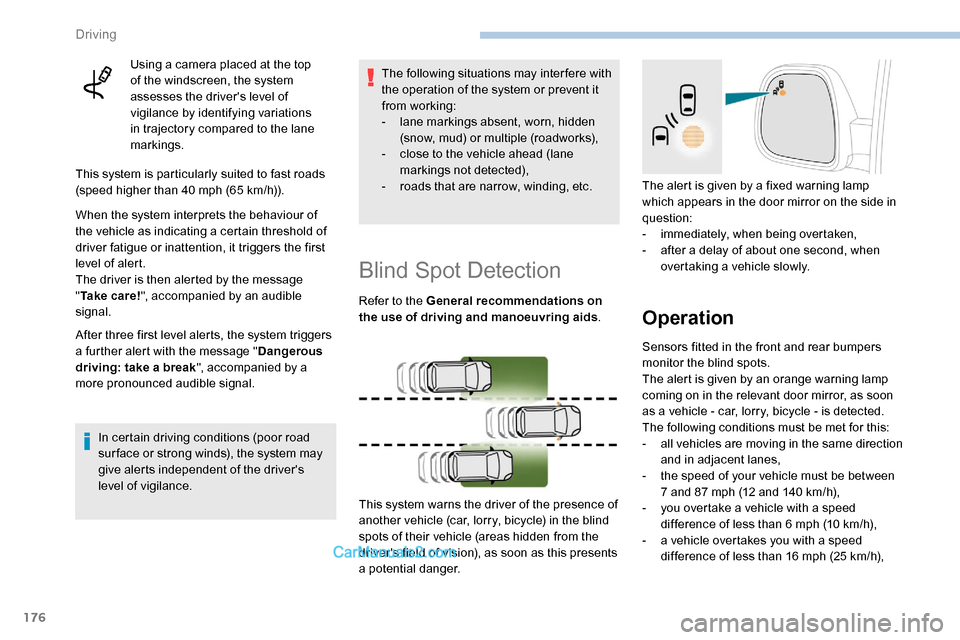
a potential danger. The alert is given by a fixed warning lamp
which appears in the door mirror on the side in
question:
-
i
mmediately, when being overtaken,
-
a
fter a delay of about one second, when
overtaking a vehicle slowly.
Operation
Sensors fitted in the front and rear bumpers
monitor the blind spots.
The alert is given by an orange warning lamp
coming on in the relevant door mirror, as soon
as a vehicle - car, lorry, bicycle - is detected.
The following conditions must be met for this:
-
a
ll vehicles are moving in the same direction
and in adjacent lanes,
-
t
he speed of your vehicle must be between
7 and 87 mph (12 and 140
km/h),
-
y
ou overtake a vehicle with a speed
difference of less than 6 mph (10
km/h),
-
a v
ehicle overtakes you with a speed
difference of less than 16 mph (25
km/h),
Driving
Page 201 of 324
199
If your vehicle's AdBlue® tank is
completely empty – which is confirmed
by the message "Top up AdBlue: Starting
impossible", you must top up with at least
5 litres.
Important: in the event of a top-up after
a breakdown because of a lack of
AdBlue, you must wait around 5 minutes
before switching on the ignition, without
opening the driver’s door, locking
the vehicle, introducing the key into
the ignition switch, or introducing
the key of the Keyless Entr y and
Star ting system into the passenger
compartment .
Switch on the ignition, then wait for
10
seconds before starting the engine.
Advice on care
General recommendations on the care and
maintenance of your vehicle are given in the
warranty and maintenance record. Observe the following recommendations to avoid damaging your vehicle:
-
D
o not clean your headlamps with a dry or abrasive cloth, nor with detergent or solvent
products. Use a sponge and soapy water or a pH neutral product.
-
W
hen using a high-pressure washer on stubborn dirt, avoid prolonged use on the
headlamps, the lamps and their edges to avoid damaging their lacquer finish and seals.
-
N
ever use an abrasive sponge to clean persistent dirt, as this may scratch the paint
sur face. Use a soft cloth with soapy water instead.
-
W
hen washing your vehicle, never clean the interior with a water jet.
-
W
hen washing your vehicle in an automatic roller-brush car wash, be sure to lock your
doors and, depending on version, remove the key and deactivate the " Hands-Free
Access " system.
-
N
ever use high-pressure washing to clean the engine compartment, in order to avoid
damaging the electrical units.
-
L
iquids carried in an open vessel (e.g. a cup or mug) could be spilt, presenting a risk of
damage on contact with the controls in the dashboard and centre console. Be careful.
Depending on version, in order to avoid damaging or unpeeling the stickers on the bodywork,
you are strongly advised against using high-pressure cleaners to wash your vehicle. It is
recommended that you wash it using a high-flow water jet and rinse the vehicle down using
demineralised water.
Only a microfibre cloth is recommended for wiping your vehicle; it must be clean and used
g e nt l y.
It is always preferable to have paint repairs carried out by a PEUGEOT dealer or a qualified
workshop.
7
Practical information
Page 202 of 324
200
Warning triangle
This safety equipment should be used in
addition to the hazard warning lamps.
Placing the triangle on the
road
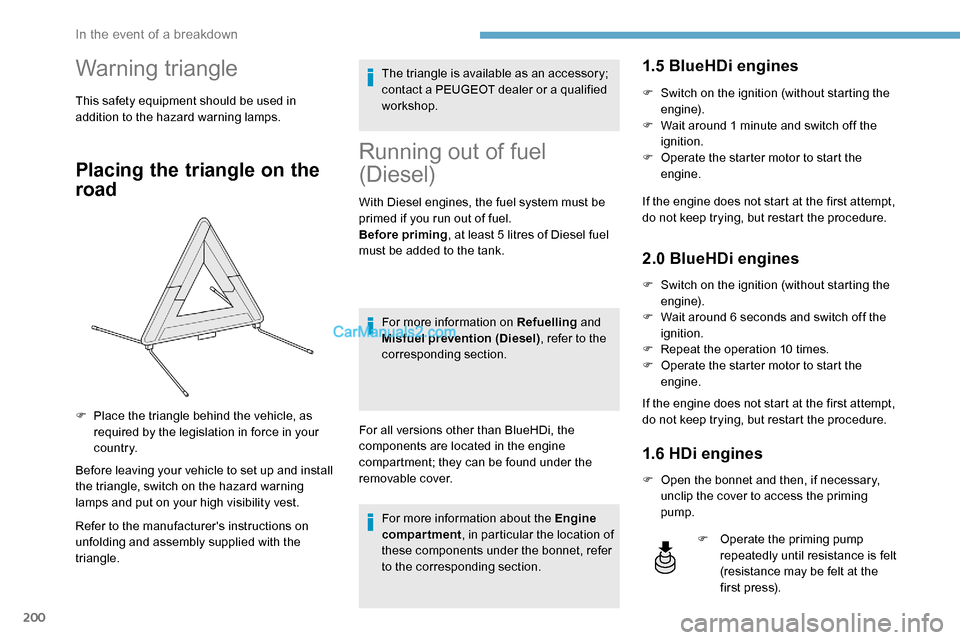
Before leaving your vehicle to set up and install
the triangle, switch on the hazard warning
lamps and put on your high visibility vest.
Refer to the manufacturer's instructions on
unfolding and assembly supplied with the
triangle.The triangle is available as an accessory;
contact a PEUGEOT dealer or a qualified
workshop.
Running out of fuel
(Diesel)
With Diesel engines, the fuel system must be
primed if you run out of fuel.
Before priming
, at least 5
litres of Diesel fuel
must be added to the tank.
For more information on Refuelling and
Misfuel prevention (Diesel) , refer to the
corresponding section.
For all versions other than BlueHDi, the
components are located in the engine
compartment; they can be found under the
removable cover. For more information about the Engine
compartment , in particular the location of
these components under the bonnet, refer
to the corresponding section.
1.5 BlueHDi engines
F Switch on the ignition (without starting the engine).
F
W
ait around 1 minute and switch off the
ignition.
F
O
perate the starter motor to start the
engine.
If the engine does not start at the first attempt,
do not keep trying, but restart the procedure.
2.0 BlueHDi engines
F Switch on the ignition (without starting the engine).
F
W
ait around 6 seconds and switch off the
ignition.
F
R
epeat the operation 10
times.
F
O
perate the starter motor to start the
engine.
If the engine does not start at the first attempt,
do not keep trying, but restart the procedure.
1.6 HDi engines
F Open the bonnet and then, if necessary, unclip the cover to access the priming
pump.
F
P
lace the triangle behind the vehicle, as
required by the legislation in force in your
c o u nt r y.
F
O
perate the priming pump
repeatedly until resistance is felt
(resistance may be felt at the
f i r st p r e s s).
In the event of a breakdown
Page 203 of 324
201
F Operate the starter motor to start the engine (if the engine does not start at the first
attempt, wait around 15 seconds before
trying again).
F
I
f the engine does not start after a few
attempts, operate the priming pump again,
then the starter motor.
F
P
ut the cover back in place and clip it in,
then close the bonnet.
2.0 HDi engines
F Open the bonnet and then, if necessary, unclip the cover to access the priming
pump.
F
L
oosen the degassing bolt. F
O
perate the priming pump until
fuel appears in the transparent
tube.
F
R
etighten the degassing bolt.
F
O
perate the starter motor until the engine
starts (if the engine does not start at the
first attempt, wait around 15
seconds before
trying again).
F
I
f the engine does not start after a few
attempts, operate the priming pump again,
then the starter motor.
F
P
ut the cover back in place and clip it in,
then close the bonnet.
Tool box
Access
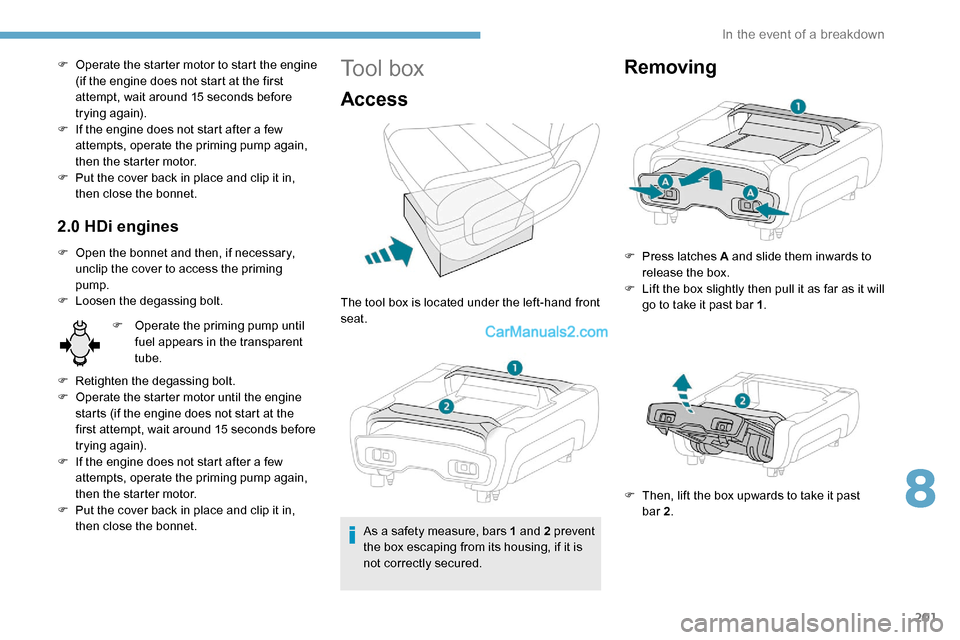
The tool box is located under the left-hand front
seat.
As a safety measure, bars 1 and 2 prevent
the box escaping from its housing, if it is
not correctly secured.
Removing
F Press latches A and slide them inwards to release the box.
F
L
ift the box slightly then pull it as far as it will
go to take it past bar 1 .
F
T
hen, lift the box upwards to take it past
bar
2.
8
In the event of a breakdown
Page 204 of 324
202
Opening
Storage
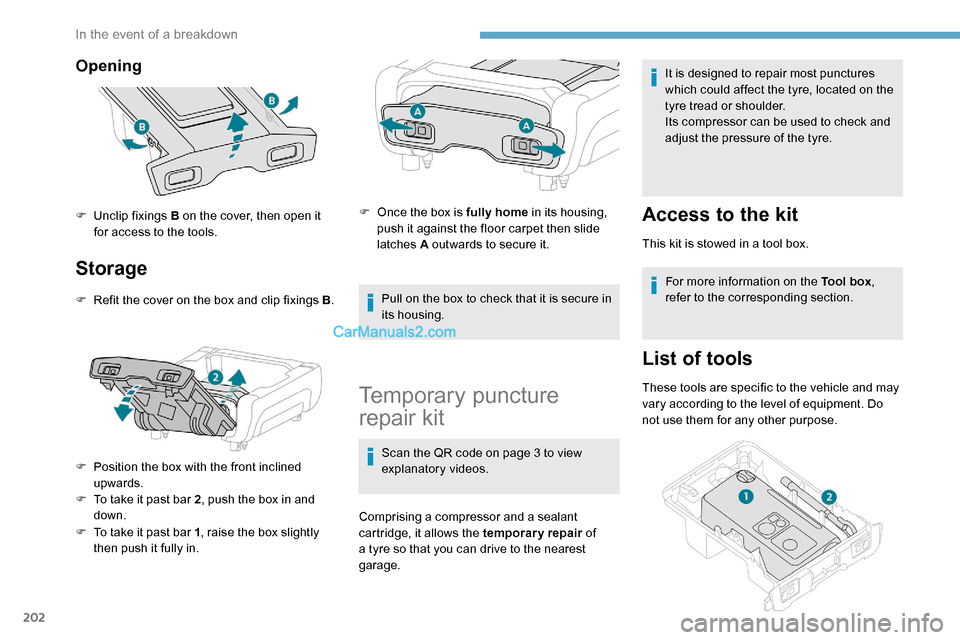
F Refit the cover on the box and clip fixings B.
F
P
osition the box with the front inclined
upwards.
F
T
o take it past bar 2 , push the box in and
down.
F
T
o take it past bar 1 , raise the box slightly
then push it fully in. F
O
nce the box is fully home
in its housing,
push it against the floor carpet then slide
latches A outwards to secure it.
Pull on the box to check that it is secure in
its housing.
Temporary puncture
repair kit
Scan the QR code on page 3 to view
explanatory videos.
Comprising a compressor and a sealant
cartridge, it allows the temporary repair of
a tyre so that you can drive to the nearest
garage. It is designed to repair most punctures
which could affect the tyre, located on the
tyre tread or shoulder.
Its compressor can be used to check and
adjust the pressure of the tyre.
Access to the kit
This kit is stowed in a tool box.
For more information on the Tool box ,
refer to the corresponding section.
List of tools
These tools are specific to the vehicle and may
vary according to the level of equipment. Do
not use them for any other purpose.
F
U
nclip fixings B on the cover, then open it
for access to the tools.
In the event of a breakdown
Page 205 of 324
203
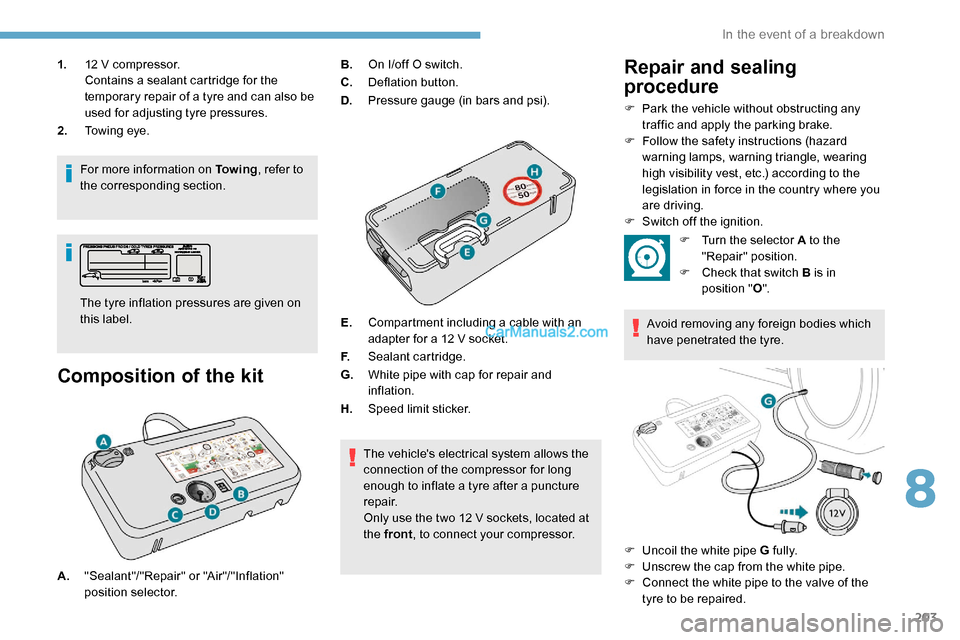
1.12 V compressor.
Contains a sealant cartridge for the
temporary repair of a tyre and can also be
used for adjusting tyre pressures.
2. Towing eye.
For more information on To w i n g , refer to
the corresponding section.
Composition of the kit
The tyre inflation pressures are given on
this label. B.
On I/off O switch.
C. Deflation button.
D. Pressure gauge (in bars and psi).
E. Compartment including a cable with an
adapter for a 12 V socket.
F. Sealant cartridge.
G. White pipe with cap for repair and
inflation.
H. Speed limit sticker.
The vehicle's electrical system allows the
connection of the compressor for long
enough to inflate a tyre after a puncture
repair.
Only use the two 12 V sockets, located at
the front , to connect your compressor.
Repair and sealing
procedure
F Park the vehicle without obstructing any
traffic and apply the parking brake.
F
F
ollow the safety instructions (hazard
warning lamps, warning triangle, wearing
high visibility vest, etc.) according to the
legislation in force in the country where you
are driving.
F
S
witch off the ignition.
A. "Sealant"/"Repair" or "Air"/"Inflation"
position selector. F
T
urn the selector A to the
"Repair" position.
F
C
heck that switch B is in
position " O".
Avoid removing any foreign bodies which
have penetrated the tyre.
F
U
ncoil the white pipe G fully.
F
U
nscrew the cap from the white pipe.
F
C
onnect the white pipe to the valve of the
tyre to be repaired.
8
In the event of a breakdown
Page 206 of 324
204
F Connect the compressor's electrical plug to the vehicle's 12 V socket.
F
A
ffix the speed limit sticker.
The speed limit sticker must be secured
to the interior of the vehicle in the driver's
field of vision, to remind you that a wheel
is in temporary use.
F
S
tart the vehicle and leave the engine
running.
Do not start the compressor before
connecting the white pipe to the tyre valve:
the sealant product would be expelled
through the pipe.
F
S
witch on the compressor by moving
switch B to position I until the tyre pressure
reaches 2.0 bars. The sealant product is
injected under pressure into the tyre; do not
disconnect the pipe from the valve during
this operation (risk of blowback). If after approximately seven minutes this
pressure is not reached, this indicates
that the tyre is not repairable; contact a
PEUGEOT dealer or a qualified workshop
for assistance.
F
R
emove the kit and screw the cap back
on the white pipe. Take care to avoid
contaminating the vehicle with traces of
fluid. Keep the kit to hand.
Take care, the sealant product is harmful
if swallowed and causes irritation to the
eyes.
Keep this product out of the reach of
children.
The use-by date of the fluid is marked on
the bottle.
After use, do not discard the bottle in
standard waste, take it to a PEUGEOT
dealer or an authorised waste disposal
site.
Do not forget to obtain a new bottle of
sealant, available from a PEUGEOT
dealer or a qualified workshop.
Inflation, occasional
inflation and checking
pressure
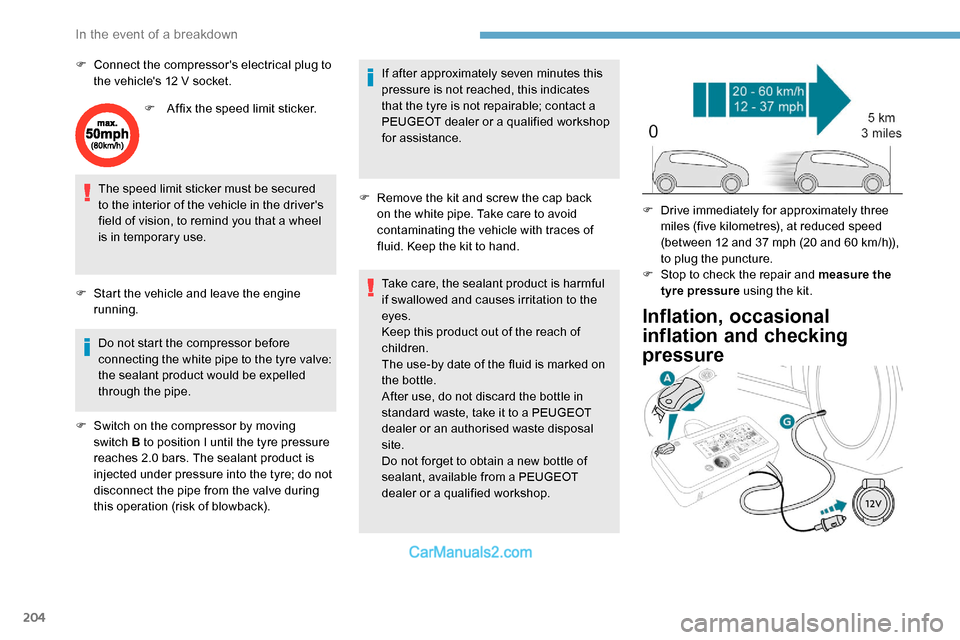
F Drive immediately for approximately three miles (five kilometres), at reduced speed
(between 12 and 37
mph (20 and 60 km/h)),
to plug the puncture.
F
S
top to check the repair and measure the
tyre pressure using the kit.
In the event of a breakdown
Page 207 of 324
205
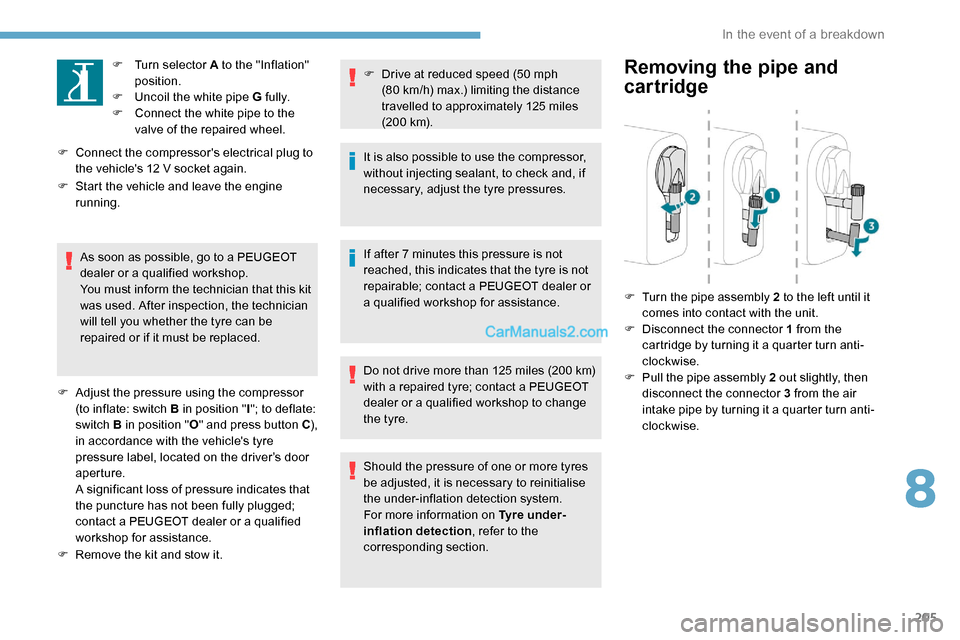
F Turn selector A to the "Inflation" position.
F
U
ncoil the white pipe G fully.
F
C
onnect the white pipe to the
valve of the repaired wheel.
F
C
onnect the compressor's electrical plug to
the vehicle's 12 V socket again.
F
S
tart the vehicle and leave the engine
running.
As soon as possible, go to a PEUGEOT
dealer or a qualified workshop.
You must inform the technician that this kit
was used. After inspection, the technician
will tell you whether the tyre can be
repaired or if it must be replaced.
F
A
djust the pressure using the compressor
(to inflate: switch B in position " I"; to deflate:
switch B
in position " O" and press button
C),
in accordance with the vehicle's tyre
pressure label, located on the driver’s door
aperture.
A significant loss of pressure indicates that
the puncture has not been fully plugged;
contact a PEUGEOT dealer or a qualified
workshop for assistance.
F
R
emove the kit and stow it. F
D rive at reduced speed (50 mph
(80
km/h) max.) limiting the distance
travelled to approximately 125
miles
(2 0 0
k m).
It is also possible to use the compressor,
without injecting sealant, to check and, if
necessary, adjust the tyre pressures.
If after 7
minutes this pressure is not
reached, this indicates that the tyre is not
repairable; contact a PEUGEOT dealer or
a qualified workshop for assistance.
Do not drive more than 125 miles (200 km)
with a repaired tyre; contact a PEUGEOT
dealer or a qualified workshop to change
the tyre.
Should the pressure of one or more tyres
be adjusted, it is necessary to reinitialise
the under-inflation detection system.
For more information on Tyre under-
inflation detection , refer to the
corresponding section.Removing the pipe and
cartridge
F Turn the pipe assembly 2 to the left until it comes into contact with the unit.
F
D
isconnect the connector 1 from the
cartridge by turning it a quarter turn anti-
clockwise.
F
P
ull the pipe assembly 2 out slightly, then
disconnect the connector 3 from the air
intake pipe by turning it a quarter turn anti-
clockwise.
8
In the event of a breakdown