can Peugeot Expert 2019 Owner's Guide
[x] Cancel search | Manufacturer: PEUGEOT, Model Year: 2019, Model line: Expert, Model: Peugeot Expert 2019Pages: 324, PDF Size: 13.07 MB
Page 73 of 324
71
Individual rear seat(s) on
rails
Allure, Business VIP
The different levels of equipment and settings
described hereafter vary according to the
version and the configuration of the vehicle.
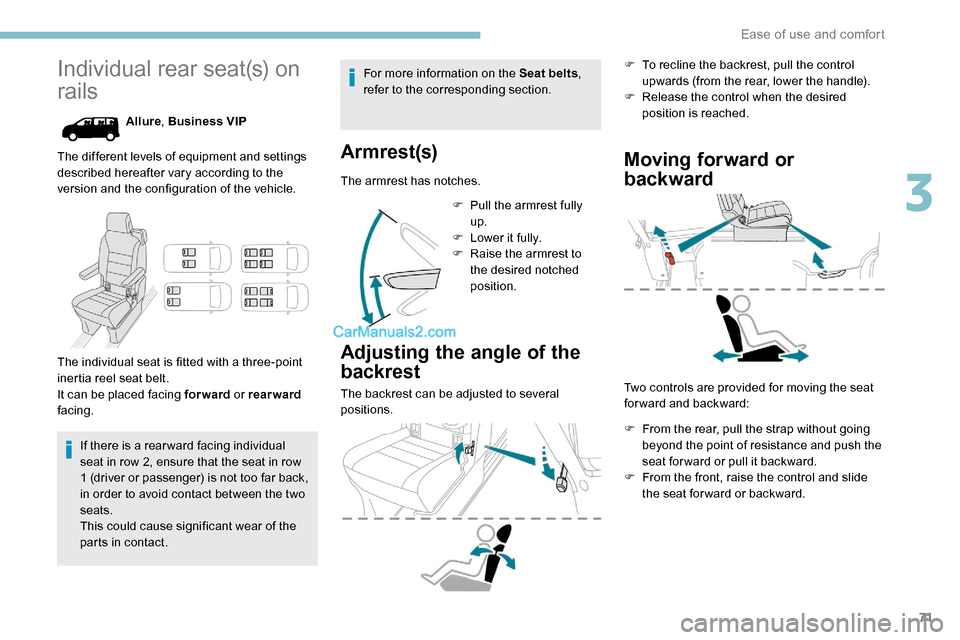
The individual seat is fitted with a three-point
inertia reel seat belt.
It can be placed facing forward or rearward
facing.
If there is a rear ward facing individual
seat in row 2, ensure that the seat in row
1 (driver or passenger) is not too far back,
in order to avoid contact between the two
seats.
This could cause significant wear of the
parts in contact. The backrest can be adjusted to several
positions.
Moving forward or
backward
Ar mrest(s)
The armrest has notches.
Adjusting the angle of the
backrest
F Pull the armrest fully
up.
F
L
ower it fully.
F
R
aise the armrest to
the desired notched
position.
For more information on the Seat belts
,
refer to the corresponding section. F
T
o recline the backrest, pull the control
upwards (from the rear, lower the handle).
F
R
elease the control when the desired
position is reached.
Two controls are provided for moving the seat
forward and backward:
F
F
rom the rear, pull the strap without going
beyond the point of resistance and push the
seat for ward or pull it backward.
F
F
rom the front, raise the control and slide
the seat for ward or backward.
3
Ease of use and comfort
Page 74 of 324
72
Folding the backrest to the
table position
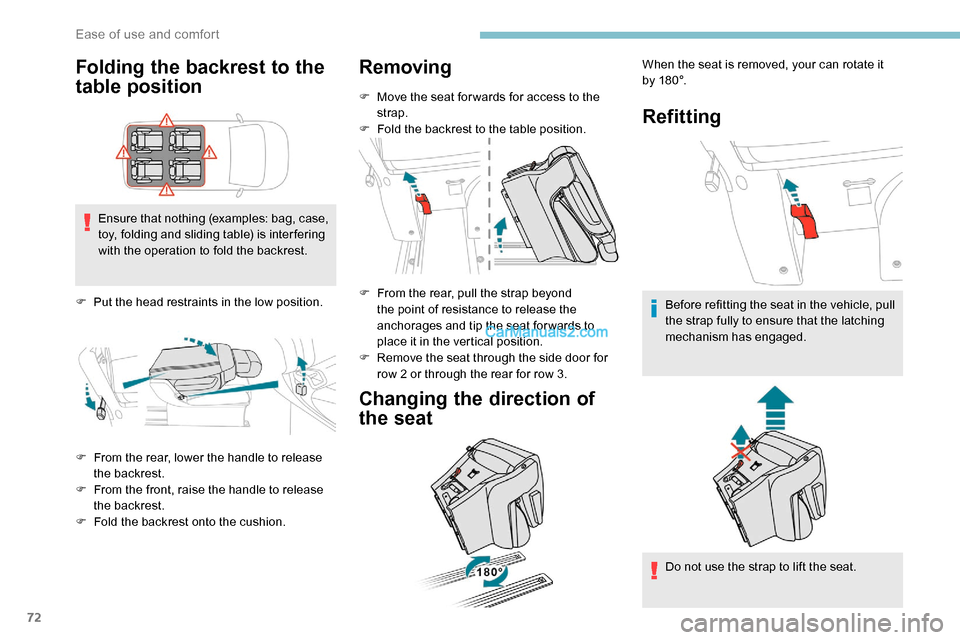
Ensure that nothing (examples: bag, case,
toy, folding and sliding table) is inter fering
with the operation to fold the backrest.
F
P
ut the head restraints in the low position.
F
F
rom the rear, lower the handle to release
the backrest.
F
F
rom the front, raise the handle to release
the backrest.
F
F
old the backrest onto the cushion.
Removing
F Move the seat for wards for access to the strap.
F
F
old the backrest to the table position.
F
F
rom the rear, pull the strap beyond
the point of resistance to release the
anchorages and tip the seat for wards to
place it in the vertical position.
F
R
emove the seat through the side door for
row 2 or through the rear for row 3.
Changing the direction of
the seat Refitting
When the seat is removed, your can rotate it
by 18 0 °.
Before refitting the seat in the vehicle, pull
the strap fully to ensure that the latching
mechanism has engaged.
Do not use the strap to lift the seat.
Ease of use and comfort
Page 76 of 324
74
Depending on the country of sale, the wells can
be dismantled and removed through the rear so
that bulky objects can be stowed underneath
the bench seat.Do not attach anything to the cab fixing
structure.
Do not exceed the number of passengers
indicated on the registration certificate.
In the rear, the loading area is intended
for carrying goods only.
You are advised to place the goods or
heavy objects as far for wards as possible
in the loading area (towards the cab) and
secure them by means of straps using the
stowing rings on the floor.
The rear seat belt frames are not designed
to secure the load being carried.
Crew cab, folding
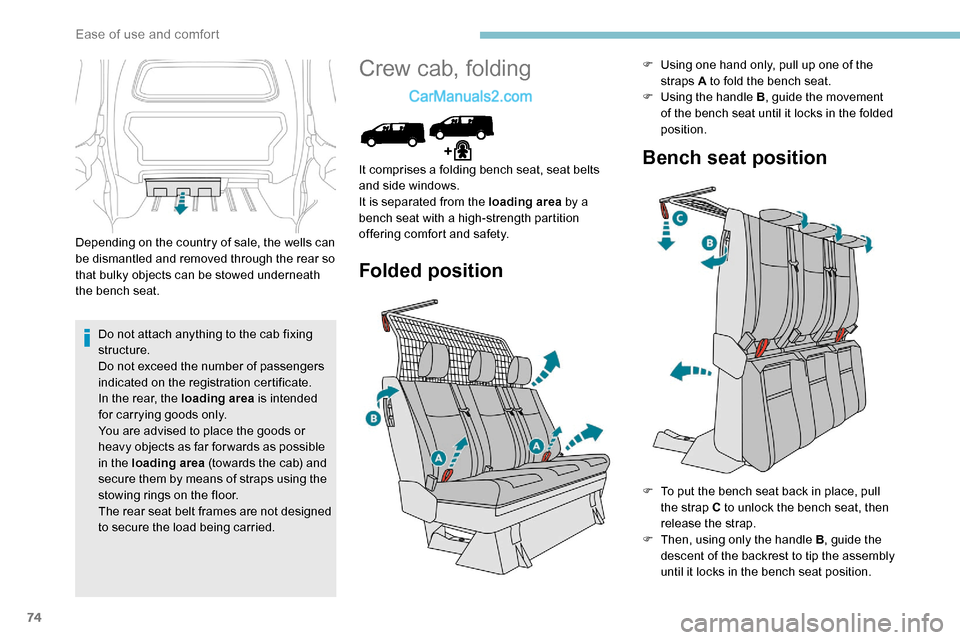
It comprises a folding bench seat, seat belts
and side windows.
It is separated from the loading area by a
bench seat with a high-strength partition
offering comfort and safety.
Folded position
F Using one hand only, pull up one of the straps A to fold the bench seat.
F
Us
ing the handle B , guide the movement
of the bench seat until it locks in the folded
position.
F
T
o put the bench seat back in place, pull
the strap C to unlock the bench seat, then
release the strap.
F
T
hen, using only the handle B , guide the
descent of the backrest to tip the assembly
until it locks in the bench seat position.
Bench seat position
Ease of use and comfort
Page 78 of 324
76
Use the Velcro to connect the transverse mats
in row 2 with the longitudinal mats in rows 2
and 3.
Glove box
It houses the front passenger airbag
deactivation switch and can hold a bottle of
water, the vehicle's handbook pack, etc.Never drive with the glove box (if
equipped) open when a passenger is
sitting at the front. It may cause injury
during sharp deceleration.
Storage compartment
This can hold a bottle of water, the vehicle's
documentation, etc. F
T
o open the storage compartment, press
the left-hand end of the control and guide
the lid to its open position notch.
If your vehicle is so equipped, it is lit when the
lid is opened.
When driving , keep the storage
compartment closed. Otherwise, there is a
risk of injury in the event of an accident or
sudden braking.
Depending on the country of
sale, with air conditioning, it
gives access to the ventilation
nozzle, delivering the same air-
conditioned air as the vents in
the passenger compartment.
Front door storage pockets
Liquids carried in an open vessel (e.g.
a cup or mug) could be spilt, presenting
a risk of damage on contact with the
controls in the dashboard and centre
console. Be careful.
Upper glove box
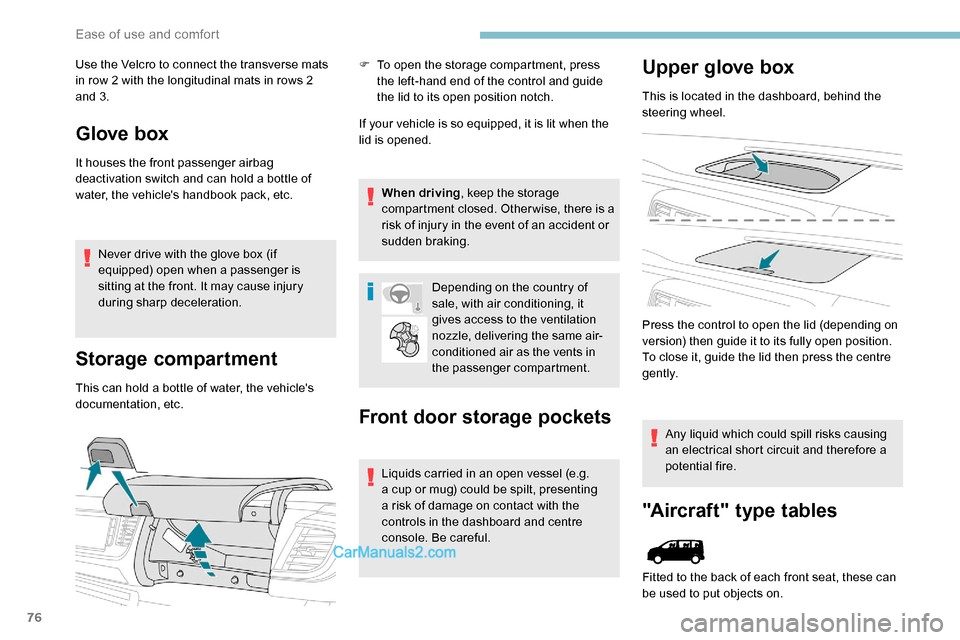
This is located in the dashboard, behind the
steering wheel.
Press the control to open the lid (depending on
version) then guide it to its fully open position.
To close it, guide the lid then press the centre
g e nt l y.
Any liquid which could spill risks causing
an electrical short circuit and therefore a
potential fire.
"Aircraft" type tables
Fitted to the back of each front seat, these can
be used to put objects on.
Ease of use and comfort
Page 81 of 324
79
As a safety measure in the event of
sudden braking, it is recommended that
heavy objects are placed on the floor as
close as possible to the backrest of the
seat(s) or bench seat.
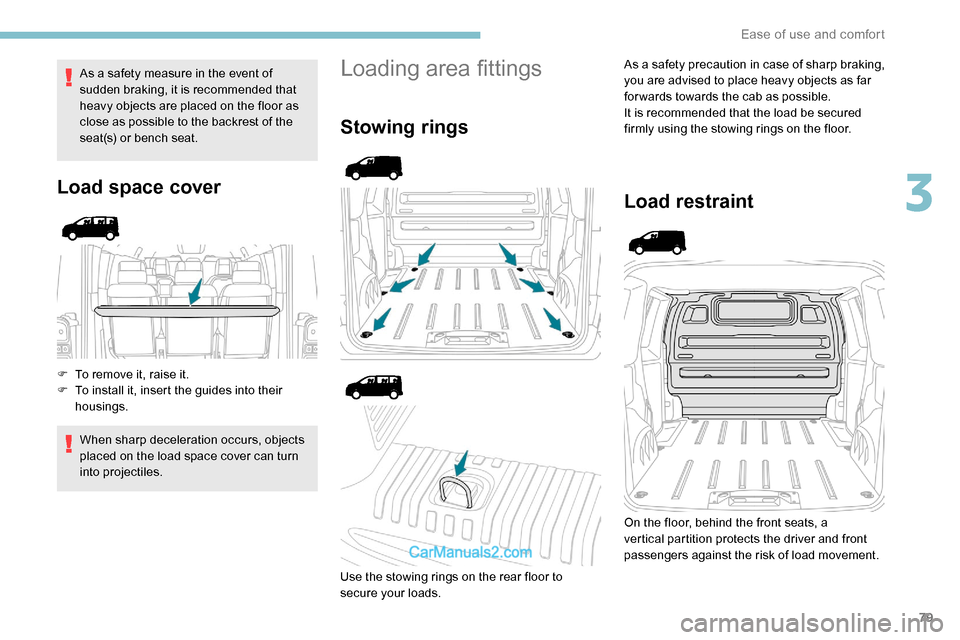
Load space cover
F To remove it, raise it.
F T o install it, insert the guides into their
housings.
When sharp deceleration occurs, objects
placed on the load space cover can turn
into projectiles.
Loading area fittings
Stowing rings
As a safety precaution in case of sharp braking,
you are advised to place heavy objects as far
for wards towards the cab as possible.
It is recommended that the load be secured
firmly using the stowing rings on the floor.
Load restraint
On the floor, behind the front seats, a
vertical partition protects the driver and front
passengers against the risk of load movement.
Use the stowing rings on the rear floor to
secure your loads.
3
Ease of use and comfort
Page 82 of 324
80
Recommendations on
loading
The weight of the load must comply with
the Gross Train Weight (GTW).
For more information on Engine
technical data and towed loads, refer to
the corresponding section.
If you are using a carrying system (roof
bars/roof rack), comply with the maximum
loads associated with this system.
For more information on Roof bars/Roof
rack , refer to the corresponding section.
Make sure that the size, shape and
volume of the loads carried are compatible
with the highway code and safety
regulations and do not impair the driver’s
field of vision.
Steel or glass partitions separate the loading
area from the cab.
The load must be evenly distributed in the
loading area so as not to inter fere with
driving the vehicle.
Place the load close to the side panels,
or even push it against the side panels
between the wheel arches.
However, it is recommended that heavy
objects are placed as close to the cab as
possible as a precaution in case of sharp
braking.
Firmly secure all parts of the load using
the stowing rings on the floor of the
loading area.
For more information on the Interior
fittings
and in particular on the stowing
rings, refer to the corresponding section. To avoid the risk of injury or accident, the
load must be made stable so that it cannot
slide, tip over, fall or be thrown. To do this,
use only retaining straps that conform to
current standards (DIN for example).
For more information on putting straps
in place, refer to the manufacturer’s user
guide.
There must not be any empty space
between the components of the load.
To prevent the load sliding, there must not
be any empty space between the load and
the panels of the vehicle.
As well as the straps, optimise the stability
of the load with stable handling equipment
(wedges, rigid blocks of wood or padding).
When washing your vehicle, never clean
the inside directly using a water jet.
Ease of use and comfort
Page 84 of 324
82
F Position the net upper fixings in the corresponding anchorages in the roof (first
one side, then the other).
F
F
ully extend the straps.
F
O
n each side, attach the bottom fixings of
the net to the lower anchorages (behind row
1) or in the stowing rings (behind row 2).
F
T
ension the straps to extend the net.
F
C
heck that the net is attached securely and
properly extended.
Never use the ISOFIX ring provided for
fixing the strap of a child seat with Top
Tether.
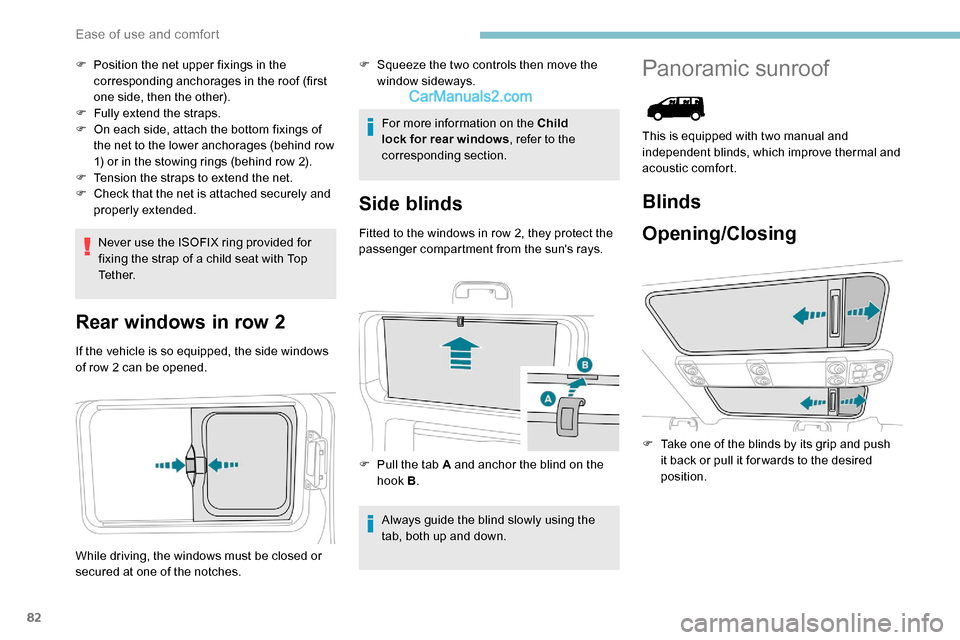
Rear windows in row 2
If the vehicle is so equipped, the side windows
of row 2 can be opened. For more information on the Child
lock for rear windows
, refer to the
corresponding section.
Side blinds
Fitted to the windows in row 2, they protect the
passenger compartment from the sun's rays.
While driving, the windows must be closed or
secured at one of the notches. Always guide the blind slowly using the
tab, both up and down.
F
P
ull the tab A and anchor the blind on the
hook B .
Panoramic sunroof
This is equipped with two manual and
independent blinds, which improve thermal and
acoustic comfort.
Blinds
Opening/Closing
F Take one of the blinds by its grip and push
it back or pull it for wards to the desired
position.
F
S
queeze the two controls then move the
window sideways.
Ease of use and comfort
Page 85 of 324
83
Retractable sliding table
Allure, Business VIP
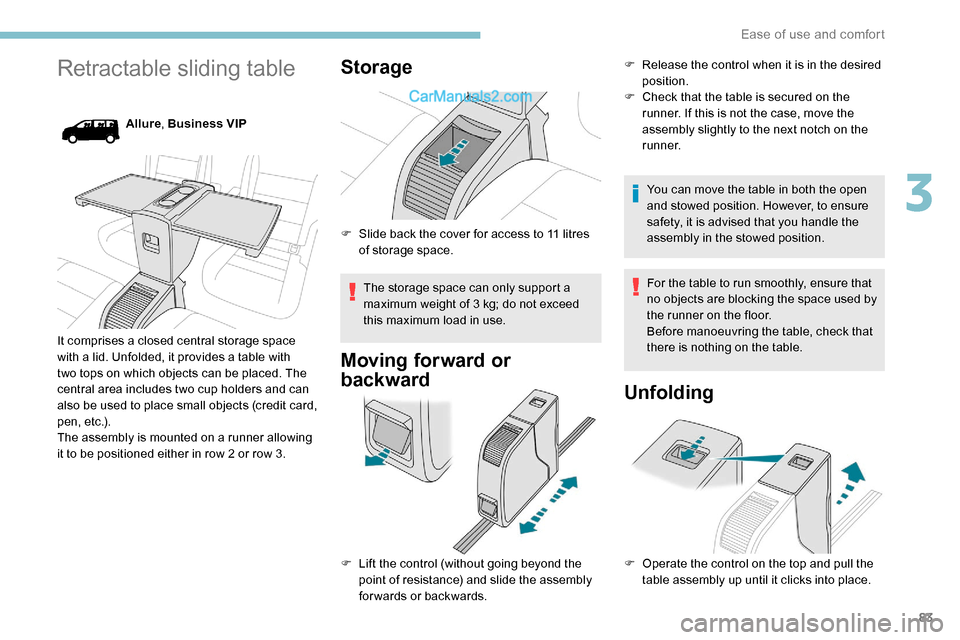
It comprises a closed central storage space
with a lid. Unfolded, it provides a table with
two tops on which objects can be placed. The
central area includes two cup holders and can
also be used to place small objects (credit card,
pen, etc.).
The assembly is mounted on a runner allowing
it to be positioned either in row 2 or row 3.
Storage
F Slide back the cover for access to 11 litres of storage space.
The storage space can only support a
maximum weight of 3 kg; do not exceed
this maximum load in use.
Moving forward or
backward
F Lift the control (without going beyond the point of resistance) and slide the assembly
forwards or backwards. F
R
elease the control when it is in the desired
position.
F
C
heck that the table is secured on the
runner. If this is not the case, move the
assembly slightly to the next notch on the
r u n n e r.
You can move the table in both the open
and stowed position. However, to ensure
safety, it is advised that you handle the
assembly in the stowed position.
For the table to run smoothly, ensure that
no objects are blocking the space used by
the runner on the floor.
Before manoeuvring the table, check that
there is nothing on the table.
Unfolding
F Operate the control on the top and pull the table assembly up until it clicks into place.
3
Ease of use and comfort
Page 86 of 324
84
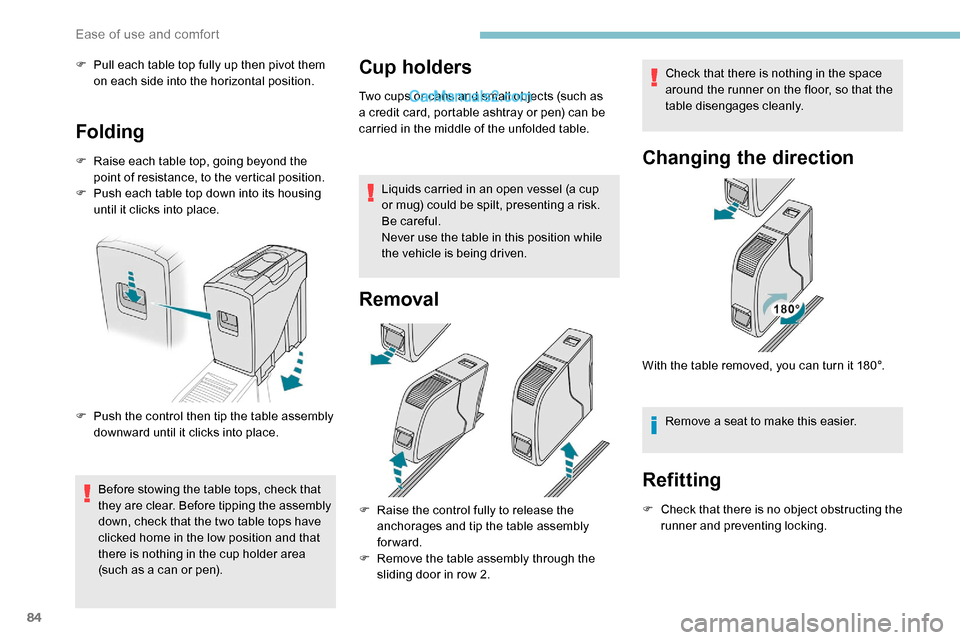
F Pull each table top fully up then pivot them on each side into the horizontal position.
Folding
F Raise each table top, going beyond the point of resistance, to the vertical position.
F
P
ush each table top down into its housing
until it clicks into place.
F
P
ush the control then tip the table assembly
downward until it clicks into place.
Before stowing the table tops, check that
they are clear. Before tipping the assembly
down, check that the two table tops have
clicked home in the low position and that
there is nothing in the cup holder area
(such as a can or pen).
Cup holders
Two cups or cans and small objects (such as
a credit card, portable ashtray or pen) can be
carried in the middle of the unfolded table.
Liquids carried in an open vessel (a cup
or mug) could be spilt, presenting a risk.
Be careful.
Never use the table in this position while
the vehicle is being driven.
Removal
F Raise the control fully to release the anchorages and tip the table assembly
forward.
F
R
emove the table assembly through the
sliding door in row 2.
Changing the direction
Remove a seat to make this easier.
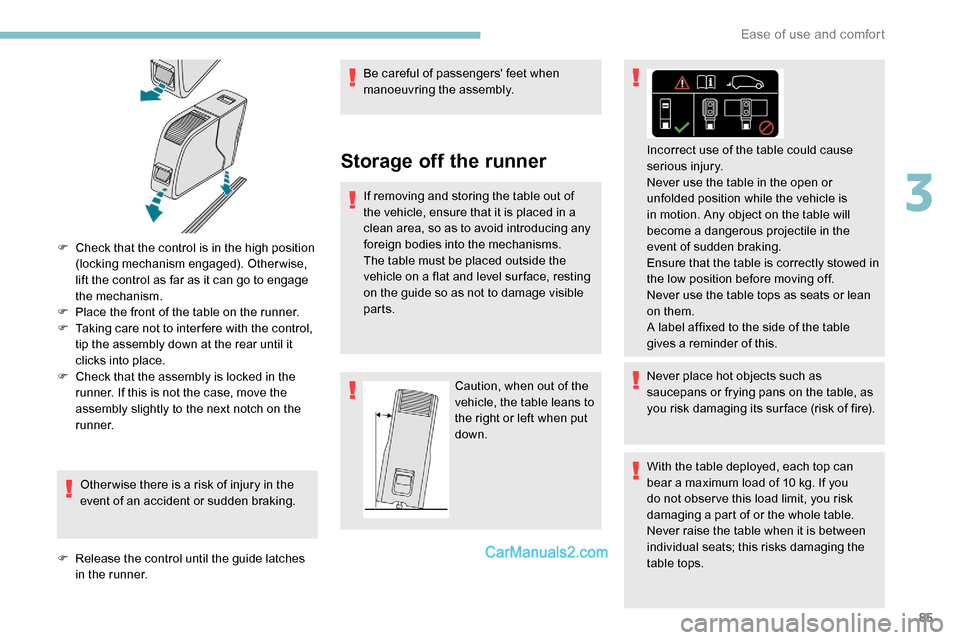
Refitting
F Check that there is no object obstructing the runner and preventing locking.Check that there is nothing in the space
around the runner on the floor, so that the
table disengages cleanly.
With the table removed, you can turn it 180°.
Ease of use and comfort
Page 87 of 324
85
F Check that the control is in the high position (locking mechanism engaged). Otherwise,
lift the control as far as it can go to engage
the mechanism.
F
P
lace the front of the table on the runner.
F
T
aking care not to inter fere with the control,
tip the assembly down at the rear until it
clicks into place.
F
C
heck that the assembly is locked in the
runner. If this is not the case, move the
assembly slightly to the next notch on the
r u n n e r.
Other wise there is a risk of injury in the
event of an accident or sudden braking.
F
R
elease the control until the guide latches
in the runner. Be careful of passengers' feet when
manoeuvring the assembly.
Storage off the runner
If removing and storing the table out of
the vehicle, ensure that it is placed in a
clean area, so as to avoid introducing any
foreign bodies into the mechanisms.
The table must be placed outside the
vehicle on a flat and level sur face, resting
on the guide so as not to damage visible
parts.
Incorrect use of the table could cause
serious injury.
Never use the table in the open or
unfolded position while the vehicle is
in motion. Any object on the table will
become a dangerous projectile in the
event of sudden braking.
Ensure that the table is correctly stowed in
the low position before moving off.
Never use the table tops as seats or lean
on them.
A label affixed to the side of the table
gives a reminder of this.
Caution, when out of the
vehicle, the table leans to
the right or left when put
down. Never place hot objects such as
saucepans or frying pans on the table, as
you risk damaging its surface (risk of fire).
With the table deployed, each top can
bear a maximum load of 10 kg. If you
do not obser ve this load limit, you risk
damaging a part of or the whole table.
Never raise the table when it is between
individual seats; this risks damaging the
table tops.
3
Ease of use and comfort