Air con Peugeot Expert 2019 Owner's Manual
[x] Cancel search | Manufacturer: PEUGEOT, Model Year: 2019, Model line: Expert, Model: Peugeot Expert 2019Pages: 324, PDF Size: 13.07 MB
Page 4 of 324
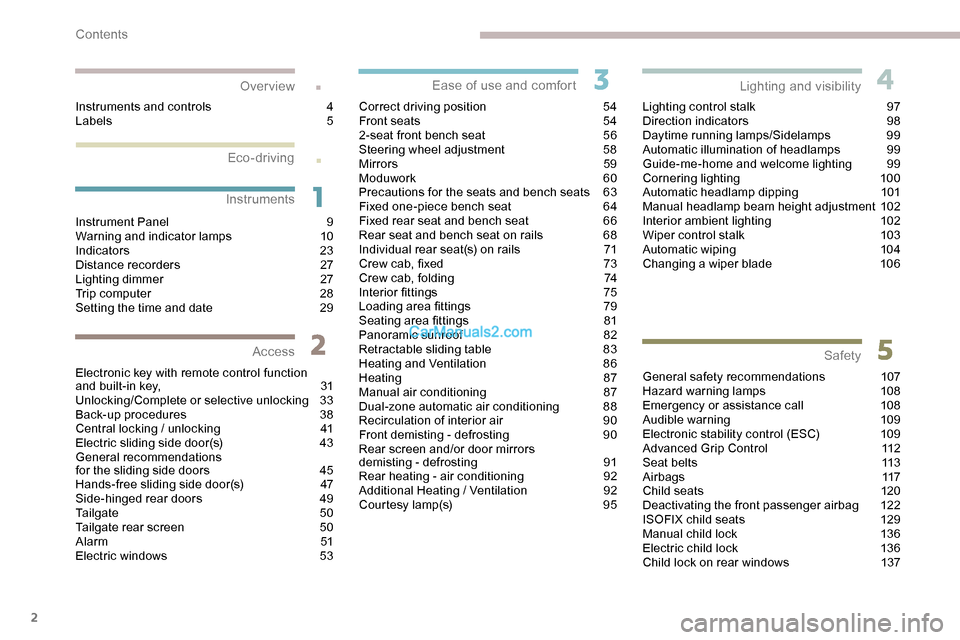
2
.
.
Instrument Panel 9
W arning and indicator lamps 1 0
Indicators
23
Distance recorders
2
7
Lighting dimmer
2
7
Trip computer
2
8
Setting the time and date
2
9
Electronic key with remote control function
and built-in key,
3
1
Unlocking/Complete or selective unlocking
3
3
Back-up procedures
3
8
Central locking / unlocking
4
1
Electric sliding side door(s)
4
3
General recommendations
for the sliding side doors
4
5
Hands-free sliding side door(s)
4
7
Side-hinged rear doors
4
9
Tailgate
5
0
Tailgate rear screen
5
0
Alarm
51
Electric windows
5
3Correct driving position
5
4
Front seats
5
4
2-seat front bench seat
5
6
Steering wheel adjustment
5
8
Mirrors 59
Moduwork
6
0
Precautions for the seats and bench seats
6
3
Fixed one-piece bench seat 6 4
Fixed rear seat and bench seat 6 6
Rear seat and bench seat on rails 6 8
Individual rear seat(s) on rails
7
1
Crew cab, fixed
7
3
Crew cab, folding
7
4
Interior fittings
7
5
Loading area fittings
7
9
Seating area fittings
8
1
Panoramic sunroof
8
2
Retractable sliding table
8
3
Heating and Ventilation
8
6
Heating
87
Manual air conditioning
8
7
Dual-zone automatic air conditioning
8
8
Recirculation of interior air
9
0
Front demisting - defrosting
9
0
Rear screen and/or door mirrors
demisting - defrosting
9
1
Rear heating - air conditioning
9
2
Additional Heating / Ventilation
9
2
Courtesy lamp(s)
9
5Lighting control stalk
9
7
Direction indicators
9
8
Daytime running lamps/Sidelamps
9
9
Automatic illumination of headlamps
9
9
Guide-me-home and welcome lighting
9
9
Cornering lighting
1
00
Automatic headlamp dipping
1
01
Manual headlamp beam height adjustment 1 02
Interior ambient lighting 1 02
Wiper control stalk 1 03
Automatic wiping
1
04
Changing a wiper blade
1
06
General safety recommendations
1
07
Hazard warning lamps
1
08
Emergency or assistance call
1
08
Audible warning
1
09
Electronic stability control (ESC)
1
09
Advanced Grip Control
1
12
Seat belts
1
13
Airbags
117
Child seats
1
20
Deactivating the front passenger airbag
1
22
ISOFIX child seats
1
29
Manual child lock
1
36
Electric child lock
1
36
Child lock on rear windows
1
37
Over view
Instruments
Access Ease of use and comfort
Safety
Lighting and visibility
Instruments and controls 4
L abels 5
Eco-driving
Contents
Page 5 of 324
3
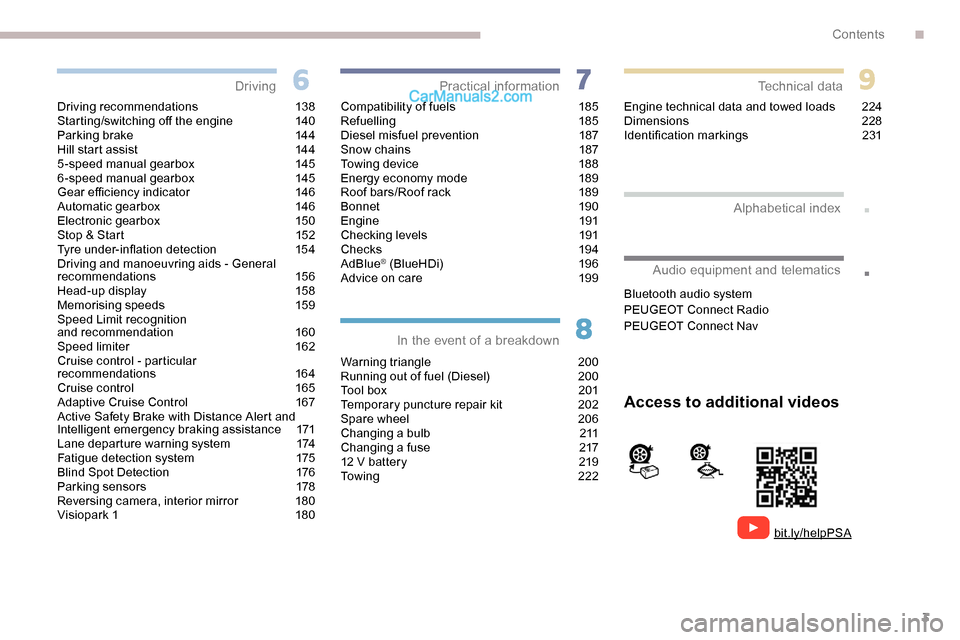
.
.
Driving recommendations 138
Starting/switching off the engine 1 40
Parking brake
1
44
Hill start assist
1
44
5-speed manual gearbox
1
45
6-speed manual gearbox
1
45
Gear efficiency indicator
1
46
Automatic gearbox
1
46
Electronic gearbox
1
50
Stop & Start
1
52
Tyre under-inflation detection
1
54
Driving and manoeuvring aids - General
recommendations
156
Head-up display
1
58
Memorising speeds
1
59
Speed Limit recognition
and recommendation
1
60
Speed limiter
1
62
Cruise control - particular
recommendations
164
Cruise control
1
65
Adaptive Cruise Control
1
67
Active Safety Brake with Distance Alert and
Intelligent emergency braking assistance
1
71
Lane departure warning system
1
74
Fatigue detection system
1
75
Blind Spot Detection
1
76
Parking sensors
1
78
Reversing camera, interior mirror
1
80
Visiopark 1
1
80Compatibility of fuels 1
85
Refuelling 185
Diesel misfuel prevention
1
87
Snow chains
1
87
Towing device
1
88
Energy economy mode
1
89
Roof bars/Roof rack
1
89
Bonnet
19 0
Engine
191
Checking levels
1
91
Checks
19
4
AdBlue
® (BlueHDi) 1 96
Advice on care 1 99
Warning triangle
2
00
Running out of fuel (Diesel)
2
00
Tool box
2
01
Temporary puncture repair kit
2
02
Spare wheel
20
6
Changing a bulb
2
11
Changing a fuse
2
17
12 V battery
2
19
Towing
222Engine technical data and towed loads
2
24
Dimensions
228
Identification markings
2
31
Driving
Practical information
In the event of a breakdown Technical data
Alphabetical index
Access to additional videos
bit.ly/helpPSA
Audio equipment and telematics
Bluetooth audio system
PEUGEOT Connect Radio
PEUGEOT Connect Nav
.
Contents
Page 6 of 324
4
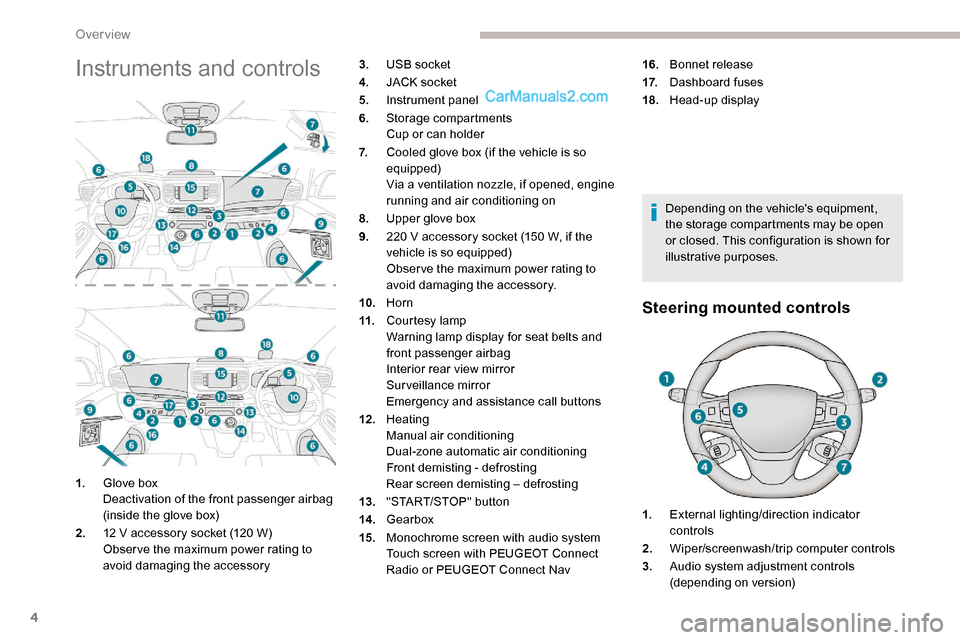
Instruments and controls
Depending on the vehicle's equipment,
the storage compartments may be open
or closed. This configuration is shown for
illustrative purposes.
Steering mounted controls
1.Glove box
Deactivation of the front passenger airbag
(inside the glove box)
2. 12 V accessory socket (120 W)
Obser ve the maximum power rating to
avoid damaging the accessory 3.
USB socket
4. JACK socket
5. Instrument panel
6. Storage compartments
Cup or can holder
7. Cooled glove box (if the vehicle is so
equipped)
Via a ventilation nozzle, if opened, engine
running and air conditioning on
8. Upper glove box
9. 220 V accessory socket (150 W, if the
vehicle is so equipped)
Obser ve the maximum power rating to
avoid damaging the accessory.
10. Horn
11. Courtesy lamp
Warning lamp display for seat belts and
front passenger airbag
Interior rear view mirror
Surveillance mirror
Emergency and assistance call buttons
12 . Heating
Manual air conditioning
Dual-zone automatic air conditioning
Front demisting - defrosting
Rear screen demisting – defrosting
13. "START/STOP" button
14 . Gearbox
15. Monochrome screen with audio system
Touch screen with PEUGEOT Connect
Radio or PEUGEOT Connect Nav 16.
Bonnet release
17. Dashboard fuses
18. Head-up display
1. External lighting/direction indicator
controls
2. Wiper/screenwash/trip computer controls
3. Audio system adjustment controls
(depending on version)
Over view
Page 9 of 324
7
As a passenger, avoid connecting your
multimedia devices (film, music, video game,
etc.) to contribute towards reducing the
consumption of electrical energy, and so of
fuel.
Disconnect all portable devices before leaving
the vehicle.
Eco- driving
Optimise the use of your
gearbox
With a manual gearbox, move off gently and
change up without waiting. While accelerating,
change up early.
With an electronic gearbox, favour automatic
mode, without pressing the accelerator pedal
heavily or suddenly.
With an automatic gearbox, favour automatic
mode, without pressing the accelerator pedal
heavily or suddenly.
Drive smoothly
Maintain a safe distance between vehicles,
use engine braking rather than the brake
pedal and press the accelerator gradually.
These practices contribute towards a
reduction in fuel consumption and CO
2 emissions and also help to reduce the
background traffic noise.
If your vehicle has the steering-mounted
"CRUISE" control, make use of cruise control
at speeds above 25 mph (40 km/h) when the
traffic is flowing well.
Be proficient in the use of
electrical equipment
Before moving off, if the passenger
compartment is too warm, ventilate it by
opening the windows and air vents before
using the air conditioning.
Above 31
mph (50 km/h), close the windows
and leave the air vents open.
Consider using equipment that can help
keep the temperature in the passenger
compartment down (sunroof blind and window
blinds, etc.). Switch off the headlamps and front foglamps
when the visibility conditions do not require
their use.
Avoid running the engine before moving off,
particularly in winter; your vehicle will warm up
much faster while driving. Unless it has automatic regulation, switch off
the air conditioning as soon as the desired
temperature has been reached.
Switch off the demisting and defrosting
controls, if these are not automatically
managed.
Switch off the heated seat as soon as
possible.
Eco-driving is a range of everyday practices that allow the motorist to optimise their fuel consumption and CO
2 emissions.
The gear efficiency indicator invites you to
engage the most suitable gear: as soon as the
indication is displayed in the instrument panel,
follow it straight away.
With an electronic gearbox, this indicator
appears only in manual mode.
With an automatic gearbox, this indicator
appears only in manual mode.
.
Eco-driving
Page 10 of 324
8
Limit the causes of excess
consumption
Spread loads throughout the vehicle; place
the heaviest items in the boot, as close as
possible to the rear seats.
Limit the loads carried in the vehicle and
reduce wind resistance (roof bars, roof rack,
bicycle carrier, trailer, etc.). Preferably, use a
roof box.
Remove roof bars and roof racks after use.
At the end of winter, remove snow tyres and
refit the summer tyres.
Comply with servicing
instructions
Check the tyre pressures regularly, when cold,
referring to the label in the door aperture,
driver's side.
Carry out this check in particular:
-
b
efore a long journey,
-
a
t each change of season,
-
a
fter a long period out of use.
Do not forget the spare wheel and the tyres on
any trailer or caravan. Have your vehicle ser viced regularly (engine
oil, oil filter, air filter, cabin filter, etc.) and
obser ve the schedule of operations in the
manufacturer's service schedule.
When filling the tank, do not continue after the
3
rd cut-off of the nozzle to avoid over flow.
You will only see the fuel consumption
of your new vehicle settle down to a
consistent average after the first 1,900 miles
(3,000
kilometres).
With a BlueHDi Diesel engine, if the SCR
system is faulty, your vehicle becomes
polluting. Visit a PEUGEOT dealer or a
qualified workshop as soon as possible to
bring your vehicle’s nitrogen oxides emissions
back in line with the regulations.
Eco-driving
Page 20 of 324
18
Warning / indicator lamp State Cause Actions / Observations
Under-inflation Fixed, accompanied
by an audible signal
and a message. The pressure in one or more tyres is
too low.
Check the pressure of the tyres as soon as possible.
Reinitialise the detection system after adjusting the
pressure.
+ Under-inflation
warning lamp flashing
then fixed and Ser vice
warning lamp fixed.The system is faulty: tyre pressures
are no longer monitored.
Under-inflation detection is no longer assured.
As soon as possible, check the pressure of the tyres
and carry out (3).
Diesel engine
pre-heating Temporarily on.
When switching on the ignition, if the
weather conditions and the engine
temperature make it necessary. Wait until the warning lamp goes off before starting.
If the engine does not start, switch the ignition off and
then on, wait until the indicator lamp goes off again,
then start the engine.
Front passenger
airbag (ON) Fixed.
The front passenger airbag is
activated.
The control is in the "ON" position. In this case, do NOT install a "rear ward facing"
child seat on the front passenger seat - Risk of
serious injury!
Front passenger
airbag(OFF) Fixed.
The front passenger airbag is
deactivated.
The control is in the "OFF" position. You can install a "rear ward facing" child seat, unless
there is a fault with the airbags (airbag warning lamp
o n).
Airbags Fixed. One of the airbags or seat belt
pretensioners is faulty. Carry out (3).
Instruments
Page 50 of 324
48
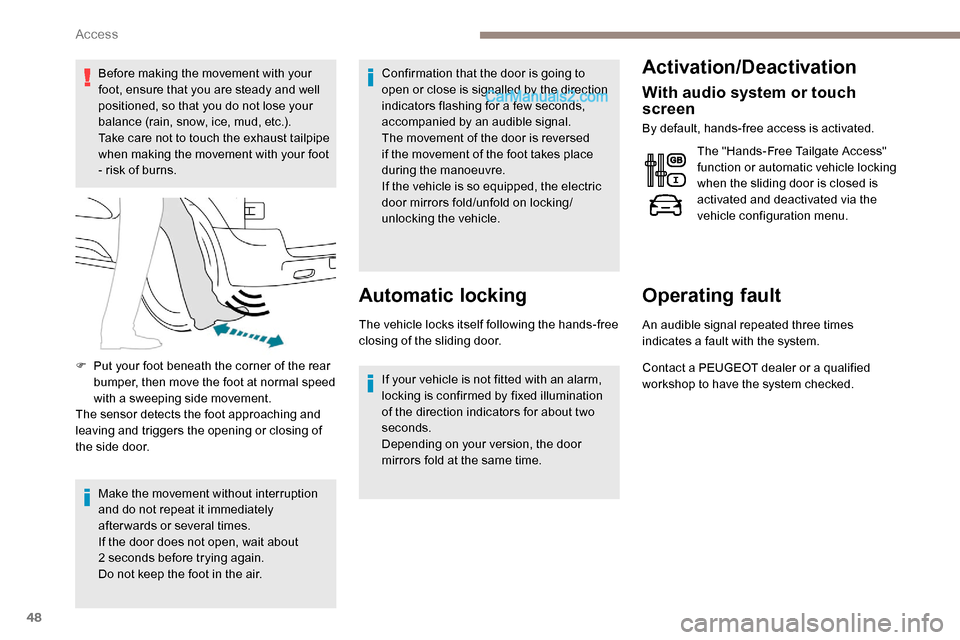
Before making the movement with your
foot, ensure that you are steady and well
positioned, so that you do not lose your
balance (rain, snow, ice, mud, etc.).
Take care not to touch the exhaust tailpipe
when making the movement with your foot
- risk of burns.
Make the movement without interruption
and do not repeat it immediately
after wards or several times.
If the door does not open, wait about
2
seconds before trying again.
Do not keep the foot in the air.
Automatic locking
The vehicle locks itself following the hands-free
closing of the sliding door.
Activation/Deactivation
With audio system or touch
screen
By default, hands-free access is activated.
The "Hands-Free Tailgate Access"
function or automatic vehicle locking
when the sliding door is closed is
activated and deactivated via the
vehicle configuration menu.
Operating fault
An audible signal repeated three times
indicates a fault with the system.
Contact a PEUGEOT dealer or a qualified
workshop to have the system checked.
F
P
ut your foot beneath the corner of the rear
bumper, then move the foot at normal speed
with a sweeping side movement.
The sensor detects the foot approaching and
leaving and triggers the opening or closing of
the side door. Confirmation that the door is going to
open or close is signalled by the direction
indicators flashing for a few seconds,
accompanied by an audible signal.
The movement of the door is reversed
if the movement of the foot takes place
during the manoeuvre.
If the vehicle is so equipped, the electric
door mirrors fold/unfold on locking/
unlocking the vehicle.
If your vehicle is not fitted with an alarm,
locking is confirmed by fixed illumination
of the direction indicators for about two
seconds.
Depending on your version, the door
mirrors fold at the same time.
Access
Page 57 of 324
55
Lumbar
F Turn the knob manually to obtain the desired level of lumbar support.
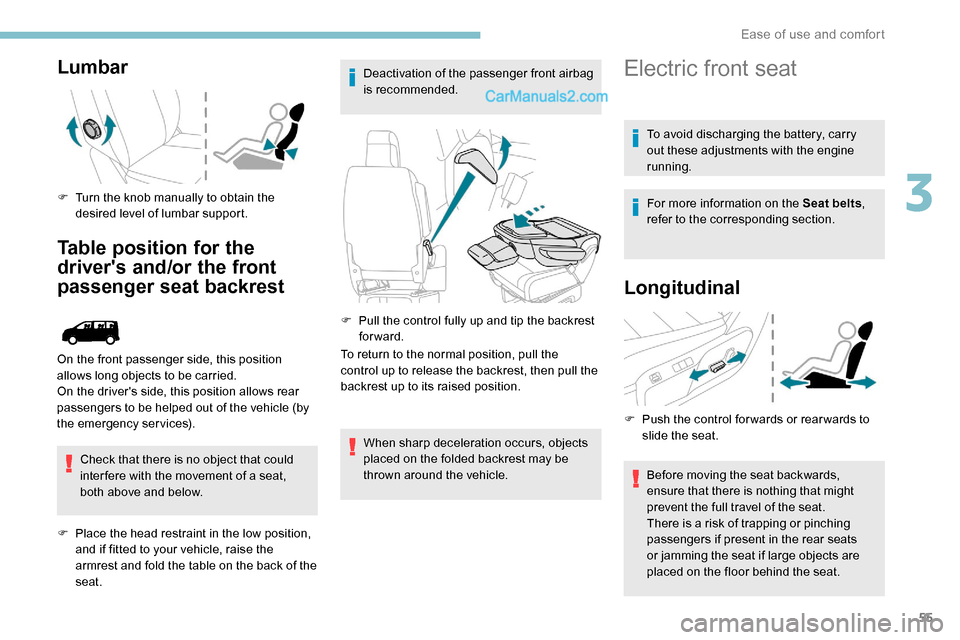
Table position for the
driver's and/or the front
passenger seat backrest
Check that there is no object that could
inter fere with the movement of a seat,
both above and below.
F
P
lace the head restraint in the low position,
and if fitted to your vehicle, raise the
armrest and fold the table on the back of the
seat. Deactivation of the passenger front airbag
is recommended.
F
P
ull the control fully up and tip the backrest
forward.
To return to the normal position, pull the
control up to release the backrest, then pull the
backrest up to its raised position.
On the front passenger side, this position
allows long objects to be carried.
On the driver's side, this position allows rear
passengers to be helped out of the vehicle (by
the emergency services).
When sharp deceleration occurs, objects
placed on the folded backrest may be
thrown around the vehicle.
Electric front seat
To avoid discharging the battery, carry
out these adjustments with the engine
running.
For more information on the Seat belts,
refer to the corresponding section.
Longitudinal
F Push the control for wards or rear wards to slide the seat.
Before moving the seat backwards,
ensure that there is nothing that might
prevent the full travel of the seat.
There is a risk of trapping or pinching
passengers if present in the rear seats
or jamming the seat if large objects are
placed on the floor behind the seat.
3
Ease of use and comfort
Page 59 of 324
57
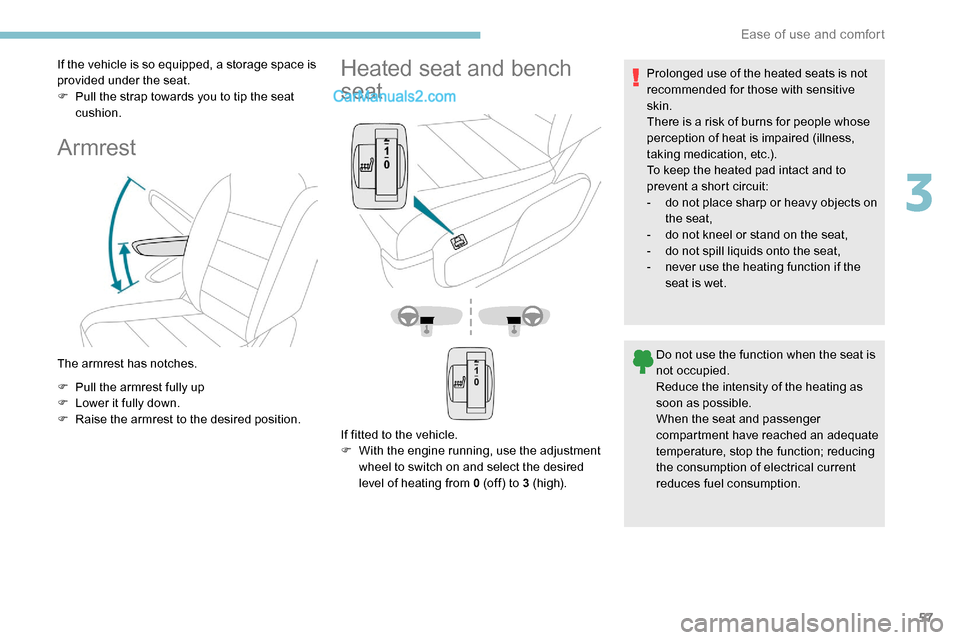
If the vehicle is so equipped, a storage space is
provided under the seat.
F
P
ull the strap towards you to tip the seat
cushion.
Armrest
The armrest has notches.
F
P
ull the armrest fully up
F
L
ower it fully down.
F
R
aise the armrest to the desired position.
Heated seat and bench
seat
If fitted to the vehicle.
F W ith the engine running, use the adjustment
wheel to switch on and select the desired
level of heating from 0
(off) to 3 (h i g h).Prolonged use of the heated seats is not
recommended for those with sensitive
skin.
There is a risk of burns for people whose
perception of heat is impaired (illness,
taking medication, etc.).
To keep the heated pad intact and to
prevent a short circuit:
-
d
o not place sharp or heavy objects on
the seat,
-
d
o not kneel or stand on the seat,
-
d
o not spill liquids onto the seat,
-
n
ever use the heating function if the
seat is wet.
Do not use the function when the seat is
not occupied.
Reduce the intensity of the heating as
soon as possible.
When the seat and passenger
compartment have reached an adequate
temperature, stop the function; reducing
the consumption of electrical current
reduces fuel consumption.
3
Ease of use and comfort
Page 65 of 324
63
Removing the net
F Release the hooks from the rings 4 and 3.
F R emove the lower fastener 2 then the upper
fastener 1 , turning them by a quarter turn
backwards to unlock them.
Make sure that the size, shape and
volume of the loads carried are compatible
with the highway code and safety
regulations and do not impair the driver’s
field of vision.
All loads must be appropriately secured
to prevent or minimise displacement and
prevent injury.
Install the anti-slip net (supplied with the
vehicle) every time that the seat is raised
and the partition flap removed.
Never use the net for any other purposes.
Regularly check the condition of the
anti-slip net. As soon as signs of wear or
tear appear, contact a PEUGEOT dealer
to have it replaced by an anti-slip net
that meets the specifications required by
PEUGEOT for the vehicle.
Always fit the removable flap back into
place when you are not carrying any long
loads.
"Swivelling writing table"
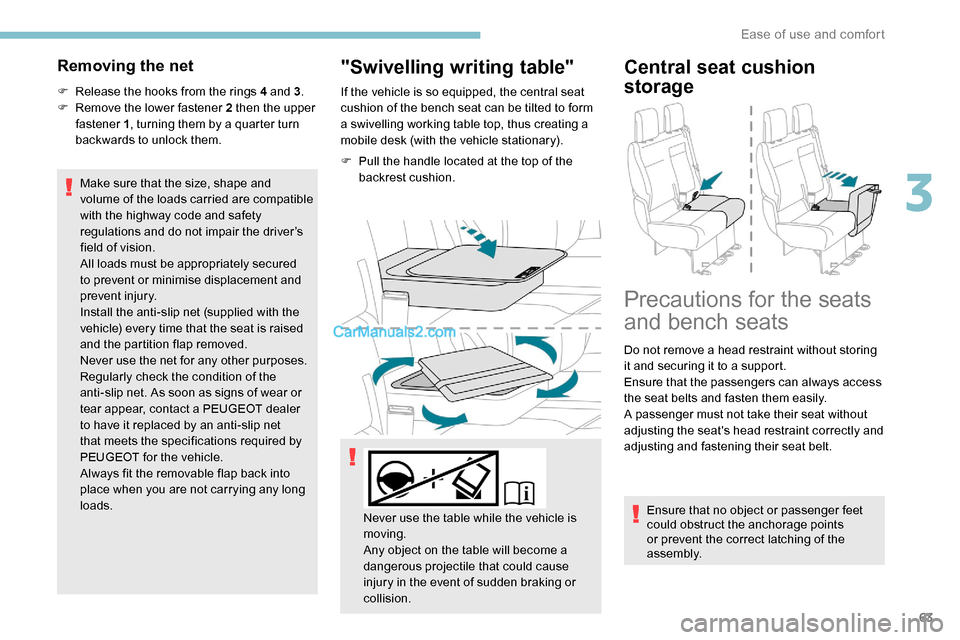
If the vehicle is so equipped, the central seat
cushion of the bench seat can be tilted to form
a swivelling working table top, thus creating a
mobile desk (with the vehicle stationary).
F
P
ull the handle located at the top of the
backrest cushion.
Central seat cushion
storage
Never use the table while the vehicle is
moving.
Any object on the table will become a
dangerous projectile that could cause
injury in the event of sudden braking or
collision.
Precautions for the seats
and bench seats
Do not remove a head restraint without storing
it and securing it to a support.
Ensure that the passengers can always access
the seat belts and fasten them easily.
A passenger must not take their seat without
adjusting the seat's head restraint correctly and
adjusting and fastening their seat belt.
Ensure that no object or passenger feet
could obstruct the anchorage points
or prevent the correct latching of the
assembly.
3
Ease of use and comfort