belt PEUGEOT EXPERT 2023 User Guide
[x] Cancel search | Manufacturer: PEUGEOT, Model Year: 2023, Model line: EXPERT, Model: PEUGEOT EXPERT 2023Pages: 348, PDF Size: 12 MB
Page 63 of 348
61
Ease of use and comfort
3
► If fitted to your vehicle, pull the control and
raise the backrest (from the rear , lower the
lever).
Check that the seat has correctly
engaged in its anchorage points on the
floor when returned to the sitting position.
Rear seat and bench seat
on rails
Active, Allure, Business VIP
The different equipment and settings described
hereafter vary according to the version and the
configuration of your vehicle.
The individual seat is always on the right and the
bench seat on the left (facing forward).
The seat has an independent backrest and the
bench seat has two independent backrests.
For more information on the Seat belts,
refer to the corresponding section.
Adjusting the angle of the backrest
The reclining backrest can be adjusted to several
positions.
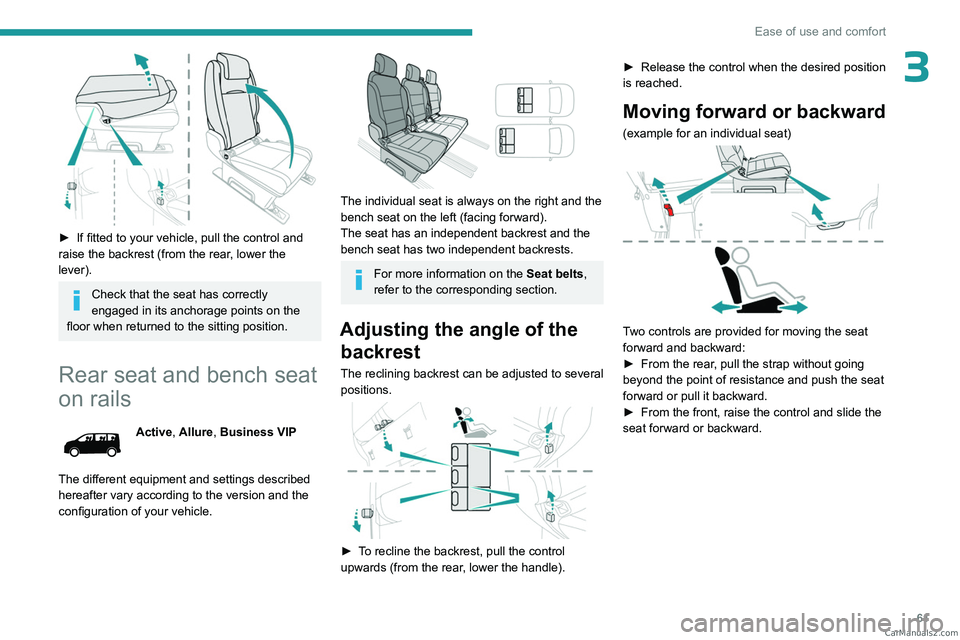
► To recline the backrest, pull the control
upwards (from the rear, lower the handle). ►
Release the control when the desired position
is reached.
Moving forward or backward
(example for an individual seat)
Two controls are provided for moving the seat
forward and backward:
►
From the rear
, pull the strap without going
beyond the point of resistance and push the seat
forward or pull it backward.
►
From the front, raise the control and slide the
seat forward or backward. CarM an uals 2 .c o m
Page 65 of 348
63
Ease of use and comfort
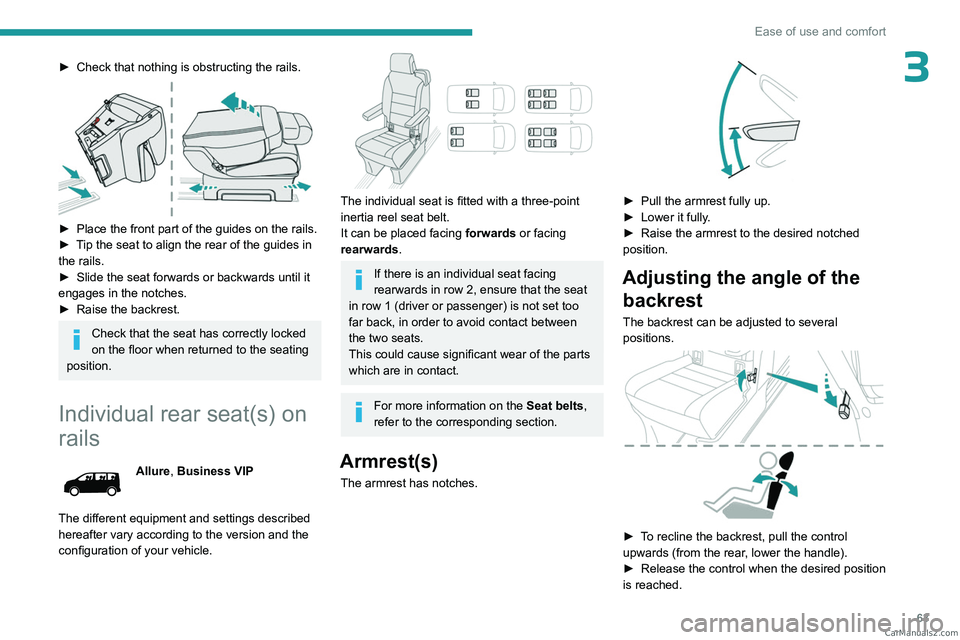
3► Check that nothing is obstructing the rails.
► Place the front part of the guides on the rails.
► T ip the seat to align the rear of the guides in
the rails.
►
Slide the seat forwards or backwards until it
engages in the notches.
►
Raise the backrest.
Check that the seat has correctly locked
on the floor when returned to the seating
position.
Individual rear seat(s) on
rails
Allure, Business VIP
The different equipment and settings described
hereafter vary according to the version and the
configuration of your vehicle.
The individual seat is fitted with a three-point
inertia reel seat belt.
It can be placed facing forwards or facing
rearwards .
If there is an individual seat facing
rearwards in row 2, ensure that the seat
in row 1 (driver or passenger) is not set too
far back, in order to avoid contact between
the two seats.
This could cause significant wear of the parts
which are in contact.
For more information on the Seat belts,
refer to the corresponding section.
Armrest(s)
The armrest has notches.
► Pull the armrest fully up.
► Lower it fully .
►
Raise the armrest to the desired notched
position.
Adjusting the angle of the backrest
The backrest can be adjusted to several
positions.
► To recline the backrest, pull the control
upwards (from the rear, lower the handle).
►
Release the control when the desired position
is reached. CarM an uals 2 .c o m
Page 67 of 348
65
Ease of use and comfort
3Refitting
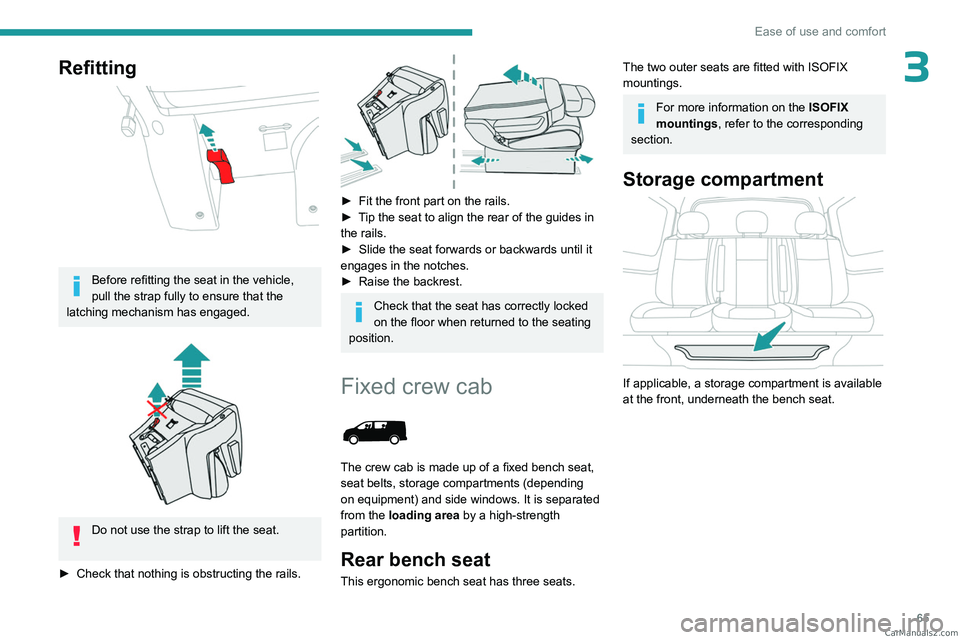
Before refitting the seat in the vehicle,
pull the strap fully to ensure that the
latching mechanism has engaged.
Do not use the strap to lift the seat.
►
Check that nothing is obstructing the rails.
► Fit the front part on the rails.
► T ip the seat to align the rear of the guides in
the rails.
►
Slide the seat forwards or backwards until it
engages in the notches.
►
Raise the backrest.
Check that the seat has correctly locked
on the floor when returned to the seating
position.
Fixed crew cab
The crew cab is made up of a fixed bench seat,
seat belts, storage compartments (depending
on equipment) and side windows. It is separated
from the loading area by a high-strength
partition.
Rear bench seat
This ergonomic bench seat has three seats.
The two outer seats are fitted with ISOFIX
mountings.
For more information on the ISOFIX
mountings , refer to the corresponding
section.
Storage compartment
If applicable, a storage compartment is available
at the front, underneath the bench seat. CarM an uals 2 .c o m
Page 68 of 348
66
Ease of use and comfort
Under seat cushion storage
wells
If the vehicle is so equipped, they are located
underneath the centre and outer left-hand seats.
To gain access to it from the cab, tip the required
seat forwards.
Depending on the country of sale, the wells can
be dismantled and removed through the rear so
that bulky objects can be stowed underneath the
bench seat.
Do not attach anything to the cab fixing
structure.
Do not exceed the number of passengers
indicated on the registration certificate.
In the rear, the loading area is intended for
carrying goods only.
You are advised to place the goods or heavy
objects as far forwards as possible in the
loading area (towards the cab) and secure
them by means of straps using the stowing
rings on the floor.
The rear seat belt frames are not designed to
secure the load being carried.
Folding crew cab
The crew cab has a folding bench seat, seat
belts and side windows. It is separated from
the loading area by the bench seat by a high-
strength grille.
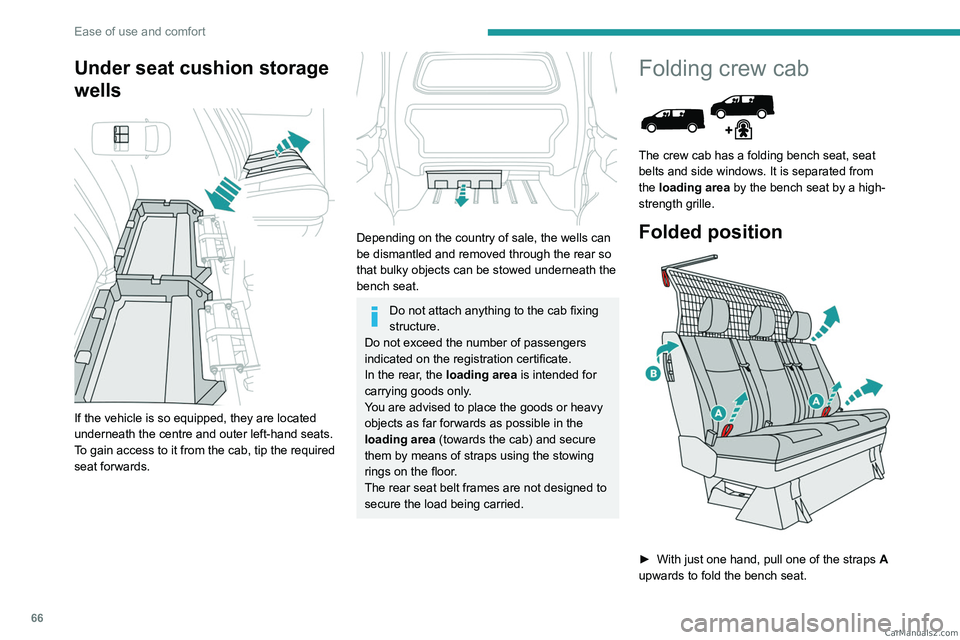
Folded position
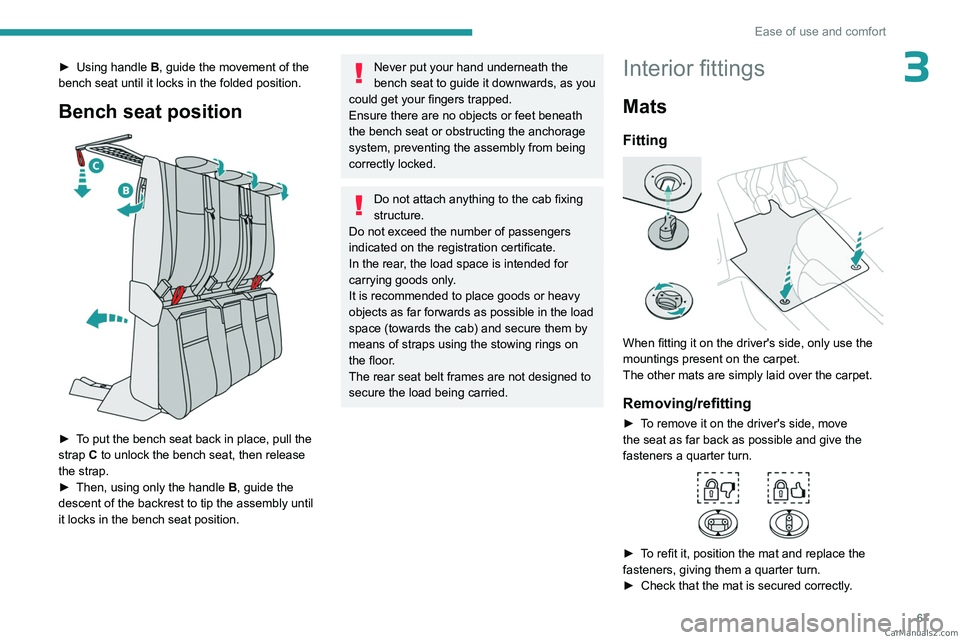
► With just one hand, pull one of the straps A
upwards to fold the bench seat. CarM an uals 2 .c o m
Page 69 of 348
67
Ease of use and comfort
3► Using handle B , guide the movement of the
bench seat until it locks in the folded position.
Bench seat position
► To put the bench seat back in place, pull the
strap C to unlock the bench seat, then release
the strap.
►
Then, using only the handle
B
, guide the
descent of the backrest to tip the assembly until
it locks in the bench seat position.
Never put your hand underneath the
bench seat to guide it downwards, as you
could get your fingers trapped.
Ensure there are no objects or feet beneath
the bench seat or obstructing the anchorage
system, preventing the assembly from being
correctly locked.
Do not attach anything to the cab fixing
structure.
Do not exceed the number of passengers
indicated on the registration certificate.
In the rear, the load space is intended for
carrying goods only.
It is recommended to place goods or heavy
objects as far forwards as possible in the load
space (towards the cab) and secure them by
means of straps using the stowing rings on
the floor.
The rear seat belt frames are not designed to
secure the load being carried.
Interior fittings
Mats
Fitting
When fitting it on the driver's side, only use the
mountings present on the carpet.
The other mats are simply laid over the carpet.
Removing/refitting
► To remove it on the driver's side, move
the seat as far back as possible and give the
fasteners a quarter turn.
► To refit it, position the mat and replace the
fasteners, giving them a quarter turn.
►
Check that the mat is secured correctly
. CarM an uals 2 .c o m
Page 105 of 348
103
Safety
5An indicator lamp associated with each mode
comes on, accompanied by the display of a
message to confirm your choice.
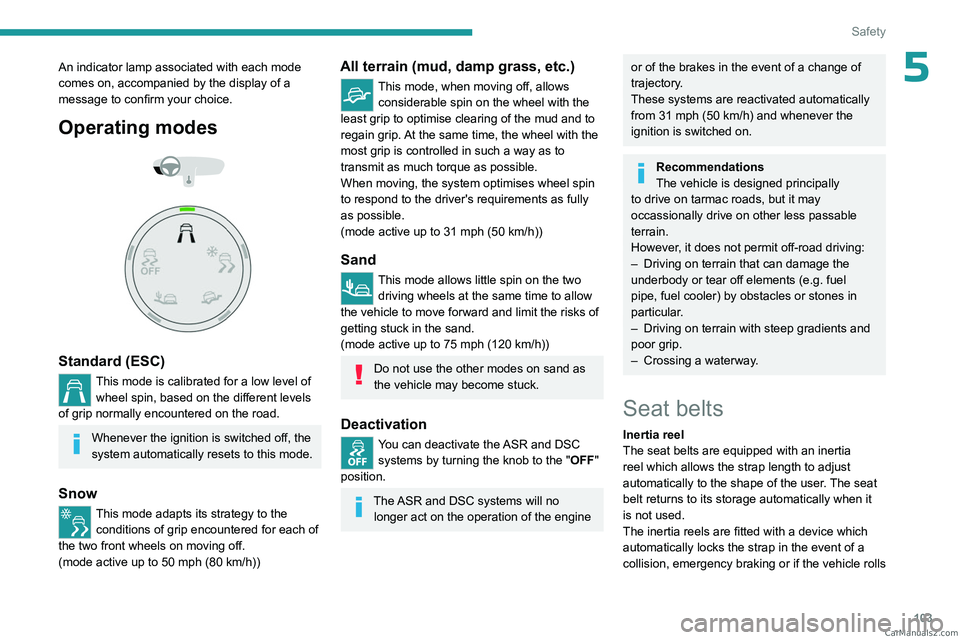
Operating modes
Standard (ESC)
This mode is calibrated for a low level of wheel spin, based on the different levels
of grip normally encountered on the road.
Whenever the ignition is switched off, the
system automatically resets to this mode.
Snow
This mode adapts its strategy to the conditions of grip encountered for each of
the two front wheels on moving off.
(mode active up to 50 mph (80
km/h))
All terrain (mud, damp grass, etc.)
This mode, when moving off, allows considerable spin on the wheel with the
least grip to optimise clearing of the mud and to
regain grip. At the same time, the wheel with the
most grip is controlled in such a way as to
transmit as much torque as possible.
When moving, the system optimises wheel spin
to respond to the driver's requirements as fully
as possible.
(mode active up to 31 mph (50
km/h))
Sand
This mode allows little spin on the two driving wheels at the same time to allow
the vehicle to move forward and limit the risks of
getting stuck in the sand.
(mode active up to 75 mph (120
km/h))
Do not use the other modes on sand as
the vehicle may become stuck.
Deactivation
You can deactivate the ASR and DSC systems by turning the knob to the "OFF"
position.
The ASR and DSC systems will no longer act on the operation of the engine
or of the brakes in the event of a change of
trajectory.
These systems are reactivated automatically
from 31 mph (50
km/h) and whenever the
ignition is switched on.
Recommendations
The vehicle is designed principally
to drive on tarmac roads, but it may
occassionally drive on other less passable
terrain.
However, it does not permit off-road driving:
–
Driving on terrain that can damage the
underbody or tear off elements (e.g.
fuel
pipe, fuel cooler) by obstacles or stones in
particular.
–
Driving on terrain with steep gradients and
poor grip.
–
Crossing a waterway
.
Seat belts
Inertia reel
The seat belts are equipped with an inertia
reel which allows the strap length to adjust
automatically to the shape of the user. The seat
belt returns to its storage automatically when it
is not used.
The inertia reels are fitted with a device which
automatically locks the strap in the event of a
collision, emergency braking or if the vehicle rolls CarM an uals 2 .c o m
Page 106 of 348
104
Safety
over. It can be released by pulling the strap firmly
and then releasing it so that it reels in slightly.
Pyrotechnic pretensioning
This system improves safety in the event of a
frontal or side impact.
Depending on the severity of the impact, the
pyrotechnic pretensioning system instantly
tightens the seat belts against the body of the
occupants.
The pyrotechnic pretensioning seat belts are
enabled when the ignition is on.
Force limiting system
This system reduces the pressure of the seat
belt on the chest of the occupant, thus improving
their protection.
In the event of an impact
Depending on the nature and
seriousness of the impacts, the pyrotechnic
device may trigger before and independently
of airbag deployment. Deployment of the
pretensioners is accompanied by a slight
discharge of harmless smoke and a noise,
due to the activation of the pyrotechnic
cartridge incorporated in the system.
In all cases, the airbag warning lamp comes
on.
Following an impact, have the seat belt
system checked, and if necessary replaced,
by a PEUGEOT dealer or a qualified
workshop.
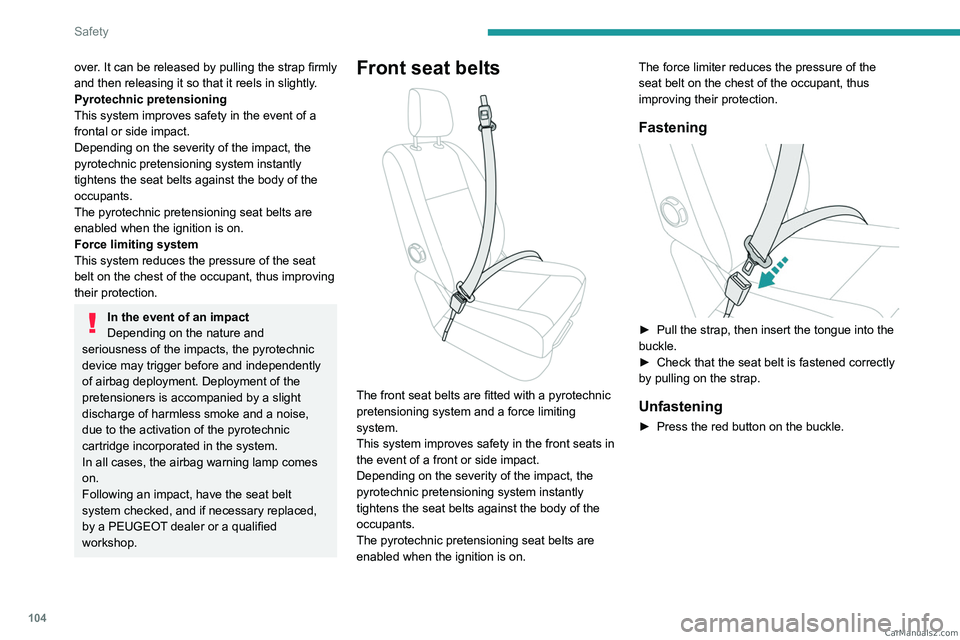
Front seat belts
The front seat belts are fitted with a pyrotechnic
pretensioning system and a force limiting
system.
This system improves safety in the front seats in
the event of a front or side impact.
Depending on the severity of the impact, the
pyrotechnic pretensioning system instantly
tightens the seat belts against the body of the
occupants.
The pyrotechnic pretensioning seat belts are
enabled when the ignition is on. The force limiter reduces the pressure of the
seat belt on the chest of the occupant, thus
improving their protection.
Fastening
► Pull the strap, then insert the tongue into the
buckle.
►
Check that the seat belt is fastened correctly
by pulling on the strap.
Unfastening
► Press the red button on the buckle. CarM an uals 2 .c o m
Page 107 of 348
105
Safety
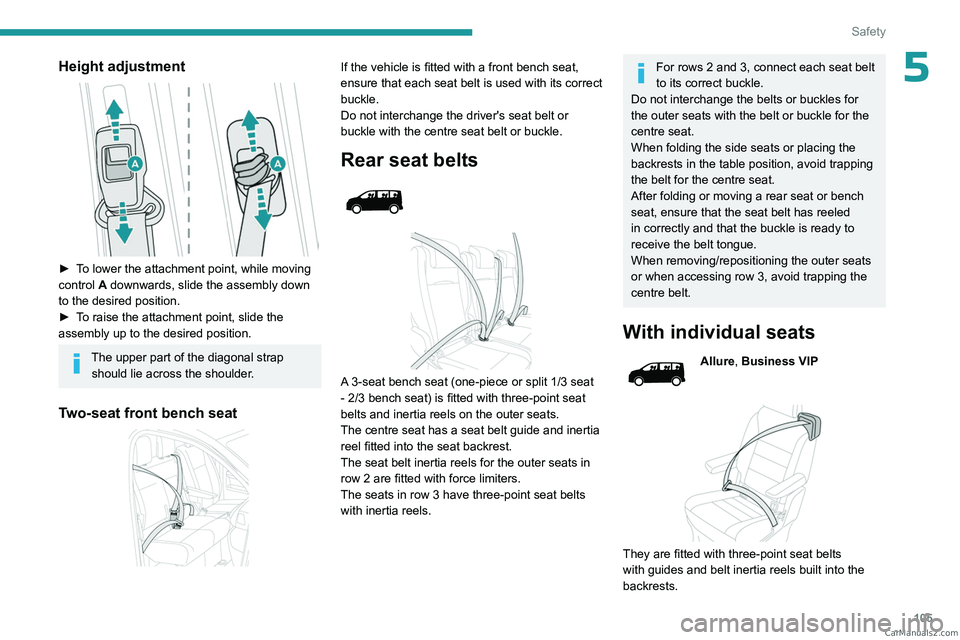
5Height adjustment
► To lower the attachment point, while moving
control A downwards, slide the assembly down
to the desired position.
►
T
o raise the attachment point, slide the
assembly up to the desired position.
The upper part of the diagonal strap should lie across the shoulder.
Two-seat front bench seat
If the vehicle is fitted with a front bench seat,
ensure that each seat belt is used with its correct
buckle.
Do not interchange the driver's seat belt or
buckle with the centre seat belt or buckle.
Rear seat belts
A 3-seat bench seat (one-piece or split 1/3 seat
- 2/3 bench seat) is fitted with three-point seat
belts and inertia reels on the outer seats.
The centre seat has a seat belt guide and inertia
reel fitted into the seat backrest.
The seat belt inertia reels for the outer seats in
row 2 are fitted with force limiters.
The seats in row 3 have three-point seat belts
with inertia reels.
For rows 2 and 3, connect each seat belt
to its correct buckle.
Do not interchange the belts or buckles for
the outer seats with the belt or buckle for the
centre seat.
When folding the side seats or placing the
backrests in the table position, avoid trapping
the belt for the centre seat.
After folding or moving a rear seat or bench
seat, ensure that the seat belt has reeled
in correctly and that the buckle is ready to
receive the belt tongue.
When removing/repositioning the outer seats
or when accessing row 3, avoid trapping the
centre belt.
With individual seats
Allure, Business VIP
They are fitted with three-point seat belts
with guides and belt inertia reels built into the
backrests. CarM an uals 2 .c o m
Page 108 of 348
106
Safety
Seat belt(s) warning lamps
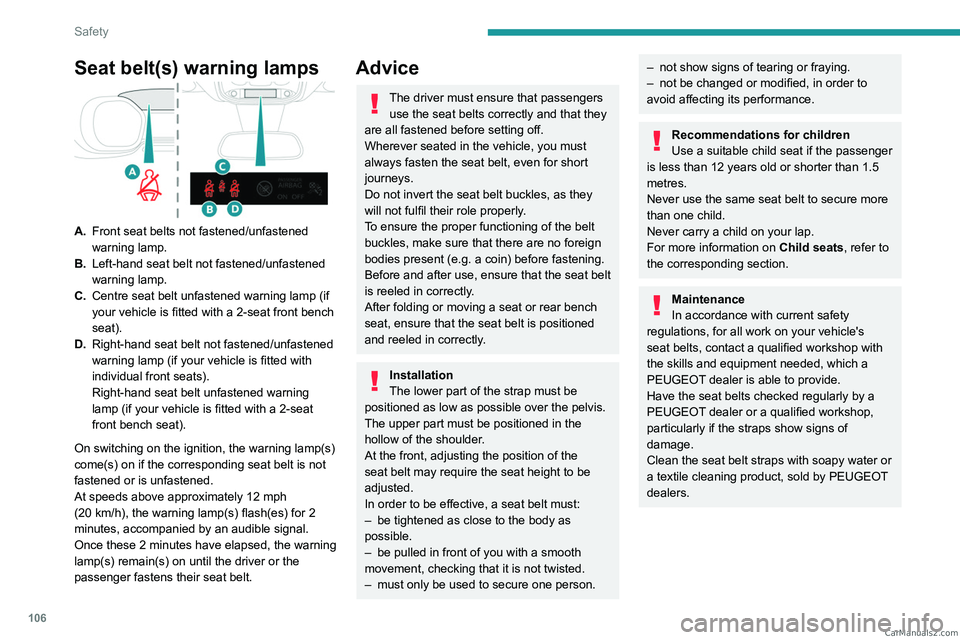
A.Front seat belts not fastened/unfastened
warning lamp.
B. Left-hand seat belt not fastened/unfastened
warning lamp.
C. Centre seat belt unfastened warning lamp (if
your vehicle is fitted with a 2-seat front bench
seat).
D. Right-hand seat belt not fastened/unfastened
warning lamp (if your vehicle is fitted with
individual front seats).
Right-hand seat belt unfastened warning
lamp (if your vehicle is fitted with a 2-seat
front bench seat).
On switching on the ignition, the warning lamp(s)
come(s) on if the corresponding seat belt is not
fastened or is unfastened.
At speeds above approximately 12 mph
(20
km/h), the warning lamp(s) flash(es) for 2
minutes, accompanied by an audible signal.
Once these 2 minutes have elapsed, the warning
lamp(s) remain(s) on until the driver or the
passenger fastens their seat belt.
Advice
The driver must ensure that passengers use the seat belts correctly and that they
are all fastened before setting off.
Wherever seated in the vehicle, you must
always fasten the seat belt, even for short
journeys.
Do not invert the seat belt buckles, as they
will not fulfil their role properly.
To ensure the proper functioning of the belt
buckles, make sure that there are no foreign
bodies present (e.g.
a coin) before fastening.
Before and after use, ensure that the seat belt
is reeled in correctly.
After folding or moving a seat or rear bench
seat, ensure that the seat belt is positioned
and reeled in correctly.
Installation
The lower part of the strap must be
positioned as low as possible over the pelvis.
The upper part must be positioned in the
hollow of the shoulder.
At the front, adjusting the position of the
seat belt may require the seat height to be
adjusted.
In order to be effective, a seat belt must:
–
be tightened as close to the body as
possible.
–
be pulled in front of you with a smooth
movement, checking that it is not twisted.
–
must only be used to secure one person.
– not show signs of tearing or fraying.
– not be changed or modified, in order to
avoid affecting its performance.
Recommendations for children
Use a suitable child seat if the passenger
is less than 12 years old or shorter than 1.5
metres.
Never use the same seat belt to secure more
than one child.
Never carry a child on your lap.
For more information on Child seats, refer to
the corresponding section.
Maintenance
In accordance with current safety
regulations, for all work on your vehicle's
seat belts, contact a qualified workshop with
the skills and equipment needed, which a
PEUGEOT
dealer is able to provide.
Have the seat belts checked regularly by a
PEUGEOT dealer or a qualified workshop,
particularly if the straps show signs of
damage.
Clean the seat belt straps with soapy water or
a textile cleaning product, sold by PEUGEOT
dealers. CarM an uals 2 .c o m
Page 109 of 348
107
Safety
5Airbags
General information
This system is designed to improve the safety
of the occupants of the front seats and the rear
outer seats in the event of a violent collision. The
airbags supplement the action of the seat belts
equipped with a force limiting system.
Electronic detectors record and analyse the
front and side impacts sustained in the impact
detection zones:
–
In the event of violent impact, the airbags
deploy instantly and help better protect the
occupants of the vehicle; immediately after the
impact, the airbags deflate rapidly in order not
to hinder the visibility or the possible exit of the
occupants.
–
In the event of a slight impact, a rear impact
and under certain rollover conditions, the airbags
may not deploy; only the seat belt helps to
protect you in these situations.
The seriousness of the impact depends on the
nature of the obstacle and the speed of the
vehicle at the moment of collision.
The airbags do not operate when the
ignition is switched off.
This equipment will only deploy once. If a
second impact occurs (during the same or a
* For more information on Deactivating the front passenger airbag, refer t\
o the corresponding section.
subsequent accident), the airbag will not be
deployed again.
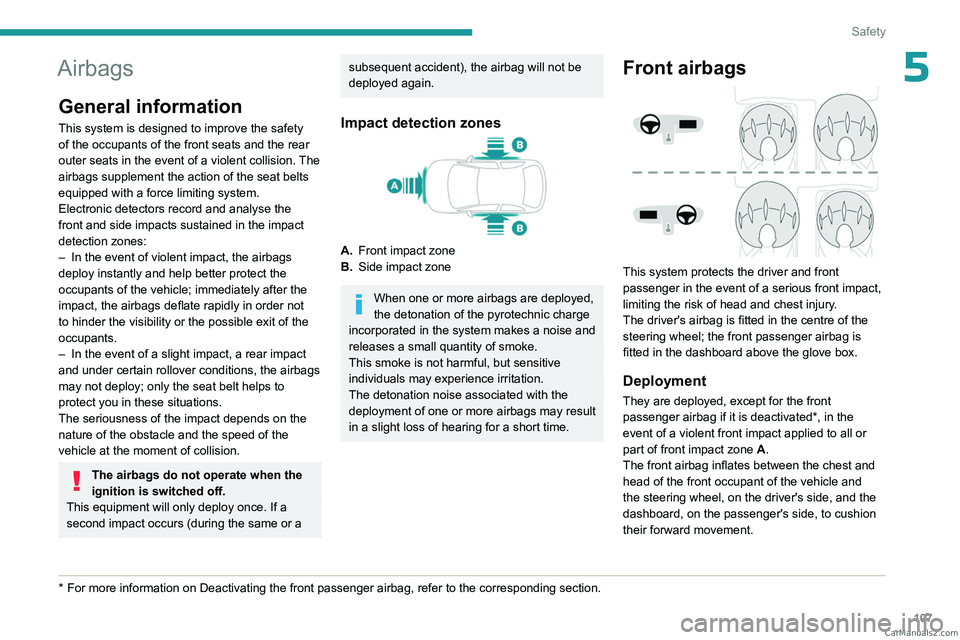
Impact detection zones
A. Front impact zone
B. Side impact zone
When one or more airbags are deployed,
the detonation of the pyrotechnic charge
incorporated in the system makes a noise and
releases a small quantity of smoke.
This smoke is not harmful, but sensitive
individuals may experience irritation.
The detonation noise associated with the
deployment of one or more airbags may result
in a slight loss of hearing for a short time.
Front airbags
This system protects the driver and front
passenger in the event of a serious front impact,
limiting the risk of head and chest injury.
The driver's airbag is fitted in the centre of the
steering wheel; the front passenger airbag is
fitted in the dashboard above the glove box.
Deployment
They are deployed, except for the front
passenger airbag if it is deactivated*, in the
event of a violent front impact applied to all or
part of front impact zone A.
The front airbag inflates between the chest and
head of the front occupant of the vehicle and
the steering wheel, on the driver's side, and the
dashboard, on the passenger's side, to cushion
their forward movement.
CarM an uals 2 .c o m