battery PEUGEOT EXPERT 2023 Repair Manual
[x] Cancel search | Manufacturer: PEUGEOT, Model Year: 2023, Model line: EXPERT, Model: PEUGEOT EXPERT 2023Pages: 348, PDF Size: 12 MB
Page 303 of 348
Instruments and controls 11
Hydrogen leakage
u illuminates red together with C
and a warning message is displayed
in the Driver Information Centre.
A hydrogen leak has been detected.
Do not park or transport the vehicle
indoors,
such as a garage or the like. 9
Warning Have the cause of the fault
remedied immediately by a
workshop. Fuel cell system fault
v and C are illuminated yellow
and a warning message is displayed
in the Driver Information Centre.
The range of the vehicle might be
reduced. In order to enable the
continuation of the journey, the high
voltage battery will be used.
Therefore, ensure that the charging
level
of the high voltage battery is high
enough.
Seek the assistance of a workshop.
Charging 3 14. Displays
Driver Information Centre Combined autonomy information
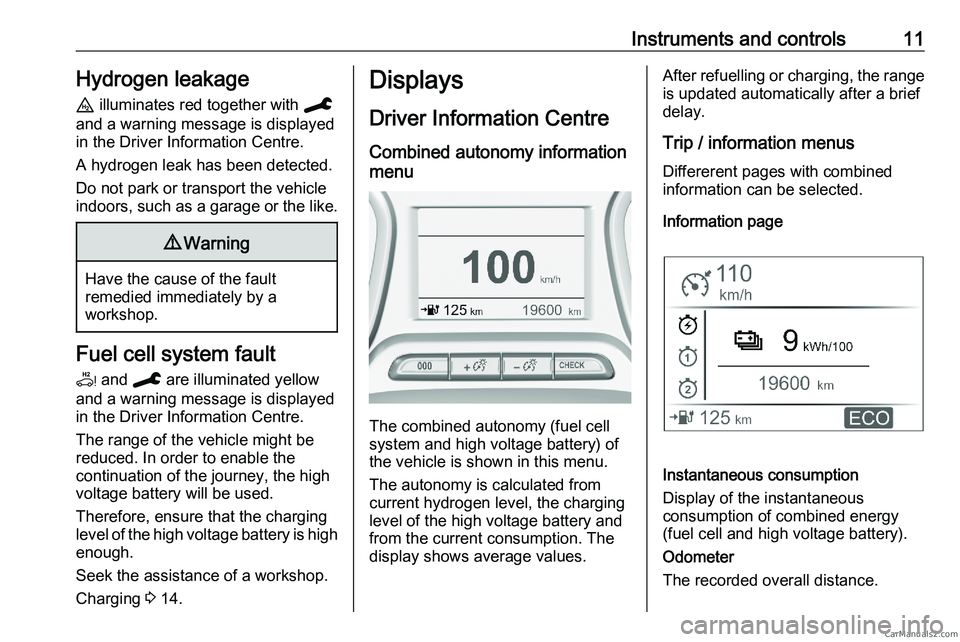
menu The combined autonomy (fuel cell
system and high voltage battery) of
the vehicle is shown in this menu.
The autonomy is calculated from
current hydrogen level, the charging
level of the high voltage battery and
from the current consumption. The
display shows average values. After refuelling or charging, the range
is updated automatically after a brief
delay.
Trip / information menus
Differerent pages with combined
information can be selected.
Information page Instantaneous consumption
Display of the instantaneous
consumption of combined energy
(fuel cell and high voltage battery).
Odometer
The recorded overall distance.CarM an uals 2 .c o m
Page 304 of 348
12 Instruments and controls
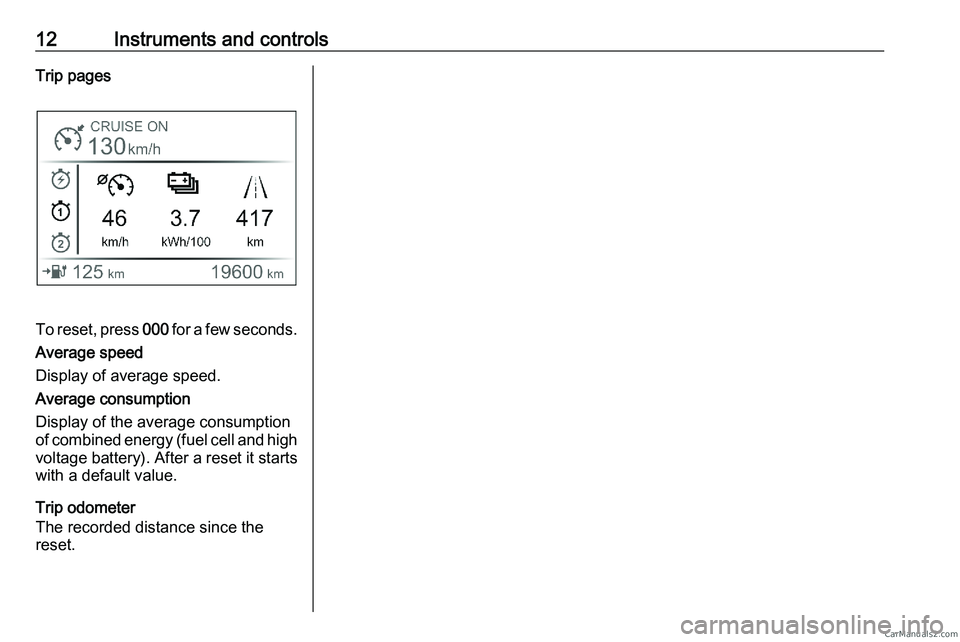
Trip pages To reset, press
000 for a few seconds.
Average speed
Display of average speed.
Average consumption
Display of the average consumption
of combined energy (fuel cell and high voltage battery). After a reset it starts
with a default value.
Trip odometer
The recorded distance since the
reset.CarM an uals 2 .c o m
Page 306 of 348
14 Driving and operating
Charging
General information Electric power consumption and
rangeThe electric power consumption and
the vehicle's range by using only the
high voltage battery were not
available at time of printing.
For the values specific to your
vehicle,
refer to the EEC Certificate of
Conformity provided with your vehicle
or other national registration
documents.
The determination of electric power
consumption is regulated by directive
R (EC) No. 715/2007 and No.
2017/1151 (in the latest applicable
version).
Charging
In order to ensure the compatibility of
plug and outlet, different labels are
used. The labels are located on the
inside of the vehicle's charging port
flap. Make sure to connect only a
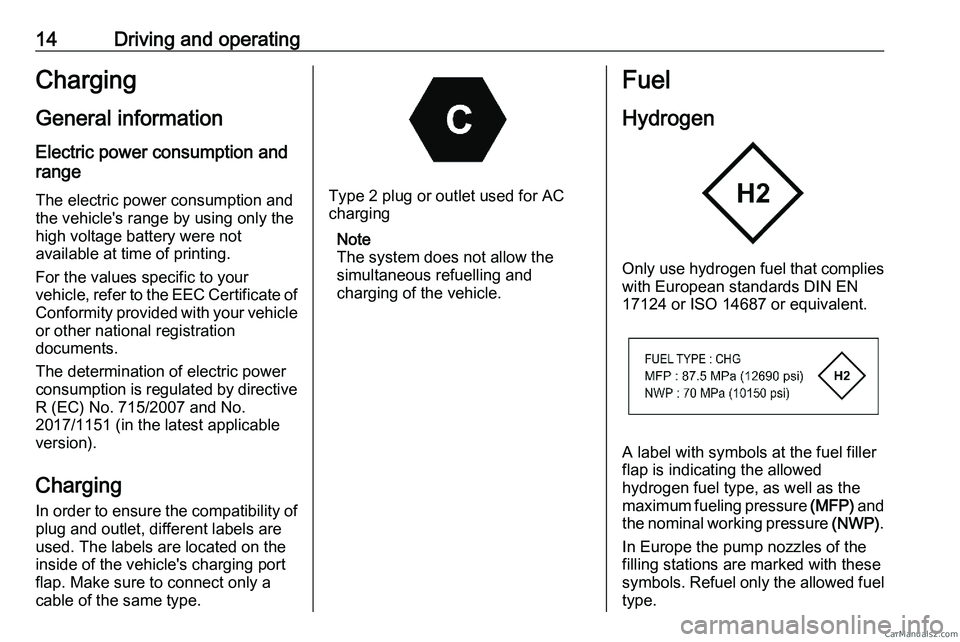
cable of the same type. Type 2 plug or outlet used for AC
charging
Note
The system does not allow the
simultaneous refuelling and
charging of the vehicle. Fuel
Hydrogen Only use hydrogen fuel that complies
with European standards DIN EN
17124 or ISO 14687 or equivalent. A label with symbols at the fuel filler
flap is indicating the allowed
hydrogen fuel type, as well as the
maximum
fueling pressure (MFP) and
the nominal working pressure (NWP).
In Europe the pump nozzles of the
filling stations are marked with these
symbols. Refuel only the allowed fuel type.CarM an uals 2 .c o m
Page 313 of 348
Vehicle care 21
Wheels and tyres
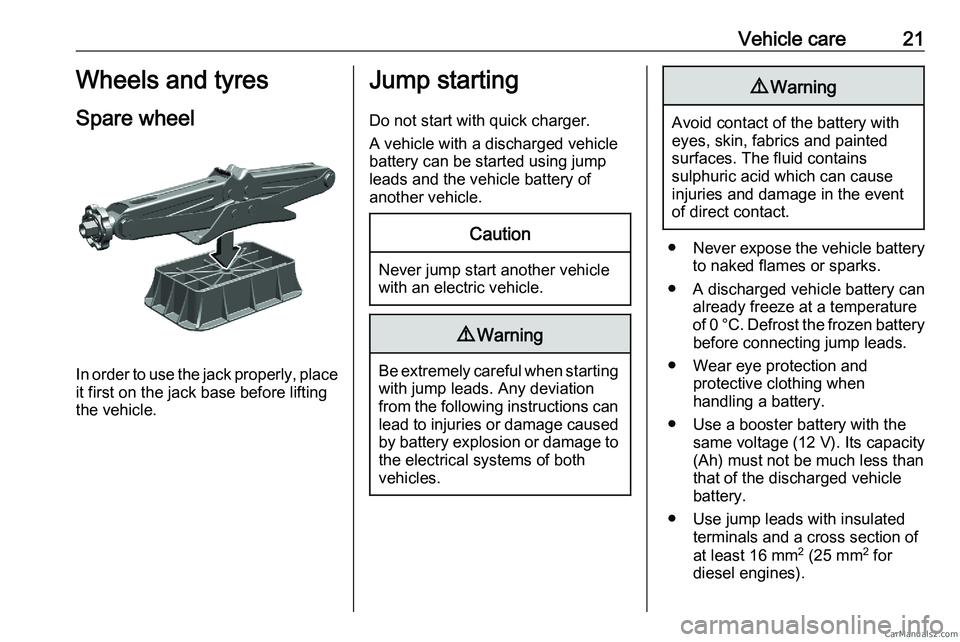
Spare wheel In order to use the jack properly, place
it first on the jack base before lifting
the vehicle. Jump starting
Do not start with quick charger.
A vehicle with a discharged vehicle
battery can be started using jump
leads and the vehicle battery of
another vehicle. Caution
Never jump start another vehicle
with an electric vehicle.
9
Warning Be extremely careful when starting
with jump leads. Any deviation
from
the following instructions can
lead to injuries or damage caused
by battery explosion or damage to the electrical systems of both
vehicles. 9
Warning Avoid contact of the battery with
eyes, skin, fabrics and painted
surfaces. The fluid contains
sulphuric acid which can cause
injuries and damage in the event
of direct contact. ● Never
expose the vehicle battery
to naked flames or sparks.
● A discharged vehicle battery can already freeze at a temperature
of 0 °C. Defrost the frozen batterybefore connecting jump leads.
● Wear eye protection and protective clothing when
handling a battery.
● Use a booster battery with the same voltage (12 V). Its capacity
(Ah) must not be much less than
that of the discharged vehicle
battery.
● Use jump leads with insulated terminals and a cross section of
at least 16 mm 2
(25 mm 2
for
diesel engines).CarM an uals 2 .c o m
Page 314 of 348
22 Vehicle care
● Do not disconnect the discharged vehicle battery from the vehicle.
● Switch off all unnecessary electrical consumers.
● Do not lean over the vehicle battery during jump starting.
● Do not allow the terminals of one lead to touch those of the other
lead.
● The vehicles must not come into contact with each other during
the jump starting process.
● Apply the parking brake, transmission in neutral,
automatic transmission in P. Disengage the cover of the fuse box
in the engine compartment to access
the positive terminal of the vehicle
battery.
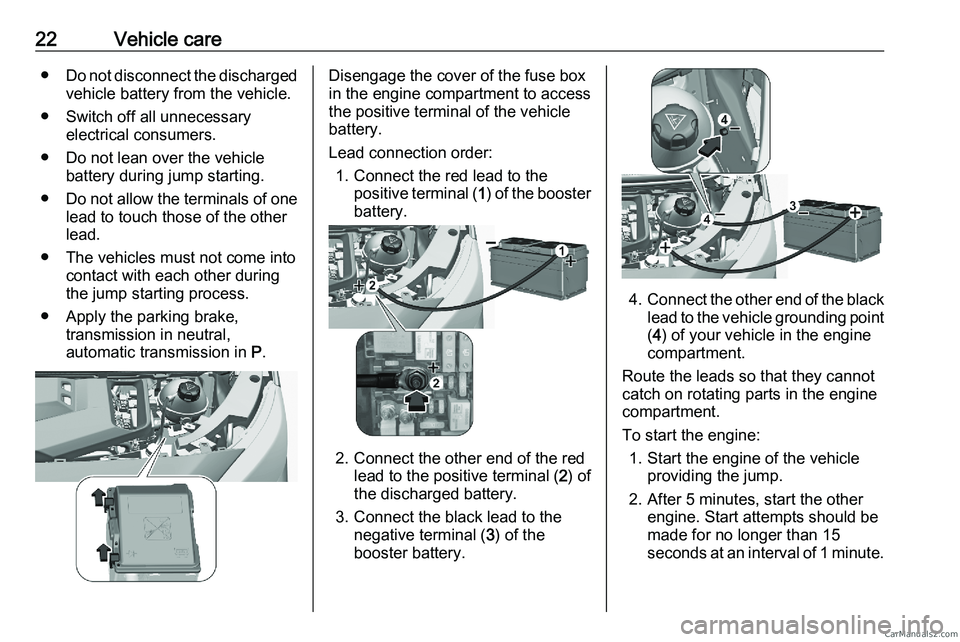
Lead connection order:
1.
Connect the red lead to the
positive terminal (1) of the booster
battery. 2. Connect the other end of the red
lead to the positive terminal ( 2) of
the discharged battery.
3.
Connect the black lead to the
negative terminal ( 3) of the
booster battery. 4. Connect
the other end of the black
lead to the vehicle grounding point
(4) of your vehicle in the engine
compartment.
Route the leads so that they cannot
catch on rotating parts in the engine
compartment.
To start the engine: 1. Start the engine of the vehicle providing the jump.
2. After 5 minutes, start the other engine. Start attempts should be
made for no longer than 15
seconds at an interval of 1 minute.CarM an uals 2 .c o m
Page 318 of 348
![PEUGEOT EXPERT 2023 Repair Manual 26 Technical data
Vehicle data Engine data Fuel cell vehicle
Engine power [kW] 100
Fuel cell power [kW] 45
Fuel type Hydrogen
Combined range (high voltage battery and fuel cell) approx. 400 kmCapaciti](/img/29/77114/w960_77114-317.png "PEUGEOT EXPERT 2023 Repair Manual 26 Technical data
Vehicle data Engine data Fuel cell vehicle
Engine power [kW] 100
Fuel cell power [kW] 45
Fuel type Hydrogen
Combined range (high voltage battery and fuel cell) approx. 400 kmCapaciti")
26 Technical data
Vehicle data Engine data Fuel cell vehicle
Engine power [kW] 100
Fuel cell power [kW] 45
Fuel type Hydrogen
Combined range (high voltage battery and fuel cell) approx. 400 kmCapacities
Hydrogen tanks
Hydrogen, refilling quantity [kg] 4.4High voltage battery
Battery capacity [kWh] 10.5Tyre pressures
Regarding tyre pressures for a
specific vehicle, refer to the tyre
pressure information label on the B-
pillar. The tyre pressure information label
indicates
the original equipment tyres
and the correspondent tyre
pressures.CarM an uals 2 .c o m