chapter 9 Peugeot Expert Tepee 2013 User Guide
[x] Cancel search | Manufacturer: PEUGEOT, Model Year: 2013, Model line: Expert Tepee, Model: Peugeot Expert Tepee 2013Pages: 260, PDF Size: 9.78 MB
Page 39 of 260
37
Instruments and controls
REA
DY
TO SET OFF
2
EMISSIONS CONTROLS
The driver is warned of any malfunction
of this emission control system by the
illumination of this specific warning lamp in
the instrument panel.
There is a risk of damage to the catalytic
converter. Have it checked by a PEUGEOT
dealer or a qualified workshop. EOBD (European On Board
Diagnosis) is a diagnostics system
which complies with, among
others, the standards concerning
authorised emissions of:
- CO (carbon monoxide),
- HC (unburnt hydrocarbons),
- NOx (nitrous oxides) or particles,
detected by oxygen sensors placed
upstream and downstream of the
catalytic converters.
DETECTION
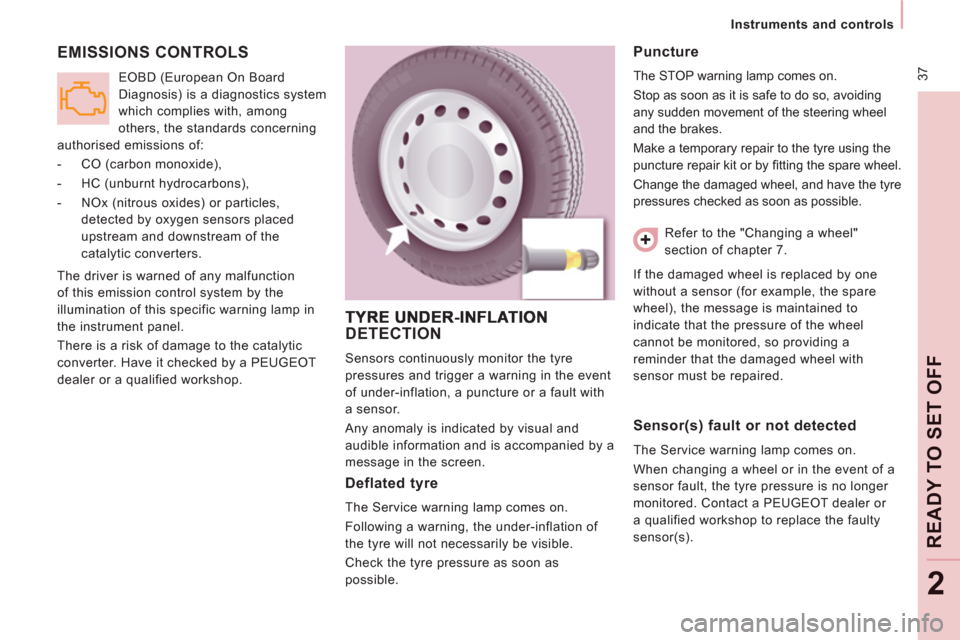
Sensors continuously monitor the tyre
pressures and trigger a warning in the event
of under-inflation, a puncture or a fault with
a sensor.
Any anomaly is indicated by visual and
audible information and is accompanied by a
message in the screen.
Deflated tyre
The Service warning lamp comes on.
Following a warning, the under-inflation of
the tyre will not necessarily be visible.
Check the tyre pressure as soon as
possible.
Puncture
The STOP warning lamp comes on.
Stop as soon as it is safe to do so, avoiding
any sudden movement of the steering wheel
and the brakes.
Make a temporary repair to the tyre using the
puncture repair kit or by fi tting the spare wheel.
Change the damaged wheel, and have the tyre
pressures checked as soon as possible.
Sensor(s) fault or not detected
The Service warning lamp comes on.
When changing a wheel or in the event of a
sensor fault, the tyre pressure is no longer
monitored. Contact a PEUGEOT dealer or
a qualified workshop to replace the faulty
sensor(s). Refer to the "Changing a wheel"
section of chapter 7.
If the damaged wheel is replaced by one
without a sensor (for example, the spare
wheel), the message is maintained to
indicate that the pressure of the wheel
cannot be monitored, so providing a
reminder that the damaged wheel with
sensor must be repaired.
Page 48 of 260
46
Steering mounted controls
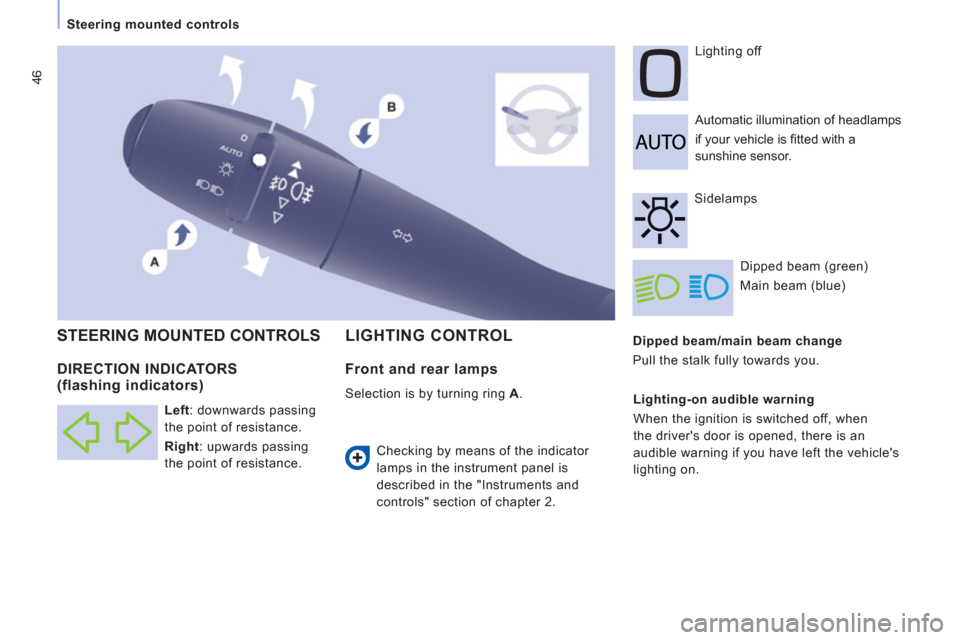
Dipped beam/main beam change
Pull the stalk fully towards you. Automatic illumination of headlamps
if your vehicle is fi tted with a
sunshine sensor. Lighting off
Dipped beam (green)
Main beam (blue)
LIGHTING CONTROL
STEERING MOUNTED CONTROLS
Sidelamps
Lighting-on audible warning
When the ignition is switched off, when
the driver's door is opened, there is an
audible warning if you have left the vehicle's
lighting on.
DIRECTION INDICATORS (flashing indicators)
Left
: downwards passing
the point of resistance.
Right
: upwards passing
the point of resistance.
Front and rear lamps
Selection is by turning ring A
.
Checking by means of the indicator
lamps in the instrument panel is
described in the "Instruments and
controls" section of chapter 2.
Page 51 of 260
49
Steering mounted controls
EASE OF USE and COMFOR
T
3
WINDSCREEN WIPER STALK
Manual windscreen wipers
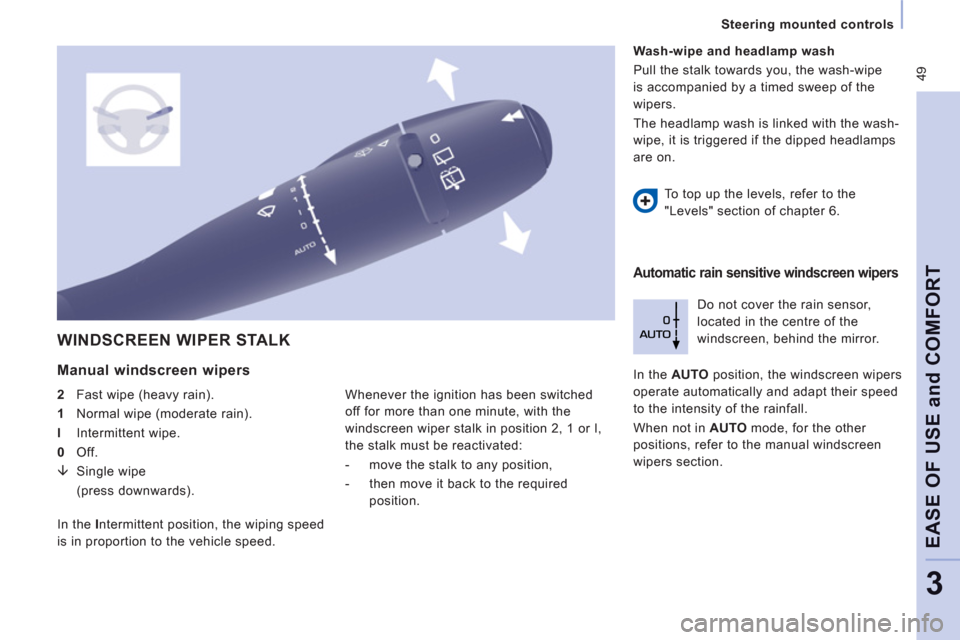
2
Fast wipe (heavy rain).
1
Normal wipe (moderate rain).
l
Intermittent wipe.
0
Off.
È
Single wipe
(press downwards). Do not cover the rain sensor,
located in the centre of the
windscreen, behind the mirror.
In the AUTO
position, the windscreen wipers
operate automatically and adapt their speed
to the intensity of the rainfall.
When not in AUTO
mode, for the other
positions, refer to the manual windscreen
wipers section.
In the I
ntermittent position, the wiping speed
is in proportion to the vehicle speed.
Wash-wipe and headlamp wash
Pull the stalk towards you, the wash-wipe
is accompanied by a timed sweep of the
wipers.
The headlamp wash is linked with the wash-
wipe, it is triggered if the dipped headlamps
are on.
To top up the levels, refer to the
"Levels" section of chapter 6.
Automatic rain sensitive windscreen wipers
Whenever the ignition has been switched
off for more than one minute, with the
windscreen wiper stalk in position 2, 1 or I,
the stalk must be reactivated:
- move the stalk to any position,
- then move it back to the required
position.
Page 52 of 260
Steering mounted controls
Special position of the windscreen
wipers
In the minute following switching off of the
ignition, any action on the stalk positions the
wipers against the windscreen uprights. This action enables you to position the
wiper blades for winter parking, cleaning or
replacement.
Refer to the "Changing a windscreen
wiper blade" section of chapter 7.
To park the wipers in their normal position
after this has been done, switch on the
ignition and move the stalk. When using an automatic car wash,
switch off the ignition to avoid
triggering the automatic wiping.
In winter, it is advisable to wait for the
windscreen to completely clear of ice before
operating automatic wipe.
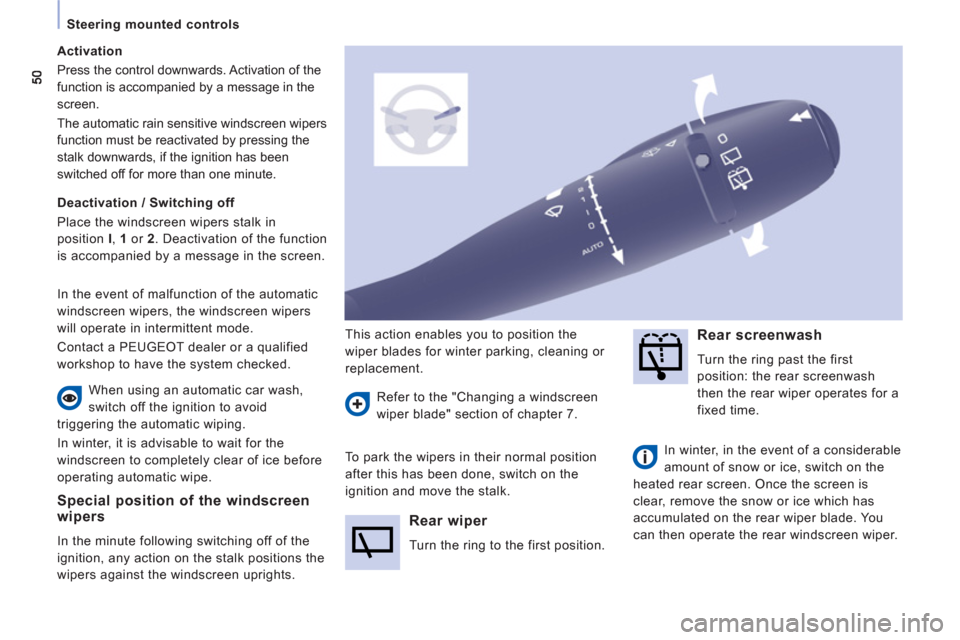
Rear wiper
Turn the ring to the first position.
Rear screenwash
Turn the ring past the first
position: the rear screenwash
then the rear wiper operates for a
fixed time.
In winter, in the event of a considerable
amount of snow or ice, switch on the
heated rear screen. Once the screen is
clear, remove the snow or ice which has
accumulated on the rear wiper blade. You
can then operate the rear windscreen wiper.
Activation
Press the control downwards. Activation of the
function is accompanied by a message in the
screen.
The automatic rain sensitive windscreen wipers
function must be reactivated by pressing the
stalk downwards, if the ignition has been
switched off for more than one minute.
Deactivation / Switching off
Place the windscreen wipers stalk in
position I
, 1
or 2
. Deactivation of the function
is accompanied by a message in the screen.
In the event of malfunction of the automatic
windscreen wipers, the windscreen wipers
will operate in intermittent mode.
Contact a PEUGEOT dealer or a qualified
workshop to have the system checked.
Page 64 of 260
62
Ventilation
CORRECT USE OF THE VENTILATION AND AIR
CONDITIONING
Vents
"Leave them open"
For optimum distribution and diffusion of hot
or cool air in the passenger compartment,
there are adjustable central and side vents
which can be directed sideways (right or
left) towards the top of the body. For your
comfort while driving, do not close them,
direct the flow of air towards the windows
instead.
The air vents directed towards the floor of
the vehicle complete the equipment.
Passenger compartment filter, carbon filter
Ensure that this fi lter is in good condition and
have all of the fi lter elements replaced regularly.
Refer to the "Checks" section of
chapter 6.
Air conditioning
In all seasons, the air conditioning should
only be used with the windows closed.
However, if the interior temperature remains
high after a prolonged period parked
in the sun, first ventilate the passenger
compartment for a few minutes. Use the AUTO mode as much as
possible as it permits optimised control
of all of the functions: air flow, passenger
compartment comfort temperature,
air distribution, air intake mode or air
recirculation in the passenger compartment.
Operate the air conditioning system for 5 to
10 minutes, once or twice a month, to keep
it in perfect working order.
It is normal that the condensation created by
the air conditioning system results in a flow
of water which may form a puddle under the
vehicle when parked.
If the system does not produce cold air, do
not use it and contact a PEUGEOT dealer or
a qualified workshop.
Page 92 of 260
90
Rear suspension
Deactivation of manual height correction
Good practice
When stationary and with the ignition key
removed, excessive use of the system
consumes battery power.
Long term parking
Avoid parking for a long duration on ground
which could present a potential obstacle as
your vehicle could lower.
Following a long period out of use, the
height of the platform may change due to the
automatic height correction on unlocking or
on opening one of your vehicle's doors. With the vehicle stationary:
- press and hold,
- release the control.
Deactivation is confirmed by
the LED which is on. It remains on for
approximately 30 seconds.
Return to manual height correction
You must deactivate the manual height
correction in the following situations:
- when working underneath the vehicle,
- when changing a wheel,
- when the vehicle is being transported by
lorry, train, ferry, boat, ...
Driving with the height of the rear platform:
- too low, risks damaging the technical
components underneath the vehicle,
- too high, risks unstable driving.
If you start and the warning lamp flashes, to
switch it off:
- correct the position of the manual
control which is still at the lower or
upper limit,
- or drive slowly at above 6 mph
(10 km/h), until height correction returns
to automatic mode.
Warning lamp
Refer to the "Instruments and controls"
section of chapter 2.
With the vehicle stationary:
- press and hold,
- release the control.
Return to manual correction is
confirmed by the LED which goes off.
According to the configuration, a beep may
be heard during these operations.
Page 103 of 260
101
Seat belts
SAFETY
4
The force limiter reduces the pressure of the
seat belt against the body of the occupants.
The pretensioning seat belts are active when
the ignition is switched on.
The inertia reels are fitted with a device
which automatically locks the strap in the
event of a collision or emergency braking or
if the vehicle rolls over.
You can unfasten the seat belt by pressing
the red button on the buckle. Guide the seat
belt after unfastening.
The airbag warning lamp comes on if the
pretensioners are deployed. Contact a
PEUGEOT dealer or a qualified workshop.
Recommendations for children:
- use a suitable child seat if the
passenger is less than 12 years old or
shorter than one metre fifty,
- never allow a child to travel on your lap,
even with the seat belt fastened.
FRONT SEAT BELTS
REAR SEAT BELTS
If your vehicle is fitted with an individual seat
and a 2-seat bench, the 3 seats are fitted
with three-point seat belts and inertia reels.
The centre seat has its seat belt guide and
inertia reel integrated with the seat back. For more information on child seats,
refer to the "Children on board" section
of chapter 4.
In accordance with current safety
regulations, your PEUGEOT dealer can
guarantee all work or any checks, from
testing to maintenance, on your seat belt
equipment.
Have the seat belts checked regularly (even
after a minor impact) by a PEUGEOT dealer
or a qualified workshop: they must not show
any signs of wear, cutting or fraying and they
must not be converted or modified.
Clean the seat belt straps with soapy
water or a textile cleaning product, sold
by PEUGEOT dealers.
In order to be effective, a seat belt must:
- restrain one person only,
- must not be twisted, check by pulling in
front of you with an even movement,
- be tightened as close to the body as
possible.
The upper part of the seat belt should be
positioned in the hollow of the shoulder.
The lap part should be placed as low as
possible on the pelvis.
Do not invert the seat belt buckles as they will
not fulfi l their role completely. If the seats are
fi tted with armrests, the lap part of the seat
belt should always pass under the armrest.
Check that the seat belt is fastened correctly
by pulling the strap firmly.
With front air bags
The front seats are fitted with pretensioners
and force limiters.
Without front air bag
If your vehicle is fitted with a front bench
without front air bag, the centre passenger's
seat belt does not have a pretensioner.
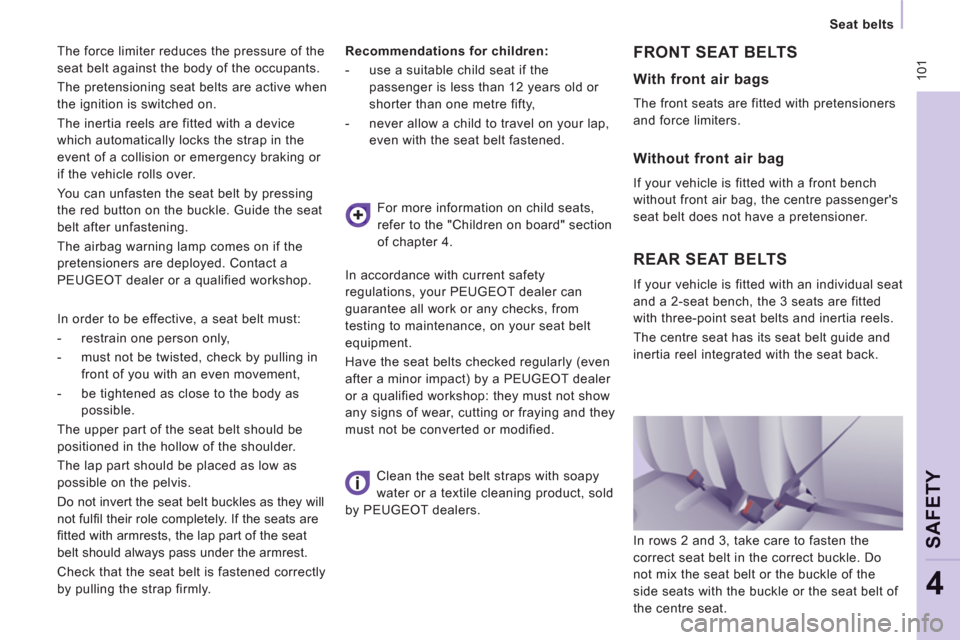
In rows 2 and 3, take care to fasten the
correct seat belt in the correct buckle. Do
not mix the seat belt or the buckle of the
side seats with the buckle or the seat belt of
the centre seat.
Page 105 of 260
103
Airbags
SAFETY
4
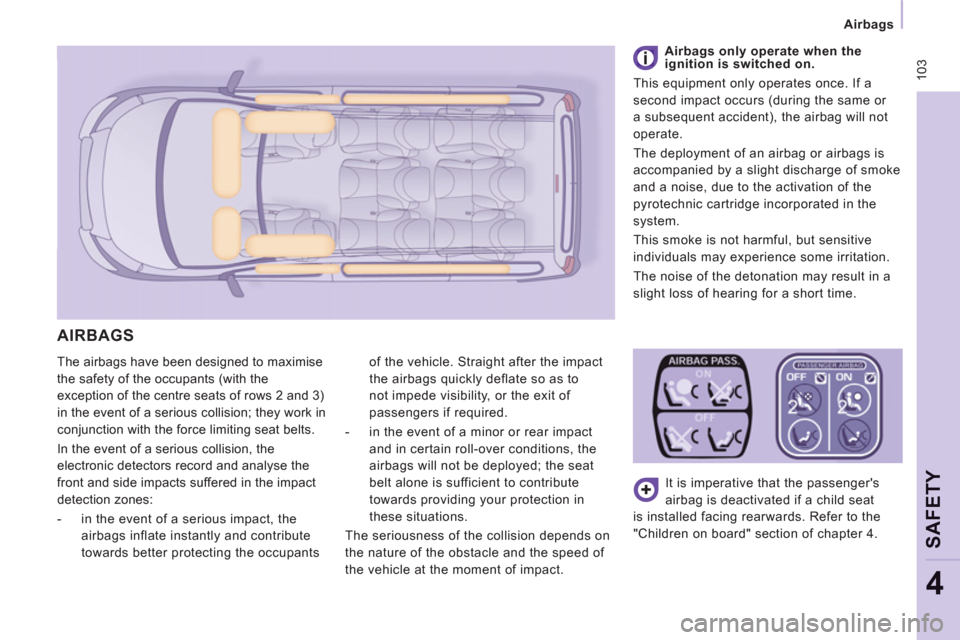
The airbags have been designed to maximise
the safety of the occupants (with the
exception of the centre seats of rows 2 and 3)
in the event of a serious collision; they work in
conjunction with the force limiting seat belts.
In the event of a serious collision, the
electronic detectors record and analyse the
front and side impacts suffered in the impact
detection zones:
- in the event of a serious impact, the
airbags inflate instantly and contribute
towards better protecting the occupants of the vehicle. Straight after the impact
the airbags quickly deflate so as to
not impede visibility, or the exit of
passengers if required.
- in the event of a minor or rear impact
and in certain roll-over conditions, the
airbags will not be deployed; the seat
belt alone is sufficient to contribute
towards providing your protection in
these situations.
The seriousness of the collision depends on
the nature of the obstacle and the speed of
the vehicle at the moment of impact. It is imperative that the passenger's
airbag is deactivated if a child seat
is installed facing rearwards. Refer to the
"Children on board" section of chapter 4.
Airbags only operate when the
ignition is switched on.
This equipment only operates once. If a
second impact occurs (during the same or
a subsequent accident), the airbag will not
operate.
The deployment of an airbag or airbags is
accompanied by a slight discharge of smoke
and a noise, due to the activation of the
pyrotechnic cartridge incorporated in the
system.
This smoke is not harmful, but sensitive
individuals may experience some irritation.
The noise of the detonation may result in a
slight loss of hearing for a short time.
AIRBAGS
Page 110 of 260
108
Child safety
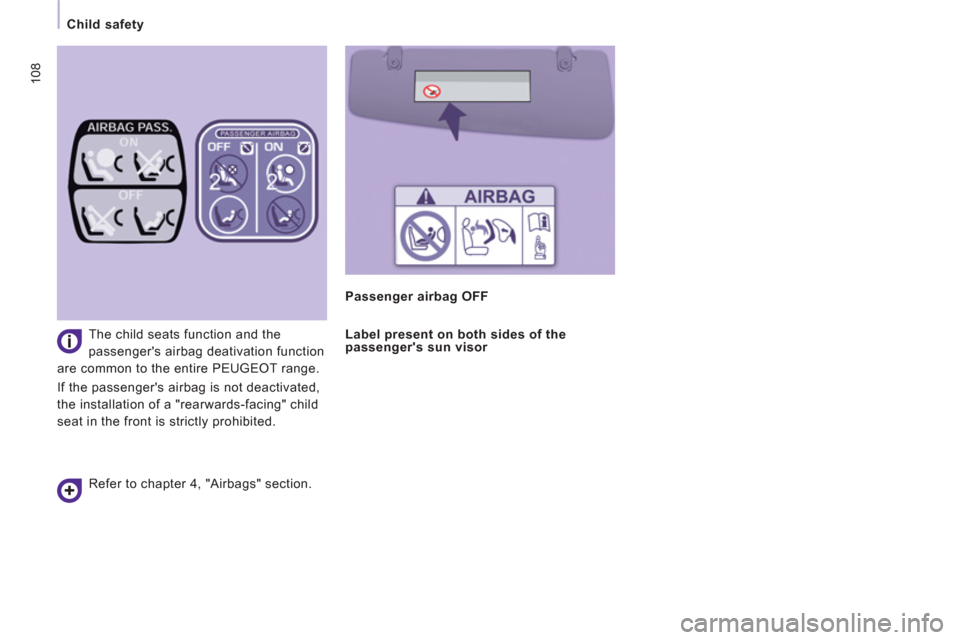
The child seats function and the
passenger's airbag deativation function
are common to the entire PEUGEOT range.
If the passenger's airbag is not deactivated,
the installation of a "rearwards-facing" child
seat in the front is strictly prohibited.
Refer to chapter 4, "Airbags" section.
Passenger airbag OFF
Label present on both sides of the
passenger's sun visor
Page 119 of 260
11 7
Towing a trailer
ACCE
SS
ORIE
S
5
For more information about weights,
refer to the administrative documents
(registration document, ...) or to the
"Weights" section of chapter 8.
TOWING A TRAILER, CARAVAN, BOAT, ETC...
Distribution of loads
Distribute the load in the trailer so that the
heaviest objects are as close as possible
to the axle and the nose weight is close to
the maximum authorised without, however,
exceeding it.
Cooling
Towing a trailer on a slope increases the
coolant temperature.
As the fan is electrically controlled, its
cooling capacity is not dependent on the
engine speed.
Driving advice
A towed vehicle must free wheel: gearbox in
neutral.