chapter 9 Peugeot Expert Tepee 2013 Owner's Guide
[x] Cancel search | Manufacturer: PEUGEOT, Model Year: 2013, Model line: Expert Tepee, Model: Peugeot Expert Tepee 2013Pages: 260, PDF Size: 9.78 MB
Page 120 of 260
11 8
Towing a trailer
You should therefore use a high gear to
lower the engine speed and reduce your
speed.
In all cases, pay attention to the coolant
temperature.
Ty r e s
Check the tyre pressures of the towing
vehicle (see the "Identification markings"
section of chapter 8) and of the trailer,
observing the recommended pressures.
Towbar
We recommend the use of genuine
PEUGEOT towbars and their harnesses,
which have been tested and approved from
the design stage of your vehicle, and that
you entrust the fitting of this equipment to a
PEUGEOT dealer.
If this equipment is not fitted by a PEUGEOT
dealer, it is imperative that it is fitted using
the electrical pre-equipment installed at the
rear of the vehicle and in accordance with
the manufacturer's instructions.
In accordance with the general instructions
a reminder of which has been given above,
we draw your attention to the risk associated
with fitting a towbar or electrical accessory
not recommended by PEUGEOT. Fitting
such equipment could result in the failure
of your vehicle's electronic system. Please
obtain information from the Manufacturer
before fitting this type of equipment. If the coolant temperature warning
lamp comes on, stop the vehicle
and switch off the engine as soon
as possible.
Good Practice
In certain cases of particularly arduous
use (towing the maximum load up a steep
slope in high temperatures), the engine
automatically limits its power. In this
case, the air conditioning is automatically
cut off to save engine power.
See the "Levels" section of chapter 6.
Brakes
Towing increases the braking distance. Drive
at a moderate speed, change down early
and brake gradually.
Side wind
Sensitivity to side wind is increased. Drive
smoothly and at a moderate speed.
ABS/DSC
The ABS or DSC systems only control the
vehicle, not the trailer or caravan.
Rear parking sensors
The parking sensors system does not
function while the vehicle is towing.
Page 125 of 260
123
Levels
CHECK
S
6
LEVELS
To maintain the reliability of engines and
emission control systems, the use of
additives in engine oil is prohibited.
Changing the brake fluid
The brake fluid must be changed at
the intervals stated, according to the
manufacturer's servicing schedule.
Use fluids recommended by the
manufacturer, which fulfil DOT4 standards.
The level must be between the MIN and
MAX marks on the reservoir.
If fluid has to be added frequently, this
indicates a fault which must be checked by a
PEUGEOT dealer or a qualified workshop as
soon as possible. These regular maintenance operations
will keep your vehicle in good running
order. Consult a PEUGEOT dealer or the
servicing and warranty booklet enclosed in
the handbook pack.
If you have to remove / refit the engine
style cover, handle it with care to avoid
damaging the fixing clips.
Check the level regularly and top up
between changes.
Check the level with the vehicle level,
engine cold, using the dipstick.
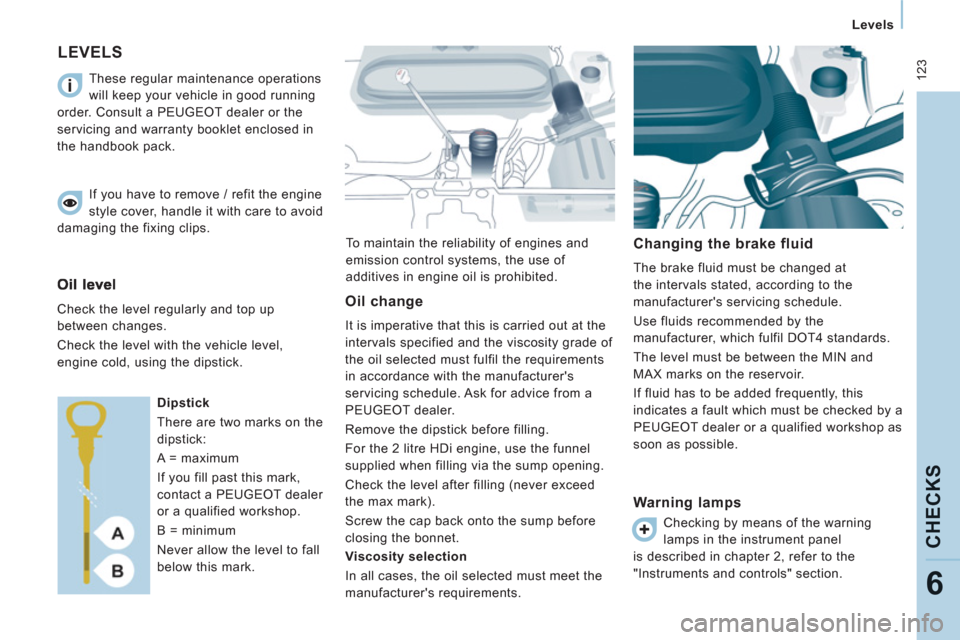
Dipstick
There are two marks on the
dipstick:
A = maximum
If you fill past this mark,
contact a PEUGEOT dealer
or a qualified workshop.
B = minimum
Never allow the level to fall
below this mark. Oil change
It is imperative that this is carried out at the
intervals specified and the viscosity grade of
the oil selected must fulfil the requirements
in accordance with the manufacturer's
servicing schedule. Ask for advice from a
PEUGEOT dealer.
Remove the dipstick before filling.
For the 2 litre HDi engine, use the funnel
supplied when filling via the sump opening.
Check the level after filling (never exceed
the max mark).
Screw the cap back onto the sump before
closing the bonnet.
Viscosity selection
In all cases, the oil selected must meet the
manufacturer's requirements.
Warning lamps
Checking by means of the warning
lamps in the instrument panel
is described in chapter 2, refer to the
"Instruments and controls" section.
Page 137 of 260
135
Changing a wheel
QUICK HELP
7
CHANGING A WHEEL
If your vehicle is equipped with a spare
wheel located underneath the vehicle, follow
these instructions.
1. PARKING THE VEHICLE
- You must ensure that the occupants
get out of the vehicle and wait in a safe
location.
- If possible, park the vehicle on level,
stable and non-slippery ground.
- Apply the parking brake, switch off the
ignition and engage first or reverse gear.
- If available, place a chock under the
wheel diagonally opposite the one to be
changed.
On certain types of ground and/or if heavy
loads are being transported, the vehicle
must be raised in order to disengage
the spare wheel from the carrier. Call a
PEUGEOT dealer or a qualified workshop.
If your vehicle is fitted with suspension
with pneumatic height correction,
please deactivate the system. Refer to the
"Rear suspension" section of chapter 3.
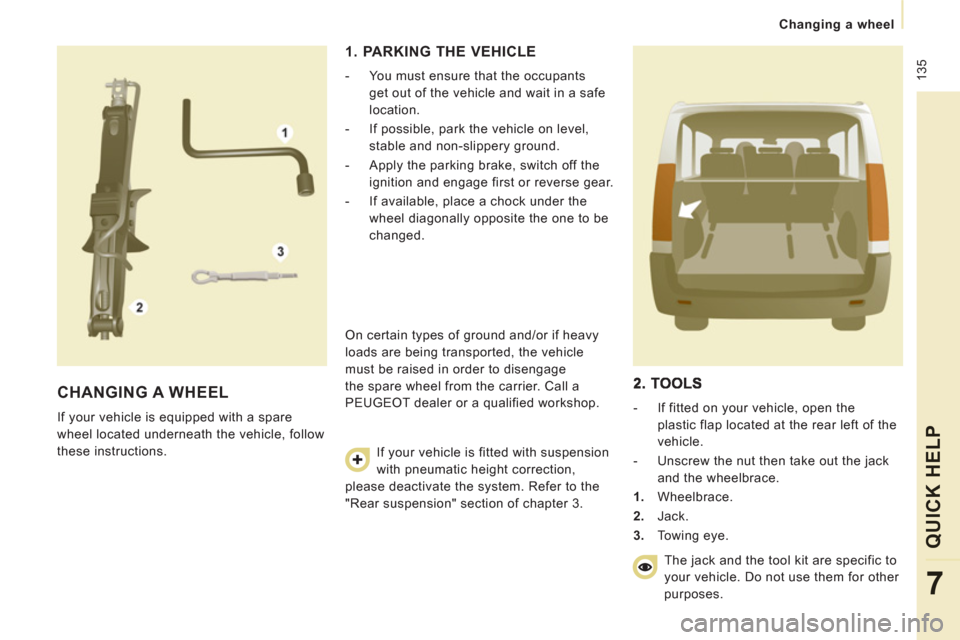
- If fitted on your vehicle, open the
plastic flap located at the rear left of the
vehicle.
- Unscrew the nut then take out the jack
and the wheelbrace.
1.
Wheelbrace.
2.
Jack.
3.
Towing eye.
The jack and the tool kit are specific to
your vehicle. Do not use them for other
purposes.
Page 141 of 260
139
Snow screen
QUICK HELP
7
REMOVABLE SNOW SCREEN
According to country, the removable snow
screen is installed on the lower part of the
front bumper to prevent the accumulation of
snow at the radiator cooling fan.
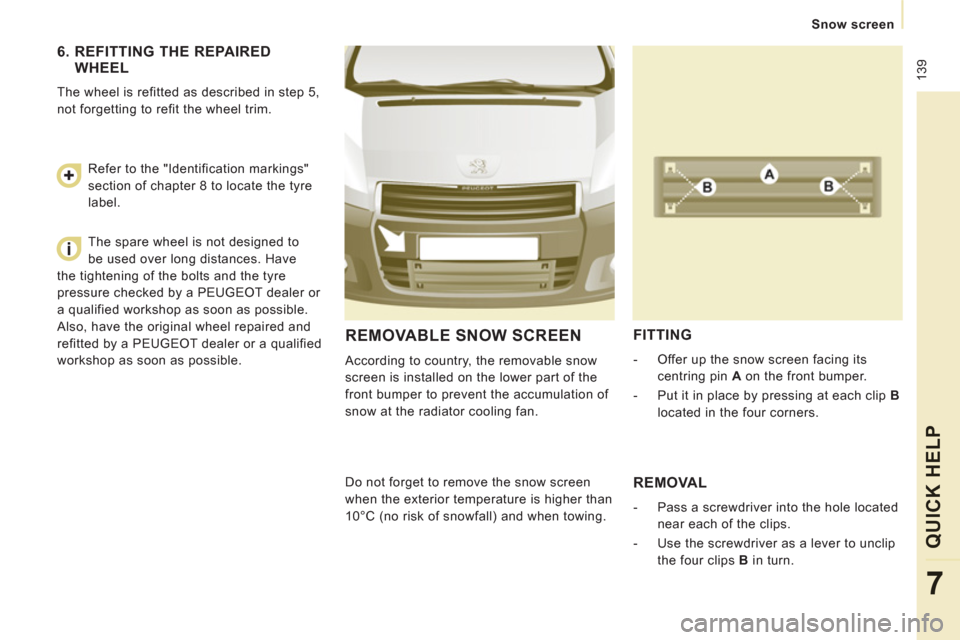
FITTING
- Offer up the snow screen facing its
centring pin A
on the front bumper.
- Put it in place by pressing at each clip B
located in the four corners.
Do not forget to remove the snow screen
when the exterior temperature is higher than
10°C (no risk of snowfall) and when towing.
REMOVAL
- Pass a screwdriver into the hole located
near each of the clips.
- Use the screwdriver as a lever to unclip
the four clips B
in turn.
6. REFITTING THE REPAIREDWHEEL
The wheel is refitted as described in step 5,
not forgetting to refit the wheel trim.
Refer to the "Identification markings"
section of chapter 8 to locate the tyre
label.
The spare wheel is not designed to
be used over long distances. Have
the tightening of the bolts and the tyre
pressure checked by a PEUGEOT dealer or
a qualified workshop as soon as possible.
Also, have the original wheel repaired and
refitted by a PEUGEOT dealer or a qualified
workshop as soon as possible.
Page 146 of 260
144
Changing a bulb
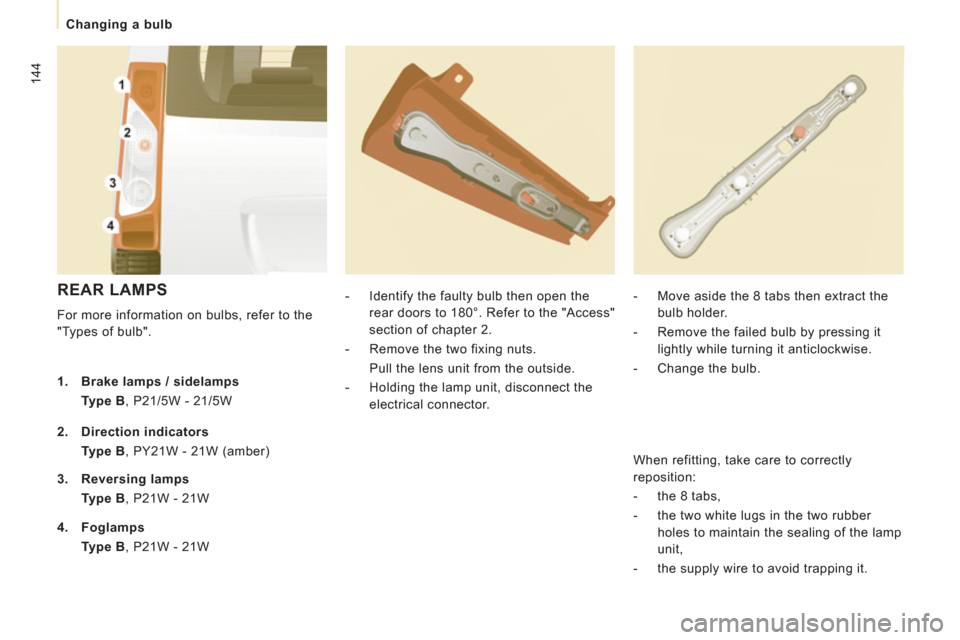
REAR LAMPS
For more information on bulbs, refer to the
"Types of bulb".
- Identify the faulty bulb then open the
rear doors to 180°. Refer to the "Access"
section of chapter 2.
- Remove the two fixing nuts.
Pull the lens unit from the outside.
- Holding the lamp unit, disconnect the
electrical connector.
- Move aside the 8 tabs then extract the
bulb holder.
- Remove the failed bulb by pressing it
lightly while turning it anticlockwise.
- Change the bulb.
1.
Brake lamps / sidelamps
Type B
, P21/5W - 21/5W
2.
Direction indicators
Type B
, PY21W - 21W (amber)
3.
Reversing lamps
Type B
, P21W - 21W
4.
Foglamps
Type B
, P21W - 21W When refitting, take care to correctly
reposition:
- the 8 tabs,
- the two white lugs in the two rubber
holes to maintain the sealing of the lamp
unit,
- the supply wire to avoid trapping it.