warning light Peugeot Expert VU 2011 User Guide
[x] Cancel search | Manufacturer: PEUGEOT, Model Year: 2011, Model line: Expert VU, Model: Peugeot Expert VU 2011Pages: 260, PDF Size: 9.46 MB
Page 63 of 260
61
Ventilation
EASE OF USE AND COMFOR
T
3
Good practice
To avoid any risk of poisoning or
asphyxiation, the heater must not be used,
even
for short periods, in an enclosed space
such as a garage or workshop which is not
fitted with an exhaust
gas extraction system.
Do not park the vehicle on an inflammable
surface (dry grass, dead leaves, paper…),
th
ere is a risk of fire. The temperature near the heater must not
exceed 120 °C. A temperature higher than
this
(for example in the case of painting in
an oven
) could damage the components of
th
e electronic circuits.
The heater is supplied b
y the vehicle's fuel
tank. Ensure that the low
fuel warning lamp
i
s not on.
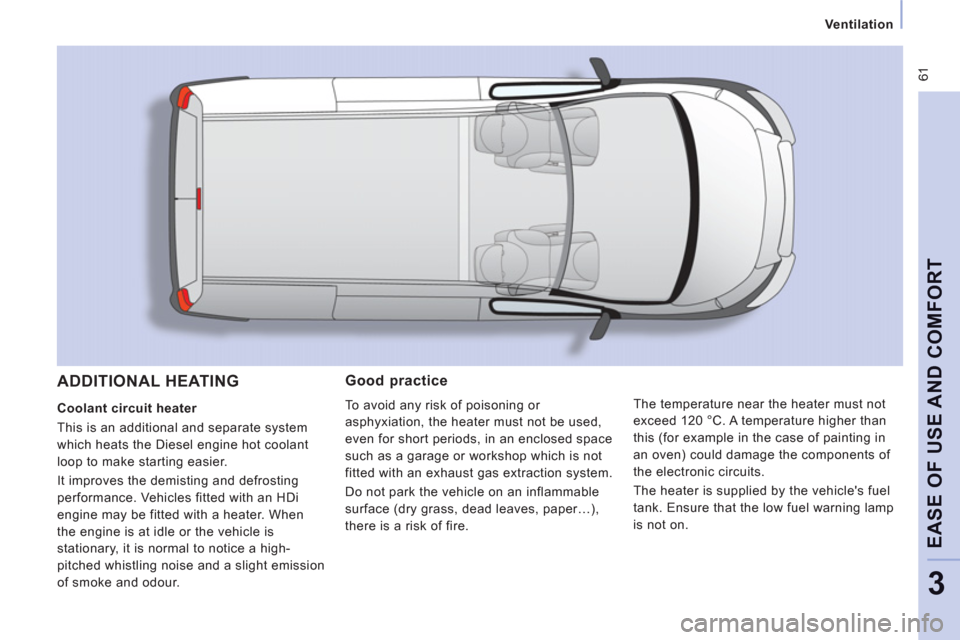
ADDITIONAL HEATING
Coolant circuit heater
This is an additional and separate s
ystem
which heats the Diesel en
gine hot coolant
loop to make starting easier.
It improves the demistin
g and defrosting
performance. Vehicles fitted with an HDi
engine may be fitted with a heater. When
t
he engine is at idle or the vehicle is
stationary, it is normal to notice a high-
pitched whistling noise and a slight emission
of smoke and odour.
Page 78 of 260
76
Rear suspension
Metal suspension
This equipment adopts long movement limiters
which make it possible to
guarantee stable
behaviour both when loaded and when empt
y.
No action on your part is required except to
ensure that maintenance is carried out and that
the authorised loads are com
plied with.irrespective o
f the weight of the load, within
the limit of the authorised values.
On board,
the increasin
g or lightening of the load on
the vehicle's plat
form is detected by two
hei
ght sensors. When all of the doors are
closed, the sensors trigger the automatic
hei
ght correction and determine the optimum
hei
ght of the sill for the vehicle's driving
conditions.
Deactivation of automatic height correction
The control which permits deactivation o
f
automatic re
gulation is located on the right-
hand side, at the rear of the vehicle.
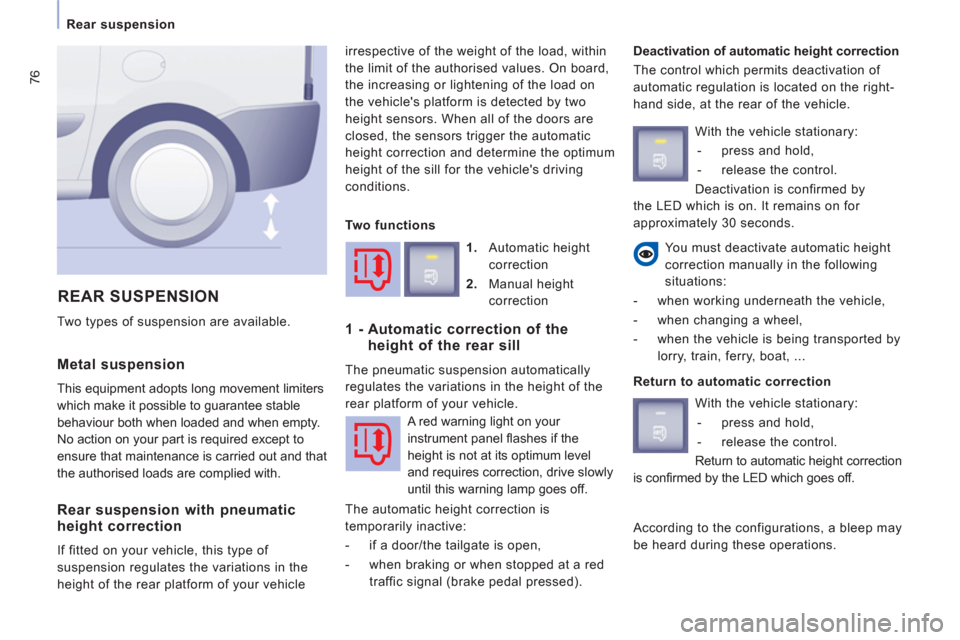
REAR SUSPENSION
You must deactivate automatic height
correction manually in the following
situations:
- when working underneath the vehicle,
- when changing a wheel,
- when the vehicle is being transported by
lorry, train, ferry, boat, ...
Two t
ypes of suspension are available.
Rear suspension with pneumatic height correction
If fitted on your vehicle, this type of
suspension regulates the variations in the
height of the rear platform of your vehicle
1.
Automatic height
correction
2.
Manual height
correction
1 - Automatic correction of the
height of the rear sill
The pneumatic suspension automatically
re
gulates the variations in the height of the
rear plat
form of your vehicle.
A red warning light on your
instrument panel
fl ashes if the
height is not at its optimum level
and requires correction, drive slowl
y
until this warning lamp goes off.
The automatic hei
ght correction is
temporar
ily inactive:
- if a door/the tailgate is open,
- when braking or when stopped at a red
traffic signal (brake pedal pressed).
With the vehicle stationary:
- press and hold,
- release the control.
Deactivation is confirmed b
y
th
e LED which is on. It remains on for
approximately
30 seconds.
Return to automatic correction
With the vehicle stationary:
- press and hold,
- release the control.
Return to automatic hei
ght correction
is confi rmed b
y the LED which goes off.
According to the configurations, a bleep may
be heard durin
g these operations.
Two functions
Page 86 of 260
ABS
ABS
Driving safely
HORN
Press the centre of the steering wheel.
ANTI-LOCK BRAKING SYSTEM(ABS - EBFD)
The ABS and EBFD (electronic brake force
distribution) systems improve the stability
and manoeuvrability of your vehicle on
braking, in particular on poor or slippery
surfaces.
The ABS prevents locking of the wheels,
the EBFD provides control of the braking
pressure wheel by wheel.
Good practice
The anti-lock braking system comes into
operation automatically when there is a risk
of wheel lock. It does not reduce the braking
distance.
On very slippery surfaces (ice, oil, etc...)
the ABS may increase the braking distance.
When braking in an emergency, do not
hesitate to press the brake pedal firmly,
without releasing the pressure, even on a
slippery surface, you will then be able to
continue to manoeuvre the vehicle to avoid
an obstacle.
Normal operation of the ABS may be felt by
slight vibration of the brake pedal.
When changing wheels (tyres and rims),
ensure that these are recommended by
PEUGEOT. If this warning light comes on,
together with the brake and STOP
warning lights, accompanied by
an audible signal and a message
on the display, it indicates a malfunction of
the electronic brake force distribution which
could result in a loss of control of the vehicle
on braking.
Stop immediately.
In both cases, contact a PEUGEOT dealer
or a qualified workshop.
ASSISTANCE SYSTEM (EBA)
In an emergency, this system enables the
optimum braking pressure to be reached
more quickly, press the pedal firmly without
releasing it.
It is triggered by the speed at which the
brake pedal is activated.
This alters the resistance of the brake pedal
under your foot. If this warning light comes on,
accompanied by an audible signal
and a message on the display,
it indicates a malfunction of the
ABS which could result in a loss of control of
the vehicle on braking. To prolong the operation of the emergency
braking assistance system: keep your foot
on the brake pedal.
Page 88 of 260
86
Seat belts
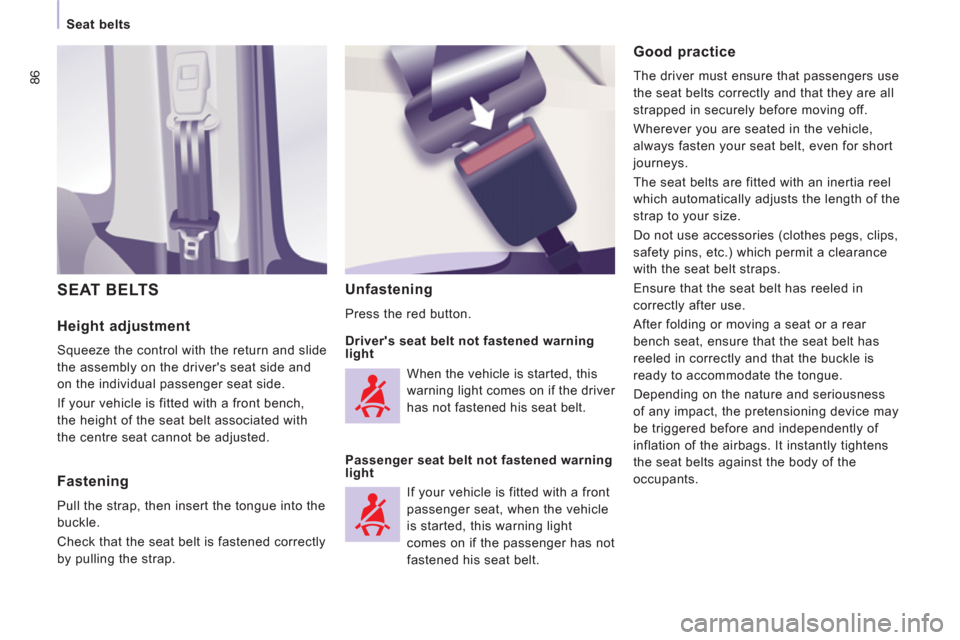
Height adjustment
Squeeze the control with the return and slide
the assembly on the driver's seat side and
on the individual passenger seat side.
If your vehicle is fitted with a front bench,
the height of the seat belt associated with
the centre seat cannot be adjusted.
Unfastening
Press the red button.
SEAT BELTS
Good practice
The driver must ensure that passengers use
the seat belts correctly and that they are all
strapped in securely before moving off.
Wherever you are seated in the vehicle,
always fasten your seat belt, even for short
journeys.
The seat belts are fitted with an inertia reel
which automatically adjusts the length of the
strap to your size.
Do not use accessories (clothes pegs, clips,
safety pins, etc.) which permit a clearance
with the seat belt straps.
Ensure that the seat belt has reeled in
correctly after use.
After folding or moving a seat or a rear
bench seat, ensure that the seat belt has
reeled in correctly and that the buckle is
ready to accommodate the tongue.
Depending on the nature and seriousness
of any impact, the pretensioning device may
be triggered before and independently of
inflation of the airbags. It instantly tightens
the seat belts against the body of the
occupants.
Fastening
Pull the strap, then insert the tongue into the
buckle.
Check that the seat belt is fastened correctly
by pulling the strap.
Driver's seat belt not fastened warning
light
Passenger seat belt not fastened warning
light When the vehicle is started, this
warning light comes on if the driver
has not fastened his seat belt.
If your vehicle is fitted with a front
passenger seat, when the vehicle
is started, this warning light
comes on if the passenger has not
fastened his seat belt.
Page 89 of 260
87
Seat belts
SAFETY
4
Triggering of the pretensioners is
accompanied by a slight discharge of
harmless smoke and a noise, due to the
activation of the pyrotechnic cartridge
incorporated in the system.
The force limiter reduces the pressure of the
seat belt against the body of the occupants.
The pretensioning seat belts are active
when the ignition is switched on.
The inertia reels are fitted with a device
which automatically locks the strap in the
event of a collision or emergency braking or
if the vehicle rolls over.
You can unfasten the seat belt by pressing
the red button on the buckle. Guide the seat
belt after unfastening.
The airbag warning lamp comes on if the
pretensioners are triggered.
Contact a PEUGEOT or a qualified
workshop.
In order to be effective, a seat belt must:
- restrain one person only,
- must not be twisted, check by pulling in
front of you with an even movement,
- be tightened as close to the body as
possible.
The upper part of the seat belt should be
positioned in the hollow of the shoulder.
The lap part should be placed as low as
possible on the pelvis.
Recommendations for children:
- use a suitable child seat if the
passenger is less than 12 years old or
shorter than one metre fifty,
- never allow a child to travel on your lap,
even with the seat belt fastened.
FRONT SEAT BELTS
For further information regarding child
seats, refer to the "Children on board"
section of chapter 4.
In accordance with current safety
regulations, your PEUGEOT dealer
guarantees all work or any checks, from
testing to maintenance, on your seat belt
equipment.
Have the seat belts checked regularly (even
after a minor impact) by a PEUGEOT dealer
or a qualified workshop: they must not show
any signs of wear, cutting or fraying and they
must not be transformed or modified.
Clean the seat belt straps with soapy
water or a textile cleaning product, sold
by PEUGEOT dealers.
With front airbags
The front seats are fitted with pretensioners
and force limiters.
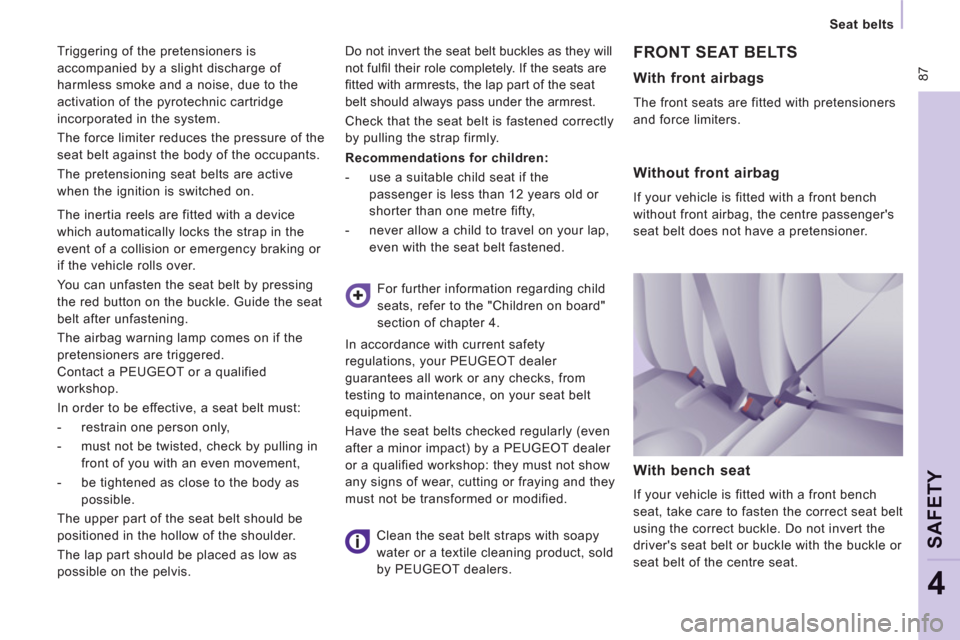
Without front airbag
If your vehicle is fitted with a front bench
without front airbag, the centre passenger's
seat belt does not have a pretensioner.
With bench seat
If your vehicle is fitted with a front bench
seat, take care to fasten the correct seat belt
using the correct buckle. Do not invert the
driver's seat belt or buckle with the buckle or
seat belt of the centre seat. Do not invert the seat belt buckles as they will
not fulfi l their role completely. If the seats are
fi tted with armrests, the lap part of the seat
belt should always pass under the armrest.
Check that the seat belt is fastened correctly
by pulling the strap firmly.
Page 104 of 260
102
Opening the bonnet
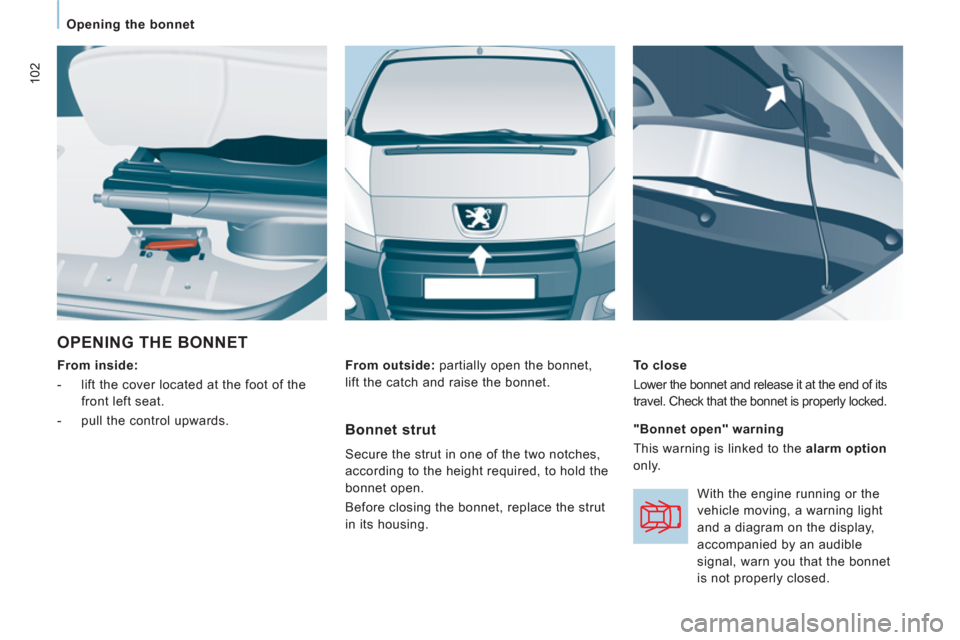
OPENING THE BONNET
From inside:
- lift the cover located at the foot of the
front left seat.
- pull the control upwards.
To close
Lower the bonnet and release it at the end of its
travel. Check that the bonnet is properly locked.
From outside:
partially open the bonnet,
lift the catch and raise the bonnet.
Bonnet strut
Secure the strut in one of the two notches,
according to the height required, to hold the
bonnet open.
Before closing the bonnet, replace the strut
in its housing.
"Bonnet open" warning
This warning is linked to the alarm option
only.
With the engine running or the
vehicle moving, a warning light
and a diagram on the display,
accompanied by an audible
signal, warn you that the bonnet
is not properly closed.
Page 108 of 260
106
Levels
Cooling system
Only use the fluid recommended by the
manufacturer.
Otherwise, you risk seriously damaging your
engine.
When the engine is warm, the temperature
of the coolant is controlled by the engine
fan. As this fan can operate with the ignition
key removed and because the cooling
system is pressurised, wait for at least one
hour after the engine has stopped before
carrying out any work.
Slacken the cap by 1/4 of a turn to release
the pressure to prevent any risk of scalding.
When the pressure has dropped, remove the
cap and top up the level with coolant.
If fluid has to be added frequently, this
indicates a fault which must be checked by a
PEUGEOT dealer or a qualified workshop as
soon as possible.
Power steering fluid level
The vehicle must be parked on level ground
with the engine cold. Unscrew the cap
integrated with the gauge and check the
level which must be between the MIN and
MAX marks. When this occurs with the engine running it
is due to the start of saturation of the particle
emission filter (exceptionally prolonged
urban type driving conditions: low speed,
long traffic jams, ...).
In order to regenerate the filter, you are
advised to drive at a speed higher than
40 mph (60 km/h) for at least five minutes
as soon as possible, when traffic conditions
permit (until the message disappears and
the service warning lamp goes off).
During regeneration of the particle emission
filter, relay noise may be heard under the
dashboard.
If the message is still displayed and if the
service warning lamp remains on, contact a
PEUGEOT dealer or a qualified workshop.
Topping up
The level must be between the MIN and
MAX marks on the expansion bottle. If
more than 1 litre of fluid is required to top
up the level, have the system checked by a
PEUGEOT dealer or a qualified workshop.
Screenwash and headlamp wash
level
For best quality cleaning and for your safety,
we would advise that you use products of
the PEUGEOT range.
Capacity of the screenwash reservoir:
approximately 4.5 litres.
If your vehicle is fitted with headlamp
washers, the capacity of the reservoir is
7.5 litres.
To ensure optimum cleaning and prevent
freezing, this fluid must not be topped up or
replaced with plain water.
Diesel additive level (Diesel
with particle emission filter)
The minimum level of this additive
is indicated by lighting of the
service warning light, accompanied by an
audible signal and a message in the screen.
Topping up
This additive must be topped up by a
PEUGEOT dealer or a qualified workshop
without delay.
Page 112 of 260
11 0
Fuel
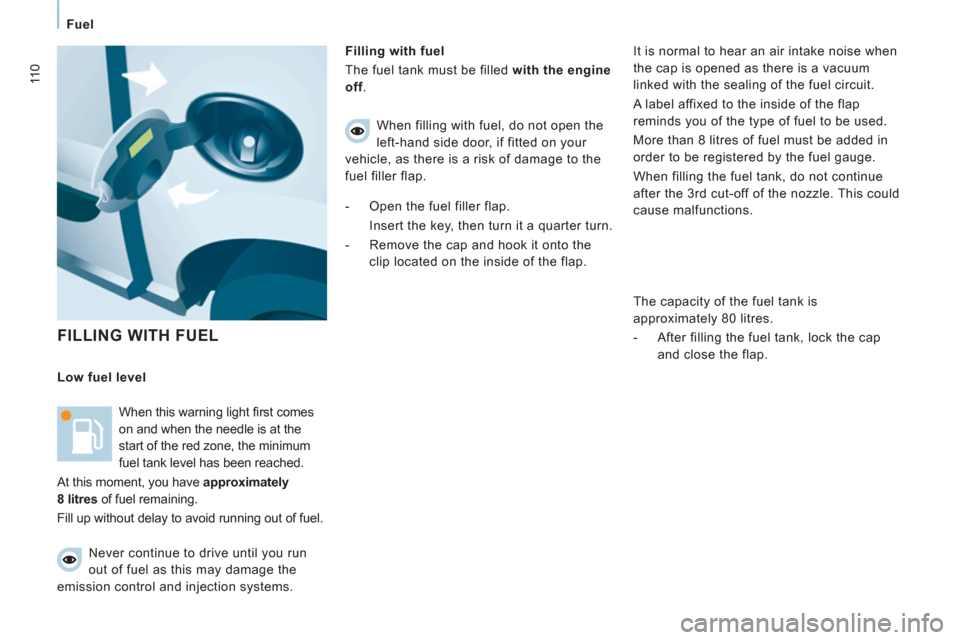
FILLING WITH FUEL
Filling with fuel
The fuel tank must be filled with the engine
off
.
Low fuel level
When this warning light fi rst comes
on and when the needle is at the
start of the red zone, the minimum
fuel tank level has been reached.
At this moment, you have approximately
8 litres
of fuel remaining.
Fill up without delay to avoid running out of fuel. When filling with fuel, do not open the
left-hand side door, if fitted on your
vehicle, as there is a risk of damage to the
fuel filler flap.
- Open the fuel filler flap.
Insert the key, then turn it a quarter turn.
- Remove the cap and hook it onto the
clip located on the inside of the flap.
It is normal to hear an air intake noise when
the cap is opened as there is a vacuum
linked with the sealing of the fuel circuit.
A label affixed to the inside of the flap
reminds you of the type of fuel to be used.
More than 8 litres of fuel must be added in
order to be registered by the fuel gauge.
When filling the fuel tank, do not continue
after the 3 rd cut-off of the nozzle. This could
cause malfunctions.
The capacity of the fuel tank is
approximately 80 litres.
- After filling the fuel tank, lock the cap
and close the flap.
Never continue to drive until you run
out of fuel as this may damage the
emission control and injection systems.
Page 113 of 260
DIESEL
111
Fuel
CHECK
S
6
FUEL CIRCUIT DISARMED
DIESEL REPRIMING
PUMP
If you should run out of fuel, it is necessary
to re-prime the circuit:
- fill the fuel tank with at least five litres of
diesel,
- squeeze and release the manual
re-priming pump, under the bonnet
under the protective cover, until fuel
appears in the transparent pipe,
- operate the starter until the engine
starts. In a serious collision, a mechanism
automatically prevents fuel from reaching
the engine.
The flashing of this warning light
is accompanied by a message on
the display.
Check that there is no odour or leakage of
fuel outside the vehicle and re-establish the
fuel supply:
- switch off the ignition (STOP position),
- remove the key,
- put the key back in the ignition,
- switch on the ignition and start.
Quality of the fuel used for petrol
engines
Quality of the fuel used for Diesel
engines
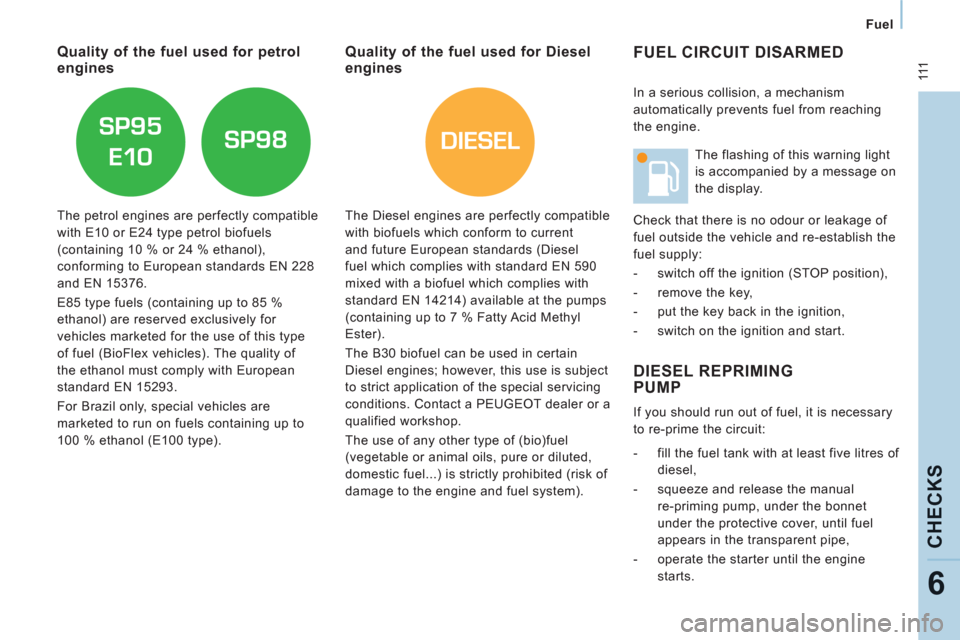
The petrol engines are perfectly compatible
with E10 or E24 type petrol biofuels
(containing 10 % or 24 % ethanol),
conforming to European standards EN 228
and EN 15376.
E85 type fuels (containing up to 85 %
ethanol) are reserved exclusively for
vehicles marketed for the use of this type
of fuel (BioFlex vehicles). The quality of
the ethanol must comply with European
standard EN 15293.
For Brazil only, special vehicles are
marketed to run on fuels containing up to
100 % ethanol (E100 type).
The Diesel engines are perfectly compatible
with biofuels which conform to current
and future European standards (Diesel
fuel which complies with standard EN 590
mixed with a biofuel which complies with
standard EN 14214) available at the pumps
(containing up to 7 % Fatty Acid Methyl
Ester).
The B30 biofuel can be used in certain
Diesel engines; however, this use is subject
to strict application of the special servicing
conditions. Contact a PEUGEOT dealer or a
qualified workshop.
The use of any other type of (bio)fuel
(vegetable or animal oils, pure or diluted,
domestic fuel...) is strictly prohibited (risk of
damage to the engine and fuel system).
Page 115 of 260
11
3
Battery
QUICK HELP
7
BATTERY
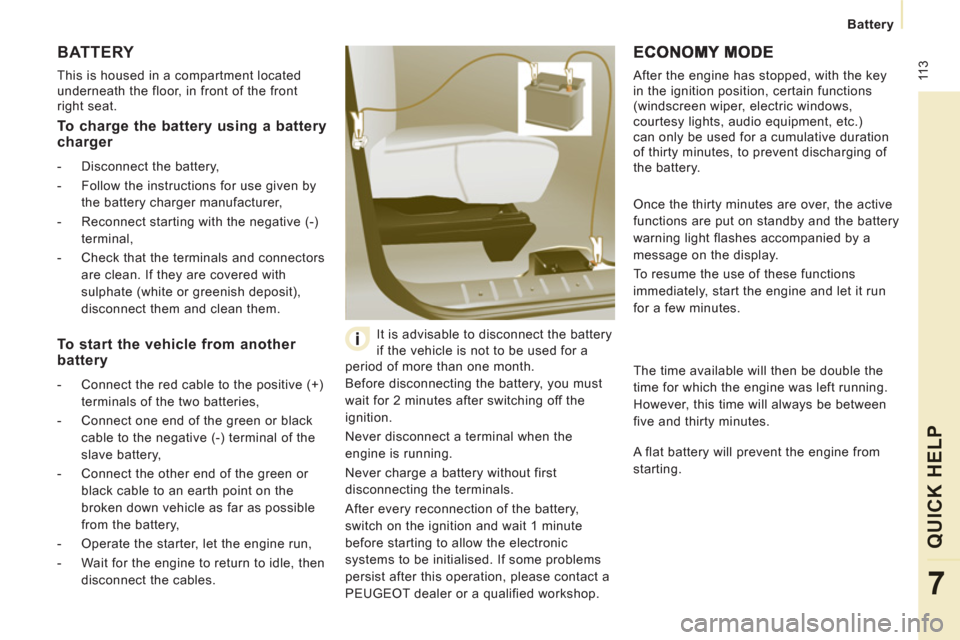
This is housed in a compartment located
underneath the floor, in front of the front
right seat.
Before disconnecting the battery, you must
wait for 2 minutes after switching off the
ignition.
Never disconnect a terminal when the
engine is running.
Never charge a battery without first
disconnecting the terminals.
After every reconnection of the battery,
switch on the ignition and wait 1 minute
before starting to allow the electronic
systems to be initialised. If some problems
persist after this operation, please contact a
PEUGEOT dealer or a qualified workshop. It is advisable to disconnect the battery
if the vehicle is not to be used for a
period of more than one month. After the engine has stopped, with the key
in the ignition position, certain functions
(windscreen wiper, electric windows,
courtesy lights, audio equipment, etc.)
can only be used for a cumulative duration
of thirty minutes, to prevent discharging of
the battery.
To charge the battery using a battery
charger
- Disconnect the battery,
- Follow the instructions for use given by
the battery charger manufacturer,
- Reconnect starting with the negative (-)
terminal,
- Check that the terminals and connectors
are clean. If they are covered with
sulphate (white or greenish deposit),
disconnect them and clean them.
To start the vehicle from another
battery
- Connect the red cable to the positive (+)
terminals of the two batteries,
- Connect one end of the green or black
cable to the negative (-) terminal of the
slave battery,
- Connect the other end of the green or
black cable to an earth point on the
broken down vehicle as far as possible
from the battery,
- Operate the starter, let the engine run,
- Wait for the engine to return to idle, then
disconnect the cables. Once the thirty minutes are over, the active
functions are put on standby and the battery
warning light flashes accompanied by a
message on the display.
To resume the use of these functions
immediately, start the engine and let it run
for a few minutes.
The time available will then be double the
time for which the engine was left running.
However, this time will always be between
five and thirty minutes.
A flat battery will prevent the engine from
starting.