run flat Peugeot Expert VU 2016 Owner's Manual
[x] Cancel search | Manufacturer: PEUGEOT, Model Year: 2016, Model line: Expert VU, Model: Peugeot Expert VU 2016Pages: 599, PDF Size: 13.14 MB
Page 5 of 599
.
.
Expert_en_Chap00a_sommaire_ed01-2016
Driving recommendations 196
Starting-switching off the engine, manual key, remote control
1
99
Starting and switching off the engine, "Keyless Entry and Starting"
2
02
Parking brake
2
05
Hill start assist
2
06
5-speed manual gearbox
2
07
6-speed manual gearbox
2
07
ge
ar shift indicator
2
08
Automatic gearbox
20
9
Electronic gearbox
2
14
Stop & Start
2
18
Head-up display
2
22
Memorising speeds
2
24
Speed limit recognition
2
25
Speed limiter
2
29
Cruise control
2
32
Dynamic cruise control
2
36
Collision Risk Alert and Active Safety Brake
2
43
Lane departure warning system
2
48
Fatigue detection system
2
50
Blind spot monitoring system
2
52
Parking sensors
2
55
Reversing camera, interior mirror
2
58
180° rear vision
2
59
Under-inflation detection
2
62Fuel tank
2 65
Diesel misfuel prevention 26
6
Snow chains
2
68
to
wing a trailer
2
69
Energy economy mode
2
70
Accessories
271
Roof bars / Roof rack
2
73
Changing a wiper blade
2
74
Bonnet
276
Diesel engine
2
77
Checking levels
2
78
Checks
281
AdBlue
® and SCR system
(BlueHDi Diesel) 2 83
Warning triangle (stowing)
2
87
to
ol box
2
87
te
mporary puncture repair kit
2
90
Changing a wheel
2
96
Changing a bulb
3
03
Changing a fuse
3
16
12 V battery
3
21
to
wing
325
Running out of fuel (Diesel)
3
27Dimensions
328
Engines
332
Weights
332
Identification markings
3
37
Driving
Practical information
In the event of a breakdownte chnical data
Emergency or assistance 338
PEu gEo t Connect Nav 3 41
PE
u
g
Eo
t Connect Radio
4
29
Bluetooth
® audio system 4 83
Audio equipment and telematics
Alphabetical index
Contents
Page 6 of 599
4
Expert_en_Chap00b_vue-ensemble_ed01-2016
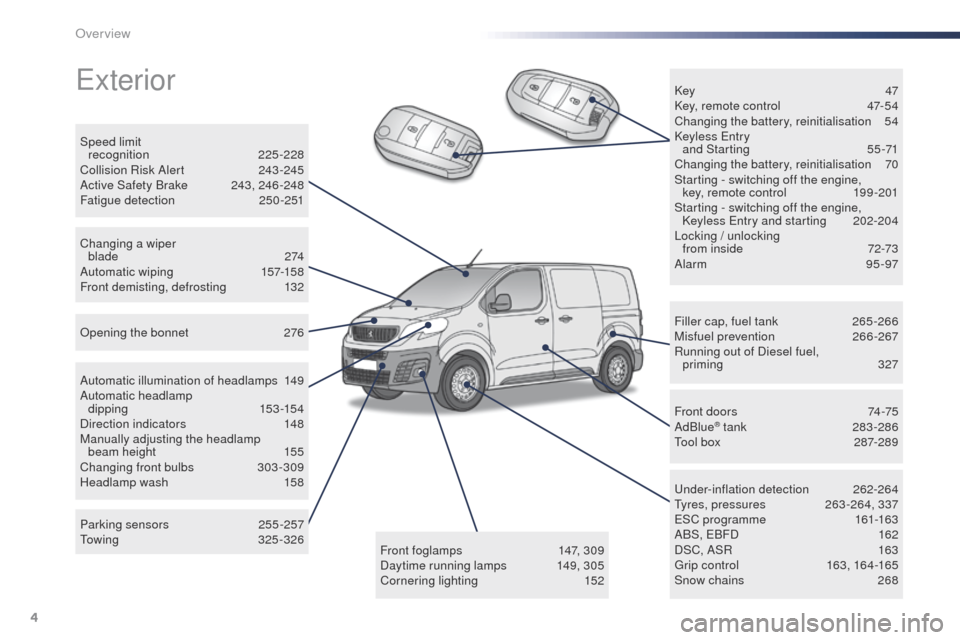
Exterior
Filler cap, fuel tank 265 -266
Misfuel prevention 26 6-267
Running out of Diesel fuel, priming
327
un
der-inflation detection
26
2-264
ty
res, pressures
2
63 -264, 337
ESC programme
1
61-163
ABS, EBFD
1
62
DSC, ASR
1
63
gr
ip control
16
3, 16 4 -165
Snow chains
2
68
Front doors
7
4-75
AdBlue
® tank 28 3-286to
ol box 2 87-289
Automatic illumination of headlamps
1
49
Automatic headlamp dipping
153 -15 4
Direction indicators 1
48
Manually adjusting the headlamp beam height
1
55
Changing front bulbs
3
03-309
Headlamp wash
1
58
op
ening the bonnet
2
76 Key
47
Key, remote control
4
7-54
Changing the battery, reinitialisation
5
4
Keyless Entry and Starting
5
5-71
Changing the battery, reinitialisation
7
0
Starting - switching off the engine, key, remote control
1
99 -201
Starting - switching off the engine, Keyless Entry and starting
2
02-204
Locking / unlocking from inside
7
2-73
Alarm
95-97
Speed limit
recognition
225-228
Collision Risk Alert
2
43 -245
Active Safety Brake
2
43, 246 -248
Fatigue detection
2
50-251
Changing a wiper b l a d e
2 74
Automatic wiping
1
57-158
Front demisting, defrosting
1
32
Front foglamps
1
47, 309
Daytime running lamps
1
49, 305
Cornering lighting
1
52
Parking sensors
2
55-257
to
wing
325-326
over view
Page 24 of 599
22
Warning / indicator lampStateCause Action / Observations
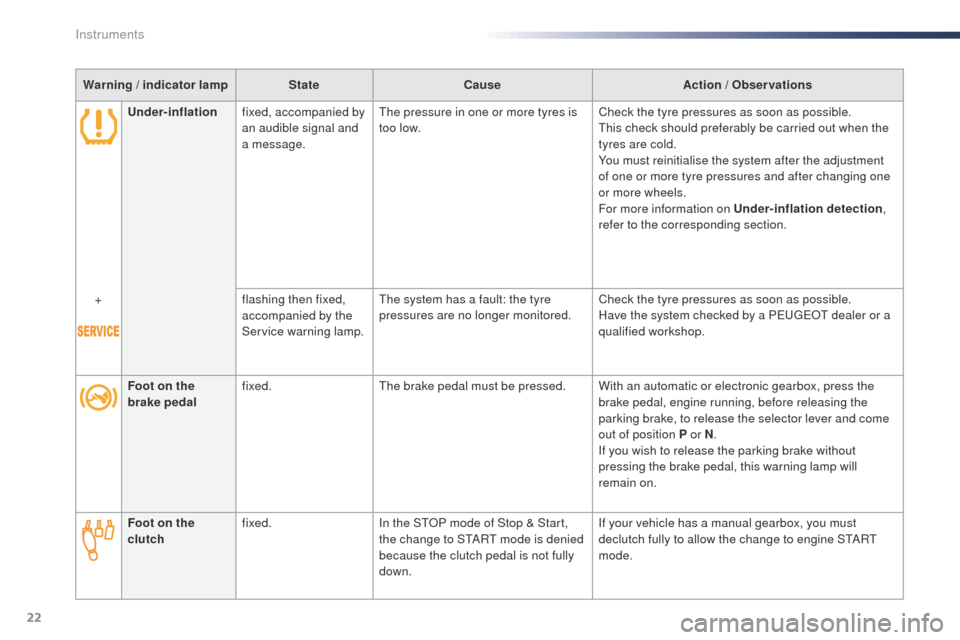
Under-inflation fixed, accompanied by
an audible signal and
a message.
th
e pressure in one or more tyres is
too low. Check the tyre pressures as soon as possible.
th
is check should preferably be carried out when the
tyres are cold.
You must reinitialise the system after the adjustment
of one or more tyre pressures and after changing one
or more wheels.
For more information on Under-inflation detection ,
refer to the corresponding section.
+ flashing then fixed,
accompanied by the
Service warning lamp.
th
e system has a fault: the tyre
pressures are no longer monitored. Check the tyre pressures as soon as possible.
Have the system checked by a PE
u
g
Eo
t dealer or a
qualified workshop.
Foot on the
brake pedal fixed.
th
e brake pedal must be pressed. With an automatic or electronic gearbox, press the brake pedal, engine running, before releasing the
parking brake, to release the selector lever and come
out of position P or N.
If you wish to release the parking brake without
pressing the brake pedal, this warning lamp will
remain on.
Foot on the
clutch fixed.
In the S
t
o
P m
ode of Stop & Start,
the change to S
tA
R
t
mode is denied
because the clutch pedal is not fully
down. If your vehicle has a manual gearbox, you must
declutch fully to allow the change to engine S
tA
R
t
mode.
Instruments
Page 215 of 599
213
Expert_en_Chap06_conduite_ed01-2016
When the ignition is on, a message
appears in the instrument panel
screen to indicate a gearbox fault.
Operating fault
In this case, the gearbox switches to back-up
mode and is locked in 3rd gear. You may feel
a substantial knock when changing from P
to R and from N to R.
t
h
is will not cause any
damage to the gearbox.
Do not exceed 60 mph (100 km/h), local speed
restrictions permitting.
Have it checked by a PE
u
g
Eo
t dealer or a
qualified workshop. You risk damaging the gearbox:
-
i
f you press the accelerator and
brake pedals at the same time
(braking or acceleration must be
done only with the right foot),
-
i
f you force the selector from
position P to another position when
the battery is flat.
to r
educe fuel consumption when
stationary for long periods with the
engine running (traffic jam...), position
the selector at N and apply the parking
brake.
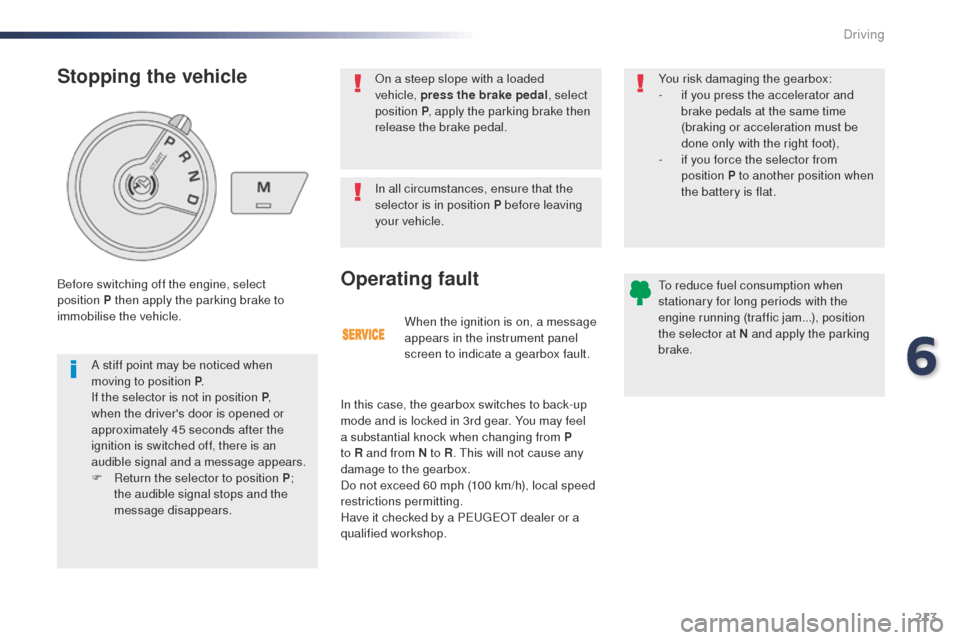
Stopping the vehicle
A stiff point may be noticed when
moving to position P .
If the selector is not in position P ,
when the driver's door is opened or
approximately 45 seconds after the
ignition is switched off, there is an
audible signal and a message appears.
F
R
eturn the selector to position P ;
the audible signal stops and the
message disappears.
Before switching off the engine, select
position
P then apply the parking brake to
immobilise the vehicle. In all circumstances, ensure that the
selector is in position P before leaving
your vehicle.
on a s
teep slope with a loaded
vehicle, press the brake pedal , select
position
P
, apply the parking brake then
release the brake pedal.
6
Driving
Page 270 of 599
268
Expert_en_Chap07_info-pratiques_ed01-2016
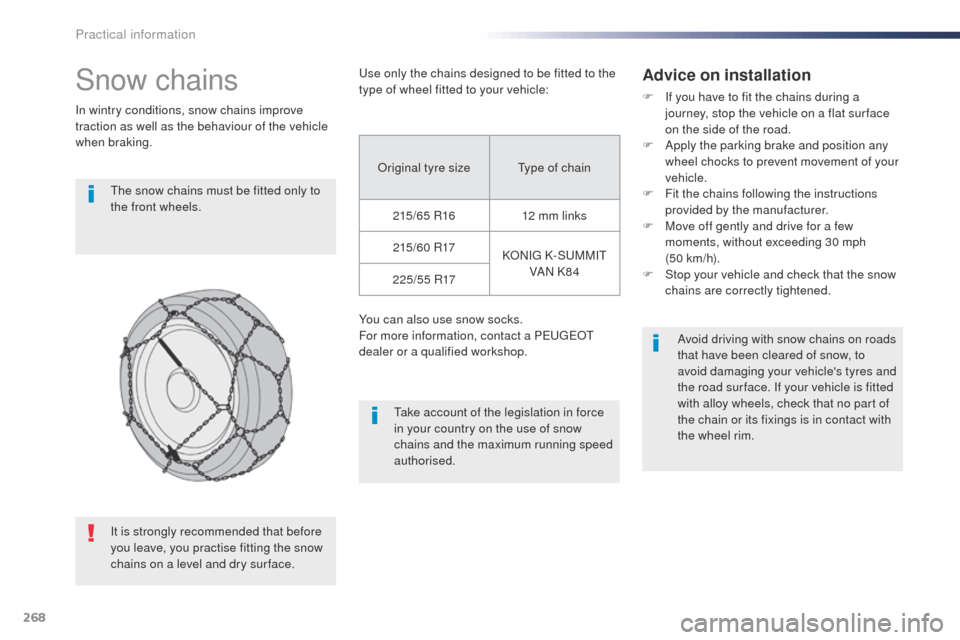
Snow chains
In wintry conditions, snow chains improve
traction as well as the behaviour of the vehicle
when braking.
th
e snow chains must be fitted only to
the front wheels.
ta
ke account of the legislation in force
in your country on the use of snow
chains and the maximum running speed
authorised. Avoid driving with snow chains on roads
that have been cleared of snow, to
avoid damaging your vehicle's tyres and
the road sur face. If your vehicle is fitted
with alloy wheels, check that no part of
the chain or its fixings is in contact with
the wheel rim.
us
e only the chains designed to be fitted to the
type of wheel fitted to your vehicle:
You can also use snow socks.
For more information, contact a PE
u
g
Eo
t
dealer or a qualified workshop.
Advice on installation
F If you have to fit the chains during a journey, stop the vehicle on a flat sur face
on the side of the road.
F
A
pply the parking brake and position any
wheel chocks to prevent movement of your
vehicle.
F
F
it the chains following the instructions
provided by the manufacturer.
F
M
ove off gently and drive for a few
moments, without exceeding 30 mph
(50
km/h).
F
S
top your vehicle and check that the snow
chains are correctly tightened.
or
iginal tyre size
ty
pe of chain
215/65 R16 12 mm links
215/60 R17 K
oN
I
g
K-S
uM
MI
t
VA N K8 4
225/55 R17
It is strongly recommended that before
you leave, you practise fitting the snow
chains on a level and dry sur face.
Practical information
Page 272 of 599
270
Expert_en_Chap07_info-pratiques_ed01-2016
Energy economy mode
System which manages the duration of use of certain functions to conserve a sufficient level of
charge in the battery.
After the engine has stopped, you can still use functions such as the audio and telematics
system, windscreen wipers, dipped beam headlamps, courtesy lamps, etc. for a maximum
combined duration of about forty minutes.
Switching to economy
mode
A message appears in the instrument panel
screen indicating that the vehicle has switched
to economy mode and the active functions are
put on standby.
If a telephone call is being made at this time, it
will be maintained for around 10 minutes with
the Bluetooth hands-free system of your audio
system.
Exiting economy mode
these functions are reactivated automatically
next time the vehicle is driven.
In order to restore the use of these functions
immediately, start the engine and let it run:
-
f
or less than ten minutes, to use the
equipment for approximately five minutes,
-
f
or more than ten minutes, to use the
equipment for up to approximately
thirty
minutes.
Let the engine run for the duration specified to
ensure that the battery charge is sufficient.
Do not repeatedly and continuously restart the
engine in order to charge the battery.
A flat battery prevents the engine from starting.
For more information on the 12 V batter y , refer
to the corresponding section.
Load reduction mode
System which manages the use of certain
functions according to the level of charge
remaining in the battery.
When the vehicle is being driven, the load
reduction function temporarily deactivates
certain functions, such as the air conditioning,
the heated rear screen...
th
e deactivated functions are reactivated
automatically as soon as conditions permit.
Practical information
Page 296 of 599
294
Expert_en_Chap08_En-cas-de-panne_ed01-2016
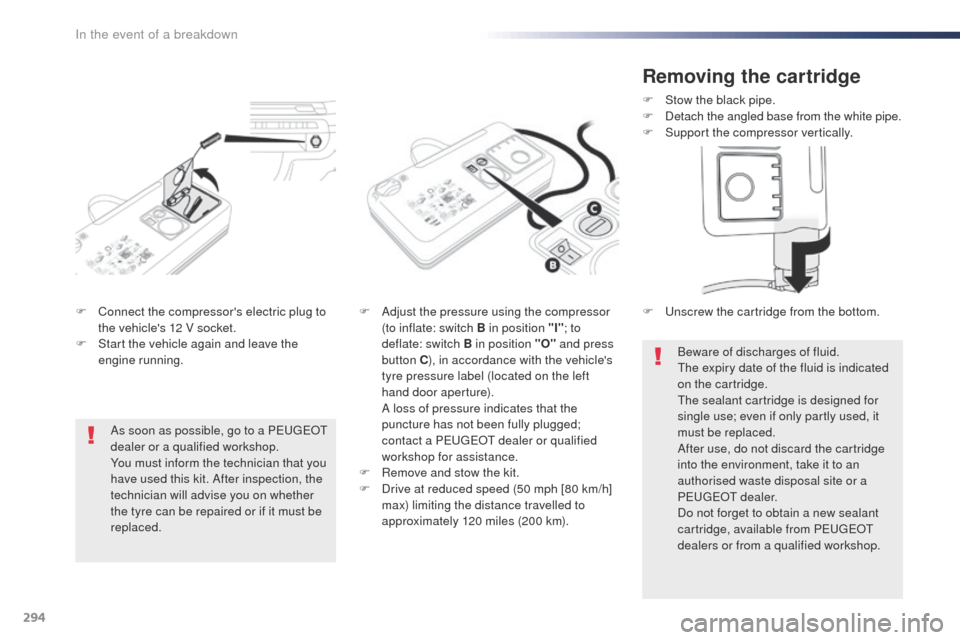
F Connect the compressor's electric plug to the vehicle's 12 V socket.
F
S
tart the vehicle again and leave the
engine running. F
A djust the pressure using the compressor
(to inflate: switch B in position "I" ; to
deflate: switch B
in position "O" and press
button C ), in accordance with the vehicle's
tyre pressure label (located on the left
hand door aperture).
A l
oss of pressure indicates that the
puncture has not been fully plugged;
contact a PE
u
g
Eo
t dealer or qualified
workshop for assistance.
F
R
emove and stow the kit.
F
D
rive at reduced speed (50 mph [80 km/h]
max) limiting the distance travelled to
approximately 120 miles (200 km).
As soon as possible, go to a PE
u
g
Eo
t
dealer or a qualified workshop.
You must inform the technician that you
have used this kit. After inspection, the
technician will advise you on whether
the tyre can be repaired or if it must be
replaced.
Removing the cartridge
F Stow the black pipe.
F D etach the angled base from the white pipe.
F
S
upport the compressor vertically.
Beware of discharges of fluid.
th
e expiry date of the fluid is indicated
on the cartridge.
th
e sealant cartridge is designed for
single use; even if only partly used, it
must be replaced.
After use, do not discard the cartridge
into the environment, take it to an
authorised waste disposal site or a
PE
u
g
Eo
t
d
ealer.
Do not forget to obtain a new sealant
cartridge, available from PE
u
g
Eo
t
dealers or from a qualified workshop.
F
u
n
screw the cartridge from the bottom.
In the event of a breakdown
Page 297 of 599
295
Expert_en_Chap08_En-cas-de-panne_ed01-2016
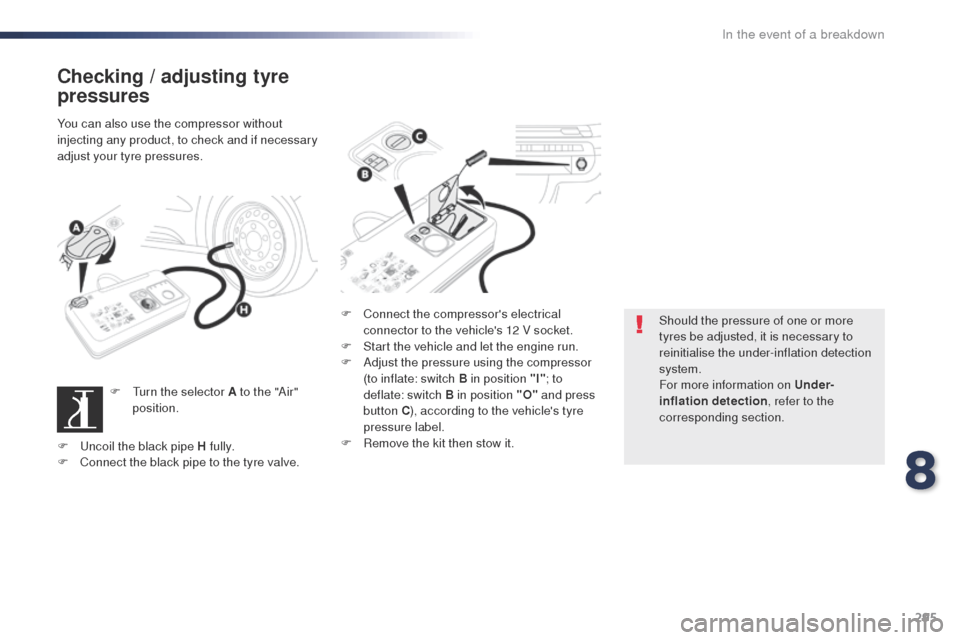
Checking / adjusting tyre
pressures
You can also use the compressor without
injecting any product, to check and if necessary
adjust your tyre pressures.F
t
u
rn the selector A to the "Air"
position. F
C
onnect the compressor's electrical
connector to the vehicle's 12 V socket.
F
S
tart the vehicle and let the engine run.
F
A
djust the pressure using the compressor
(to inflate: switch B in position "I" ; to
deflate: switch B in position "O" and press
button C ), according to the vehicle's tyre
pressure label.
F
R
emove the kit then stow it.Should the pressure of one or more
tyres be adjusted, it is necessary to
reinitialise the under-inflation detection
system.
For more information on Under-
inflation detection
, refer to the
corresponding section.
F
u
n
coil the black pipe H fully.
F
C
onnect the black pipe to the tyre valve.
8
In the event of a breakdown
Page 324 of 599
322
Expert_en_Chap08_En-cas-de-panne_ed01-2016
Starting using another
battery
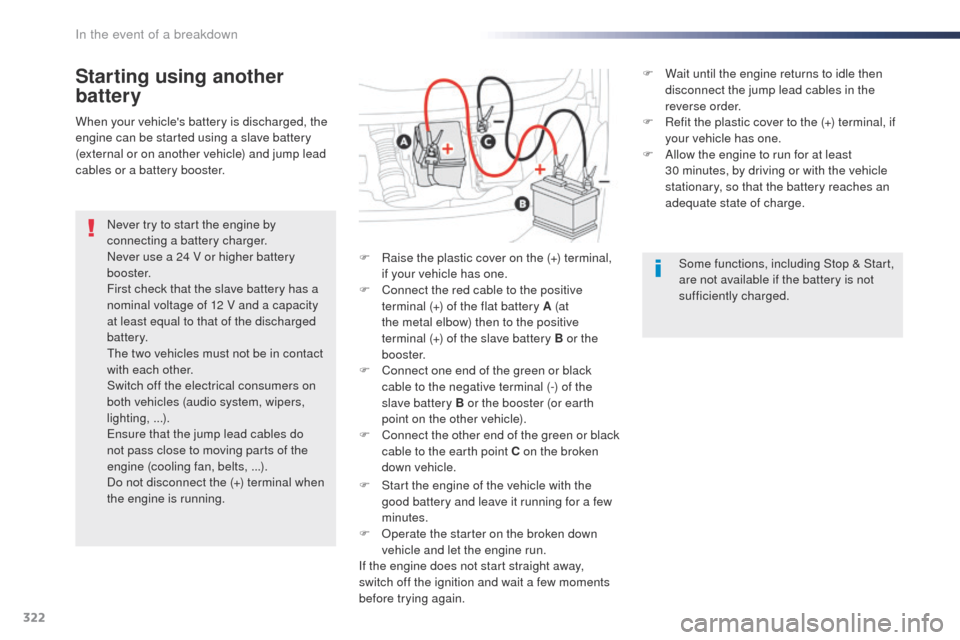
Never try to start the engine by
connecting a battery charger.
Never use a 24 V or higher battery
b o o s t e r.
First check that the slave battery has a
nominal voltage of 12 V and a capacity
at least equal to that of the discharged
battery.
th
e two vehicles must not be in contact
with each other.
Switch off the electrical consumers on
both vehicles (audio system, wipers,
lighting, ...).
Ensure that the jump lead cables do
not pass close to moving parts of the
engine (cooling fan, belts, ...).
Do not disconnect the (+) terminal when
the engine is running. F
R
aise the plastic cover on the (+) terminal,
if your vehicle has one.
F
C
onnect the red cable to the positive
terminal (+) of the flat battery A (at
the metal elbow) then to the positive
terminal
(+) of the slave battery B or the
b o o s t e r.
F
C
onnect one end of the green or black
cable to the negative terminal (-) of the
slave battery B or the booster (or earth
point on the other vehicle).
F
C
onnect the other end of the green or black
cable to the earth point C on the broken
down vehicle.
F
S
tart the engine of the vehicle with the
good battery and leave it running for a few
minutes.
F
o
p
erate the starter on the broken down
vehicle and let the engine run.
If the engine does not start straight away,
switch off the ignition and wait a few moments
before trying again.
When your vehicle's battery is discharged, the
engine can be started using a slave battery
(external or on another vehicle) and jump lead
cables or a battery booster.
Some functions, including Stop & Start,
are not available if the battery is not
sufficiently charged.
F
W
ait until the engine returns to idle then
disconnect the jump lead cables in the
reverse order.
F
R
efit the plastic cover to the (+) terminal, if
your vehicle has one.
F
A
llow the engine to run for at least
30 minutes, by driving or with the vehicle
stationary, so that the battery reaches an
adequate state of charge.
In the event of a breakdown
Page 509 of 599
507
Expert_en_Chap11_index-alpha_ed01-2016
D
E
DAB (Digital Audio Broadcasting) - Digital radio ................... 396, 397, 452, 453, 490, 491
Date (setting)
...............................
....46, 420, 476
Daytime running lamps
.........146, 149, 3 0 4 - 3 0 6
Deactivating the passenger airbag
.......171, 17 7
Deactivation of DSC (ESC)
...........................163
Deadlocking
........................................ 51, 58, 65
Defrosting
.............................................. 132, 14 4
Demisting
...............................
.......................132
Demisting, rear
...................................... 13
3, 13 4
Demisting, rear screen
.........................13 3, 13 4
Diagnostic system, engine
..............................21
Dial
............................................................ 15, 16
Dials and gauges
............................................ 14
Dimensions
........................................... 328-330
Dipstick
................
.................................... 34, 278
Direction indicators
....148, 304, 307, 308, 310, 313, 315
Display, head-up
........................................... 222
Display screen, instrument panel
......14 -16, 2 0 8
Door pockets
................................................. 12
0
Doors
............................................................... 74
Doors, rear
...................................................... 91
Doors, side-hinged
........64, 65, 91-93, 310, 311 EBA
...............................................................161
EBFD
.............................................................161
Eco-driving (advice)
........................................12
Economy mode
.............................................270
Electric windows
.............................................98
Electronic brake force distribution (EBFD)
........................................................161
Emergency call
..................................... 16
0, 338
Emergency warning lamps
................... 1
60, 287
Emissions control system, SCR
.....................27
Energy economy mode
.................................270
Engine compartment
....................................277
Engine, Diesel
............21, 267, 277, 327, 333, 335, 336
Environment
...............................
.12, 54, 70, 139
ESC/ASR
...............................
........................161
ESC (electronic stability control)
....................25
ESC system
.....................................................25
Changing a fuse
............................
316, 317, 320
Changing a wheel
.........................................
296
Changing a wiper blade
........................
15 9 , 2 74
Changing the remote control battery
........
54, 70
Checking the engine oil level
..........................
34
Checking the levels
...............................
278-280
Checking tyre pressures (using the kit)
..............................
................
290
Checks
...............
...........................
277, 281, 282
Checks, routine
.....................................
281, 282
Child lock
...............................
................
19 4, 195
Child lock, electric
...............................
..........
19 4
Child lock on rear windows
...........................
195
Children
...............................
..
182, 187, 188, 190
Children (safety) ...............................
.............
19 4
Child seats
..............................
..... 16 9, 174 -176 ,
180 -182, 18 4, 193
Child seats, conventional
.............. 180 -182, 18 4
Child seats, IS
oF
IX
...................... 1
87, 188, 190
Closing the boot
.............................................. 94
Closing the doors
... 5
9, 64, 74, 75, 77, 82, 91, 93
Collision risk alert
................... 2
3, 243-245, 247
Compressor, tyre inflation
............................ 290
Connection, Bluetooth
.... 380, 406 - 408, 436, 462- 464, 498
Connection, MirrorLink
........ 382, 384, 438, 440
Connection, Wi-Fi network
................... 3 81, 4 37
Connectivity
.......................................... 378, 434
Control, emergency boot release
................... 94
Control, emergency door
..........................53, 68
Control, heated seats
............................ 103, 105
Control stalk, lighting
.............................. 3
0, 146
Control stalk, wipers
............................. 15 6, 157
Courtesy lamp
............................................... 312
Courtesy lamp, front
.............. 141, 142, 312, 315
Courtesy lamp, rear
............... 141, 142, 312, 315
Courtesy lamps
...................... 141, 142, 312, 315
Cover, load space
......................................... 12
3
Crew cab, fixed
............................................. 117Cruise control
................
2
24, 227, 232, 233, 237
Cruise control, adaptive
........................ 2
2 7, 2 3 6
Cruise control by speed limit recognition
.....
2
27
Driver's door open warning
.............................
75
Driver’s fatigue warning
........................ 25
0, 251
Driving abroad ............................................... 148
Driving economically ....................................... 12
Driving time warning
.............................
250, 251
DSC
............................................................... 16
1
Dynamic stability control (DSC)
....................................
25, 161, 163, 16 4
.
Alphabetical index