instrument panel PEUGEOT PARTNER 2014 Owner's Manual
[x] Cancel search | Manufacturer: PEUGEOT, Model Year: 2014, Model line: PARTNER, Model: PEUGEOT PARTNER 2014Pages: 244, PDF Size: 10.39 MB
Page 87 of 244
85
Partner-2-VU_en_Chap05_Securite_ed02-2014
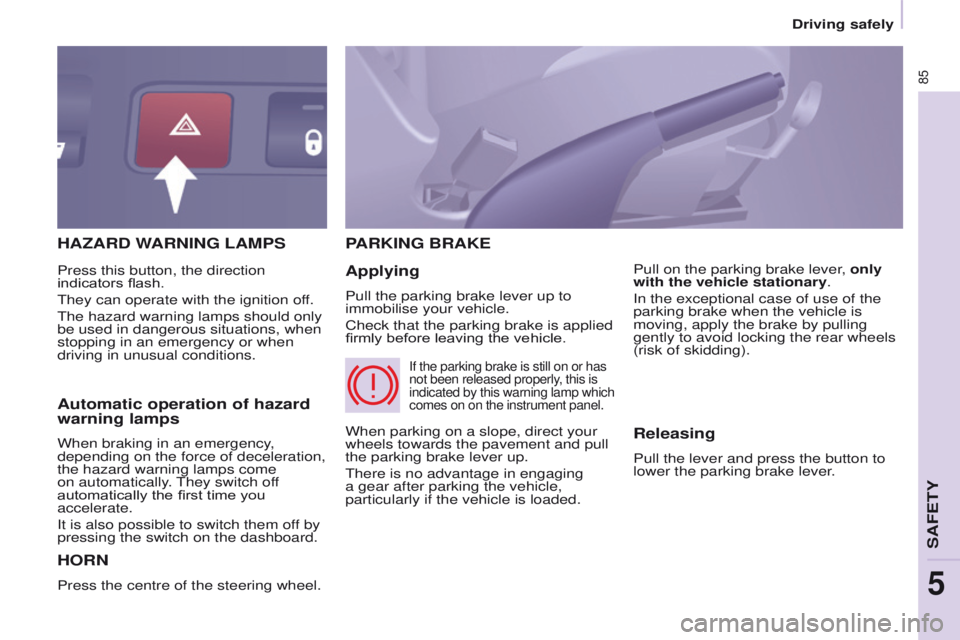
HAZARD WARNING LAMPS
HORN
Press the centre of the steering wheel.
PARKING BRAKE
Applying
Pull the parking brake lever up to
immobilise your vehicle.
Check that the parking brake is applied
firmly before leaving the vehicle.Pull on the parking brake lever, only
with the vehicle stationary.
In the exceptional case of use of the
parking brake when the vehicle is
moving, apply the brake by pulling
gently to avoid locking the rear wheels
(risk of skidding).
Press this button, the direction
indicators flash.
They can operate with the ignition off.
The hazard warning lamps should only
be used in dangerous situations, when
stopping in an emergency or when
driving in unusual conditions.
When parking on a slope, direct your
wheels towards the pavement and pull
the parking brake lever up.
There is no advantage in engaging
a gear after parking the vehicle,
particularly if the vehicle is loaded.
If the parking brake is still on or has
not been released properly, this is
indicated by this warning lamp which
comes on on the instrument panel.
Automatic operation of hazard
warning lamps
When braking in an emergency,
depending on the force of deceleration,
the hazard warning lamps come
on automatically. They switch off
automatically the first time you
accelerate.
It is also possible to switch them off by
pressing the switch on the dashboard.Releasing
Pull the lever and press the button to
lower the parking brake lever.
SAFETY
5
Driving safely
Page 98 of 244
96
Partner-2-VU_en_Chap05_Securite_ed02-2014
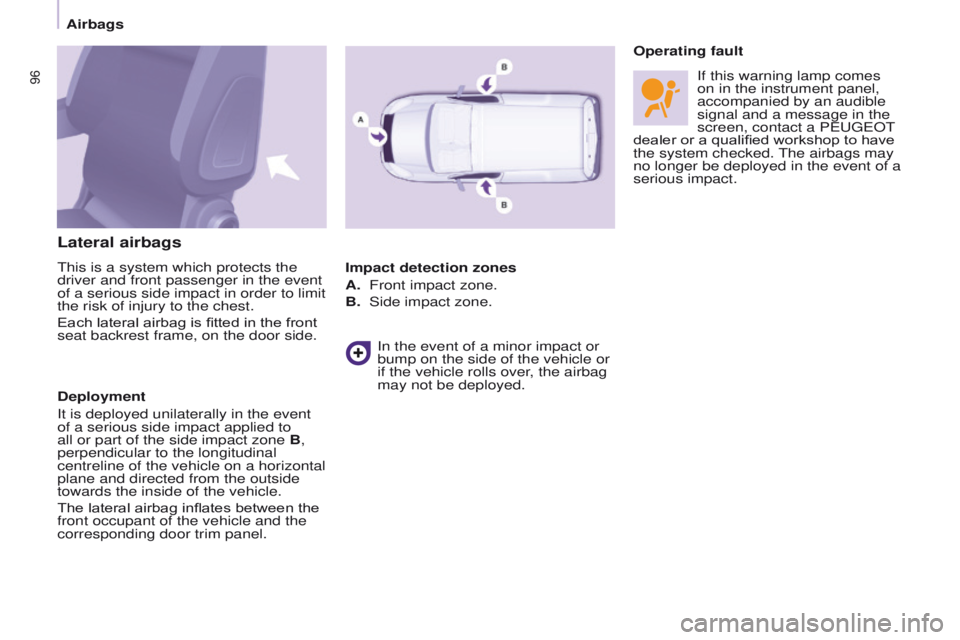
Lateral airbags
This is a system which protects the
driver and front passenger in the event
of a serious side impact in order to limit
the risk of injury to the chest.
Each lateral airbag is fitted in the front
seat backrest frame, on the door side.
Deployment
It is deployed unilaterally in the event
of a serious side impact applied to
all or part of the side impact zone B,
perpendicular to the longitudinal
centreline of the vehicle on a horizontal
plane and directed from the outside
towards the inside of the vehicle.
The lateral airbag inflates between the
front occupant of the vehicle and the
corresponding door trim panel. Impact detection zones
A.
Front impact zone.
B.
Side impact zone.
In the event of a minor impact or
bump on the side of the vehicle or
if the vehicle rolls over
, the airbag
may not be deployed. Operating fault
If this warning lamp comes
on in the instrument panel,
accompanied by an audible
signal and a message in the
screen, contact a PEUGEOT
dealer or a qualified workshop to have
the system checked. The airbags may
no longer be deployed in the event of a
serious impact.
Airbags
Page 99 of 244
97
Partner-2-VU_en_Chap05_Securite_ed02-2014
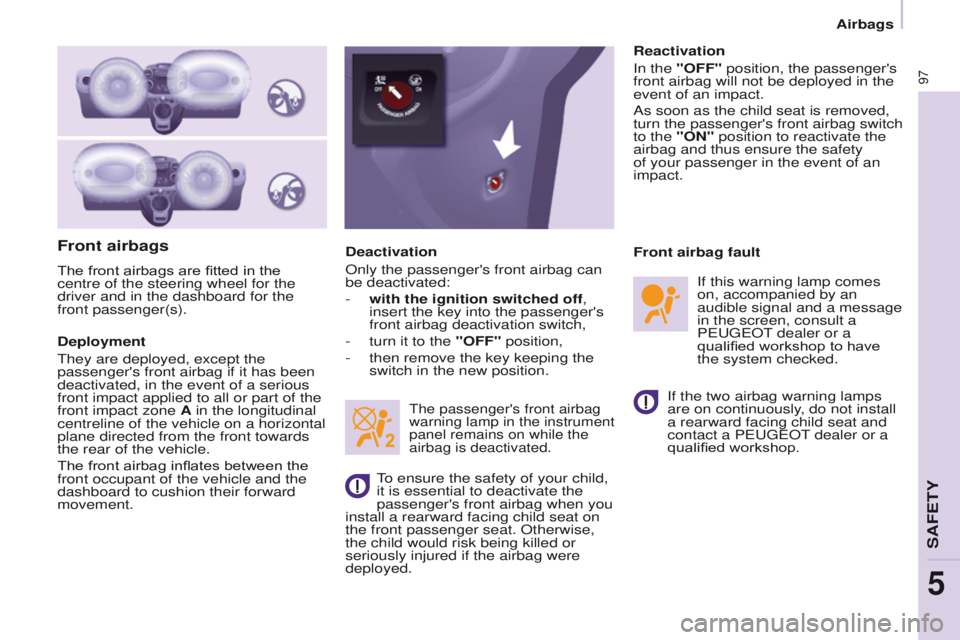
Front airbags
The front airbags are fitted in the
centre of the steering wheel for the
driver and in the dashboard for the
front passenger(s).
Deployment
They are deployed, except the
passenger's front airbag if it has been
deactivated, in the event of a serious
front impact applied to all or part of the
front impact zone A in the longitudinal
centreline of the vehicle on a horizontal
plane directed from the front towards
the rear of the vehicle.
The front airbag inflates between the
front occupant of the vehicle and the
dashboard to cushion their forward
movement.Deactivation
Only the passenger's front airbag can
be deactivated:
-
with the ignition switched off
,
insert the key into the passenger's
front airbag deactivation switch,
-
turn it to the
"OFF" position,
-
then remove the key keeping the
switch in the new position.
The passenger's front airbag
warning lamp in the instrument
panel remains on while the
airbag is deactivated.If the two airbag warning lamps
are on continuously, do not install
a rearward facing child seat and
contact a PEUGEOT dealer or a
qualified workshop.
Front airbag fault
To ensure the safety of your child,
it is essential to deactivate the
passenger's front airbag when you
install a rearward facing child seat on
the front passenger seat. Otherwise,
the child would risk being killed or
seriously injured if the airbag were
deployed. Reactivation
In the "OFF" position, the passenger's
front airbag will not be deployed in the
event of an impact.
As soon as the child seat is removed,
turn the passenger's front airbag switch
to the "ON" position to reactivate the
airbag and thus ensure the safety
of your passenger in the event of an
impact.
If this warning lamp comes
on, accompanied by an
audible signal and a message
in the screen, consult a
PEUGEOT dealer or a
qualified workshop to have
the system checked.
SAFETY
5
Airbags
Page 117 of 244
11 5
Partner-2-VU_en_Chap07_Verification_ed02-2014
LEVELSOil change
This must be carried out at
the intervals specified in the
manufacturer's servicing schedule. Ask
for advice from a PEUGEOT dealer.
Remove the dipstick before filling.
Check the level after filling (never
exceed the max mark).
Refit the oil filler cap before closing the
bonnet.
Changing the brake fluid
The brake fluid must be changed at
the intervals stated, according to the
manufacturer's servicing schedule.
Use fluids recommended by the
manufacturer, which meet the DOT4
standard.
The level must be between the MIN
and MAX marks on the reservoir.
If fluid has to be added frequently,
this indicates a fault which must be
checked by a PEUGEOT dealer or
a qualified workshop as soon as
possible.
Warning lamps
If you have to remove / refit the
engine style cover, handle it with
care to avoid damaging the fixing clips.
Oil level
It is recommended that the oil level be
checked every 3 000 miles (5 000 km)
and topped up if necessary between oil
changes.
Check the level with the vehicle level,
engine cold, using the dipstick.
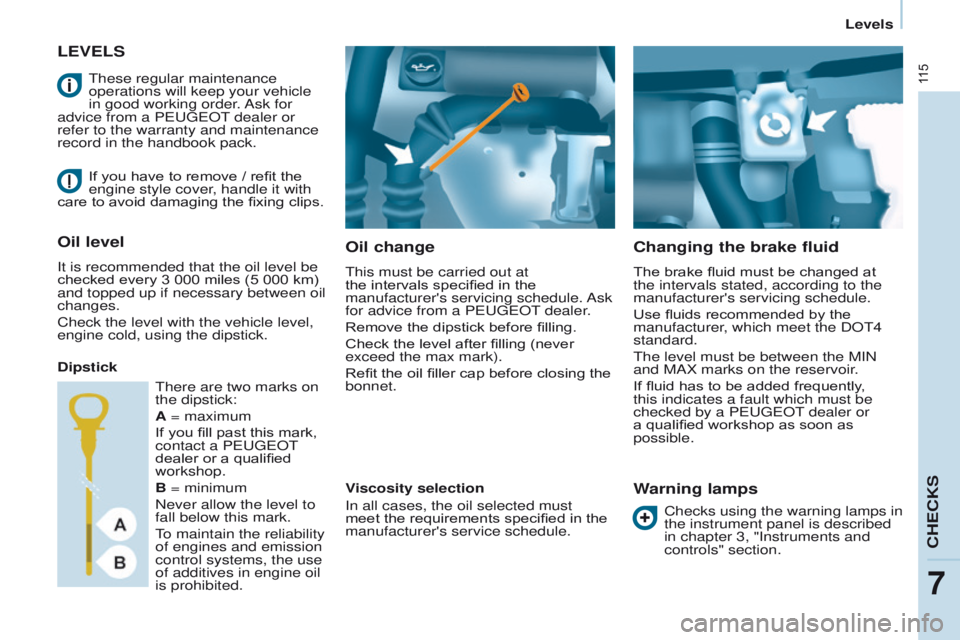
Dipstick
Viscosity selection
In all cases, the oil selected must
meet the requirements specified in the
manufacturer's service schedule.
These regular maintenance
operations will keep your vehicle
in good working order. Ask for
advice from a PEUGEOT dealer or
refer to the warranty and maintenance
record in the handbook pack.
Checks using the warning lamps in
the instrument panel is described
in chapter 3, "Instruments and
controls" section.
There are two marks on
the dipstick:
A = maximum
If you fill past this mark,
contact a PEUGEOT
dealer or a qualified
workshop.
B = minimum
Never allow the level to
fall below this mark.
To maintain the reliability
of engines and emission
control systems, the use
of additives in engine oil
is prohibited.
CHECKS
7
Levels
Page 124 of 244
122
Partner-2-VU_en_Chap07_Verification_ed02-2014
Range indicators
When switching on the ignition, an
indicator gives an estimate of the
distance that can be travelled with
your vehicle before engine starting
is automatically prevented, once the
vehicle starts using the reserve of
AdBlue
® or after a fault is detected with
the SCR system.
In the event of simultaneous system
fault and low AdBlue
® level, the
shortest range is the one displayed.
In the event of the risk of non-
starting related to a lack of AdBlue
®
The engine start prevention
system required by regulations is
activated automatically once the
AdBlue
® tank is empty.
Range greater than 1 500 miles (2 400 km)
When the ignition is switched on, no
information on range is displayed
automatically in the instrument panel.
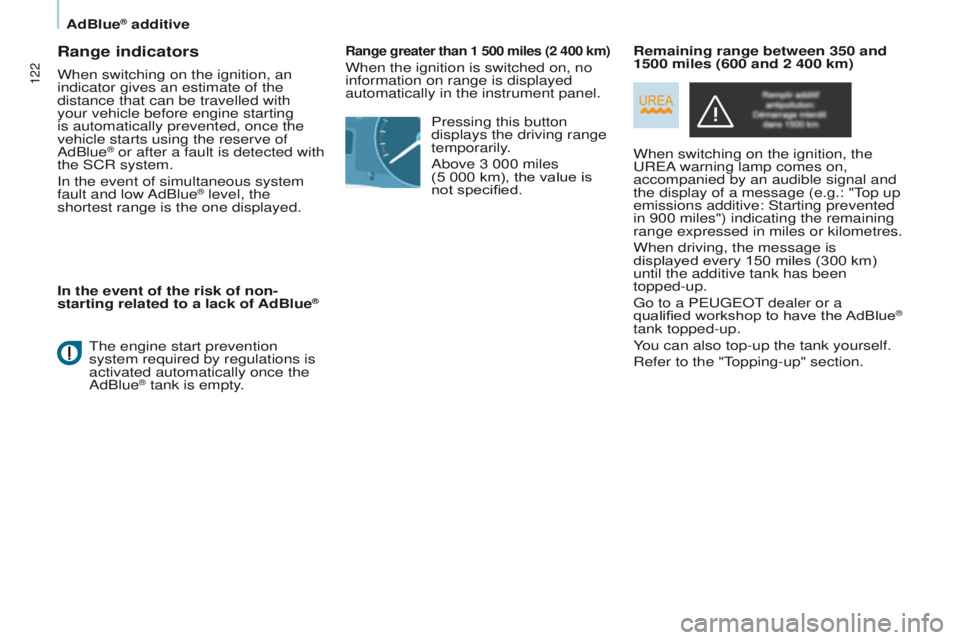
When switching on the ignition, the
UREA
warning lamp comes on,
accompanied by an audible signal and
the display of a message (e.g.: "Top up
emissions additive: Starting prevented
in 900 miles") indicating the remaining
range expressed in miles or kilometres.
When driving, the message is
displayed every 150 miles (300 km)
until the additive tank has been
topped-up.
Go to a PEUGEOT dealer or a
qualified workshop to have the AdBlue
®
tank topped-up.
You can also top-up the tank yourself.
Refer to the "Topping-up" section. Remaining range between 350 and
1500 miles (600 and 2 400 km)
Pressing this button
displays the driving range
temporarily.
Above 3 000 miles
(5
000
km), the value is
not specified.
AdBlue® additive
Page 145 of 244
143
Partner-2-VU_en_Chap08_Aide-rapide_ed02-2014
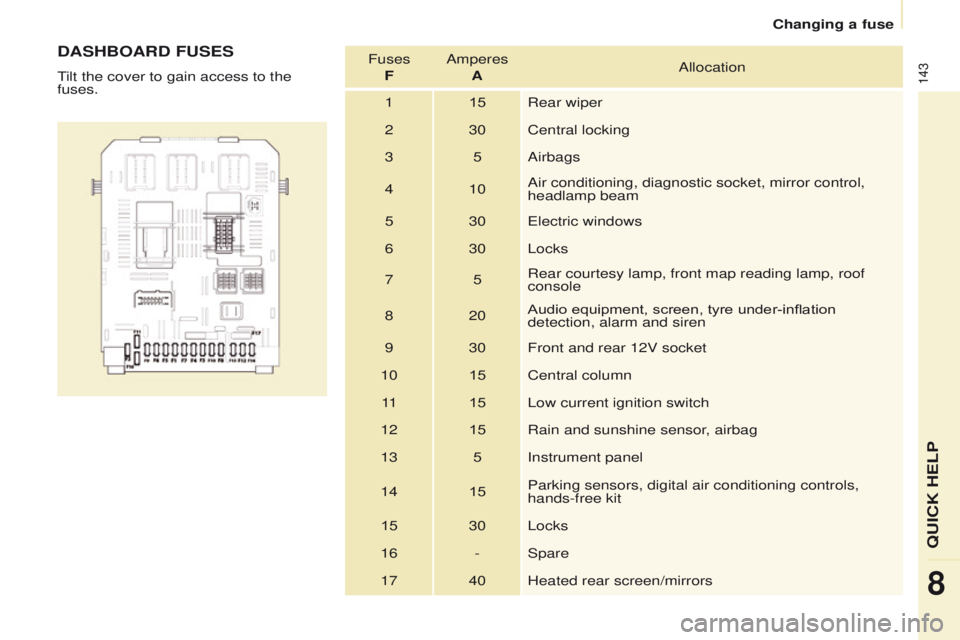
DASHBOARD FUSES
Tilt the cover to gain access to the
fuses.Fuses
F Amperes
A Allocation
1 15Rear wiper
2 30 Central locking
3 5Airbags
4 10 Air conditioning, diagnostic socket, mirror control,
headlamp beam
5 30 Electric windows
6 30 Locks
7 5Rear courtesy lamp, front map reading lamp, roof
console
8 20 Audio equipment, screen, tyre under-inflation
detection, alarm and siren
9 30 Front and rear 12V socket
10 15Central column
11 15Low current ignition switch
12 15Rain and sunshine sensor, airbag
13 5Instrument panel
14 15Parking sensors, digital air conditioning controls,
hands-free kit
15 30 Locks
16 - Spare 17 40 Heated rear screen/mirrors
QUICK HELP
8
Changing a fuse
Page 202 of 244
09
10.44
Partner-2-VU_en_Chap10b_RT6-2-8_ed02-2014
AUDIO SETTINGS
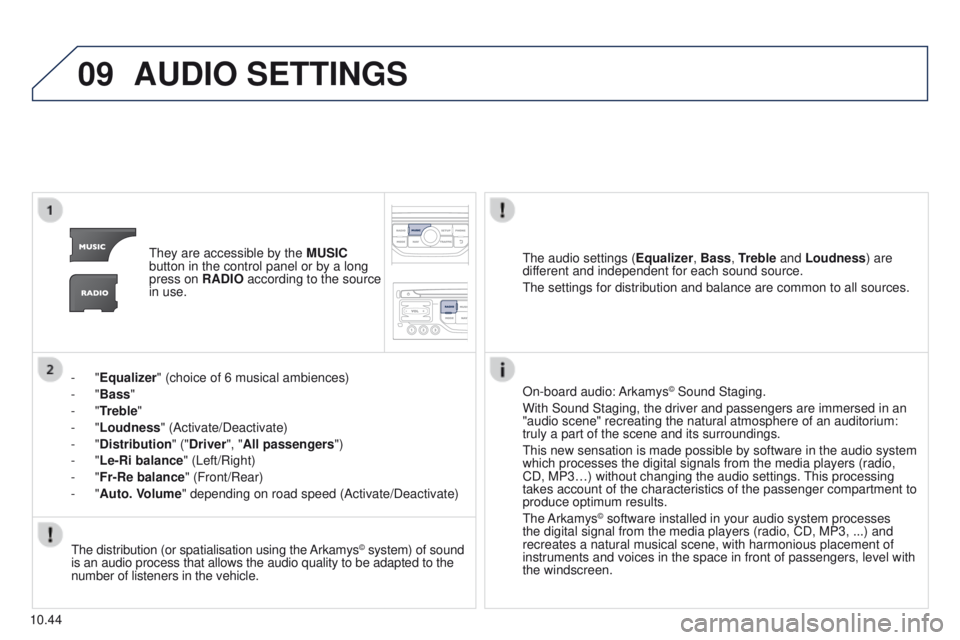
They are accessible by the MUSIC
button in the control panel or by a long
press on RADIO according to the source
in use.
-
"Equalizer" (choice of 6 musical ambiences)
-
"Bass "
-
"Treble"
-
"Loudness" (Activate/Deactivate)
-
"Distribution " ("Driver", "All passengers")
-
"Le-Ri balance" (Left/Right)
-
"Fr-Re balance" (Front/Rear)
-
"Auto. Volume" depending on road speed (Activate/Deactivate) The audio settings (
Equalizer, Bass, Treble and Loudness) are
different and independent for each sound source.
The settings for distribution and balance are common to all sources.
The distribution (or spatialisation using the Arkamys
© system) of sound
is an audio process that allows the audio quality to be adapted to the
number of listeners in the vehicle. On-board audio: Arkamys
© Sound Staging.
With Sound Staging, the driver and passengers are immersed in an
"audio scene" recreating the natural atmosphere of an auditorium:
truly a part of the scene and its surroundings.
This new sensation is made possible by software in the audio system
which processes the digital signals from the media players (radio,
CD, MP3…) without changing the audio settings. This processing
takes account of the characteristics of the passenger compartment to
produce optimum results.
The Arkamys
© software installed in your audio system processes
the digital signal from the media players (radio, CD, MP3, ...) and
recreates a natural musical scene, with harmonious placement of
instruments and voices in the space in front of passengers, level with
the windscreen.