brake light Peugeot Partner 2016 User Guide
[x] Cancel search | Manufacturer: PEUGEOT, Model Year: 2016, Model line: Partner, Model: Peugeot Partner 2016Pages: 260, PDF Size: 8.83 MB
Page 132 of 260
130
Partner-2-Vu_en_Chap07_Verification_ed02-2015
Good practice
Only use products recommended by
PEUGEOT or products of equivalent
quality and specification.
In order to optimise the operation
of units as important as the braking
system, PEUGEOT selects and offers
specific products.
Bleeding water from the Diesel
filterManual gearbox
Have the level checked in accordance with
the manufacturer's servicing schedule.
In order to avoid damaging the
electrical units, high pressure
washing to clean the engine
compartment is strictly prohibited.
After washing the vehicle dampness,
or in winter, ice may form on the brake
discs and pads: braking efficiency may
be reduced. Make some light brake
applications to dry and de-ice the
brakes.
If this warning lamp comes
on, bleed the filter. Otherwise
bleed regularly each time the
engine oil is changed.
To drain the water, unscrew the bleed
screw located on the filter.
Operate until all of the water no longer
flows in the transparent pipe, then
tighten the bleed screw.
Particle filter (Diesel)
Maintenance of the particle filter must
be carried out by a PEUGEOT dealer.
On acceleration after the vehicle has
been running for a prolonged period
at very low speed or at idle, you may,
in exceptional circumstances, notice
the emission of water vapour at the
exhaust. This water vapour does not
have any adverse effect on vehicle
handling or the environment.
Oil filter
Change the filter regularly in
accordance with the manufacturer's
servicing schedule.
HDi engines use advanced
technology. All work requires
special training, so should be
entrusted to a PEUGEOT dealer.
Depending on country of sale.
Checks
Page 144 of 260
142
Partner-2-Vu_en_Chap08_Aide-rapide_ed02-2015
1. Parking the vehicle
- The occupants must get out of the
vehicle and wait in a safe location.
-
If possible, park the vehicle on
level, stable and non-slippery
ground.
-
Apply the parking brake, switch
of
f the ignition and engage first or
reverse gear. -
Place the chock against the wheel
diagonally opposite the one to be
changed.
CHANGING A WHEEL
2. T
ools
The tools are stowed in an open
storage compartment under a front
seat.
-
If necessary
, move the seat to
access the storage compartment
from the rear.
-
T
ake out the jack and tool carrier.
-
Remove the tools needed from the
carrier
.
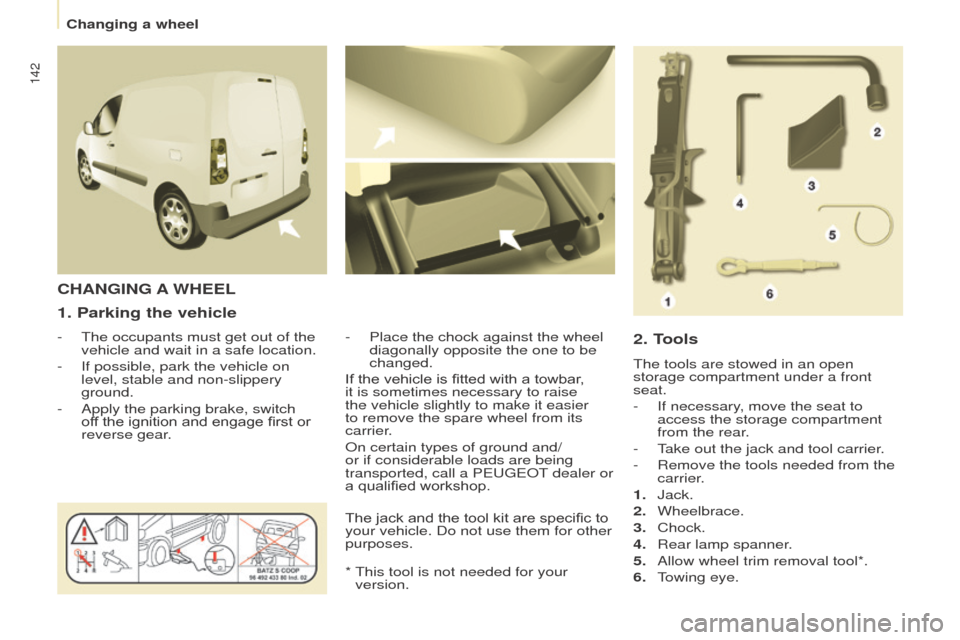
1.
Jack.
2.
Wheelbrace.
3.
Chock.
4.
Rear lamp spanner
.
5.
Allow wheel trim removal tool*.
6.
T
owing eye.
If the vehicle is fitted with a towbar,
it is sometimes necessary to raise
the vehicle slightly to make it easier
to remove the spare wheel from its
carrier.
On certain types of ground and/
or if considerable loads are being
transported, call a PEUGEOT dealer or
a qualified workshop.
*
This tool is not needed for your
version.
The jack and the tool kit are specific to
your vehicle. Do not use them for other
purposes.
Changing a wheel
Page 154 of 260
152
Partner-2-Vu_en_Chap08_Aide-rapide_ed02-2015
This procedure requires the use of
the spanner supplied with the tools for
changing a wheel.-
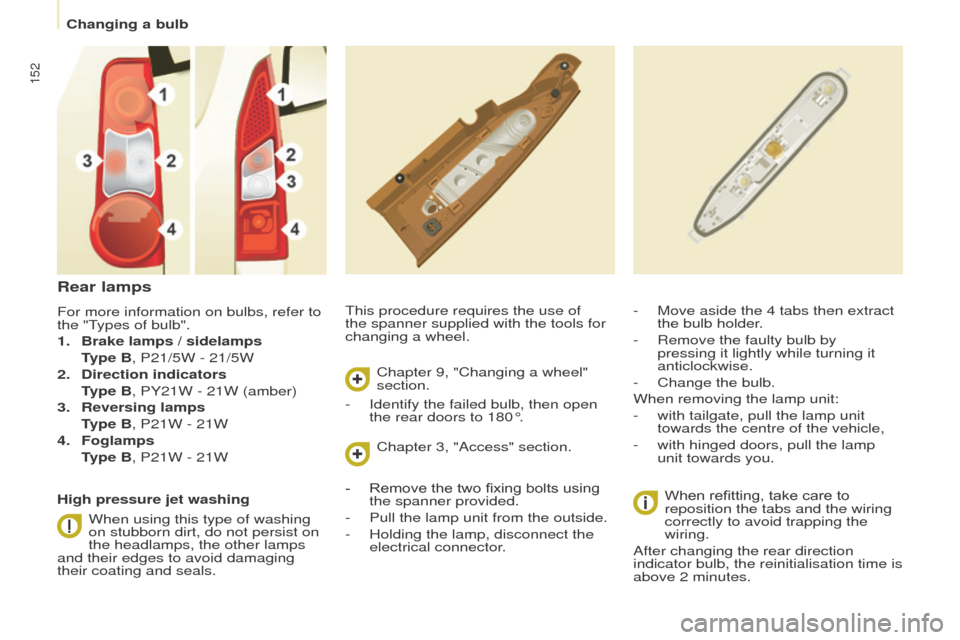
Move aside the 4 tabs then extract
the bulb holder
.
-
Remove the faulty bulb by
pressing it lightly while turning it
anticlockwise.
-
Change the bulb.
When removing the lamp unit:
-
with tailgate, pull the lamp unit
towards the centre of the vehicle,
-
with hinged doors, pull the lamp
unit towards you.When refitting, take care to
reposition the tabs and the wiring
correctly to avoid trapping the
wiring.
After changing the rear direction
indicator bulb, the reinitialisation time is
above 2 minutes.
Rear lamps
For more information on bulbs, refer to
the "Types of bulb".
1.
Brake lamps / sidelamps
T
ype B, P21/5W - 21/5W
2.
Direction indicators
T
ype B, PY21W - 21W (amber)
3.
Reversing lamps
T
ype B, P21W - 21W
4.
Foglamps
T
ype B, P21W - 21W
High pressure jet washing When using this type of washing
on stubborn dirt, do not persist on
the headlamps, the other lamps
and their edges to avoid damaging
their coating and seals. Chapter 9, "Changing a wheel"
section.
Chapter 3, "Access" section.
-
Identify the failed bulb, then open
the rear doors to 180°.
-
Remove the two fixing bolts using
the spanner provided.
-
Pull the lamp unit from the outside.
-
Holding the lamp, disconnect the
electrical connector
.
Changing a bulb
Page 169 of 260
167
Partner-2-Vu_en_Chap09_Caract-technique_ed02-2015
WEIGHTS AND TOWED LOADS
These values, expressed in kg, can be
found on the manufacturer's VIN plate
or label.
The maximum weights and towed
loads for your vehicle can be found on
the vehicle's registration certificate. The recommended nose weight is
the downward force on the towball
(removable with or without tools).
In each country, it is imperative that
the maximum towed loads authorised
by local legislation are complied
with. To find out your vehicle's towing
capacities and its gross train weight,
consult a PEUGEOT dealer.
The kerb weight is equal to the weight
without load + driver (75 kg) + fuel tank
filled to 90%.
The GTW and towed load values
indicated are valid up to a maximum
altitude of 1000 metres. The value of
the towed load mentioned must be
reduced by 10 % for each additional
1000 metres.
With load transfer, the braked trailer
weight can be increased, on condition
that the equivalent of this load is
removed from the vehicle so that the
GTW is not exceeded. High ambient temperatures
may result in a reduction in the
performance of the vehicle in
order to protect the engine. When
the ambient temperature is higher
than 37 °C, limit the towed weight.
The location of the manufacturer's
plate is given in chapter 9,
"Identification markings" section.
ENGINE CHARACTERISTICS
The engine characteristics (capacity,
maximum power, maximum power
speed, fuel, CO
2 emissions...) for your
vehicle are given in the registration
certificate.
These characteristics correspond
to the values type-approved
on a test bed, under conditions
defined in European legislation
(Directive
1999/99/EC).
For more information, refer to the
manufacturer's website or sales
brochure for the model. Contact
a PEUGEOT dealer or a qualified
workshop. GVW: gross vehicle weight, the
maximum authorised weight.
GTW: gross train weight, the maximum
weight for vehicle plus trailer.
Towing with a lightly loaded
vehicle can adversely affect road
holding.
Towing a trailer increases braking
distances.
When towing, the maximum permitted
speed is reduced (comply with the
legislation in force in the country).
TECHNICAL DATA
9
Weights