tow Peugeot Partner 2016 Owner's Guide
[x] Cancel search | Manufacturer: PEUGEOT, Model Year: 2016, Model line: Partner, Model: Peugeot Partner 2016Pages: 260, PDF Size: 8.83 MB
Page 109 of 260
107
Partner-2-Vu_en_Chap05_Securite_ed02-2015
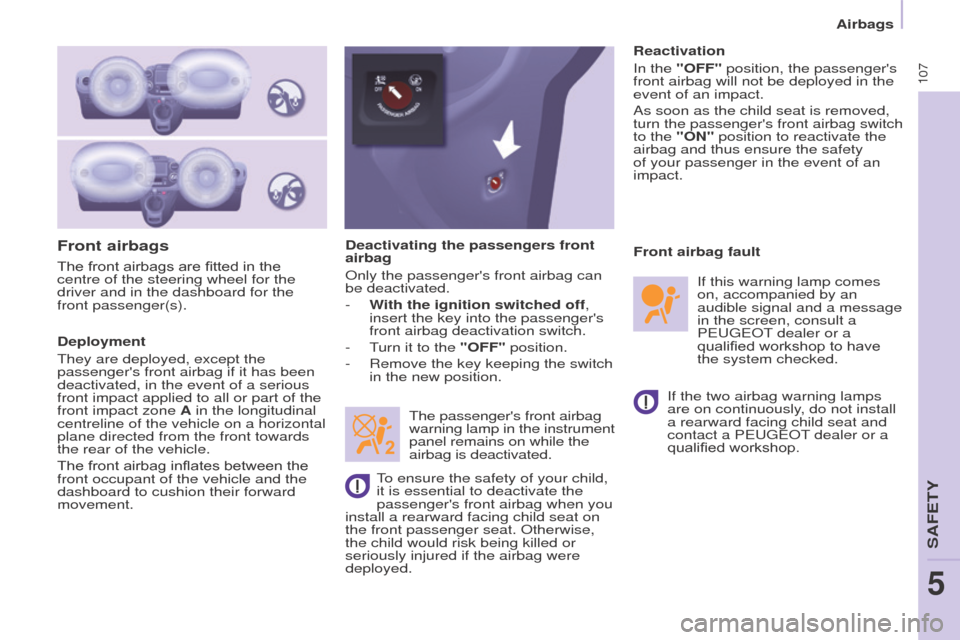
Front airbags
Deployment
They are deployed, except the
passenger's front airbag if it has been
deactivated, in the event of a serious
front impact applied to all or part of the
front impact zone A in the longitudinal
centreline of the vehicle on a horizontal
plane directed from the front towards
the rear of the vehicle.
The front airbag inflates between the
front occupant of the vehicle and the
dashboard to cushion their forward
movement.Deactivating the passengers front
airbag
Only the passenger's front airbag can
be deactivated.
-
W
ith the ignition switched off,
insert the key into the passenger's
front airbag deactivation switch.
- T urn it to the "OFF" position.
-
Remove the key keeping the switch
in the new position.
The passenger's front airbag
warning lamp in the instrument
panel remains on while the
airbag is deactivated. If the two airbag warning lamps
are on continuously, do not install
a rearward facing child seat and
contact a PEUGEOT dealer or a
qualified workshop.
Front airbag fault
To ensure the safety of your child,
it is essential to deactivate the
passenger's front airbag when you
install a rearward facing child seat on
the front passenger seat. Otherwise,
the child would risk being killed or
seriously injured if the airbag were
deployed. Reactivation
In the "OFF" position, the passenger's
front airbag will not be deployed in the
event of an impact.
As soon as the child seat is removed,
turn the passenger's front airbag switch
to the "ON" position to reactivate the
airbag and thus ensure the safety
of your passenger in the event of an
impact.
If this warning lamp comes
on, accompanied by an
audible signal and a message
in the screen, consult a
PEUGEOT dealer or a
qualified workshop to have
the system checked.
The front airbags are fitted in the
centre of the steering wheel for the
driver and in the dashboard for the
front passenger(s).
SAFETY
5
Airbags
Page 117 of 260

11 5
Partner-2-Vu_en_Chap05_Securite_ed02-2015
(a) Universal child seat: child seat that
can be fitted in any vehicle using
the seat belt.
(b)
Group 0: from birth to 10 kg. Cots
cannot be installed on the front
seat.
(c)
Consult the legislation in force in
your country before installin
g your
child on this seat.
(d)
When a rearward facing child seat
is installed on a
front passenger
seat, the passenger's front airbag
must be deactivated. Otherwise,
the child risks being seriously
injured or killed if the airbag is
deployed.
When a forward facing child seat
is installed on a
front passenger
seat, the passenger's front airbag
must remain active.
(e)
the "RÖMER Baby-Safe Plus" child
seat cannot be installed on this
seat.
With the exception of the "KLIPP
AN
Optima", PEUGEOT advises against
installing a child seat on the centre
seat. Remove and stow the head
restraint before installing a child
seat with backrest on a passenger
seat.
Refit the head restraint once the child
seat has been removed.
SAFETY
5
Child safety
Page 118 of 260

11 6
Partner-2-Vu_en_Chap05_Securite_ed02-2015
ADVICE ON CHILD SEATS
The incorrect installation of a child seat
in a vehicle compromises the child's
protection in the event of an accident.
Check that there is no seat belt or seat
belt buckle under the child seat, as this
could destabilise the seat.
Remember to fasten the seat belts or
the child seat harnesses keeping the
slack relative to the child's body to a
minimum, even for short journeys.
For the installation of a child seat using
the seat belt, ensure that the seat belt
is well tensioned on the child seat
and that it is holding the child seat
firmly against the vehicle's seat. If the
passenger seat is adjustable, move it
forward if necessary.
At the rear, always leave sufficient
space between the front seat and:
-
a rearward facing child seat,
-
the feet of a child seated in a
forward facing child seat.
For this, move the front seat forward
and, if necessary
, straighten its
backrest as well. For the optimum installation of a
forward facing child seat, ensure that
the back of the child seat is as close as
possible to the backrest of the vehicle's
seat, or in contact if possible.
The head restraint must be removed
before installing a child seat with a
backrest on the passenger seat.
Ensure that the head restraint is
stowed or attached securely so that it
is not thrown around the vehicle in the
event of sharp braking.
Refit the head restraint as soon as the
child seat is removed.
Children at the front
The legislation on carrying a child on
the front passenger seat is specific to
each country. Refer to the legislation in
force in your country.
Deactivate the passenger's airbag
when a rearward facing child seat is
installed on the front seat.
Otherwise, the child would risk being
seriously injured or killed if the airbag
were deployed.
Installing a booster seat
The chest part of the seat belt must
be positioned on the child's shoulder
without touching the neck.
Ensure that the lap part of the seat belt
passes correctly over the child's thighs.
PEUGEOT recommends the use of a
booster seat which has a back, fitted
with a seat belt guide at shoulder level.
As a safety precaution, never leave:
-
one or more children alone and
unsupervised in a vehicle,
-
a child or an animal in a vehicle
which is exposed to the sun, with
the windows closed,
-
the keys within reach of children
inside the vehicle.
T
o prevent accidental opening of the
doors, use the "Child Lock".
Take care not to open the rear windows
by more than one third.
To protect young children from the rays
of the sun, fit side blinds to the rear
windows.
Child safety
Page 119 of 260
11 7
Towing a trailer
Partner-2-Vu_en_Chap06_Accessoire_ed02-2015
For more information about
weights and towed loads, refer to
chapter 9, "Weights" section.
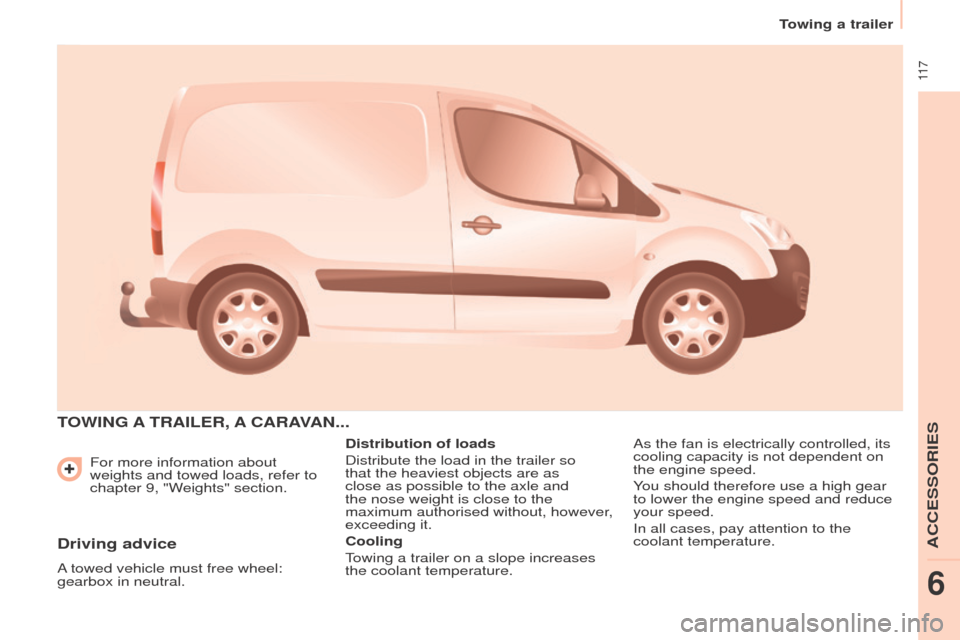
TOWING A TRAILER , A CARA VAN ...
Distribution of loads
Distribute the load in the trailer so
that the heaviest objects are as
close as possible to the axle and
the nose weight is close to the
maximum authorised without, however,
exceeding it.
Cooling
Towing a trailer on a slope increases
the coolant temperature. As the fan is electrically controlled, its
cooling capacity is not dependent on
the engine speed.
You should therefore use a high gear
to lower the engine speed and reduce
your speed.
In all cases, pay attention to the
coolant temperature.
Driving advice
A towed vehicle must free wheel:
gearbox in neutral.
ACCESSORIES
6
Page 120 of 260
11 8
Towing a trailer
Partner-2-Vu_en_Chap06_Accessoire_ed02-2015
Good Practice
In certain cases of particularly arduous
use (towing the maximum load up a
steep slope in high temperatures), the
engine automatically limits its power.
In this case, the air conditioning is
automatically cut off to save engine
power.
Tyres
Check the tyre pressures of the towing
vehicle and of the trailer, observing the
recommended pressures. Chapter 7, "Levels" section.If the coolant temperature
warning lamp comes on, stop
the vehicle and switch off the
engine as soon as possible. Brakes
Towing increases the braking distance.
Drive at a moderate speed, change
down early and brake gradually.
Towbar
We recommend the use of genuine
PEUGEOT towbars and their wiring
harnesses, which have been tested
and approved from the design stage of
your vehicle, and that you entrust the
fitting of this equipment to a PEUGEOT
dealer.
If this equipment is not fitted by a
PEUGEOT dealer, it is imperative that
it is fitted using the electrical pre-
equipment installed at the rear of the
vehicle and in accordance with the
manufacturer's instructions.
In accordance with the general
instructions a reminder of which has
been given above, we draw your
attention to the risk associated with
fitting a towbar or electrical accessory
not recommended by PEUGEOT.
Fitting such equipment could result in
the failure of your vehicle's electronic
system. Please obtain information from
the Manufacturer before fitting this type
of equipment.
Side wind
Sensitivity to side wind is increased.
Drive smoothly and at a moderate
speed.
ABS/DSC
The ABS or DSC systems only control
the vehicle, not the trailer or caravan.
Parking sensors
The rear parking sensors system does
not function while the vehicle is towing.
Chapter 9, "Identification
markings" section.
Page 121 of 260

11 9
Towing a trailer
Partner-2-Vu_en_Chap06_Accessoire_ed02-2015
TOWBAR WITH SWAN NECK
T
OWBALL ,
LOCKABLE AND QUICKLY DETACHABLE
Presentation
This swan neck towbar, delivered
assembled, can be removed and fitted
easily. No tools are needed.
Instructions for fitting and before
every use
Check that the swan neck is correctly
locked by verifying the following points:
-
the green mark on the locking
wheel is visible
-
the safety lock on the locking wheel
is directed toward the rear
,
-
the safety lock is closed and the
key removed; the locking wheel can
no longer be operated,
-
the swan neck must no longer
move at all in its carrier
.
When hooking up the trailer, don't
forget to connect the trailer harness.
Fitting
ACCESSORIES
6
Page 122 of 260

120
Towing a trailer
Partner-2-Vu_en_Chap06_Accessoire_ed02-2015
During use
Never unlock the device when
a trailer or load carrier is fitted to the
swan neck.
After use
For journeys made without a trailer
or load carrier, the swan neck must
be removed and
the blanking plug
inserted in the carrier. This measure
applies particularly if the swan neck
could hinder visibility of the number
plate or lighting.Removal
Maintenance
Correct operation is only possible if the
swan neck and its carrier remain clean.
Before cleaning the vehicle with a high
pressure jet wash, the swan neck must
be removed and the blanking plug
inserted in the carrier.
Page 123 of 260
121
Partner-2-Vu_en_Chap06_Accessoire_ed02-2015
Audio equipment, hands-free kit,
speakers, CD changer, satellite
navigation system, USB Box, video kit, ...
Regardless of the audio and telematic
equipment offered on the market,
the technical constraints associated
with the fitting of equipment of these
families of products mean that the
special features of the equipment and
its compatibility with the capacities of
the your vehicle's standard equipment
must be taken into account. Please
contact a PEUGEOT dealer for
more information before fitting such
equipment. To prevent the mat from becoming
caught under the pedals:
-
ensure that the mat and its fixings
are positioned correctly
,
-
never fit one mat on top of another
.
Maximum weights on bars
-
Roof rack: 120 kg.
-
T
ransverse bars on roof: 100 kg.
-
T
ransverse bars on longitudinal
bars: 75 kg. Installation of radiocommunication
transmitters
Before installing accessory
radiocommunication transmitters with
an external aerial on your vehicle, you
are advised to contact a PEUGEOT
dealer.
A PEUGEOT dealer can inform you
of the specifications (frequency band,
maximum output power, aerial position,
specific installation conditions) of the
transmitters which can be fitted, in
accordance with the Motor Vehicle
Electromagnetic Compatibility
Directive
(2004/104/CE).
Front mud flaps, rear mud flaps,
15/17 inch alloy wheels, wheelarch
trim, leather steering wheel, .... Screenwash, interior and exterior
cleaning and maintenance products,
replacement bulbs, ...
Anti-theft alarm, window etching, first
aid kit, high visibility vest, front and
rear parking sensors, warning triangle,
security bolts for alloy wheels, ... Front seat covers compatible with
airbags, bench, rubber mats, carpet
mats, snow chains, blind, tailgate
bicycle carrier.
Other accessories
These accessories and parts, having been
tested and approved for reliability and
safety, are all adapted to your vehicle. A
wide range of recommended accessories
and genuine parts is available.
Range of trade equipment
The parts department publishes an
accessory catalogue offering various
equipment and fittings, such as:
Load retainers (all models).
Loading roller.
Towbar, towbar harness: trailer towbar
which should preferably be fitted by a
PEUGEOT dealer.
Separation partitions and grilles,
smooth, planed wood protective liner
with non-slip floor.
Protective grilles.
Another range is also available,
structured around comfort, leisure and
maintenance:
ACCESSORIES
6
Equipment
Page 125 of 260
123123
Partner-2-Vu_en_Chap07_Verification_ed02-2015
PEUGEOT & TOTAL,
A PARTNERSHIP TO DELIVER
B
ETTER
PERFORMANCE
!
Innovation, the key to success
The TOTAL Research and Development and
PEUGEOT teams work together to develop high
quality lubricants that meet the requirements
of PEUGEOT vehicles. For you, this is the
assurance that the performance of your engine
is optimised while also ensuring its durability.
The 208 HYbrid FE demonstrates the ability of
PEUGEOT and TOTAL to develop innovative
technologies and provide other ways of moving
towards the future.
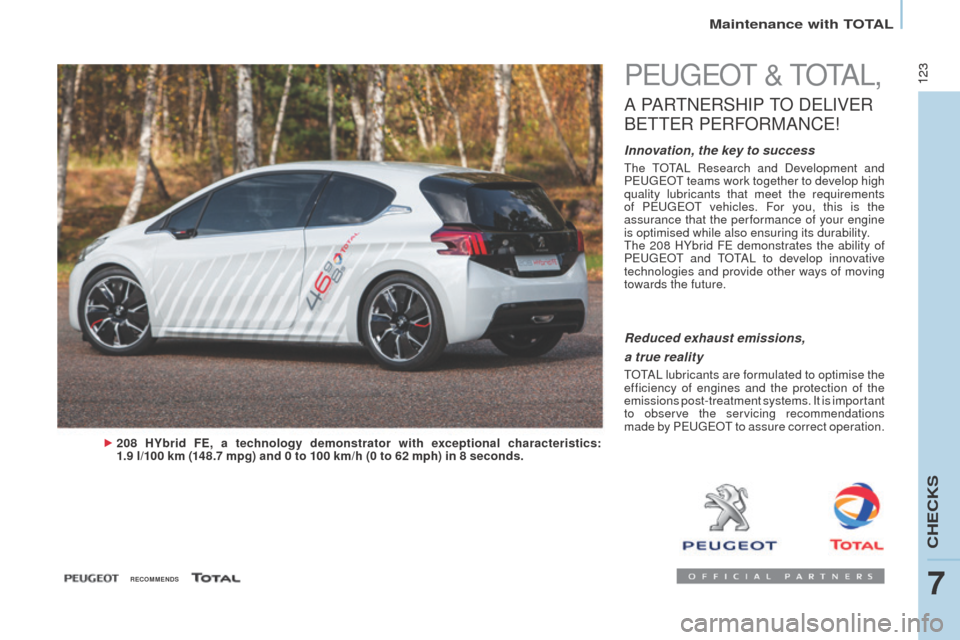
208 HYbrid FE, a technology demonstrator with exceptional characteristics:
1.9 l/100 km (148.7 mpg) and 0 to 100 km/h (0 to 62 mph) in 8 seconds.
Reduced exhaust emissions,
a true reality
TOTAL lubricants are formulated to optimise the
efficiency of engines and the protection of the
emissions post-treatment systems. It is important
to observe the servicing recommendations
made by PEUGEOT to assure correct operation.
RECOMMENDS
CHECKS
7
Maintenance with TOTAL
CHECKS
7
Page 126 of 260
124
Partner-2-Vu_en_Chap07_Verification_ed02-2015
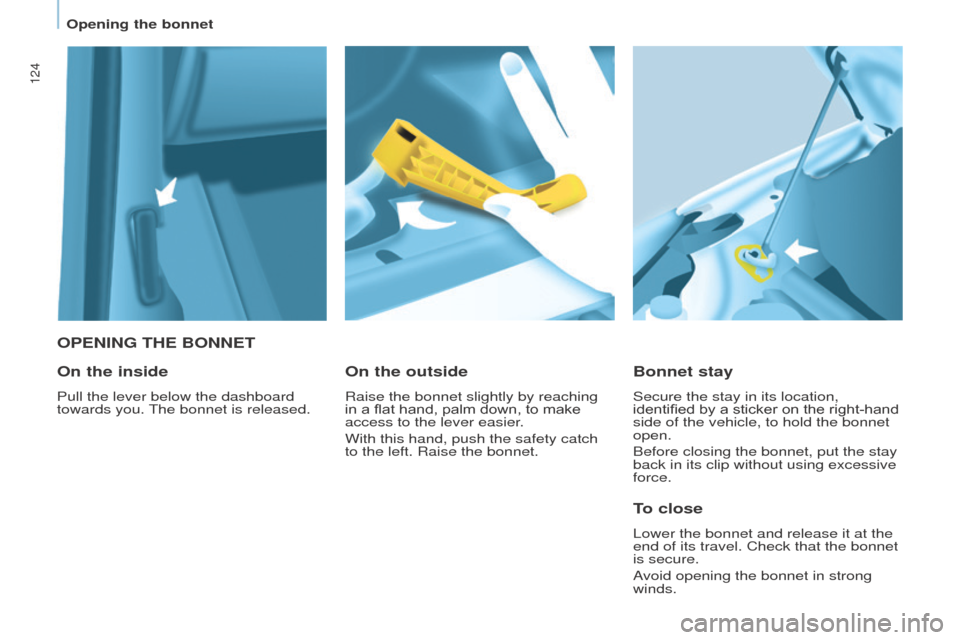
OPENING THE BONNET
Bonnet stay
Secure the stay in its location,
identified by a sticker on the right-hand
side of the vehicle, to hold the bonnet
open.
Before closing the bonnet, put the stay
back in its clip without using excessive
force.
On the outside
Raise the bonnet slightly by reaching
in a flat hand, palm down, to make
access to the lever easier.
With this hand, push the safety catch
to the left. Raise the bonnet.
On the inside
Pull the lever below the dashboard
towards you. The bonnet is released.
To close
Lower the bonnet and release it at the
end of its travel. Check that the bonnet
is secure.
Avoid opening the bonnet in strong
winds.
Opening the bonnet