engine Peugeot Partner 2016 Owner's Guide
[x] Cancel search | Manufacturer: PEUGEOT, Model Year: 2016, Model line: Partner, Model: Peugeot Partner 2016Pages: 260, PDF Size: 8.83 MB
Page 101 of 260
99
Driving safely
Partner-2-Vu_en_Chap05_Securite_ed02-2015
Operation
When your vehicle is too close to or
approaches the vehicle ahead too
quickly the system automatically
applies the brakes to avoid a collision.
You are then alerted by the display of a
message.
The brake lamps on your vehicle come
on to warn other road users.
The collision can be avoided
automatically if the difference in
speed between your vehicle and the
vehicle ahead does not exceed 9 mph
(15 km/h).
Above this threshold, the system will
do what is possible to avoid or reduce
the accident by lowering the speed of
impact.
The automatic braking may bring
the vehicle to a complete stop if the
situation requires it.
In this case, the vehicle is held
stationary temporarily (for about
1.5
seconds) to allow the driver to take
back control by pressing the brake
pedal. The triggering of the system may
cause the engine to stall, unless
the driver depresses the clutch
pedal quickly enough during
automatic braking.
During automatic braking, the
driver can always obtain a higher
rate of deceleration than that
controlled by the system, by pressing
firmly on the brake pedal.
After an impact, the system is
automatically put out of service: it
no longer operates.
You must go to a PEUGEOT dealer
or a qualified workshop to have the
system made operational again.
Operating limits
The system only detects vehicles that
are stationary or moving in the same
direction as your vehicle.
It does not detect small vehicles
(bicycles, motorcycles),
pedestrians or animals, nor non-
reflective stationary objects.
The system is not triggered or is
interrupted if the driver:
-
accelerates strongly
-
or turns the steering wheel
suddenly (avoiding manoeuvre). In difficult weather conditions (very
heavy rain, snow
, fog, hail...),
braking distances increase, which
can reduce the ability of the system to
avoid a collision.
The driver must therefore remain
particularly vigilant.
Never leave accumulations of
snow or any object projecting
above the bonnet or in front of
the roof: this might fall into the field of
vision of the sensor and generate a
detection.
SAFETY
5
Page 119 of 260
11 7
Towing a trailer
Partner-2-Vu_en_Chap06_Accessoire_ed02-2015
For more information about
weights and towed loads, refer to
chapter 9, "Weights" section.
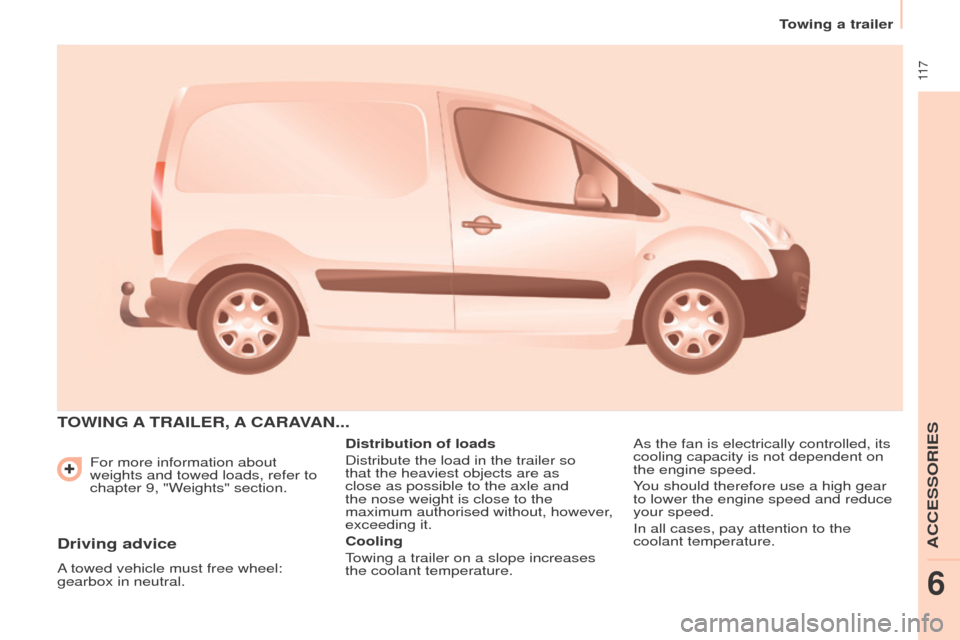
TOWING A TRAILER , A CARA VAN ...
Distribution of loads
Distribute the load in the trailer so
that the heaviest objects are as
close as possible to the axle and
the nose weight is close to the
maximum authorised without, however,
exceeding it.
Cooling
Towing a trailer on a slope increases
the coolant temperature. As the fan is electrically controlled, its
cooling capacity is not dependent on
the engine speed.
You should therefore use a high gear
to lower the engine speed and reduce
your speed.
In all cases, pay attention to the
coolant temperature.
Driving advice
A towed vehicle must free wheel:
gearbox in neutral.
ACCESSORIES
6
Page 120 of 260
11 8
Towing a trailer
Partner-2-Vu_en_Chap06_Accessoire_ed02-2015
Good Practice
In certain cases of particularly arduous
use (towing the maximum load up a
steep slope in high temperatures), the
engine automatically limits its power.
In this case, the air conditioning is
automatically cut off to save engine
power.
Tyres
Check the tyre pressures of the towing
vehicle and of the trailer, observing the
recommended pressures. Chapter 7, "Levels" section.If the coolant temperature
warning lamp comes on, stop
the vehicle and switch off the
engine as soon as possible. Brakes
Towing increases the braking distance.
Drive at a moderate speed, change
down early and brake gradually.
Towbar
We recommend the use of genuine
PEUGEOT towbars and their wiring
harnesses, which have been tested
and approved from the design stage of
your vehicle, and that you entrust the
fitting of this equipment to a PEUGEOT
dealer.
If this equipment is not fitted by a
PEUGEOT dealer, it is imperative that
it is fitted using the electrical pre-
equipment installed at the rear of the
vehicle and in accordance with the
manufacturer's instructions.
In accordance with the general
instructions a reminder of which has
been given above, we draw your
attention to the risk associated with
fitting a towbar or electrical accessory
not recommended by PEUGEOT.
Fitting such equipment could result in
the failure of your vehicle's electronic
system. Please obtain information from
the Manufacturer before fitting this type
of equipment.
Side wind
Sensitivity to side wind is increased.
Drive smoothly and at a moderate
speed.
ABS/DSC
The ABS or DSC systems only control
the vehicle, not the trailer or caravan.
Parking sensors
The rear parking sensors system does
not function while the vehicle is towing.
Chapter 9, "Identification
markings" section.
Page 125 of 260
123123
Partner-2-Vu_en_Chap07_Verification_ed02-2015
PEUGEOT & TOTAL,
A PARTNERSHIP TO DELIVER
B
ETTER
PERFORMANCE
!
Innovation, the key to success
The TOTAL Research and Development and
PEUGEOT teams work together to develop high
quality lubricants that meet the requirements
of PEUGEOT vehicles. For you, this is the
assurance that the performance of your engine
is optimised while also ensuring its durability.
The 208 HYbrid FE demonstrates the ability of
PEUGEOT and TOTAL to develop innovative
technologies and provide other ways of moving
towards the future.
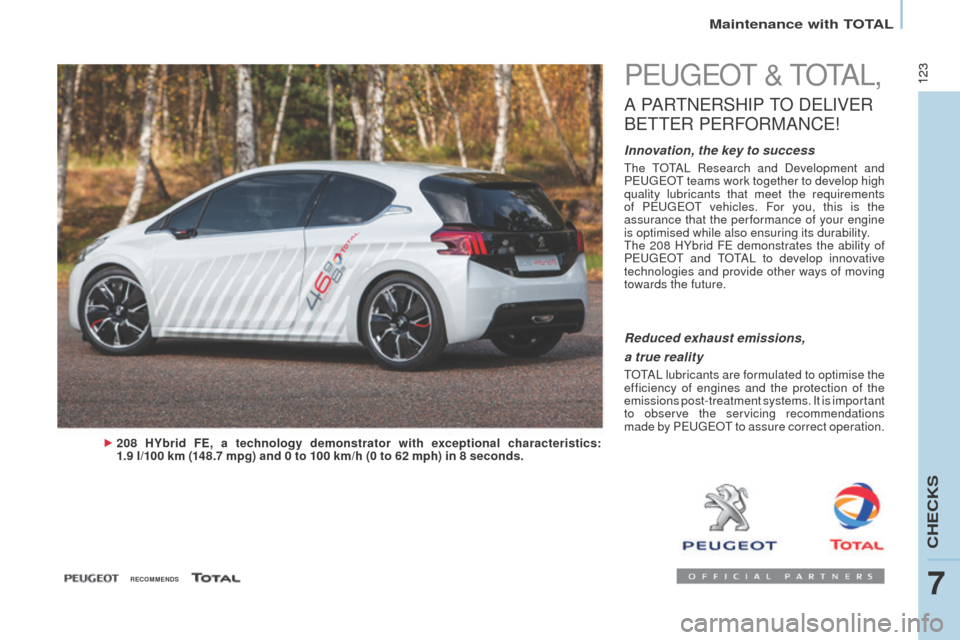
208 HYbrid FE, a technology demonstrator with exceptional characteristics:
1.9 l/100 km (148.7 mpg) and 0 to 100 km/h (0 to 62 mph) in 8 seconds.
Reduced exhaust emissions,
a true reality
TOTAL lubricants are formulated to optimise the
efficiency of engines and the protection of the
emissions post-treatment systems. It is important
to observe the servicing recommendations
made by PEUGEOT to assure correct operation.
RECOMMENDS
CHECKS
7
Maintenance with TOTAL
CHECKS
7
Page 127 of 260
125
Partner-2-Vu_en_Chap07_Verification_ed02-2015
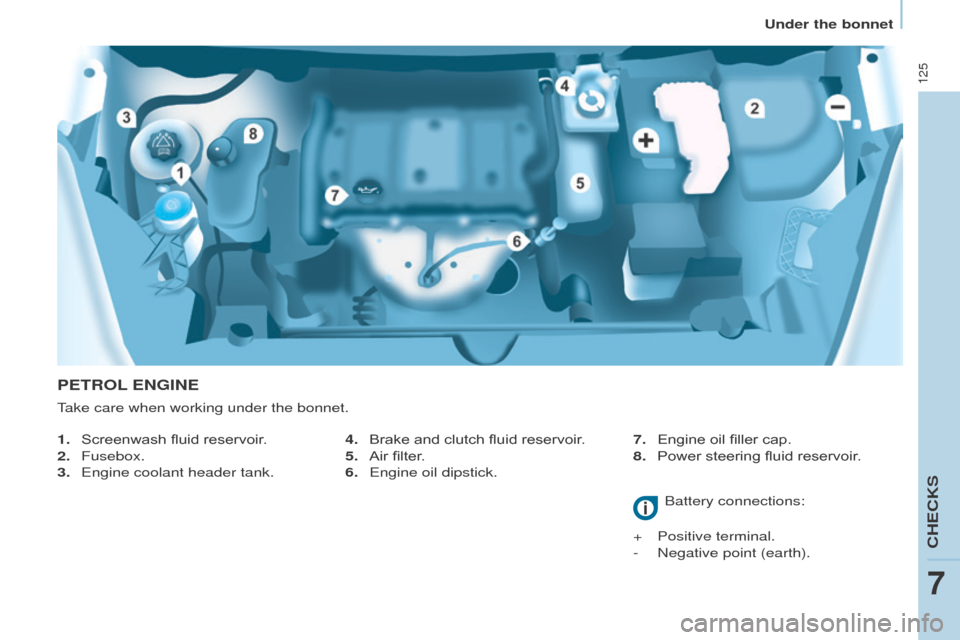
PETROL ENGINE
1. Screenwash fluid reservoir .
2.
Fusebox.
3.
Engine coolant header tank. Battery connections:
+
Positive terminal.
-
Negative point (earth).
T
ake care when working under the bonnet.
4. Brake and clutch fluid reservoir .
5.
Air filter
.
6.
Engine oil dipstick.7.
Engine oil filler cap.
8.
Power steering fluid reservoir
.
CHECKS
7
Under the bonnet
Page 128 of 260
126
Partner-2-Vu_en_Chap07_Verification_ed02-2015
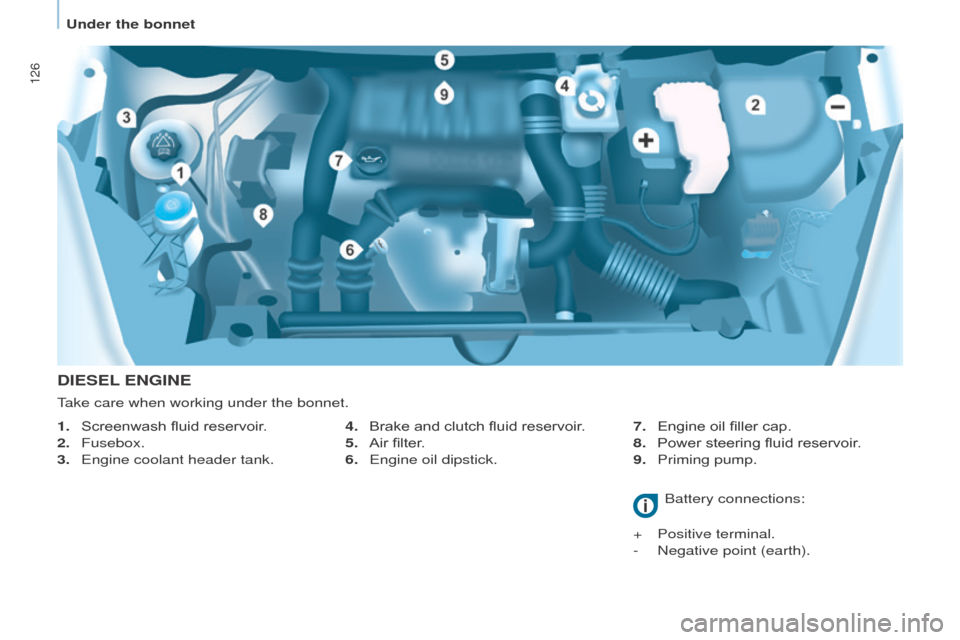
DIESEL ENGINE
4. Brake and clutch fluid reservoir .
5.
Air filter
.
6.
Engine oil dipstick. 7.
Engine oil filler cap.
8.
Power steering fluid reservoir
.
9.
Priming pump.
1.
Screenwash fluid reservoir
.
2.
Fusebox.
3.
Engine coolant header tank.
Battery connections:
+
Positive terminal.
-
Negative point (earth).
T
ake care when working under the bonnet.
Under the bonnet
Page 129 of 260
127
Partner-2-Vu_en_Chap07_Verification_ed02-2015
LEVELS
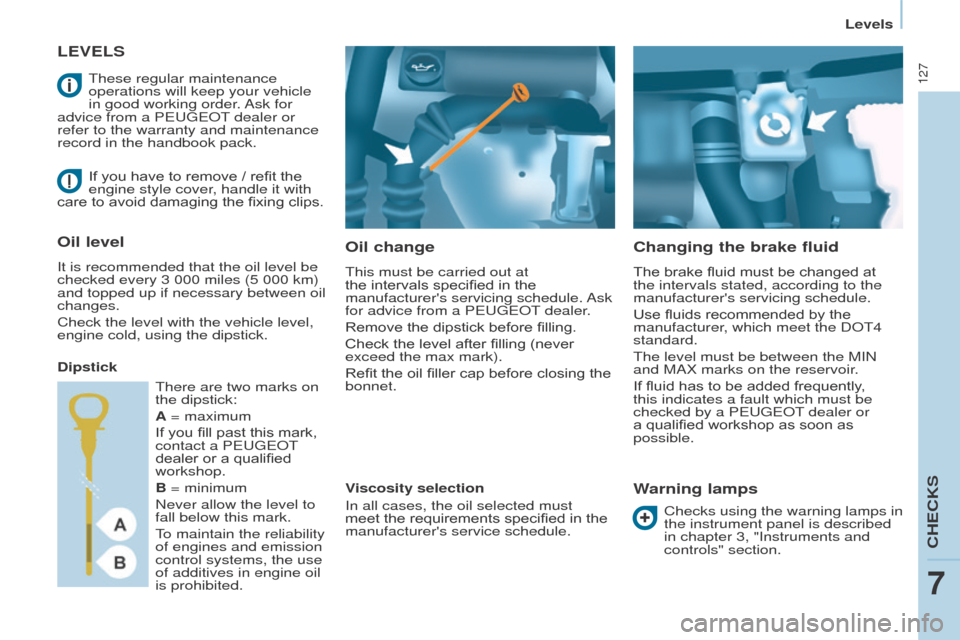
Oil change
This must be carried out at
the intervals specified in the
manufacturer's servicing schedule. Ask
for advice from a PEUGEOT dealer.
Remove the dipstick before filling.
Check the level after filling (never
exceed the max mark).
Refit the oil filler cap before closing the
bonnet.
Changing the brake fluid
The brake fluid must be changed at
the intervals stated, according to the
manufacturer's servicing schedule.
Use fluids recommended by the
manufacturer, which meet the DOT4
standard.
The level must be between the MIN
and MAX marks on the reservoir.
If fluid has to be added frequently,
this indicates a fault which must be
checked by a PEUGEOT dealer or
a qualified workshop as soon as
possible.
Warning lamps
If you have to remove / refit the
engine style cover, handle it with
care to avoid damaging the fixing clips.
Oil level
It is recommended that the oil level be
checked every 3 000 miles (5 000 km)
and topped up if necessary between oil
changes.
Check the level with the vehicle level,
engine cold, using the dipstick.
Dipstick
Viscosity selection
In all cases, the oil selected must
meet the requirements specified in the
manufacturer's service schedule.
These regular maintenance
operations will keep your vehicle
in good working order. Ask for
advice from a PEUGEOT dealer or
refer to the warranty and maintenance
record in the handbook pack.
Checks using the warning lamps in
the instrument panel is described
in chapter 3, "Instruments and
controls" section.
There are two marks on
the dipstick:
A = maximum
If you fill past this mark,
contact a PEUGEOT
dealer or a qualified
workshop.
B = minimum
Never allow the level to
fall below this mark.
To maintain the reliability
of engines and emission
control systems, the use
of additives in engine oil
is prohibited.
CHECKS
7
Levels
Page 130 of 260
128
Partner-2-Vu_en_Chap07_Verification_ed02-2015
Cooling system
Only use the fluid recommended by the
manufacturer.
Otherwise, you risk seriously damaging
your engine.
When the engine is warm, the
temperature of the coolant is controlled
by the engine fan. As this fan can
operate with the ignition key removed
and because the cooling system is
pressurised, wait for at least one hour
after the engine has stopped before
carrying out any work.
Slacken the cap by 1/4 of a turn to
release the pressure to prevent any
risk of scalding. When the pressure
has dropped, remove the cap and top
up the level with coolant.
If fluid has to be added frequently,
this indicates a fault which must be
checked by a PEUGEOT dealer as
soon as possible.
Power steering fluid level
The vehicle must be parked on level
ground with the engine cold. Unscrew
the cap integrated with the gauge and
check the level which must be between
the MIN and MAX marks.In order to regenerate the filter, you
are advised to drive at a speed higher
than 40 mph (60 km/h) for at least five
minutes as soon as possible, when
traffic conditions permit (until the
message disappears and the service
warning lamp goes off).
During regeneration of the particle
emission filter, the noise of a relay
operating may be heard under the
dashboard.
If the message is still displayed and
if the service warning lamp remains
on, contact a PEUGEOT dealer or a
qualified workshop.
Topping up
The level must be between the MIN
and MAX marks on the expansion
bottle. If more than 1 litre of fluid is
required to top up the level, have
the system checked by a PEUGEOT
dealer or a qualified workshop.
Screenwash and headlamp
wash level
For best quality cleaning and for your
safety, we would advise that you use
products of the PEUGEOT range.
For optimum cleaning and to avoid
freezing, this fluid must not be topped
up or replaced with plain water.
Capacity of the screenwash reservoir:
approximately 3 litres.
If your vehicle is fitted with headlamp
washers, the capacity of the reservoir
is 6 litres.
Diesel additive level
(Diesel with particle
filter)
Topping up
This additive must be topped up by
a PEUGEOT dealer or a qualified
workshop without delay.
Waste products
Avoid prolonged contact of used oil
with the skin.
Brake fluid is harmful to health and
very corrosive.
Do not dispose of used oil, brake fluid
or coolant into drains or into the ground
but into the containers dedicated to this
use at a PEUGEOT dealer (France) or
an authorised waste disposal site.
The minimum level of this additive
is indicated by lighting of the service
warning lamp, accompanied by an
audible signal and a message in the
screen.
When this occurs with the engine
running it is due to the start of
saturation of the particle filter
(exceptionally prolonged urban type
driving conditions: low speed, long
traffic jams, ...).
Levels
Page 132 of 260
130
Partner-2-Vu_en_Chap07_Verification_ed02-2015
Good practice
Only use products recommended by
PEUGEOT or products of equivalent
quality and specification.
In order to optimise the operation
of units as important as the braking
system, PEUGEOT selects and offers
specific products.
Bleeding water from the Diesel
filterManual gearbox
Have the level checked in accordance with
the manufacturer's servicing schedule.
In order to avoid damaging the
electrical units, high pressure
washing to clean the engine
compartment is strictly prohibited.
After washing the vehicle dampness,
or in winter, ice may form on the brake
discs and pads: braking efficiency may
be reduced. Make some light brake
applications to dry and de-ice the
brakes.
If this warning lamp comes
on, bleed the filter. Otherwise
bleed regularly each time the
engine oil is changed.
To drain the water, unscrew the bleed
screw located on the filter.
Operate until all of the water no longer
flows in the transparent pipe, then
tighten the bleed screw.
Particle filter (Diesel)
Maintenance of the particle filter must
be carried out by a PEUGEOT dealer.
On acceleration after the vehicle has
been running for a prolonged period
at very low speed or at idle, you may,
in exceptional circumstances, notice
the emission of water vapour at the
exhaust. This water vapour does not
have any adverse effect on vehicle
handling or the environment.
Oil filter
Change the filter regularly in
accordance with the manufacturer's
servicing schedule.
HDi engines use advanced
technology. All work requires
special training, so should be
entrusted to a PEUGEOT dealer.
Depending on country of sale.
Checks
Page 133 of 260
131
Partner-2-Vu_en_Chap07_Verification_ed02-2015
REFUELLING
Low fuel level
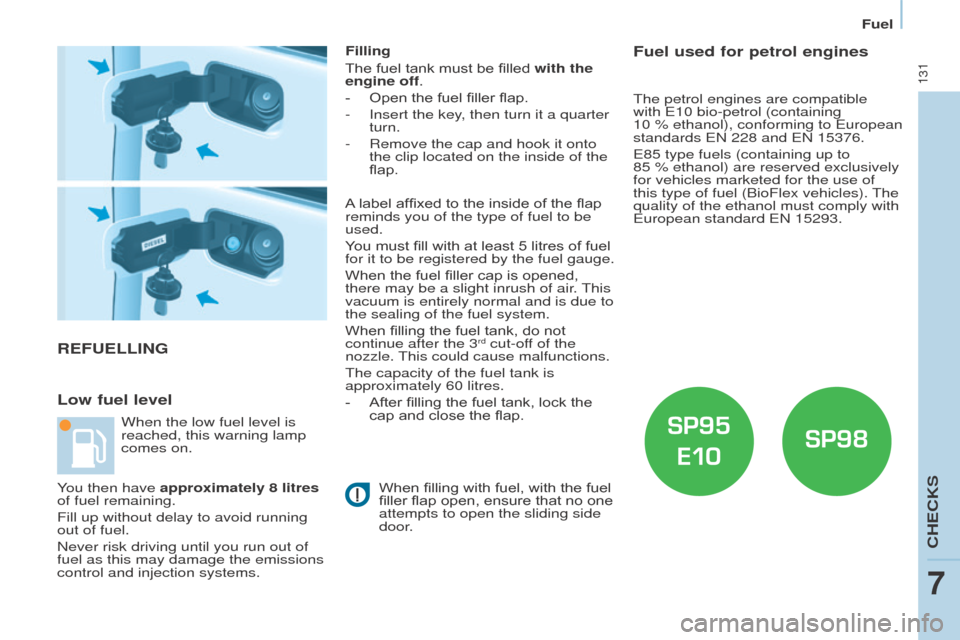
Filling
The fuel tank must be filled with the
engine off.
-
Open the fuel filler flap.
-
Insert the key
, then turn it a quarter
turn.
-
Remove the cap and hook it onto
the clip located on the inside of the
flap.
When fillin
g with fuel, with the fuel
filler flap open, ensure that no one
attempts to open the sliding side
door.
When the low fuel level is
reached, this warning lamp
comes on.
You then have approximately 8 litres
of fuel remaining.
Fill up without delay to avoid running
out of fuel.
Never risk driving until you run out of
fuel as this may damage the emissions
control and injection systems.Fuel used for petrol engines
A label affixed to the inside of the flap
reminds you of the type of fuel to be
used.
You must fill with at least 5 litres of fuel
for it to be registered by the fuel gauge.
When the fuel filler cap is opened,
there may be a slight inrush of air. This
vacuum is entirely normal and is due to
the sealing of the fuel system.
When filling the fuel tank, do not
continue after the 3
rd cut-off of the
nozzle. This could cause malfunctions.
The capacity of the fuel tank is
approximately 60 litres.
-
After fillin
g the fuel tank, lock the
cap and close the flap. The petrol engines are compatible
with E10 bio-petrol (containing
10
% ethanol), conforming to European
standards EN 228 and EN 15376.
E85 type fuels (containing up to
85 % ethanol) are reserved exclusively
for vehicles marketed for the use of
this type of fuel (BioFlex vehicles). The
quality of the ethanol must comply with
European standard EN 15293.
CHECKS
7
Fuel