ignition Peugeot Partner 2016 Owner's Guide
[x] Cancel search | Manufacturer: PEUGEOT, Model Year: 2016, Model line: Partner, Model: Peugeot Partner 2016Pages: 260, PDF Size: 8.83 MB
Page 91 of 260
89
Partner-2-Vu_en_Chap04_Ergonomie_ed02-2015
ELECTRIC WINDOWS
Safety anti-pinch
When the window rises and meets an
obstacle, it stops and partially lowers. The electrical functions of the electric
windows are deactivated:
-
approximately 45 seconds after the
ignition is switched of
f,
-
after one of the front doors is
opened, if the ignition is of
f.
Manual mode
Press or pull the control, without
passing the point of resistance.
The window stops when you release
the control. This mode is available
depending on equipment; it is
identified by this symbol on the
control in question.
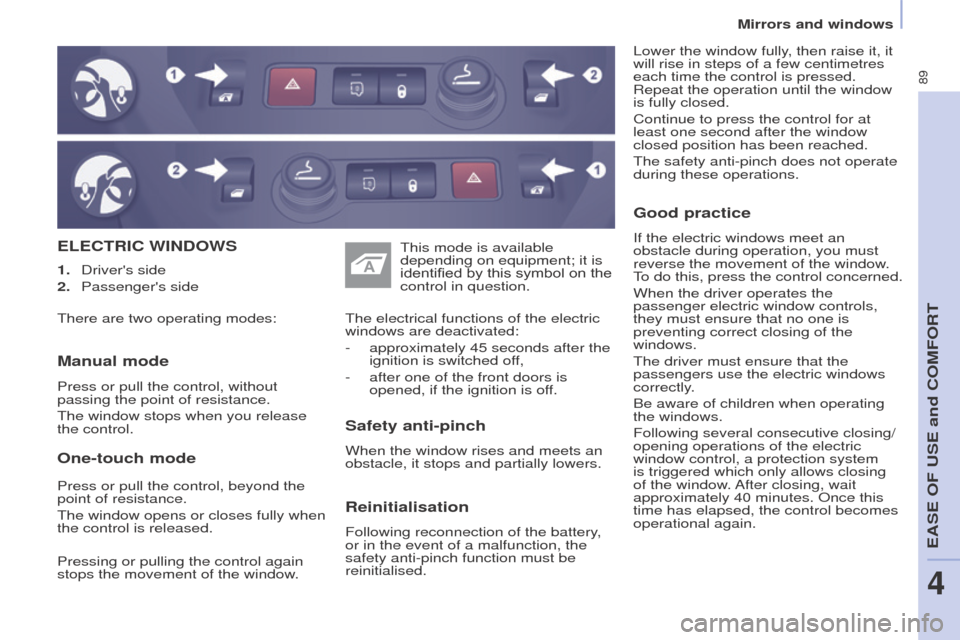
1.
Driver's side
2.
Passenger's side
Reinitialisation
Following reconnection of the battery,
or in the event of a malfunction, the
safety anti-pinch function must be
reinitialised.
Good practice
If the electric windows meet an
obstacle during operation, you must
reverse the movement of the window.
To do this, press the control concerned.
When the driver operates the
passenger electric window controls,
they must ensure that no one is
preventing correct closing of the
windows.
The driver must ensure that the
passengers use the electric windows
correctly.
Be aware of children when operating
the windows.
Following several consecutive closing/
opening operations of the electric
window control, a protection system
is triggered which only allows closing
of the window. After closing, wait
approximately 40 minutes. Once this
time has elapsed, the control becomes
operational again. Lower the window fully, then raise it, it
will rise in steps of a few centimetres
each time the control is pressed.
Repeat the operation until the window
is fully closed.
Continue to press the control for at
least one second after the window
closed position has been reached.
The safety anti-pinch does not operate
during these operations.
There are two operating modes:
One-touch mode
Press or pull the control, beyond the
point of resistance.
The window opens or closes fully when
the control is released.
Pressing or pulling the control again
stops the movement of the window.
EASE OF USE and COMFORT
4
Mirrors and windows
Page 92 of 260
90
Driving safely
Partner-2-Vu_en_Chap05_Securite_ed02-2015
HAZARD WARNING LAMPS
H
ORN
Press the centre of the steering wheel.
PARKING BRAKE
Applying
Pull the parking brake lever up to
immobilise your vehicle.
Check that the parking brake is applied
firmly before leaving the vehicle. Pull on the parking brake lever, only
with the vehicle stationary.
In the exceptional case of use of the
parking brake when the vehicle is
moving, apply the brake by pulling
gently to avoid locking the rear wheels
(risk of skidding).
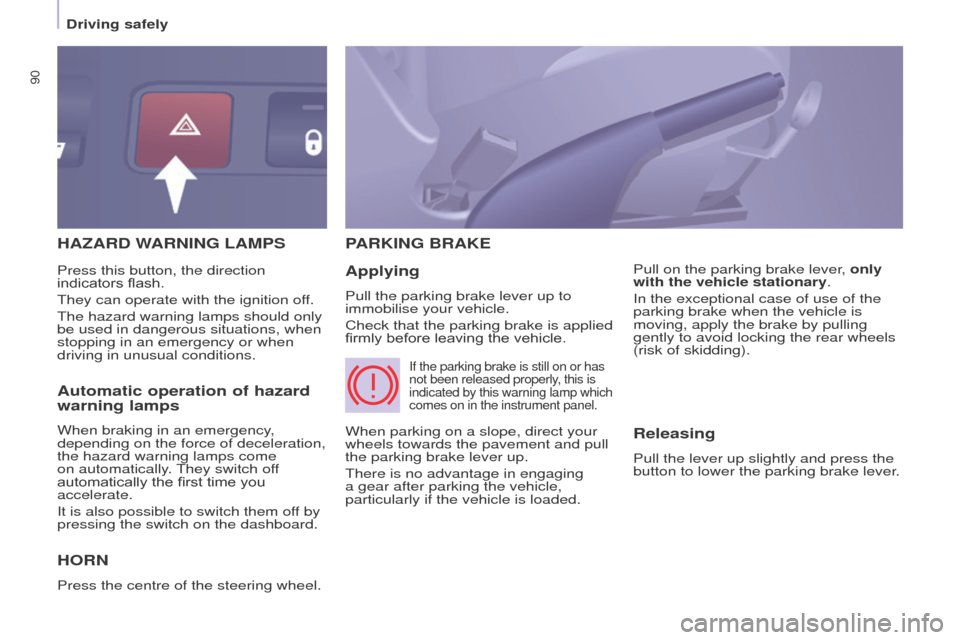
Press this button, the direction
indicators flash.
They can operate with the ignition off.
The hazard warning lamps should only
be used in dangerous situations, when
stopping in an emergency or when
driving in unusual conditions.
When parking on a slope, direct your
wheels towards the pavement and pull
the parking brake lever up.
There is no advantage in engaging
a gear after parking the vehicle,
particularly if the vehicle is loaded.
If the parking brake is still on or has
not been released properly, this is
indicated by this warning lamp which
comes on in the instrument panel.
Automatic operation of hazard
warning lamps
When braking in an emergency,
depending on the force of deceleration,
the hazard warning lamps come
on automatically. They switch off
automatically the first time you
accelerate.
It is also possible to switch them off by
pressing the switch on the dashboard.Releasing
Pull the lever up slightly and press the
button to lower the parking brake lever.
Page 99 of 260
97
Driving safely
Partner-2-Vu_en_Chap05_Securite_ed02-2015
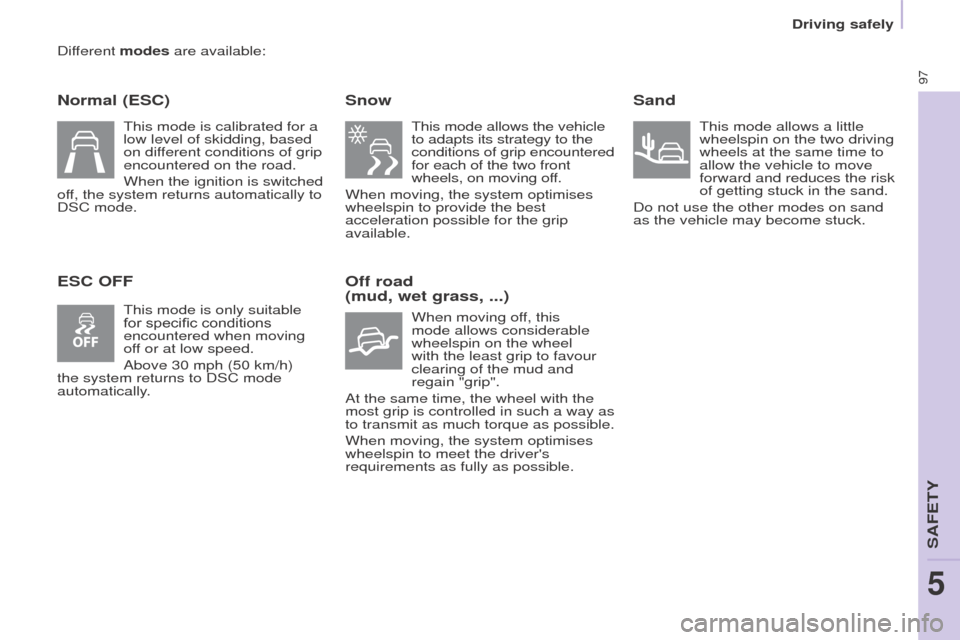
Different modes are available:
Normal (ESC)
ESC OFFSnow
This mode allows the vehicle
to adapts its strategy to the
conditions of grip encountered
for each of the two front
wheels, on moving off.
When moving, the system optimises
wheelspin to provide the best
acceleration possible for the grip
available.
Off road
(mud, wet grass, ...)
When moving off, this
mode allows considerable
wheelspin on the wheel
with the least grip to favour
clearing of the mud and
regain "grip".
At the same time, the wheel with the
most grip is controlled in such a way as
to transmit as much torque as possible.
When moving, the system optimises
wheelspin to meet the driver's
requirements as fully as possible.
Sand
This mode allows a little
wheelspin on the two driving
wheels at the same time to
allow the vehicle to move
forward and reduces the risk
of getting stuck in the sand.
Do not use the other modes on sand
as the vehicle may become stuck.
This mode is calibrated for a
low level of skidding, based
on different conditions of grip
encountered on the road.
When the ignition is switched
off, the system returns automatically to
DSC mode.
This mode is only suitable
for specific conditions
encountered when moving
off or at low speed.
Above 30 mph (50 km/h)
the system returns to DSC mode
automatically.
SAFETY
5
Page 100 of 260
98
Driving safely
Partner-2-Vu_en_Chap05_Securite_ed02-2015
ACTIVE CITY BRAKE
Active City Brake is a driving
assistance system that aims to avoid
a frontal collision or reduce the speed
of an impact if the driver does not
react sufficiently (inadequate brake
application).
This system is designed to
improve driving safety.
It remains the driver's
responsibility to continuously
monitor the state of the traffic and
to assess the distances and relative
speeds of other vehicles.
Active City Brake can in no
circumstances replace the need for
vigilance on the part of the driver. Never look at the laser sensor
through an optical instrument
(magnifying glass, microscope...)
at a distance of less than
10
centimetres: risk of eye injury.Principle
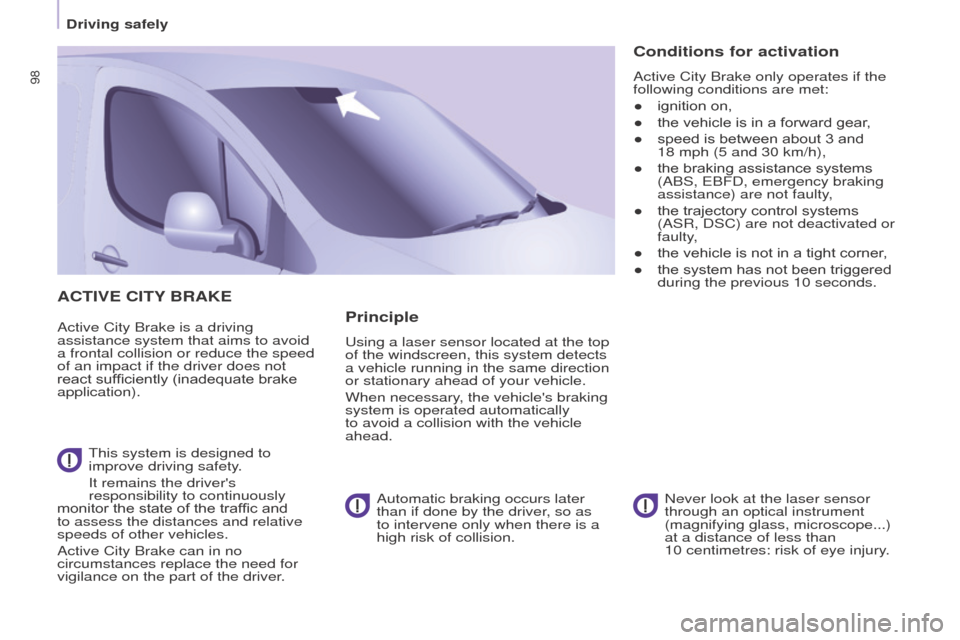
Using a laser sensor located at the top
of the windscreen, this system detects
a vehicle running in the same direction
or stationary ahead of your vehicle.
When necessary, the vehicle's braking
system is operated automatically
to avoid a collision with the vehicle
ahead.Automatic braking occurs later
than if done by the driver, so as
to intervene only when there is a
high risk of collision.
Conditions for activation
Active City Brake only operates if the
following conditions are met:
●
ignition on,
●
the vehicle is in a forward gear
,
●
speed is between about 3 and
18
mph (5 and 30 km/h),
●
the braking assistance systems
(ABS, EBFD, emergency braking
assistance) are not faulty
,
●
the trajectory control systems
(ASR, DSC) are not deactivated or
faulty
,
●
the vehicle is not in a tight corner
,
●
the system has not been triggered
during the previous 10 seconds.
Page 102 of 260
100
Driving safely
Partner-2-Vu_en_Chap05_Securite_ed02-2015
Deactivation
The system is deactivated in the
vehicle configuration menu, accessible
with the ignition on.
Its state is memorised when the
ignition is switched off.When the system is deactivated,
a message is displayed every
time the ignition is switched on, to
warn
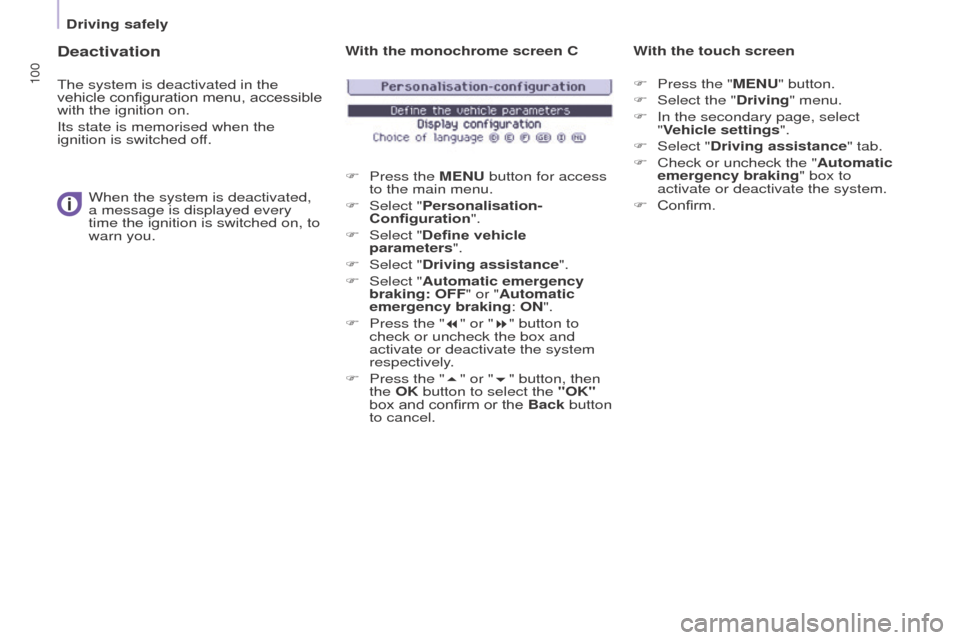
you. With the monochrome screen C
F
Press the
MENU button for access
to the main menu.
F
Select "
Personalisation-
Configuration".
F
Select "
Define vehicle
parameters".
F
Select "
Driving assistance".
F
Select "
Automatic emergency
braking: OFF" or "Automatic
emergency braking: ON".
F
Press the "
7" or "8" button to
check or uncheck the box and
activate or deactivate the system
respectively.
F
Press the "
5" or "6" button, then
the OK button to select the "OK"
box and confirm or the Back button
to cancel. With the touch screen
F
Press the " MENU" button.
F Select the " Driving" menu.
F
In the secondary page, select
"
Vehicle settings".
F
Select "
Driving assistance" tab.
F
Check or uncheck the "
Automatic
emergency braking" box to
activate or deactivate the system.
F
Confirm.
Page 104 of 260
102
Partner-2-Vu_en_Chap05_Securite_ed02-2015
SEAT BELTS
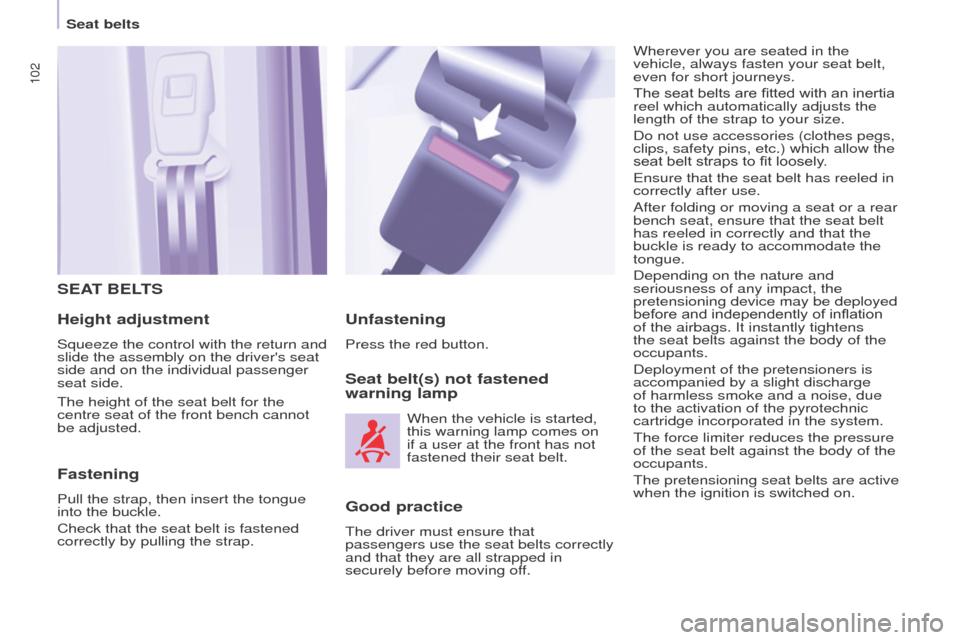
Height adjustment
Squeeze the control with the return and
slide the assembly on the driver's seat
side and on the individual passenger
seat side.
Fastening
Pull the strap, then insert the tongue
into the buckle.
Check that the seat belt is fastened
correctly by pulling the strap.
Seat belt(s) not fastened
warning lamp
Wherever you are seated in the
vehicle, always fasten your seat belt,
even for short journeys.
The seat belts are fitted with an inertia
reel which automatically adjusts the
length of the strap to your size.
Do not use accessories (clothes pegs,
clips, safety pins, etc.) which allow the
seat belt straps to fit loosely.
Ensure that the seat belt has reeled in
correctly after use.
After folding or moving a seat or a rear
bench seat, ensure that the seat belt
has reeled in correctly and that the
buckle is ready to accommodate the
tongue.
Depending on the nature and
seriousness of any impact, the
pretensioning device may be deployed
before and independently of inflation
of the airbags. It instantly tightens
the seat belts against the body of the
occupants.
Deployment of the pretensioners is
accompanied by a slight discharge
of harmless smoke and a noise, due
to the activation of the pyrotechnic
cartridge incorporated in the system.
The force limiter reduces the pressure
of the seat belt against the body of the
occupants.
The pretensioning seat belts are active
when the ignition is switched on.
Unfastening
Press the red button.When the vehicle is started,
this warning lamp comes on
if a user at the front has not
fastened their seat belt.
Good practice
The driver must ensure that
passengers use the seat belts correctly
and that they are all strapped in
securely before moving off.
The height of the seat belt for the
centre seat of the front bench cannot
be adjusted.
Seat belts
Page 107 of 260
105
Partner-2-Vu_en_Chap05_Securite_ed02-2015
Good practice
Sit in a normal upright position.
Wear a correctly adjusted seat belt.
Do not leave anything between the
occupants and the airbags (a child,
pet, object...). This could hinder the
operation of the airbags or injure the
occupants.
After an accident or if the vehicle has
been stolen or broken into, have the
airbag systems checked.
All work on the airbag system is strictly
forbidden unless it is carried out by
qualified personnel at a PEUGEOT
dealer or a qualified workshop.
Even if all of the precautions
mentioned are observed, a risk of
injury or of minor burns to the head,
chest or arms when an airbag is
deployed cannot be ruled out. In fact,
the bag inflates almost instantly (within
a few milliseconds) then deflates within
the same time discharging the hot gas
via openings provided for this purpose.Lateral airbags
Only put recommended covers on
the seats. These will not hinder
inflation of the lateral airbags. Contact
a PEUGEOT dealer or a qualified
workshop.
Do not fix or attach anything to the seat
backs. This could cause injury to the
chest or arms when the lateral airbag
inflates.
Do not sit with the upper part of the
body any nearer to the door than
necessary.
Front airbags
Do not drive holding the steering wheel
by its spokes or resting your hands on
the centre part of the wheel.
Do not allow passengers to place
their feet on the dashboard, they risk
serious injury if the airbag is deployed.
Smoke as little as possible as
deployment of the airbags can cause
burns or the risk of injury from a
cigarette or pipe.
Never remove or pierce the steering
wheel or hit it violently.
Airbags only operate when the
ignition is switched on.
This equipment only operates once.
If a second impact occurs (during the
same or a subsequent accident), the
airbag will not operate.
The deployment of an airbag or airbags
is accompanied by a slight discharge
of smoke and a noise, due to the
activation of the pyrotechnic cartridge
incorporated in the system.
This smoke is not harmful, but
sensitive individuals may experience
some irritation.
The noise of the detonation may result
in a slight loss of hearing for a short
time.
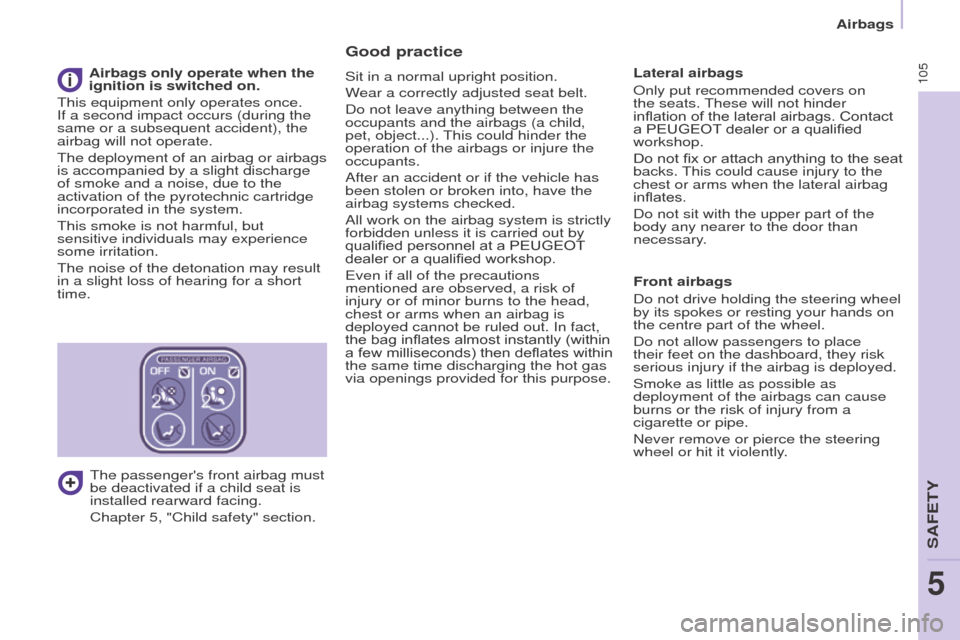
The passenger's front airbag must
be deactivated if a child seat is
installed rearward facing.
Chapter 5, "Child safety" section.
SAFETY
5
Airbags
Page 109 of 260
107
Partner-2-Vu_en_Chap05_Securite_ed02-2015
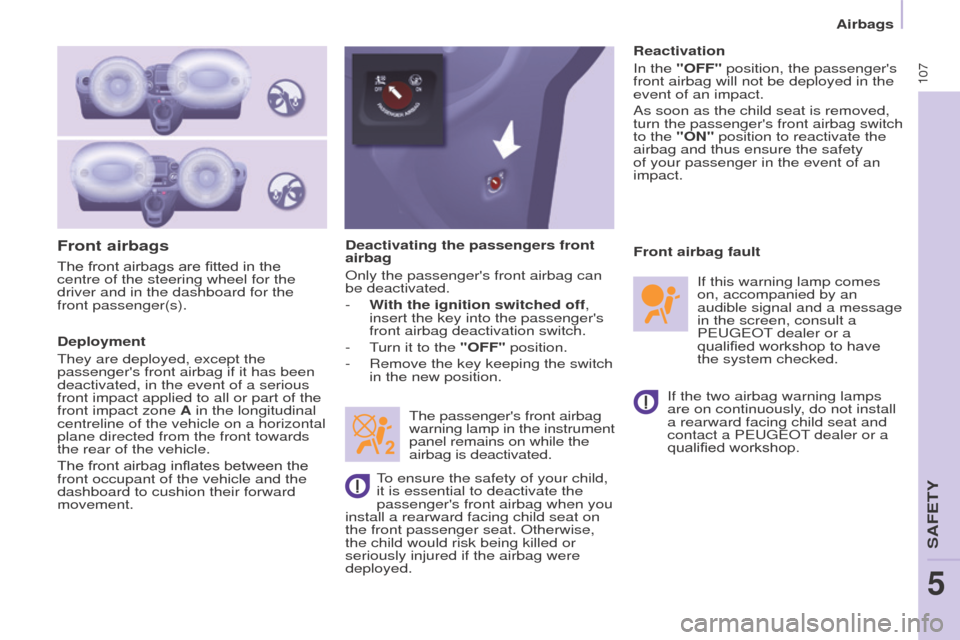
Front airbags
Deployment
They are deployed, except the
passenger's front airbag if it has been
deactivated, in the event of a serious
front impact applied to all or part of the
front impact zone A in the longitudinal
centreline of the vehicle on a horizontal
plane directed from the front towards
the rear of the vehicle.
The front airbag inflates between the
front occupant of the vehicle and the
dashboard to cushion their forward
movement.Deactivating the passengers front
airbag
Only the passenger's front airbag can
be deactivated.
-
W
ith the ignition switched off,
insert the key into the passenger's
front airbag deactivation switch.
- T urn it to the "OFF" position.
-
Remove the key keeping the switch
in the new position.
The passenger's front airbag
warning lamp in the instrument
panel remains on while the
airbag is deactivated. If the two airbag warning lamps
are on continuously, do not install
a rearward facing child seat and
contact a PEUGEOT dealer or a
qualified workshop.
Front airbag fault
To ensure the safety of your child,
it is essential to deactivate the
passenger's front airbag when you
install a rearward facing child seat on
the front passenger seat. Otherwise,
the child would risk being killed or
seriously injured if the airbag were
deployed. Reactivation
In the "OFF" position, the passenger's
front airbag will not be deployed in the
event of an impact.
As soon as the child seat is removed,
turn the passenger's front airbag switch
to the "ON" position to reactivate the
airbag and thus ensure the safety
of your passenger in the event of an
impact.
If this warning lamp comes
on, accompanied by an
audible signal and a message
in the screen, consult a
PEUGEOT dealer or a
qualified workshop to have
the system checked.
The front airbags are fitted in the
centre of the steering wheel for the
driver and in the dashboard for the
front passenger(s).
SAFETY
5
Airbags
Page 130 of 260
128
Partner-2-Vu_en_Chap07_Verification_ed02-2015
Cooling system
Only use the fluid recommended by the
manufacturer.
Otherwise, you risk seriously damaging
your engine.
When the engine is warm, the
temperature of the coolant is controlled
by the engine fan. As this fan can
operate with the ignition key removed
and because the cooling system is
pressurised, wait for at least one hour
after the engine has stopped before
carrying out any work.
Slacken the cap by 1/4 of a turn to
release the pressure to prevent any
risk of scalding. When the pressure
has dropped, remove the cap and top
up the level with coolant.
If fluid has to be added frequently,
this indicates a fault which must be
checked by a PEUGEOT dealer as
soon as possible.
Power steering fluid level
The vehicle must be parked on level
ground with the engine cold. Unscrew
the cap integrated with the gauge and
check the level which must be between
the MIN and MAX marks.In order to regenerate the filter, you
are advised to drive at a speed higher
than 40 mph (60 km/h) for at least five
minutes as soon as possible, when
traffic conditions permit (until the
message disappears and the service
warning lamp goes off).
During regeneration of the particle
emission filter, the noise of a relay
operating may be heard under the
dashboard.
If the message is still displayed and
if the service warning lamp remains
on, contact a PEUGEOT dealer or a
qualified workshop.
Topping up
The level must be between the MIN
and MAX marks on the expansion
bottle. If more than 1 litre of fluid is
required to top up the level, have
the system checked by a PEUGEOT
dealer or a qualified workshop.
Screenwash and headlamp
wash level
For best quality cleaning and for your
safety, we would advise that you use
products of the PEUGEOT range.
For optimum cleaning and to avoid
freezing, this fluid must not be topped
up or replaced with plain water.
Capacity of the screenwash reservoir:
approximately 3 litres.
If your vehicle is fitted with headlamp
washers, the capacity of the reservoir
is 6 litres.
Diesel additive level
(Diesel with particle
filter)
Topping up
This additive must be topped up by
a PEUGEOT dealer or a qualified
workshop without delay.
Waste products
Avoid prolonged contact of used oil
with the skin.
Brake fluid is harmful to health and
very corrosive.
Do not dispose of used oil, brake fluid
or coolant into drains or into the ground
but into the containers dedicated to this
use at a PEUGEOT dealer (France) or
an authorised waste disposal site.
The minimum level of this additive
is indicated by lighting of the service
warning lamp, accompanied by an
audible signal and a message in the
screen.
When this occurs with the engine
running it is due to the start of
saturation of the particle filter
(exceptionally prolonged urban type
driving conditions: low speed, long
traffic jams, ...).
Levels
Page 134 of 260
DIESEL
132
Partner-2-Vu_en_Chap07_Verification_ed02-2015
FUEL CUT- OFF
The flashing of this warning
lamp is accompanied by a
message in the screen.
Check that there is no odour or
leakage of fuel outside the vehicle and
re-establish the fuel supply:
-
switch of
f the ignition (STOP
position),
-
remove the key
,
-
put the key back in the ignition,
-
switch on the ignition and start.
DIESEL PRIMING PUMPFuel used for Diesel engines
The Diesel engines are compatible with
biofuels which conform to current and
future European standards (Diesel fuel
which complies with standard EN 590
mixed with a biofuel which complies
with standard EN 14214) available at
the pumps (containing up to 7 % Fatty
Acid Methyl Ester).
B30 biofuel can be used in certain
Diesel engines. However, this use,
even occasional, requires strict
application of the special servicing
conditions. Contact a PEUGEOT
dealer or a qualified workshop.
The use of any other type of (bio)
fuel (vegetable or animal oils, pure
or diluted, domestic fuel...) is strictly
prohibited (risk of damage to the
engine and fuel system). In a serious collision, a mechanism
automatically prevents fuel from
reaching the engine.
If you run out of fuel, it is necessary to
prime the fuel circuit.
Other HDi engines
- Fill the fuel tank with at least five
litres of Diesel.
-
Squeeze and release the manual
priming pump, under the bonnet,
under the protective cover
.
-
Operate the starter until the engine
starts.
BlueHDi engine
- Fill the fuel tank with at least
five litres of Diesel.
-
Switch on the ignition (without
starting the engine).
-
W
ait around 6 seconds and switch
off the ignition.
-
Repeat the operation 10 times.
-
Operate the starter to run the
engine.
Fuel