instrument panel Peugeot Partner 2017 User Guide
[x] Cancel search | Manufacturer: PEUGEOT, Model Year: 2017, Model line: Partner, Model: Peugeot Partner 2017Pages: 260, PDF Size: 9.05 MB
Page 48 of 260
46
Partner-2-VU_en_Chap03_Pret-a-partir_ed02-2016
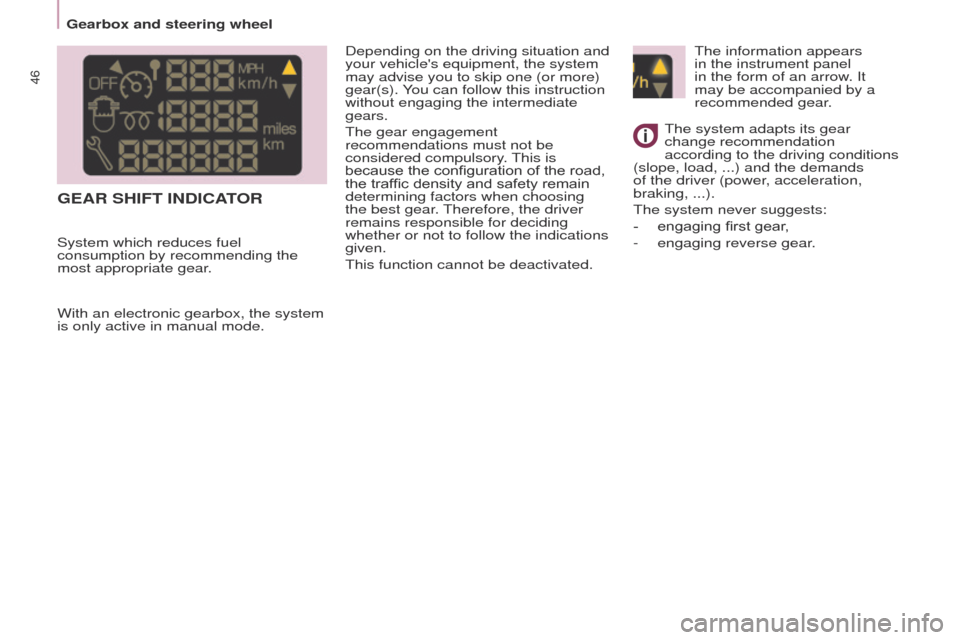
GEAR SHIFT INDICATOR
Depending on the driving situation and
your vehicle's equipment, the system
may advise you to skip one (or more)
gear(s). You can follow this instruction
without engaging the intermediate
gears.
The gear engagement
recommendations must not be
considered compulsory. This is
because the configuration of the road,
the traffic density and safety remain
determining factors when choosing
the best gear. Therefore, the driver
remains responsible for deciding
whether or not to follow the indications
given.
This function cannot be deactivated.
With an electronic gearbox, the system
is only active in manual mode. The system adapts its gear
change recommendation
according to the driving conditions
(slope, load,
...) and the demands
of the driver (power, acceleration,
braking,
...).
The system never suggests:
-
engaging first gear
,
-
engaging reverse gear
.
The information appears
in the instrument panel
in the form of an arrow. It
may be accompanied by a
recommended gear.
System which reduces fuel
consumption by recommending the
most appropriate gear.
Gearbox and steering wheel
Page 49 of 260
47
Partner-2-VU_en_Chap03_Pret-a-partir_ed02-2016
Moving off
- To start the engine, the gear selector must be in position N.
-
Press firmly on the brake pedal.
-
Operate the starter
.
-
When the engine is running, place
the gear selector on
R, A or M as
desired.
-
Release the brake pedal and
accelerate.
If the gear selector is not in position N,
and/or if the brake pedal is not pressed,
the engine will not start. Repeat the
above procedure.
Reverse gear Engaging reverse gear
Move the gear selector to R.
Only attempt to select reverse gear
when the vehicle is stationary.
Neutral Changing to neutral
Move the gear selector to N. If the
vehicle is moving, do not select this
position even momentarily.
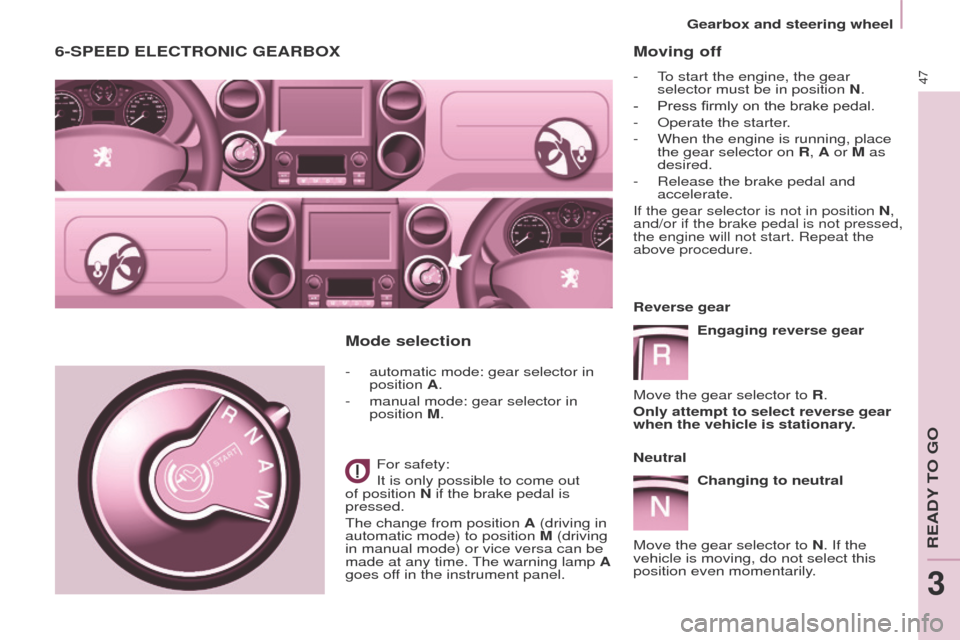
6-SPEED ELECTRONIC GEARBOx
- automatic mode: gear selector in
position A.
-
manual mode: gear selector in
position
M.
For safety:
It is only possible to come out
of position N if the brake pedal is
pressed.
The change from position A (driving in
automatic mode) to position M (driving
in manual mode) or vice versa can be
made at any time. The warning lamp A
goes off in the instrument panel.
Mode selection
READY TO GO
3
Gearbox and steering wheel
Page 50 of 260
48
Partner-2-VU_en_Chap03_Pret-a-partir_ed02-2016
Manual modeChanging to manual mode
Move the gear selector to M.
Automatic mode
Changing to automatic
mode
Move the gear selector to A.
The gearbox then operates in
automatic mode, without any action on
your part.
It constantly selects the gear that is
best suited to the following conditions:
-
driving style,
-
road profile,
-
optimum fuel consumption.
Vehicle stationary, with
the
engine running
In the event of a prolonged stop with
the engine running, the gearbox
changes automatically to neutral N.
Stopping the vehicle
Before stopping the engine, put the
gear selector in position N.
In all cases, it is essential to apply
the parking brake. Check that the
parking brake warning lamp is on in the
instrument panel.
Before doing anything in the
engine compartment, check that
the gear selector is in neutral N.
Acceleration
For optimum acceleration (e.g. to
overtake another vehicle), simply
press the pedal beyond the point of
resistance at the end of its travel, by
pressing down firmly.
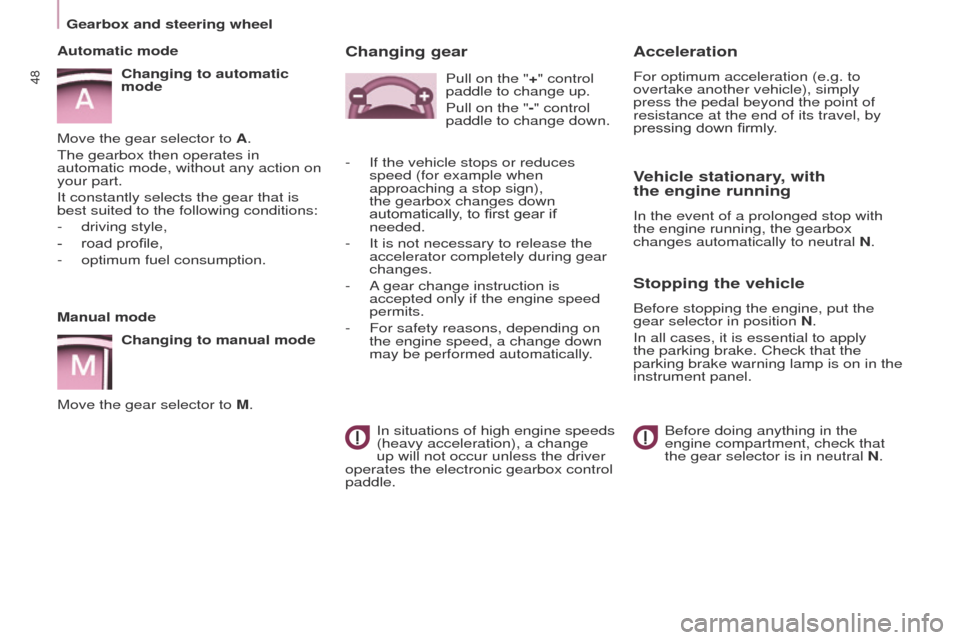
Changing gear
In situations of high engine speeds
(heavy acceleration), a change
up will not occur unless the driver
operates the electronic gearbox control
paddle. Pull on the "+" control
paddle to change up.
Pull on the "-" control
paddle to change down.
-
If the vehicle stops or reduces
speed (for example when
approaching a stop sign),
the gearbox changes down
automatically
, to first gear if
needed.
-
It is not necessary to release the
accelerator completely during gear
changes.
-
A
gear change instruction is
accepted only if the engine speed
permits.
-
For safety reasons, depending on
the engine speed, a change down
may be performed automatically
.
Gearbox and steering wheel
Page 51 of 260
49
Partner-2-VU_en_Chap03_Pret-a-partir_ed02-2016
STOP & START
The Stop & Start system puts the
engine temporarily on standby - ST OP
mode - during stops in the traffic (red
lights, traffic jams, or other...).
The engine restarts automatically -
START mode - as soon as you want to
move off.
The restart takes place instantly,
quickly and silently.
Perfect for urban use, the Stop & Start
system reduces fuel consumption and
exhaust emissions as well as the noise
level when stationary.
Operation
Going into engine STOP mode
The "ECO" warning lamp
comes on in the instrument
panel and the engine goes
into standby:
-
with a manual gearbox
, at speeds
below 12 mph (20 km/h), when you
put the gear lever into neutral and
release the clutch pedal,
-
with a 6-speed electronic
gearbox
, at speeds below 5 mph
(8 km/h), when you press the brake
pedal or put the gear lever into
position N. If your vehicle is fitted with the system,
a time counter calculates the sum of
the periods in STOP mode during a
journey. It rests itself to zero every time
the ignition is switched on with the key.
With a 6-speed electronic
gearbox, for your comfort during
parking manoeuvres, STOP mode
is not available for a few seconds after
coming out of reverse gear.
STOP mode does not affect the
functionality of the vehicle, such as
braking, power steering, for example.
Never refuel with the engine in
STOP mode; you must switch off
the ignition with the key. Special cases: STOP mode
unavailable
STOP mode is not invoked when:
-
the vehicle is on a steep slope
(rising or fallin
g),
-
the driver's door is open,
-
the driver's seat belt is not
fastened,
-
the vehicle has not exceeded 6
mph (10 km/h) since the last engine
start using the key
,
-
the engine is needed to maintain
a comfortable temperature in the
passenger compartment,
-
demisting is on,
-
some special conditions (battery
charge, engine temperature,
braking assistance, ambient
temperature...) where the engine
is needed to assure control of a
system.
In this case, the
"ECO"
warning lamp flashes for a
few seconds, then goes off.
This operation is perfectly normal.
READY TO GO
3
Stop & Start
Page 52 of 260
50
Partner-2-VU_en_Chap03_Pret-a-partir_ed02-2016
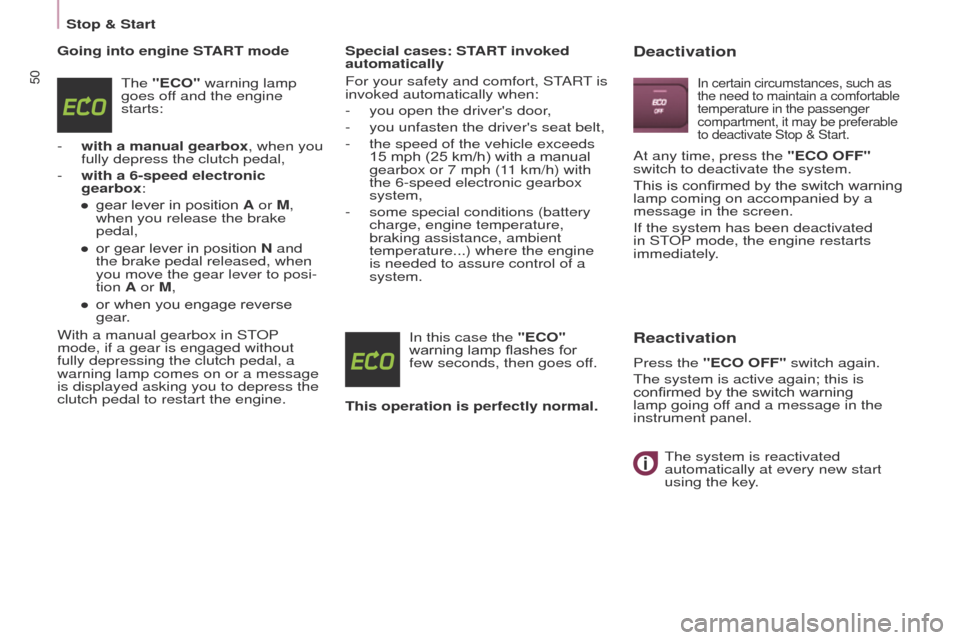
Going into engine START modeThe "ECO" warning lamp
goes off and the engine
starts:
-
with a manual gearbox
, when you
fully depress the clutch pedal,
-
with a 6-speed electronic
gearbox
:
●
gear lever in position
A or M,
when you release the brake
pedal,
●
or gear lever in position
N and
the brake pedal released, when
you move the gear lever to posi-
tion A or M,
●
or when you engage reverse
gear
.
With a manual gearbox in STOP
mode, if a gear is engaged without
fully depressing the clutch pedal, a
warning lamp comes on or a message
is displayed asking you to depress the
clutch pedal to restart the engine. Special cases: START invoked
automatically
For your safety and comfort, START is
invoked automatically when:
-
you open the driver's door
,
-
you unfasten the driver's seat belt,
-
the speed of the vehicle exceeds
15 mph (25 km/h) with a manual
gearbox or 7 mph (1
1 km/h) with
the 6-speed electronic gearbox
system,
-
some special conditions (battery
charge, engine temperature,
braking assistance, ambient
temperature...) where the engine
is needed to assure control of a
system.In this case the
"ECO"
warning lamp flashes for
few
seconds, then goes off.
This operation is perfectly normal.Deactivation
In certain circumstances, such as
the need to maintain a comfortable
temperature in the passenger
compartment, it may be preferable
to deactivate Stop & Start.
At any time, press the "ECO OFF"
switch to deactivate the system.
This is confirmed by the switch warning
lamp coming on accompanied by a
message in the screen.
If the system has been deactivated
in ST
OP mode, the engine restarts
immediately.
Reactivation
Press the "ECO OFF" switch again.
The system is active again; this is
confirmed by the switch warning
lamp going off and a message in the
instrument panel.
The system is reactivated
automatically at every new start
using the key.
Stop & Start
Page 53 of 260
51
Partner-2-VU_en_Chap03_Pret-a-partir_ed02-2016
Operating fault
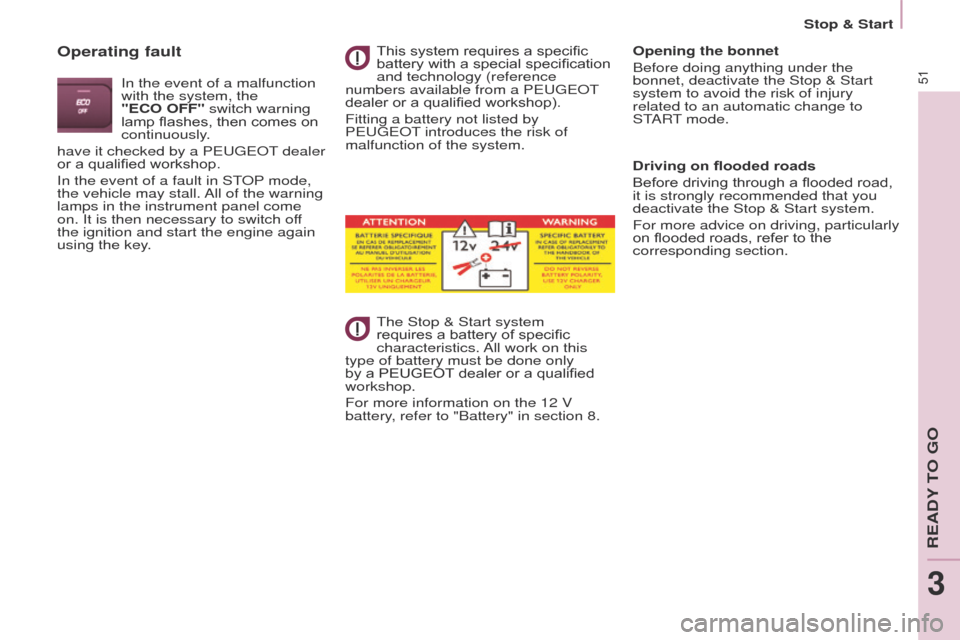
In the event of a malfunction
with the system, the
"ECO OFF" switch warning
lamp flashes, then comes on
continuously.
have it checked by a PEUGEOT dealer
or a qualified workshop.
In the event of a fault in STOP mode,
the vehicle may stall. All of the warning
lamps in the instrument panel come
on. It is then necessary to switch off
the ignition and start the engine again
using the key. This system requires a specific
battery with a special specification
and technology (reference
numbers available from a PEUGEOT
dealer or a qualified workshop).
Fitting a battery not listed by
PEUGEOT
introduces the risk of
malfunction of the system.
The Stop & Start system
requires a battery of specific
characteristics. All work on this
type of battery must be done only
by a PEUGEOT dealer or a qualified
workshop.
For more information on the 12 V
battery, refer to "Battery" in section 8. Opening the bonnet
Before doing anything under the
bonnet, deactivate the Stop & Start
system to avoid the risk of injury
related to an automatic change to
START mode.
Driving on flooded roads
Before driving through a flooded road,
it is strongly recommended that you
deactivate the Stop & Start system.
For more advice on driving, particularly
on flooded roads, refer to the
corresponding section.
READY TO GO
3
Stop & Start
Page 57 of 260
55
Partner-2-VU_en_Chap04_Ergonomie_ed02-2016
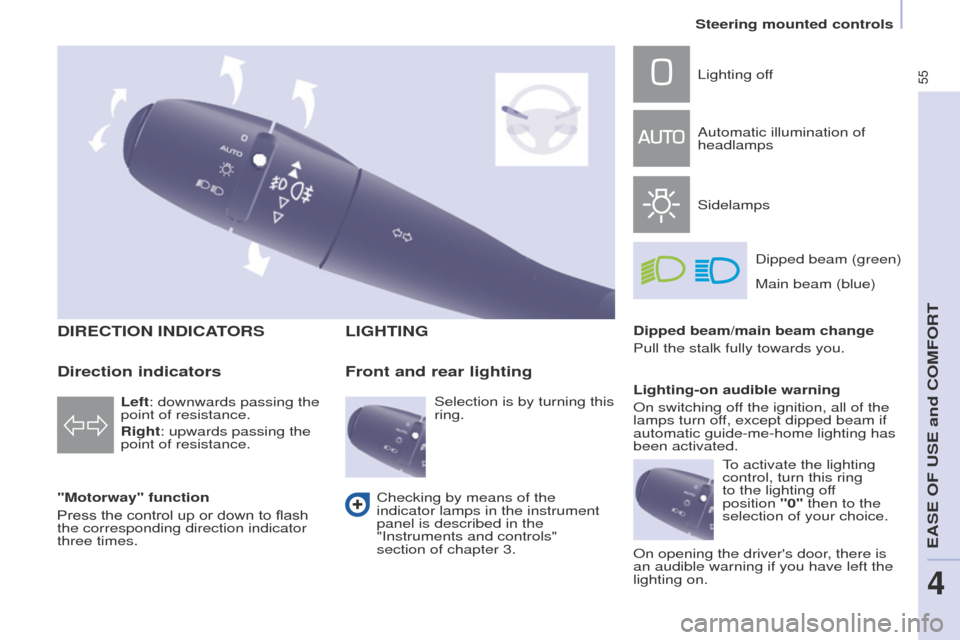
DIRECTION INDICATORS
"Motorway" function
Press the control up or down to flash
the corresponding direction indicator
three times.
LIGHTING
Left: downwards passing the
point of resistance.
Right: upwards passing the
point of resistance.
Front and rear lighting
Lighting off
Automatic illumination of
headlamps
SidelampsDipped beam (green)
Main beam (blue)
Dipped beam/main beam change
Pull the stalk fully towards you.
Checking by means of the
indicator lamps in the instrument
panel is described in the
"Instruments and controls"
section
of chapter 3.
Direction indicators
Selection is by turning this
ring. Lighting-on audible warning
On switching off the ignition, all of the
lamps turn off, except dipped beam if
automatic guide-me-home lighting has
been activated.
To activate the lighting
control, turn this ring
to the lighting off
position
"0" then to the
selection of your choice.
On opening the driver's door, there is
an audible warning if you have left the
lighting on.
Steering mounted controls
EASE OF USE and COMFORT
4
Page 58 of 260
56
Partner-2-VU_en_Chap04_Ergonomie_ed02-2016
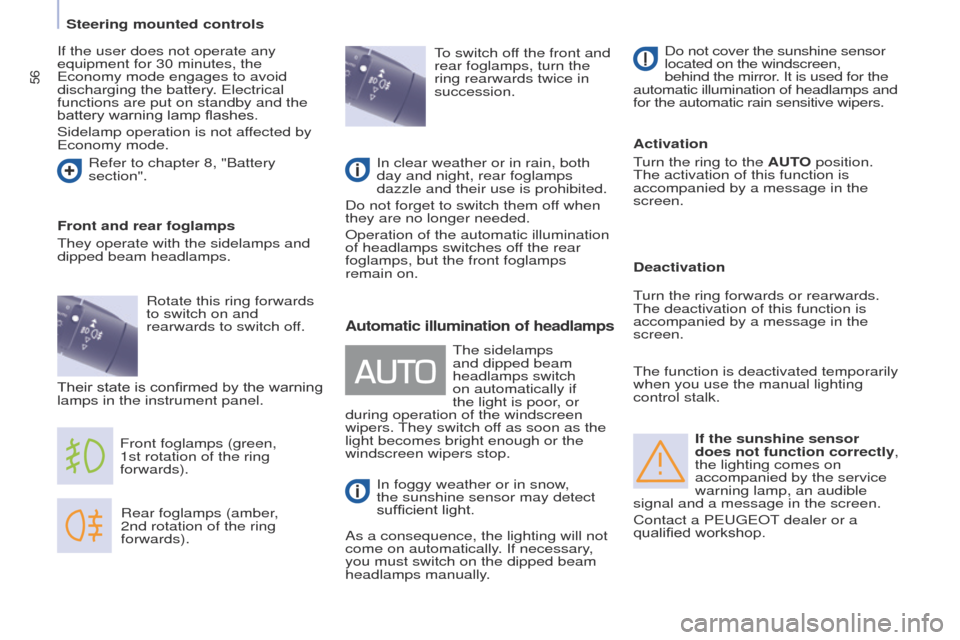
If the sunshine sensor
does not function correctly,
the lighting comes on
accompanied by the service
warning lamp, an audible
signal and a message in the screen.
Contact a PEUGEOT dealer or a
qualified workshop.
Rear foglamps (amber,
2nd
rotation of the ring
forwards).
Front foglamps (green,
1st
rotation of the ring
forwards).
Front and rear foglamps
They operate with the sidelamps and
dipped beam headlamps.
To switch off the front and
rear foglamps, turn the
ring rearwards twice in
succession.
Automatic illumination of headlamps
In foggy weather or in snow,
the sunshine sensor may detect
sufficient light.
As a consequence, the lighting will not
come on automatically. If necessary,
you must switch on the dipped beam
headlamps manually. Do not cover the sunshine sensor
located on the windscreen,
behind the mirror. It is used for the
automatic illumination of headlamps and
for the automatic rain sensitive wipers.
Activation
Turn the ring to the AUTO position.
The activation of this function is
accompanied by a message in the
screen.
The sidelamps
and dipped beam
headlamps switch
on automatically if
the light is poor, or
during operation of the windscreen
wipers. They switch off as soon as the
light becomes bright enough or the
windscreen wipers stop.
If the user does not operate any
equipment for 30 minutes, the
Economy mode engages to avoid
discharging the battery. Electrical
functions are put on standby and the
battery warning lamp flashes.
Sidelamp operation is not affected by
Economy mode.
Refer to chapter 8, "Battery
section".
Rotate this ring forwards
to switch on and
rearwards to switch off.
Their state is confirmed by the warning
lamps in the instrument panel. In clear weather or in rain, both
day and night, rear foglamps
dazzle and their use is prohibited.
Do not forget to switch them off when
they are no longer needed.
Operation of the automatic illumination
of headlamps switches off the rear
foglamps, but the front foglamps
remain on. Deactivation
Turn the ring forwards or rearwards.
The deactivation of this function is
accompanied by a message in the
screen.
The function is deactivated temporarily
when you use the manual lighting
control stalk.
Steering mounted controls
Page 63 of 260
61
Partner-2-VU_en_Chap04_Ergonomie_ed02-2016
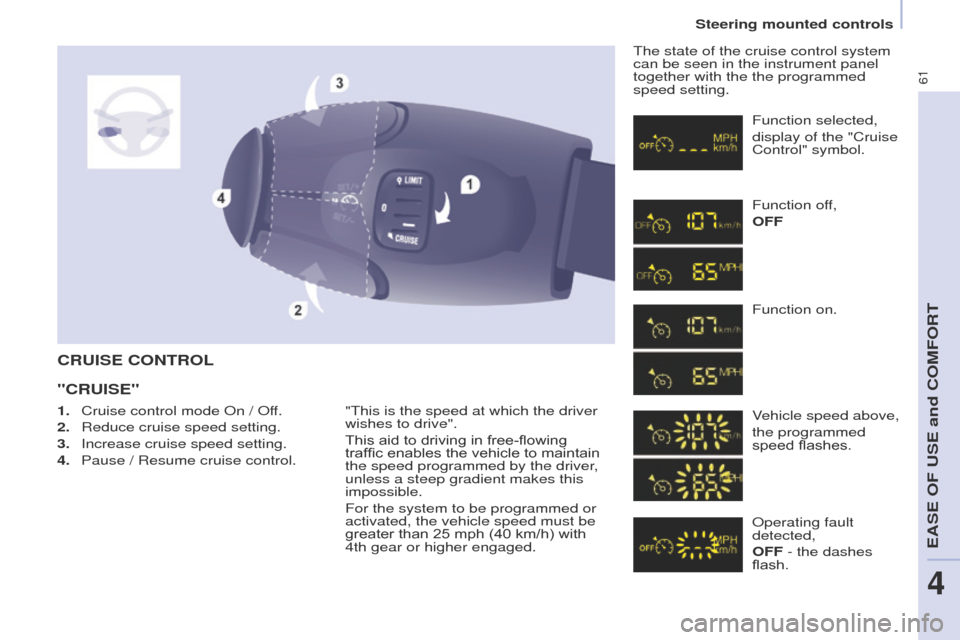
CRUISE CONTROL
"CRUISE"
"This is the speed at which the driver
wishes to drive".
This aid to driving in free-flowing
traffic enables the vehicle to maintain
the speed programmed by the driver,
unless a steep gradient makes this
impossible.
For the system to be programmed or
activated, the vehicle speed must be
greater than 25 mph (40 km/h) with
4th gear or higher engaged. The state of the cruise control system
can be seen in the instrument panel
together with the the programmed
speed setting.
Function selected,
display of the "Cruise
Control" symbol.
Function off,
OFF
Function on.
Vehicle speed above,
the programmed
speed flashes.
Operating fault
detected,
OFF - the dashes
flash.
1.
Cruise control mode On / Of
f.
2.
Reduce cruise speed setting.
3.
Increase cruise speed setting.
4.
Pause / Resume cruise control.
Steering mounted controls
EASE OF USE and COMFORT
4
Page 66 of 260
64
Partner-2-VU_en_Chap04_Ergonomie_ed02-2016
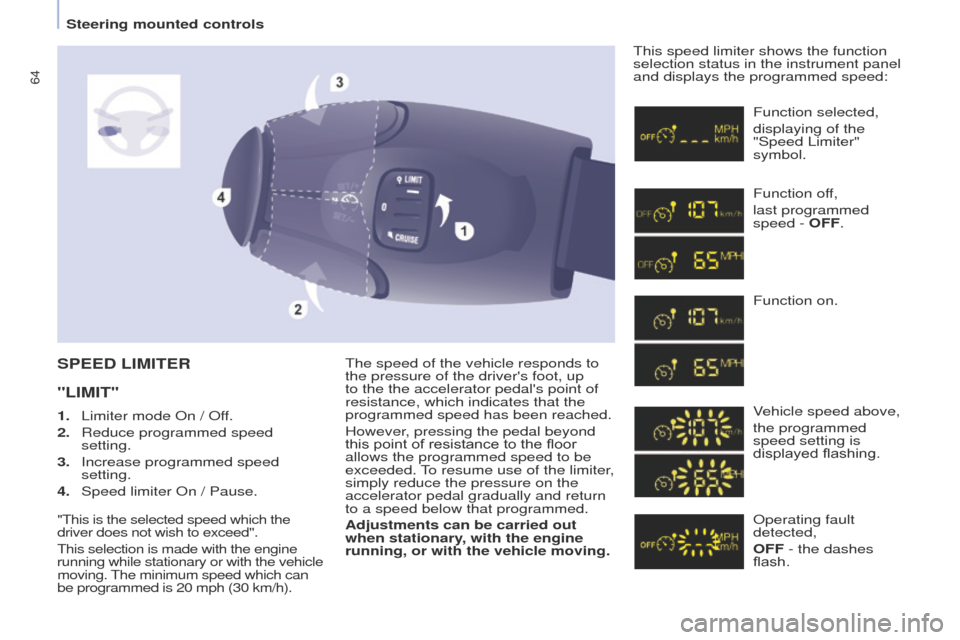
The speed of the vehicle responds to
the pressure of the driver's foot, up
to the the accelerator pedal's point of
resistance, which indicates that the
programmed speed has been reached.
However, pressing the pedal beyond
this point of resistance to the floor
allows the programmed speed to be
exceeded. To resume use of the limiter,
simply reduce the pressure on the
accelerator pedal gradually and return
to a speed below that programmed.
Adjustments can be carried out
when stationary, with the engine
running, or with the vehicle moving.This speed limiter shows the function
selection status in the instrument panel
and displays the programmed speed:SPEED LIMITER
"LIMIT"
Function selected,
displaying of the
"Speed Limiter"
symbol.
Function off,
last programmed
speed - OFF.
Function on.
Vehicle speed above,
the programmed
speed setting is
displayed flashing.
Operating fault
detected,
OFF - the dashes
flash.
1.
Limiter mode On / Of
f.
2.
Reduce programmed speed
setting.
3.
Increase programmed speed
setting.
4.
Speed limiter On / Pause.
"This is the selected speed which the
driver does not wish to exceed".
This selection is made with the engine
running while stationary or with the vehicle
moving. The minimum speed which can
be programmed is 20 mph (30 km/h).
Steering mounted controls