Level Peugeot Partner 2019 User Guide
[x] Cancel search | Manufacturer: PEUGEOT, Model Year: 2019, Model line: Partner, Model: Peugeot Partner 2019Pages: 312, PDF Size: 9.56 MB
Page 27 of 312
25
Warning/indicator lampStateCause Actions/Observations
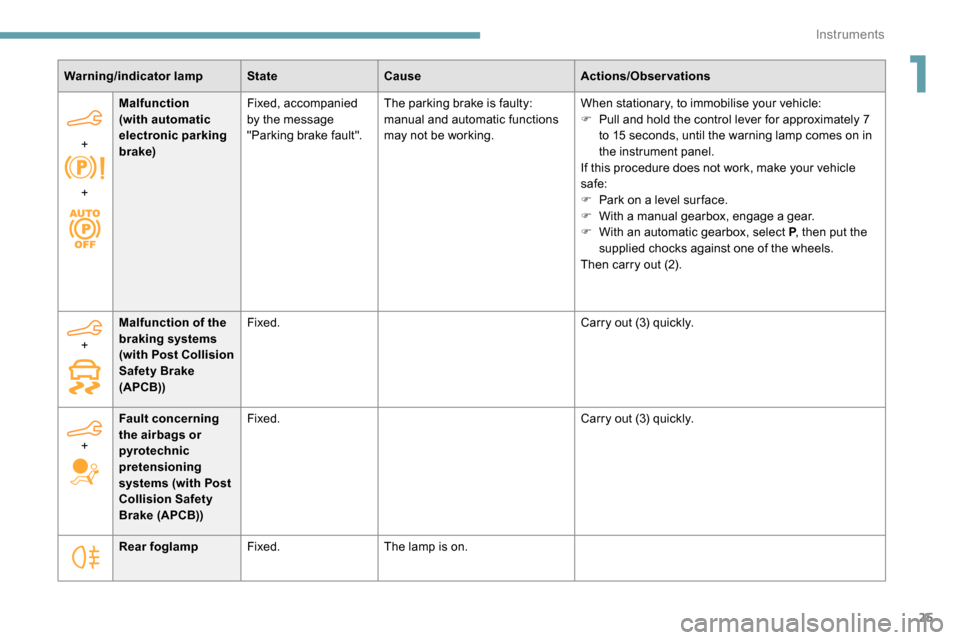
+
+ Malfunction
(with automatic
electronic parking
brake)
Fixed, accompanied
by the message
"Parking brake fault".
The parking brake is faulty:
manual and automatic functions
may not be working. When stationary, to immobilise your vehicle:
F
P
ull and hold the control lever for approximately 7
to 15
seconds, until the warning lamp comes on in
the instrument panel.
If this procedure does not work, make your vehicle
safe:
F
P
ark on a level sur face.
F
W
ith a manual gearbox, engage a gear.
F
W
ith an automatic gearbox, select P, then put the
supplied chocks against one of the wheels.
Then carry out (2).
Rear foglamp Fixed. The lamp is on.
+
Malfunction of the
braking systems
(with Post Collision
Safety Brake
(APCB)) Fixed.
Carry out (3) quickly.
+ Fault concerning
the airbags or
pyrotechnic
pretensioning
systems (with Post
Collision Safety
Brake (APCB)) Fixed.
Carry out (3) quickly.
1
Instruments
Page 32 of 312
30
You must stop as soon as it is safe to do so.
Wait a few minutes before switching off the
engine.
Contact a PEUGEOT dealer or a qualified
workshop.
Checking
After driving for a few minutes, the temperature
and pressure in the cooling system increase.
To top up the level:
F
w
ait at least one hour for the engine to cool,
F
u
nscrew the cap by two turns to allow the
pressure to drop,
F
w
hen the pressure has dropped, remove the
cap,
F
t
op up the level to the "MA X" mark.
For more information on Checking levels ,
refer to the corresponding section.
Be aware of the risk of scalding when
topping up the coolant. Do not fill above
the maximum level (indicated on the
reservoir).
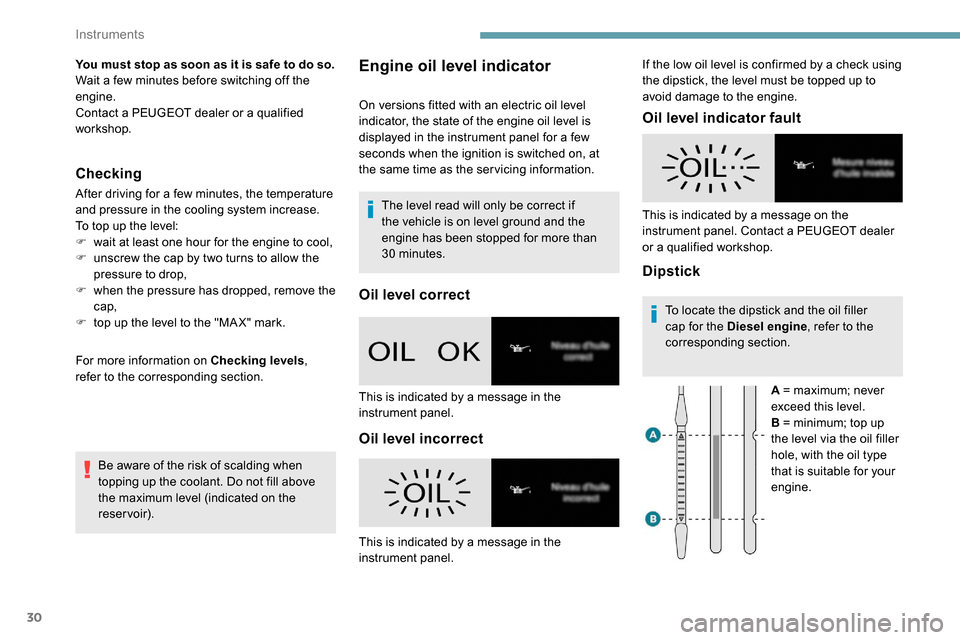
Engine oil level indicator
On versions fitted with an electric oil level
indicator, the state of the engine oil level is
displayed in the instrument panel for a few
seconds when the ignition is switched on, at
the same time as the ser vicing information.The level read will only be correct if
the vehicle is on level ground and the
engine has been stopped for more than
30
minutes.
Oil level correct
Oil level incorrect Oil level indicator fault
DipstickTo locate the dipstick and the oil filler
cap for the Diesel engine
, refer to the
corresponding section.
A = maximum; never
exceed this level.
B = minimum; top up
the level via the oil filler
hole, with the oil type
that is suitable for your
engine.
This is indicated by a message in the
instrument panel.
This is indicated by a message in the
instrument panel. This is indicated by a message on the
instrument panel. Contact a PEUGEOT dealer
or a qualified workshop. If the low oil level is confirmed by a check using
the dipstick, the level must be topped up to
avoid damage to the engine.
Instruments
Page 33 of 312
31
These range indicators are present only on
BlueHDi Diesel versions.
Once the AdBlue
® tank is on reser ve or after
detection of a fault with the SCR emissions
control system, when the ignition is switched
on, an indicator displays an estimate of the
distance that can be covered, the range, before
engine starting is prevented.
In the event of the risk of non-
starting related to a lack of
AdBlue
®
The engine starting prevention system
required by regulations is activated
automatically once the AdBlue
® tank is
e m pt y.
AdBlue® range indicators
Range greater than 1,500 miles (2,400 km)
W hen the ignition is switched on, no
information on range is displayed automatically. Pressing this button temporarily displays the
driving range.
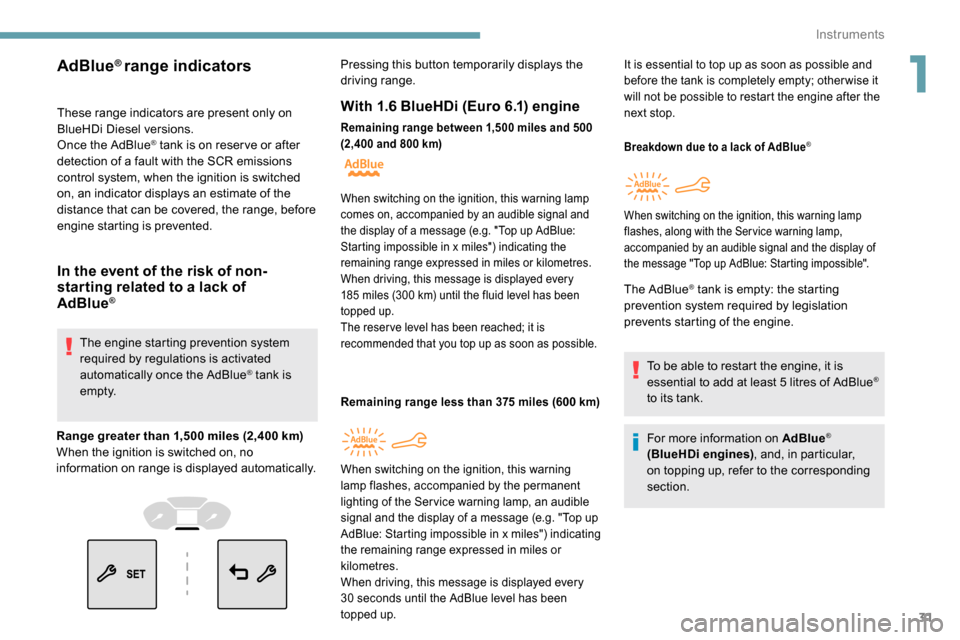
With 1.6 BlueHDi (Euro 6.1) engine
Remaining range between 1,500 miles and 500
( 2,400 and 800 km)
Remaining range less than 375 miles (600 km)
Breakdown due to a lack of AdBlue®
The AdBlue® tank is empty: the starting
prevention system required by legislation
prevents starting of the engine.
To be able to restart the engine, it is
essential to add at least 5
litres of AdBlue
®
to its tank.
For more information on AdBlue
®
(BlueHDi engines) , and, in particular,
on topping up, refer to the corresponding
section.
When switching on the ignition, this warning lamp
c omes on, accompanied by an audible signal and
the display of a message (e.g. "Top up AdBlue:
Starting impossible in x miles") indicating the
remaining range expressed in miles or kilometres.
When driving, this message is displayed every
185
miles (300 km) until the fluid level has been
topped up.
The reser ve level has been reached; it is
recommended that you top up as soon as possible.
When switching on the ignition, this warning
lam p flashes, accompanied by the permanent
lighting of the Ser vice warning lamp, an audible
signal and the display of a message (e.g. "Top up
AdBlue: Starting impossible in x miles") indicating
the remaining range expressed in miles or
kilometres.
When driving, this message is displayed every
30
seconds until the AdBlue level has been
topped up. It is essential to top up as soon as possible and
before the tank is completely empty; other wise it
will not be possible to restart the engine after the
next stop.
When switching on the ignition, this warning lamp
flashes, along with the Service warning lamp,
accompanied by an audible signal and the display of
the message "Top up AdBlue: Starting impossible".
1
Instruments
Page 34 of 312
32
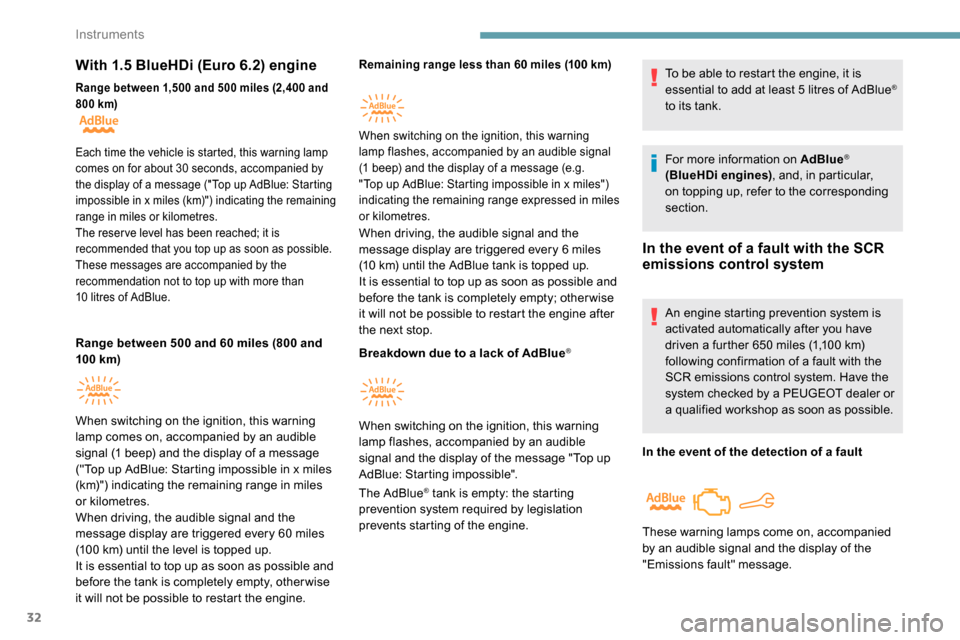
With 1.5 BlueHDi (Euro 6.2) engine
Range between 1,500 and 500 miles (2,400 and
8 00 km)
Range between 500 and 60 miles (800 and
10 0 km)
Remaining range less than 60 miles (100 km)
When driving, the audible signal and the
message display are triggered every 6 miles
(10
km) until the AdBlue tank is topped up.
It is essential to top up as soon as possible and
before the tank is completely empty; other wise
it will not be possible to restart the engine after
the next stop.
Breakdown due to a lack of AdBlue
®
The AdBlue® tank is empty: the starting
prevention system required by legislation
prevents starting of the engine. To be able to restart the engine, it is
essential to add at least 5
litres of AdBlue
®
to its tank.
For more information on AdBlue
®
(BlueHDi engines) , and, in particular,
on topping up, refer to the corresponding
section.
In the event of a fault with the SCR
emissions control system
An engine starting prevention system is
activated automatically after you have
driven a further 650
miles (1,100 km)
following confirmation of a fault with the
SCR emissions control system. Have the
system checked by a PEUGEOT dealer or
a qualified workshop as soon as possible.
In the event of the detection of a fault
Each time the vehicle is started, this warning lamp
c omes on for about 30 seconds, accompanied by
the display of a message ("Top up AdBlue: Starting
impossible in x miles (km)") indicating the remaining
range in miles or kilometres.
The reser ve level has been reached; it is
recommended that you top up as soon as possible.
These messages are accompanied by the
recommendation not to top up with more than
10
litres of AdBlue.
When switching on the ignition, this warning
l amp comes on, accompanied by an audible
signal (1 beep) and the display of a message
("Top up AdBlue: Starting impossible in x miles
(km)") indicating the remaining range in miles
or kilometres.
When driving, the audible signal and the
message display are triggered every 60
miles
(100
km) until the level is topped up.
It is essential to top up as soon as possible and
before the tank is completely empty, other wise
it will not be possible to restart the engine.
When switching on the ignition, this warning
lam p flashes, accompanied by an audible signal
(1 beep) and the display of a message (e.g.
"Top up AdBlue: Starting impossible in x miles")
indicating the remaining range expressed in miles
or kilometres.
When switching on the ignition, this warning
lamp flashes, accompanied by an audible
signal and the display of the message "Top up
AdBlue: Starting impossible".
These warning lamps come on, accompanied
by an audible signal and the display of the
"Emissions fault" message.
Instruments
Page 35 of 312
33
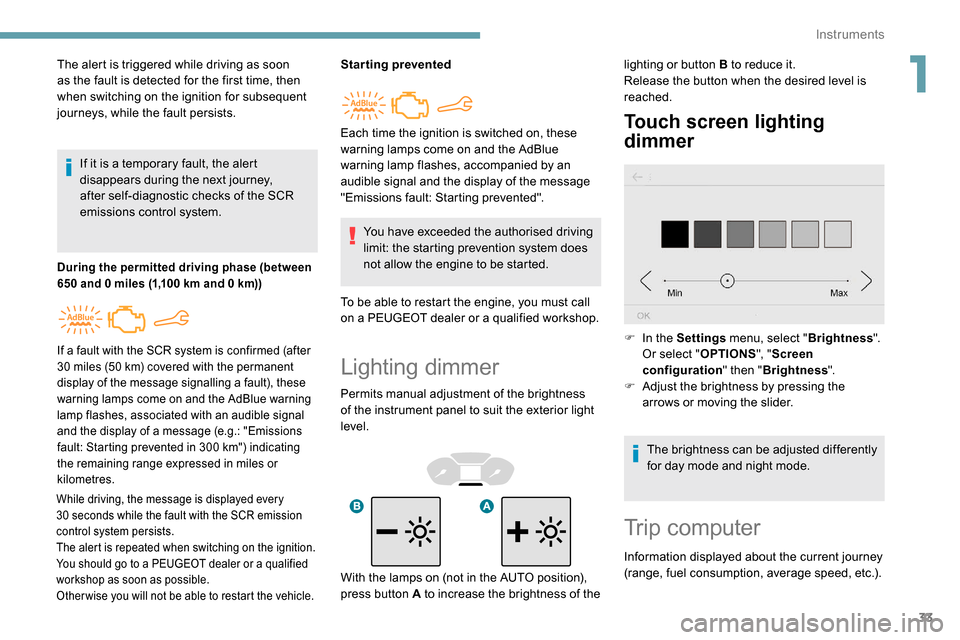
Lighting dimmer
Permits manual adjustment of the brightness
of the instrument panel to suit the exterior light
level.
Touch screen lighting
dimmer
The alert is triggered while driving as soon
as the fault is detected for the first time, then
when switching on the ignition for subsequent
journeys, while the fault persists.If it is a temporary fault, the alert
disappears during the next journey,
after self-diagnostic checks of the SCR
emissions control system.
During the permitted driving phase (between
650 and 0 miles (1,100 km and 0 km))
While driving, the message is displayed every
30 seconds while the fault with the SCR emission
control system persists.
The alert is repeated when switching on the ignition.
You should go to a PEUGEOT dealer or a qualified
workshop as soon as possible.
Other wise you will not be able to restart the vehicle.
Starting prevented
You have exceeded the authorised driving
limit: the starting prevention system does
not allow the engine to be started.
To be able to restart the engine, you must call
on a PEUGEOT dealer or a qualified workshop.
If a fault with the SCR system is confirmed (after
30 miles (50 km) covered with the permanent
display of the message signalling a fault), these
warning lamps come on and the AdBlue warning
lamp flashes, associated with an audible signal
and the display of a message (e.g.: "Emissions
fault: Starting prevented in 300
km") indicating
the remaining range expressed in miles or
kilometres.
Each time the ignition is switched on, these
warning lamps come on and the AdBlue
warning lamp flashes, accompanied by an
audible signal and the display of the message
"Emissions fault: Starting prevented". lighting or button B to reduce it.
Release the button when the desired level is
reached.
F
I
n the Settings menu, select " Brightness".
Or select " OPTIONS", "Screen
configuration " then "Brightness ".
F
A
djust the brightness by pressing the
arrows or moving the slider.
The brightness can be adjusted differently
for day mode and night mode.
Trip computer
Information displayed about the current journey
(range, fuel consumption, average speed, etc.).
With the lamps on (not in the AUTO position),
press button A to increase the brightness of the
1
Instruments
Page 62 of 312
60
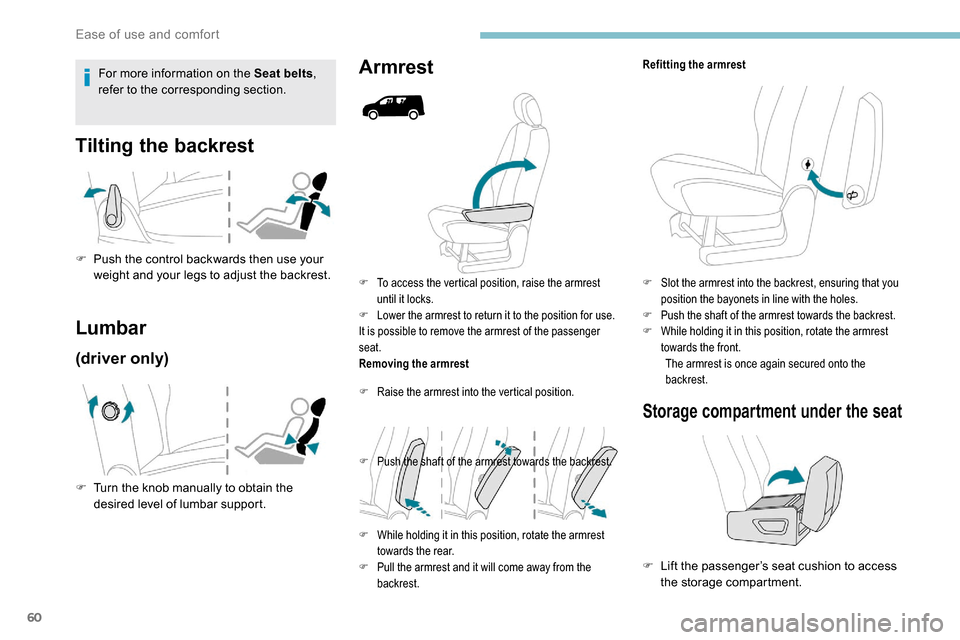
F To access the vertical position, raise the armrest until it locks.
F
L
ower the armrest to return it to the position for use.
It is possible to remove the armrest of the passenger
seat.
Removing the armrest
F
R
aise the armrest into the vertical position.
F
P
ush the shaft of the armrest towards the backrest.
F
W
hile holding it in this position, rotate the armrest
towards the rear.
F
P
ull the armrest and it will come away from the
backrest.
Tilting the backrest
Lumbar
(driver only)
F Turn the knob manually to obtain the desired level of lumbar support.
Armrest
F Push the control backwards then use your weight and your legs to adjust the backrest.
Storage compartment under the seat
Refitting the armrest
F
S
lot the armrest into the backrest, ensuring that you
position the bayonets in line with the holes.
F
P
ush the shaft of the armrest towards the backrest.
F
W
hile holding it in this position, rotate the armrest
towards the front. The armrest is once again secured onto the
backrest.For more information on the Seat belts ,
refer to the corresponding section.
F
L
ift the passenger’s seat cushion to access
the storage compartment.
Ease of use and comfort
Page 66 of 312
64
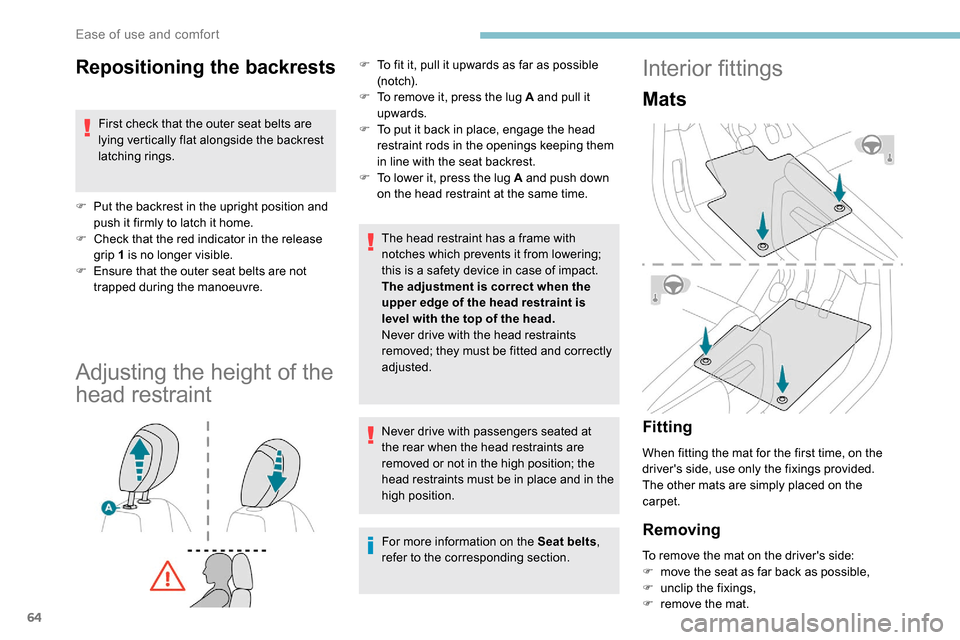
Repositioning the backrests
First check that the outer seat belts are
lying vertically flat alongside the backrest
latching rings.
F
P
ut the backrest in the upright position and
push it firmly to latch it home.
F
C
heck that the red indicator in the release
grip 1 is no longer visible.
F
E
nsure that the outer seat belts are not
trapped during the manoeuvre.
Adjusting the height of the
head restraint
The head restraint has a frame with
notches which prevents it from lowering;
this is a safety device in case of impact.
The adjustment is correct when the
upper edge of the head restraint is
level with the top of the head.
Never drive with the head restraints
removed; they must be fitted and correctly
adjusted.
Never drive with passengers seated at
the rear when the head restraints are
removed or not in the high position; the
head restraints must be in place and in the
high position.
For more information on the Seat belts ,
refer to the corresponding section.
F
T
o fit it, pull it upwards as far as possible
(n otc h).
F
T
o remove it, press the lug A and pull it
upwards.
F
T
o put it back in place, engage the head
restraint rods in the openings keeping them
in line with the seat backrest.
F
T
o lower it, press the lug A and push down
on the head restraint at the same time.
Interior fittings
Mats
Fitting
When fitting the mat for the first time, on the
driver's side, use only the fixings provided.
The other mats are simply placed on the
carpet.
Removing
To remove the mat on the driver's side:
F m ove the seat as far back as possible,
F
un
clip the fixings,
F
r
emove the mat.
Ease of use and comfort
Page 78 of 312
76
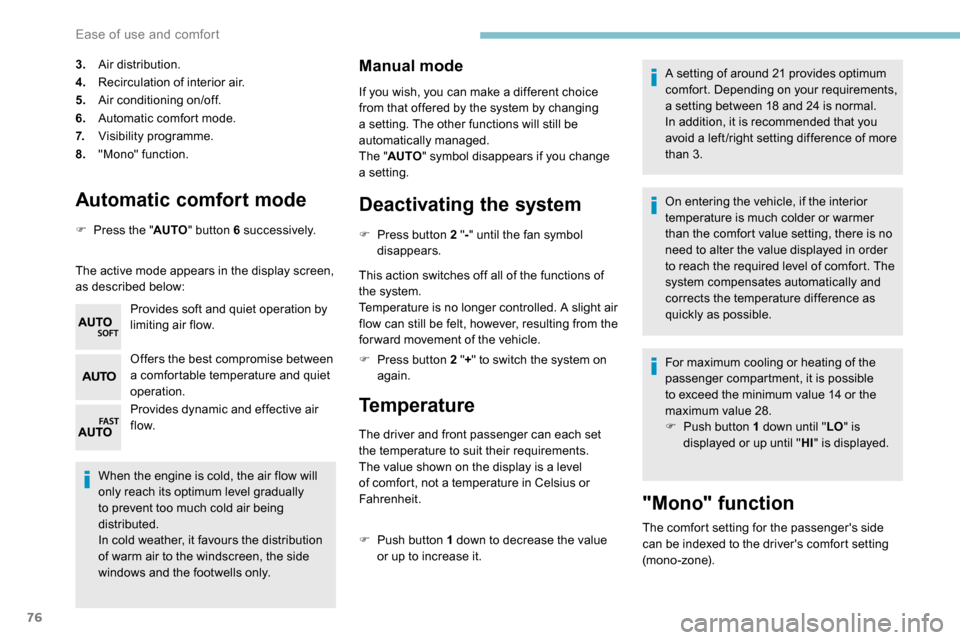
Automatic comfort mode
F Press the "AUTO" button 6 su c c e s s i ve l y.
The active mode appears in the display screen,
as described below: Provides soft and quiet operation by
limiting air flow.
Offers the best compromise between
a comfortable temperature and quiet
operation.
Provides dynamic and effective air
f low.
When the engine is cold, the air flow will
only reach its optimum level gradually
to prevent too much cold air being
distributed.
In cold weather, it favours the distribution
of warm air to the windscreen, the side
windows and the footwells only.
Manual mode
If you wish, you can make a different choice
from that offered by the system by changing
a setting. The other functions will still be
automatically managed.
The " AUTO " symbol disappears if you change
a setting.
3.
Air distribution.
4. Recirculation of interior air.
5. Air conditioning on/off.
6. Automatic comfort mode.
7. Visibility programme.
8. "Mono" function.
Deactivating the system
F Press button 2 " -" until the fan symbol
disappears.
This action switches off all of the functions of
the system.
Temperature is no longer controlled. A slight air
flow can still be felt, however, resulting from the
for ward movement of the vehicle.
F
P
ress button 2 " +" to switch the system on
again.
Temperature
The driver and front passenger can each set
the temperature to suit their requirements.
The value shown on the display is a level
of comfort, not a temperature in Celsius or
Fahrenheit.
F
P
ush button 1 down to decrease the value
or up to increase it. A setting of around 21 provides optimum
comfort. Depending on your requirements,
a setting between 18 and 24 is normal.
In addition, it is recommended that you
avoid a left /right setting difference of more
than 3.
On entering the vehicle, if the interior
temperature is much colder or warmer
than the comfort value setting, there is no
need to alter the value displayed in order
to reach the required level of comfort. The
system compensates automatically and
corrects the temperature difference as
quickly as possible.
For maximum cooling or heating of the
passenger compartment, it is possible
to exceed the minimum value 14 or the
maximum value 28.
F
P ush button 1 down until "
LO" is
displayed or up until " HI" is displayed.
"Mono" function
The comfort setting for the passenger's side
can be indexed to the driver's comfort setting
(mono-zone).
Ease of use and comfort
Page 84 of 312
82
The additional heating system is powered
by the fuel in the vehicle's fuel tank.
Before use, ensure that there is enough
fuel in the tank.
If the tank level is on reser ve, the system
cannot be used.
The ventilation is activated provided that
the battery is sufficiently charged.
The heating is activated provided that:
-
t
he battery is sufficiently charged,
-
t
he fuel level is adequate,
-
t
he engine has been started since the
previous heating cycle.
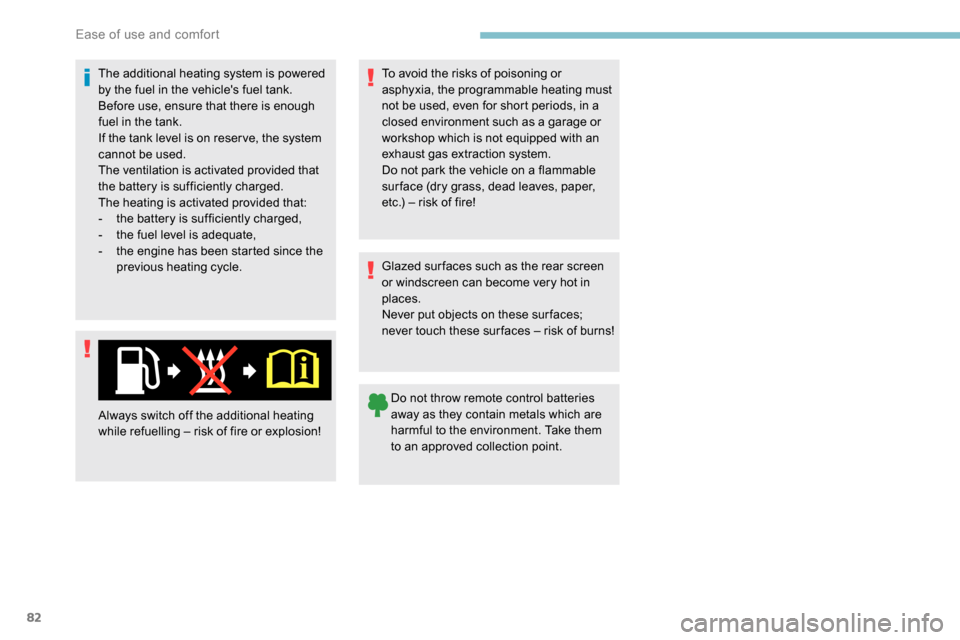
Always switch off the additional heating
while refuelling – risk of fire or explosion! Glazed sur faces such as the rear screen
or windscreen can become very hot in
places.
Never put objects on these sur faces;
never touch these sur faces – risk of burns!
Do not throw remote control batteries
away as they contain metals which are
harmful to the environment. Take them
to an approved collection point.
To avoid the risks of poisoning or
asphyxia, the programmable heating must
not be used, even for short periods, in a
closed environment such as a garage or
workshop which is not equipped with an
exhaust gas extraction system.
Do not park the vehicle on a flammable
sur face (dry grass, dead leaves, paper,
etc.) – risk of fire!
Ease of use and comfort
Page 88 of 312
86
Turn the ring:
F o nce for wards to switch on the front
foglamps,
F
f
or wards a second time to switch on the rear
foglamps,
F
o
nce backwards to switch off the rear
foglamps,
F
b
ackwards a second time to switch off the
front foglamps.
If the lamps are switched off automatically
(" AUTO " position) or the dipped beams are
switched off manually, the foglamps and
sidelamps remain on.
F
T
urn the ring backwards to switch off the
foglamps, the sidelamps will then switch off.
When the lighting is left on
An audible signal when a front door is
opened warns the driver that the vehicle's
exterior lighting is on, with the ignition off
and in manual lighting mode.
In this case, switching off the lighting
stops the audible signal.
The lighting goes off when you switch off
the ignition, but you can always switch it
on again using the lighting control stalk. Travelling abroad
If using your vehicle in a country that
drives on the other side of the road, the
headlamps must be adjusted to avoid
dazzling on-coming drivers.
Contact a PEUGEOT dealer or a qualified
workshop.
In good or rainy weather, by both day and
night, use of the front foglamps and the
rear foglamps are prohibited. In these
situations, the power of their beams may
dazzle other drivers. They should only be
used in fog or falling snow.
In these weather conditions, it is your
responsibility to switch on the foglamps
and dipped headlamps manually as the
sunshine sensor may detect sufficient
light.
Switch off the front and rear foglamps
when they are no longer necessary.
Never look too closely at the luminous
beam of LED headlamps: risk of serious
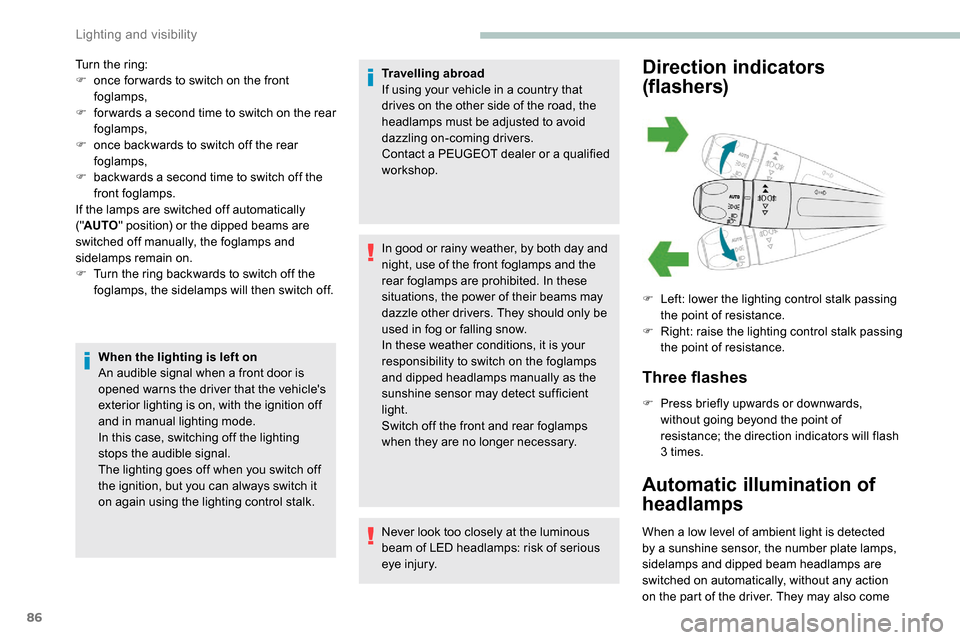
eye injury.Direction indicators
(flashers)
Three flashes
F Press briefly upwards or downwards,
without going beyond the point of
resistance; the direction indicators will flash
3 times.
Automatic illumination of
headlamps
When a low level of ambient light is detected
by a sunshine sensor, the number plate lamps,
sidelamps and dipped beam headlamps are
switched on automatically, without any action
on the part of the driver. They may also come F
L
eft: lower the lighting control stalk passing
the point of resistance.
F
R
ight: raise the lighting control stalk passing
the point of resistance.
Lighting and visibility