weight Peugeot Partner Tepee 2011 User Guide
[x] Cancel search | Manufacturer: PEUGEOT, Model Year: 2011, Model line: Partner Tepee, Model: Peugeot Partner Tepee 2011Pages: 232, PDF Size: 7.4 MB
Page 124 of 232
122 122
Child safety
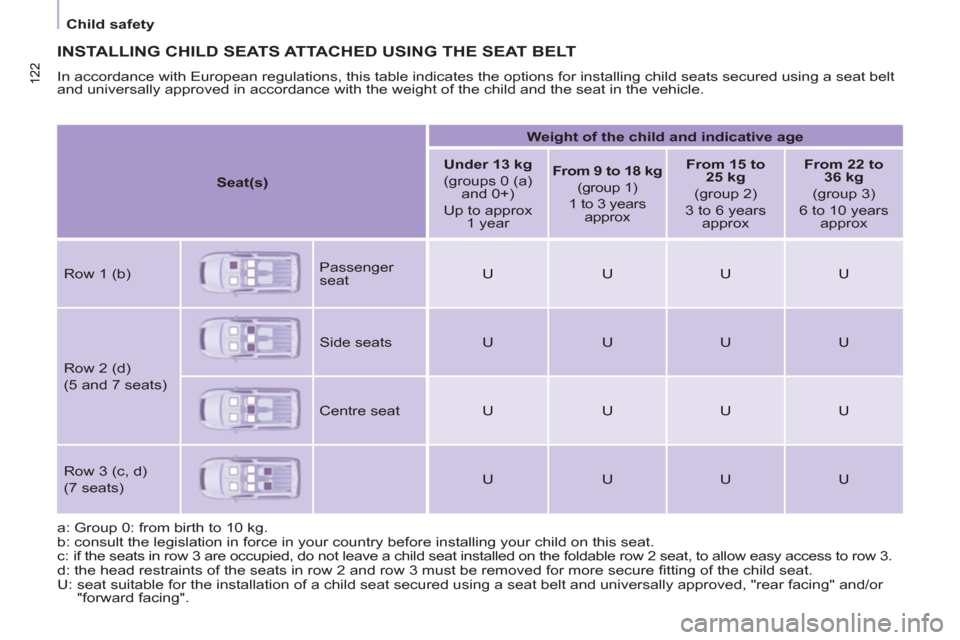
INSTALLING CHILD SEATS ATTACHED USING THE SEAT BELT
In accordance with European regulations, this table indicates the options for installing child seats secured using a seat belt
and universally approved in accordance with the weight of the child and the seat in the vehicle.
a: Group 0: from birth to 10 kg.
b: consult the legislation in force in your country before installing your child on this seat.
c: if the seats in row 3 are occupied, do not leave a child seat installed on the foldable row 2 seat, to allow easy access to row 3.
d: the head restraints of the seats in row 2 and row 3 must be removed for more secure fi tting of the child seat.
U: seat suitable for the installation of a child seat secured using a seat belt and universally approved, "rear facing" and/or
"forward facing".
Seat(s)
Weight of the child and indicative age
Under 13 kg
(groups 0 (a)
and 0+)
Up to approx
1 year
From 9 to 18 kg
(group 1)
1 to 3 years
approx
From 15 to
25 kg
(group 2)
3 to 6 years
approx
From 22 to
36 kg
(group 3)
6 to 10 years
approx
Row 1 (b) Passenger
seat
U
U
U
U
Row 2 (d)
(5 and 7 seats) Side seats
U
U
U
U
Centre seat
U
U
U
U
Row 3 (c, d)
(7 seats)
U
U
U
U
Page 127 of 232
125
SAFETY
4
125
Child safety
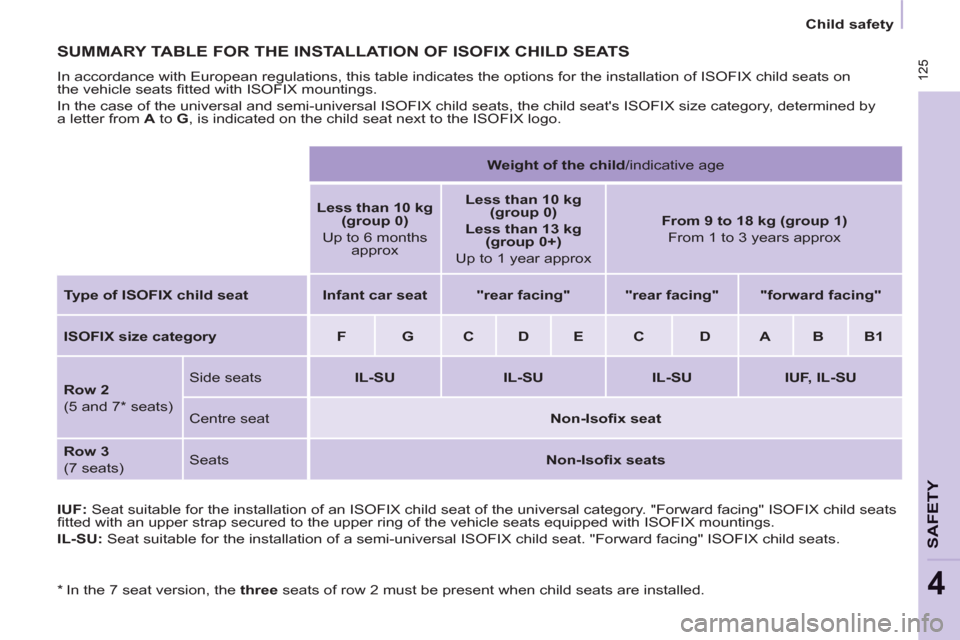
SUMMARY TABLE FOR THE INSTALLATION OF ISOFIX CHILD SEATS
In accordance with European regulations, this table indicates the options for the installation of ISOFIX child seats on
the vehicle seats fi tted with ISOFIX mountings.
In the case of the universal and semi-universal ISOFIX child seats, the child seat's ISOFIX size category, determined by
a letter from A
to G
, is indicated on the child seat next to the ISOFIX logo.
Weight of the child
/indicative age
Less than 10 kg
(group 0)
Up to 6 months
approx
Less than 10 kg
(group 0)
Less than 13 kg
(group 0+)
Up to 1 year approx
From 9 to 18 kg (group 1)
From 1 to 3 years approx
Type of ISOFIX child seat
Infant car seat
"rear facing"
"rear facing"
"forward facing"
ISOFIX size category
F
G
C
D
E
C
D
A
B
B1
Row 2
(5 and 7 * seats)
Side seats
IL-SU
IL-SU
IL-SU
IUF, IL-SU
Centre seat
Non-Isofi x seat
Row 3
(7 seats)
Seats
Non-Isofi x seats
IUF:
Seat suitable for the installation of an ISOFIX child seat of the universal category. "Forward facing" ISOFIX child seats
fi tted with an upper strap secured to the upper ring of the vehicle seats equipped with ISOFIX mountings.
IL-SU:
Seat suitable for the installation of a semi-universal ISOFIX child seat. "Forward facing" ISOFIX child seats.
*
In the 7 seat version, the three seats of row 2 must be present when child seats are installed.
Page 129 of 232
127
Towing a trailer
ACCESSORIE
S
5
For more information about
weights, refer to the administrative
documents (V5 registration
document, ...) or to the "Weights"
section of chapter 8.
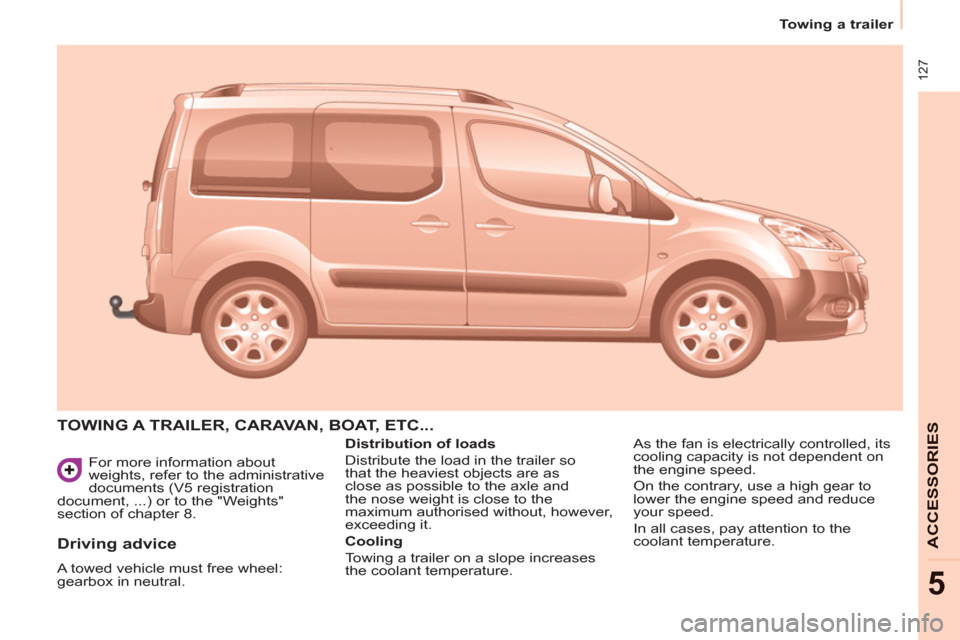
TOWING A TRAILER, CARAVAN, BOAT, ETC...
Distribution of loads
Distribute the load in the trailer so
that the heaviest objects are as
close as possible to the axle and
the nose weight is close to the
maximum authorised without, however,
exceeding it.
Cooling
Towing a trailer on a slope increases
the coolant temperature. As the fan is electrically controlled, its
cooling capacity is not dependent on
the engine speed.
On the contrary, use a high gear to
lower the engine speed and reduce
your speed.
In all cases, pay attention to the
coolant temperature.
Driving advice
A towed vehicle must free wheel:
gearbox in neutral.
Page 131 of 232
Equipment
129
ACCESSORIE
S
5
A further range is also available,
structured around comfort, leisure and
maintenance:
Anti-theft alarm, window
etching, fi rst aid kit, high
visibility vest, front and rear
parking sensors, warning
triangle, security bolts for alloy
wheels, ...
Seat covers compatible with
airbags for the front seats,
bench seat, rubber mats, carpet
mats, snow chains, blinds,
tailgate bicycle carrier, ...
Audio equipment, hands-free
kit, speakers, CD changer,
satellite navigation system, USB
box, Video kit, ...
Regardless of the audio and
telematic equipment offered on the
market, the technical constraints
associated with the fi tting of equipment
of these product groups mean that the
special features of the equipment and
its compatibility with the capacities of
your vehicle's standard equipment must
be taken into account. Please ask a
PEUGEOT dealer for more information
before fi tting such equipment.
To prevent the mat from becoming
caught under the pedals:
- ensure that the mat and its fi xings
are positioned correctly,
- never fi t one mat on top of another.
Maximum weights on bars
- Transverse bars on longitudinal
bars: 75 Kg (these bars are not
compatible with the Zénith roof).
OTHER ACCESSORIES
These accessories and parts, having been
tested and approved for reliability and
safety, are all adapted to your vehicle. A
wide range of recommended accessories
and genuine parts is available.
Installing radiocommunication
transmitters
You are advised to contact a
PEUGEOT dealer before installing
accessory radiocommunication
transmitters with external aerial on
your vehicle.
The PEUGEOT dealer network
will inform you of the specifi cation
(frequency band, maximum output
power, aerial position, specifi c
conditions of installation) of the
transmitters which can be fi tted, in
accordance with the Motor Vehicle
Electromagnetic Compatibility Directive
(2004/104/EC).
Page 166 of 232
164
Weights
WEIGHTS AND TOWED LOADS (KG)
General points
For more information, refer to your
registration certifi cate.
In each country, it is imperative that
the towed loads authorised by local
legislation are complied with. To fi nd
out your vehicle's towing capacities
and its gross train weight, consult a
PEUGEOT dealer. The braked towed weight with load
transfer can be increased on condition
that the equivalent of this load is
removed from the vehicle so that the
GTW is not exceeded. Warning: towing
using a lightly loaded towing vehicle
may have an adverse effect on its road
holding.
The speed of a towing vehicle must not
exceed 50 mph (80 km/h) (comply with
the legislation in force in your country). High ambient temperatures may result
in a reduction in the performance
of the vehicle in order to protect the
engine; when the ambient temperature
is higher than 37 °C, limit the towed
weight.
The kerb weight is equal to the weight
without load + driver (75 kg) + fuel tank
fi lled to 90 %.
The GTW and towed load values
indicated are valid up to a maximum
altitude of 1 000 metres; the towed
load mentioned must be reduced by
10 % for each additional 1 000 metres.
Page 229 of 232
171
Technical data - Maintenance
VISUAL SEARCH
10
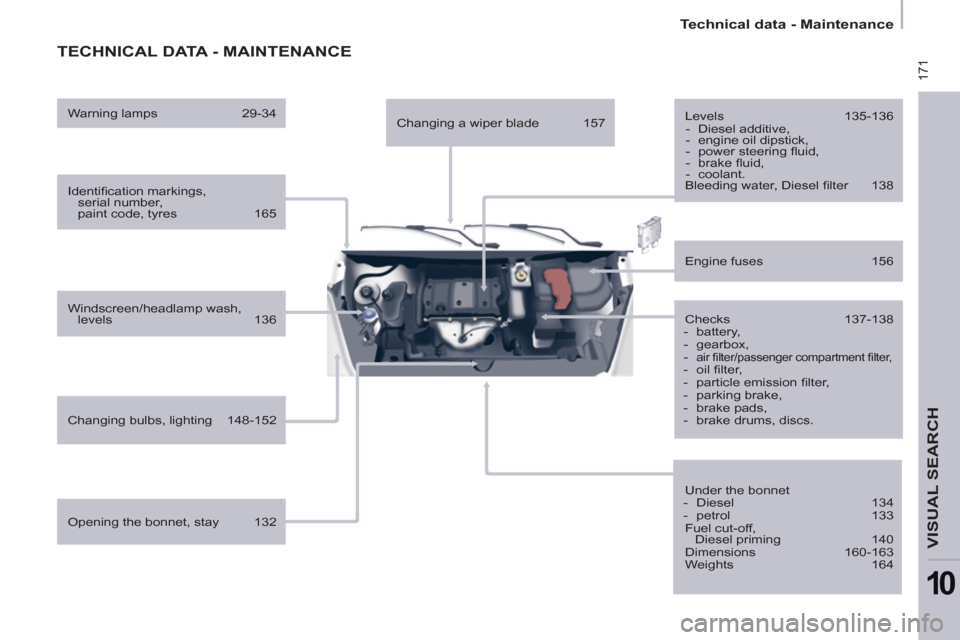
TECHNICAL DATA - MAINTENANCE
Identifi cation markings,
serial number,
paint code, tyres 165
Windscreen/headlamp wash,
levels 136
Changing bulbs, lighting 148-152
Checks 137-138
- battery,
- gearbox,
-
air fi lter/passenger compartment fi lter,
- oil fi lter,
- particle emission fi lter,
- parking brake,
- brake pads,
- brake drums, discs.
Engine fuses 156
Under the bonnet
- Diesel 134
- petrol 133
Fuel cut-off,
Diesel priming 140
Dimensions 160-163
Weights 164
Opening the bonnet, stay 132
Levels 135-136
- Diesel additive,
- engine oil dipstick,
- power steering fl uid,
- brake fl uid,
- coolant.
Bleeding water, Diesel fi lter 138
Warning lamps 29-34
Changing a wiper blade 157