engine Peugeot Partner Tepee 2012 Owner's Manual
[x] Cancel search | Manufacturer: PEUGEOT, Model Year: 2012, Model line: Partner Tepee, Model: Peugeot Partner Tepee 2012Pages: 240, PDF Size: 7.41 MB
Page 5 of 240
3
Contents
CONTENT
S
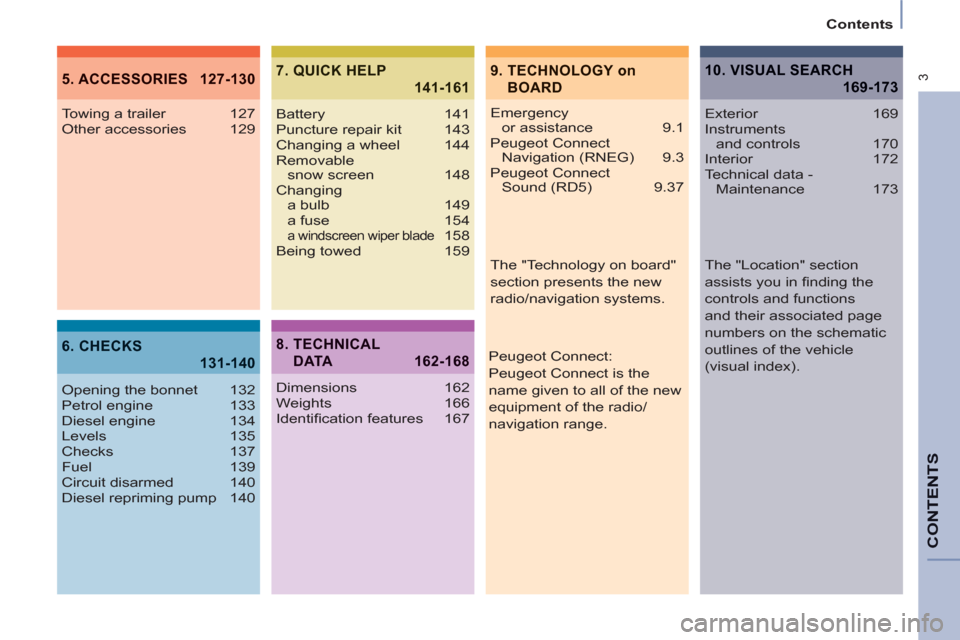
9. TECHNOLOGY on
BOARD5. ACCESSORIES 127-130
6. CHECKS
131-140
7. QUICK HELP
141-161
Emergency
or assistance 9.1
Peugeot Connect
Navigation (RNEG) 9.3
Peugeot Connect
Sound (RD5) 9.37 Towing a trailer 127
Other accessories 129
Opening the bonnet 132
Petrol engine 133
Diesel engine 134
Levels 135
Checks 137
Fuel 139
Circuit disarmed 140
Diesel repriming pump 140Battery 141
Puncture repair kit 143
Changing a wheel 144
Removable
snow screen 148
Changing
a bulb 149
a fuse 154
a windscreen wiper blade 158
Being towed 159
8. TECHNICAL
DATA 162-168
Dimensions 162
Weights 166
Identifi cation features 167
10. VISUAL SEARCH
169-173
Exterior 169
Instruments
and controls 170
Interior 172
Technical data -
Maintenance 173
Peugeot Connect:
Peugeot Connect is the
name given to all of the new
equipment of the radio/
navigation range.
The "Technology on board"
section presents the new
radio/navigation systems.
The "Location" section
assists you in fi nding the
controls and functions
and their associated page
numbers on the schematic
outlines of the vehicle
(visual index).
Page 19 of 240
ECO-DRIVING
Eco-driving is a range of everyday practices that allow the motorist to optimise their fuel consumption and CO2
emissions.
Optimise the use of your
gearbox
With a manual gearbox, move off
gently, change up without waiting and
drive by changing up quite soon. If
your vehicle has the system, the gear
shift indicator invites you to change
up; it is displayed in the instrument
panel, follow its instructions.
With an automatic or electronic
gearbox, stay in Drive "D"
or
Auto "A"
, according to the type
of gearbox, without pressing
the accelerator pedal heavily or
suddenly.
Control the use of your
electrical equipment
Before moving off, if the passenger
compartment is too warm, ventilate it
by opening the windows and air vents
before using the air conditioning.
Above 30 mph (50 km/h), close the
windows and leave the air vents open.
Remember to make use of equipment
that can help keep the temperature
in the passenger compartment down
(sunroof and window blinds...).
Switch off the headlamps and front
foglamps when the level of light does
not require their use.
Avoid running the engine before
moving off, particularly in winter; your
vehicle will warm up much faster
while driving.
Drive smoothly
Maintain a safe distance between
vehicles, use engine braking rather
than the brake pedal, and press the
accelerator progressively. These
practices contribute towards a
reduction in fuel consumption and CO
2
emissions and also helps reduce the
background traffi c noise.
If your vehicle has cruise control,
make use of the system at speeds
above 25 mph (40 km/h) when the
traffi c is fl owing well.
As a passenger, if you avoid
connecting your multimedia devices
(fi lm, music, video game...),
you will contribute towards limiting
the consumption of electrical energy,
and so of fuel.
Disconnect your portable devices
before leaving the vehicle.
Switch off the air conditioning, unless
it has automatic digital regulation,
as soon as the desired temperature
is attained.
Switch off the demisting and
defrosting controls, if not automatic.
Switch off the heated seat as soon as
possible.
17
1
FAMILIARISATION
Page 20 of 240
18
Limit the causes of excess
consumption
Spread loads throughout the
vehicle; place the heaviest items in
the bottom of the boot, as close as
possible to the rear seats.
Limit the loads carried in the
vehicle and reduce wind resistance
(roof bars, roof rack, bicycle
carrier, trailer...). Use a roof box in
preference.
Remove roof bars and roof racks
after use.
At the end of winter, remove snow
tyres and refi t your summer tyres.
Observe the recommendations
on maintenance
Check the tyre pressures regularly,
when cold, referring to the label in the
door aperture, driver's side.
Carry out this check in particular:
- before a long journey,
- at each change of season,
- after a long period out of use.
Don't forget the spare wheel and the
tyres on any trailer or caravan.
Have your vehicle serviced regularly
(engine oil, oil fi lter, air fi lter...) and
observe the schedule of operations
recommended by the manufacturer.
When refuelling, do not continue after
the 3 rd cut-off of the nozzle to avoid
any overfl ow.
At the wheel of your new vehicle,
it is only after the fi rst 1 800 miles
(3 000 kilometres) that you will see
the fuel consumption settle down to a
consistent average.
Page 21 of 240
19
Access
READY TO SET OFF
2
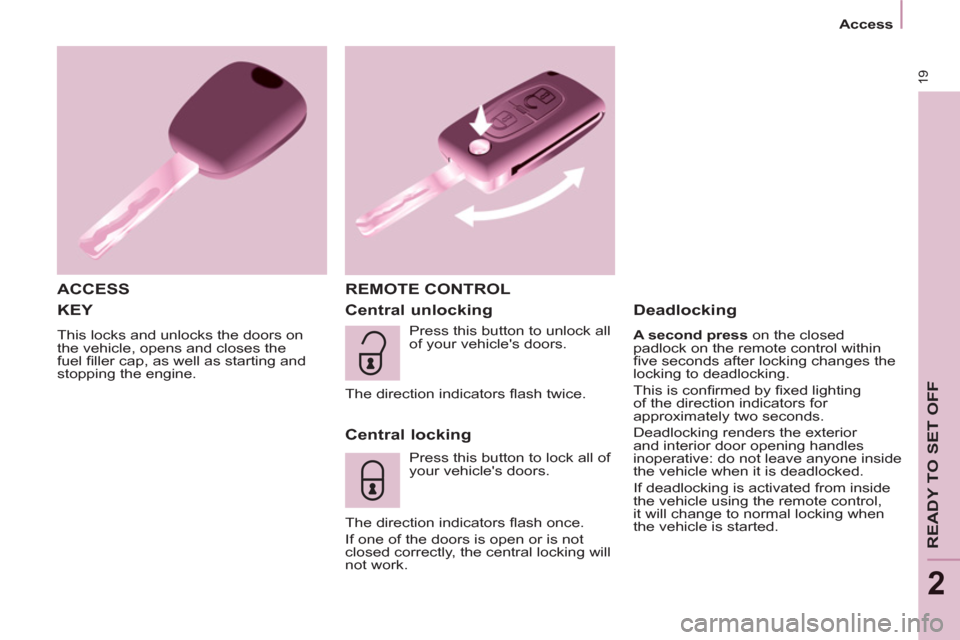
KEY
This locks and unlocks the doors on
the vehicle, opens and closes the
fuel fi ller cap, as well as starting and
stopping the engine.
ACCESS REMOTE CONTROL
Central unlocking
Central locking
Press this button to lock all of
your vehicle's doors.
The direction indicators fl ash once.
If one of the doors is open or is not
closed correctly, the central locking will
not work.
Deadlocking
A second press on the closed
padlock on the remote control within
fi ve seconds after locking changes the
locking to deadlocking.
This is confi rmed by fi xed lighting
of the direction indicators for
approximately two seconds.
Deadlocking renders the exterior
and interior door opening handles
inoperative: do not leave anyone inside
the vehicle when it is deadlocked.
If deadlocking is activated from inside
the vehicle using the remote control,
it will change to normal locking when
the vehicle is started. Press this button to unlock all
of your vehicle's doors.
The direction indicators fl ash twice.
Page 23 of 240
21
Access
READY TO SET OFF
2
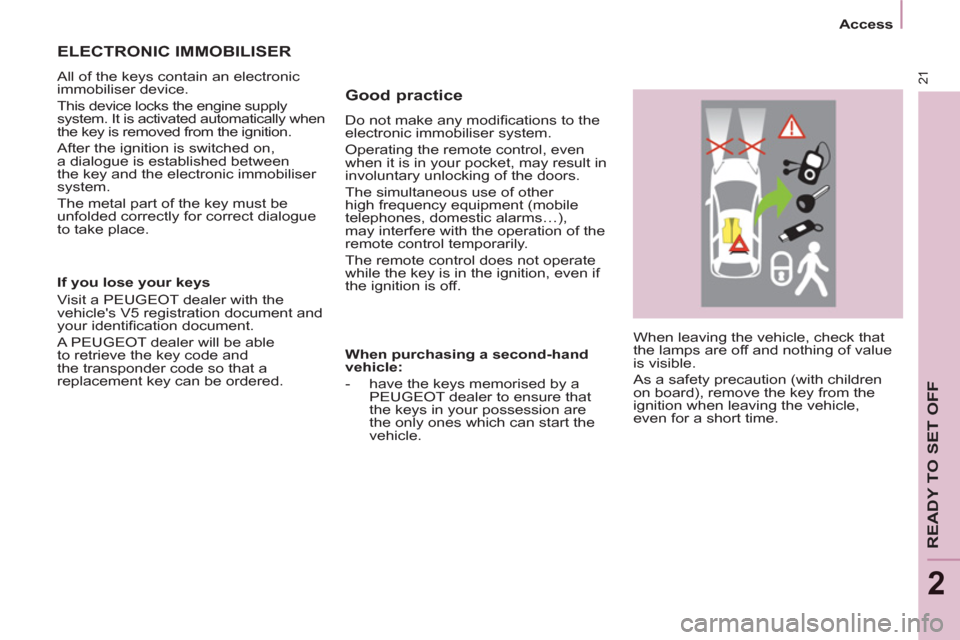
When leaving the vehicle, check that
the lamps are off and nothing of value
is visible.
As a safety precaution (with children
on board), remove the key from the
ignition when leaving the vehicle,
even for a short time.
Good practice
Do not make any modifi cations to the
electronic immobiliser system.
Operating the remote control, even
when it is in your pocket, may result in
involuntary unlocking of the doors.
The simultaneous use of other
high frequency equipment (mobile
telephones, domestic alarms…),
may interfere with the operation of the
remote control temporarily.
The remote control does not operate
while the key is in the ignition, even if
the ignition is off.
ELECTRONIC IMMOBILISER
All of the keys contain an electronic
immobiliser device.
This device locks the engine supply
system. It is activated automatically when
the key is removed from the ignition.
After the ignition is switched on,
a dialogue is established between
the key and the electronic immobiliser
system.
The metal part of the key must be
unfolded correctly for correct dialogue
to take place.
If you lose your keys
Visit a PEUGEOT dealer with the
vehicle's V5 registration document and
your identifi cation document.
A PEUGEOT dealer will be able
to retrieve the key code and
the transponder code so that a
replacement key can be ordered.
When purchasing a second-hand
vehicle:
- have the keys memorised by a
PEUGEOT dealer to ensure that
the keys in your possession are
the only ones which can start the
vehicle.
Page 30 of 240
28
Access
CENTRAL LOCKING
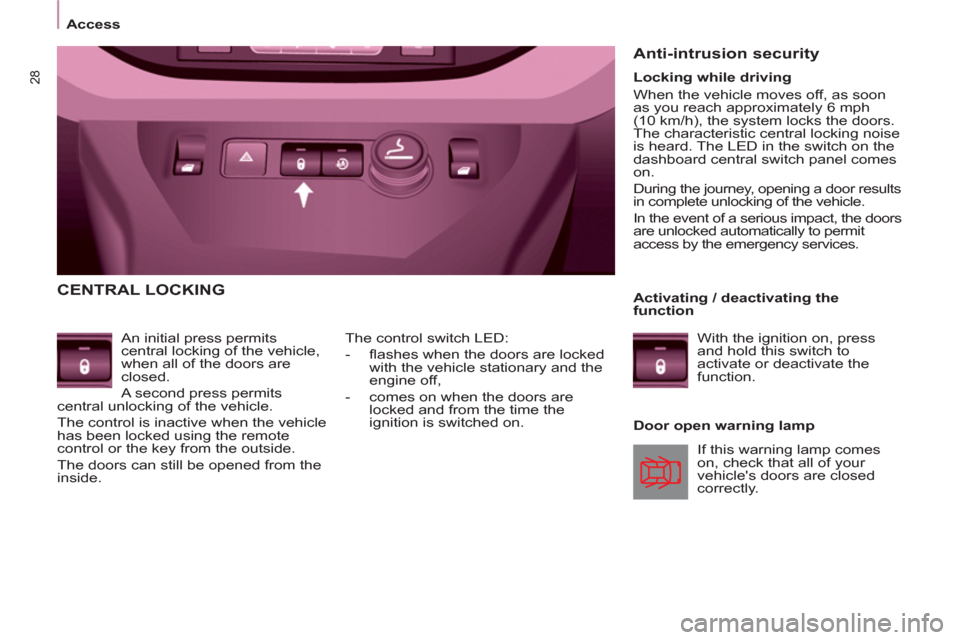
An initial press permits
central locking of the vehicle,
when all of the doors are
closed.
A second press permits
central unlocking of the vehicle.
The control is inactive when the vehicle
has been locked using the remote
control or the key from the outside.
The doors can still be opened from the
inside.
Door open warning lamp
The control switch LED:
- fl ashes when the doors are locked
with the vehicle stationary and the
engine off,
- comes on when the doors are
locked and from the time the
ignition is switched on.
Anti-intrusion security
If this warning lamp comes
on, check that all of your
vehicle's doors are closed
correctly.
Locking while driving
When the vehicle moves off, as soon
as you reach approximately 6 mph
(10 km/h), the system locks the doors.
The characteristic central locking noise
is heard. The LED in the switch on the
dashboard central switch panel comes
on.
During the journey, opening a door results
in complete unlocking of the vehicle.
In the event of a serious impact, the doors
are unlocked automatically to permit
access by the emergency services.
Activating / deactivating the
function
With the ignition on, press
and hold this switch to
activate or deactivate the
function.
Page 31 of 240
READY TO SET OFF
22
Instruments and controls
INSTRUMENT PANEL
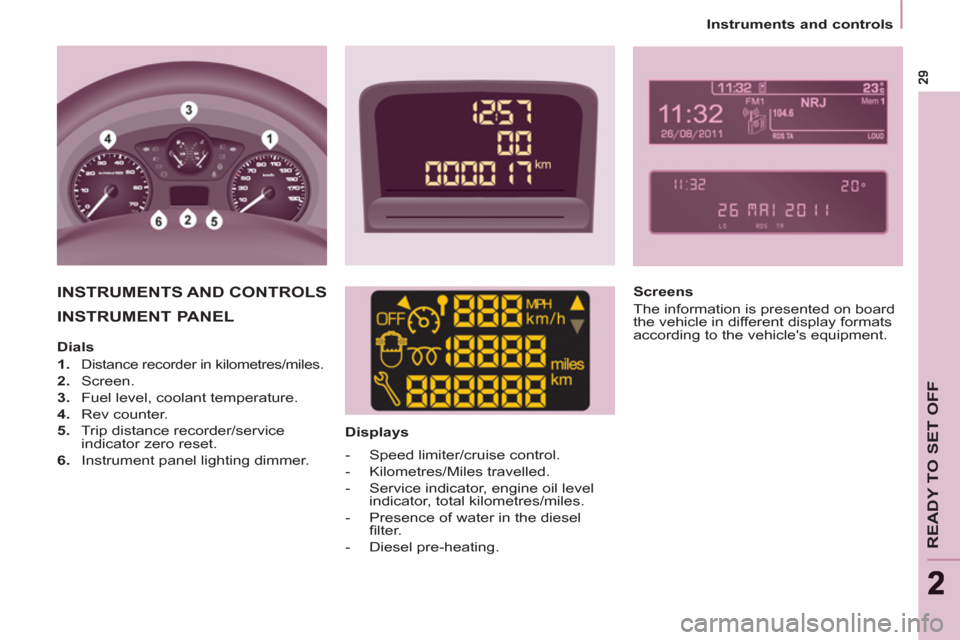
Displays
INSTRUMENTS AND CONTROLS
Screens
The information is presented on board
the vehicle in different display formats
according to the vehicle's equipment.
Dials
1.
Distance recorder in kilometres/miles.
2. Screen.
3. Fuel level, coolant temperature.
4. Rev counter.
5. Trip distance recorder/service
indicator zero reset.
6. Instrument panel lighting dimmer.
- Speed limiter/cruise control.
- Kilometres/Miles travelled.
- Service indicator, engine oil level
indicator, total kilometres/miles.
- Presence of water in the diesel
fi lter.
- Diesel pre-heating.
Page 33 of 240
READY TO SET OFF
22
Instruments and controls
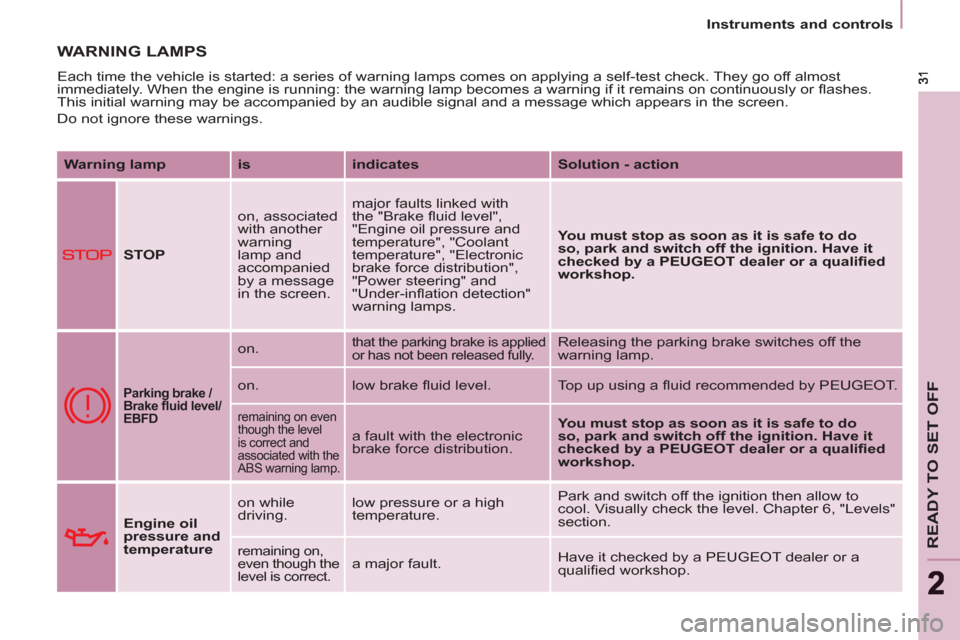
WARNING LAMPS
Each time the vehicle is started: a series of warning lamps comes on applying a self-test check. They go off almost
immediately. When the engine is running: the warning lamp becomes a warning if it remains on continuously or fl ashes.
This initial warning may be accompanied by an audible signal and a message which appears in the screen.
Do not ignore these warnings.
Warning lamp
is
indicates
Solution - action
STOP
on, associated
with another
warning
lamp and
accompanied
by a message
in the screen. major faults linked with
the "Brake fl uid level",
"Engine oil pressure and
temperature", "Coolant
temperature", "Electronic
brake force distribution",
"Power steering" and
"Under-infl ation detection"
warning lamps.
You must stop as soon as it is safe to do
so, park and switch off the ignition. Have it
checked by a
PEUGEOT
dealer or a qualifi ed
workshop.
Parking brake /
Brake fl uid level/
EBFD
on.
that the parking brake is applied
or has not been released fully. Releasing the parking brake switches off the
warning lamp.
on. low brake fl uid level. Top up using a fl uid recommended by PEUGEOT.
remaining on even
though the level
is correct and
associated with the
ABS warning lamp.
a fault with the electronic
brake force distribution.
You must stop as soon as it is safe to do
so, park and switch off the ignition.
Have it
checked by a PEUGEOT dealer or a qualifi ed
workshop.
Engine oil
pressure and
temperature
on while
driving. low pressure or a high
temperature. Park and switch off the ignition then allow to
cool. Visually check the level. Chapter 6, "Levels"
section.
remaining on,
even though the
level is correct. a major fault. Have it checked by a PEUGEOT dealer or a
qualifi ed workshop.
Page 34 of 240
32
Instruments and controls
Warning lamp
is
indicates
Solution - action
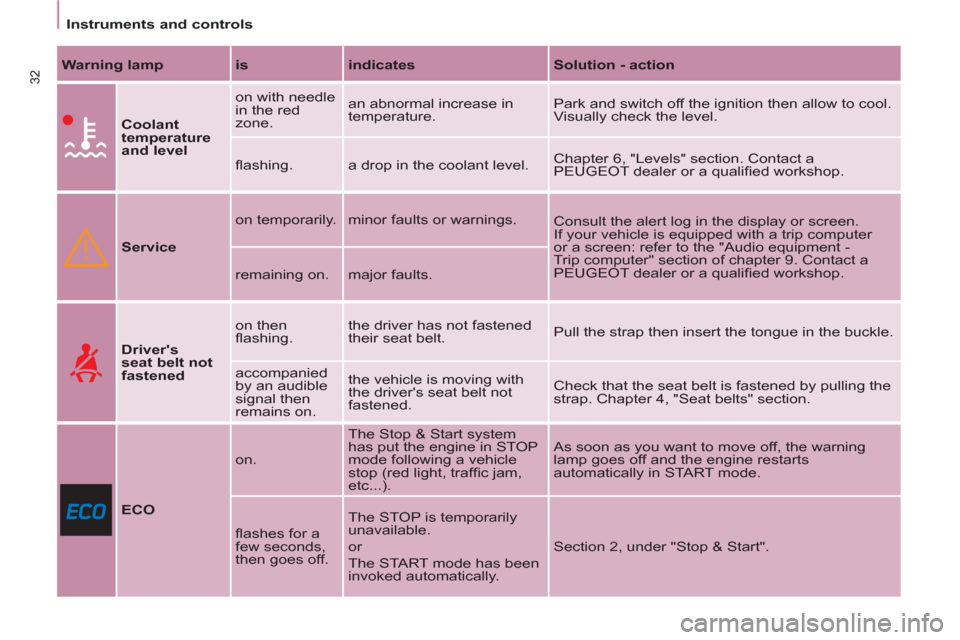
Coolant
temperature
and level
on with needle
in the red
zone. an abnormal increase in
temperature. Park and switch off the ignition then allow to cool.
Visually check the level.
fl ashing. a drop in the coolant level. Chapter 6, "Levels" section. Contact a
PEUGEOT dealer or a qualifi ed workshop.
Service
on temporarily. minor faults or warnings.
Consult the alert log in the display or screen.
If your vehicle is equipped with a trip computer
or a screen: refer to the "Audio equipment -
Trip computer" section of chapter 9. Contact a
PEUGEOT dealer or a qualifi ed workshop.
remaining on. major faults.
Driver's
seat belt not
fastened
on then
fl ashing. the driver has not fastened
their seat belt. Pull the strap then insert the tongue in the buckle.
accompanied
by an audible
signal then
remains on. the vehicle is moving with
the driver's seat belt not
fastened. Check that the seat belt is fastened by pulling the
strap. Chapter 4, "Seat belts" section.
ECO
on. The Stop & Start system
has put the engine in STOP
mode following a vehicle
stop (red light, traffi c jam,
etc...). As soon as you want to move off, the warning
lamp goes off and the engine restarts
automatically in START mode.
fl ashes for a
few seconds,
then goes off. The STOP is temporarily
unavailable.
or
The START mode has been
invoked automatically. Section 2, under "Stop & Start".
Page 39 of 240
37
READY TO SET OFF
22
Instruments and controls
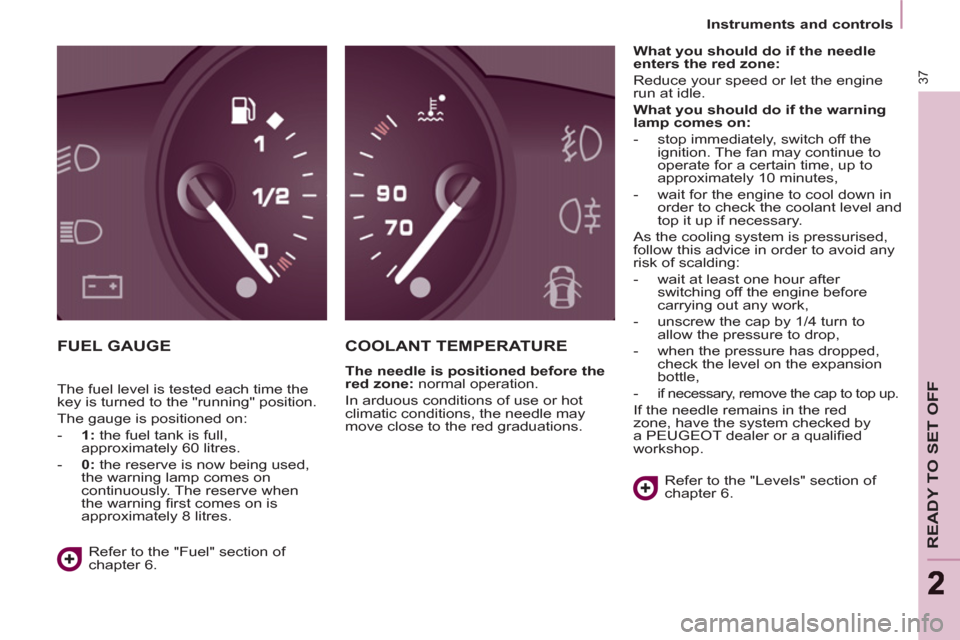
FUEL GAUGE COOLANT TEMPERATURE
The needle is positioned before the
red zone:
normal operation.
In arduous conditions of use or hot
climatic conditions, the needle may
move close to the red graduations.
What you should do if the needle
enters the red zone:
Reduce your speed or let the engine
run at idle.
What you should do if the warning
lamp comes on:
- stop immediately, switch off the
ignition. The fan may continue to
operate for a certain time, up to
approximately 10 minutes,
- wait for the engine to cool down in
order to check the coolant level and
top it up if necessary.
As the cooling system is pressurised,
follow this advice in order to avoid any
risk of scalding:
- wait at least one hour after
switching off the engine before
carrying out any work,
- unscrew the cap by 1/4 turn to
allow the pressure to drop,
- when the pressure has dropped,
check the level on the expansion
bottle,
-
if necessary, remove the cap to top up.
If the needle remains in the red
zone, have the system checked by
a PEUGEOT dealer or a qualifi ed
workshop.
Refer to the "Levels" section of
chapter 6.
Refer to the "Fuel" section of
chapter 6. The fuel level is tested each time the
key is turned to the "running" position.
The gauge is positioned on:
- 1: the fuel tank is full,
approximately 60 litres.
- 0: the reserve is now being used,
the warning lamp comes on
continuously. The reserve when
the warning fi rst comes on is
approximately 8 litres.