parking brake Peugeot Partner Tepee 2013 Owner's Manual
[x] Cancel search | Manufacturer: PEUGEOT, Model Year: 2013, Model line: Partner Tepee, Model: Peugeot Partner Tepee 2013Pages: 268, PDF Size: 9.88 MB
Page 4 of 268
2
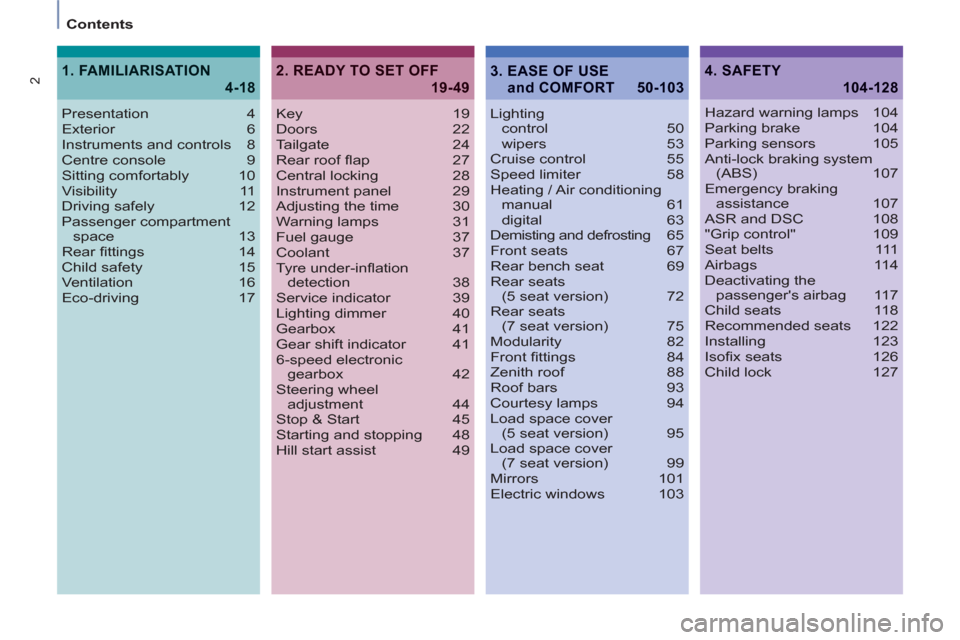
Contents
Key 19
Doors 22
Tailgate 24
Rear roof fl ap 27
Central locking 28
Instrument panel 29
Adjusting the time 30
Warning lamps 31
Fuel gauge 37
Coolant 37
Tyre under-infl ation
detection 38
Service indicator 39
Lighting dimmer 40
Gearbox 41
Gear shift indicator 41
6-speed electronic
gearbox 42
Steering wheel
adjustment 44
Stop & Start 45
Starting and stopping 48
Hill start assist 49Lighting
control 50
wipers 53
Cruise control 55
Speed limiter 58
Heating / Air conditioning
manual 61
digital 63
Demisting and defrosting 65
Front seats 67
Rear bench seat 69
Rear seats
(5 seat version) 72
Rear seats
(7 seat version) 75
Modularity 82
Front fi ttings 84
Zenith roof 88
Roof bars 93
Courtesy lamps 94
Load space cover
(5 seat version) 95
Load space cover
(7 seat version) 99
Mirrors 101
Electric windows 103
2. READY TO SET OFF
19-49
4. SAFETY
104-128
Presentation 4
Exterior 6
Instruments and controls 8
Centre console 9
Sitting comfortably 10
Visibility 11
Driving safely 12
Passenger compartment
space 13
Rear fi ttings 14
Child safety 15
Ventilation 16
Eco-driving 17
1. FAMILIARISATION
4-18
Hazard warning lamps 104
Parking brake 104
Parking sensors 105
Anti-lock braking system
(ABS) 107
Emergency braking
assistance 107
ASR and DSC 108
"Grip control" 109
Seat belts 111
Airbags 114
Deactivating the
passenger's airbag 117
Child seats 118
Recommended seats 122
Installing 123
Isofi x seats 126
Child lock 127
3. EASE OF USE
and COMFORT 50-103
Page 14 of 268
3
29
3
9
4
12
Interior
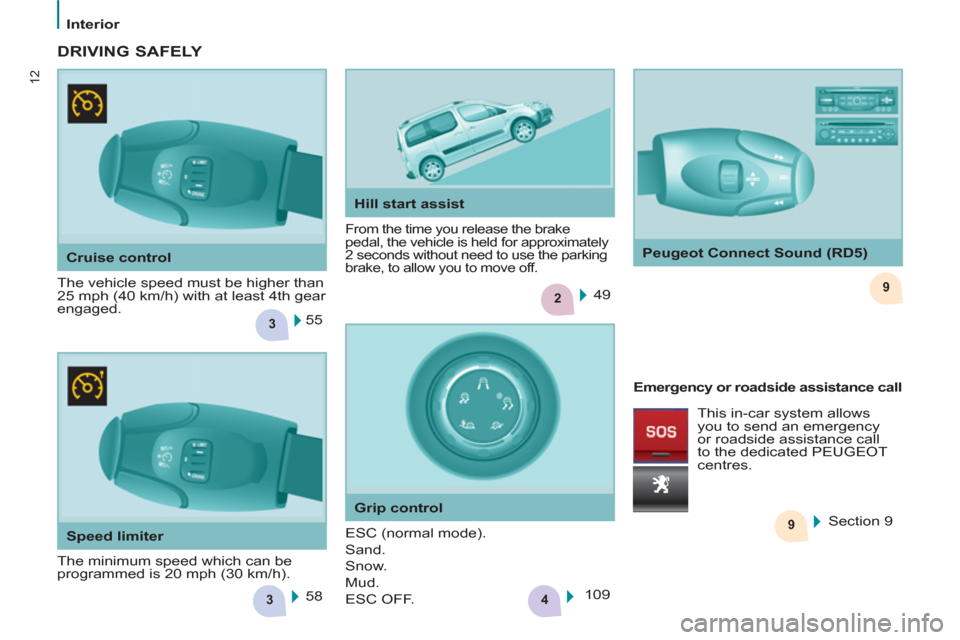
Cruise control
The vehicle speed must be higher than
25 mph (40 km/h) with at least 4th gear
engaged.
From the time you release the brake
pedal, the vehicle is held for approximately
2 seconds without need to use the parking
brake, to allow you to move off.
55 49
DRIVING SAFELY
The minimum speed which can be
programmed is 20 mph (30 km/h).
58
Emergency or roadside assistance call
Section 9
Hill start assist
Peugeot Connect Sound (RD5)
Grip control
Speed limiter This in-car system allows
you to send an emergency
or roadside assistance call
to the dedicated PEUGEOT
centres.
ESC (normal mode).
Sand.
Snow.
Mud.
ESC OFF. 109
Page 33 of 268
READY TO SET OFF
22
Instruments and controls
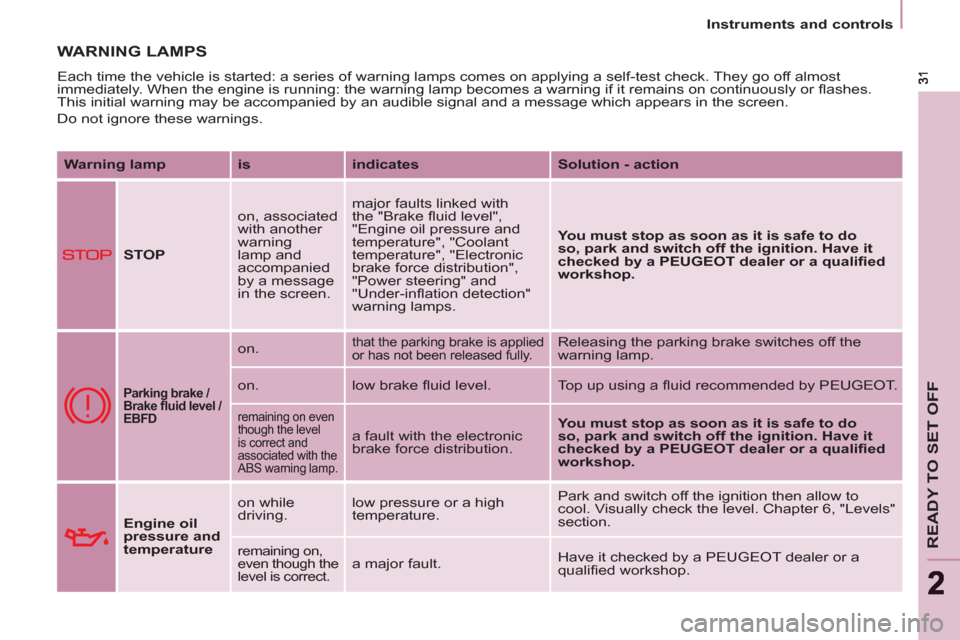
WARNING LAMPS
Each time the vehicle is started: a series of warning lamps comes on applying a self-test check. They go off almost
immediately. When the engine is running: the warning lamp becomes a warning if it remains on continuously or fl ashes.
This initial warning may be accompanied by an audible signal and a message which appears in the screen.
Do not ignore these warnings.
Warning lamp
is
indicates
Solution - action
STOP
on, associated
with another
warning
lamp and
accompanied
by a message
in the screen. major faults linked with
the "Brake fl uid level",
"Engine oil pressure and
temperature", "Coolant
temperature", "Electronic
brake force distribution",
"Power steering" and
"Under-infl ation detection"
warning lamps.
You must stop as soon as it is safe to do
so, park and switch off the ignition. Have it
checked by a
PEUGEOT
dealer or a qualifi ed
workshop.
Parking brake /
Brake fl uid level /
EBFD
on.
that the parking brake is applied
or has not been released fully. Releasing the parking brake switches off the
warning lamp.
on. low brake fl uid level. Top up using a fl uid recommended by PEUGEOT.
remaining on even
though the level
is correct and
associated with the
ABS warning lamp.
a fault with the electronic
brake force distribution.
You must stop as soon as it is safe to do
so, park and switch off the ignition. Have it
checked by a PEUGEOT dealer or a qualifi ed
workshop.
Engine oil
pressure and
temperature
on while
driving. low pressure or a high
temperature. Park and switch off the ignition then allow to
cool. Visually check the level. Chapter 6, "Levels"
section.
remaining on,
even though the
level is correct. a major fault. Have it checked by a PEUGEOT dealer or a
qualifi ed workshop.
Page 46 of 268
44
Gearbox and steering wheel
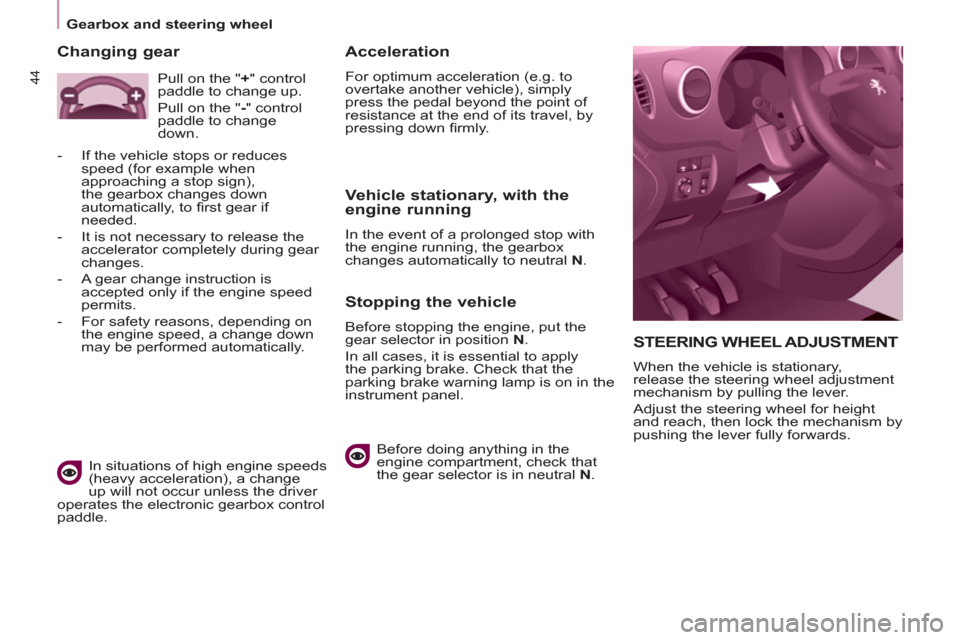
STEERING WHEEL ADJUSTMENT
When the vehicle is stationary,
release the steering wheel adjustment
mechanism by pulling the lever.
Adjust the steering wheel for height
and reach, then lock the mechanism by
pushing the lever fully forwards.
Acceleration
For optimum acceleration (e.g. to
overtake another vehicle), simply
press the pedal beyond the point of
resistance at the end of its travel, by
pressing down fi rmly.
Vehicle stationary, with the
engine running
In the event of a prolonged stop with
the engine running, the gearbox
changes automatically to neutral N
.
Stopping the vehicle
Before stopping the engine, put the
gear selector in position N
.
In all cases, it is essential to apply
the parking brake. Check that the
parking brake warning lamp is on in the
instrument panel.
Before doing anything in the
engine compartment, check that
the gear selector is in neutral N
.
Changing gear
In situations of high engine speeds
(heavy acceleration), a change
up will not occur unless the driver
operates the electronic gearbox control
paddle. Pull on the " +
" control
paddle to change up.
Pull on the " -
" control
paddle to change
down.
- If the vehicle stops or reduces
speed (for example when
approaching a stop sign),
the gearbox changes down
automatically, to fi rst gear if
needed.
- It is not necessary to release the
accelerator completely during gear
changes.
- A gear change instruction is
accepted only if the engine speed
permits.
- For safety reasons, depending on
the engine speed, a change down
may be performed automatically.
Page 47 of 268
45
READY TO SET OFF
22
Stop & Start
STOP & START
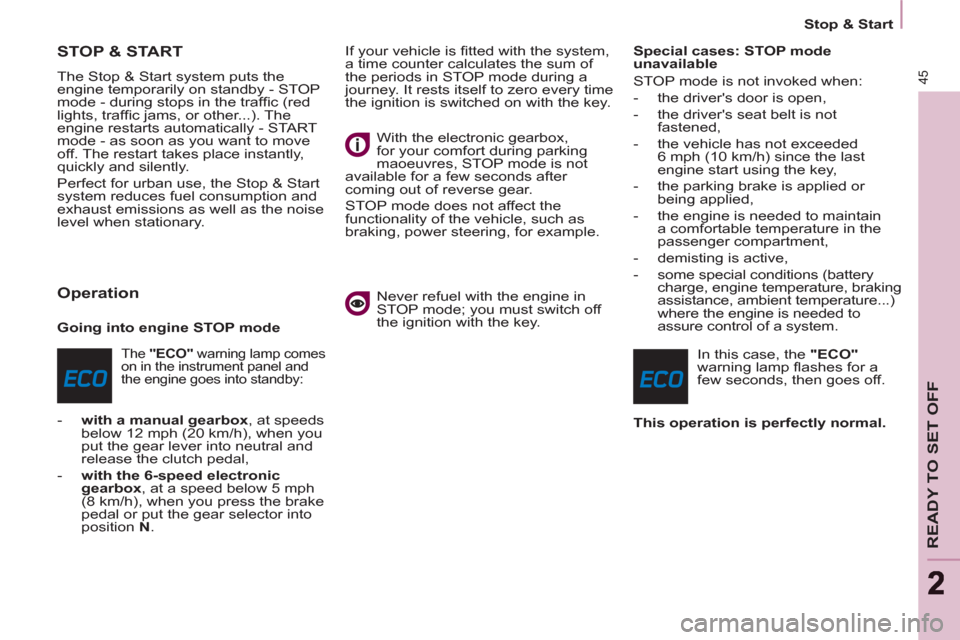
The Stop & Start system puts the
engine temporarily on standby - STOP
mode - during stops in the traffi c (red
lights, traffi c jams, or other...). The
engine restarts automatically - START
mode - as soon as you want to move
off. The restart takes place instantly,
quickly and silently.
Perfect for urban use, the Stop & Start
system reduces fuel consumption and
exhaust emissions as well as the noise
level when stationary.
Operation
Going into engine STOP mode
The "ECO"
warning lamp comes
on in the instrument panel and
the engine goes into standby:
- with a manual gearbox
, at speeds
below 12 mph (20 km/h), when you
put the gear lever into neutral and
release the clutch pedal,
- with the 6-speed electronic
gearbox
, at a speed below 5 mph
(8 km/h), when you press the brake
pedal or put the gear selector into
position N
. If your vehicle is fi tted with the system,
a time counter calculates the sum of
the periods in STOP mode during a
journey. It rests itself to zero every time
the ignition is switched on with the key.
With the electronic gearbox,
for your comfort during parking
maoeuvres, STOP mode is not
available for a few seconds after
coming out of reverse gear.
STOP mode does not affect the
functionality of the vehicle, such as
braking, power steering, for example.
Never refuel with the engine in
STOP mode; you must switch off
the ignition with the key.
Special cases: STOP mode
unavailable
STOP mode is not invoked when:
- the driver's door is open,
- the driver's seat belt is not
fastened,
- the vehicle has not exceeded
6 mph (10 km/h) since the last
engine start using the key,
- the parking brake is applied or
being applied,
- the engine is needed to maintain
a comfortable temperature in the
passenger compartment,
- demisting is active,
- some special conditions (battery
charge, engine temperature, braking
assistance, ambient temperature...)
where the engine is needed to
assure control of a system.
In this case, the "ECO"
warning lamp fl ashes for a
few seconds, then goes off.
This operation is perfectly normal.
Page 48 of 268
46
Stop & Start
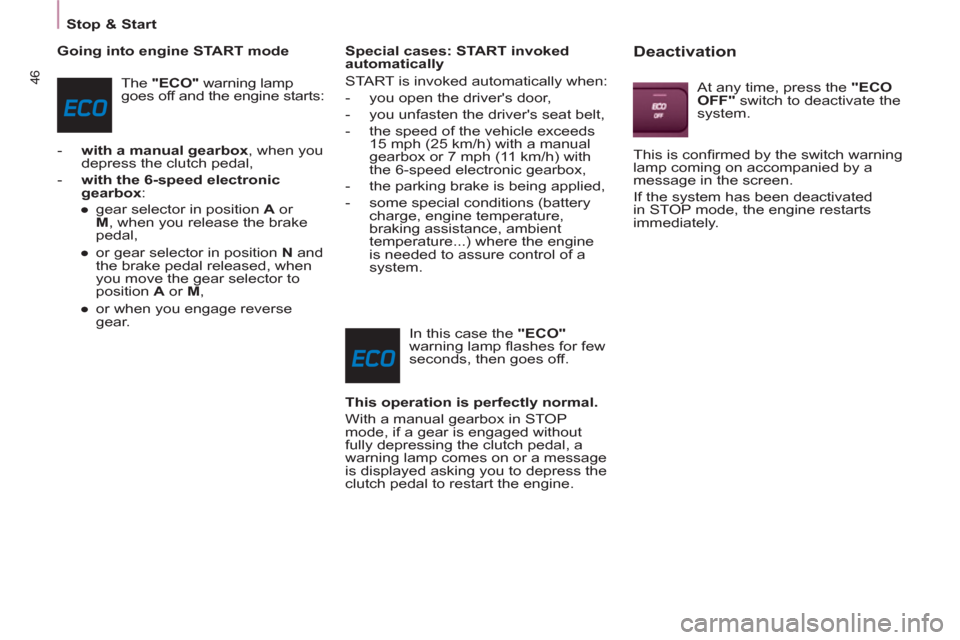
Going into engine START mode
The "ECO"
warning lamp
goes off and the engine starts:
- with a manual gearbox
, when you
depress the clutch pedal,
- with the 6-speed electronic
gearbox
:
●
gear selector in position A
or
M
, when you release the brake
pedal,
●
or gear selector in position N
and
the brake pedal released, when
you move the gear selector to
position A
or M
,
●
or when you engage reverse
gear.
Special cases: START invoked
automatically
START is invoked automatically when:
- you open the driver's door,
- you unfasten the driver's seat belt,
- the speed of the vehicle exceeds
15 mph (25 km/h) with a manual
gearbox or 7 mph (11 km/h) with
the 6-speed electronic gearbox,
- the parking brake is being applied,
- some special conditions (battery
charge, engine temperature,
braking assistance, ambient
temperature...) where the engine
is needed to assure control of a
system.
In this case the "ECO"
warning lamp fl ashes for few
seconds, then goes off.
This operation is perfectly normal.
With a manual gearbox in STOP
mode, if a gear is engaged without
fully depressing the clutch pedal, a
warning lamp comes on or a message
is displayed asking you to depress the
clutch pedal to restart the engine.
Deactivation
At any time, press the "ECO
OFF"
switch to deactivate the
system.
This is confi rmed by the switch warning
lamp coming on accompanied by a
message in the screen.
If the system has been deactivated
in STOP mode, the engine restarts
immediately.
Page 51 of 268
49
READY TO SET OFF
22
Starting and stopping
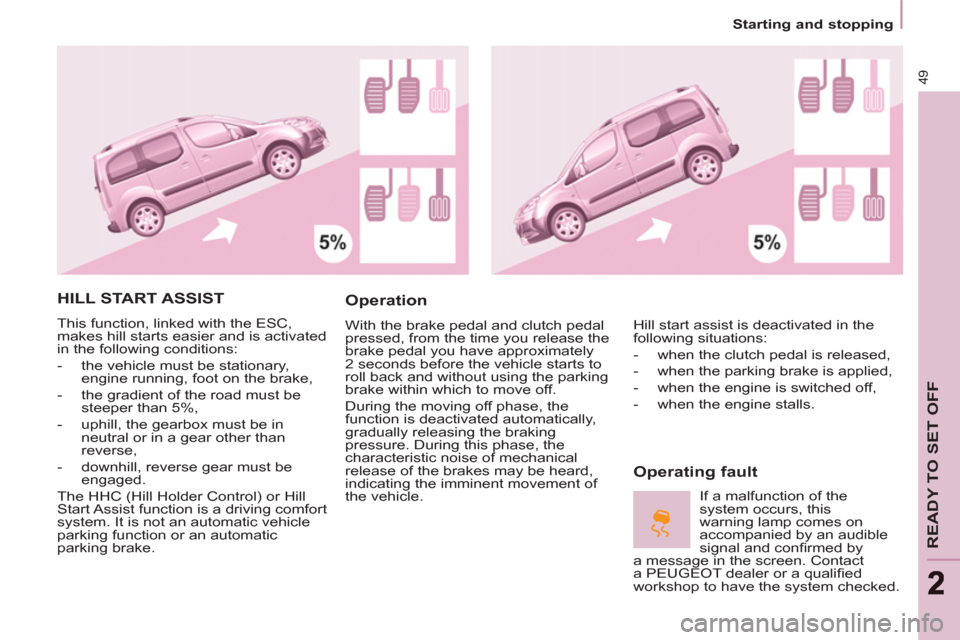
HILL START ASSIST
This function, linked with the ESC,
makes hill starts easier and is activated
in the following conditions:
- the vehicle must be stationary,
engine running, foot on the brake,
- the gradient of the road must be
steeper than 5%,
- uphill, the gearbox must be in
neutral or in a gear other than
reverse,
- downhill, reverse gear must be
engaged.
The HHC (Hill Holder Control) or Hill
Start Assist function is a driving comfort
system. It is not an automatic vehicle
parking function or an automatic
parking brake.
Operation
With the brake pedal and clutch pedal
pressed, from the time you release the
brake pedal you have approximately
2 seconds before the vehicle starts to
roll back and without using the parking
brake within which to move off.
During the moving off phase, the
function is deactivated automatically,
gradually releasing the braking
pressure. During this phase, the
characteristic noise of mechanical
release of the brakes may be heard,
indicating the imminent movement of
the vehicle.
Operating fault
Hill start assist is deactivated in the
following situations:
- when the clutch pedal is released,
- when the parking brake is applied,
- when the engine is switched off,
- when the engine stalls.
If a malfunction of the
system occurs, this
warning lamp comes on
accompanied by an audible
signal and confi rmed by
a message in the screen. Contact
a PEUGEOT dealer or a qualifi ed
workshop to have the system checked.
Page 106 of 268
104
Driving safely
DRIVING SAFELY
HORN
Press the centre of the steering wheel.
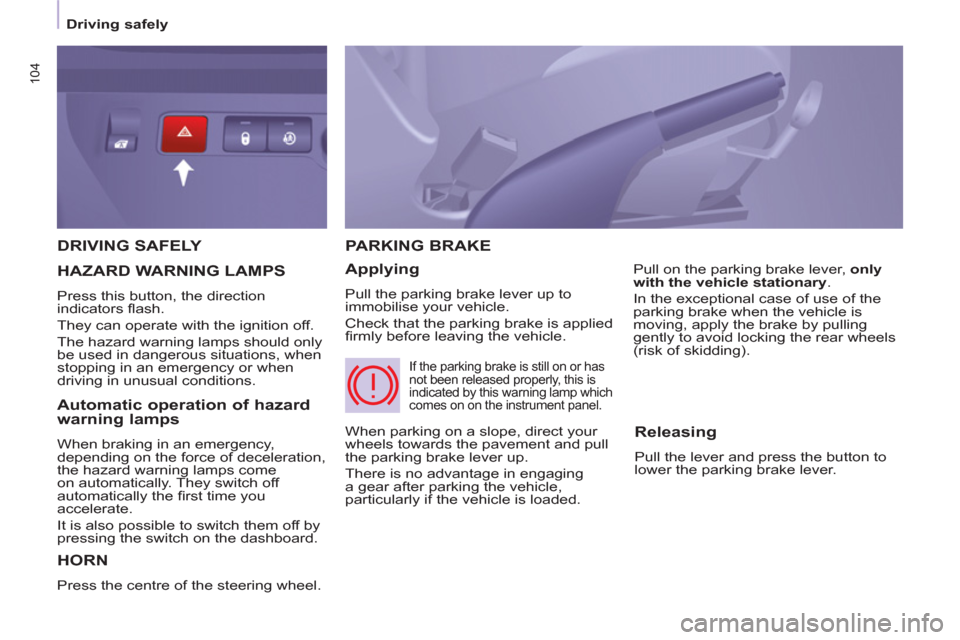
PARKING BRAKE
Applying
Pull the parking brake lever up to
immobilise your vehicle.
Check that the parking brake is applied
fi rmly before leaving the vehicle.
Pull on the parking brake lever, only
with the vehicle stationary
.
In the exceptional case of use of the
parking brake when the vehicle is
moving, apply the brake by pulling
gently to avoid locking the rear wheels
(risk of skidding).
HAZARD WARNING LAMPS
Press this button, the direction
indicators fl ash.
They can operate with the ignition off.
The hazard warning lamps should only
be used in dangerous situations, when
stopping in an emergency or when
driving in unusual conditions.
When parking on a slope, direct your
wheels towards the pavement and pull
the parking brake lever up.
There is no advantage in engaging
a gear after parking the vehicle,
particularly if the vehicle is loaded.
If the parking brake is still on or has
not been released properly, this is
indicated by this warning lamp which
comes on on the instrument panel.
Automatic operation of hazard
warning lamps
When braking in an emergency,
depending on the force of deceleration,
the hazard warning lamps come
on automatically. They switch off
automatically the fi rst time you
accelerate.
It is also possible to switch them off by
pressing the switch on the dashboard.
Releasing
Pull the lever and press the button to
lower the parking brake lever.
Page 132 of 268
130
Towing a trailer
Good Practice
In certain cases of particularly arduous
use (towing the maximum load up a
steep slope in high temperatures), the
engine automatically limits its power.
In this case, the air conditioning is
automatically cut off to save engine
power.
Tyres
Check the tyre pressures of the
towing vehicle (see the "Identifi cation
markings" section of chapter 8) and of
the trailer, observing the recommended
pressures. See the "Levels" section of
chapter 6. If the coolant temperature
warning lamp comes on, stop
the vehicle and switch off the
engine as soon as possible.
Brakes
Towing increases the braking distance.
Drive at a moderate speed, change
down early and brake gradually.
Towbar
We recommend the use of genuine
PEUGEOT towbars and their
harnesses, which have been tested
and approved from the design stage of
your vehicle, and that you entrust the
fi tting of this equipment to a PEUGEOT
dealer.
If this equipment is not fi tted by a
PEUGEOT dealer, it is imperative that
it is fi tted using the electrical pre-
equipment installed at the rear of the
vehicle and in accordance with the
manufacturer's instructions.
In accordance with the general
instructions a reminder of which has
been given above, we draw your
attention to the risk associated with
fi tting a towbar or electrical accessory
not recommended by PEUGEOT.
Fitting such equipment could result in
the failure of your vehicle's electronic
system. Please obtain information from
the Manufacturer before fi tting this type
of equipment.
Side wind
Sensitivity to side wind is increased.
Drive smoothly and at a moderate
speed.
ABS/DSC
The ABS or DSC systems only control
the vehicle, not the trailer or caravan.
Rear parking sensors
The parking sensors system does not
function while the vehicle is towing.
Page 141 of 268
139
CHECK
S
6
Checks
CHECKS
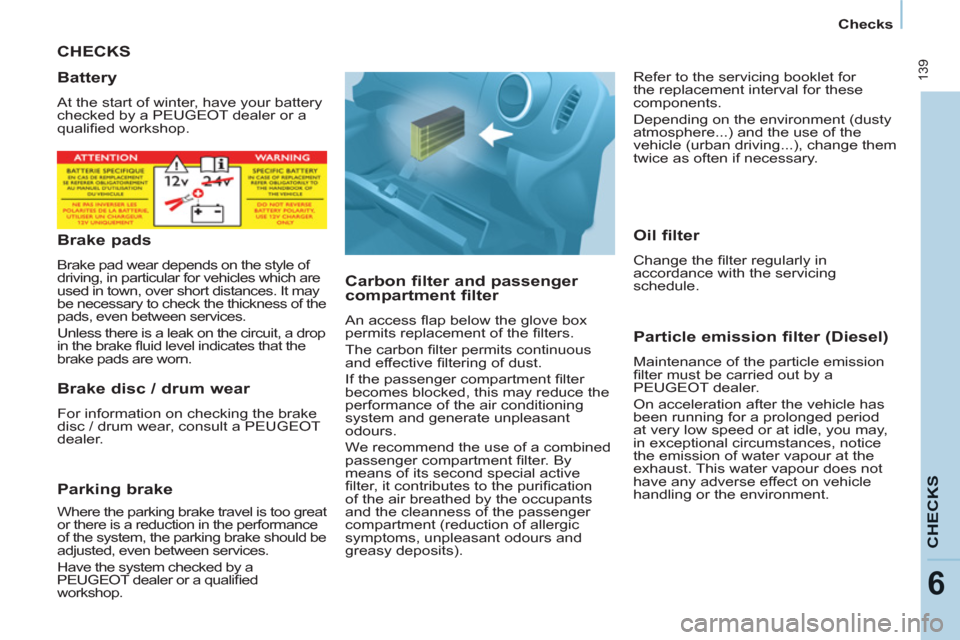
Carbon filter and passenger
compartment filter
An access fl ap below the glove box
permits replacement of the fi lters.
The carbon fi lter permits continuous
and effective fi ltering of dust.
If the passenger compartment fi lter
becomes blocked, this may reduce the
performance of the air conditioning
system and generate unpleasant
odours.
We recommend the use of a combined
passenger compartment fi lter. By
means of its second special active
fi lter, it contributes to the purifi cation
of the air breathed by the occupants
and the cleanness of the passenger
compartment (reduction of allergic
symptoms, unpleasant odours and
greasy deposits).
Particle emission filter (Diesel)
Maintenance of the particle emission
fi lter must be carried out by a
PEUGEOT dealer.
On acceleration after the vehicle has
been running for a prolonged period
at very low speed or at idle, you may,
in exceptional circumstances, notice
the emission of water vapour at the
exhaust. This water vapour does not
have any adverse effect on vehicle
handling or the environment.
Battery
At the start of winter, have your battery
checked by a PEUGEOT dealer or a
qualifi ed workshop.
Brake pads
Brake pad wear depends on the style of
driving, in particular for vehicles which are
used in town, over short distances. It may
be necessary to check the thickness of the
pads, even between services.
Unless there is a leak on the circuit, a drop
in the brake fl uid level indicates that the
brake pads are worn.
Brake disc / drum wear
For information on checking the brake
disc / drum wear, consult a PEUGEOT
dealer.
Parking brake
Where the parking brake travel is too great
or there is a reduction in the performance
of the system, the parking brake should be
adjusted, even between services.
Have the system checked by a
PEUGEOT dealer or a qualifi ed
workshop.
Oil filter
Change the fi lter regularly in
accordance with the servicing
schedule. Refer to the servicing booklet for
the replacement interval for these
components.
Depending on the environment (dusty
atmosphere...) and the use of the
vehicle (urban driving...), change them
twice as often if necessary.