ECO mode Peugeot Partner Tepee 2015 User Guide
[x] Cancel search | Manufacturer: PEUGEOT, Model Year: 2015, Model line: Partner Tepee, Model: Peugeot Partner Tepee 2015Pages: 276, PDF Size: 12.76 MB
Page 112 of 276
11 0
Partner_2_VP_en_Chap05_Securite_ed02-2014
ANTI-SLIP REGULATION (ASR)
AND DYNAMIC STABILITY
CONTROL (DSC)
these systems are linked and
complement the ABS.
t
he ASR system is very useful for
maintaining optimum drive and
avoiding losses of control of the vehicle
on acceleration.
t
he system optimises drive to prevent
the wheels skidding, by acting on the
brakes of the drive wheels and on the
engine. It also allows the directional
stability of the vehicle to be improved
on acceleration.
u
se the DSC to hold your course
without attempting to countersteer.
If there is a variation between the
trajectory followed by the vehicle and
that required by the driver, the DSC
system automatically acts on the
engine and the brake of one or more
wheels, in order to put the vehicle back
on course.
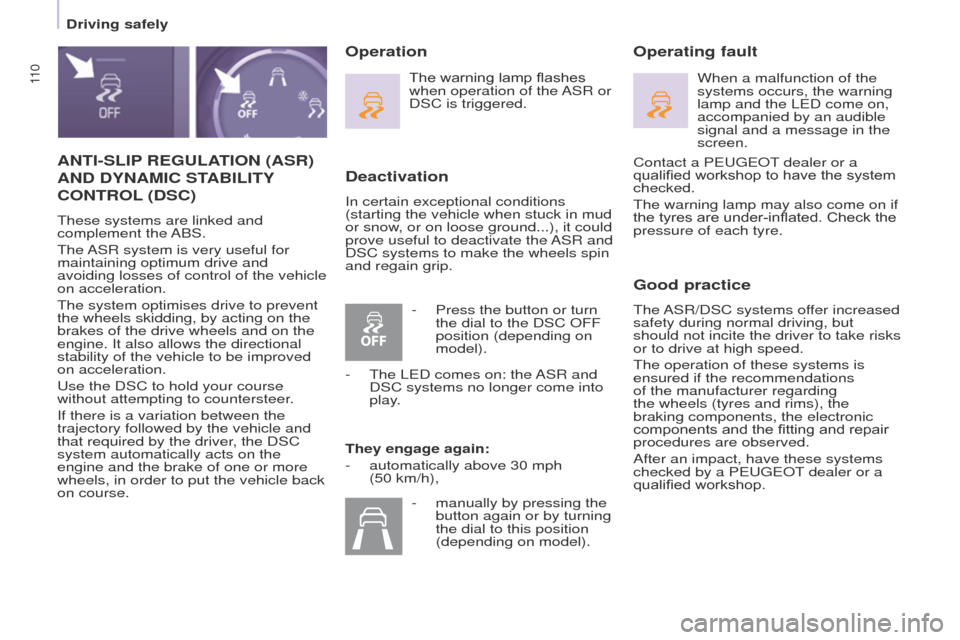
Deactivation
In certain exceptional conditions
(starting the vehicle when stuck in mud
or snow, or on loose ground...), it could
prove useful to deactivate the ASR and
DSC systems to make the wheels spin
and regain grip.
Operating fault
Good practice
the ASR/DSC systems offer increased
safety during normal driving, but
should not incite the driver to take risks
or to drive at high speed.
t
he operation of these systems is
ensured if the recommendations
of the manufacturer regarding
the wheels (tyres and rims), the
braking components, the electronic
components and the fitting and repair
procedures are observed.
After an impact, have these systems
checked by a P
euge O t
dealer or a
qualified workshop.
Operation
The warning lamp flashes
when operation of the ASR or
DSC is triggered.
They engage again:
-
automatically above 30 mph
(50 km/h), When a malfunction of the
systems occurs, the warning
lamp and the L
e D come on,
accompanied by an audible
signal and a message in the
screen.
-
Press the button or turn
the dial to the DSC OFF
position (depending on
model).
-
t
he L
e D comes on: the ASR and
DSC systems no longer come into
play.
-
manually by pressing the
button again or by turning
the dial to this position
(depending on model). Contact a P
euge O t
dealer or a
qualified workshop to have the system
checked.
t
he warning lamp may also come on if
the tyres are under-inflated. Check the
pressure of each tyre.
Driving safely
Page 114 of 276
11 2
Partner_2_VP_en_Chap05_Securite_ed02-2014
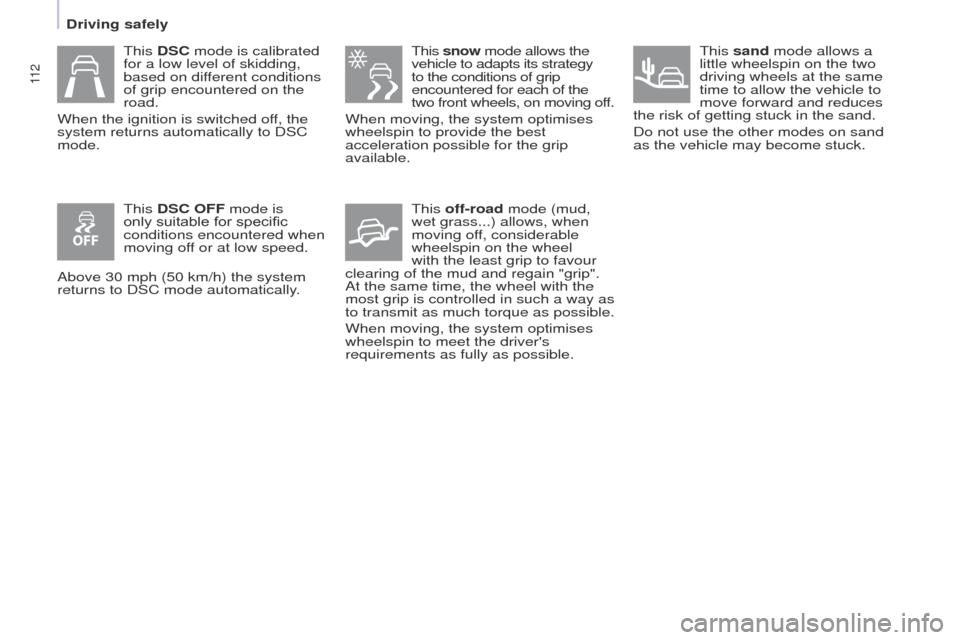
this DSC mode is calibrated
for a low level of skidding,
based on dif
ferent conditions
of grip encountered on the
road.
When the ignition is switched off, the
system returns automatically to DSC
mode.
t
his DSC OFF mode is
only suitable for specific
conditions encountered when
moving off or at low speed.
Above 30 mph (50 km/h) the system
returns to DSC mode automatically.t his snow mode allows the
vehicle to adapts its strategy
to the conditions of grip
encountered for each of the
two front wheels, on moving off.
When moving, the system optimises
wheelspin to provide the best
acceleration possible for the grip
available.
t
his off-road mode (mud,
wet grass...) allows, when
moving off, considerable
wheelspin on the wheel
with the least grip to favour
clearing of the mud and regain "grip".
At the same time, the wheel with the
most grip is controlled in such a way as
to transmit as much torque as possible.
When moving, the system optimises
wheelspin to meet the driver's
requirements as fully as possible.t his sand mode allows a
little wheelspin on the two
driving wheels at the same
time to allow the vehicle to
move forward and reduces
the risk of getting stuck in the sand.
Do not use the other modes on sand
as the vehicle may become stuck.
Driving safely
Page 138 of 276
136
Partner_2_VP_en_Chap06_Accessoire_ed02-2014
Good Practice
In certain cases of particularly arduous
use (towing the maximum load up a
steep slope in high temperatures), the
engine automatically limits its power.
In this case, the air conditioning is
automatically cut off to save engine
power.
Tyres
Check the tyre pressures of the towing
vehicle and of the trailer, observing the
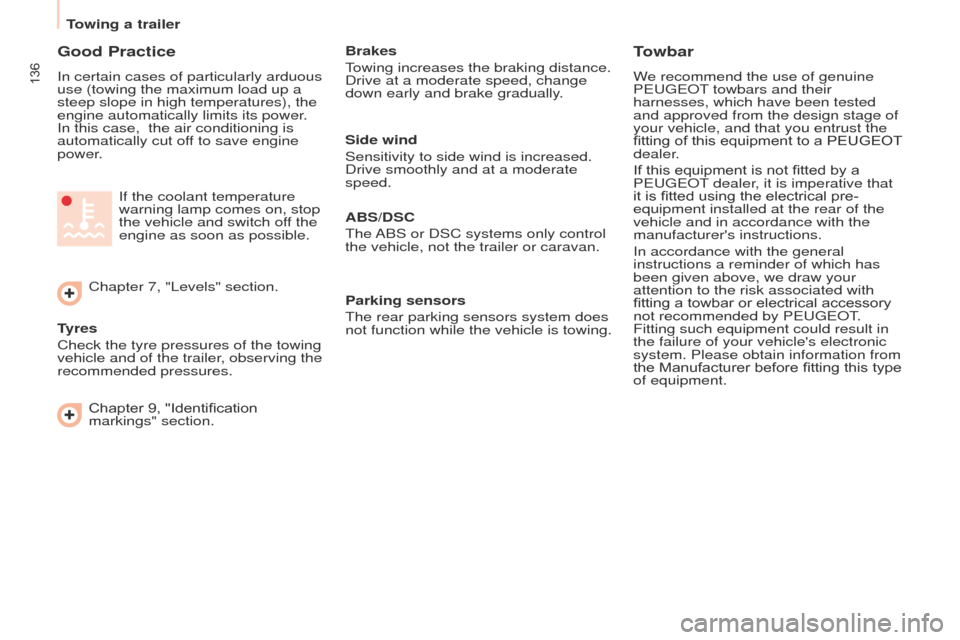
recommended pressures. Chapter 7, "Levels" section.If the coolant temperature
warning lamp comes on, stop
the vehicle and switch off the
engine as soon as possible. Brakestowing increases the braking distance.
Drive at a moderate speed, change
down early and brake gradually
.
Towbar
We recommend the use of genuine
Peuge O t towbars and their
harnesses, which have been tested
and approved from the design stage of
your vehicle, and that you entrust the
fitting of this equipment to a PEUGEOT
dealer.
If this equipment is not fitted by a
P
euge O t
dealer
, it is imperative that
it is fitted using the electrical pre-
equipment installed at the rear of the
vehicle and in accordance with the
manufacturer's instructions.
In accordance with the general
instructions a reminder of which has
been given above, we draw your
attention to the risk associated with
fitting a towbar or electrical accessory
not recommended by P
euge O t
.
Fitting such equipment could result in
the failure of your vehicle's electronic
system. Please obtain information from
the Manufacturer before fitting this type
of equipment.
Side wind
Sensitivity to side wind is increased.
Drive smoothly and at a moderate
speed.
ABS/DSC
t
he ABS or DSC systems only control
the vehicle, not the trailer or caravan.
Parking sensors
t
he rear parking sensors system does
not function while the vehicle is towing.
Chapter 9, "Identification
markings" section.
Towing a trailer
Page 160 of 276
158
Partner_2_VP_en_Chap08_Aide-rapide_ed02-2014
ECONOMY MODE
After the engine has stopped, with
the key in the ignition position, certain
functions (windscreen wiper, electric
windows, courtesy lamps, audio
equipment, etc.) can only be used for a
cumulative duration of thirty minutes, to
prevent discharging of the battery.
Once the thirty minutes are over, the
active functions are put on standby
and the battery warning lamp flashes
accompanied by a message in the
screen.
to resume the use of these functions
immediately
, start the engine and let it
run for a few minutes.
t
he time available will then be double
the time for which the engine was left
running. However, this time will always
be between five and thirty minutes.
A flat battery will prevent the
engine from starting.
Battery
Page 186 of 276
184
Partner_2_VP_en_Chap09_Caract-technique_ed02-2014
ENGINE CHARACTERISTICS
the engine characteristics (capacity,
maximum power , maximum power
speed, fuel, CO
2 emissions...) for your
vehicle are given in the registration
document.
t
hese characteristics correspond
to the values type-approved
on a test bed, under conditions
defined in European legislation
(Directive
1999/99/ e C).
For more information, refer to the
manufacturer's website or sales
brochure for the model. Contact
a PEUGEOT dealer or a qualified
workshop.
WEIGHTS AND TOWED LOADS
the weights and towable loads for your
vehicle can be found on the vehicle's
registration certificate.
t
hese values, expressed in kg, are
laos present on the manufacturer's
plate or label.
t
he kerb weight is equal to the weight
without load + driver (75 kg) + fuel tank
filled to 90%.
t
he gt W and towed load values
indicated are valid up to a maximum
altitude of 1000 metres.
t
he value of
the towed load mentioned must be
reduced by 10 % for each additional
1000 metres.
With load transfer, the braked trailer
weight can be increased, on condition
that the equivalent of this load is
removed from the vehicle so that the
gt
W is not exceeded. High ambient temperatures
may result in a reduction in the
performance of the vehicle in
order to protect the engine. When the
ambient temperature is higher than
37
°C, limit the towed weight.
towing with a lightly loaded
vehicle can adversely af
fect road
holding.
towing a trailer increases braking
distances.
When towing, the maximum permitted
speed is reduced (comply with the
legislation in force in the country).
t he recommended nose weight is
the downward force on the towball
(removable with or without tools).
GVW: gross vehicle weight, the
maximum authorised weight.
GTW: gross train weight, the maximum
weight for vehicle plus trailer.
Refer to chapter 9, "Identification
markings" section.
In each country, it is imperative that
the towed loads authorised by local
legislation are complied with. To find
out your vehicle's towing capacities
and its gross train weight, consult a
P
euge O t
dealer
.
Weights
Page 188 of 276
186
Partner_2_VP_en_Chap09_Caract-technique_ed02-2014
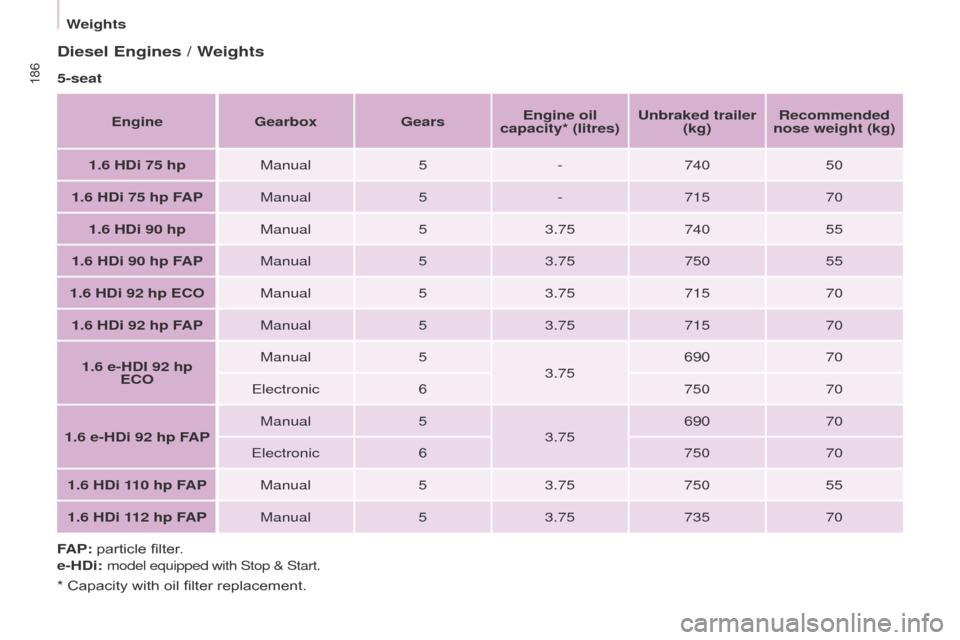
Diesel Engines / Weights
5-seatEngine Gearbox GearsEngine oil
capacity* (litres) Unbraked trailer
(kg) Recommended
nose weight (kg)
1.6 HDi 75 hp Manual5-740 50
1.6 HDi 75 hp FAP Manual5-715 70
1.6 HDi 90 hp Manual53.75 740 55
1.6 HDi 90 hp FAP Manual53.75 750 55
1.6 HDi 92 hp ECO Manual53.75 715 70
1.6 HDi 92 hp FAP Manual53.75 715 70
1.6 e-HDI 92 hp ECO Manual
5
3.75 690
70
e
lectronic6 75070
1.6 e-HDi 92 hp FAP Manual
5
3.75 690
70
e
lectronic6 75070
1.6 HDi 110 hp FAP Manual53.75 750 55
1.6 HDi 112 hp FAP Manual53.75 735 70
FAP: particle filter.
e-HDi:
model equipped with Stop & Start.
* Capacity with oil filter replacement.
Weights
Page 189 of 276
187
Partner_2_VP_en_Chap09_Caract-technique_ed02-2014
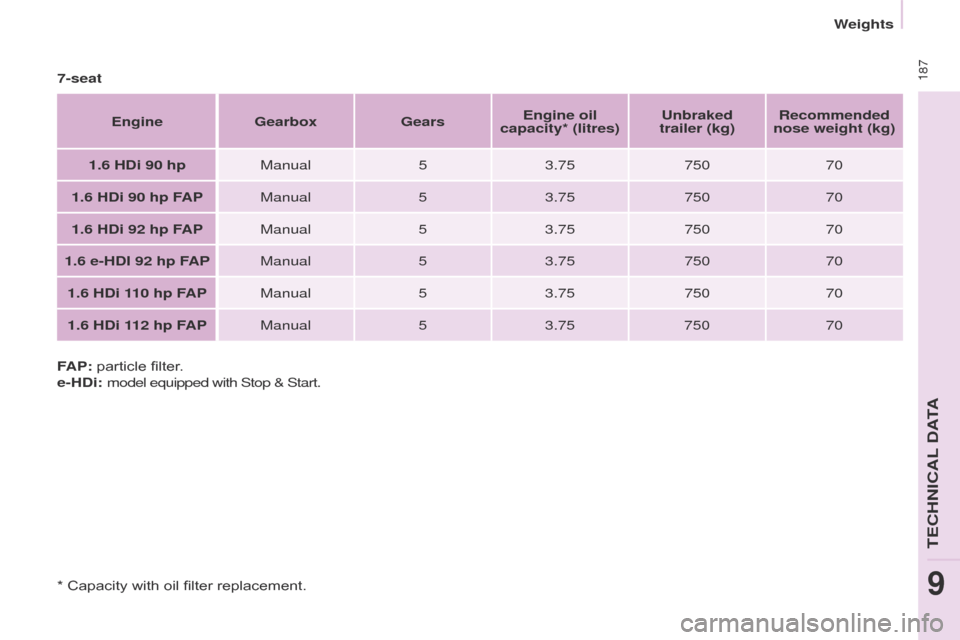
7-seatEngine Gearbox GearsEngine oil
capacity* (litres) Unbraked
trailer (kg) Recommended
nose weight (kg)
1.6 HDi 90 hp Manual53.75 750 70
1.6 HDi 90 hp FAP Manual53.75 750 70
1.6 HDi 92 hp FAP Manual53.75 750 70
1.6 e-HDI 92 hp FAP Manual53.75 750 70
1.6 HDi 110 hp FAP Manual53.75 750 70
1.6 HDi 112 hp FAP Manual53.75 750 70
FAP: particle filter.
e-HDi: model equipped with Stop & Start.
* Capacity with oil filter replacement.
teCHNICAL DAtA
9
Weights
Page 193 of 276
10.3
Partner_2_VP_en_Chap10b_RT6-2-8_ed02-2014
the system is protected in such a way that it will only
operate in your vehicle.
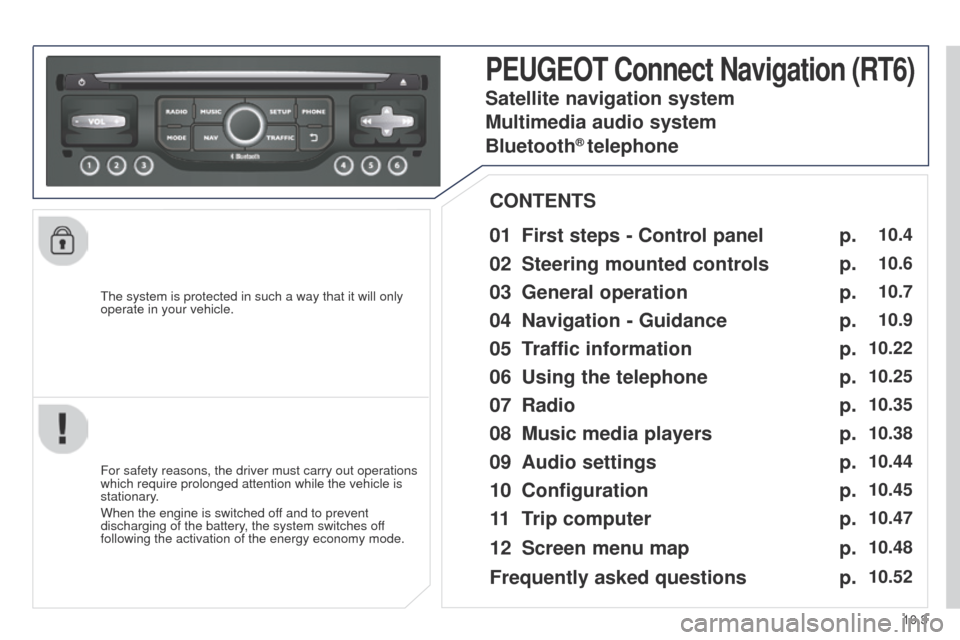
PEUGEOT Connect Navigation (RT6)
01 First steps - Control panel
For safety reasons, the driver must carry out operations
which require prolonged attention while the vehicle is
stationary.
When the engine is switched off and to prevent
discharging of the battery, the system switches off
following the activation of the energy economy mode.
CONTENTS
02
Steering mounted
controls
03
General operation
04
Navigation
- Guidance
05
T
raffic information
06
Using
the telephone
07
Radio
08
Music media players
09
Audio
settings
10
Configuration
11
T
rip computer
Satellite navigation system
Multimedia audio system
Bluetooth
® telephone
12
Screen menu
map
Frequently asked questions p.
p.
p.
p.
p.
p.
p.
p.
p.
p.
p.
p.
p.
10.4
10.6
10.7
10.9
10.22
10.25
10.35
10.38
10.44
10.45
10.47
10.48
10.52
Page 197 of 276
03
10.7
Partner_2_VP_en_Chap10b_RT6-2-8_ed02-2014
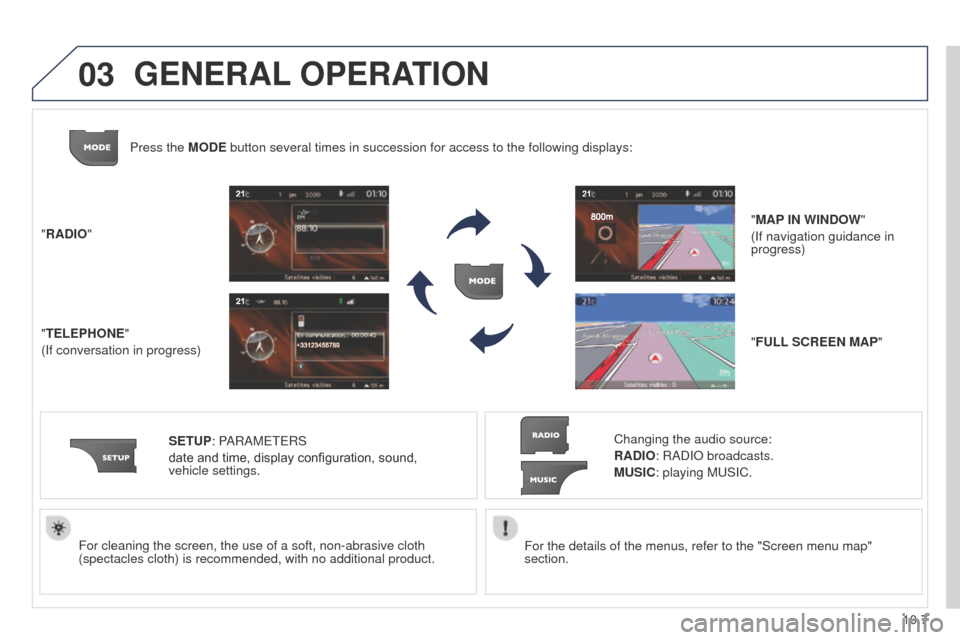
For the details of the menus, refer to the "Screen menu map"
section.
For cleaning the screen, the use of a soft, non-abrasive cloth
(spectacles cloth) is recommended, with no additional product.
"RADIO"
"TELEPHONE"
(If conversation in progress)
SETUP: PARAM
ete
RS
date and time, display configuration, sound,
vehicle
settings.
Changing the audio source:
RADIO: RADIO broadcasts.
MUSIC: playing Mu SIC.
Press the MODE button several times in succession for access to the following displays\
:
"FULL SCREEN MAP" "MAP IN WINDOW"
(If navigation guidance in
progress)
GENERAL OPERATION
Page 217 of 276
06
10.27
Partner_2_VP_en_Chap10b_RT6-2-8_ed02-2014
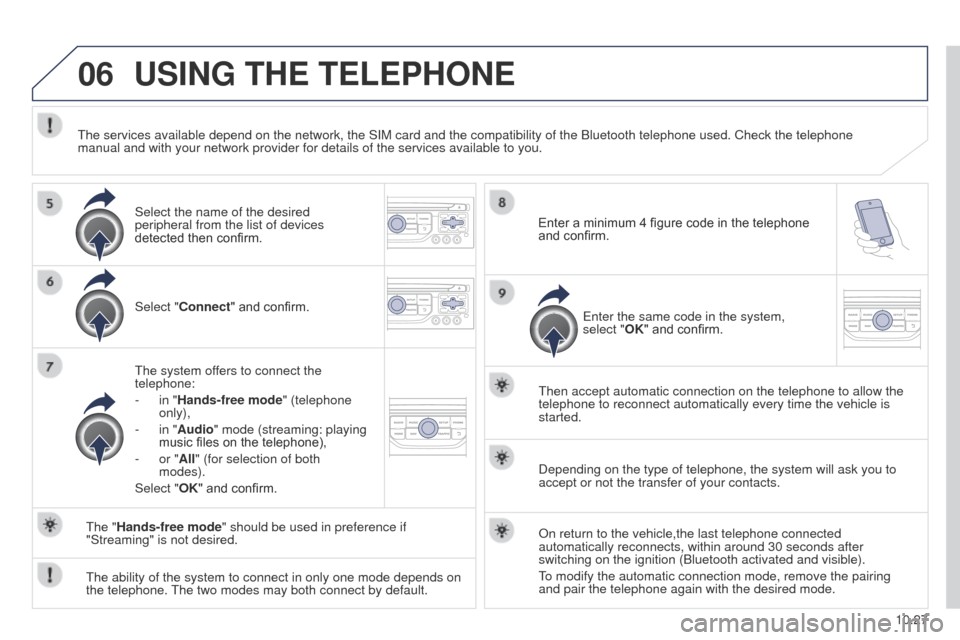
USING THE TELEPHONE
Select "Connect" and confirm.
t
he system offers to connect the
telephone:
-
in "
Hands-free mode" (telephone
only),
-
in "
Audio" mode (streaming: playing
music files on the telephone),
-
or "
All" (for selection of both
modes).
Select "OK" and confirm.
t
hen accept automatic connection on the telephone to allow the
telephone to reconnect automatically every time the vehicle is
started.
t
he ability of the system to connect in only one mode depends on
the telephone.
t
he two modes may both connect by default.
t
he "Hands-free mode" should be used in preference if
"Streaming" is not desired.
t
he services available depend on the network, the SIM card and the compat\
ibility of the Bluetooth telephone used. Check the telephone
manual and with your network provider for details of the services availa\
ble to you.
Depending on the type of telephone, the system will ask you to
accept or not the transfer of your contacts.
On return to the vehicle,the last telephone connected
automatically reconnects, within around 30 seconds after
switching on the ignition (Bluetooth activated and visible).
to modify the automatic connection mode, remove the pairing
and pair the telephone again with the desired mode.
Enter a minimum 4 figure code in the telephone
and confirm.
e
nter the same code in the system,
select "OK" and confirm.
Select the name of the desired
peripheral from the list of devices
detected then confirm.