ECU Peugeot Partner Tepee 2015 User Guide
[x] Cancel search | Manufacturer: PEUGEOT, Model Year: 2015, Model line: Partner Tepee, Model: Peugeot Partner Tepee 2015Pages: 276, PDF Size: 12.76 MB
Page 89 of 276
87
Partner_2_VP_en_Chap04_ergonomie_ed02-2014
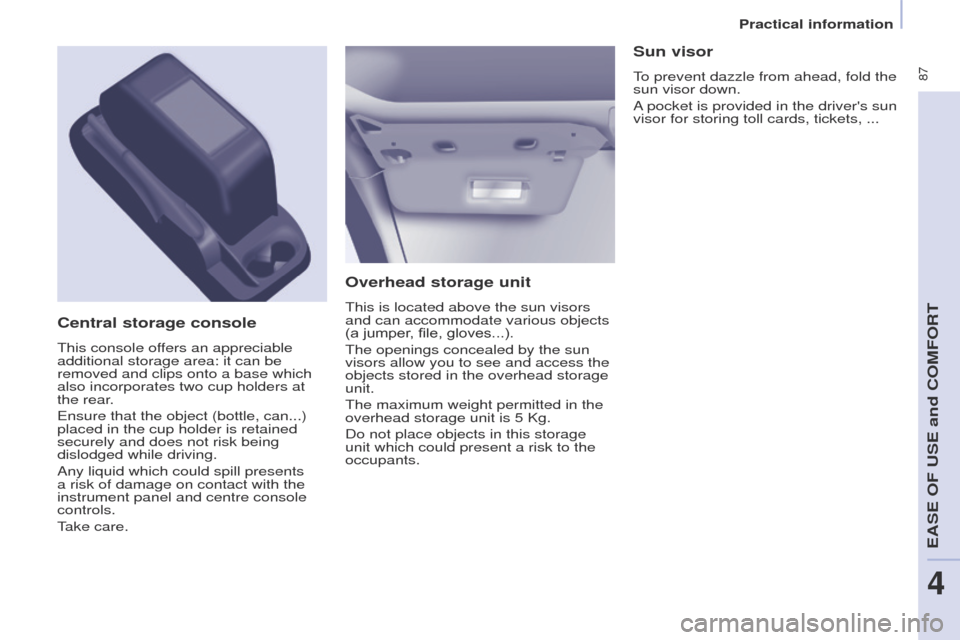
Overhead storage unit
this is located above the sun visors
and can accommodate various objects
(a jumper
, file, gloves...).
t
he openings concealed by the sun
visors allow you to see and access the
objects stored in the overhead storage
unit.
t
he maximum weight permitted in the
overhead storage unit is 5 Kg.
Do not place objects in this storage
unit which could present a risk to the
occupants.
Central storage console
this console offers an appreciable
additional storage area: it can be
removed and clips onto a base which
also incorporates two cup holders at
the rear
.
e
nsure that the object (bottle, can...)
placed in the cup holder is retained
securely and does not risk being
dislodged while driving.
Any liquid which could spill presents
a risk of damage on contact with the
instrument panel and centre console
controls.
take care.
Sun visor
to prevent dazzle from ahead, fold the
sun visor down.
A
pocket is provided in the driver's sun
visor for storing toll cards, tickets, ...
Practical information
eASe OF uSe and COMFORt
4
Page 91 of 276
89
Partner_2_VP_en_Chap04_ergonomie_ed02-2014
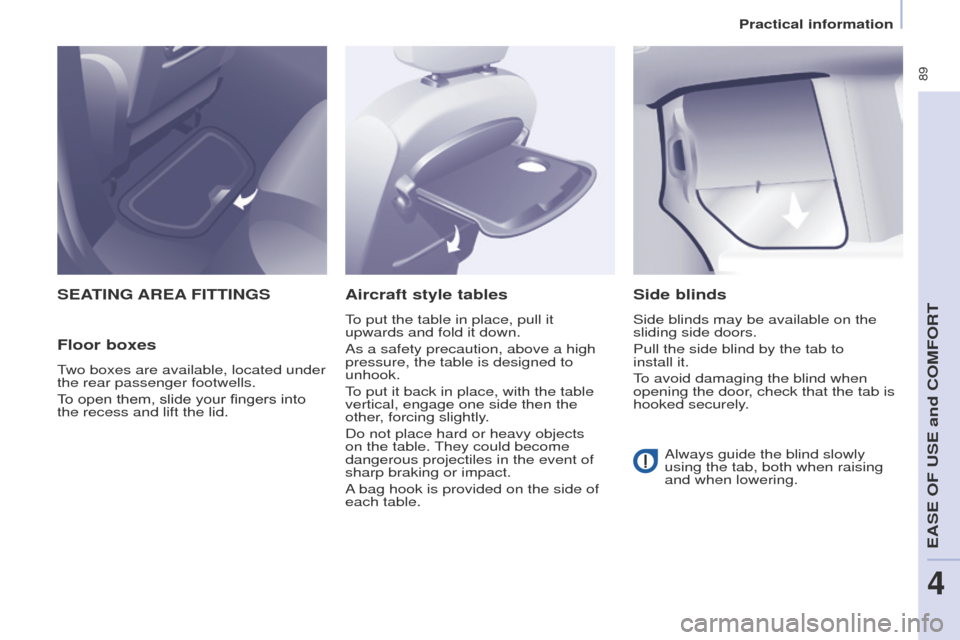
SEATING AREA FITTINGS
Floor boxes
two boxes are available, located under
the rear passenger footwells.
T
o open them, slide your fingers into
the recess and lift the lid.
Aircraft style tables
to put the table in place, pull it
upwards and fold it down.
As a safety precaution, above a high
pressure, the table is designed to
unhook.
to put it back in place, with the table
vertical, engage one side then the
other
, forcing slightly.
Do not place hard or heavy objects
on the table.
t
hey could become
dangerous projectiles in the event of
sharp braking or impact.
A bag hook is provided on the side of
each table.
Side blinds
Side blinds may be available on the
sliding side doors.
Pull the side blind by the tab to
install
it.
to avoid damaging the blind when
opening the door
, check that the tab is
hooked securely.
Always guide the blind slowly
using the tab, both when raising
and when lowering.
Practical information
eASe OF uSe and COMFORt
4
Page 96 of 276
94
Partner_2_VP_en_Chap04_ergonomie_ed02-2014
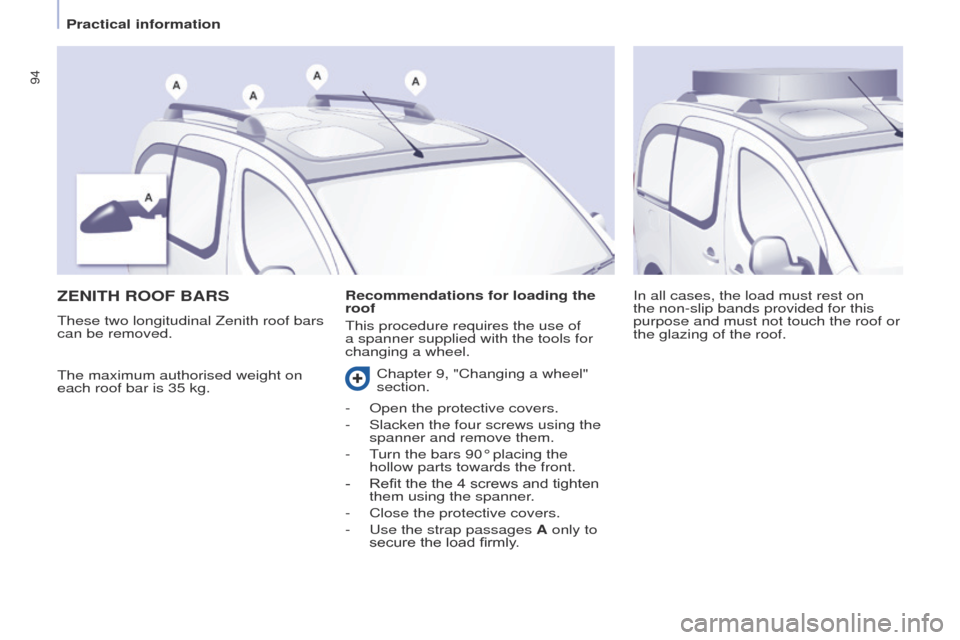
ZENITH ROOF BARS
the maximum authorised weight on
each roof bar is 35 kg. In all cases, the load must rest on
the non-slip bands provided for this
purpose and must not touch the roof or
the glazing of the roof.
Recommendations for loading the
roof
t
his procedure requires the use of
a spanner supplied with the tools for
changing a wheel.
t
hese two longitudinal Zenith roof bars
can be removed.
Chapter 9, "Changing a wheel"
section.
-
Open the protective covers.
-
Slacken the four screws using the
spanner and remove them.
-
t
urn the bars 90° placing the
hollow parts towards the front.
-
Refit the the 4 screws and tighten
them using the spanner
.
-
Close the protective covers.
-
u se the strap passages A only to
secure the load firmly.
Practical information
Page 100 of 276
98
Partner_2_VP_en_Chap04_ergonomie_ed02-2014
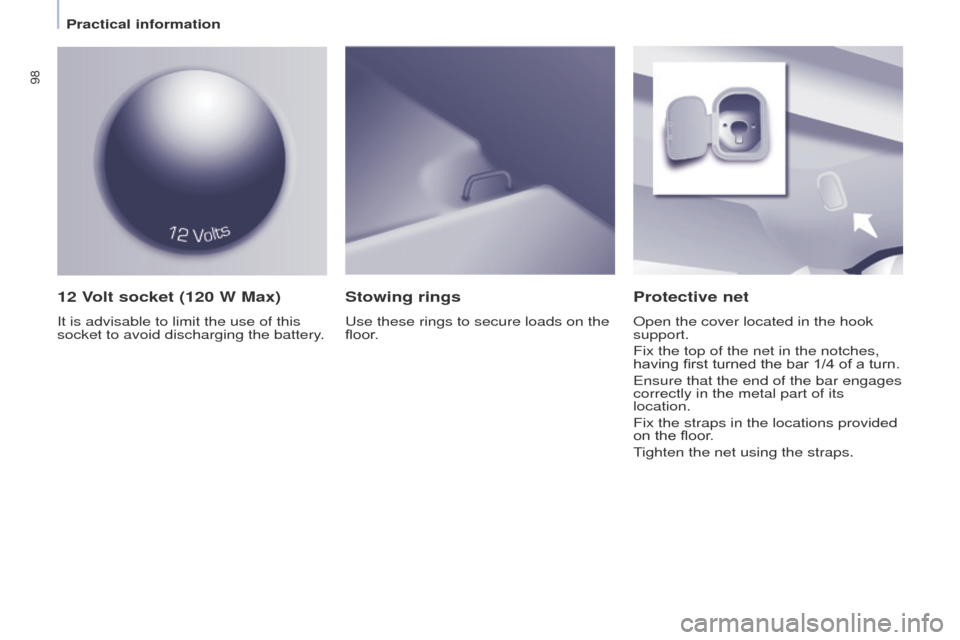
12 Volt socket (120 W Max)
It is advisable to limit the use of this
socket to avoid discharging the battery.
Protective net
Open the cover located in the hook
support.
Fix the top of the net in the notches,
having first turned the bar 1/4 of a turn.
e
nsure that the end of the bar engages
correctly in the metal part of its
location.
Fix the straps in the locations provided
on the floor.
tighten the net using the straps.
Stowing rings
use these rings to secure loads on the
floor .
Practical information
Page 101 of 276
99
Partner_2_VP_en_Chap04_ergonomie_ed02-2014
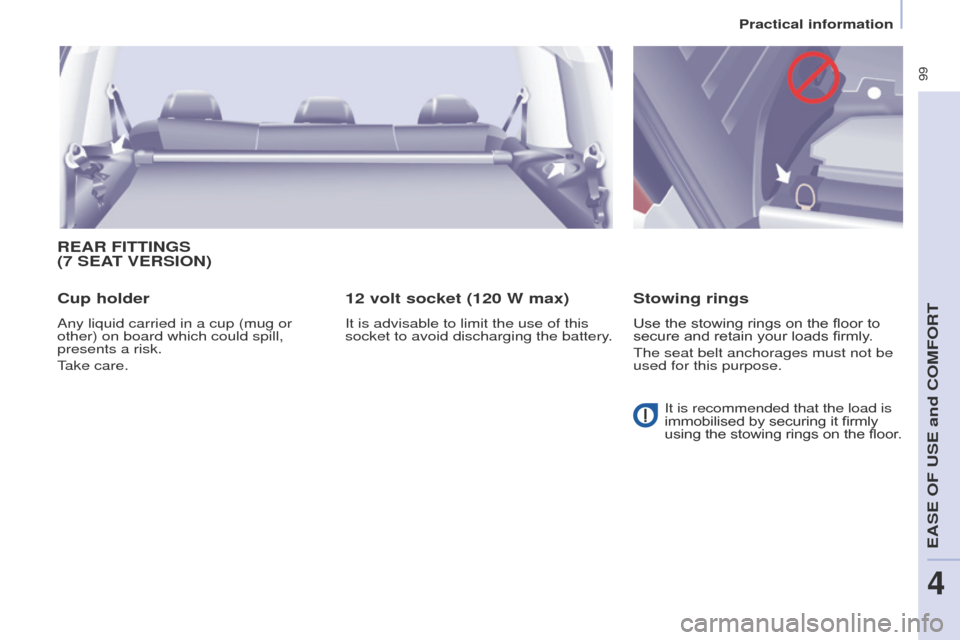
REAR FITTINGS
(7 SEAT VERSION )
Cup holder
Any liquid carried in a cup (mug or
other) on board which could spill,
presents a risk.
take care.
12 volt socket (120 W max)
It is advisable to limit the use of this
socket to avoid discharging the battery.
Stowing rings
Use the stowing rings on the floor to
secure and retain your loads firmly.
t
he seat belt anchorages must not be
used for this purpose.
It is recommended that the load is
immobilised by securing it firmly
using the stowing rings on the floor.
Practical information
eASe OF uSe and COMFORt
4
Page 107 of 276
105
Partner_2_VP_en_Chap04_ergonomie_ed02-2014
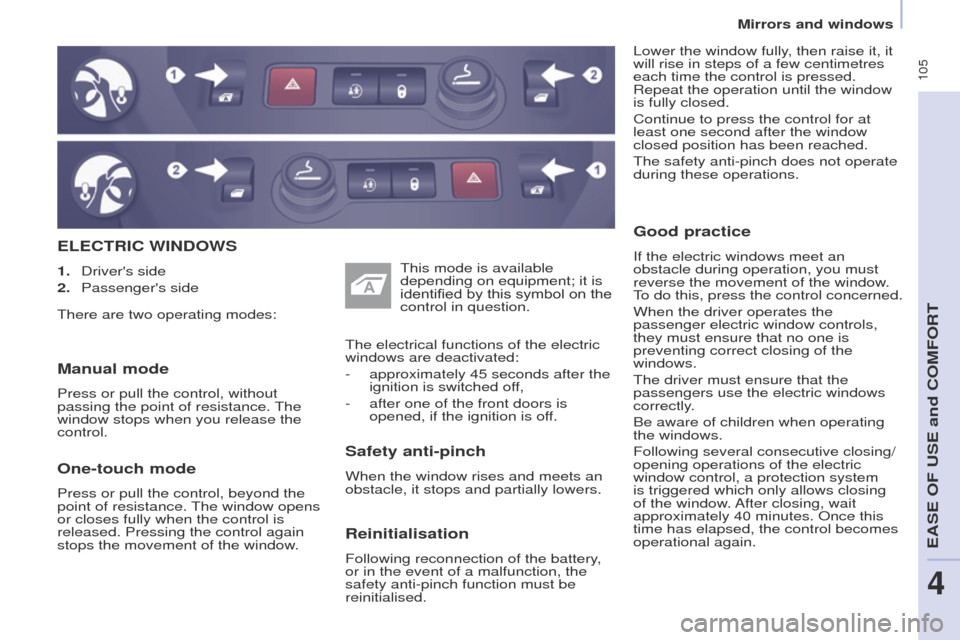
ELECTRIC WINDOWS
1. Driver's side
2.
Passenger's side Lower the window fully
, then raise it, it
will rise in steps of a few centimetres
each time the control is pressed.
Repeat the operation until the window
is fully closed.
Continue to press the control for at
least one second after the window
closed position has been reached.
t
he safety anti-pinch does not operate
during these operations.
Safety anti-pinch
When the window rises and meets an
obstacle, it stops and partially lowers.One-touch mode
Press or pull the control, beyond the
point of resistance. t he window opens
or closes fully when the control is
released. Pressing the control again
stops the movement of the window.
t
his mode is available
depending on equipment; it is
identified by this symbol on the
control in question.
Good practice
If the electric windows meet an
obstacle during operation, you must
reverse the movement of the window.
to
do this, press the control concerned.
When the driver operates the
passenger electric window controls,
they must ensure that no one is
preventing correct closing of the
windows.
t
he driver must ensure that the
passengers use the electric windows
correctly.
Be aware of children when operating
the windows.
Following several consecutive closing/
opening operations of the electric
window control, a protection system
is triggered which only allows closing
of the window. After closing, wait
approximately 40 minutes. Once this
time has elapsed, the control becomes
operational again.
Manual mode
Press or pull the control, without
passing the point of resistance. t he
window stops when you release the
control.
Reinitialisation
Following reconnection of the battery,
or in the event of a malfunction, the
safety anti-pinch function must be
reinitialised.
t
he electrical functions of the electric
windows are deactivated:
-
approximately 45 seconds after the
ignition is switched of
f,
-
after one of the front doors is
opened, if the ignition is of
f.
t
here are two operating modes:
Mirrors and windows
eASe OF uSe and COMFORt
4
Page 108 of 276
106
Partner_2_VP_en_Chap05_Securite_ed02-2014
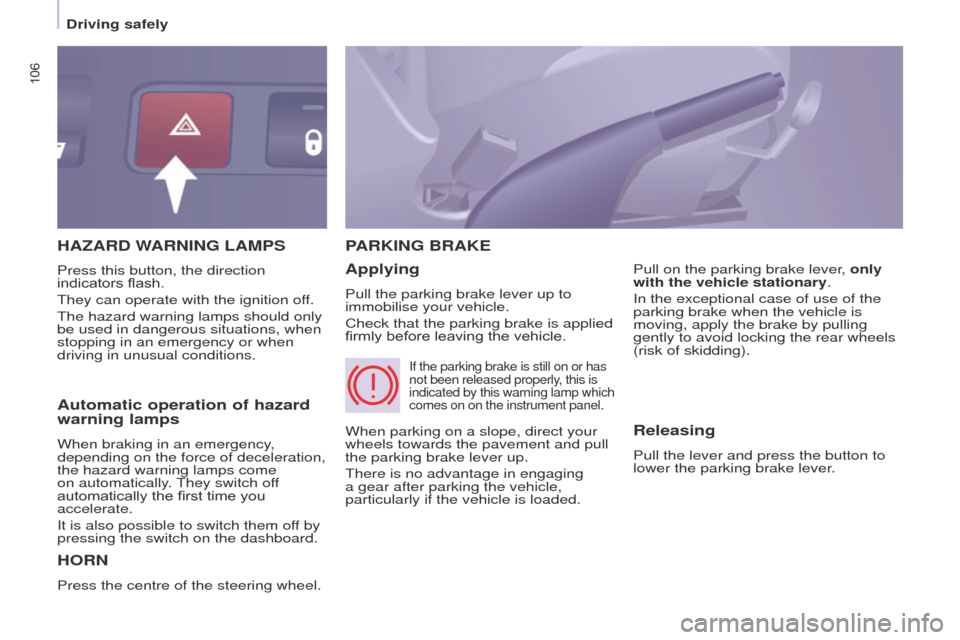
HAZARD WARNING LAMPS
HORN
Press the centre of the steering wheel.
PARKING BRAKE
Applying
Pull the parking brake lever up to
immobilise your vehicle.
Check that the parking brake is applied
firmly before leaving the vehicle.Pull on the parking brake lever, only
with the vehicle stationary.
In the exceptional case of use of the
parking brake when the vehicle is
moving, apply the brake by pulling
gently to avoid locking the rear wheels
(risk of skidding).
Press this button, the direction
indicators flash.t
hey can operate with the ignition off.
t
he hazard warning lamps should only
be used in dangerous situations, when
stopping in an emergency or when
driving in unusual conditions.
When parking on a slope, direct your
wheels towards the pavement and pull
the parking brake lever up.
t
here is no advantage in engaging
a gear after parking the vehicle,
particularly if the vehicle is loaded.
If the parking brake is still on or has
not been released properly, this is
indicated by this warning lamp which
comes on on the instrument panel.
Automatic operation of hazard
warning lamps
When braking in an emergency,
depending on the force of deceleration,
the hazard warning lamps come
on automatically.
t
hey switch off
automatically the first time you
accelerate.
It is also possible to switch them off by
pressing the switch on the dashboard.Releasing
Pull the lever and press the button to
lower the parking brake lever.
Driving safely
Page 109 of 276
107
Partner_2_VP_en_Chap05_Securite_ed02-2014
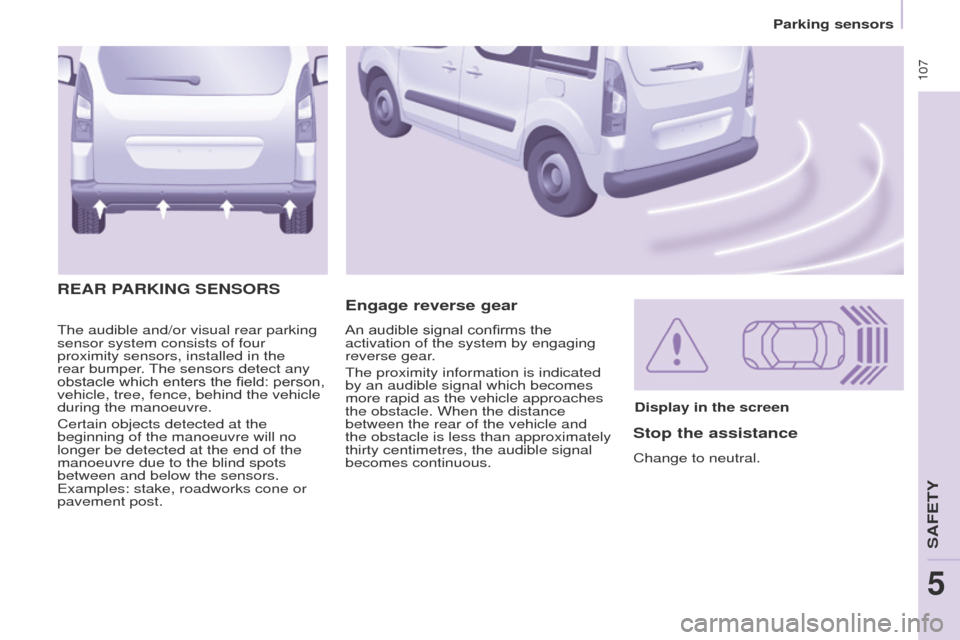
the audible and/or visual rear parking
sensor system consists of four
proximity sensors, installed in the
rear bumper
.
t
he sensors detect any
obstacle which enters the field: person,
vehicle, tree, fence, behind the vehicle
during the manoeuvre.
Certain objects detected at the
beginning of the manoeuvre will no
longer be detected at the end of the
manoeuvre due to the blind spots
between and below the sensors.
e
xamples: stake, roadworks cone or
pavement post.
Engage reverse gear
REAR PARKING SENSORS
Display in the screen
Stop the assistance
Change to neutral.
An audible signal confirms the
activation of the system by engaging
reverse gear.
t
he proximity information is indicated
by an audible signal which becomes
more rapid as the vehicle approaches
the obstacle. When the distance
between the rear of the vehicle and
the obstacle is less than approximately
thirty centimetres, the audible signal
becomes continuous.
Parking sensors
SAFetY
5
Page 110 of 276
108
Partner_2_VP_en_Chap05_Securite_ed02-2014
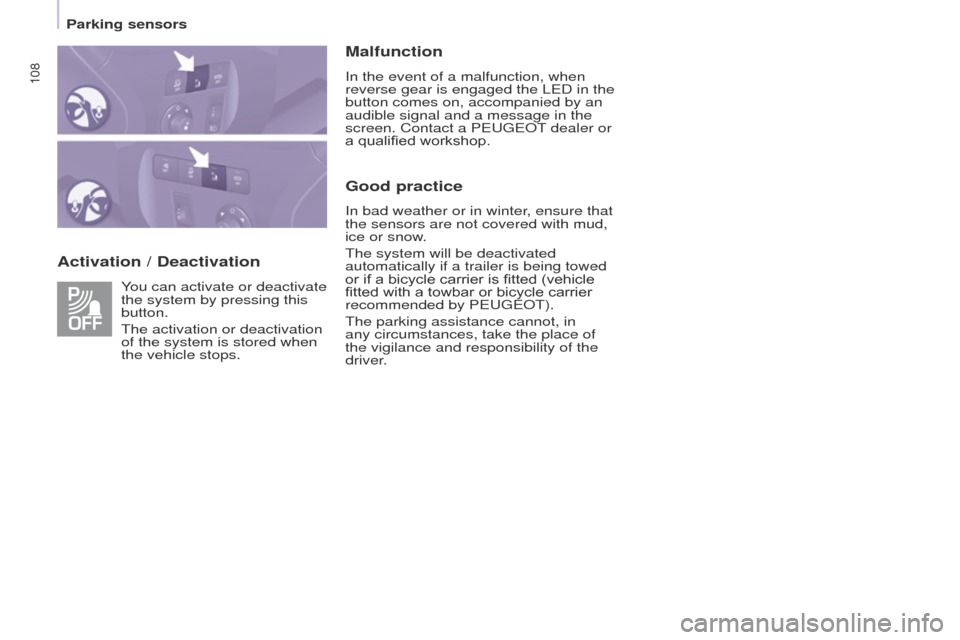
Activation / DeactivationMalfunction
In the event of a malfunction, when
reverse gear is engaged the L
e D in the
button comes on, accompanied by an
audible signal and a message in the
screen. Contact a P
euge O t
dealer or
a qualified workshop.
Good practice
In bad weather or in winter, ensure that
the sensors are not covered with mud,
ice or snow.
t
he system will be deactivated
automatically if a trailer is being towed
or if a bicycle carrier is fitted (vehicle
fitted with a towbar or bicycle carrier
recommended by P
euge O t ).
t
he parking assistance cannot, in
any circumstances, take the place of
the vigilance and responsibility of the
driver.
You can activate or deactivate
the system by pressing this
button.
t
he activation or deactivation
of the system is stored when
the vehicle stops.
Parking sensors
Page 111 of 276
ABS
ABS
109
Partner_2_VP_en_Chap05_Securite_ed02-2014
ANTI-LOCK BRAKING SYSTEM
(ABS - EBFD)
the ABS and eBFD (electronic brake
force distribution) systems improve the
stability and manoeuvrability of your
vehicle on braking, in particular on
poor or slippery surfaces.
t
he ABS prevents locking of the
wheels, the
e BFD provides control of
the braking pressure wheel by wheel. If this warning lamp comes
on, accompanied by an
audible signal and a message
in the screen, it indicates a
malfunction of the ABS which
could result in a loss of control of the
vehicle on braking.
If this warning lamp comes
on, together with the brake
and S
t
OP
warning lamps,
accompanied by an audible
signal and a message in the
screen, it indicates a malfunction of
the electronic brake force distribution
which could result in a loss of control of
the vehicle on braking.
EMERGENCY BRAKING
ASSISTANCE SYSTEM (EBA)
In an emergency, this system enables
the optimum braking pressure to be
reached more quickly, press the pedal
firmly without releasing it.
It is triggered by the speed at which the
brake pedal is activated.
t
his alters the resistance of the brake
pedal under your foot.
to prolong the operation of the
emergency braking assistance system:
keep your foot on the brake pedal.Good practice
the anti-lock braking system comes
into operation automatically when
there is a risk of wheel lock. It does not
reduce the braking distance.
On very slippery surfaces (ice,
oil,
etc...) the ABS may increase the
braking distance. When braking in
an emergency, do not hesitate to
press the brake pedal firmly, without
releasing the pressure, even on a
slippery surface, you will then be able
to continue to manoeuvre the vehicle
to avoid an obstacle.
Normal operation of the ABS may be
felt by slight vibration of the brake
pedal.
When changing wheels (tyres
and rims), ensure that these are
recommended by P
euge O t
.Stop as soon as it is safe to do so.
In both cases, contact a P
euge O t
dealer or a qualified workshop.
Driving safely
SAFetY
5