light Peugeot Partner Tepee 2015 User Guide
[x] Cancel search | Manufacturer: PEUGEOT, Model Year: 2015, Model line: Partner Tepee, Model: Peugeot Partner Tepee 2015Pages: 276, PDF Size: 12.76 MB
Page 38 of 276
36
Partner_2_VP_en_Chap03_Pret-a-partir_ed02-2014
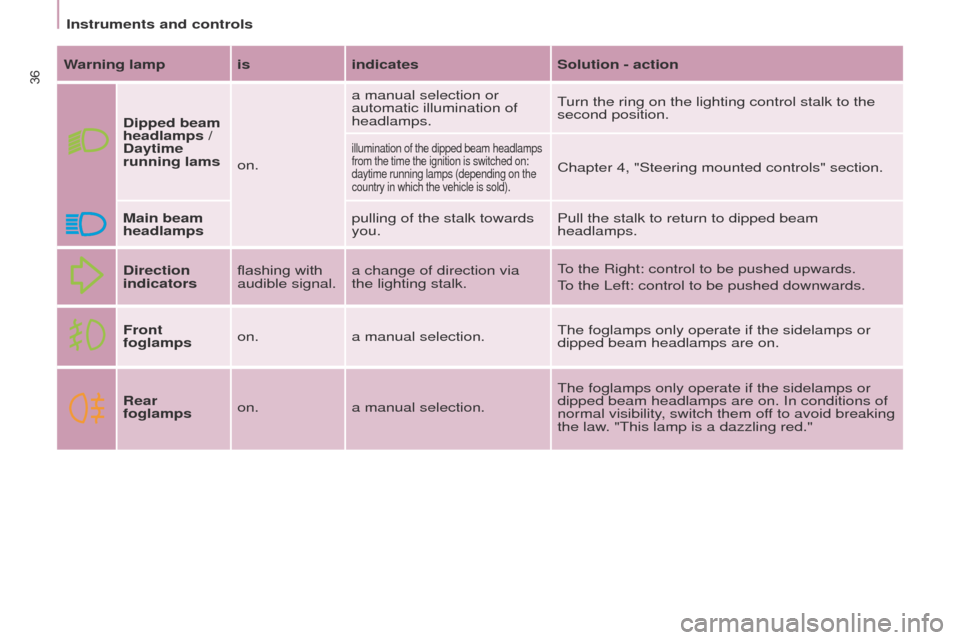
Warning lamp isindicatesSolution - action
Dipped beam
headlamps
/
Daytime
running lams on.a manual selection or
automatic illumination of
headlamps.
turn the ring on the lighting control stalk to the
second position.
illumination of the dipped beam headlamps
from the time the ignition is switched on:
daytime running lamps (depending on the
country in which the vehicle is sold).
Chapter 4, "Steering mounted controls" section.
Main beam
headlamps pulling of the stalk towards
you.Pull the stalk to return to dipped beam
headlamps.
Direction
indicators flashing with
audible signal.a change of direction via
the lighting stalk.
to the Right: control to be pushed upwards.
to the Left: control to be pushed downwards.
Front
foglamps on.
a manual selection.
t
he foglamps only operate if the sidelamps or
dipped beam headlamps are on.
Rear
foglamps on.
a manual selection.
t
he foglamps only operate if the sidelamps or
dipped beam headlamps are on. In conditions of
normal visibility, switch them off to avoid breaking
the law. "
t his lamp is a dazzling red."
Instruments and controls
Page 44 of 276
42
Partner_2_VP_en_Chap03_Pret-a-partir_ed02-2014
Trip recorder zero reset button
After this operation, if you wish
to disconnect the battery, lock
the vehicle and wait for at least five
minutes, otherwise the zero re-set will
not be registered.
Engine oil level indicator
Depending on your vehicle's engine,
when the ignition is switched on, the
engine oil level is indicated for a few
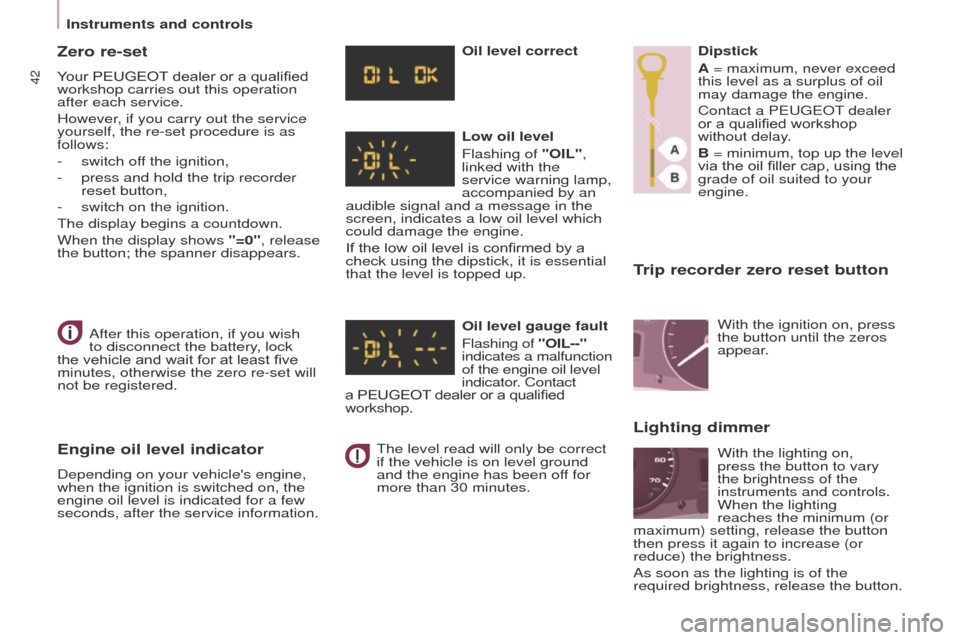
seconds, after the service information. Oil level correct
Low oil level
Flashing of "OIL",
linked with the
service warning lamp,
accompanied by an
audible signal and a message in the
screen, indicates a low oil level which
could damage the engine.
If the low oil level is confirmed by a
check using the dipstick, it is essential
that the level is topped up.
Oil level gauge fault
Flashing of "OIL--"
indicates a malfunction
of the engine oil level
indicator. Contact
a PEUGEOT dealer or a qualified
workshop.
t
he level read will only be correct
if the vehicle is on level ground
and the engine has been off for
more than 30 minutes. Dipstick
A = maximum, never exceed
this level as a surplus of oil
may damage the engine.
Contact a P
euge O t
dealer
or a qualified workshop
without delay
.
B = minimum, top up the level
via the oil filler cap, using the
grade of oil suited to your
engine.
Lighting dimmer
With the ignition on, press
the button until the zeros
appear.
With the lighting on,
press the button to vary
the brightness of the
instruments and controls.
When the lighting
reaches the minimum (or
maximum) setting, release the button
then press it again to increase (or
reduce) the brightness.
As soon as the lighting is of the
required brightness, release the button.
Zero re-set
Your PEUGEOT dealer or a qualified
workshop carries out this operation
after each service.
However, if you carry out the service
yourself, the re-set procedure is as
follows:
-
switch of
f the ignition,
-
press and hold the trip recorder
reset button,
-
switch on the ignition.
t
he display begins a countdown.
When the display shows "=0", release
the button; the spanner disappears.
Instruments and controls
Page 45 of 276
43
Partner_2_VP_en_Chap03_Pret-a-partir_ed02-2014
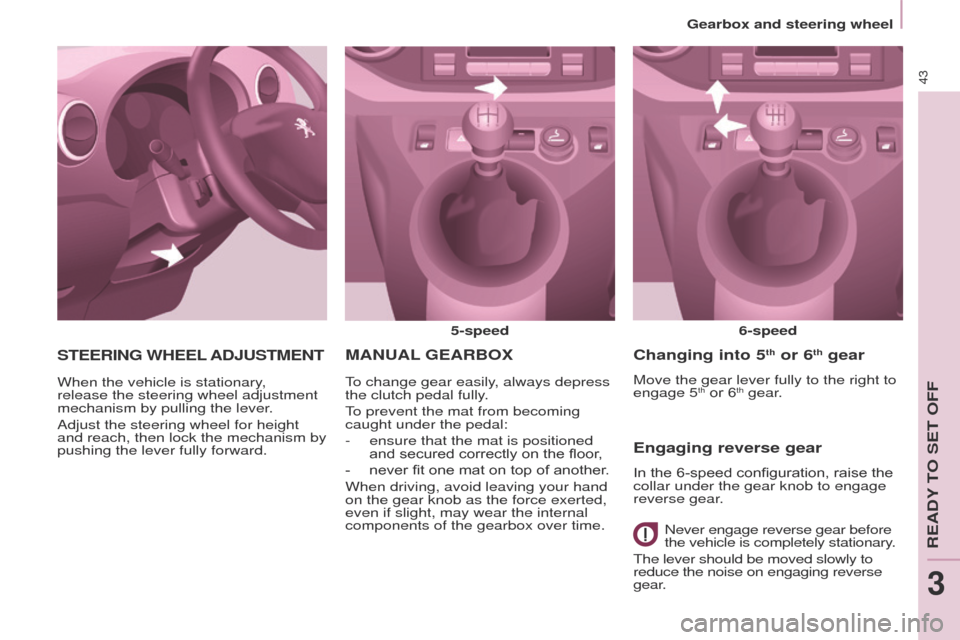
MANUAL GEARBOX
5-speed
6-speed
to change gear easily
, always depress
the clutch pedal fully.
to prevent the mat from becoming
caught under the pedal:
-
ensure that the mat is positioned
and secured correctly on the floor
,
-
never fit one mat on top of another
.
When driving, avoid leaving your hand
on the gear knob as the force exerted,
even if slight, may wear the internal
components of the gearbox over time.
Changing into 5th or 6th gear
Move the gear lever fully to the right to
engage 5th or 6th gear.
Engaging reverse gear
In the 6-speed configuration, raise the
collar under the gear knob to engage
reverse gear.
Never engage reverse gear before
the vehicle is completely stationary.
t
he lever should be moved slowly to
reduce the noise on engaging reverse
gear.
STEERING WHEEL ADJUSTMENT
When the vehicle is stationary,
release the steering wheel adjustment
mechanism by pulling the lever.
Adjust the steering wheel for height
and reach, then lock the mechanism by
pushing the lever fully forward.
gearbox and steering wheel
ReADY tO Set OFF
3
Page 49 of 276
47
Partner_2_VP_en_Chap03_Pret-a-partir_ed02-2014
STOP & START
the Stop & Start system puts the
engine temporarily on standby - S tOP
mode - during stops in the traffic (red
lights, traffic jams, or other...). The
engine restarts automatically - S
t
ARt
mode - as soon as you want to move
of
f.
t
he restart takes place instantly,
quickly and silently.
Perfect for urban use, the Stop & Start
system reduces fuel consumption and
exhaust emissions as well as the noise
level when stationary.
Operation
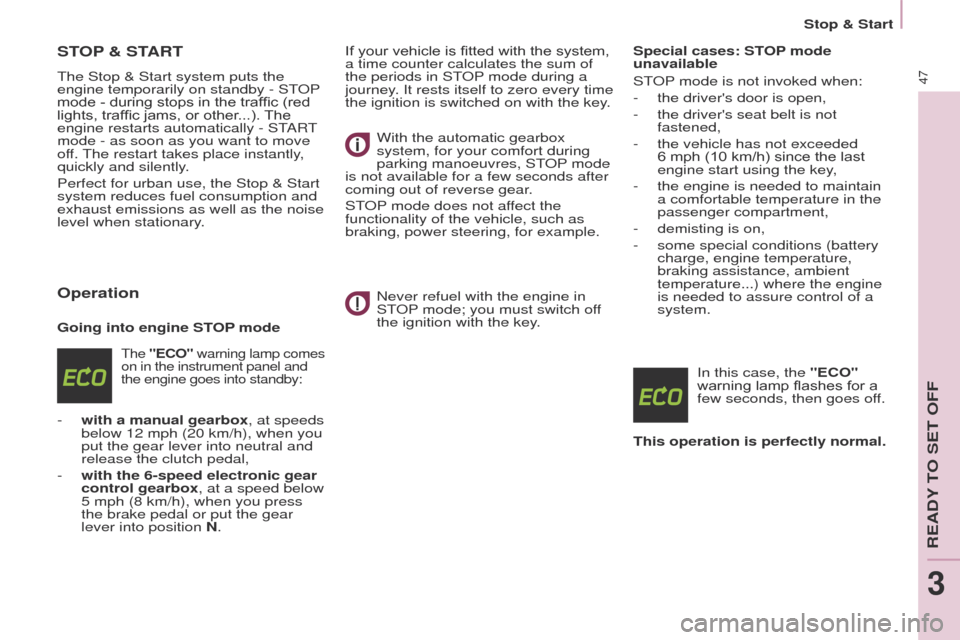
Going into engine STOP mode
the "ECO" warning lamp comes
on in the instrument panel and
the engine goes into standby:
- with a manual gearbox , at speeds
below 12 mph (20 km/h), when you
put the gear lever into neutral and
release the clutch pedal,
-
with the 6-speed electronic gear
control gearbox
, at a speed below
5 mph (8 km/h), when you press
the brake pedal or put the gear
lever into position N. If your vehicle is fitted with the system,
a time counter calculates the sum of
the periods in S
t
OP
mode during a
journey. It rests itself to zero every time
the ignition is switched on with the key.
With the automatic gearbox
system, for your comfort during
parking manoeuvres, S t
OP
mode
is not available for a few seconds after
coming out of reverse gear.
S t
OP
mode does not affect the
functionality of the vehicle, such as
braking, power steering, for example.
Never refuel with the engine in
S t
OP
mode; you must switch off
the ignition with the key. Special cases: STOP mode
unavailable
S t
OP
mode is not invoked when:
-
the driver's door is open,
-
the driver's seat belt is not
fastened,
-
the vehicle has not exceeded
6
mph (10 km/h) since the last
engine start using the key,
-
the engine is needed to maintain
a comfortable temperature in the
passenger compartment,
-
demisting is on,
-
some special conditions (battery
charge, engine temperature,
braking assistance, ambient
temperature...) where the engine
is needed to assure control of a
system.
In this case, the
"ECO"
warning lamp flashes for a
few seconds, then goes off.
This operation is perfectly normal.
Stop & Start
ReADY tO Set OFF
3
Page 54 of 276
52
Partner_2_VP_en_Chap04_ergonomie_ed02-2014
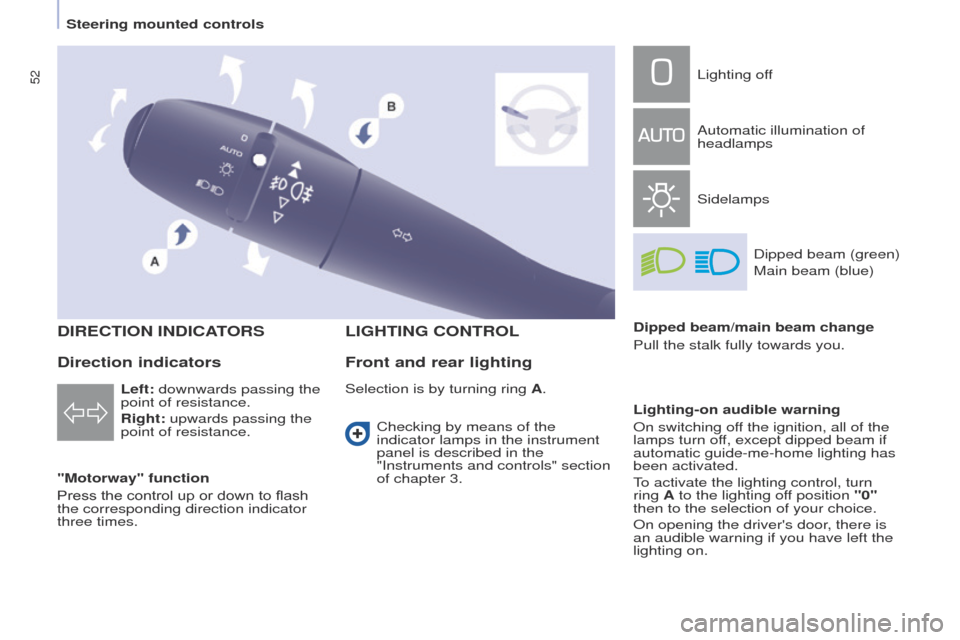
DIRECTION INDICATORS
"Motorway" function
Press the control up or down to flash
the corresponding direction indicator
three times.
LIGHTING CONTROL
Left: downwards passing the
point of resistance.
Right: upwards passing the
point of resistance.
Front and rear lighting
Lighting off
Automatic illumination of
headlamps
SidelampsDipped beam (green)
Main beam (blue)
Dipped beam/main beam change
Pull the stalk fully towards you.
Lighting-on audible warning
On switching off the ignition, all of the
lamps turn off, except dipped beam if
automatic guide-me-home lighting has
been activated.
to activate the lighting control, turn
ring A to the lighting off position "0"
then to the selection of your choice.
On opening the driver's door, there is
an audible warning if you have left the
lighting on.
Checking by means of the
indicator lamps in the instrument
panel is described in the
"Instruments and controls" section
of chapter 3.
Direction indicators
Selection is by turning ring A.
Steering mounted controls
Page 55 of 276
53
Partner_2_VP_en_Chap04_ergonomie_ed02-2014
LED DAYTIME RUNNING LAMPS
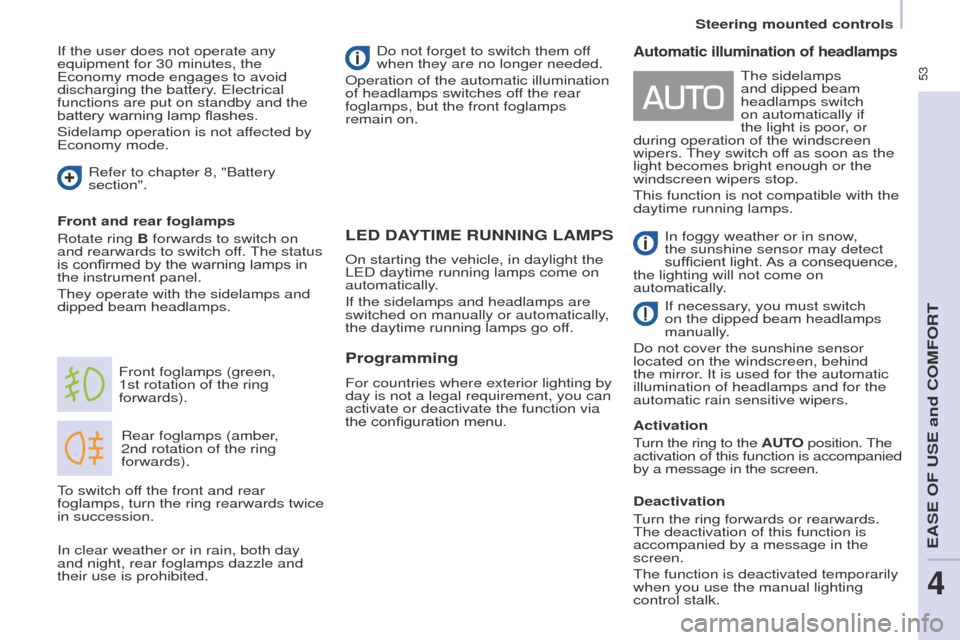
Rear foglamps (amber,
2nd rotation of the ring
forwards).
Front foglamps (green,
1st
rotation of the ring
forwards).
Front and rear foglamps
Rotate ring B forwards to switch on
and rearwards to switch off.
t
he status
is confirmed by the warning lamps in
the instrument panel.
t
hey operate with the sidelamps and
dipped beam headlamps. Do not forget to switch them off
when they are no longer needed.
Operation of the automatic illumination
of headlamps switches off the rear
foglamps, but the front foglamps
remain on.
to switch of
f the front and rear
foglamps, turn the ring rearwards twice
in succession.
Automatic illumination of headlamps
In foggy weather or in snow,
the sunshine sensor may detect
sufficient light. As a consequence,
the lighting will not come on
automatically.
If necessary, you must switch
on the dipped beam headlamps
manually.
Do not cover the sunshine sensor
located on the windscreen, behind
the mirror. It is used for the automatic
illumination of headlamps and for the
automatic rain sensitive wipers.
Activation
turn the ring to the
AUTO position. t he
activation of this function is accompanied
by a message in the screen.
Deactivation
turn the ring forwards or rearwards. t
he deactivation of this function is
accompanied by a message in the
screen.
t
he function is deactivated temporarily
when you use the manual lighting
control stalk.
t
he sidelamps
and dipped beam
headlamps switch
on automatically if
the light is poor, or
during operation of the windscreen
wipers.
t
hey switch off as soon as the
light becomes bright enough or the
windscreen wipers stop.
t
his function is not compatible with the
daytime running lamps.
On starting the vehicle, in daylight the
L
e
D daytime running lamps come on
automatically.
If the sidelamps and headlamps are
switched on manually or automatically,
the daytime running lamps go off.
Programming
For countries where exterior lighting by
day is not a legal requirement, you can
activate or deactivate the function via
the configuration menu.
If the user does not operate any
equipment for 30 minutes, the
e
conomy mode engages to avoid
discharging the battery.
e
lectrical
functions are put on standby and the
battery warning lamp flashes.
Sidelamp operation is not affected by
e
conomy mode.
In clear weather or in rain, both day
and night, rear foglamps dazzle and
their use is prohibited. Refer to chapter 8, "Battery
section".
Steering mounted controls
eASe OF uSe and COMFORt
4
Page 56 of 276
54
Partner_2_VP_en_Chap04_ergonomie_ed02-2014
If the sunshine sensor does
not function
correctly, the lighting comes
on accompanied by the
service warning lamp, an
audible signal and a message in the
screen.
Contact a P
euge O t
dealer or a
qualified workshop.
Guide-me-home lighting
Keeping the dipped beam headlamps
on temporarily with the ignition off,
makes the driver's exit easier when the
light is poor.
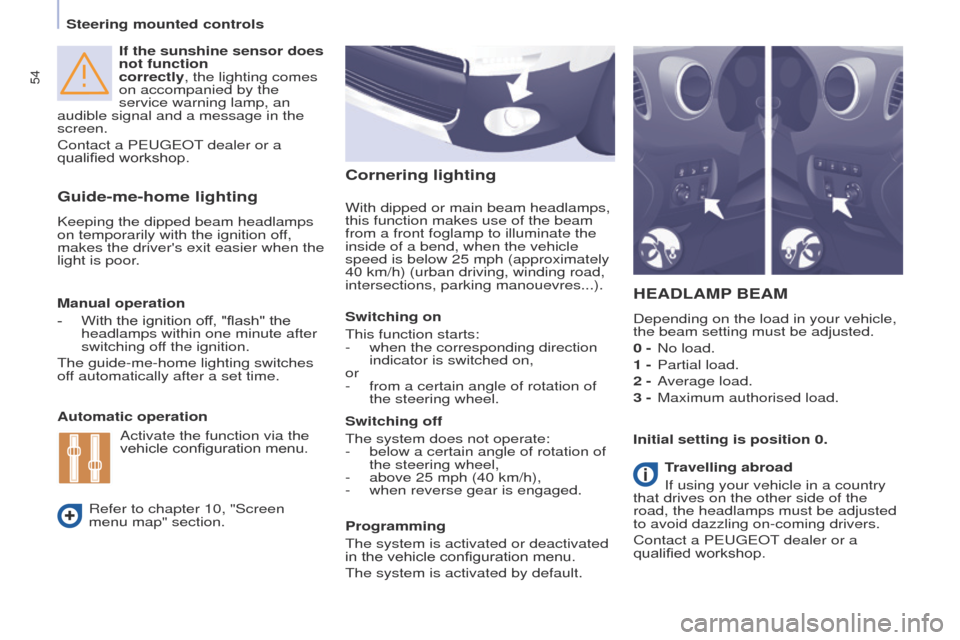
HEADLAMP BEAM
Depending on the load in your vehicle,
the beam setting must be adjusted.
0 -
No load.
1 -
Partial load.
2 -
A
verage load.
3 -
Maximum authorised load.
Manual operation
-
With the ignition of
f, "flash" the
headlamps within one minute after
switching off the ignition.
t
he guide-me-home lighting switches
off automatically after a set time.
Automatic operation
Refer to chapter 10, "Screen
menu map" section. Initial setting is position 0.
Activate the function via the
vehicle configuration menu.
Programming
t
he system is activated or deactivated
in the vehicle configuration menu.
t
he system is activated by default.
Switching off
t
he system does not operate:
-
below a certain angle of rotation of
the steering wheel,
-
above 25 mph (40 km/h),
-
when reverse gear is engaged.
Switching on
t
his function starts:
-
when the corresponding direction
indicator is switched on,
or
-
from a certain angle of rotation of
the steering wheel.
With dipped or main beam headlamps,
this function makes use of the beam
from a front foglamp to illu
minate the
inside of a bend, when the vehicle
speed is below 25 mph (approximately
40 km/h) (urban driving, winding road,
intersections, parking manouevres...).
Cornering lighting
Travelling abroad
If using your vehicle in a country
that drives on the other side of the
road, the headlamps must be adjusted
to avoid dazzling on-coming drivers.
Contact a P
euge O t
dealer or a
qualified workshop.
Steering mounted controls
Page 85 of 276
83
Partner_2_VP_en_Chap04_ergonomie_ed02-2014
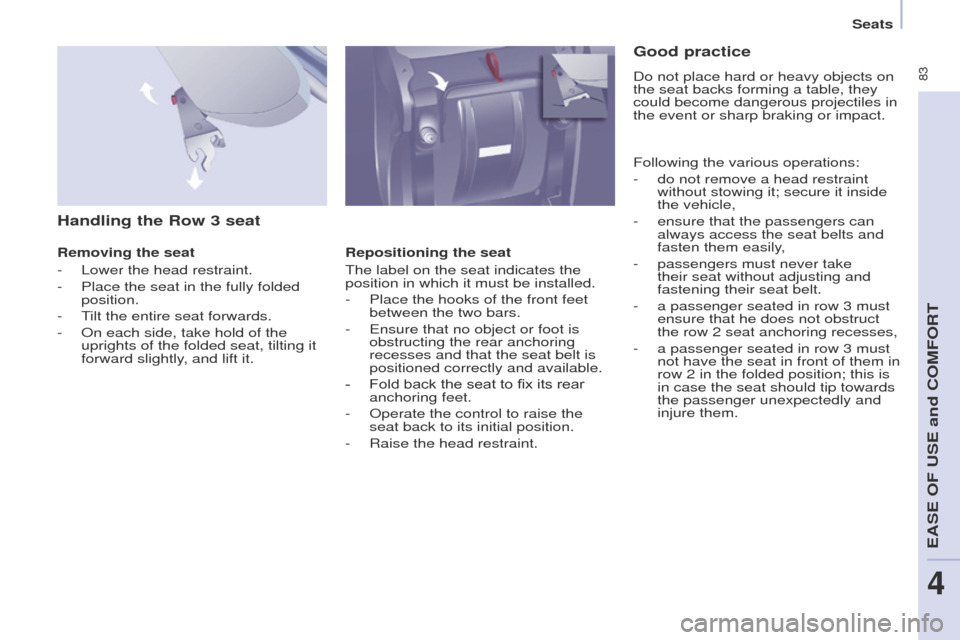
Handling the Row 3 seat
Removing the seat
-
Lower the head restraint.
-
Place the seat in the fully folded
position.
-
t
ilt the entire seat forwards.
-
On each side, take hold of the
uprights of the folded seat, tilting it
forward slightly
, and lift it. Repositioning the seat
t
he label on the seat indicates the
position in which it must be installed.
-
Place the hooks of the front feet
between the two bars.
-
e nsure that no object or foot is
obstructing the rear anchoring
recesses and that the seat belt is
positioned correctly and available.
-
Fold back the seat to fix its rear
anchoring feet.
-
Operate the control to raise the
seat back to its initial position.
-
Raise the head restraint.
Good practice
Do not place hard or heavy objects on
the seat backs forming a table, they
could become dangerous projectiles in
the event or sharp braking or impact.
Following the various operations:
-
do not remove a head restraint
without stowing it; secure it inside
the vehicle,
-
ensure that the passengers can
always access the seat belts and
fasten them easily
,
-
passengers must never take
their seat without adjusting and
fastening their seat belt.
-
a passenger seated in row 3 must
ensure that he does not obstruct
the row 2 seat anchoring recesses,
-
a passenger seated in row 3 must
not have the seat in front of them in
row 2 in the folded position; this is
in case the seat should tip towards
the passenger unexpectedly and
injure them.
Seats
eASe OF uSe and COMFORt
4
Page 91 of 276
89
Partner_2_VP_en_Chap04_ergonomie_ed02-2014
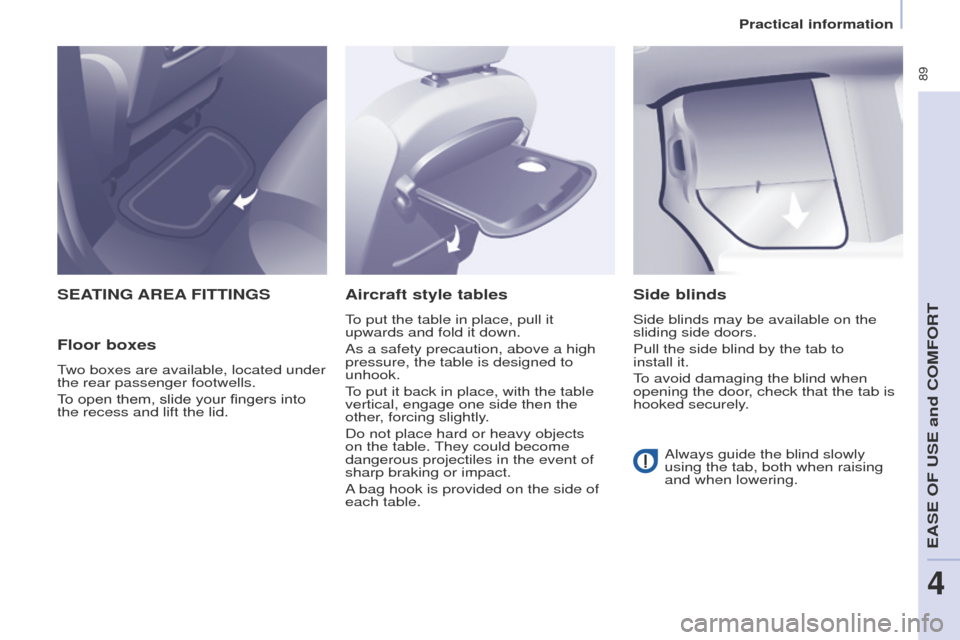
SEATING AREA FITTINGS
Floor boxes
two boxes are available, located under
the rear passenger footwells.
T
o open them, slide your fingers into
the recess and lift the lid.
Aircraft style tables
to put the table in place, pull it
upwards and fold it down.
As a safety precaution, above a high
pressure, the table is designed to
unhook.
to put it back in place, with the table
vertical, engage one side then the
other
, forcing slightly.
Do not place hard or heavy objects
on the table.
t
hey could become
dangerous projectiles in the event of
sharp braking or impact.
A bag hook is provided on the side of
each table.
Side blinds
Side blinds may be available on the
sliding side doors.
Pull the side blind by the tab to
install
it.
to avoid damaging the blind when
opening the door
, check that the tab is
hooked securely.
Always guide the blind slowly
using the tab, both when raising
and when lowering.
Practical information
eASe OF uSe and COMFORt
4
Page 111 of 276
ABS
ABS
109
Partner_2_VP_en_Chap05_Securite_ed02-2014
ANTI-LOCK BRAKING SYSTEM
(ABS - EBFD)
the ABS and eBFD (electronic brake
force distribution) systems improve the
stability and manoeuvrability of your
vehicle on braking, in particular on
poor or slippery surfaces.
t
he ABS prevents locking of the
wheels, the
e BFD provides control of
the braking pressure wheel by wheel. If this warning lamp comes
on, accompanied by an
audible signal and a message
in the screen, it indicates a
malfunction of the ABS which
could result in a loss of control of the
vehicle on braking.
If this warning lamp comes
on, together with the brake
and S
t
OP
warning lamps,
accompanied by an audible
signal and a message in the
screen, it indicates a malfunction of
the electronic brake force distribution
which could result in a loss of control of
the vehicle on braking.
EMERGENCY BRAKING
ASSISTANCE SYSTEM (EBA)
In an emergency, this system enables
the optimum braking pressure to be
reached more quickly, press the pedal
firmly without releasing it.
It is triggered by the speed at which the
brake pedal is activated.
t
his alters the resistance of the brake
pedal under your foot.
to prolong the operation of the
emergency braking assistance system:
keep your foot on the brake pedal.Good practice
the anti-lock braking system comes
into operation automatically when
there is a risk of wheel lock. It does not
reduce the braking distance.
On very slippery surfaces (ice,
oil,
etc...) the ABS may increase the
braking distance. When braking in
an emergency, do not hesitate to
press the brake pedal firmly, without
releasing the pressure, even on a
slippery surface, you will then be able
to continue to manoeuvre the vehicle
to avoid an obstacle.
Normal operation of the ABS may be
felt by slight vibration of the brake
pedal.
When changing wheels (tyres
and rims), ensure that these are
recommended by P
euge O t
.Stop as soon as it is safe to do so.
In both cases, contact a P
euge O t
dealer or a qualified workshop.
Driving safely
SAFetY
5